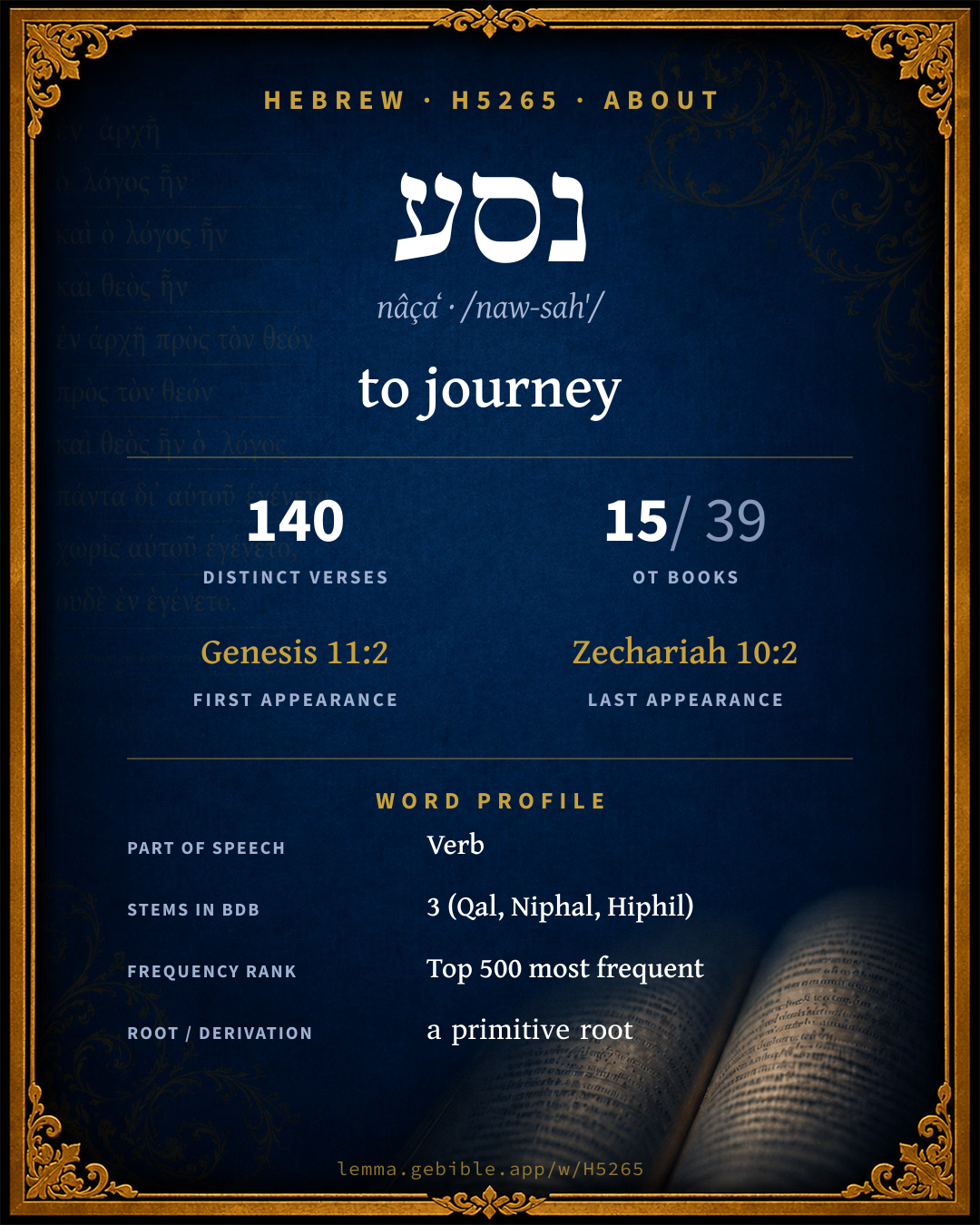
נָסַע
to journey
‘to journey’ is one of 2 main senses fuller range ↓
Full lexicon entry — Brown-Driver-Briggs (BDB)
From Brown-Driver-Briggs (BDB)
Where this word appears
See every Qal verb in the Hebrew Bible →
Grammar key — what these labels mean
Part of speech
- Verb
- An action or state-of-being word.
Stem
- Qal
- The basic, simple active stem — the plain form of the verb (“he wrote”). Here: ‘pull out or up’
- Hiphil
- The causative active stem (“he caused / brought about”). Here: ‘cause to set out’
- Niphal
- Usually the simple passive or reflexive of the Qal (“he was written”). Here: ‘be pulled up’
Form
- Sequential Imperfect
- An imperfect with prefixed waw — the standard past-narrative form (waw-consecutive imperfect).
- Imperfect
- An incomplete, ongoing, or future action (“he will / would write”).
- Perfect
- A completed action or state — Hebrew marks aspect (completeness) more than strict tense (“he wrote”).
- Sequential Perfect
- A perfect with prefixed waw continuing a preceding imperfect or command (waw-consecutive perfect).
- Infinitive Construct
- A bound verbal noun, frequently with prepositions (“to write / in writing”).
- Imperative
- A direct command (“write!”).
- Participle Active
- A verbal adjective expressing ongoing or characteristic action (“writing / one who writes”).
- Infinitive Absolute
- An unbound verbal noun, often intensifying or standing in for a finite verb.
- Jussive
- A third- or second-person volitional form expressing wish or command (“let him write”).
- Cohortative
- A first-person volitional form expressing wish or resolve (“let me / let us write”).
State
- Absolute
- The independent form of a noun, not bound to a following word.
Person
- 3rd Person
- The one spoken about (“he / she / it / they”).
- 2nd Person
- The one addressed (“you”).
- 1st Person
- The speaker (“I / we”).
Gender
- Masculine
- Grammatically masculine.
- Common
- Either gender — not distinguished for this form.
- Feminine
- Grammatically feminine.
Number
- Plural
- More than one (in Hebrew, generally three or more).
- Singular
- One.
Grammatical forms 24 distinct
- Verb, Qal, Sequential Imperfect, 3rd Person, Masculine, Plural 62 times (42%)
- Verb, Qal, Imperfect, 3rd Person, Masculine, Plural 14 times (10%)
- Verb, Qal, Sequential Imperfect, 3rd Person, Masculine, Singular 12 times (8%)
- Verb, Qal, Perfect, 3rd Person, Common, Plural 9 times (6%)
- Verb, Qal, Sequential Perfect, 3rd Person, Common, Plural 7 times (5%)
- Verb, Qal, Infinitive Construct 7 times (5%)
- Verb, Qal, Perfect, 3rd Person, Masculine, Singular 6 times (4%)
- Verb, Qal, Sequential Perfect, 3rd Person, Masculine, Singular 4 times (3%)
+16 more forms (25 occurrences)
Parsed forms decoded from the imported morphology (morphhb / Westminster Leningrad Codex — WLC text public domain, morphhb tagging CC BY 4.0), counted across 146 parsed occurrences — not distinct verses.
Every verse where H5265 appears — 140 distinct verses across 15 books. Click any verse to open its interlinear word-by-word view. Verse text shown in the World English Bible for context — . Each verse’s Hebrew form is shown with its reference; the English is not keyword-highlighted, since the data carries no word-level English alignment. Use “Compare translations” on any verse to read it across multiple English versions. This concordance covers the Hebrew Bible; Septuagint (Greek Old Testament) occurrences are not indexed here.
Genesis 11 verses
- Genesis 11:2 בְּ/נָסְעָ֣/ם prep + Qal inf.cs + sfx pers 3mp It happened, as they traveled east, that they found a plain in the land of Shinar; and they lived there.
- Genesis 12:9 וַ/יִּסַּ֣ע וְ/נָס֖וֹעַ conj + Qal wimpf 3ms conj + Qal inf.abs Abram traveled, going on still toward the South.
- Genesis 13:11 וַ/יִּסַּ֥ע conj + Qal wimpf 3ms So Lot chose the Plain of the Jordan for himself. Lot traveled east, and they separated themselves the one from the other.
- Genesis 20:1 וַ/יִּסַּ֨ע conj + Qal wimpf 3ms Abraham traveled from there toward the land of the South, and lived between Kadesh and Shur. He lived as a foriegner in Gerar.
- Genesis 33:12 נִסְעָ֣ה Qal coh 1cp Esau said, "Let us take our journey, and let us go, and I will go before you."
- Genesis 33:17 נָסַ֣ע Qal pf 3ms Jacob traveled to Succoth, built himself a house, and made shelters for his cattle. Therefore the name of the place is called Succoth.
- Genesis 35:5 וַ/יִּסָּ֑עוּ conj + Qal wimpf 3mp They traveled: and a terror of God was on the cities that were round about them, and they didn't pursue the sons of Jacob.
- Genesis 35:16 וַ/יִּסְעוּ֙ conj + Qal wimpf 3mp They traveled from Bethel. There was still some distance to come to Ephrath, and Rachel travailed. She had hard labor.
- Genesis 35:21 וַ/יִּסַּ֖ע conj + Qal wimpf 3ms Israel traveled, and spread his tent beyond the tower of Eder.
- Genesis 37:17 נָסְע֣וּ Qal pf 3cp The man said, "They have left here, for I heard them say, 'Let us go to Dothan.'" Joseph went after his brothers, and found them in Dothan.
- Genesis 46:1 וַ/יִּסַּ֤ע conj + Qal wimpf 3ms Israel traveled with all that he had, and came to Beersheba, and offered sacrifices to the God of his father, Isaac.
Exodus 11 verses
- Exodus 12:37 וַ/יִּסְע֧וּ conj + Qal wimpf 3mp The children of Israel traveled from Rameses to Succoth, about six hundred thousand on foot who were men, besides children.
- Exodus 13:20 וַ/יִּסְע֖וּ conj + Qal wimpf 3mp They took their journey from Succoth, and encamped in Etham, in the edge of the wilderness.
- Exodus 14:10 נֹסֵ֣עַ Qal ptcp.act ms When Pharaoh drew near, the children of Israel lifted up their eyes, and behold, the Egyptians were marching after them; and they were very afraid. The children of Israel cried out to Yahweh.
- Exodus 14:15 וְ/יִסָּֽעוּ conj + Qal juss 3mp Yahweh said to Moses, "Why do you cry to me? Speak to the children of Israel, that they go forward.
- Exodus 14:19 וַ/יִּסַּ֞ע וַ/יִּסַּ֞ע conj + Qal wimpf 3ms conj + Qal wimpf 3ms The angel of God, who went before the camp of Israel, moved and went behind them; and the pillar of cloud moved from before them, and stood behind them.
- Exodus 15:22 וַ/יַּסַּ֨ע conj + Hiphil wimpf 3ms Moses led Israel onward from the Red Sea, and they went out into the wilderness of Shur; and they went three days in the wilderness, and found no water.
- Exodus 16:1 וַ/יִּסְעוּ֙ conj + Qal wimpf 3mp They took their journey from Elim, and all the congregation of the children of Israel came to the wilderness of Sin, which is between Elim and Sinai, on the fifteenth day of the second month after their departing out of the land of Egypt.
- Exodus 17:1 וַ֠/יִּסְעוּ conj + Qal wimpf 3mp All the congregation of the children of Israel traveled from the wilderness of Sin, by their journeys, according to Yahweh's commandment, and encamped in Rephidim; but there was no water for the people to drink.
- Exodus 19:2 וַ/יִּסְע֣וּ conj + Qal wimpf 3mp When they had departed from Rephidim, and had come to the wilderness of Sinai, they encamped in the wilderness; and there Israel encamped before the mountain.
- Exodus 40:36 יִסְע֖וּ Qal impf 3mp When the cloud was taken up from over the tent, the children of Israel went onward, throughout all their journeys;
- Exodus 40:37 יִסְע֔וּ Qal impf 3mp but if the cloud wasn't taken up, then they didn't travel until the day that it was taken up.
Numbers 85 verses
- Numbers 1:51 וּ/בִ/נְסֹ֣עַ conj + prep + Qal inf.cs When the tabernacle is to move, the Levites shall take it down; and when the tabernacle is to be set up, the Levites shall set it up. The stranger who comes near shall be put to death.
- Numbers 2:9 יִסָּֽעוּ Qal impf 3mp All who were numbered of the camp of Judah were one hundred eighty-six thousand four hundred, according to their divisions. They shall set out first.
- Numbers 2:16 יִסָּֽעוּ Qal impf 3mp "All who were numbered of the camp of Reuben were one hundred fifty-one thousand four hundred fifty, according to their hosts. They shall set out second.
- Numbers 2:17 וְ/נָסַ֧ע יִסָּ֔עוּ conj + Qal wpf 3ms Qal impf 3mp "Then the tent of meeting shall set out, with the camp of the Levites in the midst of the camps. As they encamp, so shall they set out, every man in his place, by their standards.
- Numbers 2:24 יִסָּֽעוּ Qal impf 3mp "All who were numbered of the camp of Ephraim were one hundred eight thousand one hundred, according to their divisions. They shall set out third.
- Numbers 2:31 יִסְע֖וּ Qal impf 3mp "All who were numbered of the camp of Dan were one hundred fifty-seven thousand six hundred. They shall set out last by their standards."
- Numbers 2:34 נָסָ֔עוּ Qal pf 3cp Thus the children of Israel did. According to all that Yahweh commanded Moses, so they encamped by their standards, and so they set out, everyone by their families, according to their fathers' houses.
- Numbers 4:5 בִּ/נְסֹ֣עַ prep + Qal inf.cs When the camp moves forward, Aaron shall go in, and his sons, and they shall take down the veil of the screen, and cover the ark of the Testimony with it,
- Numbers 4:15 בִּ/נְסֹ֣עַ prep + Qal inf.cs "When Aaron and his sons have finished covering the sanctuary, and all the furniture of the sanctuary, as the camp moves forward; after that, the sons of Kohath shall come to carry it: but they shall not touch the sanctuary, lest they die. These things are the burden of the sons of Kohath in the Tent of Meeting.
- Numbers 9:17 יִסְע֖וּ Qal impf 3mp Whenever the cloud was taken up from over the Tent, then after that the children of Israel traveled; and in the place where the cloud remained, there the children of Israel encamped.
- Numbers 9:18 יִסְעוּ֙ Qal impf 3mp At the commandment of Yahweh, the children of Israel traveled, and at the commandment of Yahweh they encamped. As long as the cloud remained on the tabernacle they remained encamped.
- Numbers 9:19 יִסָּֽעוּ Qal impf 3mp When the cloud stayed on the tabernacle many days, then the children of Israel kept the charge of Yahweh, and didn't travel.
- Numbers 9:20 יִסָּֽעוּ Qal impf 3mp Sometimes the cloud was a few days on the tabernacle; then according to the commandment of Yahweh they remained encamped, and according to the commandment of Yahweh they traveled.
- Numbers 9:21 וְ/נָסָ֑עוּ וְ/נָסָֽעוּ conj + Qal wpf 3cp conj + Qal wpf 3cp Sometimes the cloud was from evening until morning; and when the cloud was taken up in the morning, they traveled: or by day and by night, when the cloud was taken up, they traveled.
- Numbers 9:22 יִסָּ֑עוּ יִסָּֽעוּ Qal impf 3mp Qal impf 3mp Whether it was two days, or a month, or a year that the cloud stayed on the tabernacle, remaining on it, the children of Israel remained encamped, and didn't travel; but when it was taken up, they traveled.
- Numbers 9:23 יִסָּ֑עוּ Qal impf 3mp At the commandment of Yahweh they encamped, and at the commandment of Yahweh they traveled. They kept the charge of Yahweh, at the commandment of Yahweh by Moses.
- Numbers 10:5 וְ/נָֽסְעוּ֙ conj + Qal wpf 3cp When you blow an alarm, the camps that lie on the east side shall take their journey.
- Numbers 10:6 וְ/נָֽסְעוּ֙ conj + Qal wpf 3cp When you blow an alarm the second time, the camps that lie on the south side shall take their journey: they shall blow an alarm for their journeys.
- Numbers 10:12 וַ/יִּסְע֧וּ conj + Qal wimpf 3mp The children of Israel set forward according to their journeys out of the wilderness of Sinai; and the cloud abode in the wilderness of Paran.
- Numbers 10:13 וַ/יִּסְע֖וּ conj + Qal wimpf 3mp They first took their journey according to the commandment of Yahweh by Moses.
- Numbers 10:14 וַ/יִּסַּ֞ע conj + Qal wimpf 3ms In the first [place] the standard of the camp of the children of Judah set forward according to their hosts: and over his host was Nahshon the son of Amminadab.
- Numbers 10:17 וְ/נָסְע֤וּ conj + Qal wpf 3cp The tent was taken down; and the sons of Gershon and the sons of Merari, who bore the tent, set forward.
- Numbers 10:18 וְ/נָסַ֗ע conj + Qal wpf 3ms The standard of the camp of Reuben set forward according to their hosts: and over his host was Elizur the son of Shedeur.
- Numbers 10:21 וְ/נָסְעוּ֙ conj + Qal wpf 3cp The Kohathites set forward, bearing the sanctuary: and [the others] did set up the tent against their coming.
- Numbers 10:22 וְ/נָסַ֗ע conj + Qal wpf 3ms The standard of the camp of the children of Ephraim set forward according to their hosts: and over his host was Elishama the son of Ammihud.
- Numbers 10:25 וְ/נָסַ֗ע conj + Qal wpf 3ms The standard of the camp of the children of Dan, which was the rearward of all the camps, set forward according to their hosts: and over his host was Ahiezer the son of Ammishaddai.
- Numbers 10:28 וַ/יִּסָּֽעוּ conj + Qal wimpf 3mp Thus were the travels of the children of Israel according to their hosts; and they set forward.
- Numbers 10:29 נֹסְעִ֣ים Qal ptcp.act mp Moses said to Hobab, the son of Reuel the Midianite, Moses' father-in-law, We are journeying to the place of which Yahweh said, I will give it you: come you with us, and we will do you good; for Yahweh has spoken good concerning Israel.
- Numbers 10:33 וַ/יִּסְעוּ֙ נֹסֵ֣עַ conj + Qal wimpf 3mp Qal ptcp.act ms They set forward from the Mount of Yahweh three days' journey; and the ark of the covenant of Yahweh went before them three days' journey, to seek out a resting-place for them.
- Numbers 10:34 בְּ/נָסְעָ֖/ם prep + Qal inf.cs + sfx pers 3mp The cloud of Yahweh was over them by day, when they set forward from the camp.
- Numbers 10:35 בִּ/נְסֹ֥עַ prep + Qal inf.cs It happened, when the ark set forward, that Moses said, Rise up, Yahweh, and let your enemies be scattered; and let those who hate you flee before you.
- Numbers 11:31 נָסַ֣ע Qal pf 3ms There went forth a wind from Yahweh, and brought quails from the sea, and let them fall by the camp, about a day's journey on this side, and a day's journey on the other side, round about the camp, and about two cubits above the surface of the earth.
- Numbers 11:35 נָסְע֥וּ Qal pf 3cp From Kibrothhattaavah the people traveled to Hazeroth; and they abode at Hazeroth.
- Numbers 12:15 נָסַ֔ע Qal pf 3ms Miriam was shut up outside of the camp seven days: and the people didn't travel until Miriam was brought in again.
- Numbers 12:16 נָסְע֥וּ Qal pf 3cp Afterward the people traveled from Hazeroth, and encamped in the wilderness of Paran.
- Numbers 14:25 וּ/סְע֥וּ conj + Qal impv 2mp Now the Amalekite and the Canaanite dwell in the valley: tomorrow turn you, and get you into the wilderness by the way to the Red Sea.
- Numbers 20:22 וַ/יִּסְע֖וּ conj + Qal wimpf 3mp They traveled from Kadesh: and the children of Israel, even the whole congregation, came to Mount Hor.
- Numbers 21:4 וַ/יִּסְע֞וּ conj + Qal wimpf 3mp They traveled from Mount Hor by the way to the Red Sea, to compass the land of Edom: and the soul of the people was much discouraged because of the way.
- Numbers 21:10 וַ/יִּסְע֖וּ conj + Qal wimpf 3mp The children of Israel traveled, and encamped in Oboth.
- Numbers 21:11 וַ/יִּסְע֖וּ conj + Qal wimpf 3mp They traveled from Oboth, and encamped at Iyeabarim, in the wilderness which is before Moab, toward the sunrise.
- Numbers 21:12 נָסָ֑עוּ Qal pf 3cp From there they traveled, and encamped in the valley of Zered.
- Numbers 21:13 נָסָעוּ֒ Qal pf 3cp From there they traveled, and encamped on the other side of the Arnon, which is in the wilderness, that comes out of the border of the Amorites: for the Arnon is the border of Moab, between Moab and the Amorites.
- Numbers 22:1 וַ/יִּסְע֖וּ conj + Qal wimpf 3mp The children of Israel traveled, and encamped in the plains of Moab beyond the Jordan at Jericho.
- Numbers 33:3 וַ/יִּסְע֤וּ conj + Qal wimpf 3mp They traveled from Rameses in the first month, on the fifteenth day of the first month; on the next day after the Passover the children of Israel went out with a high hand in the sight of all the Egyptians,
- Numbers 33:5 וַ/יִּסְע֥וּ conj + Qal wimpf 3mp The children of Israel traveled from Rameses, and encamped in Succoth.
- Numbers 33:6 וַ/יִּסְע֖וּ conj + Qal wimpf 3mp They traveled from Succoth, and encamped in Etham, which is in the edge of the wilderness.
- Numbers 33:7 וַ/יִּסְעוּ֙ conj + Qal wimpf 3mp They traveled from Etham, and turned back to Pihahiroth, which is before Baal Zephon: and they encamped before Migdol.
- Numbers 33:8 וַ/יִּסְעוּ֙ conj + Qal wimpf 3mp They traveled from before Hahiroth, and passed through the midst of the sea into the wilderness: and they went three days' journey in the wilderness of Etham, and encamped in Marah.
- Numbers 33:9 וַ/יִּסְעוּ֙ conj + Qal wimpf 3mp They traveled from Marah, and came to Elim: and in Elim were twelve springs of water, and seventy palm trees; and they encamped there.
- Numbers 33:10 וַ/יִּסְע֖וּ conj + Qal wimpf 3mp They traveled from Elim, and encamped by the Red Sea.
- Numbers 33:11 וַ/יִּסְע֖וּ conj + Qal wimpf 3mp They traveled from the Red Sea, and encamped in the wilderness of Sin.
- Numbers 33:12 וַ/יִּסְע֖וּ conj + Qal wimpf 3mp They traveled from the wilderness of Sin, and encamped in Dophkah.
- Numbers 33:13 וַ/יִּסְע֖וּ conj + Qal wimpf 3mp They traveled from Dophkah, and encamped in Alush.
- Numbers 33:14 וַ/יִּסְע֖וּ conj + Qal wimpf 3mp They traveled from Alush, and encamped in Rephidim, where was no water for the people to drink.
- Numbers 33:15 וַ/יִּסְע֖וּ conj + Qal wimpf 3mp They traveled from Rephidim, and encamped in the wilderness of Sinai.
- Numbers 33:16 וַ/יִּסְע֖וּ conj + Qal wimpf 3mp They traveled from the wilderness of Sinai, and encamped in Kibroth-hattaavah.
- Numbers 33:17 וַ/יִּסְע֖וּ conj + Qal wimpf 3mp They traveled from Kibroth-hattaavah, and encamped in Hazeroth.
- Numbers 33:18 וַ/יִּסְע֖וּ conj + Qal wimpf 3mp They traveled from Hazeroth, and encamped in Rithmah.
- Numbers 33:19 וַ/יִּסְע֖וּ conj + Qal wimpf 3mp They traveled from Rithmah, and encamped in Rimmon Perez.
- Numbers 33:20 וַ/יִּסְע֖וּ conj + Qal wimpf 3mp They traveled from Rimmon Perez, and encamped in Libnah.
- Numbers 33:21 וַ/יִּסְע֖וּ conj + Qal wimpf 3mp They traveled from Libnah, and encamped in Rissah.
- Numbers 33:22 וַ/יִּסְע֖וּ conj + Qal wimpf 3mp They traveled from Rissah, and encamped in Kehelathah.
- Numbers 33:23 וַ/יִּסְע֖וּ conj + Qal wimpf 3mp They traveled from Kehelathah, and encamped in Mount Shepher.
- Numbers 33:24 וַ/יִּסְע֖וּ conj + Qal wimpf 3mp They traveled from Mount Shepher, and encamped in Haradah.
- Numbers 33:25 וַ/יִּסְע֖וּ conj + Qal wimpf 3mp They traveled from Haradah, and encamped in Makheloth.
- Numbers 33:26 וַ/יִּסְע֖וּ conj + Qal wimpf 3mp They traveled from Makheloth, and encamped in Tahath.
- Numbers 33:27 וַ/יִּסְע֖וּ conj + Qal wimpf 3mp They traveled from Tahath, and encamped in Terah.
- Numbers 33:28 וַ/יִּסְע֖וּ conj + Qal wimpf 3mp They traveled from Terah, and encamped in Mithkah.
- Numbers 33:29 וַ/יִּסְע֖וּ conj + Qal wimpf 3mp They traveled from Mithkah, and encamped in Hashmonah.
- Numbers 33:30 וַ/יִּסְע֖וּ conj + Qal wimpf 3mp They traveled from Hashmonah, and encamped in Moseroth.
- Numbers 33:31 וַ/יִּסְע֖וּ conj + Qal wimpf 3mp They traveled from Moseroth, and encamped in Bene Jaakan.
- Numbers 33:32 וַ/יִּסְע֖וּ conj + Qal wimpf 3mp They traveled from Bene Jaakan, and encamped in Hor Haggidgad.
- Numbers 33:33 וַ/יִּסְע֖וּ conj + Qal wimpf 3mp They traveled from Hor Haggidgad, and encamped in Jotbathah.
- Numbers 33:34 וַ/יִּסְע֖וּ conj + Qal wimpf 3mp They traveled from Jotbathah, and encamped in Abronah.
- Numbers 33:35 וַ/יִּסְע֖וּ conj + Qal wimpf 3mp They traveled from Abronah, and encamped in Ezion Geber.
- Numbers 33:36 וַ/יִּסְע֖וּ conj + Qal wimpf 3mp They traveled from Ezion Geber, and encamped in the wilderness of Zin (the same is Kadesh).
- Numbers 33:37 וַ/יִּסְע֖וּ conj + Qal wimpf 3mp They traveled from Kadesh, and encamped in Mount Hor, in the edge of the land of Edom.
- Numbers 33:41 וַ/יִּסְע֖וּ conj + Qal wimpf 3mp They traveled from Mount Hor, and encamped in Zalmonah.
- Numbers 33:42 וַ/יִּסְע֖וּ conj + Qal wimpf 3mp They traveled from Zalmonah, and encamped in Punon.
- Numbers 33:43 וַ/יִּסְע֖וּ conj + Qal wimpf 3mp They traveled from Punon, and encamped in Oboth.
- Numbers 33:44 וַ/יִּסְע֖וּ conj + Qal wimpf 3mp They traveled from Oboth, and encamped in Iye-abarim, in the border of Moab.
- Numbers 33:45 וַ/יִּסְע֖וּ conj + Qal wimpf 3mp They traveled from Iyim, and encamped in Dibon-gad.
- Numbers 33:46 וַ/יִּסְע֖וּ conj + Qal wimpf 3mp They traveled from Dibon-gad, and encamped in Almon Diblathaim.
- Numbers 33:47 וַ/יִּסְע֖וּ conj + Qal wimpf 3mp They traveled from Almon Diblathaim, and encamped in the mountains of Abarim, before Nebo.
- Numbers 33:48 וַ/יִּסְע֖וּ conj + Qal wimpf 3mp They traveled from the mountains of Abarim, and encamped in the plains of Moab by the Jordan at Jericho.
Deuteronomy 7 verses
- Deuteronomy 1:7 וּ/סְע֣וּ conj + Qal impv 2mp turn you, and take your journey, and go to the hill-country of the Amorites, and to all [the places] near thereunto, in the Arabah, in the hill-country, and in the lowland, and in the South, and by the sea-shore, the land of the Canaanites, and Lebanon, as far as the great river, the river Euphrates.
- Deuteronomy 1:19 וַ/נִּסַּ֣ע conj + Qal wimpf 1cp We traveled from Horeb, and went through all that great and terrible wilderness which you saw, by the way to the hill-country of the Amorites, as Yahweh our God commanded us; and we came to Kadesh-barnea.
- Deuteronomy 1:40 וּ/סְע֥וּ conj + Qal impv 2mp But as for you, turn you, and take your journey into the wilderness by the way to the Red Sea.
- Deuteronomy 2:1 וַ/נִּסַּ֤ע conj + Qal wimpf 1cp Then we turned, and took our journey into the wilderness by the way to the Red Sea, as Yahweh spoke to me; and we compassed Mount Seir many days.
- Deuteronomy 2:24 סְּע֗וּ Qal impv 2mp Rise up, take your journey, and pass over the valley of the Arnon: behold, I have given into your hand Sihon the Amorite, king of Heshbon, and his land; begin to possess it, and contend with him in battle.
- Deuteronomy 10:6 נָֽסְע֛וּ Qal pf 3cp (The children of Israel traveled from Beeroth Bene Jaakan to Moserah. There Aaron died, and there he was buried; and Eleazar his son ministered in the priest's office in his place.
- Deuteronomy 10:7 נָסְע֖וּ Qal pf 3cp From there they traveled to Gudgodah; and from Gudgodah to Jotbathah, a land of brooks of water.
Joshua 4 verses
- Joshua 3:1 וַ/יִּסְע֣וּ conj + Qal wimpf 3mp Joshua rose up early in the morning; and they removed from Shittim, and came to the Jordan, he and all the children of Israel; and they lodged there before they passed over.
- Joshua 3:3 תִּסְעוּ֙ Qal impf 2mp and they commanded the people, saying, When you see the ark of the covenant of Yahweh your God, and the priests the Levites bearing it, then you shall remove from your place, and go after it.
- Joshua 3:14 בִּ/נְסֹ֤עַ prep + Qal inf.cs It happened, when the people removed from their tents, to pass over the Jordan, the priests who bore the ark of the covenant being before the people;
- Joshua 9:17 וַ/יִּסְע֣וּ conj + Qal wimpf 3mp The children of Israel traveled, and came to their cities on the third day. Now their cities were Gibeon, and Chephirah, and Beeroth, and Kiriath Jearim.
Judges 3 verses
- Judges 16:3 וַ/יִּסָּעֵ/ם֙ conj + Qal wimpf 3ms + sfx pers 3mp Samson lay until midnight, and arose at midnight, and laid hold of the doors of the gate of the city, and the two posts, and plucked them up, bar and all, and put them on his shoulders, and carried them up to the top of the mountain that is before Hebron.
- Judges 16:14 וַ/יִּסַּ֛ע conj + Qal wimpf 3ms She fastened it with the pin, and said to him, The Philistines are on you, Samson. He awakened out of his sleep, and plucked away the pin of the beam, and the web.
- Judges 18:11 וַ/יִּסְע֤וּ conj + Qal wimpf 3mp There set forth from there of the family of the Danites, out of Zorah and out of Eshtaol, six hundred men girt with weapons of war.
1 Kings 1 verse
2 Kings 4 verses
- 2 Kings 3:27 וַ/יִּסְעוּ֙ conj + Qal wimpf 3mp Then he took his eldest son who would have reigned in his place, and offered him for a burnt offering on the wall. There was great wrath against Israel: and they departed from him, and returned to their own land.
- 2 Kings 4:4 תַּסִּֽיעִי Hiphil impf 2fs You shall go in, and shut the door on you and on your sons, and pour out into all those vessels; and you shall set aside that which is full.
- 2 Kings 19:8 נָסַ֖ע Qal pf 3ms So Rabshakeh returned, and found the king of Assyria warring against Libnah; for he had heard that he was departed from Lachish.
- 2 Kings 19:36 וַ/יִּסַּ֣ע conj + Qal wimpf 3ms So Sennacherib king of Assyria departed, and went and returned, and lived at Nineveh.
Ezra 1 verse
Job 2 verses
Psalms 3 verses
- Psalms 78:26 יַסַּ֣ע Hiphil impf 3ms He caused the east wind to blow in the sky. By his power he guided the south wind.
- Psalms 78:52 וַ/יַּסַּ֣ע conj + Hiphil wimpf 3ms But he led forth his own people like sheep, And guided them in the wilderness like a flock.
- Psalms 80:8 תַּסִּ֑יעַ Hiphil impf 2ms You brought a vine out of Egypt. You drove out the nations, and planted it.
Ecclesiastes 1 verse
Isaiah 4 verses
- Isaiah 33:20 יִסַּ֤ע Qal impf 3ms Look on Zion, the city of our solemnities: your eyes shall see Jerusalem a quiet habitation, a tent that shall not be removed, the stakes of it shall never be plucked up, neither shall any of the cords of it be broken.
- Isaiah 37:8 נָסַ֖ע Qal pf 3ms So Rabshakeh returned, and found the king of Assyria warring against Libnah; for he had heard that he was departed from Lachish.
- Isaiah 37:37 וַ/יִּסַּ֣ע conj + Qal wimpf 3ms So Sennacherib king of Assyria departed, and went and returned, and lived at Nineveh.
- Isaiah 38:12 נִסַּ֧ע Niphal pf 3ms My dwelling is removed, and is carried away from me as a shepherd's tent: I have rolled up, like a weaver, my life; he will cut me off from the loom: From day even to night will you make an end of me.
Jeremiah 2 verses
- Jeremiah 4:7 נָסַ֖ע Qal pf 3ms A lion is gone up from his thicket, and a destroyer of nations; he is on his way, he is gone forth from his place, to make your land desolate, that your cities be laid waste, without inhabitant.
- Jeremiah 31:24 וְ/נָסְע֖וּ conj + Qal wpf 3cp Judah and all the cities of it shall dwell therein together, the farmers, and those who go about with flocks.
Zechariah 1 verse
About this entry
At a glance — auto-summarized from this page’s data, not written by a person. Every figure links to its source below. This summary describes the numbers; it doesn’t interpret them.
The Hebrew verb נסע centers on the idea of “to journey.” The word gravitates to Numbers (61%), then Genesis and Exodus. It turns up in 140 verses across 15 books, a common footprint. Read the stem: it spans 3 stems, including Qal and Niphal. Older and newer Bibles part ways — “they departed” in the King James Version, “they set out” (Berean Standard Bible) in modern versions. See the renderings breakdown. For the data behind this summary, explore the sense tree and the renderings breakdown below.
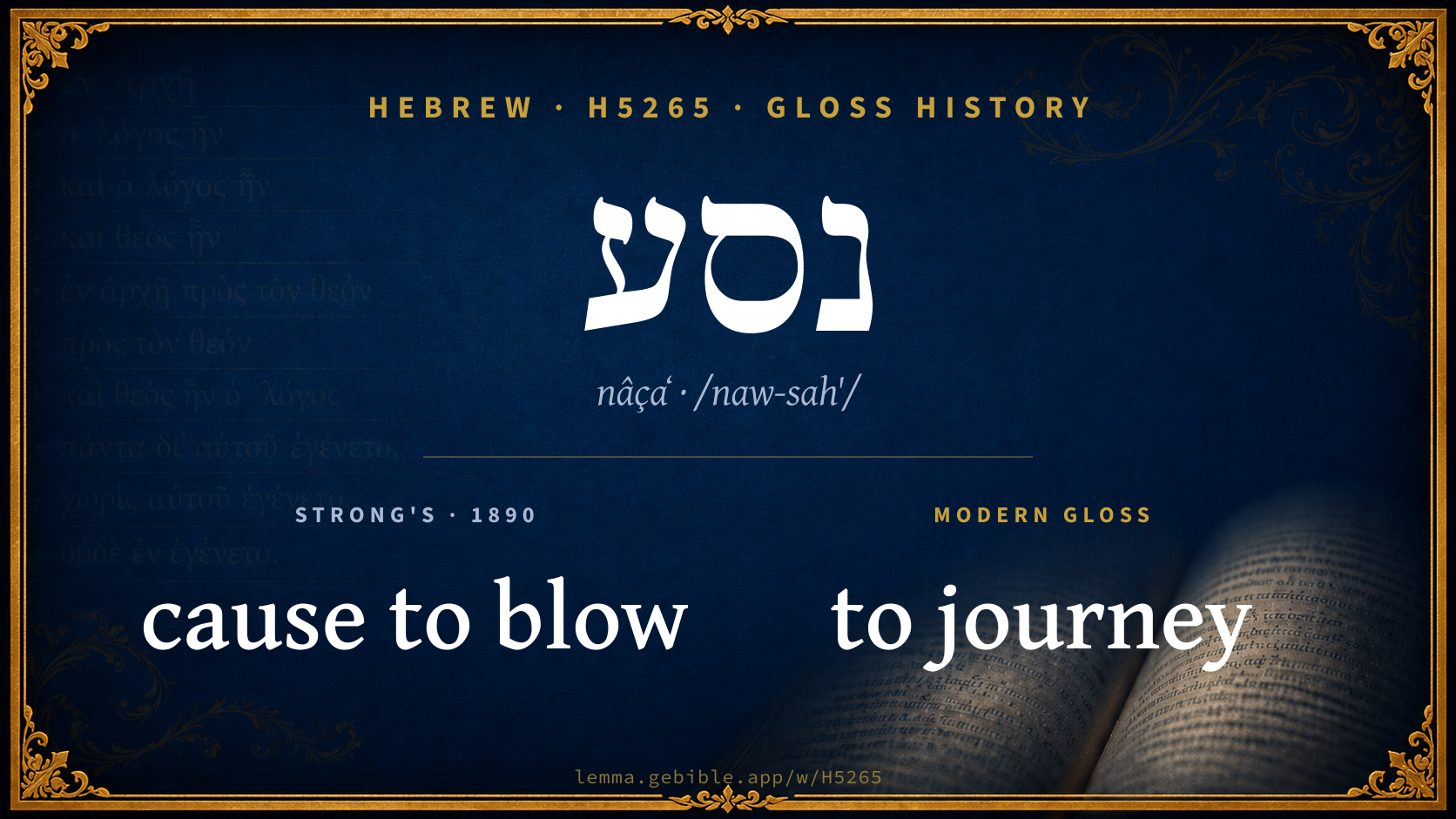
Gloss history
Strong's 1890 vs modern scholarship
About this word
Strong's H5265 catalogs a Hebrew word from the Hebrew Old Testament.
These counts are not copied from any lexicon or concordance. They are computed here, from the morphology-tagged Hebrew Old Testament. What Lemma adds →
- 140
- distinct verses
- The word appears in 140 distinct verses.
- 15 / 39
- OT books
- The word appears in 15 of 39 Old Testament books.
- #307
- by frequency
- Top 500 most frequent Hebrew words (rank 307 of 8,640 Hebrew words by occurrence).
View all 140 occurrences in the concordance →
By section of the Old Testament
By traditional corpus
Conventional, traditional groupings — biblical authorship is debated, so this is a traditional corpus grouping, not an authorship claim. Each share is this word’s portion of its verses in that division of the Hebrew canon. Each figure is a share of the word’s 140 distinct verses.
- Torah (Pentateuch) 114 verses · 81%
- Prophets (Nevi'im) 19 verses · 14%
- Writings (Ketuvim) 7 verses · 5%
How translations render this word
Counts come from each version’s own published word-to-Strong’s tagging or interlinear alignment — an approximate guide to how each version renders this word, not a word-level alignment the data otherwise carries. Because each total is that version’s own tagged count, the per-version totals vary from one another and need not match the appearance or distinct-verse counts above. These counts may also differ from a printed concordance because Lemma counts each distinctly tagged rendering and does not collapse phrase taggings into a single head-word total. This is a fixed set of word-tagged versions (KJV, ASV, BSB, ULT) and does not change with the reading translation you choose elsewhere. Each version’s license is shown beside its name below (and on Sources).
- King James Version: They departed 21×, They removed 18×, Journeyed 14×
- American Standard Version: They journeyed 51×, Journeyed 18×, Set forward 6×
- Berean Standard Bible: They set out 47×, Set out 25×, They shall set out 4×
- unfoldingWord Literal Text: They set out 60×, Set out 27×, And 21×
King James Version Public Domain
Renders H5265 across 146 tagged occurrences — most commonly:
Plus other, less common renderings. Plus 43 renderings that appear only once — usually multi-word phrases or single function words the recovered tagging swept in, not distinct renderings.
American Standard Version Public Domain
Renders H5265 across 146 tagged occurrences — most commonly:
Plus other, less common renderings. Plus 46 renderings that appear only once — usually multi-word phrases or single function words the recovered tagging swept in, not distinct renderings.
Berean Standard Bible Public Domain
Renders H5265 across 145 tagged occurrences — most commonly:
Plus 50 renderings that appear only once — usually multi-word phrases or single function words the recovered tagging swept in, not distinct renderings. Not rendered by a distinct English word in 1 further occurrence.
unfoldingWord Literal Text CC BY-SA 4.0
Renders H5265 across 184 tagged occurrences — most commonly:
Plus other, less common renderings. Plus 34 renderings that appear only once — usually multi-word phrases or single function words the recovered tagging swept in, not distinct renderings.
11 senses and sub-senses in the full BDB
Hebrew verbs can shift meaning by stem (binyan): Qal is the basic action, Niphal is often passive or reflexive, Piel often intensifies or makes it factitive, and Hiphil is typically causative. The senses below are grouped under the stem BDB assigns to each.
What do BDB’s symbols mean?
BDB uses these scholarly abbreviations:
| Symbol | Meaning |
|---|---|
| 𝔊 | the Septuagint (the ancient Greek translation, LXX) |
| 𝔙 | the Vulgate (the Latin translation) |
| 𝔖 | the Syriac version (the Peshitta) |
| 𝔗 | the Targum (the Aramaic translation) |
| ψ | the Psalms |
| √ | root (the underlying root or stem) |
| ‖ | parallel passage (a synonymous or contrasted parallel) |
| † | the dagger: every passage where the word occurs is cited |
The 11 senses and sub-senses the full Brown-Driver-Briggs lexicon distinguishes for this word, in lexicon order (not ranked by frequency), with BDB’s own verbatim wording and sub-sense lettering. Shown in Hebrew script with BDB’s own scholarly abbreviations. The condensed entry is in the Lexicon Entry tab. See also the Forms in the corpus table below.
Qal
- Pf. 3 ms. נ׳ Gn 33:17 +, 3 mpl. נָֽסְעוּ Dt 10:6, נָסָ֑עוּ Nu 2:34 +, etc.; Impf. יִסַּע Is 33:20, וַיִּסַּע Gn 12:9 +, sf. וַיִּסָּעֵם Ju 16:3; 3 mpl. יִסְעוּ Ex 40:36 +, יִסָּ֑עוּ Nu 2:9 +; 2 mpl. תִּסְעוּ Jos 3:3; 1 pl. נִסְעָה cohort. Gn 33:12, וַנִּסַּע Dt 1:19; 2:1, וַנִּסְעָה Ezr 8:31, etc.; Imv. סְעוּ Dt 2:24 +; Inf. abs. נָסוֹעַ Gn 12:9; cstr. נְסֹעַ Jos 3:14 +; sf. נָסְעָם Gn 11:2 Nu 10:34; Pt. נֹסֵעַ Ex 14:10; Nu 10:33; pl. נֹסְעִים Nu 10:29;— e.g. Genesis 33:17
- 1. pull out or up, city-gate and gate-posts Ju 16:3; loom v 14 (on text cf. GFM), tent-pegs Is 33:20 (fig. of Jerusalem; cf. also Niph.) e.g. Judges 16:3
- 2. hence (from pulling up tent-pegs),
- a. set out Gn 35:5; Nu 12:15 (both E), Je 4:7 (‖ יָצָא מִמְּקוֹמוֹ); even of lifeless things, e.g. the ark, הָאָרוֹן Nu 10:35 (JE); often in P: Ex 14:15; 40:37; Nu 1:51; 4:5, 15; 9:17 + 8 times Nu 9, 10:5, 6, 17, 18, 21, 22, 25, so prob. also 2:8 + 6 times Nu 2 (v. infr.; even of lifeless things, דֶּגֶל 10:18, 22, מִשְׁכָּן 1:51, אֹהֶל מוֹעֵד 2:17), 33:3; וַיִּסַּע … וַיָּבֹא Gn 46:1 (E) and Isr. set out, and came, etc., Ex 16:1; 19:2; Nu 20:22; Jos 9:17 (all P), Dt 1:7, נִסְעָה וְנֵלֵ֑כָה 33:12 (J); (… וַיַּעֲלוּ) וַיִּסְעוּ Ju 18:11, סְעוּ וְעִבְרוּ Dt 2:24; נ׳ often c. מִן Gn 35:16 (E), Nu 10:34 (JE), נ׳ מֵאָהֳלֵיהֶם לַעֲבֹר Jos 3:14 (JE), set out from their tents, to cross, etc., cf. נ׳ מִן … לָלֶכֶת Ezr 8:31; c. מִן + ויבא, Jos 3:1 (JE), Nu 33:9 (P), + וַיֵּלֶךְ v 3 (D), Dt 1:19, + וַיַּעַבְרוּ Nu 33:8 (P); + וַיָּשָׁב + וַיַּחֲנוּ Nu 33:7 (P). e.g. Genesis 35:5
- b. depart, c. מִן Gn 37:17 (J), 2 K 3:27; 19:8, 36 = Is 37:8, 37; even of עַמּוּד הֶעָנָן Ex 14:19 (J); of angel v 19 (E; + וַיֵּלֶךְ). e.g. Genesis 37:17
- 3. journey, march (by stages) Gn 12:9; 35:21 both J), Nu 10:13, 14, 28 (P), (poss. also Nu 2:9 etc., cf. 2 supr.); + לְמַסְעֵיהֶם according to their stations, i.e. by stages Ex 17:1; Nu 10:12 (+ מִן), cf. Ex 40:36 (all P); sq. ה loc. Gn 12:9; 33:17 (both J), Dt 1:40; 2:1; סְעוּ לָכֶם הַמִּדְבָּר Nu 14:25 (JE); sq. מִקֶּדֶם eastward (v. מִן 1. c) Gn 11:2; 13:11 (both J), אַחֲרֵי Ex 14:10 (J), אֶל־ Nu 10:29, לִפְנֵי v 33 (of ark; all J); sq. מִן + ה loc. Gn 20:1 (E), Dt 10:6, 7; Ex 12:37 (P), + acc. loc. Nu 11:35 (JE); sq. מִן + acc. of distance, דֶּרֶךְ 10:33 (JE), 21:4 (P); especially וַיִּסְעוּ מִן … וַיַּחֲנוּ Nu 21:12, 13 (JE), Ex 13:20; Nu 21:11; 33:5 + 37 times Nu 33 (all P); of shepherds Je 31:24.—נָֽסְעוּ כְמוֹ צֹאן Zc 10:2 is dub.; We נָעוּ or יָנֻעוּ, so Now. e.g. Genesis 12:9
- 4. of wind, נ׳ רוּחַ מֵאֵת י׳ Nu 11:31 there set forth (sprang up) a wind from י׳. e.g. Numbers 11:31
Niphal
- Pf. be pulled up, removed: 3 ms. דּוֹרִי נִסַּע וְנִגְלָה מִנִּי כְּאֹהֶל רֹעִי Is 38:12; of wealth הֲלֹא נִסַּע Jb 4:21 (reading יְתֵדָם for יִתְרָם, v. ii. יֶתֶר). e.g. Isaiah 38:12
Hiphil
- Impf. 3 ms. יַסַּע ψ 78:26, וַיַּסַּע Ex 15:22 + 2 times; 2 ms. תַּסִּיעַ ψ 80:9, 3 fs. תַּסִּיעִי 2 K 4:4; 3 mpl. וַיַּסִּ֫עוּ 1 K 5:31; Pt. מַסִּיעַ Ec 10:9;— e.g. Psalms 78:26
- 1. cause to set out, lead out, c. acc. pers. Ex 15:22 (J; + מִן, וַיֵּצְאוּ), ψ 78:52 (כַּצֹּאן; ‖ וַיְנַהֲגֵם), 80:9 (מִן; fig. of vine); fig. of a wind, cause to spring up, יַסַּע קָדִים ψ 78:26 (‖ וַיְנַהֵג; cf. Qal 4). e.g. Exodus 15:22
- 2. remove, c. acc. rei 2 K 4:4; וַיַּסַּע כָּעֵץ תִּקְוָתִי Jb 19:10; specif., remove from quarry, quarry: 1 K 5:31 and they quarried great stones, cf. Ec 10:9. e.g. 2 Kings 4:4
Senses from the full Brown-Driver-Briggs lexicon (Brown, Driver, Briggs; Oxford 1906 — public domain), digitized via Sefaria, supplemented by the OpenScriptures HebrewLexicon (CC BY 4.0). Full attribution on Sources.
Word origin
vb. pull out or up, set out, journey (NH id., move, march; Assyrian nisû, set out, withdraw, etc. DlHWB 470; NöZMG xl (1886), 723 cp. also Arabic نَزَعَ, Ethiopic ነዝዐ: [rare] pull up, away, so BaES 51);—
— Brown-Driver-Briggs (Oxford 1906, public domain), digitized via Sefaria, supplemented by the OpenScriptures HebrewLexicon (CC BY 4.0). See Sources.
Origin: a primitive root
Jastrow Dictionary
A second Hebrew/Aramaic lexicon for comparison, covering Aramaic and post-biblical (Talmudic, Targumic, Midrashic) usage that the biblical-Hebrew BDB does not. Matched by lemma rather than by Strong’s number, so a lemma may carry more than one Jastrow headword (shown separately below), and the entries cover usage well beyond the Bible.
נָסַע
- (b. h.) to move, march. Tosef. Sot. VIII, 1 בכל יום … נוֹסֵעַ אחר וכ׳ every day the ark moved behind two standards (divisions), …, but on that day it moved in front; Sot. 33ᵇ. Num. R. s. 2 לאחר שהיו נוֹסְעִים … נוסעים את המשכן after these two standards had moved, the Levites marched (carrying) the Tabernacle. Yalk. ib. 686 מתקרבים לִיסַּע came together to make ready for the march. Mekh. B’shall., Vayass’a, s. 1 זו נסיעה לא נָסְעוּ וכ׳ this march they undertook by the order of Moses, but all other marches they made at the order of the Deity, a. fr.
- 1. to remove, cause to depart, to separate, take apart. Mekh. l. c. הִסִּיעָן בעל כרחן במקל he forced them to march, against their will, with the staff. Ib. ע"ז עברה … והִסִּיעָהּ משה וכ׳ an idol went with the Israelites across the sea, and Moses removed it &c. Kel. V, 7 צריך להַסִּיעוֹ he must (not only divide, but) separate the parts of the stove entirely. Sot. 8ᵃ בית דין מַסִּיעִין את העדים וכ׳ the court orders the witnesses to change their places; Tosef. Snh. IX, 1 (ed. Zuck. מַשִּׂיאִין). Gen. R. s. 38 (ref. to Gen. XI, 2) הִסִּיעוּ עצמן מקדמונו וכ׳ they removed themselves from the Originator of the world; ib. s. 41 ה׳ עצמו וכ׳ he removed himself &c. Mekh. B’shall., Shir., s. 10 גפן שהִסַּעְתָּה ממצרים the vine (Israel) which thou didst transfer from Egypt (Ps. LXXX, 9); a. fr.—B. Bath. 8ᵇ להַסִּיעַ על קיצתן to remove (place outside of the protection of the law, Rashi) those who disregard the terms fixed by the authorities.—Erub. VIII, 5 (86ᵃ) הסעי מלבו (Ms. M. הסירה; ed. Sonc. הסיחה מדעתו, v. Rabb. D. S. a. l. note) he has removed from his mind (the thought of returning to his residence). Mekh. B’shall. s. 3 (ref. to ויסעו, Ex. XIV, 15) יַסִּיעוּ דברים (שהיו דוברים) מלבן let them remove from their hearts the (evil) words which &c.; Ex. R. s. 21.—ה׳ דעת = הסיח דעת, v. נָסַח. Y. Ber. V, 9ᶜ bot.; a. fr.—[Y. Taan. IV, beg. 67ᵇ מפני מסיע, read: הֶסֵּיעַ.—Tosef. Shebi. II, 20 מסיעין, read מְסַיְּיעִין.]—2) to signalize, v. נָשָׂא. e.g. Genesis 11:2
- to be removed. Tosef. Yoma I, 4 ה׳ מן הכהונה was removed (deposed) from the high priesthood; Y. Hor. III, 47ᵈ top.
נְסַע
- Gen. R. s. 38 (ref. to Gen. XI, 2) נַסְעוּ מן מדינחא וכ׳ they moved from the east to go further east. e.g. Genesis 11:2
- to remove. Y. Meg. IV, 75ᶜ top אנא מסתכל ולא מַסַּע דעתי I can look (at the priests) without diverting my attention (from my prayers); Y. Taan. IV, beg. 67ᵇ מַסְּעָה; v. הֶסֵּעַ.
*נֶסַע
- (preced.) march.—Pl. נְסָעִים. Num. R. s. 2 תחלה לנ׳ (Judah was) the first in marching in the desert, opp. חֲנִיּיוֹת.
A Dictionary of the Targumim, the Talmud Babli and Yerushalmi, and the Midrashic Literature (Marcus Jastrow; London, Luzac, 1903) — Public Domain. Digitized via Sefaria. Digitized via Sefaria. Full attribution on Sources.
Forms in the corpus
The 71 distinct written forms H5265 takes in the Hebrew Bible, most frequent first — each parse links to that stem’s occurrences in the concordance. Hebrew forms include their vowel points and cantillation, so a single lemma takes many written forms.
The 60 most common forms are shown; 11 rarer forms follow in the full concordance.
Same root — word family
Other BDB entries built from the same root as H5265, grouped by Strong’s listed origin. These share a root / origin per the lexicon — not necessarily a shared meaning. Each links to that word’s own entry.
Derived from this word
Compare all same-root words → They share a root, not necessarily a meaning.
Septuagint verse parallels
This word appears in 135 verses that also exist in the Greek Old Testament (Septuagint), out of the 140 Hebrew verses it occurs in. You can read those verses in Greek by switching the Old Testament edition to the Septuagint.
Read these verses in the Septuagint
- Genesis 11:2
- Exodus 12:37
- Numbers 1:51
- Deuteronomy 1:7
- Joshua 3:1
- Judges 16:3
- 1 Kings 5:17
- 2 Kings 3:27
- Ezra 8:31
- Job 4:21
- Psalms 80:8
- Ecclesiastes 10:9
This is a verse-level parallel only — the same verses exist in both the Hebrew and Greek Old Testaments. No word-level Hebrew↔Greek correspondence is claimed: the data carries no such alignment, so no Greek word is shown as this Hebrew word’s translation. Coverage is not total — the Septuagint omits the deuterocanon and renumbers the Psalms, so some Hebrew verses have no direct Greek parallel.