
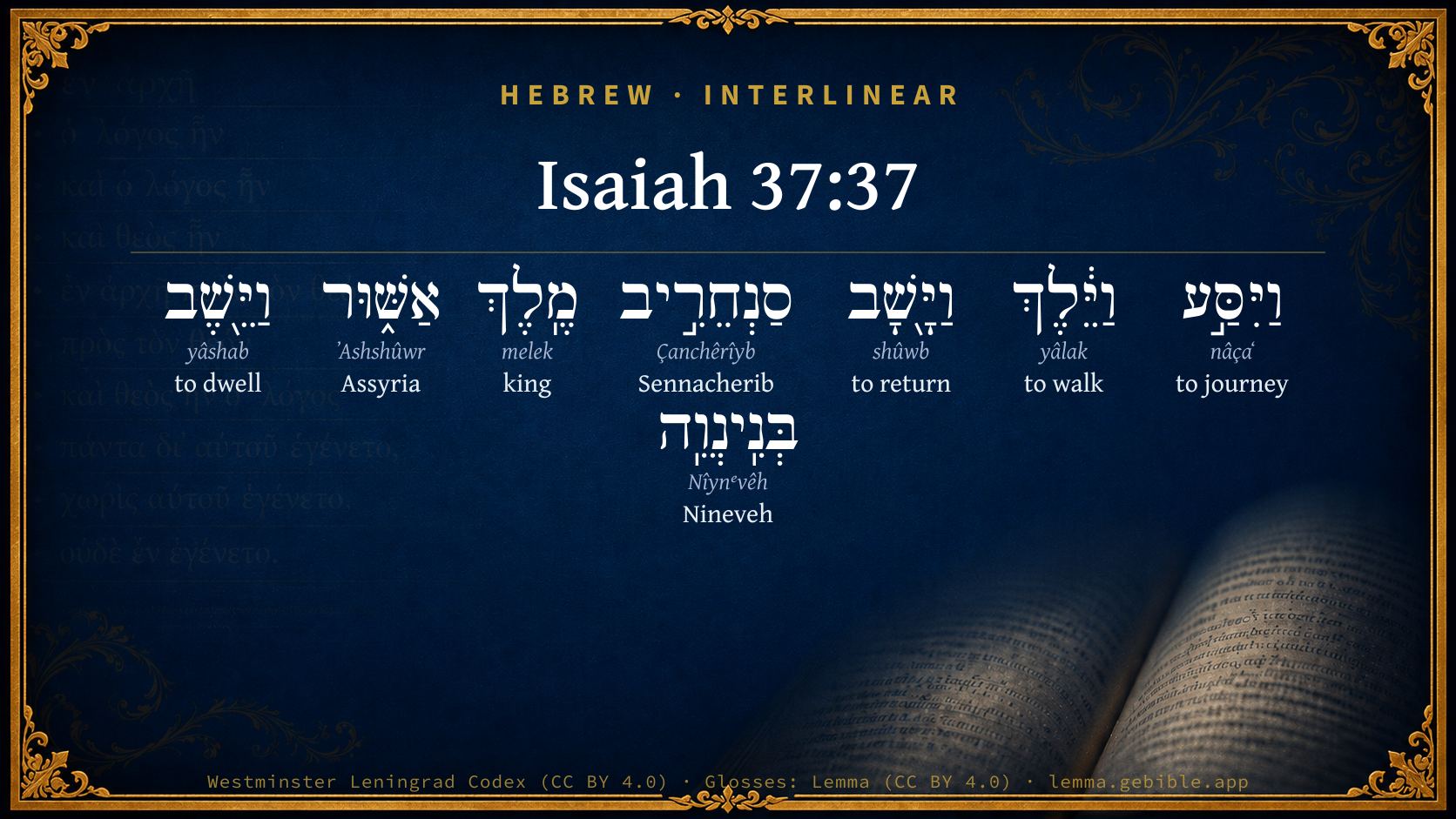
Isaiah 37:37

Hebrew (Westminster Leningrad Codex) Isaiah 37:37 appears in the Hebrew Old Testament. The text above is from the Westminster Leningrad Codex. Each word links to its Strong’s number, a concise gloss, and parsing drawn from the Open Scriptures Hebrew Bible morphology. Click any word for its full Brown-Driver-Briggs (BDB) entry.
Download image
Cite this verse

Isaiah 37:37 (World English Bible). Public Domain. Lemma interlinear Bible study tool, https://lemma.gebible.app/v/isaiah/37/37.

Show BibTeX & RIS
BibTeX
RIS
English Translation
So Sennacherib king of Assyria departed, and went and returned, and lived at Nineveh.
World English Bible · Public Domain
Download a study sheet

One document with this verse’s original text, its word-by-word gloss line, the meaning frame, cross-references with their text, attributed commentary, and full source and license credits — printable, and it pastes into notes with its structure intact.

This verse Autodidact and up

Study sheet (.html) Plain text (.txt)

A passage Seminary Student

Up to 50 verses in one chapter. A passage sheet keeps up to 6 commentary sources and 12 cross-references per verse, in the order this page ranks them, and says so on the sheet whenever that leaves anything out. Ask for a single verse and you get the Autodidact verse sheet above.

Everything on this page stays free to read, with no account — the sheet is a download of what is already on screen, not access to it.

Want to remove ads? Support Godless Engineer
Compare translations 3

The same verse in 3 English versions, stacked beneath the original-language interlinear above. Click any original word for its lexicon entry.

Each is an independent rendering of the whole verse — the interlinear is not word-aligned to these translations.

Highlighted words mark where these versions differ — a whole-verse word diff, not a word-by-word alignment.

  • World English Bible Public Domain
    So Sennacherib king of Assyria departed, and went and returned, and lived at Nineveh.
  • King James Version Public Domain
    So Sennacherib king of Assyria departed, and went and returned, and dwelt at Nineveh.
  • unfoldingWord Literal Text CC BY-SA 4.0
    And he departed and went, and Sennacherib, the king of Assyria, returned and stayed in Nineveh.

unfoldingWord Literal Text — © unfoldingWord, licensed CC BY-SA 4.0. Word-aligned USFM3 via Door43 (git.door43.org/unfoldingWord/en_ult).

Versions to compare (up to 4)

3 of 4 selected

Show all 18 translations

Every available English version of this verse, each an independent rendering of the whole verse.

  • World English Bible Public Domain
    So Sennacherib king of Assyria departed, and went and returned, and lived at Nineveh.
  • Berean Standard Bible Public Domain
    So Sennacherib king of Assyria broke camp and withdrew. He returned to Nineveh and stayed there.
  • Majority Standard Bible Public Domain
    So Sennacherib king of Assyria broke camp and withdrew. He returned to Nineveh and stayed there.
  • King James Version Public Domain
    So Sennacherib king of Assyria departed, and went and returned, and dwelt at Nineveh.
  • American Standard Version (1901) Public Domain
    So Sennacherib king of Assyria departed, and went and returned, and dwelt at Nineveh.
  • Revised Version (1885) Public Domain
    So Sennacherib king of Assyria departed, and went and returned, and dwelt at Nineveh.
  • Geneva Bible (1599) Public Domain
    So Saneherib king of Asshur departed, and went away and returned and dwelt at Nineueh.
  • Douay-Rheims (1899) Public Domain
    And Sennacherib the king of the Assyrians went out and departed, and returned, and dwelt in Ninive.
  • Young's Literal Translation Public Domain
    And journey, and go, and turn back doth Sennacherib king of Asshur, and dwelleth in Nineveh.
  • Literal Standard Version CC BY-SA 4.0
    And he journeys, and goes, and Sennacherib king of Asshur turns back, and dwells in Nineveh.
  • Unlocked Literal Bible CC BY-SA 4.0
    So Sennacherib king of Assyria left Israel and went home and stayed in Nineveh.
  • unfoldingWord Literal Text CC BY-SA 4.0
    And he departed and went, and Sennacherib, the king of Assyria, returned and stayed in Nineveh.
  • Darby Bible Public Domain
    And Sennacherib king of Assyria departed, and went and returned, and abode at Nineveh.
  • World Messianic Bible Public Domain
    So Sennacherib king of Assyria departed, went away, returned to Nineveh, and stayed there.
  • Webster's Bible Public Domain
    So Sennacherib king of Assyria departed, and went and returned, and dwelt at Nineveh.
  • Free Bible Version CC BY-SA 4.0
    Sennacherib, king of Assyria, gave up and left. He returned home to Nineveh and stayed there.
  • Bible in Basic English Public Domain
    Sennacherib, king of Assyria, went back to his place at Nineveh.
  • JPS Tanakh (1917) Public Domain
    So Sennacherib king of Assyria departed, and went, and returned, and dwelt at Nineveh.

Literal Standard Version (2020), Covenant Press — licensed CC BY-SA 4.0. Text via the HelloAO Bible API (eBible.org). Unlocked Literal Bible (unfoldingWord) — licensed CC BY-SA 4.0. Text via the HelloAO Bible API (eBible.org). unfoldingWord Literal Text — © unfoldingWord, licensed CC BY-SA 4.0. Word-aligned USFM3 via Door43 (git.door43.org/unfoldingWord/en_ult). Free Bible Version, Dr. Jonathan Gallagher — licensed CC BY-SA 4.0. Text via the HelloAO Bible API (eBible.org).

Word by word

More ways to search: Search by grammar → Find every occurrence → Compare this word →

Practice this passage: Drill this verse → Learn its vocabulary →

סַנְחֵרִ֣יב
Çanchêrîyb
H5576
“Sennacherib”
Noun, Proper
Part of Speech
Noun
Type
Proper
Full BDB Definition

Origin: of foreign origin

TWOT: None

Sennacherib = "Sin multiplied brothers" (Sin = the moon) - son of Sargon, father of Esarhaddon, and king of Assyria from 705-681 BC; attacked Judah during the reign of king Hezekiah and Judah was delivered when in response to the prayer of Hezekiah an angel smote 185,000 Assyrian soldiers
  1. וַיִּסַּ֣ע nâçaʻ H5265 “and · to journey” Conjunction + Verb, Qal, Sequential Imperfect, 3rd Person, Masculine, Singular
  2. וַיֵּ֔לֶךְ yâlak H3212 “and · to walk” Conjunction + Verb, Qal, Sequential Imperfect, 3rd Person, Masculine, Singular
  3. וַיָּ֖שָׁב shûwb H7725 “and · to return” Conjunction + Verb, Qal, Sequential Imperfect, 3rd Person, Masculine, Singular
  4. מֶֽלֶךְ melek H4428 “king of” Noun, Common, Masculine, Singular, Construct
  5. אַשּׁ֑וּר ʼAshshûwr H804 “Assyria” Noun, Proper
  6. וַיֵּ֖שֶׁב yâshab H3427 “and · to dwell” Conjunction + Verb, Qal, Sequential Imperfect, 3rd Person, Masculine, Singular
  7. בְּנִֽינְוֵֽה Nîynᵉvêh H5210 “in/at · Nineveh” Preposition + Noun, Proper

About this verse

These counts appear in no published source. They are computed here, from the morphology-tagged text and Lemma’s own curated glosses. What Lemma adds →

8
words
8
distinct lemmas
Prophets
section

Notable vocabulary

The rarest word here is סַנְחֵרִ֣יב Sennacherib H5576 — appearing just 13 times in the whole Hebrew Bible.

Shared distinctive vocabulary

סַנְחֵרִ֣יב Sennacherib H5576 occurs in 13 verses of the Hebrew Bible. Also found in:

Grammatical profile

  • 4 verbs
  • 4 nouns

Verb forms

  • וַיִּסַּ֣ע Qal · Sequential Imperfect
  • וַיֵּ֔לֶךְ Qal · Sequential Imperfect
  • וַיָּ֖שָׁב Qal · Sequential Imperfect
  • וַיֵּ֖שֶׁב Qal · Sequential Imperfect

Hebrew & Septuagint length

In English translation the verse runs 14 words from the Hebrew and 13 from the Septuagint (LXX English) — closely comparable.

A rough comparison of the two English renderings, which tokenize alike — not a word-level alignment.

Word counts can differ between the Hebrew and the Greek without any difference in meaning — e.g. the Hebrew direct-object marker אֵת has no separate Greek word, and Greek often adds the article ὁ.

In the original languages it is 8 Hebrew tokens and 9 Greek tokens — but the two are counted differently (Hebrew bundles its prefixes and suffixes into one token; the Greek is in lemma form), so that isn’t a like-for-like length.

Cross-references

9

Topical passages linked to Isaiah 37:37 in the Treasury of Scripture Knowledge — connected by theme and wording, ordered by reader-vote popularity; previews shown in the World English Bible.

  • Jonah 1:2 "Arise, go to Nineveh, that great city, and preach against it, for their wickedness has come up before me."
  • Jonah 3:3 So Jonah arose, and went to Nineveh, according to the word of Yahweh. Now Nineveh was an exceedingly great city, three days' journey across.
  • Genesis 10:11–12 Out of that land he went forth into Assyria, and built Nineveh, Rehoboth Ir, Calah,
  • Isaiah 31:9 His rock shall pass away by reason of terror, and his princes shall be dismayed at the ensign, says Yahweh, whose fire is in Zion, and his furnace in Jerusalem.
  • Isaiah 37:7 Behold, I will put a spirit in him, and he shall hear news, and shall return to his own land; and I will cause him to fall by the sword in his own land.
  • Isaiah 37:29 Because of your raging against me, and because your arrogance is come up into my ears, therefore will I put my hook in your nose, and my bridle in your lips, and I will turn you back by the way by which you came.
  • Jonah 4:11 Shouldn't I be concerned for Nineveh, that great city, in which are more than one hundred twenty thousand persons who can't discern between their right hand and their left hand; and also much cattle?"
  • Nahum 1:1 An oracle about Nineveh. The book of the vision of Nahum the Elkoshite.
  • Matthew 12:41 The men of Nineveh will stand up in the judgment with this generation, and will condemn it, for they repented at the preaching of Jonah; and behold, someone greater than Jonah is here.

Cross-references courtesy of OpenBible.info (CC BY 4.0).

Hebrew and Greek witnesses Masoretic Hebrew ↔ Greek Septuagint

The same verse in the two great witnesses to the Old Testament, shown verse-for-verse.

These are two independent witnesses, not word-aligned to each other, and the Septuagint is shown in lemma (dictionary) form.

Hebrew Isaiah 37:37 Masoretic · Westminster Leningrad Codex

וַיִּסַּ֣ע וַיֵּ֔לֶךְ וַיָּ֖שָׁב סַנְחֵרִ֣יב מֶֽלֶךְ אַשּׁ֑וּר וַיֵּ֖שֶׁב בְּנִֽינְוֵֽה

So Sennacherib king of Assyria departed, and went and returned, and lived at Nineveh.

World English Bible · Public Domain

Greek LXX Isaiah 37:37 Septuagint · lemma form

καί ἀποστρέφω ἀποἔρχομαι βασιλεύς ἀσσύριος καί οἰκέω ἐν νινευη

And Sennacherim king of the Assyrians turned and departed, and lived in Nineve.

LXX2012 (modern English Septuagint) · Public Domain

Hebrew: Westminster Leningrad Codex (CC BY 4.0). Greek: Septuagint (public domain); English from LXX2012 (modern English Septuagint) (Public Domain). How the Septuagint differs from the Hebrew →

Targum (Aramaic paraphrase)

1

The Targum is the ancient Jewish Aramaic paraphrase of the Hebrew Scriptures — an interpretive translation, not the Hebrew text itself. Onkelos (literal) and Pseudo-Jonathan (expansive) render the Torah, and Jonathan the Prophets. Coverage is partial: where no permissively-licensed English translation exists for a verse, only the Aramaic is shown. This is verse-level text, not a word-by-word alignment to the Hebrew.

  1. Targum Jonathan Prophets (Joshua–Malachi)
    וּנְטַל וַאֲזַל וְתַב סַנְחֵרִיב מַלְכָּא דְאַתּוּר וִיתֵיב בְּנִינְוֵה:

    Then Sennacherib king of Assyria departed, and went away, and returned and dwelt at Nineveh.

    Targum Jonathan — Aramaic: “Mikraot Gedolot” (public domain). English: “Sefaria Community Translation” (CC0 1.0 (public-domain dedication)); “London "Chaldee Paraphrase," 1871” (public domain). Text via Sefaria.

Commentary

Notes on Isaiah 37:37 from classic Christian and Jewish commentators (each source and its license shown beneath its notes). The classic Christian expositions comment on the surrounding passage and are grouped to its opening verse, so a note may address several verses; the Jewish commentaries on the Tanakh (Rashi and others) are per-verse, so they appear only where the commentator wrote on this verse.

Lemma curates 59 commentaries, every one of them public domain or Creative Commons licensed, each selected and text-cleaned for this edition rather than reprinted as found. About our sources →

The Cambridge Bible for Schools and Colleges

gen. ed. J. J. S. Perowne

37, 38. The flight of Sennacherib, and his death at Nineveh. If the passage be a combination of two parallel narratives, the second ends with Isa_37:36, while Isa_37:37-38 form the conclusion of the first. In the Hebrew, the first words of Isa_37:37 would be the correct continuation of “and when he heard it” in Isa_37:9.

The Cambridge Bible for Schools and Colleges (gen. ed. J. J. S. Perowne; Cambridge University Press, 1878–1918) — public domain. Text from a community e-Sword module.

Geneva Bible (1599)

Geneva Bible translators

Which was the chiefest city of the Assyrians.

Geneva Bible (1599) marginal notes — public domain. Text via Bolls.life.

Jamieson, Fausset & Brown

Robert Jamieson, A. R. Fausset & David Brown

dwelt at Nineveh--for about twenty years after his disaster, according to the inscriptions. The word, "dwelt," is consistent with any indefinite length of time. "Nineveh," so called from Ninus, that is, Nimrod, its founder; his name means "exceedingly impious rebel"; he subverted the existing patriarchal order of society, by setting up a system of chieftainship, founded on conquest; the hunting field was his training school for war; he was of the race of Ham, and transgressed the limits marked by God (Gen 10:8-11, Gen 10:25), encroaching on Shem's portion; he abandoned Babel for a time, after the miraculous confusion of tongues and went and founded Nineveh; he was, after death, worshipped as Orion, the constellation (see on Job 9:9; Job 38:31).

Jamieson, Fausset & Brown — Commentary Critical and Explanatory on the Whole Bible (1871) — public domain (CC PDM 1.0). Text via the HelloAO Bible API.

Ellicott's Commentary for English Readers

(37) So Sennacherib . . .—We have to remember that the Assyrian king had been engaged in the siege of Libnah, probably also in an Egyptian expedition, which from some cause or other was unsuccessful. The course of events was probably this: that in Egypt he heard of the ravages of the pestilence, returned to find his army too weak to fight, and then, abandoning all further action in the south, withdrew to Nineveh.

Departed, and went and returned.—We are reminded by the three synonyms of the proverbial “abiit, evasit, erupit” of Cicero, in Catil. ii. (Del.).

A Bible Commentary for English Readers, edited by Charles John Ellicott (1878–1897) — public domain. Text from a community e-Sword module.

Albert Barnes' Notes on the Bible

So Sennacherib departed - Probably with some portion of his army and retinue with him, for it is by no means probable that the whole army had been destroyed. In 2Ch 32:21, it is said that the angel ‘cut off all the mighty men of valor, and the leaders and captains in the camp of the king of Assyria.’ His army was thus entirely disabled, and the loss of so large a part of it, and the consternation produced by their sudden destruction, would of course lead him to abandon the siege.

Went and returned - Went from before Jerusalem and returned to his own land.

And dwelt at Nineveh - How long he dwelt there is not certainly known. Berosus, the Chaldean, says it was ‘a little while’ (see Jos. Ant. x. 1. 5). Nineveh was on the Tigris, and was the capital of Assyria. For an account of its site, and its present situation, see the American Biblical Repository for Jan. 1837, pp. 139-159.

Albert Barnes' Notes on the Bible (1834–1885) — public domain. Text from a community e-Sword/MySword module.

Whedon's Commentary on the Bible

Daniel D. Whedon

37, 38. The same lack of facts leaves it uncertain how long Sennacherib survived his mortifying return to Nineveh. The book of Tobit, (i, 21,) Josephus, (Antiquities, Isa_10:2; Isa_10:2,) and Rawlinson, all clash. See RAWLINSON’S Ancient Monarchies, vol. ii, page 169, where he claims that Sennacherib lived seventeen years after his return, made other wars, and left his power and territories undiminished for his son and successor, Esarhaddon. In this case, it must be suspected that some other hand than Isaiah’s added these last verses. In any case, the snatches of history furnished by the monuments, as yet only throw the subject into confusion rather than give the light required to explain some facts and apparent dates here presented.

Daniel D. Whedon (gen. ed.), Commentary on the Old and New Testaments (1874–1909) — public domain. Text from a community e-Sword module.

The Pulpit Commentary

So Sennacherib... departed; rather, broke up his comp. The word used for all the removals of the children of Israel in the wilderness. (Num_33:3-48) The loss of even an entire corps d"armeee would not have caused an Assyrian king, at the head of an intact main army, to break up his camp and abandon his enterprise. And dwelt at Nineveh. Sennacherib lived some eighteen or twenty years from the probable date of his discomfiture, dying in B.C. 681. His ordinary residence was at Nineveh, which he greatly adorned and beautified ("Records of the Past," vol. 11. pp. 55-57). His father, Sargon, on the contrary, dwelt commonly at Khorsabad (Dur-Sargina), and his son, Esarhaddon, dwelt, during the latter part of his reign, at Babylon. We must not suppose, however, that Sennacherib was shut up in Nineveh during the remainder of his life. On the contrary, he made frequent expeditions towards the south, the east, and the north. But he made no farther expedition to the south-west, no further attack on Jerusalem, or attempt on Egypt. The Jews had peace, so far as the Assyrians were concerned, from the event related in ver. 36 to a late date in the reign of Esarhaddon.

The Pulpit Commentary (1880–1919), ed. H.D.M. Spence-Jones & Joseph S. Exell — public domain. Text from a community e-Sword module.

J. A. Alexander on Isaiah

Joseph Addison Alexander

“Then decamped and departed and returned Sennacherib, king of Assyria, and dwelt (or remained) in Nineveh.” The form of expression in the first clause is thought by some writers to resemble Cicero’s famous description of Catiline’s escape (abiit, excessit, evasit, erupit), the rapid succession of the verbs suggesting the idea of confused and sudden flight. His dwelling in Nineveh is supposed by some interpreters to be mentioned as implying that he went forth no more to war, at least not against the Jews. An old tradition says that he lived only fifty days after his return; but according to other chronological hypotheses, he reigned eighteen years longer, and during that interval waged war successively against the Greeks and founded Tarsus in Cilicia.

Joseph Addison Alexander, The Prophecies of Isaiah (1846–1847; New York: Scribner, 1870–1878) — public domain. Text from a community e-Sword module.

Rashi

Rabbi Shlomo Yitzchaki (Rashi)

and dwelt in Nineveh That is the capital, as it is said (Gen. 10:11): “From that land Asshur came out, and he built Nineveh.”

Rashi on the Tanakh — English translations: “The Judaica Press complete Tanach with Rashi, translated by A. J. Rosenberg” (CC BY 4.0); “Pentateuch with Rashi's commentary by M. Rosenbaum and A.M. Silbermann, 1929-1934” (public domain); “The Metsudah Tanach series, Lakewood, N.J” (CC BY 4.0); and “The Book of Joshua, Metsudah Publications, 1997” (CC BY 4.0). Text via Sefaria.

Lesson kit

Teaching starters — assembled from the data on this page, not authored interpretation. Every prompt links to the verse data it draws on. Edit before teaching.

Isaiah, in the Prophets, opens this verse with 8 words (8 distinct Hebrew lemmas). Its most distinctive word is Çanchêrîyb (“Sennacherib”). A historical commentator’s framing appears above. Read the whole chapter for the surrounding context.

Discussion questions

  1. How does “Sennacherib” (Çanchêrîyb) shape what this verse is saying?
  2. How does 2 Kings 18:13, which shares the word «Sennacherib», read alongside this verse?
  3. These translations render this verse differently. What is at stake in choosing one wording over another?
  4. «וַיִּסַּ֣ע» is a Qal Sequential Imperfect verb. How does that grammatical form shape the action described?
  5. Compare how The Cambridge Bible for Schools and Colleges and Geneva Bible (1599) read this verse. Where do they agree or differ?

Things to notice

Reading settings

Reading text

Shown beneath each verse's original-language words.

Old Testament
Old Testament edition

Read the OT as the Masoretic Hebrew (MT) or the Greek Septuagint (LXX).

English shown for the Greek Septuagint (in the Hebrew ↔ Greek comparison).

Comparing translations? Open the Compare panel on any verse page to stack up to four side by side.