Numbers 33:7

Hebrew (Westminster Leningrad Codex) Numbers 33:7 appears in the Hebrew Old Testament. The text above is from the Westminster Leningrad Codex. Each word links to its Strong’s number, a concise gloss, and parsing drawn from the Open Scriptures Hebrew Bible morphology. Click any word for its full Brown-Driver-Briggs (BDB) entry.
Download image
Cite this verse

Numbers 33:7 (World English Bible). Public Domain. Lemma interlinear Bible study tool, https://lemma.gebible.app/v/numbers/33/7.

Show BibTeX & RIS
BibTeX
RIS
English Translation
They traveled from Etham, and turned back to Pihahiroth, which is before Baal Zephon: and they encamped before Migdol.
World English Bible · Public Domain
Download a study sheet

One document with this verse’s original text, its word-by-word gloss line, the meaning frame, cross-references with their text, attributed commentary, and full source and license credits — printable, and it pastes into notes with its structure intact.

This verse Autodidact and up

Study sheet (.html) Plain text (.txt)

A passage Seminary Student

Up to 50 verses in one chapter. A passage sheet keeps up to 6 commentary sources and 12 cross-references per verse, in the order this page ranks them, and says so on the sheet whenever that leaves anything out. Ask for a single verse and you get the Autodidact verse sheet above.

Everything on this page stays free to read, with no account — the sheet is a download of what is already on screen, not access to it.

Want to remove ads? Support Godless Engineer
Compare translations 3

The same verse in 3 English versions, stacked beneath the original-language interlinear above. Click any original word for its lexicon entry.

Each is an independent rendering of the whole verse — the interlinear is not word-aligned to these translations.

Highlighted words mark where these versions differ — a whole-verse word diff, not a word-by-word alignment.

  • World English Bible Public Domain
    They traveled from Etham, and turned back to Pihahiroth, which is before Baal Zephon: and they encamped before Migdol.
  • King James Version Public Domain
    And they removed from Etham, and turned again unto Pihahiroth, which is before Baalzephon: and they pitched before Migdol.
  • unfoldingWord Literal Text CC BY-SA 4.0
    And they set out from Etham and turned back to Pi Hahiroth, which is on the face of Baal Zephon, and they camped before the face of Migdol.

unfoldingWord Literal Text — © unfoldingWord, licensed CC BY-SA 4.0. Word-aligned USFM3 via Door43 (git.door43.org/unfoldingWord/en_ult).

Versions to compare (up to 4)

3 of 4 selected

Show all 18 translations

Every available English version of this verse, each an independent rendering of the whole verse.

  • World English Bible Public Domain
    They traveled from Etham, and turned back to Pihahiroth, which is before Baal Zephon: and they encamped before Migdol.
  • Berean Standard Bible Public Domain
    They set out from Etham and turned back to Pi-hahiroth, opposite Baal-zephon, and they camped near Migdol.
  • Majority Standard Bible Public Domain
    They set out from Etham and turned back to Pi-hahiroth, opposite Baal-zephon, and they camped near Migdol.
  • King James Version Public Domain
    And they removed from Etham, and turned again unto Pihahiroth, which is before Baalzephon: and they pitched before Migdol.
  • American Standard Version (1901) Public Domain
    And they journeyed from Etham, and turned back unto Pihahiroth, which is before Baal-zephon: and they encamped before Migdol.
  • Revised Version (1885) Public Domain
    And they journeyed from Etham, and turned back unto Pi-hahiroth, which is before Baal-zephon: and they pitched before Migdol.
  • Geneva Bible (1599) Public Domain
    And they remoued from Etham, and turned againe vnto Pi-hahiroth, which is before Baal-zephon, and pitched before Migdol.
  • Douay-Rheims (1899) Public Domain
    Departing from thence they came over against Phihahiroth, which looketh towards Beelsephon, and they camped before Magdalum.
  • Young's Literal Translation Public Domain
    and they journey from Etham, and turn back on Pi-Hahiroth, which `is' on the front of Baal-Zephon, and they encamp before Migdol.
  • Literal Standard Version CC BY-SA 4.0
    And they journey from Etham and turn back over Pi-Hahiroth, which [is] on the front of Ba‘al-Zephon, and they encamp before Migdol.
  • Unlocked Literal Bible CC BY-SA 4.0
    They set out from Etham and turned back to Pi Hahiroth, which is opposite Baal Zephon, where they camped opposite Migdol.
  • unfoldingWord Literal Text CC BY-SA 4.0
    And they set out from Etham and turned back to Pi Hahiroth, which is on the face of Baal Zephon, and they camped before the face of Migdol.
  • Darby Bible Public Domain
    And they removed from Etham, and turned back to Pi-hahiroth, which is opposite Baal-Zephon, and encamped before Migdol.
  • World Messianic Bible Public Domain
    They traveled from Etham, and turned back to Pihahiroth, which is before Baal Zephon, and they encamped before Migdol.
  • Webster's Bible Public Domain
    And they removed from Etham, and turned again to Pi-hahiroth, which is before Baal-zephon: and they encamped before Migdol.
  • Free Bible Version CC BY-SA 4.0
    They moved on from Etham, turning back towards Pi-hahiroth, opposite Baal-zephon, and set up camp near Migdol.
  • Bible in Basic English Public Domain
    And from Etham, turning back to Pi-hahiroth which is before Baal-zephon, they put up their tents before Migdol.
  • JPS Tanakh (1917) Public Domain
    And they journeyed from Etham, and turned back unto Pihahiroth, which is before Baal-zephon; and they pitched before Migdol.

Literal Standard Version (2020), Covenant Press — licensed CC BY-SA 4.0. Text via the HelloAO Bible API (eBible.org). Unlocked Literal Bible (unfoldingWord) — licensed CC BY-SA 4.0. Text via the HelloAO Bible API (eBible.org). unfoldingWord Literal Text — © unfoldingWord, licensed CC BY-SA 4.0. Word-aligned USFM3 via Door43 (git.door43.org/unfoldingWord/en_ult). Free Bible Version, Dr. Jonathan Gallagher — licensed CC BY-SA 4.0. Text via the HelloAO Bible API (eBible.org).

Word by word

More ways to search: Search by grammar → Find every occurrence → Compare this word →

Practice this passage: Drill this verse → Learn its vocabulary →

מֵֽאֵתָ֔ם
ʼÊthâm
H864
“from · Etham”
Preposition + Noun, Proper
Part of Speech
Preposition + Noun
Type
Proper
Full BDB Definition

Origin: of Egyptian derivation

TWOT: None

Etham = "with them: their plowshare" - a stopping place for Israel during the Exodus
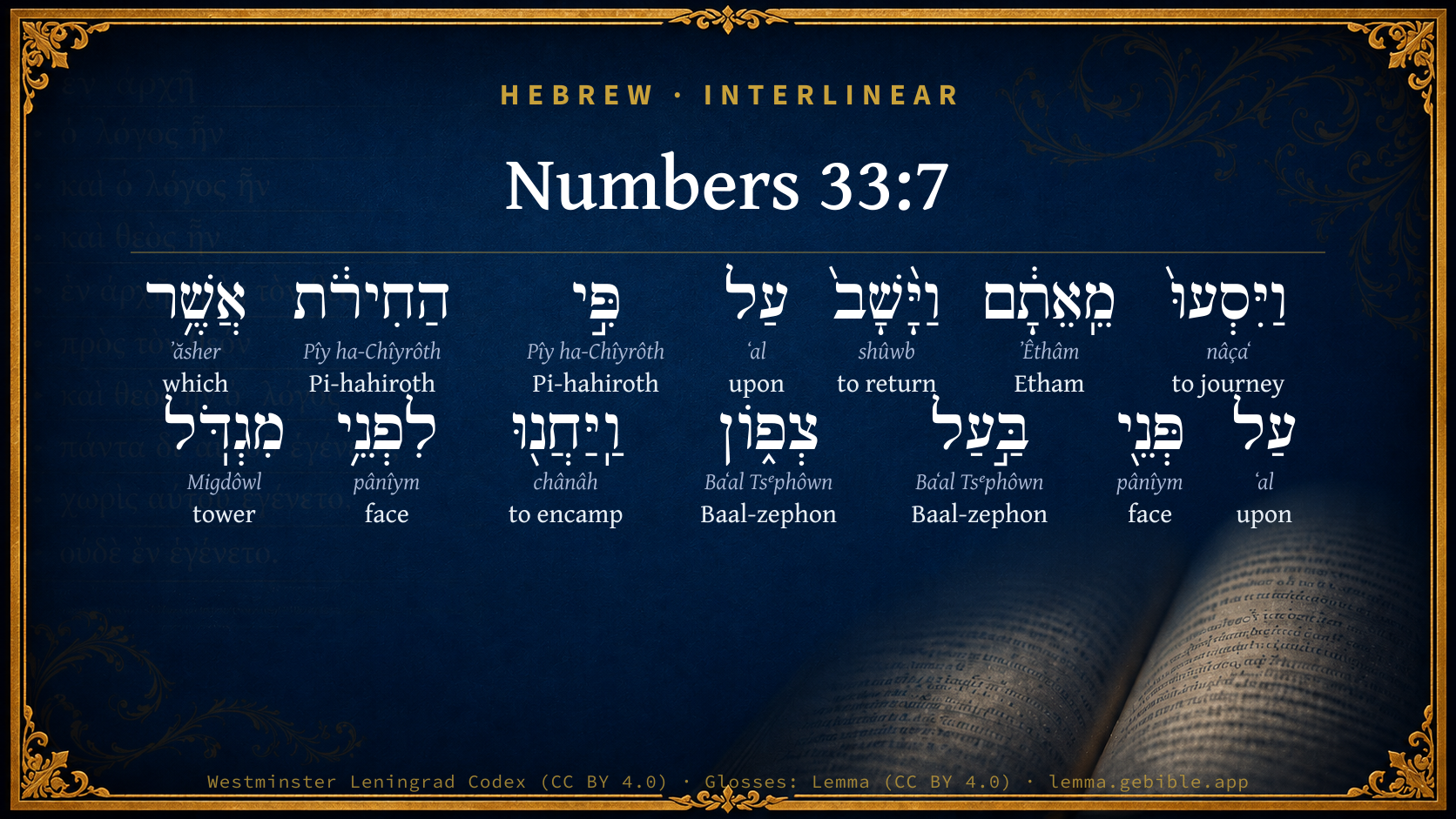
  1. וַיִּסְעוּ֙ nâçaʻ H5265 “and · to journey” Conjunction + Verb, Qal, Sequential Imperfect, 3rd Person, Masculine, Plural
  2. וַיָּ֨שָׁב֙ shûwb H7725 “and · to return” Conjunction + Verb, Qal, Sequential Imperfect, 3rd Person, Masculine, Singular
  3. עַל ʻal H5921 “upon” Preposition
  4. פִּ֣י Pîy ha-Chîyrôth H6367 “Pi-hahiroth” Noun, Proper
  5. הַחִירֹ֔ת Pîy ha-Chîyrôth H6367 “Pi-hahiroth” Noun, Proper
  6. אֲשֶׁ֥ר ʼăsher H834 “which” Particle, Relative
  7. עַל ʻal H5921 “upon” Preposition
  8. פְּנֵ֖י pânîym H6440 “face(s) of” Noun, Common, Both, Plural, Construct
  9. בַּ֣עַל Baʻal Tsᵉphôwn H1189 “Baal-zephon” Noun, Proper
  10. צְפ֑וֹן Baʻal Tsᵉphôwn H1189 “Baal-zephon” Noun, Proper
  11. וַֽיַּחֲנ֖וּ chânâh H2583 “and · to encamp” Conjunction + Verb, Qal, Sequential Imperfect, 3rd Person, Masculine, Plural
  12. לִפְנֵ֥י pânîym H6440 “to/for · face(s) of” Preposition + Noun, Common, Both, Plural, Construct
  13. מִגְדֹּֽל Migdôwl H4024 “tower” Noun, Proper

About this verse

These counts appear in no published source. They are computed here, from the morphology-tagged text and Lemma’s own curated glosses. What Lemma adds →

14
words
10
distinct lemmas
Pentateuch
section

Notable vocabulary

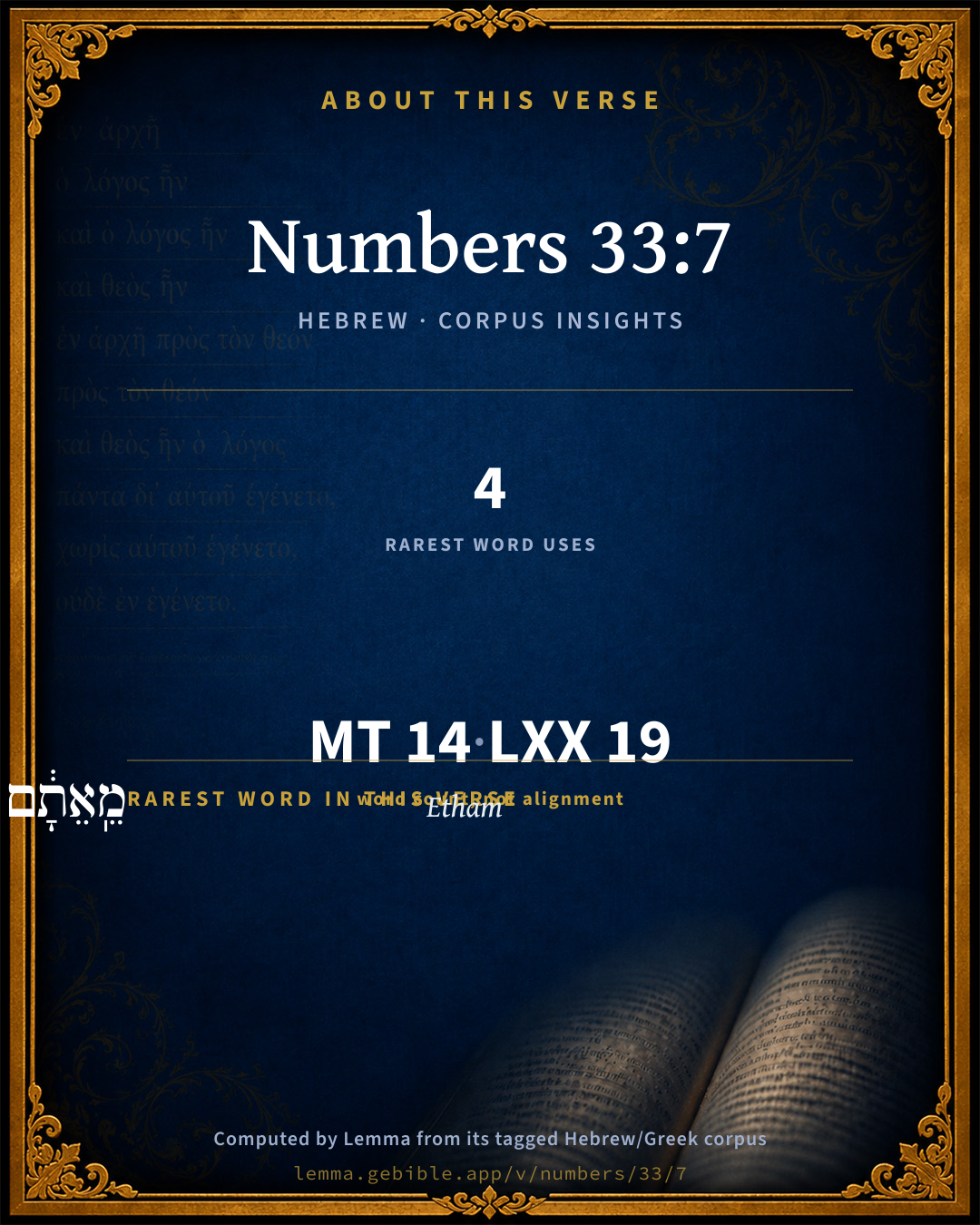
The rarest word here is מֵֽאֵתָ֔ם Etham H864 — appearing just 4 times in the whole Hebrew Bible.

Shared distinctive vocabulary

מֵֽאֵתָ֔ם Etham H864 occurs in 4 verses of the Hebrew Bible. Also found in:

Grammatical profile

  • 3 verbs
  • 8 nouns
  • 2 prepositions
  • 1 particle

Verb forms

  • וַיִּסְעוּ֙ Qal · Sequential Imperfect
  • וַיָּ֨שָׁב֙ Qal · Sequential Imperfect
  • וַֽיַּחֲנ֖וּ Qal · Sequential Imperfect

Repetition

Words recur within this verse — often emphatic in Hebrew:

  • עַל upon H5921 ×2
  • פִּ֣י Pi-hahiroth H6367 ×2
  • פְּנֵ֖י face H6440 ×2
  • בַּ֣עַל Baal-zephon H1189 ×2

Hebrew & Septuagint length

In English translation the verse runs 19 words from the Hebrew and 20 from the Septuagint (LXX English) — closely comparable.

A rough comparison of the two English renderings, which tokenize alike — not a word-level alignment.

Word counts can differ between the Hebrew and the Greek without any difference in meaning — e.g. the Hebrew direct-object marker אֵת has no separate Greek word, and Greek often adds the article ὁ.

In the original languages it is 14 Hebrew tokens and 19 Greek tokens — but the two are counted differently (Hebrew bundles its prefixes and suffixes into one token; the Greek is in lemma form), so that isn’t a like-for-like length.

Cross-references

3

Topical passages linked to Numbers 33:7 in the Treasury of Scripture Knowledge — connected by theme and wording, ordered by reader-vote popularity; previews shown in the World English Bible.

  • Exodus 14:2 "Speak to the children of Israel, that they turn back and encamp before Pihahiroth, between Migdol and the sea, before Baal Zephon. You shall encamp opposite it by the sea.
  • Exodus 14:9 The Egyptians pursued after them: all the horses and chariots of Pharaoh, his horsemen, and his army; and overtook them encamping by the sea, beside Pihahiroth, before Baal Zephon.
  • Numbers 33:8 They traveled from before Hahiroth, and passed through the midst of the sea into the wilderness: and they went three days' journey in the wilderness of Etham, and encamped in Marah.

Cross-references courtesy of OpenBible.info (CC BY 4.0).

Hebrew and Greek witnesses Masoretic Hebrew ↔ Greek Septuagint

The same verse in the two great witnesses to the Old Testament, shown verse-for-verse.

These are two independent witnesses, not word-aligned to each other, and the Septuagint is shown in lemma (dictionary) form.

Hebrew Numbers 33:7 Masoretic · Westminster Leningrad Codex

וַיִּסְעוּ֙ מֵֽאֵתָ֔ם וַיָּ֨שָׁב֙ עַל פִּ֣י הַחִירֹ֔ת אֲשֶׁ֥ר עַל פְּנֵ֖י בַּ֣עַל צְפ֑וֹן וַֽיַּחֲנ֖וּ לִפְנֵ֥י מִגְדֹּֽל

They traveled from Etham, and turned back to Pihahiroth, which is before Baal Zephon: and they encamped before Migdol.

World English Bible · Public Domain

Greek LXX Numbers 33:7 Septuagint · lemma form

καί ἀποαἴρω ἐκ βουθαν καί παρα ἐνβάλλω ἐπί στόμα εϊρωθ ὅς εἰμί ἀπέναντι βεελσεπφων καί παρα ἐνβάλλω ἀπέναντι μαγδώλου

And they departed from Buthan and encamped at the mouth of Iroth, which is opposite Beel-sepphon, and encamped opposite Magdol.

LXX2012 (modern English Septuagint) · Public Domain

Hebrew: Westminster Leningrad Codex (CC BY 4.0). Greek: Septuagint (public domain); English from LXX2012 (modern English Septuagint) (Public Domain). How the Septuagint differs from the Hebrew →

Targum (Aramaic paraphrase)

2

The Targum is the ancient Jewish Aramaic paraphrase of the Hebrew Scriptures — an interpretive translation, not the Hebrew text itself. Onkelos (literal) and Pseudo-Jonathan (expansive) render the Torah, and Jonathan the Prophets. Coverage is partial: where no permissively-licensed English translation exists for a verse, only the Aramaic is shown. This is verse-level text, not a word-by-word alignment to the Hebrew.

  1. Targum Onkelos Torah (Genesis–Deuteronomy)
    וּנְטָלוּ מֵאֵתָם וְתָב עַל פּוּם חִירָתָא דִי קֳדָם בְּעֵיל צְפוֹן וּשְׁרוֹ קֳדָם מִגְדֹל

    (no public-domain English translation for this verse)

    Targum Onkelos — Aramaic: “Onkelos Genesis” (public domain); “Onkelos Exodus” (public domain); “Onkelos Leviticus” (public domain); “Onkelos Numbers” (public domain); “Onkelos Deuteronomy” (public domain). English: “Sefaria Community Translation” (CC0 1.0 (public-domain dedication)); “J.W. Etheridge. The Targums of Onkelos and Jonathan Ben Uzziel on the Pentateuch. London: Longmans, Green, 1862” (public domain). Text via Sefaria.

  2. Targum Pseudo-Jonathan Torah (Genesis–Deuteronomy)
    וּנְטָלוּ מֵאֵיתָם וְתָבוּ עַל פּוּמֵי חִירָתָא מְרַבְעָתָא דִקְדָם טַעֲוַות צְפוֹן וּשְׁרוֹ קֳדָם מִגְדוֹל

    They removed from Etham, and returned unto Pumey Hiratha, which lie in front of the idol of Zephon, and encamped before Migdol.

    Targum Pseudo-Jonathan — Aramaic: “Targum Jonathan on Genesis” (public domain); “Targum Jonathan on Exodus” (public domain); “Targum Jonathan on Leviticus” (public domain); “Targum Jonathan on Numbers” (public domain); “Targum Jonathan on Deuteronomy” (public domain). English: “The Targum of Jonathan ben Uzziel, trans. J. W. Etheridge, London, 1862” (public domain). Text via Sefaria.

Commentary

Notes on Numbers 33:7 from classic Christian and Jewish commentators (each source and its license shown beneath its notes). The classic Christian expositions comment on the surrounding passage and are grouped to its opening verse, so a note may address several verses; the Jewish commentaries on the Tanakh (Rashi and others) are per-verse, so they appear only where the commentator wrote on this verse.

Lemma curates 59 commentaries, every one of them public domain or Creative Commons licensed, each selected and text-cleaned for this edition rather than reprinted as found. About our sources →

Geneva Bible (1599)

Geneva Bible translators

At the commandment of the Lord, Exod. 14:2.

Geneva Bible (1599) marginal notes — public domain. Text via Bolls.life.

Jamieson, Fausset & Brown

Robert Jamieson, A. R. Fausset & David Brown

Pi-hahiroth, Baal-zephon . . . Migdol--(See on Exo 14:2).

Jamieson, Fausset & Brown — Commentary Critical and Explanatory on the Whole Bible (1871) — public domain (CC PDM 1.0). Text via the HelloAO Bible API.

Adam Clarke's Commentary

STAT. III.

Verse 7. PI-HAHIROTH] See on Ex 14:1; Ex 14:2. Baal-zephon Calmet supposes to be the Clysma of the Greeks, and the Kolzum of the Arabians.

Adam Clarke's Commentary on the Bible (1810–1826) — public domain. Text from a community e-Sword/MySword module.

John Gill's Exposition

And they removed from Etham, and turned again to Pihahiroth,.... Which was sixteen miles from Etham. This turning, Aben Ezra says, respects the cloud, or Israel; and indeed it may respect both, for, as the cloud turned, Israel turned, being directed by it; and this does not mean that they had been at Pihahiroth before, and now returned to it again; but that they by direction turned out of the straight way in which they were to go to Pihahiroth; for the word "again" may as well, or better, be left out; see Gill on Exo 14:2,

which is before Baalzephon; the name of an idol, as the Targums of Jonathan and Jerusalem, supposed to be placed here, to watch and guard the passage, as Zephon signifies:

and they pitched before Migdol: which was either the name of a city, the same with Migdol, Jer 44:1 or it was a tower, as the word signifies, placed here on the borders of the land, for the defence of it.

John Gill's Exposition of the Whole Bible (1746–1763) — public domain (CC PDM 1.0). Text via the HelloAO Bible API.

Haydock's Catholic Bible Commentary

Beelsephon; perhaps the city of Clysma, or Colzan, where the Hebrews crossed the sea.

George Leo Haydock (1774–1849), Haydock's Catholic Family Bible and Commentary, 1859 edition — public domain. Excludes Psalms (Douay-Rheims chapter numbering differs from Protestant) and Deuterocanonical books (Catholic canon only).

Whedon's Commentary on the Bible

Daniel D. Whedon

7. Pi-hahiroth,… Baal-zephon:… Migdol — See Introduction to Exodus xiv, and note on Num_33:2-3 of the same chapter.

Daniel D. Whedon (gen. ed.), Commentary on the Old and New Testaments (1874–1909) — public domain. Text from a community e-Sword module.

The Pulpit Commentary

Pi-hahiroth. Hebrew, "Hahi-roth," without the prefix. See on Exo_14:2.

The Pulpit Commentary (1880–1919), ed. H.D.M. Spence-Jones & Joseph S. Exell — public domain. Text from a community e-Sword module.

Lesson kit

Teaching starters — assembled from the data on this page, not authored interpretation. Every prompt links to the verse data it draws on. Edit before teaching.

Numbers, in the Pentateuch, opens this verse with 14 words (10 distinct Hebrew lemmas). Its most distinctive word is ʼÊthâm (“Etham”). A historical commentator’s framing appears above. Read the whole chapter for the surrounding context.

Discussion questions

  1. The word ʼÊthâm carries the sense “Etham.” How does it shape the verse?
  2. How does Exodus 13:20, which shares the word «Etham», read alongside this verse?
  3. What does the repetition of “upon” (2× in this one verse) do in this verse?
  4. These translations render this verse differently; the difference is in the English rendering, not the original. What questions does that raise?
  5. «וַיִּסְעוּ֙» is a Qal Sequential Imperfect verb. How does that grammatical form shape the action described?
  6. Compare how Geneva Bible (1599) and Jamieson, Fausset & Brown read this verse. Where do they agree or differ?

Things to notice

Reading settings

Reading text

Shown beneath each verse's original-language words.

Old Testament
Old Testament edition

Read the OT as the Masoretic Hebrew (MT) or the Greek Septuagint (LXX).

English shown for the Greek Septuagint (in the Hebrew ↔ Greek comparison).

Comparing translations? Open the Compare panel on any verse page to stack up to four side by side.