
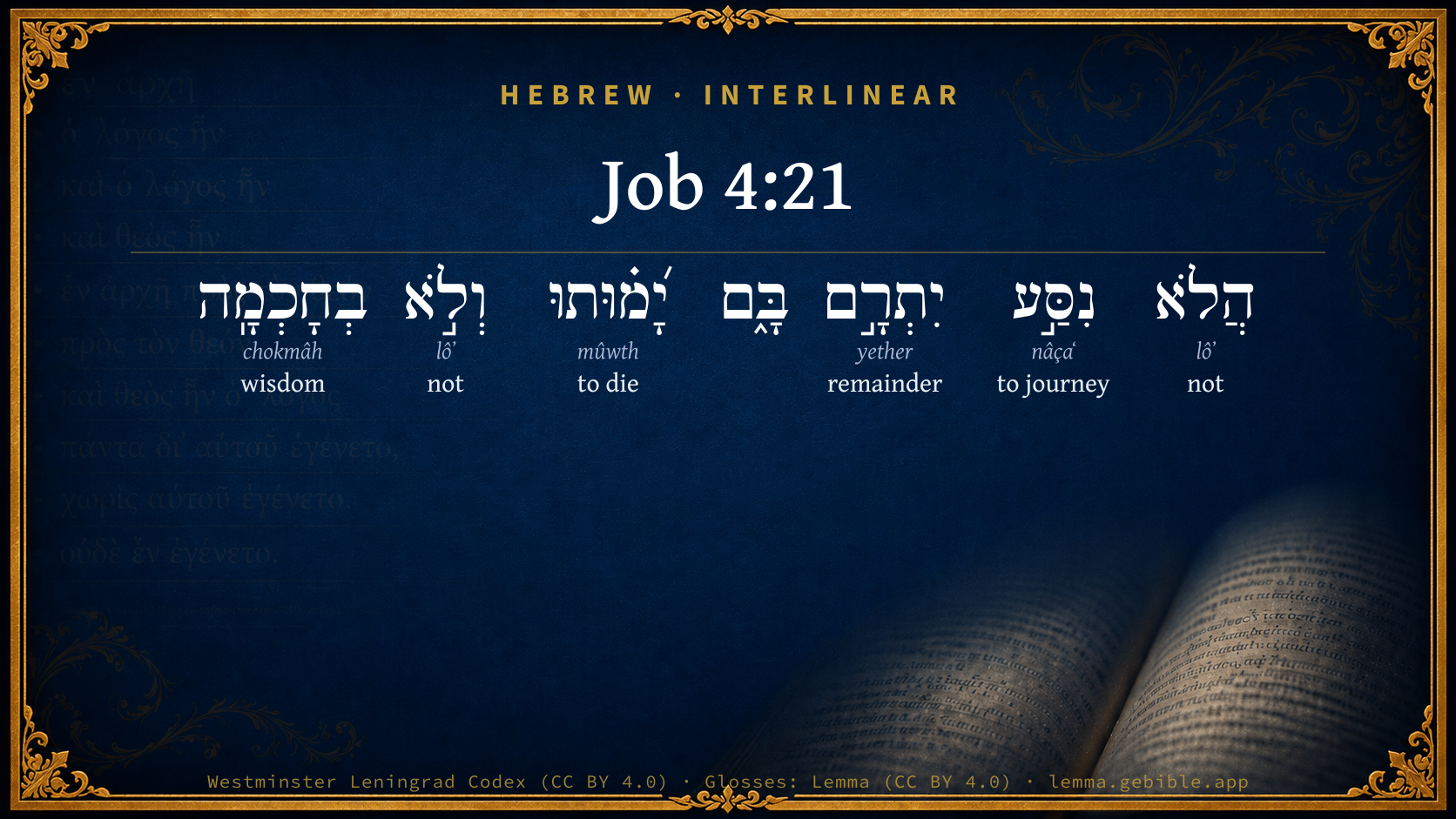
Job 4:21

Hebrew (Westminster Leningrad Codex) Job 4:21 appears in the Hebrew Old Testament. The text above is from the Westminster Leningrad Codex. Each word links to its Strong’s number, a concise gloss, and parsing drawn from the Open Scriptures Hebrew Bible morphology. Click any word for its full Brown-Driver-Briggs (BDB) entry.
Download image
Cite this verse

Job 4:21 (World English Bible). Public Domain. Lemma interlinear Bible study tool, https://lemma.gebible.app/v/job/4/21.

Show BibTeX & RIS
BibTeX
RIS
English Translation
Isn't their tent-cord plucked up within them? They die, and that without wisdom.'
World English Bible · Public Domain
Download a study sheet

One document with this verse’s original text, its word-by-word gloss line, the meaning frame, cross-references with their text, attributed commentary, and full source and license credits — printable, and it pastes into notes with its structure intact.

This verse Autodidact and up

Study sheet (.html) Plain text (.txt)

A passage Seminary Student

Up to 50 verses in one chapter. A passage sheet keeps up to 6 commentary sources and 12 cross-references per verse, in the order this page ranks them, and says so on the sheet whenever that leaves anything out. Ask for a single verse and you get the Autodidact verse sheet above.

Everything on this page stays free to read, with no account — the sheet is a download of what is already on screen, not access to it.

Want to remove ads? Support Godless Engineer
Compare translations 3

The same verse in 3 English versions, stacked beneath the original-language interlinear above. Click any original word for its lexicon entry.

Each is an independent rendering of the whole verse — the interlinear is not word-aligned to these translations.

Highlighted words mark where these versions differ — a whole-verse word diff, not a word-by-word alignment.

  • World English Bible Public Domain
    Isn't their tent-cord plucked up within them? They die, and that without wisdom.'
  • King James Version Public Domain
    Doth not their excellency which is in them go away? they die, even without wisdom.
  • unfoldingWord Literal Text CC BY-SA 4.0
    Is not their tent cord pulled up away from them? They will die, and not in wisdom.

unfoldingWord Literal Text — © unfoldingWord, licensed CC BY-SA 4.0. Word-aligned USFM3 via Door43 (git.door43.org/unfoldingWord/en_ult).

Versions to compare (up to 4)

3 of 4 selected

Show all 18 translations

Every available English version of this verse, each an independent rendering of the whole verse.

  • World English Bible Public Domain
    Isn't their tent-cord plucked up within them? They die, and that without wisdom.'
  • Berean Standard Bible Public Domain
    Are not their tent cords pulled up, so that they die without wisdom?’
  • Majority Standard Bible Public Domain
    Are not their tent cords pulled up, so that they die without wisdom?’
  • King James Version Public Domain
    Doth not their excellency which is in them go away? they die, even without wisdom.
  • American Standard Version (1901) Public Domain
    Is not their tent-cord plucked up within them? They die, and that without wisdom.
  • Revised Version (1885) Public Domain
    Is not their tent-cord plucked up within them? they die, and that without wisdom.
  • Geneva Bible (1599) Public Domain
    Doeth not their dignitie goe away with them? do they not die, and that without wisdom?
  • Douay-Rheims (1899) Public Domain
    And they that shall be left, shall be taken away from them: they shall die, and not in wisdom.
  • Young's Literal Translation Public Domain
    Hath not their excellency been removed with them? They die, and not in wisdom!
  • Literal Standard Version CC BY-SA 4.0
    Has their excellence not been removed with them? They die, and not in wisdom!”
  • Unlocked Literal Bible CC BY-SA 4.0
    Are not their tent cords plucked up among them? They die; they die without wisdom.
  • unfoldingWord Literal Text CC BY-SA 4.0
    Is not their tent cord pulled up away from them? They will die, and not in wisdom.
  • Darby Bible Public Domain
    Is not their tent-cord torn away in them? they die, and without wisdom.
  • World Messianic Bible Public Domain
    Isn’t their tent cord plucked up within them? They die, and that without wisdom.’
  • Webster's Bible Public Domain
    Doth not their excellence which is in them depart? they die, even without wisdom.
  • Free Bible Version CC BY-SA 4.0
    They are like tent ropes that are pulled up, and they collapse in death. They die without wisdom.’”
  • Bible in Basic English Public Domain
    If their tent-cord is pulled up, do they not come to an end, and without wisdom?
  • JPS Tanakh (1917) Public Domain
    Is not their tent-cord plucked up within them? They die, and that without wisdom.'

Literal Standard Version (2020), Covenant Press — licensed CC BY-SA 4.0. Text via the HelloAO Bible API (eBible.org). Unlocked Literal Bible (unfoldingWord) — licensed CC BY-SA 4.0. Text via the HelloAO Bible API (eBible.org). unfoldingWord Literal Text — © unfoldingWord, licensed CC BY-SA 4.0. Word-aligned USFM3 via Door43 (git.door43.org/unfoldingWord/en_ult). Free Bible Version, Dr. Jonathan Gallagher — licensed CC BY-SA 4.0. Text via the HelloAO Bible API (eBible.org).

Word by word

More ways to search: Search by grammar → Find every occurrence → Compare this word →

Practice this passage: Drill this verse → Learn its vocabulary →

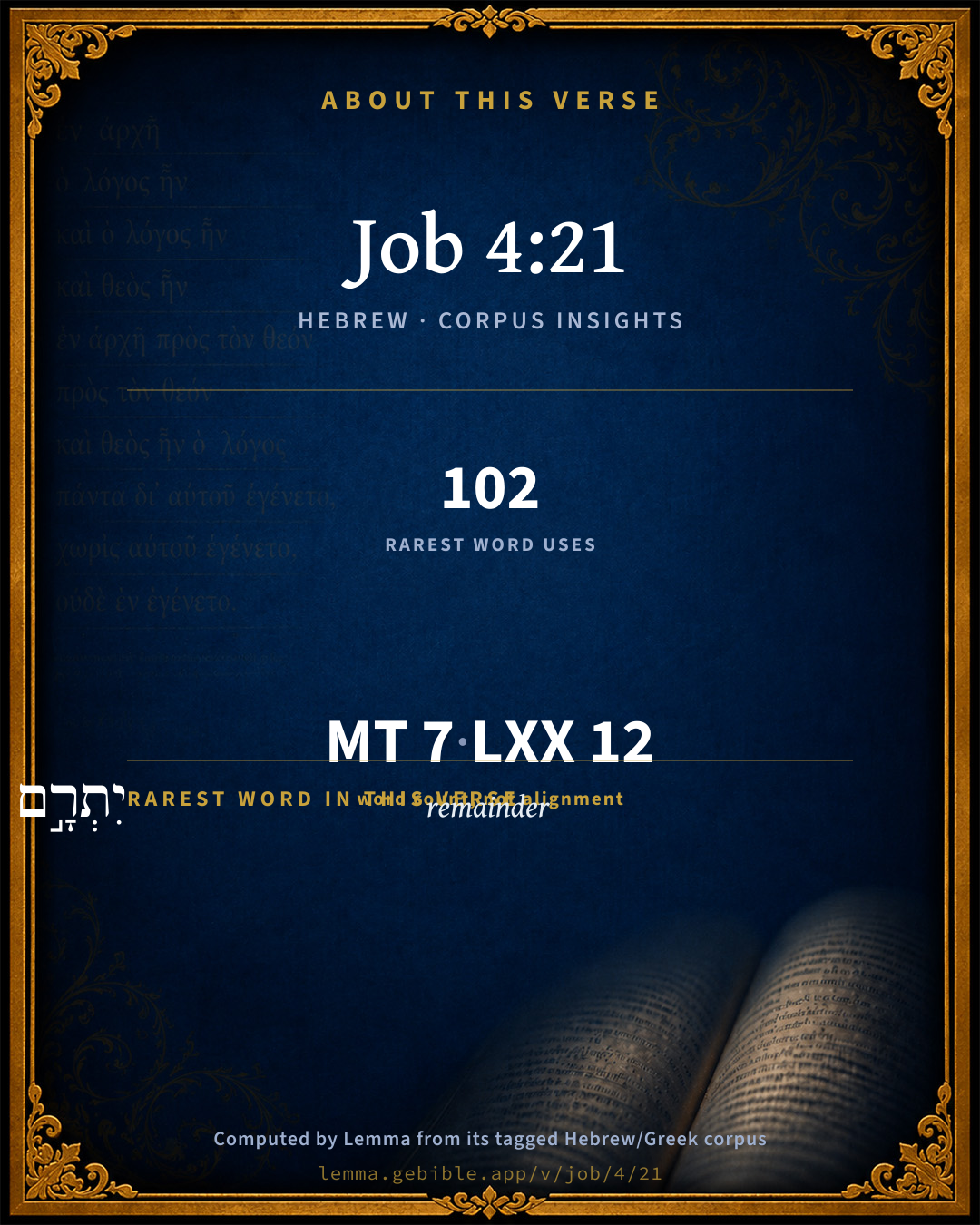
About this verse

These counts appear in no published source. They are computed here, from the morphology-tagged text and Lemma’s own curated glosses. What Lemma adds →

7
words
5
distinct lemmas
Wisdom
section

Grammatical profile

  • 2 verbs
  • 2 nouns
  • 1 preposition
  • 2 particles

Verb forms

  • נִסַּ֣ע Niphal · Perfect
  • יָ֝מ֗וּתוּ Qal · Imperfect

Repetition

A word recurs within this verse — often emphatic in Hebrew:

  • הֲלֹא not H3808 ×2

Hebrew & Septuagint length

In English translation the verse runs 13 words from the Hebrew and 16 from the Septuagint (LXX English) — closely comparable.

A rough comparison of the two English renderings, which tokenize alike — not a word-level alignment.

Word counts can differ between the Hebrew and the Greek without any difference in meaning — e.g. the Hebrew direct-object marker אֵת has no separate Greek word, and Greek often adds the article ὁ.

In the original languages it is 7 Hebrew tokens and 12 Greek tokens — but the two are counted differently (Hebrew bundles its prefixes and suffixes into one token; the Greek is in lemma form), so that isn’t a like-for-like length.

Cross-references

13

Topical passages linked to Job 4:21 in the Treasury of Scripture Knowledge — connected by theme and wording, ordered by reader-vote popularity; previews shown in the World English Bible.

  • Job 36:12 But if they don't listen, they shall perish by the sword; They shall die without knowledge.
  • Job 8:22 Those who hate you shall be clothed with shame. The tent of the wicked shall be no more."
  • Psalms 39:11 When you rebuke and correct man for iniquity, You consume his wealth like a moth. Surely every man is but a breath." Selah.
  • Luke 16:22–23 It happened that the beggar died, and that he was carried away by the angels to Abraham's bosom. The rich man also died, and was buried.
  • Job 18:21 Surely such are the dwellings of the unrighteous, This is the place of him who doesn't know God."
  • Psalms 39:5 Behold, you have made my days handbreadths. My lifetime is as nothing before you. Surely every man stands as a breath." Selah.
  • Psalms 49:14 They are appointed as a flock for Sheol. Death shall be their shepherd. The upright shall have dominion over them in the morning. Their beauty shall decay in Sheol, Far from their mansion.
  • Psalms 49:20 A man who has riches without understanding, Is like the animals that perish.
  • Psalms 146:3–4 Don't put your trust in princes, Each a son of man in whom there is no help.
  • Isaiah 2:22 Stop trusting in man, whose breath is in his nostrils; For of what account is he?
  • Isaiah 14:16 Those who see you shall gaze at you, they shall consider you, [saying], "Is this the man who made the earth to tremble, who shook kingdoms;
  • Luke 12:20 "But God said to him, 'You foolish one, tonight your soul is required of you. The things which you have prepared--whose will they be?'
  • James 1:11 For the sun arises with the scorching wind, and withers the grass, and the flower in it falls, and the beauty of its appearance perishes. So also will the rich man fade away in his pursuits.

Cross-references courtesy of OpenBible.info (CC BY 4.0).

Hebrew and Greek witnesses Masoretic Hebrew ↔ Greek Septuagint

The same verse in the two great witnesses to the Old Testament, shown verse-for-verse.

These are two independent witnesses, not word-aligned to each other, and the Septuagint is shown in lemma (dictionary) form.

Hebrew Job 4:21 Masoretic · Westminster Leningrad Codex

הֲלֹא נִסַּ֣ע יִתְרָ֣ם בָּ֑ם יָ֝מ֗וּתוּ וְלֹ֣א בְחָכְמָֽה

Isn't their tent-cord plucked up within them? They die, and that without wisdom.'

World English Bible · Public Domain

Greek LXX Job 4:21 Septuagint · lemma form

ἐνφυσάω γάρ αὐτός καί ξηραίνω ἀποὀλλύω παρά ὁ μή ἔχω αὐτός σοφία

For he blows upon them, and they are withered: they have perished for lack of wisdom.

LXX2012 (modern English Septuagint) · Public Domain

Hebrew: Westminster Leningrad Codex (CC BY 4.0). Greek: Septuagint (public domain); English from LXX2012 (modern English Septuagint) (Public Domain). How the Septuagint differs from the Hebrew →

Commentary

Notes on Job 4:21 from classic Christian and Jewish commentators (each source and its license shown beneath its notes). The classic Christian expositions comment on the surrounding passage and are grouped to its opening verse, so a note may address several verses; the Jewish commentaries on the Tanakh (Rashi and others) are per-verse, so they appear only where the commentator wrote on this verse.

Lemma curates 59 commentaries, every one of them public domain or Creative Commons licensed, each selected and text-cleaned for this edition rather than reprinted as found. About our sources →

Trapp's Complete Commentary

John Trapp

Job 4:21 Doth not their excellency [which is] in them go away? they die, even without wisdom.

Ver. 21. Doth not their excellency which is in them go away?] Journeyeth not their excellency with them? so Broughton rendereth it. By their excellence here some understand the soul, called by David his glory. A philosopher said, there was nothing excellent in the world but man, nothing in man but his soul (Favorinus). The Stoics affirmed that the body was not a part of a man, but the instrument, or rather the servant, of the soul. Hence the Latins call the body Corpus, or Corpor (as of old they speak), quasi cordis puer sive famnlus. And Plato saith that that is not the man that is seen of him; but the mind of a man, that is the man (ουκ εστιν ανθρωπος το ορωμενον). And in the Job 4:19 man is said to dwell in a house of clay; that is, the soul to inhabit the body. The soul goes away with the name of the whole person; the soul indeed is the man in a moral consideration, and is, therefore, elsewhere called the inward man, and the hidden man of the heart, 2Co 4:16 1Pe 3:4; the body, compared to it, is but as a clay wall encompassing a treasure, a coarse case to a rich instrument, a leathern sheath to an excellent blade, Dan 7:15, or as a mask to a beautiful face. Now at death this excellence of a man departeth, returneth to God that gave it, Ecc 12:7. "His breath goeth forth, he returneth to his earth, in that very day his thoughts perish," even the most excellent effects of his mind and spirit, as the word signifieth, Psa 146:4. And as that, so all other excellencies go away at death, Psa 39:11; Psa 49:13; even the whole goodliness of man, Isa 40:6, whether it be the good things of the mind, as wisdom, science, conscience, judgment; or of the body, as beauty and health; or of fortune, as they call it, as favour and applause, together with plenty of prosperity. No man’s glory goeth down with him into the grave, Psa 49:16. Where is now the flourishing beauty and gallantry of Caesar, saith one? his armies and honours, his triumphs and trophies? Where are the rich fool’s great barns? Nebuchadnezzar’s great Babel? Agrippa’s great pomp? &c. Have not all these made their bed in the dark, leaving their excellence behind them? Are they not, many of them, gone to their place, as a stone to the centre, or as a fool to the stocks?

They die, even without wisdom] Heb. They die, and not with wisdom; they die like so many beasts (but for their pillow and bolster), without any care to lay hold on eternal life; they die as a fool dieth, 2Sa 3:33. Not in wisdom; that is, in abundance of folly, saith Pineda. And this is most men’s case; their wit serves them not in this weighty work of preparing to die; they put far away the thoughts of it, and hence they die tempore non suo, Ecc 7:17, when it were better for them to do anything rather than to die. To live with dying thoughts is a high point of heavenly wisdom, Psa 90:12 Deu 32:29. How might one such wise Christian chase a thousand foolish and hurtful lusts, which drown men’s soul in perdition and destruction! 1Ti 6:4.

John Trapp, A Commentary or Exposition upon All the Books of the Old and New Testament (1647–1656) — public domain. Text from a community e-Sword module.

The Biblical Illustrator

Joseph S. Exell

Job_4:21

They die, even without wisdom.

Dying in ignorance

Alas! while the body stands so broad and brawny must the soul be blinded, dwarfed, stupefied, almost annihilated? Alas! This too was a breath of God: bestowed in heaven, but on earth never to be unfolded. That there should one man die ignorant who had capacity for knowledge, this I call a tragedy. (Carlyle.)

Unpreparedness for death:

One should think, said a friend to the celebrated Dr. Samuel Johnson, that sickness and the view of death would make men more religious. Sir, replied Johnson, they do not know how to go to work about it. A man who has never had religion before, no more grows religious when he is sick than a man who has never learned figures can count when he has need of calculation.

The Biblical Illustrator, edited by Joseph S. Exell (c. 1880s–1900s) — public domain. Text from a community e-Sword module.

Joseph Benson's Commentary

Job 4:21. Doth not their excellency which is in them go away? — Whatsoever is really, or by common estimation, excellent in men, all their natural, and moral, and civil accomplishments, as high birth, great riches, power, and wisdom; these are so far from preserving them from perishing, as one would think they should, that they perish themselves, together with those houses of clay in which they are lodged. Or, the Hebrew יתרם, jithram, may be rendered reliquiæ illorum, their remains go away. In a little time the departure of the most skilful projectors, who seem to lay the deepest and strongest foundations for permanent wealth, power, and enjoyment, is such, that every thing belonging to them is absolutely removed. If you inquire after the place and station of life they filled; the fortunes they possessed; the families they raised, you shall find them all taken away, and nothing, not the least remains to be seen. And, what is still worse, they die even without wisdom — All that skill and policy, all those arts and contrivances, which distinguished them from others, and placed them in a superior rank and situation, are, at the point of death, even in their own opinion, no better than worldly craft and human folly. They die like fools, without having attained that only wisdom for which they came into the world. Now shall such a mean, weak, foolish, sinful, dying creature as this pretend to be more just than God, more pure than his Maker? No, instead of quarrelling with his afflictions, let him admire that he is out of hell!

Joseph Benson's Commentary on the Old and New Testaments (1811–1818) — public domain. Text from a community e-Sword module.

Tyndale Open Study Notes

Tyndale Open Resources

4:21 A tent was a common symbol for mortal life (Isa 38:12; 2 Cor 5:1; cp. Eccl 12:6).

Tyndale Open Study Notes — © Tyndale Open Resources, licensed CC BY-SA 4.0. Text via the HelloAO Bible API.

Geneva Bible (1599)

Geneva Bible translators

That is, before that any of them were so wise, as to think on death.

Geneva Bible (1599) marginal notes — public domain. Text via Bolls.life.

Jamieson, Fausset & Brown

Robert Jamieson, A. R. Fausset & David Brown

their excellency-- (Psa 39:11; Psa 146:4; Co1 13:8). But UMBREIT, by an Oriental image from a bow, useless because unstrung: "Their nerve, or string would be torn away." MICHAELIS, better in accordance with Job 4:19, makes the allusion be to the cords of a tabernacle taken down (Isa 33:20).

they die, even without wisdom--rather, "They would perish, yet not according to wisdom," but according to arbitrary choice, if God were not infinitely wise and holy. The design of the spirit is to show that the continued existence of weak man proves the inconceivable wisdom and holiness of God, which alone save man from ruin [UMBREIT]. BENGEL shows from Scripture that God's holiness (Hebrew, kadosh) comprehends all His excellencies and attributes. DE WETTE loses the scope, in explaining it, of the shortness of man's life, contrasted with the angels "before they have attained to wisdom."

Next: Job Chapter 5

Jamieson, Fausset & Brown — Commentary Critical and Explanatory on the Whole Bible (1871) — public domain (CC PDM 1.0). Text via the HelloAO Bible API.

Adam Clarke's Commentary

Verse 21. Doth not their excellency - go away!] Personal beauty, corporeal strength, powerful eloquence, and various mental endowments, pass away, or are plucked up by the roots; they are no more seen or heard among men, and their memory soon perisheth.

They die, even without wisdom.] If wisdom means the pursuit of the best end, by the most legitimate and appropriate means, the great mass of mankind appear to perish without it. But, if we consider the subject more closely, we shall find that all men die in a state of comparative ignorance. With all our boasted science and arts, how little do we know! Do we know any thing to perfection that belongs either to the material or spiritual world? Do we understand even what matter is? What is its essence? Do we understand what spirit is? Then, what is its essence? Almost all the phenomena of nature, its grandest operations, and the laws of the heavenly bodies, have been explained on the principle of gravitation or attraction; but in what does this consist? Who can answer? We can traverse every part of the huge and trackless ocean by means of the compass; but who understands the nature of magnetism on which all this depends? We eat and drink in order to maintain life; but what is nutrition, and how is it effected? This has never been explained. Life depends on respiration for its continuance; but by what kind of action is it, that in a moment the lungs separate the oxygen, which is friendly to life, from the nitrogen, which would destroy it; suddenly absorbing the one, and expelling the other? Who, among the generation of hypothesis-framers, has guessed this out? Life is continued by the circulation of the blood; but by what power and law does it circulate? Have the systole and diastole of the heart, on which this circulation depends, ever been satisfactorily explained? Most certainly not. Alas, we die without wisdom; and must die, to know these, and ten thousand other matters equally unknown, and equally important. To be safe, in reference to eternity, we must know the only true God, and Jesus Christ whom he has sent; whom to know is life eternal. This knowledge, obtained and retained, will entitle us to all the rest in the eternal world.

Adam Clarke's Commentary on the Bible (1810–1826) — public domain. Text from a community e-Sword/MySword module.

The Cambridge Bible for Schools and Colleges

gen. ed. J. J. S. Perowne

21. their excellency go away] This verse is obscure. The word rendered go away means to pull out, as a pin or the posts of a gate, Jdg_16:3; Jdg_16:14 (English version, went away with), or the stake of a tent, Isa_33:20 (be removed). This is probably the original meaning. Then the word is used in a secondary, more general sense, to break up an encampment, to remove or journey, to depart, e.g. very often in Numbers 33. In the present verse the verb is pass., and probably has its original sense, plucked up, or torn out. The word translated excellency has that meaning, e.g. Gen_49:3; Pro_17:7. In other places the word means a cord, Jdg_16:7-9, the string of a bow, Psa_11:2; and similarly Job_30:11. The figure in the Poet’s mind here is the pulling down of a tent, to which the death of man is compared; so in Isa_38:12, where the meaning is, my habitation is removed. The meaning cord suits this figure better than excellency, and the sense would be, their tent-cord is torn away. As to the relation of the two clauses of the verse to one another, the construction is probably the same as in ch. Job_4:2, if one should venture … wilt thou be grieved? Therefore,

If their tent-cord is torn away in them,

Do they not die, and not in wisdom?

There is an emphasis on die; the moment the tent falls, through the tearing-away of the cord that upheld it, the inhabitant wholly perishes. It is not necessary to ask what the tent-cord is. The cord belongs to the figure, and is scarcely to be interpreted of the soul.

They die without attaining unto wisdom. This trait heightens the darkness of the picture of man’s condition. He is not only frail, his frailty is but another side of his moral imperfection, and this cleaves to him to the very end.

There is something very wise and considerate as well as profoundly reverential in these words of the aged speaker. He does not touch Job’s murmurs directly, but seeks to reach them by suggesting other thoughts to Job. First, he speaks of the exalted purity of God, to awaken reverence in Job’s mind. Then he descends to the creatures and seeks to look at them as they appear unto God. In His eyes, so sublime is He in holiness, all creatures, angels and men, are erring. Thus Eliphaz makes Job cease to be an exception, and renders it more easy for him to reconcile himself to his history and acknowledge the true cause of it. He is but one where all are the same. There is nothing strange in his having sinned (ch. Job_5:6-7). Neither, therefore, are his afflictions strange. But it will be something strange if he murmurs against God.

The Cambridge Bible for Schools and Colleges (gen. ed. J. J. S. Perowne; Cambridge University Press, 1878–1918) — public domain. Text from a community e-Sword module.

Albert Barnes' Notes on the Bible

Doth not their excellency ... - Dr. Good renders this, “Their fluttering round is over with them,” by a very forced construction of the passage. Translators and expositors have been very much divided in opinion as to its meaning; but the sense seems to be, that whatever is excellent in people is torn away or removed. Their excellence does not keep them from death, and they are taken off before they are truly wise. The word “excellency” here refers not only to moral excellency or virtue, but everything in which they excel others. Whatever there is in them of strength, or virtue, or influence, is removed. The word used here יתר yether means, literally, something hanging over or redundant (from יתר yâthar, to hang over, be redundant, or to remain), and hence, it means abundance or remainder, and then that which exceeds or abounds. It is thus applied to any distinguished virtue or excellency, as that which exceeds the ordinary limits or bounds. Men perish; and however eminent they may have been, they are soon cut off, and vanish away. The object here is to show how weak, and frail, and unworthy of confidence are people even in their most elevated condition.

They die, even without wisdom - That is, before they become truly wise. The object is to show, that people are so short-lived compared with angels, that they have no opportunity to become distinguished for wisdom. Their days are few; and however careful may be their observation, before they have had time to become truly wise they are hurried away. They are, therefore, wholly disqualified to sit in judgment on the doings of God, and to arraign, as Job had done, the divine wisdom.

Here closes the oracle which was addressed to Eliphaz. It is a description of unrivaled sublimity. In the sentiments that were addressed to Eliphaz, there is nothing that is contradictory to the other communications which God has made to people, or to what is taught by reason. Every reader of this passage must feel that the thoughts are singularly sublime, and that they are such as are adapted to make a deep impression on the mind. The error in Eliphaz consisted in the application which he makes of them to Job, and in the inference which he draws, that he must have been a hypocrite. This inference is drawn in the following chapter. As the oracle stands here, it is pertinent to the argument which Eliphaz had commenced, and just fitted to furnish a reproof to Job for the irreverent manner in which he had spoken, and the complaints which he had brought Job 3 against the dealings of God. Let us learn from the oracle:

(1) That man cannot be more just than God; and let this be an abiding principle of our lives;

(2) Not to complain at his dispensations, but to confide in his superior wisdom and goodness;

(3) That our opportunities of observation, and our rank in existence, are as nothing compared with those of the angels, who are yet so inferior to God as to be charged with folly;

(4) That our foundation is in the dust, and that the most insignificant object may sweep us away; and

(5) That in these circumstances humility becomes us.

Our proper situation is in the dust; and whatever calamities may befall us, we should confide in God, and feel that he is qualified to direct our affairs, and the affairs of the universe.

Albert Barnes' Notes on the Bible (1834–1885) — public domain. Text from a community e-Sword/MySword module.

Haydock's Catholic Bible Commentary

And they. Hebrew, "doth not their dignity pass away with them? They die without wisdom." (Haydock) --- This is but too frequently the case of the great ones of this world, who never discern true from false riches. (Calmet)

George Leo Haydock (1774–1849), Haydock's Catholic Family Bible and Commentary, 1859 edition — public domain. Excludes Psalms (Douay-Rheims chapter numbering differs from Protestant) and Deuterocanonical books (Catholic canon only).

Matthew Poole's English Annotations

Whatsoever is really or by common estimation excellent in men, all their natural, and moral, and civil accomplishments, as high birth, great riches, power, and wisdom, &c.; these are so far from preserving men from perishing, as one would think they should do, that they perish themselves, together with those houses of clay in which they are lodged.

Which is in them go away; or, go away (i.e. die and perish, as that phrase is oft used as Gen 15:15; Jos 23:14; Job 10:21; Psa 58:9; Ecc 12:5; Mat 26:21) with, (as beth is oft used) them; it doth not survive them.

Without wisdom: either,

1. Like fools. Wise men and fools die alike, Ecc 2:16. Or,

2. They never attain to perfect wisdom, to that wisdom which man once had, much less to that wisdom which is in God, which Job conceiveth he hath; otherwise he would not so boldly censure the counsels and works of God as unrighteous or unreasonable, because his human and narrow capacity cannot fully understand them. Moreover, as folly is oft put for unrighteousness and wickedness, so is wisdom for justice and goodness; which is so known, that it is needless to prove it; and so by wisdom here may be meant that perfect justice and purity which Job arrogated to himself, and which Eliphaz here denies to all men, Job 4:17, &c.

Matthew Poole's English Annotations on the Holy Bible (1683–1685) — public domain. Text from a community e-Sword/MySword module.

Whedon's Commentary on the Bible

Daniel D. Whedon

21. Excellency — יתר. Among its significations is also that of a cord, for instance, of a tent. The language is now generally regarded as figurative. The mysterious soul holds up the body as a cord does the tent: if that be torn away (נסע) the body dies, just as a tent, with its cord broken, falls to the earth. Dillmann happily renders the passage. “Is it not so, if their cord in them is torn away they die?” Renan observes, “The image is a familiar one among the Semitic races for expressing death. The body is compared to a tent, the soul to the cord which sustains the tent.” Isa_38:12. “In them is neither superfluous nor awkward, (against OLS.,) since it is intended to say that their duration of life falls in all at once, like a tent when that which in them corresponds to the cord of a tent (that is, the soul) is drawn away from it.” — Delitzsch. If we keep in view that there is nothing so excellent as the soul, and that the Scriptures sometimes connect with its removal the idea of force, we may retain the word excellency, and translate, Is not their excellency (that is) in them torn away? The spirit makes more definite the excellency to which he refers by adding in them.

Even without wisdom — Literally, and not in wisdom. In folly they lived, in folly they died. The lessons ever before them — the vanity of human life, the weakness and sinfulness of our mortal state, the relations of perishable man to an imperishable God, the necessity of some kind of preparation for another life — they had not heeded. The race of man dies without wisdom! Thus with a sense of pain closes this remarkable vision of Eliphaz. To him, one of nature’s noble children, was granted a revelation which was afterward denied to the more enlightened brothers of Dives. The vision impressed upon him these momentous truths: 1. The existence of a God; 2. That God was the maker of Man_1:3. The impurity of the human heart; 4. The possible existence of unembodied spirit, which must have suggested the immortality of his own soul. The painful question cannot fail to arise, whether this sage of the desert yielded his soul to this divine call of mercy? Did it exert a reforming power over his inner nature, guiding its out-goings to Him who should afterward come? or did he sink down into the vast deep of moralizings that encompass every thoughtful being? Literature every where abounds in profound reflections upon this weird and ephemeral life of ours. Lamentably do they fail to lead the soul to the pursuit of Him who is himself wisdom and righteousness.

Daniel D. Whedon (gen. ed.), Commentary on the Old and New Testaments (1874–1909) — public domain. Text from a community e-Sword module.

The Pulpit Commentary

Doth not their excellency which is in them go away! "Their excellency" ( would seem to mean that which is highest in them their spirit, or soul. It does not make much difference if we translate, with the Old Testament Revisers" their tent-cord," since that would be merely a metaphor for the soul, which sustains the body as the tent-cord does the tent. What deserves especial remark is that the "excellency" does not perish; it goes away, departs, or is removed. They die, even without wisdom; literally, not in wisdom; i.e. not having learned in the whole course of their lives that true wisdom which their life-trials were intended to teach them.

The Pulpit Commentary (1880–1919), ed. H.D.M. Spence-Jones & Joseph S. Exell — public domain. Text from a community e-Sword module.

John Wesley's Explanatory Notes

Excellency - Whatsoever is by common estimation excellent in men, all their natural, and moral, and civil accomplishments, as high birth, great riches, power and wisdom, these are so far from preserving men from perishing, that they perish themselves, together with those houses of clay in which they are lodged. Without wisdom - Even without having attained that only wisdom for which they came into the world. Shall such mean, weak, foolish, sinful, dying creatures as this, pretend to be more just than God, more pure than his maker? No: instead of quarrelling with his afflictions, let him admire that he is out of hell.

John Wesley, Explanatory Notes Upon the Whole Bible (1754–1765) — public domain. Text via the GEBible commentary corpus.

Rashi

Rabbi Shlomo Yitzchaki (Rashi)

Their haughtiness, which is absorbed within them does it not leave [them]? Heb. יתרם בם, like (Isa. 15:7), “Because of haughty things (יתרה) they did.” Their haughtiness and their wisdom, which is absorbed into their body—behold it will move away and be uprooted from them, like (ibid. 33: 20), “whose pegs shall never be moved (יסע).”

Rashi on the Tanakh — English translations: “The Judaica Press complete Tanach with Rashi, translated by A. J. Rosenberg” (CC BY 4.0); “Pentateuch with Rashi's commentary by M. Rosenbaum and A.M. Silbermann, 1929-1934” (public domain); “The Metsudah Tanach series, Lakewood, N.J” (CC BY 4.0); and “The Book of Joshua, Metsudah Publications, 1997” (CC BY 4.0). Text via Sefaria.

Lesson kit

Teaching starters — assembled from the data on this page, not authored interpretation. Every prompt links to the verse data it draws on. Edit before teaching.

Job, in the Wisdom, opens this verse with 7 words (5 distinct Hebrew lemmas). Its most distinctive word is yether (“remainder”). A historical commentator’s framing appears above. Read the whole chapter for the surrounding context.

Discussion questions

  1. What does “remainder” (yether) contribute to the verse as a whole?
  2. Job 36:12 shares this passage’s theme. How do the two illuminate each other?
  3. “not” occurs 2× in this one verse. What is the effect of the repetition?
  4. These translations render this verse differently. What is at stake in choosing one wording over another?
  5. The verb «נִסַּ֣ע» is Niphal Perfect. How does its form color the action?
  6. Reading how Trapp's Complete Commentary and The Biblical Illustrator read this verse, where do the two commentators agree and where do they part?

Things to notice

Reading settings

Reading text

Shown beneath each verse's original-language words.

Old Testament
Old Testament edition

Read the OT as the Masoretic Hebrew (MT) or the Greek Septuagint (LXX).

English shown for the Greek Septuagint (in the Hebrew ↔ Greek comparison).

Comparing translations? Open the Compare panel on any verse page to stack up to four side by side.