

Job 19:10

Hebrew (Westminster Leningrad Codex) Job 19:10 appears in the Hebrew Old Testament. The text above is from the Westminster Leningrad Codex. Each word links to its Strong’s number, a concise gloss, and parsing drawn from the Open Scriptures Hebrew Bible morphology. Click any word for its full Brown-Driver-Briggs (BDB) entry.
Download image
Cite this verse

Job 19:10 (World English Bible). Public Domain. Lemma interlinear Bible study tool, https://lemma.gebible.app/v/job/19/10.

Show BibTeX & RIS
BibTeX
RIS
English Translation
He has broken me down on every side, and I am gone. My hope he has plucked up like a tree.
World English Bible · Public Domain
Download a study sheet

One document with this verse’s original text, its word-by-word gloss line, the meaning frame, cross-references with their text, attributed commentary, and full source and license credits — printable, and it pastes into notes with its structure intact.

This verse Autodidact and up

Study sheet (.html) Plain text (.txt)

A passage Seminary Student

Up to 50 verses in one chapter. A passage sheet keeps up to 6 commentary sources and 12 cross-references per verse, in the order this page ranks them, and says so on the sheet whenever that leaves anything out. Ask for a single verse and you get the Autodidact verse sheet above.

Everything on this page stays free to read, with no account — the sheet is a download of what is already on screen, not access to it.

Want to remove ads? Support Godless Engineer
Compare translations 3

The same verse in 3 English versions, stacked beneath the original-language interlinear above. Click any original word for its lexicon entry.

Each is an independent rendering of the whole verse — the interlinear is not word-aligned to these translations.

Highlighted words mark where these versions differ — a whole-verse word diff, not a word-by-word alignment.

  • World English Bible Public Domain
    He has broken me down on every side, and I am gone. My hope he has plucked up like a tree.
  • King James Version Public Domain
    He hath destroyed me on every side, and I am gone: and mine hope hath he removed like a tree.
  • unfoldingWord Literal Text CC BY-SA 4.0
    He has broken me down on every side, and I have gone away, and he has removed my hope like a tree.

unfoldingWord Literal Text — © unfoldingWord, licensed CC BY-SA 4.0. Word-aligned USFM3 via Door43 (git.door43.org/unfoldingWord/en_ult).

Versions to compare (up to 4)

3 of 4 selected

Show all 18 translations

Every available English version of this verse, each an independent rendering of the whole verse.

  • World English Bible Public Domain
    He has broken me down on every side, and I am gone. My hope he has plucked up like a tree.
  • Berean Standard Bible Public Domain
    He tears me down on every side until I am gone; He uproots my hope like a tree.
  • Majority Standard Bible Public Domain
    He tears me down on every side until I am gone; He uproots my hope like a tree.
  • King James Version Public Domain
    He hath destroyed me on every side, and I am gone: and mine hope hath he removed like a tree.
  • American Standard Version (1901) Public Domain
    He hath broken me down on every side, and I am gone; And my hope hath he plucked up like a tree.
  • Revised Version (1885) Public Domain
    He hath broken me down on every side, and I am gone: and mine hope hath he plucked up like a tree.
  • Geneva Bible (1599) Public Domain
    He hath destroyed mee on euery side and I am gone: and he hath remoued mine hope like a tree.
  • Douay-Rheims (1899) Public Domain
    He hath destroyed me on every side, and I am lost, and he hath taken away my hope, as from a tree that is plucked up.
  • Young's Literal Translation Public Domain
    He breaketh me down round about, and I go, And removeth like a tree my hope.
  • Literal Standard Version CC BY-SA 4.0
    He breaks me down all around, and I go, || And removes my hope like a tree.
  • Unlocked Literal Bible CC BY-SA 4.0
    He has broken me down on every side, and I am gone; he has pulled up my hope like a tree.
  • unfoldingWord Literal Text CC BY-SA 4.0
    He has broken me down on every side, and I have gone away, and he has removed my hope like a tree.
  • Darby Bible Public Domain
    He breaketh me down on every side, and I am gone; and my hope hath he torn up as a tree.
  • World Messianic Bible Public Domain
    He has broken me down on every side, and I am gone. He has plucked my hope up like a tree.
  • Webster's Bible Public Domain
    He hath destroyed me on every side, and I am gone: and my hope hath he removed like a tree.
  • Free Bible Version CC BY-SA 4.0
    He tears me down from all sides until I am finished; he has destroyed my hope like a tree that is uprooted.
  • Bible in Basic English Public Domain
    I am broken down by him on every side, and I am gone; my hope is uprooted like a tree.
  • JPS Tanakh (1917) Public Domain
    He hath broken me down on every side, and I am gone; and my hope hath He plucked up like a tree.

Literal Standard Version (2020), Covenant Press — licensed CC BY-SA 4.0. Text via the HelloAO Bible API (eBible.org). Unlocked Literal Bible (unfoldingWord) — licensed CC BY-SA 4.0. Text via the HelloAO Bible API (eBible.org). unfoldingWord Literal Text — © unfoldingWord, licensed CC BY-SA 4.0. Word-aligned USFM3 via Door43 (git.door43.org/unfoldingWord/en_ult). Free Bible Version, Dr. Jonathan Gallagher — licensed CC BY-SA 4.0. Text via the HelloAO Bible API (eBible.org).

Word by word

More ways to search: Search by grammar → Find every occurrence → Compare this word →

Practice this passage: Drill this verse → Learn its vocabulary →

About this verse

These counts appear in no published source. They are computed here, from the morphology-tagged text and Lemma’s own curated glosses. What Lemma adds →

6
words
6
distinct lemmas
Wisdom
section

Shared distinctive vocabulary

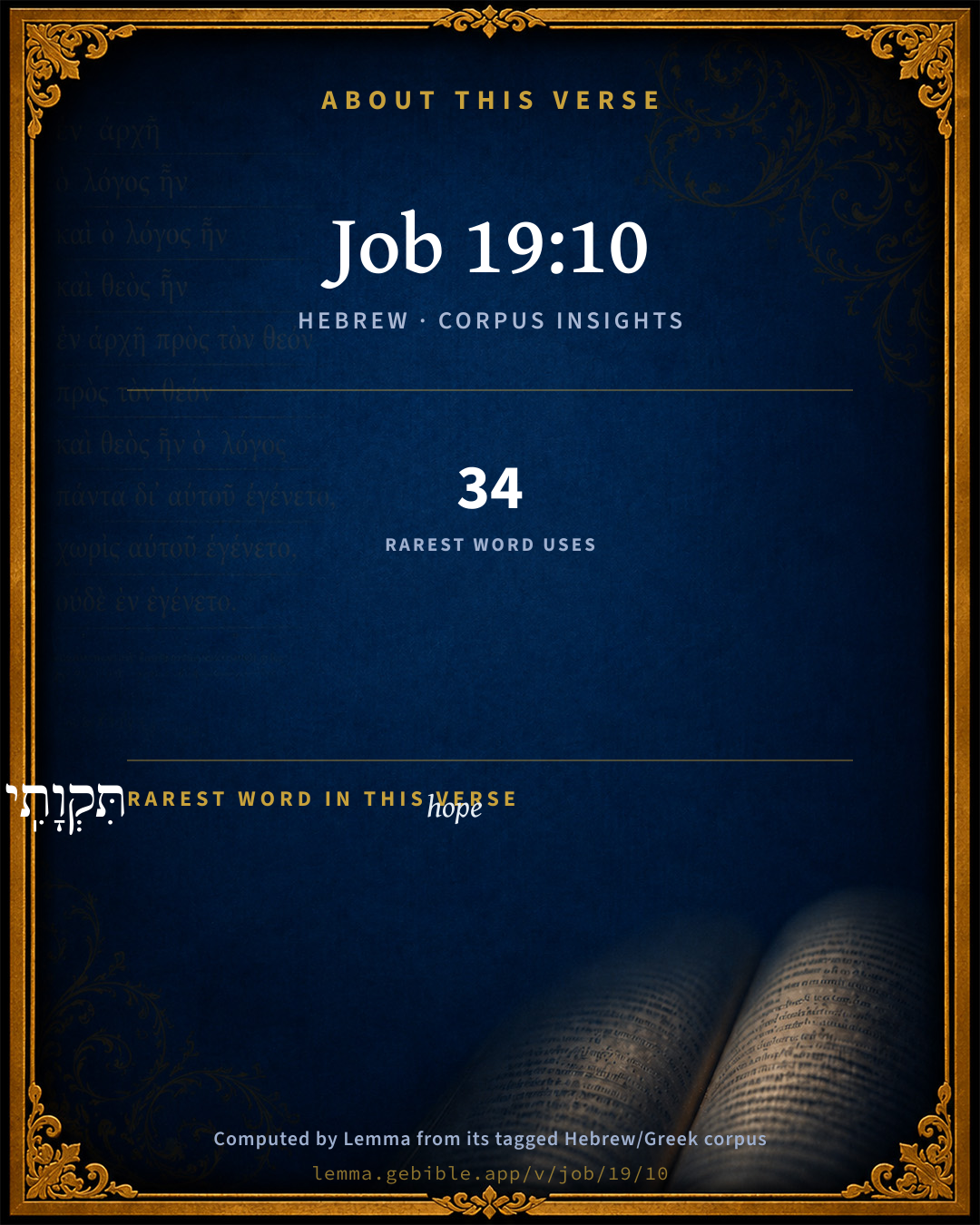
תִּקְוָתִֽי hope H8615 occurs in 33 verses of the Hebrew Bible. Also found in:

Grammatical profile

  • 3 verbs
  • 3 nouns

Verb forms

  • יִתְּצֵ֣נִי Qal · Imperfect
  • וָאֵלַ֑ךְ Qal · Sequential Imperfect
  • וַיַּסַּ֥ע Hiphil · Sequential Imperfect

Hebrew & Septuagint length

In English translation the verse runs 21 words from the Hebrew and 20 from the Septuagint (LXX English) — closely comparable.

A rough comparison of the two English renderings, which tokenize alike — not a word-level alignment.

Word counts can differ between the Hebrew and the Greek without any difference in meaning — e.g. the Hebrew direct-object marker אֵת has no separate Greek word, and Greek often adds the article ὁ.

Cross-references

14

Topical passages linked to Job 19:10 in the Treasury of Scripture Knowledge — connected by theme and wording, ordered by reader-vote popularity; previews shown in the World English Bible.

  • Job 24:20 The womb shall forget him. The worm shall feed sweetly on him. He shall be no more remembered. Unrighteousness shall be broken as a tree.
  • Psalms 37:35–36 I have seen the wicked in great power, Spreading himself like a green tree in its native soil.
  • Job 12:14 Behold, he breaks down, and it can't be built again; He imprisons a man, and there can be no release.
  • 2 Corinthians 4:8–9 We are pressed on every side, yet not crushed; perplexed, yet not to despair;
  • Job 1:13–19 It fell on a day when his sons and his daughters were eating and drinking wine in their eldest brother's house,
  • Job 2:7 So Satan went forth from the presence of Yahweh, and struck Job with painful sores from the sole of his foot to his head.
  • Job 6:11 What is my strength, that I should wait? What is my end, that I should be patient?
  • Job 7:6 My days are swifter than a weaver's shuttle, And are spent without hope.
  • Job 8:13–18 So are the paths of all who forget God. The hope of the godless man shall perish,
  • Job 17:11 My days are past, my plans are broken off, As are the thoughts of my heart.
  • Job 17:15 Where then is my hope? As for my hope, who shall see it?
  • Psalms 88:13–18 But to you, Yahweh, I have cried. In the morning, my prayer comes before you.
  • Psalms 102:11 My days are like a long shadow. I have withered like grass.
  • Lamentations 2:5–6 The Lord is become as an enemy, he has swallowed up Israel; He has swallowed up all her palaces, he has destroyed his strongholds; He has multiplied in the daughter of Judah mourning and lamentation.

Cross-references courtesy of OpenBible.info (CC BY 4.0).

Hebrew and Greek witnesses Masoretic Hebrew ↔ Greek Septuagint

The same verse in the two great witnesses to the Old Testament, shown verse-for-verse.

These are two independent witnesses, not word-aligned to each other, and the Septuagint is shown in lemma (dictionary) form.

Hebrew Job 19:10 Masoretic · Westminster Leningrad Codex

יִתְּצֵ֣נִי סָ֭בִיב וָאֵלַ֑ךְ וַיַּסַּ֥ע כָּ֝עֵ֗ץ תִּקְוָתִֽי

He has broken me down on every side, and I am gone. My hope he has plucked up like a tree.

World English Bible · Public Domain

Greek LXX Job 19:10 Septuagint · lemma form

διασπάω ἐγώ κύκλος καί οἴχομαι ἐκκόπτω δέ ὥσπερ δένδρον ὁ ἐλπίς ἐγώ

He has torn me around about, and I am gone: and he has cut off my hope like a tree.

LXX2012 (modern English Septuagint) · Public Domain

Hebrew: Westminster Leningrad Codex (CC BY 4.0). Greek: Septuagint (public domain); English from LXX2012 (modern English Septuagint) (Public Domain). How the Septuagint differs from the Hebrew →

Commentary

Notes on Job 19:10 from classic Christian and Jewish commentators (each source and its license shown beneath its notes). The classic Christian expositions comment on the surrounding passage and are grouped to its opening verse, so a note may address several verses; the Jewish commentaries on the Tanakh (Rashi and others) are per-verse, so they appear only where the commentator wrote on this verse.

Lemma curates 59 commentaries, every one of them public domain or Creative Commons licensed, each selected and text-cleaned for this edition rather than reprinted as found. About our sources →

Trapp's Complete Commentary

John Trapp

Job 19:10 He hath destroyed me on every side, and I am gone: and mine hope hath he removed like a tree.

Ver. 10. He hath destroyed me on every side] Heb. He hath demolished me, he hath pulled me down piece meal, as an old house is taken down part by part. See Lev 14:45 Jdg 8:17. God had made and fashioned Job’s body together round about, Job 10:8, and now he destroyeth it round about. The body of a man is a wonderful fabric, wherein the bones are the timber work, the head the upper lodging, the eyes as windows, the eyelids as casements, the brows as pent houses, the ears as watch towers, the mouth as a door to take in that which shall uphold the building, and keep it in repair; the stomach as a kitchen to dress that which is conveyed into it; the guts and baser parts as sinks belonging to the house, &c. All these were decaying apace in Job as he thought.

And I am gone] That is, I am as good as gone already; every day I yield somewhat unto death, I am free among the dead, free of that company.

And my hope hath he removed like a tree] He hath not left me so much as hope (which is the last comfort of the afflicted) of ever recovering here my health, wealth, and former enjoyments; but hath left me as a tree that is plucked up by the roots, and so can never grow again. A saint may be at that pass here in regard to his outward estate, that there may be to him neither hope for the better nor place for worse (Melch. Adam). This was Cranmer’s case.

John Trapp, A Commentary or Exposition upon All the Books of the Old and New Testament (1647–1656) — public domain. Text from a community e-Sword module.

Joseph Benson's Commentary

Job 19:10. He hath destroyed me on every side — In all respects, my person, and family, and estate. And I am gone — I am a lost and dead man. My hope hath he removed — All my hopes of the present life, but not of the life to come; like a tree — Which, being once plucked up by the roots, never grows again. Hope in this life is a perishing thing. But the hope of good men, when it is cut off from this world, is but removed like a tree, transplanted from this nursery to the garden of God.

Joseph Benson's Commentary on the Old and New Testaments (1811–1818) — public domain. Text from a community e-Sword module.

Geneva Bible (1599)

Geneva Bible translators

Which is plucked up, and hath no more hope to grow.

Geneva Bible (1599) marginal notes — public domain. Text via Bolls.life.

Jamieson, Fausset & Brown

Robert Jamieson, A. R. Fausset & David Brown

destroyed . . . on every side--"Shaken all round, so that I fall in the dust"; image from a tree uprooted by violent shaking from every side [UMBREIT]. The last clause accords with this (Jer 1:10)

mine hope--as to this life (in opposition to Zophar, Job 11:18); not as to the world to come (Job 19:25; Job 14:15).

removed--uprooted.

Jamieson, Fausset & Brown — Commentary Critical and Explanatory on the Whole Bible (1871) — public domain (CC PDM 1.0). Text via the HelloAO Bible API.

Adam Clarke's Commentary

Verse 10. Mine hope hath he removed like a tree.] There is no more hope of my restoration to affluence, authority, and respect, than there is that a tree shall grow and flourish, whose roots are extracted from the earth. I am pulled up by the roots, withered, and gone.

Adam Clarke's Commentary on the Bible (1810–1826) — public domain. Text from a community e-Sword/MySword module.

The Cambridge Bible for Schools and Colleges

gen. ed. J. J. S. Perowne

10. He hath destroyed] Rather, he breaketh me down; the figure of a building. In the second clause the image is that of a great tree torn up by the roots, whose fall is pitiful. The words, and I am gone, refer to his inevitable death from his disease, which he regards as already virtually come, as is expressed in the next clause—his hope (of life or recovery) is removed like a tree.

The Cambridge Bible for Schools and Colleges (gen. ed. J. J. S. Perowne; Cambridge University Press, 1878–1918) — public domain. Text from a community e-Sword module.

John Gill's Exposition

He hath also kindled his wrath against me,.... In this and some following verses the metaphor is taken from a state of warfare, in which enemies are engaged in an hostile way, Job 19:12; in which way Job apprehended God was come forth against him; he imagined that the wrath of God, which is comparable to fire for its force and fury, was kindled against him; that it began to appear, and was bursting out in a flame upon him, and all around him, to consume him; he thought his afflictions were in wrath, which is often the mistaken apprehension of good men, see Psa 38:1; and that the terrors of it were set in battle array against him, Job 6:4;

and he counted me unto him as one of his enemies; all men are by nature enemies to God, yea, enmity itself, and so are his own people while unregenerate, until the enmity of their hearts is slain, and they are reconciled to God by his spirit and grace; but as Job was truly a gracious man, and possessed of the fruits of the spirit, he must among the rest of his graces have the love of God in his heart; and he was sensible and conscious to himself that he was no enemy to God, and could appeal to him, as the searcher of hearts, that he knew he loved him; nay, he could not believe that God reckoned him his enemy, when he had given such a testimony of him, and of his fear of him, that there was none like him; and when Job so strongly trusted in him for salvation, and believed he should enjoy him for ever: but his sense is, that God treated him, by afflicting him in the manner he did, as if he was one of his enemies; had he really been one, he could not have used him, he thought, more roughly and severely; so that, judging according to the outward appearance of things, it might be concluded, as it seems it was by his friends, that he was a wicked man, an hypocrite, an enemy to God and godliness; but whereas Job thought that God dealt with him as with an enemy, he was mistaken; since when God afflicts his people, he deals with them as with sons, Heb 12:7.

John Gill's Exposition of the Whole Bible (1746–1763) — public domain (CC PDM 1.0). Text via the HelloAO Bible API.

Albert Barnes' Notes on the Bible

He hath destroyed me on every side - He has left me nothing. The word which is used here is that which is commonly applied to which is used here is that which is commonly applied to destroying cities, towns, and houses. “Rosenmuller.”

And I am gone - That is, I am near death. I cannot recover myself.

And mine hope hath he removed like a tree - A tree, which is plucked up by the roots, and which does not grow again. That is, his hopes of life and happiness, of an honored old age, and of a continuance of his prosperity, had been wholly destroyed. This does not refer to his “religious” hope - as the word hope is often used now - but to his desire of future comfort and prosperity in this life. It does not appear but that his religious hope, arising from confidence in God, remainned unaffected.

Albert Barnes' Notes on the Bible (1834–1885) — public domain. Text from a community e-Sword/MySword module.

Matthew Poole's English Annotations

On every side, i.e. in all respects, and to all intents and purposes; my person, and family, and estate.

I am gone, i.e. I am a lost and dead man. Going is oft put for dying, as Gen 15:2; Psa 39:13.

Mine hope, i.e. all my hopes of the present life, as he oft expresseth it; but not of the life to come, as appears from Job 13:15,16; 19:25, &c.

Like a tree; which being once plucked up by the roots, never groweth again.

Matthew Poole's English Annotations on the Holy Bible (1683–1685) — public domain. Text from a community e-Sword/MySword module.

Whedon's Commentary on the Bible

Daniel D. Whedon

10. Destroyed — נתצ, a word in common use for the pulling down of buildings.

Removed — Uprooted. By these figures Job expresses complete destruction.

Daniel D. Whedon (gen. ed.), Commentary on the Old and New Testaments (1874–1909) — public domain. Text from a community e-Sword module.

The Pulpit Commentary

He hath destroyed me on every side, and I am gone; or, broken me down. Job compares himself to a city, the walls of which are attacked on every side and broken down. His ruin is complete he perishes. And mine hope hath he removed like a tree; rather, torn up like a tree. Job"s "hope" was, no doubt, to lead a tranquil and a godly life, surrounded by his relatives and friends, in favour with God and man, till old age came, and he descended, like a ripe shock of corn, (Job_5:26) to the grave. This hope had been "torn up by the roots" when his calamities fell upon him.

The Pulpit Commentary (1880–1919), ed. H.D.M. Spence-Jones & Joseph S. Exell — public domain. Text from a community e-Sword module.

John Wesley's Explanatory Notes

Every side - In all respects, my person, and family, and estate. Gone - I am a lost and dead man. Hope - All my hopes of the present life, but not of the life to come. Tree - Which being once plucked up by the roots, never grows again. Hope in this life is a perishing thing. But the hope of good men, when it is cut off from this world, is but removed like a tree, transplanted from this nursery to the garden of God.

John Wesley, Explanatory Notes Upon the Whole Bible (1754–1765) — public domain. Text via the GEBible commentary corpus.

unfoldingWord translationNotes

Door43 World Missions Community

General Information:

Job continues to speak to his three friends.

He has broken me down on every side

Job speaks of God ruining him as if Job were building that God is smashing down. AT: "He has ruined me in every way" or "He has attacked me in every way" (See: Metaphor)

I am gone

The metaphor "being gone" represents being completely destroyed. AT: "I am completely destroyed" (See: Metaphor)

he has pulled up my hope like a tree

Job speaks of God causing Job not to have hope as if Job's hope were a tree that God has pulled with its roots out of the ground. AT: "he has completely taken away all my hope" or "because of what he has done, I can no longer hope for anything good" (See: Simile)

like a tree

This simile is also an ellipsis. You may need to supply the omitted words. AT: "the way a man pulls a tree up by its roots" (See: Simile and Ellipsis)

He has also kindled his wrath against me

Job speaks of God's wrath as if it were a fire. AT: "God has also lit a fire of anger against me" or "God has also become very angry with me" (See: Metaphor)

he regards me as one of his adversaries

"he thinks of me as an enemy"

His troops come on together

Job speaks of God attacking him as if Job was a city and God was sending an army to attack it. AT: "God sends his army to attack me" (See: Metaphor)

they cast up siege mounds against me

Job speaks of God attacking him as if Job was a city and God's army was piling up dirt against the city wall in order to climb over the wall and attack the city. AT: "the soldiers pile up dirt in order to climb over my wall" (See: Metaphor)

encamp around my tent

Job speaks of God attacking him as if Job was in his tent and God's army was camping around him and preparing to attack him. AT: "they camp around my tent and prepare to attack me" (See: Metaphor)

translationWords

hope

wrath

adversary

siege

tent

unfoldingWord translationNotes — © Distant Shores Media and the Door43 World Missions Community, licensed CC BY-SA 4.0. Source: git.door43.org/Door43/en_tn.

Rashi

Rabbi Shlomo Yitzchaki (Rashi)

he has uprooted Heb. ויסע, an expression of uprooting.

Rashi on the Tanakh — English translations: “The Judaica Press complete Tanach with Rashi, translated by A. J. Rosenberg” (CC BY 4.0); “Pentateuch with Rashi's commentary by M. Rosenbaum and A.M. Silbermann, 1929-1934” (public domain); “The Metsudah Tanach series, Lakewood, N.J” (CC BY 4.0); and “The Book of Joshua, Metsudah Publications, 1997” (CC BY 4.0). Text via Sefaria.

Lesson kit

Teaching starters — assembled from the data on this page, not authored interpretation. Every prompt links to the verse data it draws on. Edit before teaching.

Job, in the Wisdom, opens this verse with 6 words (6 distinct Hebrew lemmas). Its most distinctive word is tiqvâh (“hope”). A historical commentator’s framing appears above. Read the whole chapter for the surrounding context.

Discussion questions

  1. What does “hope” (tiqvâh) contribute to the verse as a whole?
  2. Joshua 2:18 shares the word «hope» with this verse. How do the two illuminate each other?
  3. These translations render this verse differently. What is at stake in choosing one wording over another?
  4. The verb «יִתְּצֵ֣נִי» is Qal Imperfect. How does its form color the action?
  5. Reading how Trapp's Complete Commentary and Joseph Benson's Commentary read this verse, where do the two commentators agree and where do they part?

Things to notice

Reading settings

Reading text

Shown beneath each verse's original-language words.

Old Testament
Old Testament edition

Read the OT as the Masoretic Hebrew (MT) or the Greek Septuagint (LXX).

English shown for the Greek Septuagint (in the Hebrew ↔ Greek comparison).

Comparing translations? Open the Compare panel on any verse page to stack up to four side by side.