
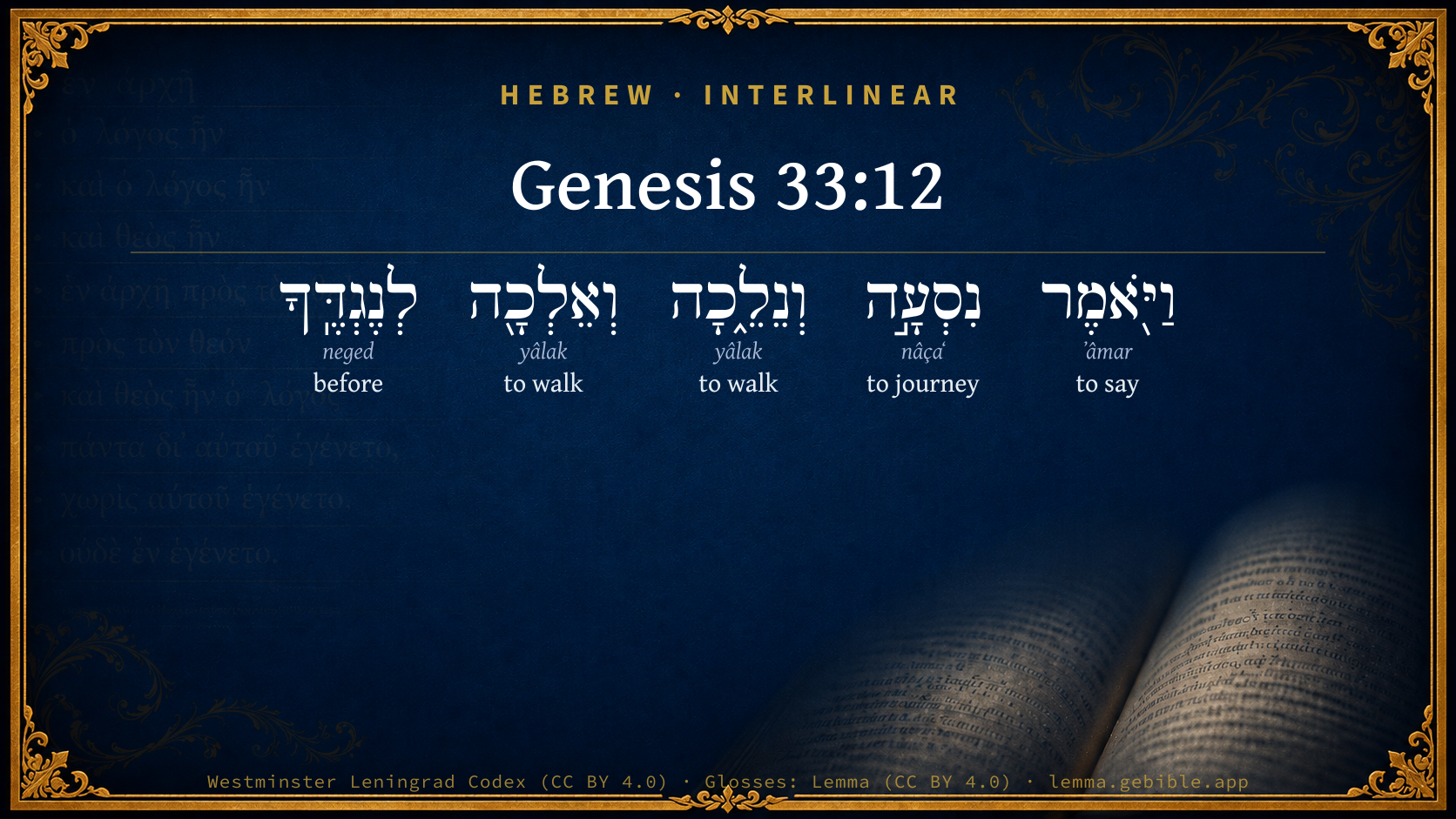
Genesis 33:12

Hebrew (Westminster Leningrad Codex) Genesis 33:12 appears in the Hebrew Old Testament. The text above is from the Westminster Leningrad Codex. Each word links to its Strong’s number, a concise gloss, and parsing drawn from the Open Scriptures Hebrew Bible morphology. Click any word for its full Brown-Driver-Briggs (BDB) entry.
Download image
Cite this verse

Genesis 33:12 (World English Bible). Public Domain. Lemma interlinear Bible study tool, https://lemma.gebible.app/v/genesis/33/12.

Show BibTeX & RIS
BibTeX
RIS
English Translation
Esau said, "Let us take our journey, and let us go, and I will go before you."
World English Bible · Public Domain
Download a study sheet

One document with this verse’s original text, its word-by-word gloss line, the meaning frame, cross-references with their text, attributed commentary, and full source and license credits — printable, and it pastes into notes with its structure intact.

This verse Autodidact and up

Study sheet (.html) Plain text (.txt)

A passage Seminary Student

Up to 50 verses in one chapter. A passage sheet keeps up to 6 commentary sources and 12 cross-references per verse, in the order this page ranks them, and says so on the sheet whenever that leaves anything out. Ask for a single verse and you get the Autodidact verse sheet above.

Everything on this page stays free to read, with no account — the sheet is a download of what is already on screen, not access to it.

Want to remove ads? Support Godless Engineer
Compare translations 3

The same verse in 3 English versions, stacked beneath the original-language interlinear above. Click any original word for its lexicon entry.

Each is an independent rendering of the whole verse — the interlinear is not word-aligned to these translations.

Highlighted words mark where these versions differ — a whole-verse word diff, not a word-by-word alignment.

  • World English Bible Public Domain
    Esau said, "Let us take our journey, and let us go, and I will go before you."
  • King James Version Public Domain
    And he said, Let us take our journey, and let us go, and I will go before thee.
  • unfoldingWord Literal Text CC BY-SA 4.0
    Then he said, “Let’s travel and go, and I will go in front of you.”

unfoldingWord Literal Text — © unfoldingWord, licensed CC BY-SA 4.0. Word-aligned USFM3 via Door43 (git.door43.org/unfoldingWord/en_ult).

Versions to compare (up to 4)

3 of 4 selected

Show all 18 translations

Every available English version of this verse, each an independent rendering of the whole verse.

  • World English Bible Public Domain
    Esau said, "Let us take our journey, and let us go, and I will go before you."
  • Berean Standard Bible Public Domain
    Then Esau said, “Let us be on our way, and I will go ahead of you.”
  • Majority Standard Bible Public Domain
    Then Esau said, “Let us be on our way, and I will go ahead of you.”
  • King James Version Public Domain
    And he said, Let us take our journey, and let us go, and I will go before thee.
  • American Standard Version (1901) Public Domain
    And he said, Let us take our journey, and let us go, and I will go before thee.
  • Revised Version (1885) Public Domain
    And he said, Let us take our journey, and let us go, and I will go before thee.
  • Geneva Bible (1599) Public Domain
    And he saide, Let vs take our iourney and go, and I will goe before thee.
  • Douay-Rheims (1899) Public Domain
    And said: Let us go on together, and I will accompany thee in thy journey.
  • Young's Literal Translation Public Domain
    and saith, `Let us journey and go on, and I go on before thee.'
  • Literal Standard Version CC BY-SA 4.0
    and says, “Let us journey and go on, and I go on before you.”
  • Unlocked Literal Bible CC BY-SA 4.0
    Then Esau said, “Let us be on our way. I will go before you.”
  • unfoldingWord Literal Text CC BY-SA 4.0
    Then he said, “Let’s travel and go, and I will go in front of you.”
  • Darby Bible Public Domain
    And he said, Let us take our journey, and go on, and I will go before thee.
  • World Messianic Bible Public Domain
    Esau said, “Let’s take our journey, and let’s go, and I will go before you.”
  • Webster's Bible Public Domain
    And he said, Let us take our journey, and let us go, and I will go before thee.
  • Free Bible Version CC BY-SA 4.0
    “Let's get on our way,” Esau said. “I'll go ahead of you.”
  • Bible in Basic English Public Domain
    And he said, Let us go on our journey together, and I will go in front.
  • JPS Tanakh (1917) Public Domain
    And he said: 'Let us take our journey, and let us go, and I will go before thee.'

Literal Standard Version (2020), Covenant Press — licensed CC BY-SA 4.0. Text via the HelloAO Bible API (eBible.org). Unlocked Literal Bible (unfoldingWord) — licensed CC BY-SA 4.0. Text via the HelloAO Bible API (eBible.org). unfoldingWord Literal Text — © unfoldingWord, licensed CC BY-SA 4.0. Word-aligned USFM3 via Door43 (git.door43.org/unfoldingWord/en_ult). Free Bible Version, Dr. Jonathan Gallagher — licensed CC BY-SA 4.0. Text via the HelloAO Bible API (eBible.org).

Word by word

More ways to search: Search by grammar → Find every occurrence → Compare this word →

Practice this passage: Drill this verse → Learn its vocabulary →

About this verse

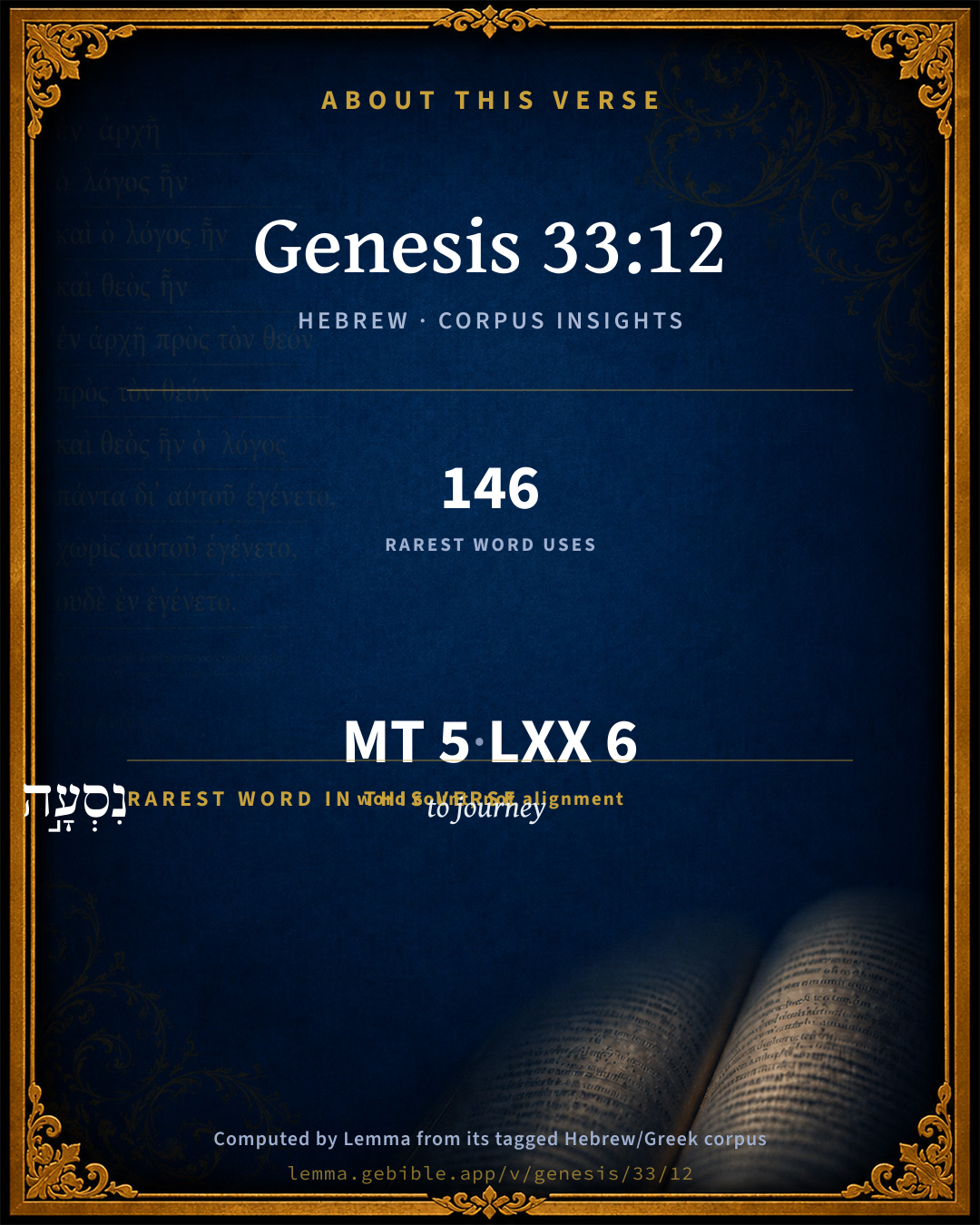
These counts appear in no published source. They are computed here, from the morphology-tagged text and Lemma’s own curated glosses. What Lemma adds →

5
words
4
distinct lemmas
Pentateuch
section

Grammatical profile

  • 4 verbs
  • 1 preposition

Verb forms

  • וַיֹּ֖אמֶר Qal · Sequential Imperfect
  • נִסְעָ֣ה Qal · Cohortative
  • וְנֵלֵ֑כָה Qal · Cohortative
  • וְאֵלְכָ֖ה Qal · Imperfect

Repetition

A word recurs within this verse — often emphatic in Hebrew:

  • וְנֵלֵ֑כָה to walk H3212 ×2

Hebrew & Septuagint length

In English translation the verse runs 17 words from the Hebrew and 10 from the Septuagint (LXX English) — the Septuagint runs noticeably shorter here. See the side-by-side →

A rough comparison of the two English renderings, which tokenize alike — not a word-level alignment.

Word counts can differ between the Hebrew and the Greek without any difference in meaning — e.g. the Hebrew direct-object marker אֵת has no separate Greek word, and Greek often adds the article ὁ.

In the original languages it is 5 Hebrew tokens and 6 Greek tokens — but the two are counted differently (Hebrew bundles its prefixes and suffixes into one token; the Greek is in lemma form), so that isn’t a like-for-like length.

Hebrew and Greek witnesses Masoretic Hebrew ↔ Greek Septuagint

The same verse in the two great witnesses to the Old Testament, shown verse-for-verse.

Here the Septuagint runs noticeably shorter than the Hebrew — LXX2012 (modern English Septuagint) 10 words vs World English Bible 17. A rough length comparison of the two English translations, not a word-level alignment — read both below.

These are two independent witnesses, not word-aligned to each other, and the Septuagint is shown in lemma (dictionary) form.

Hebrew Genesis 33:12 Masoretic · Westminster Leningrad Codex

וַיֹּ֖אמֶר נִסְעָ֣ה וְנֵלֵ֑כָה וְאֵלְכָ֖ה לְנֶגְדֶּֽךָ

Esau said, "Let us take our journey, and let us go, and I will go before you."

World English Bible · Public Domain

Greek LXX Genesis 33:12 Septuagint · lemma form

καί εἶπον ἀποαἴρω πορεύομαι ἐπί εὐθύς

And he said, Let us depart, and proceed right onward.

LXX2012 (modern English Septuagint) · Public Domain

Hebrew: Westminster Leningrad Codex (CC BY 4.0). Greek: Septuagint (public domain); English from LXX2012 (modern English Septuagint) (Public Domain). How the Septuagint differs from the Hebrew →

Targum (Aramaic paraphrase)

2

The Targum is the ancient Jewish Aramaic paraphrase of the Hebrew Scriptures — an interpretive translation, not the Hebrew text itself. Onkelos (literal) and Pseudo-Jonathan (expansive) render the Torah, and Jonathan the Prophets. Coverage is partial: where no permissively-licensed English translation exists for a verse, only the Aramaic is shown. This is verse-level text, not a word-by-word alignment to the Hebrew.

  1. Targum Onkelos Torah (Genesis–Deuteronomy)
    וַאֲמַר נִטַל וְנֵהָךְ וְאֵיהַךְ לְקָבְלָךְ

    (no public-domain English translation for this verse)

    Targum Onkelos — Aramaic: “Onkelos Genesis” (public domain); “Onkelos Exodus” (public domain); “Onkelos Leviticus” (public domain); “Onkelos Numbers” (public domain); “Onkelos Deuteronomy” (public domain). English: “Sefaria Community Translation” (CC0 1.0 (public-domain dedication)); “J.W. Etheridge. The Targums of Onkelos and Jonathan Ben Uzziel on the Pentateuch. London: Longmans, Green, 1862” (public domain). Text via Sefaria.

  2. Targum Pseudo-Jonathan Torah (Genesis–Deuteronomy)
    וַאֲמַר נְטַיֵיל וּנְהַךְ וְאָזִיל לְקִבְלָךְ עַד דְתִמְטֵי לְבֵי מְשׁוּרַיִיךְ

    And he said, Let us journey and proceed, and I will go along with thee, till thou come to the house of thy habitation.

    Targum Pseudo-Jonathan — Aramaic: “Targum Jonathan on Genesis” (public domain); “Targum Jonathan on Exodus” (public domain); “Targum Jonathan on Leviticus” (public domain); “Targum Jonathan on Numbers” (public domain); “Targum Jonathan on Deuteronomy” (public domain). English: “The Targum of Jonathan ben Uzziel, trans. J. W. Etheridge, London, 1862” (public domain). Text via Sefaria.

Commentary

Notes on Genesis 33:12 from classic Christian and Jewish commentators (each source and its license shown beneath its notes). The classic Christian expositions comment on the surrounding passage and are grouped to its opening verse, so a note may address several verses; the Jewish commentaries on the Tanakh (Rashi and others) are per-verse, so they appear only where the commentator wrote on this verse.

Lemma curates 59 commentaries, every one of them public domain or Creative Commons licensed, each selected and text-cleaned for this edition rather than reprinted as found. About our sources →

Jamieson, Fausset & Brown

Robert Jamieson, A. R. Fausset & David Brown

THE PARTING. (Gen 33:12-20)

And he said, Let us take our journey--Esau proposed to accompany Jacob and his family through the country, both as a mark of friendship and as an escort to guard them. But the proposal was prudently declined. Jacob did not need any worldly state or equipage. Notwithstanding the present cordiality, the brothers were so different in spirit, character, and habits--the one so much a man of the world, and the other a man of God, that there was great risk of something occurring to disturb the harmony. Jacob having alleged a very reasonable excuse for the tardiness of his movements, the brothers parted in peace.

Jamieson, Fausset & Brown — Commentary Critical and Explanatory on the Whole Bible (1871) — public domain (CC PDM 1.0). Text via the HelloAO Bible API.

Trapp's Complete Commentary

John Trapp

Gen 33:12 And he said, Let us take our journey, and let us go, and I will go before thee.

Ver. 12. Let us take our journey.] The Hebrews note, that Esau speaks in few, Jacob more fully: because it is the guise of proud stately persons to speak briefly, and hardly to bring forth half their words. "The poor speaketh supplications," saith Solomon; "but the rich answereth roughly". {Pro 18:23}

John Trapp, A Commentary or Exposition upon All the Books of the Old and New Testament (1647–1656) — public domain. Text from a community e-Sword module.

Joseph Benson's Commentary

Gen 33:12. Let us go, I will go before thee — He offers himself to be Jacob’s guide and companion, in token of a sincere reconciliation. We do not find that Jacob and Esau were ever before so loving with one another as they were now. God had made Esau, not only not an enemy, but a friend. He is become fond of Jacob’s company, and invites him to go along with him to mount Seir. Let us never despair of any, nor distrust God, in whose hands all hearts are.

Joseph Benson's Commentary on the Old and New Testaments (1811–1818) — public domain. Text from a community e-Sword module.

Tyndale Open Study Notes

Tyndale Open Resources

33:12-15 Despite Esau’s apparent magnanimity, Jacob was wary and cleverly avoided traveling with his brother. • I will meet you at Seir: Jacob’s lie manifests his old character, living by deception rather than by faith.

Tyndale Open Study Notes — © Tyndale Open Resources, licensed CC BY-SA 4.0. Text via the HelloAO Bible API.

John Calvin's Commentaries

12. Let us take our journey. Although Esau was inclined to benevolence, Jacob still distrusts him: not that he fears to be ensnared, or that he suspects perfidy to lie hidden under the garb of friendship; but that he cautiously avoids new occasions of offense: for a proud and ferocious man might easily be exasperated again by light causes. Now, though just reason for fear was not wanting to the holy man, yet I dare not deny that his anxiety was excessive. He suspected the liberality of Esau; but did he not know that a God was standing between them, who, as he was convinced by clear and undoubted experience, watched for his salvation? For, whence such an incredible change of mind in Esau, unless he had been divinely transformed from a wolf into a lamb? Let us then learn, from this example, to restrain our anxieties, lest when God has provided for us, we tremble, as in an affair of doubt.

John Calvin's Commentaries (1540-1563) — public domain. Text from the Calvin Translation Society English edition (1840s-50s) via the Christian Classics Ethereal Library (ccel.org). Calvin's coverage is partial (roughly two-thirds of the Bible); uncommented books and verses are honest gaps, never fabricated. The 19th-century editor's footnotes and remarks are omitted so the notes are faithfully Calvin's own voice.

The Cambridge Bible for Schools and Colleges

gen. ed. J. J. S. Perowne

12. And he said] Esau speaks. He assumes that Jacob will be glad to receive the protection of his armed men. Jacob declines, not wishing to incur the risk of friction arising from a collision between two large companies; and will not accept a kindness which might compromise his independence. It was wiser to separate, while they were still amicable. The natures remain the same; Esau’s thoughtless, Jacob’s calculating.

The Cambridge Bible for Schools and Colleges (gen. ed. J. J. S. Perowne; Cambridge University Press, 1878–1918) — public domain. Text from a community e-Sword module.

John Gill's Exposition

And he said, let us take our journey, and let us go,.... To Seir, where Esau lived, and whither he invited Jacob to stop a while, and refresh himself and his family:

and I will go before thee; to show him the way to his palace, and to protect him on the road from all dangers; or "besides thee" (q), alongside of him, keeping equal pace with him, thereby showing great honour and respect, as well as in order to converse with him as they, travelled.

(q) "e regione tui", Montanus, Fagius, Drusius; "a latere tuo", Vatablus; "juxta te", Cartwright.

John Gill's Exposition of the Whole Bible (1746–1763) — public domain (CC PDM 1.0). Text via the HelloAO Bible API.

Matthew Poole's English Annotations

Or rather, beside thee, so as to keep thee company, or to keep pace with thee.

Matthew Poole's English Annotations on the Holy Bible (1683–1685) — public domain. Text from a community e-Sword/MySword module.

The Pulpit Commentary

And he (i.e. Esau) said (in further token of his amity), Let us take our journey, and let us go, but whether he intended to accompany Jacob on his way (Keil, Kalisch, et alii) or invited Jacob to go with him to Mount Seir (Ainsworth, Clericus) is uncertain. On the first hypothesis it is difficult to explain how Esau came to be traveling in the same direction as his brother, while the adoption of the second will serve in some measure to elucidate Jacob"s language in ver. 2. But whichever way the words of Esau are understood, they amounted to an offer to be an escort to Jacob through the desert regions with which his excursions had made him familiar, since he added, and I will go before theei.e. to lead the way.

HOMILIES BY J.F. MONTGOMERY Ver. 12.

Worldly companionship.

he said, Let us take our journey, and let us go, and I will go before thee." The offer probably made with kindly intention. No sign of bitterness in Esau"s feelings; but ignorance of the necessities of Jacob"s march. Jacob knew it was not possible with safety (cf. Psa_137:4; 1Pe_4:4) Reminds us of the attitude of many worldly persons towards Christians. "The carnal mind is enmity against God." Yet worldly men may have sincere regard for Christian men; bear unconscious testimony to excellence of Christianity. And here a danger to Christians. Let us journey together. I like you; you are unselfish, trustworthy. And why not? Because in journeying with Esau he must be leader, or he would cease to be Esau. The world"s good-will does not mean a changed heart. Without any pronounced dislike to higher aims, it shares them not, and knows not anything more real than earth. There is a journey we all take in company: in the thousand ways in which men are dependent on each other; in the courtesies and good offices of life; in what belongs to our position as citizens or family men. But in what constitutes the road of life its stamp and direction, its motives and aims no union. We have another Leader. (Heb_12:2) The pillar of fire led Israelites not according to Roman judgment.

I THIS DOES NOT IMPLY KEEPING ALOOF FROM MEN, OR FROM HUMAN INTERESTS. We are called to be the salt of the earth. It is an error to shrink from contact with the world as dangerous to us. This of old led to monasticism. But there may be a spiritual solitude even when living in the throng of a city. In secular matters refusing to take an interest in what occupies others, (cf. Luk_6:31) as if God had nothing to do with these; or in spiritual things avoiding Christian intercourse with those who do not in all points agree with us; or being engrossed with our own spiritual welfare, and turning away from all concern for the welfare of others (cf. 1Co_9:20-22)

II IT DOES IMPLY A REAL CONSCIOUSNESS OF BEING REDEEMED, set free, bought with a price; OF HAYING A DEFINITE WORK TO DO FOR GOD, WITH WHICH NOTHING MUST INTERFERE; a real way to walk in, from which nothing must make us turn aside. And in order to this, watchfulness over self, that in seeking to help others we ourselves are not ensnared.

III SOME WAYS IN WHICH THE WORLD IN ITS FRIENDSHIP TEMPTS CHRISTIANS.

1. By the plea, there is no harm in this or that. We must not think that all actions can be brought to an absolute standard of fight and wrong. This is the spirit of legality, the spirit of bondage, and leads to partial service instead of entire dedication (cf. Luk_15:29) Loyalty to Christ must direct the Christian"s life; desire not merely to avoid direct disobedience, but to use our time and powers for him who loved us and gave himself for us.

2. By the display of good feelings as the equivalent of Christian graces. Esau"s kindliness and frankness are very attractive. Yet he was a "profane person;" not because of his anger or any sinful act, but because he thought little of God"s blessing.

3. By making Christians familiar with worldly aims and maxims, and thus insensibly blunting their spiritual aspirations. The way of safety is through prayer for the Holy Spirit"s help, to maintain the consciousness of Christ"s presence. M.

The Pulpit Commentary (1880–1919), ed. H.D.M. Spence-Jones & Joseph S. Exell — public domain. Text from a community e-Sword module.

John Wesley's Explanatory Notes

Esau offers himself to be his guide and companion, in token of sincere reconciliation. We never find that Jacob and Esau were so loving with one another as they were now. God made Esau not only not an enemy, but a friend. Esau is become fond of Jacob's company, courts him to mount Seir: let us never despair of any, nor distrust God, in whose hands all hearts are. Yet Jacob saw cause modestly to refute this offer, wherein he shews a tender concern for his own family and flocks, like a good shepherd and a good father. He must consider the children, and the flocks with young, and not lead the one or drive the other too fast. Jacob intimates to him, that it was his design to come to him to mount Seir; and we may presume he did so, after he had settled his concerns elsewhere, though that visit be not recorded.

John Wesley, Explanatory Notes Upon the Whole Bible (1754–1765) — public domain. Text via the GEBible commentary corpus.

Keil & Delitzsch

C. F. Keil & F. Delitzsch

Lastly, Esau proposed to accompany Jacob on his journey. But Jacob politely declined not only his own company, but also the escort, which Esau afterwards offered him, of a portion of his attendants; the latter as being unnecessary, the former as likely to be injurious to his flocks. This did not spring from any feeling of distrust; and the ground assigned was no mere pretext. He needed no military guard, "for he knew that he was defended by the hosts of God;" and the reason given was a very good one: "My lord knoweth that the children are tender, and the flocks and herds that are milking (עלות from עוּל, giving milk or suckling) are upon me" (עלי): i.e., because they are giving milk they are an object of especial anxiety to me; "and if one should overdrive them a single day, all the sheep would die." A caravan, with delicate children and cattle that required care, could not possibly keep pace with Esau and his horsemen, without taking harm. And Jacob could not expect his brother to accommodate himself to the rate at which he was travelling. For this reason he wished Esau to go on first; and he would drive gently behind, "according to the foot of the cattle (מלאכה possessions = cattle), and according to the foot of the children," i.e., "according to the pace at which the cattle and the children could go" (Luther). "Till I come to my lord to Seir:" these words are not to be understood as meaning that he intended to go direct to Seir; consequently they were not a wilful deception for the purpose of getting rid of Esau. Jacob's destination was Canaan, and in Canaan probably Hebron, where his father Isaac still lived. From thence he may have thought of paying a visit to Esau in Seir. Whether he carried out this intention or not, we cannot tell; for we have not a record of all that Jacob did, but only of the principal events of his life. We afterwards find them both meeting together as friends at their father's funeral (Gen 35:29). Again, the attitude of inferiority which Jacob assumed in his conversation with Esau, addressing him as lord, and speaking of himself as servant, was simply an act of courtesy suited to the circumstances, in which he paid to Esau the respect due to the head of a powerful band; since he could not conscientiously have maintained the attitude of a brother, when inwardly and spiritually, in spite of Esau's friendly meeting, they were so completely separated the one from the other.

Keil & Delitzsch — Biblical Commentary on the Old Testament (1861–1891) — public domain (CC PDM 1.0). Text via the HelloAO Bible API. (Old Testament only.)

unfoldingWord translationNotes

Door43 World Missions Community

My master knows

This is a polite and formal way of referring to Esau. AT: "You, my master, know" (See: First, Second, or Third Person)

the children are young

The meaning can be stated more explicitly. AT: "the children are too young to travel fast" (See: Assumed Knowledge and Implicit Information)

If they are driven hard even one day

This can be stated in active form. AT: "If we force them to go too fast even for one day" (See: Active or Passive)

Please let my master go on ahead of his servant

This is a polite and formal way of Jacob referring to himself. AT: "My lord, I am your servant. Please go ahead of me" (See: First, Second, or Third Person)

at the pace of the livestock that are before me

"at the speed the animals I am looking after can go"

Seir

This is a mountainous area in the region of Edom. See how you translated this in Genesis 32:3. (See: How to Translate Names)

translationWords

lord

flocks

servant

livestock

unfoldingWord translationNotes — © Distant Shores Media and the Door43 World Missions Community, licensed CC BY-SA 4.0. Source: git.door43.org/Door43/en_tn.

Rashi

Rabbi Shlomo Yitzchaki (Rashi)

נסעה is an imperative like שִׁמְעָה and שִׁלָחָה which are equivalent to שְׁמַע "hearken!” and שְׁלֵח “send!” Similarly here, נִסְעָה is equivalent to נְסַע “travel on!”, where the נ is a root-letter of the word and not the prefix of the future in which case the word would mean “let us travel on”, similar to the following word ונלכה “and let us go”. The Targum also takes it in this sense, rendering it: “Travel on and let us go". Thus Esau said to Jacob, “Travel thou on from here and let us go etc.

ואלכה לננדך means AND I WILL GO SIDE BY SIDE WITH THEE — I will do you this favour: that I will take a longer time on my journey by going slowly as is necessary for you. This is the meaning of לנגדך — alongside of you.

Rashi on the Tanakh — English translations: “The Judaica Press complete Tanach with Rashi, translated by A. J. Rosenberg” (CC BY 4.0); “Pentateuch with Rashi's commentary by M. Rosenbaum and A.M. Silbermann, 1929-1934” (public domain); “The Metsudah Tanach series, Lakewood, N.J” (CC BY 4.0); and “The Book of Joshua, Metsudah Publications, 1997” (CC BY 4.0). Text via Sefaria.

Radak

Rabbi David Kimhi (Radak)

ויאמר נסעה, it is possible that Esau’s “suggestion” was in the nature of a command. He was conscious that Yaakov’s progress would be slow due to the animals as well as the children some of whom were of tender age.

ואלכה לנגדך, I will go faster but will remain close by, נגדך,. Alternately, the word נסעה is suggestion in the plural mode, Esau suggesting that they proceed side by side.

Radak on the Tanakh — English translations: “Sefaria Community Translation” (CC0 1.0 (public-domain dedication)); “Eliyahu Munk, HaChut Hameshulash” (CC BY 4.0); “Rabbi Mike Feuer, Jerusalem Anthology” (CC BY 4.0); and “R. David Kimhi on the first book of Psalms, Translated by R.G. Finch, London, 1919” (public domain). Text via Sefaria.

Lesson kit

Teaching starters — assembled from the data on this page, not authored interpretation. Every prompt links to the verse data it draws on. Edit before teaching.

Genesis, in the Pentateuch, opens this verse with 5 words (4 distinct Hebrew lemmas). Its most distinctive word is nâçaʻ (“to journey”). The Greek Septuagint runs shorter here. A historical commentator’s framing appears above. Read the whole chapter for the surrounding context.

Discussion questions

  1. What does “to journey” (nâçaʻ) contribute to the verse as a whole?
  2. What does the repetition of “to walk” (2× in this one verse) do in this verse?
  3. The Septuagint runs shorter here than the Hebrew. What might account for the difference?
  4. These translations render this verse differently; the difference is in the English rendering, not the original. What questions does that raise?
  5. «וַיֹּ֖אמֶר» is a Qal Sequential Imperfect verb. How does that grammatical form shape the action described?
  6. Compare how Jamieson, Fausset & Brown and Trapp's Complete Commentary read this verse. Where do they agree or differ?

Things to notice

Reading settings

Reading text

Shown beneath each verse's original-language words.

Old Testament
Old Testament edition

Read the OT as the Masoretic Hebrew (MT) or the Greek Septuagint (LXX).

English shown for the Greek Septuagint (in the Hebrew ↔ Greek comparison).

Comparing translations? Open the Compare panel on any verse page to stack up to four side by side.