
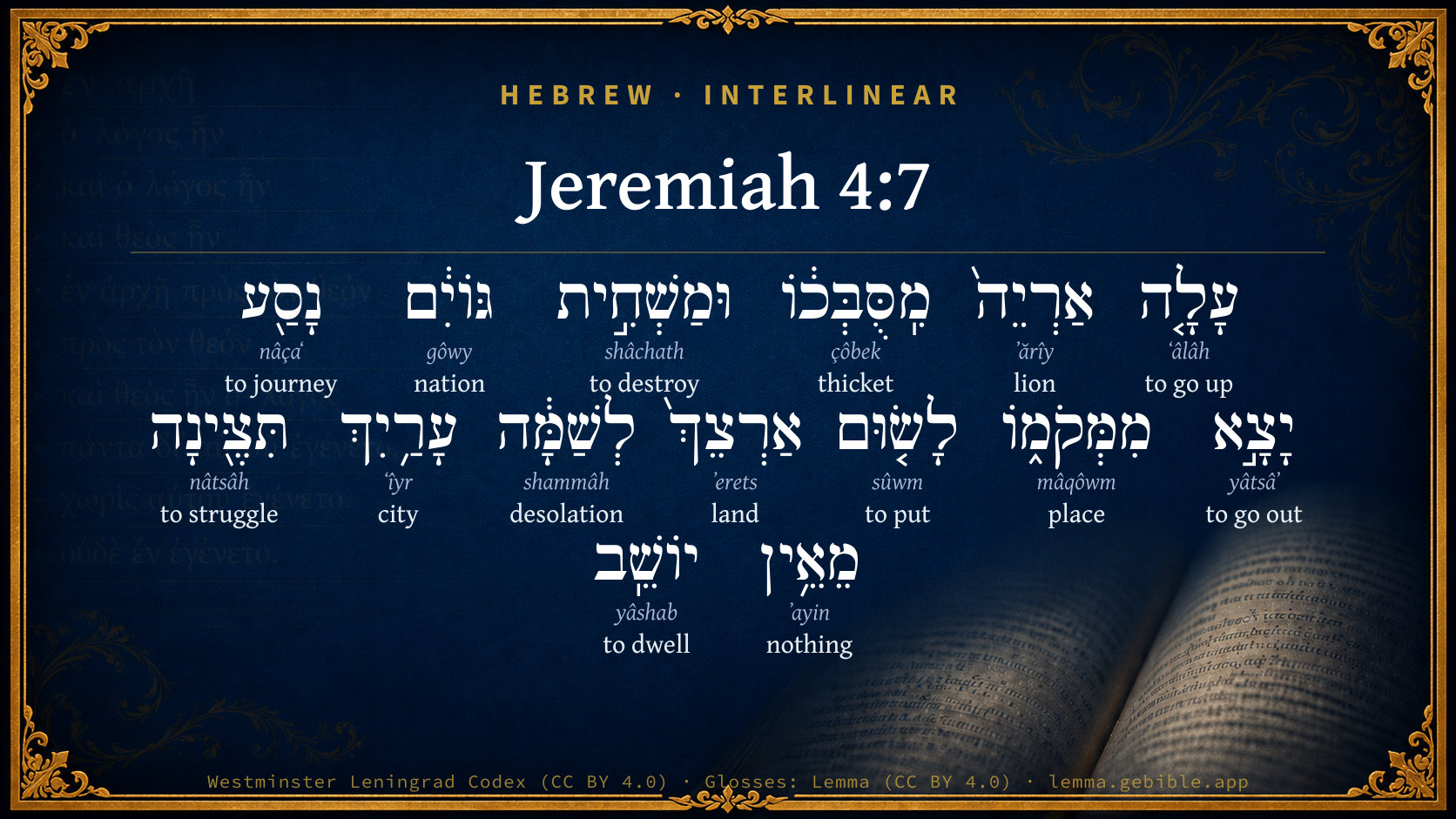
Jeremiah 4:7

Hebrew (Westminster Leningrad Codex) Jeremiah 4:7 appears in the Hebrew Old Testament. The text above is from the Westminster Leningrad Codex. Each word links to its Strong’s number, a concise gloss, and parsing drawn from the Open Scriptures Hebrew Bible morphology. Click any word for its full Brown-Driver-Briggs (BDB) entry.
Download image
Cite this verse

Jeremiah 4:7 (World English Bible). Public Domain. Lemma interlinear Bible study tool, https://lemma.gebible.app/v/jeremiah/4/7.

Show BibTeX & RIS
BibTeX
RIS
English Translation
A lion is gone up from his thicket, and a destroyer of nations; he is on his way, he is gone forth from his place, to make your land desolate, that your cities be laid waste, without inhabitant.
World English Bible · Public Domain
Highlights
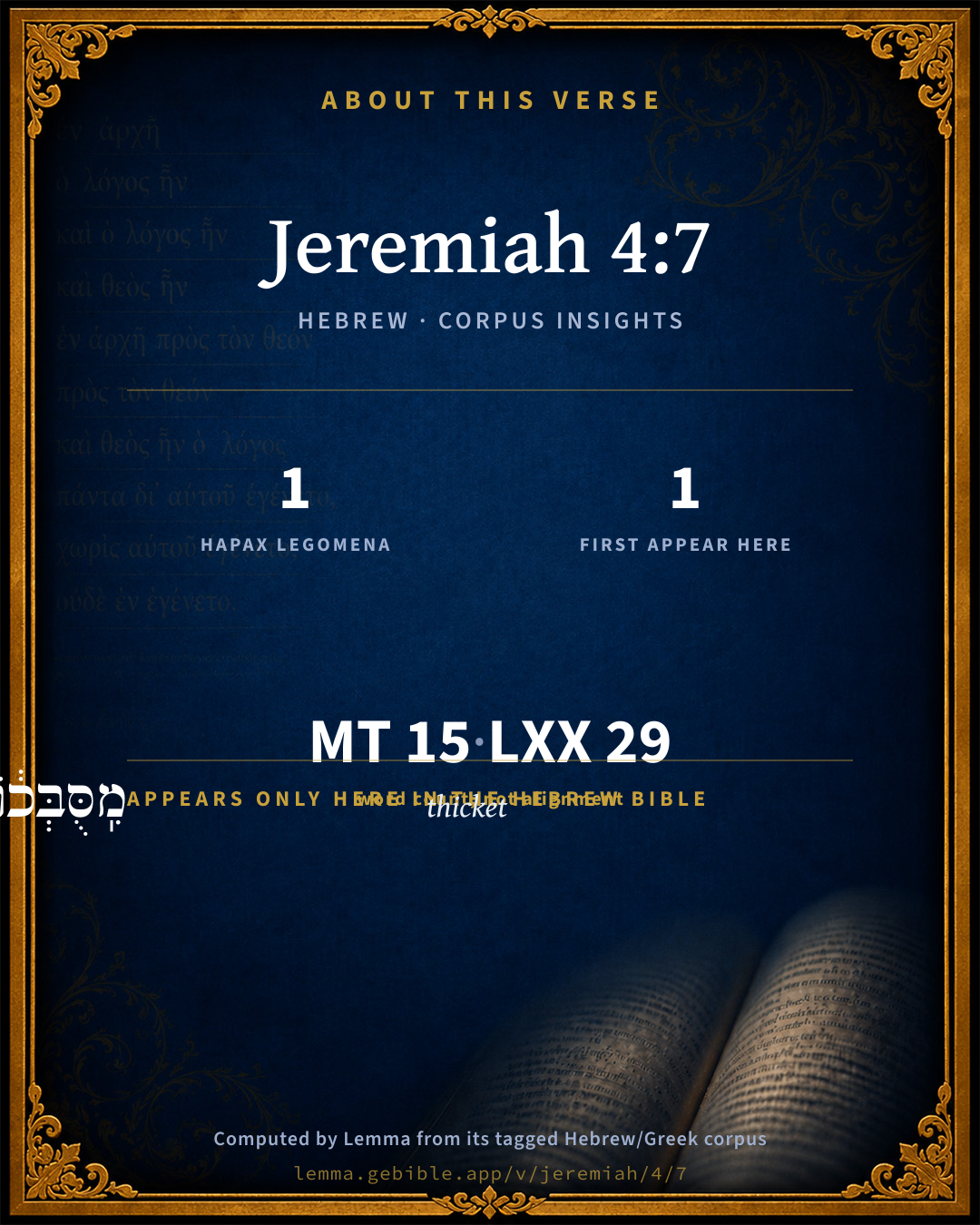
  • 1 hapax legomenon — only here in the Hebrew Bible
  • 1 first appearance in the Hebrew Bible
Full analysis ↓
Download a study sheet

One document with this verse’s original text, its word-by-word gloss line, the meaning frame, cross-references with their text, attributed commentary, and full source and license credits — printable, and it pastes into notes with its structure intact.

This verse Autodidact and up

Study sheet (.html) Plain text (.txt)

A passage Seminary Student

Up to 50 verses in one chapter. A passage sheet keeps up to 6 commentary sources and 12 cross-references per verse, in the order this page ranks them, and says so on the sheet whenever that leaves anything out. Ask for a single verse and you get the Autodidact verse sheet above.

Everything on this page stays free to read, with no account — the sheet is a download of what is already on screen, not access to it.

Want to remove ads? Support Godless Engineer
Compare translations 3

The same verse in 3 English versions, stacked beneath the original-language interlinear above. Click any original word for its lexicon entry.

Each is an independent rendering of the whole verse — the interlinear is not word-aligned to these translations.

Highlighted words mark where these versions differ — a whole-verse word diff, not a word-by-word alignment.

  • World English Bible Public Domain
    A lion is gone up from his thicket, and a destroyer of nations; he is on his way, he is gone forth from his place, to make your land desolate, that your cities be laid waste, without inhabitant.
  • King James Version Public Domain
    The lion is come up from his thicket, and the destroyer of the Gentiles is on his way; he is gone forth from his place to make thy land desolate; and thy cities shall be laid waste, without an inhabitant.
  • unfoldingWord Literal Text CC BY-SA 4.0
    A lion has come up from his thicket and a destroyer of nations has set out. He has gone out from his place to make your land into a desolation; your cities will become ruins, without an inhabitant.

unfoldingWord Literal Text — © unfoldingWord, licensed CC BY-SA 4.0. Word-aligned USFM3 via Door43 (git.door43.org/unfoldingWord/en_ult).

Versions to compare (up to 4)

3 of 4 selected

Show all 18 translations

Every available English version of this verse, each an independent rendering of the whole verse.

  • World English Bible Public Domain
    A lion is gone up from his thicket, and a destroyer of nations; he is on his way, he is gone forth from his place, to make your land desolate, that your cities be laid waste, without inhabitant.
  • Berean Standard Bible Public Domain
    A lion has gone up from his thicket, and a destroyer of nations has set out. He has left his lair to lay waste your land. Your cities will be reduced to ruins and lie uninhabited.
  • Majority Standard Bible Public Domain
    A lion has gone up from his thicket, and a destroyer of nations has set out. He has left his lair to lay waste your land. Your cities will be reduced to ruins and lie uninhabited.
  • King James Version Public Domain
    The lion is come up from his thicket, and the destroyer of the Gentiles is on his way; he is gone forth from his place to make thy land desolate; and thy cities shall be laid waste, without an inhabitant.
  • American Standard Version (1901) Public Domain
    A lion is gone up from his thicket, and a destroyer of nations; he is on his way, he is gone forth from his place, to make thy land desolate, that thy cities be laid waste, without inhabitant.
  • Revised Version (1885) Public Domain
    A lion is gone up from his thicket, and a destroyer of nations; he is on his way, he is gone forth from his place; to make thy land desolate, that thy cities be laid waste, without inhabitant.
  • Geneva Bible (1599) Public Domain
    The lyon is come vp from his denne, and the destroyer of the Gentiles is departed, and gone forth of his place to lay thy land waste, and thy cities shalbe destroyed without an inhabitant.
  • Douay-Rheims (1899) Public Domain
    The lion is come up out of his den, and the robber of nations hath roused himself: he is come forth out of his place, to make thy land desolate: thy cities shall be laid waste, remaining without an inhabitant.
  • Young's Literal Translation Public Domain
    Gone up hath a lion from his thicket, And a destroyer of nations hath journeyed, He hath come forth from his place To make thy land become a desolation, Thy cities are laid waste, without inhabitant.
  • Literal Standard Version CC BY-SA 4.0
    A lion has gone up from his thicket, || And a destroyer of nations has journeyed, || He has come forth from his place || To make your land become a desolation, || Your cities are laid waste, without inhabitant.
  • Unlocked Literal Bible CC BY-SA 4.0
    A lion is coming out from his thicket and someone who will destroy nations is setting out. He is leaving his place to bring horror to your land, to turn your cities into ruins, where no one will live.
  • unfoldingWord Literal Text CC BY-SA 4.0
    A lion has come up from his thicket and a destroyer of nations has set out. He has gone out from his place to make your land into a desolation; your cities will become ruins, without an inhabitant.
  • Darby Bible Public Domain
    The lion is come up from his thicket, the destroyer of the nations is on his way; he is gone forth from his place, to make thy land desolate; thy cities shall be laid waste, without inhabitant.
  • World Messianic Bible Public Domain
    A lion has gone up from his thicket, and a destroyer of nations. He is on his way. He has gone out from his place, to make your land desolate, that your cities be laid waste, without inhabitant.
  • Webster's Bible Public Domain
    The lion is come up from his thicket, and the destroyer of the Gentiles is on his way; he is gone forth from his place to make thy land desolate; thy cities shall be laid waste, without an inhabitant.
  • Free Bible Version CC BY-SA 4.0
    A lion has left his hiding place; a destroyer of nations has started out. He has left his den to come and turn your country into a wasteland. Your towns will be demolished, and no one will live there.
  • Bible in Basic English Public Domain
    A lion has gone up from his secret place in the woods, and one who makes waste the nations is on his way; he has gone out from his place, to make your land unpeopled, so that your towns will be made waste, with no man living in them.
  • JPS Tanakh (1917) Public Domain
    A lion is gone up from his thicket, and a destroyer of nations is set out, gone forth from his place; to make thy land desolate, that thy cities be laid waste, without inhabitant.

Literal Standard Version (2020), Covenant Press — licensed CC BY-SA 4.0. Text via the HelloAO Bible API (eBible.org). Unlocked Literal Bible (unfoldingWord) — licensed CC BY-SA 4.0. Text via the HelloAO Bible API (eBible.org). unfoldingWord Literal Text — © unfoldingWord, licensed CC BY-SA 4.0. Word-aligned USFM3 via Door43 (git.door43.org/unfoldingWord/en_ult). Free Bible Version, Dr. Jonathan Gallagher — licensed CC BY-SA 4.0. Text via the HelloAO Bible API (eBible.org).

Word by word

More ways to search: Search by grammar → Find every occurrence → Compare this word →

Practice this passage: Drill this verse → Learn its vocabulary →

מִֽסֻּבְּכ֔וֹ
çôbek
H5441
“from · thicket · his”
Preposition + Noun, Common, Masculine, Singular, Construct + Suffix, Personal, 3rd Person, Masculine, Singular
Part of Speech
Preposition + Noun
Type
Common
Gender
Masculine
Number
Singular
State
Construct
Full BDB Definition

Origin: from H5440

TWOT: 1457b

thicket
  1. עָלָ֤ה ʻâlâh H5927 “to go up” Verb, Qal, Perfect, 3rd Person, Masculine, Singular
  2. אַרְיֵה֙ ʼărîy H738 “lion” Noun, Common, Masculine, Singular, Absolute
  3. וּמַשְׁחִ֣ית shâchath H7843 “and · destroying” Conjunction + Verb, Hiphil, Participle Active, Masculine, Singular, Construct
  4. גּוֹיִ֔ם gôwy H1471 “nations” Noun, Common, Masculine, Plural, Absolute
  5. נָסַ֖ע nâçaʻ H5265 “to journey” Verb, Qal, Perfect, 3rd Person, Masculine, Singular
  6. יָצָ֣א yâtsâʼ H3318 “to go out” Verb, Qal, Perfect, 3rd Person, Masculine, Singular
  7. מִמְּקֹמ֑וֹ mâqôwm H4725 “from · place · his” Preposition + Noun, Common, Masculine, Singular, Construct + Suffix, Personal, 3rd Person, Masculine, Singular
  8. לָשׂ֤וּם sûwm H7760 “to put” Preposition + Verb, Qal, Infinitive Construct
  9. אַרְצֵךְ֙ ʼerets H776 “land · your” Noun, Common, Both, Singular, Construct + Suffix, Personal, 2nd Person, Feminine, Singular
  10. לְשַׁמָּ֔ה shammâh H8047 “to/for · desolation” Preposition + Noun, Common, Feminine, Singular, Absolute
  11. עָרַ֥יִךְ ʻîyr H5892 “cities · your” Noun, Common, Feminine, Plural, Construct + Suffix, Personal, 2nd Person, Feminine, Singular
  12. תִּצֶּ֖ינָה nâtsâh H5327 “to struggle” Verb, Qal, Imperfect, 3rd Person, Feminine, Plural
  13. מֵאֵ֥ין ʼayin H369 “from · nothing” Preposition + Particle, Negative
  14. יוֹשֵֽׁב yâshab H3427 “dwelling” Verb, Qal, Participle Active, Masculine, Singular, Absolute

About this verse

These counts appear in no published source. They are computed here, from the morphology-tagged text and Lemma’s own curated glosses. What Lemma adds →

15
words
15
distinct lemmas
Prophets
section

Notable vocabulary

1 hapax legomenon — a word that appears only here in the entire Hebrew Bible:

  • מִֽסֻּבְּכ֔וֹ thicket H5441

First appearance in Scripture

This word makes its first canonical appearance in the Hebrew Bible here:

  • מִֽסֻּבְּכ֔וֹ thicket H5441

Shared distinctive vocabulary

תִּצֶּ֖ינָה to struggle H5327 occurs in 10 verses of the Hebrew Bible. Also found in:

Grammatical profile

  • 7 verbs
  • 7 nouns
  • 1 particle

Verb forms

  • עָלָ֤ה Qal · Perfect
  • וּמַשְׁחִ֣ית Hiphil · Participle Active
  • נָסַ֖ע Qal · Perfect
  • יָצָ֣א Qal · Perfect
  • לָשׂ֤וּם Qal · Infinitive Construct
  • תִּצֶּ֖ינָה Qal · Imperfect
  • יוֹשֵֽׁב Qal · Participle Active

Hebrew & Septuagint length

In the original languages it is 15 Hebrew tokens and 29 Greek tokens — but the two are counted differently (Hebrew bundles its prefixes and suffixes into one token; the Greek is in lemma form), so that isn’t a like-for-like length.

Cross-references

22

Topical passages linked to Jeremiah 4:7 in the Treasury of Scripture Knowledge — connected by theme and wording, ordered by reader-vote popularity; previews shown in the World English Bible.

  • Isaiah 1:7 Your country is desolate. Your cities are burned with fire. Strangers devour your land in your presence, And it is desolate, As overthrown by strangers.
  • Isaiah 6:11 Then I said, "Lord, how long?" He answered, "Until cities are waste without inhabitant, And houses without man, And the land becomes utterly waste,
  • Jeremiah 2:15 The young lions have roared on him, and yelled; and they have made his land waste: his cities are burned up, without inhabitant.
  • Jeremiah 5:6 Therefore a lion out of the forest shall kill them, a wolf of the evenings shall destroy them, a leopard shall watch against their cities; everyone who goes out there shall be torn in pieces; because their transgressions are many, [and] their backsliding is increased.
  • Ezekiel 26:7–10 For thus says the Lord Yahweh: Behold, I will bring on Tyre Nebuchadrezzar king of Babylon, king of kings, from the north, with horses, and with chariots, and with horsemen, and a company, and much people.
  • Jeremiah 25:9 behold, I will send and take all the families of the north, says Yahweh, and [I will send] to Nebuchadrezzar the king of Babylon, my servant, and will bring them against this land, and against the inhabitants of it, and against all these nations round about; and I will utterly destroy them, and make them an astonishment, and a hissing, and perpetual desolations.
  • Jeremiah 50:17 Israel is a hunted sheep; the lions have driven him away: first, the king of Assyria devoured him; and now at last Nebuchadrezzar king of Babylon has broken his bones.
  • Daniel 7:4 The first was like a lion, and had eagle's wings: I saw until the wings of it were plucked, and it was lifted up from the earth, and made to stand on two feet as a man; and a man's heart was given to it.
  • 2 Kings 24:1 In his days Nebuchadnezzar king of Babylon came up, and Jehoiakim became his servant three years: then he turned and rebelled against him.
  • Isaiah 5:9 In my ears, Yahweh of Hosts says: "Surely many houses will be desolate, Even great and beautiful, unoccupied.
  • Jeremiah 25:38 He has left his covert, as the lion; for their land is become an astonishment because of the fierceness of the oppressing [sword], and because of his fierce anger.
  • Jeremiah 26:9 Why have you prophesied in the name of Yahweh, saying, This house shall be like Shiloh, and this city shall be desolate, without inhabitant? All the people were gathered to Jeremiah in the house of Yahweh.
  • Jeremiah 33:10 Thus says Yahweh: Yet again there shall be heard in this place, about which you say, It is waste, without man and without animal, even in the cities of Judah, and in the streets of Jerusalem, that are desolate, without man and without inhabitant and without animal,
  • Jeremiah 34:22 Behold, I will command, says Yahweh, and cause them to return to this city; and they shall fight against it, and take it, and burn it with fire: and I will make the cities of Judah a desolation, without inhabitant.
  • Jeremiah 49:19 Behold, he shall come up like a lion from the pride of the Jordan against the strong habitation: for I will suddenly make them run away from it; and whoever is chosen, him will I appoint over it: for who is like me? and who will appoint me a time? and who is the shepherd who will stand before me?
  • 2 Kings 25:1 It happened in the ninth year of his reign, in the tenth month, in the tenth day of the month, that Nebuchadnezzar king of Babylon came, he and all his army, against Jerusalem, and encamped against it; and they built forts against it round about.
  • Jeremiah 9:11 I will make Jerusalem heaps, a dwelling-place of jackals; and I will make the cities of Judah a desolation, without inhabitant.
  • Jeremiah 27:8 It shall happen, that the nation and the kingdom which will not serve the same Nebuchadnezzar king of Babylon, and that will not put their neck under the yoke of the king of Babylon, that nation will I punish, says Yahweh, with the sword, and with the famine, and with the pestilence, until I have consumed them by his hand.
  • Jeremiah 50:44 Behold, [the enemy] shall come up like a lion from the pride of the Jordan against the strong habitation: for I will suddenly make them run away from it; and whoever is chosen, him will I appoint over it: for who is like me? and who will appoint me a time? and who is the shepherd who can stand before me?
  • Ezekiel 30:10–11 Thus says the Lord Yahweh: I will also make the multitude of Egypt to cease, by the hand of Nebuchadrezzar king of Babylon.
  • Daniel 5:19 and because of the greatness that he gave him, all the peoples, nations, and languages trembled and feared before him: whom he would he killed, and whom he would he kept alive; and whom he would he raised up, and whom he would he put down.
  • Ezekiel 21:19–21 Also, you son of man, appoint two ways, that the sword of the king of Babylon may come; they both shall come forth out of one land: and mark out a place, mark it out at the head of the way to the city.

Cross-references courtesy of OpenBible.info (CC BY 4.0).

Hebrew and Greek witnesses Masoretic Hebrew ↔ Greek Septuagint

The same verse in the two great witnesses to the Old Testament, shown verse-for-verse.

These are two independent witnesses, not word-aligned to each other, and the Septuagint is shown in lemma (dictionary) form.

Hebrew Jeremiah 4:7 Masoretic · Westminster Leningrad Codex

עָלָ֤ה אַרְיֵה֙ מִֽסֻּבְּכ֔וֹ וּמַשְׁחִ֣ית גּוֹיִ֔ם נָסַ֖ע יָצָ֣א מִמְּקֹמ֑וֹ לָשׂ֤וּם אַרְצֵךְ֙ לְשַׁמָּ֔ה עָרַ֥יִךְ תִּצֶּ֖ינָה מֵאֵ֥ין יוֹשֵֽׁב

A lion is gone up from his thicket, and a destroyer of nations; he is on his way, he is gone forth from his place, to make your land desolate, that your cities be laid waste, without inhabitant.

World English Bible · Public Domain

Greek LXX Structure differs

In the Septuagint, Jeremiah is about an eighth shorter than the Hebrew and arranges its material differently — the Oracles Against the Nations (Hebrew chapters 46–51) appear in the middle of the Greek book, after 25:13. Because the chapter and verse boundaries do not line up, a verse-for-verse comparison with the Hebrew is not shown.

A verse-for-verse comparison isn’t shown here because the chapters and verses don’t line up. Switch to the LXX edition with the MT / LXX toggle above to read the Greek directly.

On this verse, Joseph Benson's Commentary discusses the Septuagint’s reading. Read the note in Commentary ↓

Hebrew: Westminster Leningrad Codex (CC BY 4.0). Greek: Septuagint (public domain); English from a public-domain English Septuagint. How the Septuagint differs from the Hebrew →

Targum (Aramaic paraphrase)

1

The Targum is the ancient Jewish Aramaic paraphrase of the Hebrew Scriptures — an interpretive translation, not the Hebrew text itself. Onkelos (literal) and Pseudo-Jonathan (expansive) render the Torah, and Jonathan the Prophets. Coverage is partial: where no permissively-licensed English translation exists for a verse, only the Aramaic is shown. This is verse-level text, not a word-by-word alignment to the Hebrew.

  1. Targum Jonathan Prophets (Joshua–Malachi)
    גְלָא מַלְכָּא מִכְּרַכֵּיהּ וּמְחַבֵּל עַמְמַיָא נְטַל בְּמַשִׁרְיָתֵהּ נְפַק מֵאַתְרֵיהּ לְשַׁוָאָה אַרְעִיךְ לְצָדוּ קִרְוַיִךְ יִצְדְיָן מִבְּלִי יָתֵיב:

    (no public-domain English translation for this verse)

    Targum Jonathan — Aramaic: “Mikraot Gedolot” (public domain). English: “Sefaria Community Translation” (CC0 1.0 (public-domain dedication)); “London "Chaldee Paraphrase," 1871” (public domain). Text via Sefaria.

Commentary

Notes on Jeremiah 4:7 from classic Christian and Jewish commentators (each source and its license shown beneath its notes). The classic Christian expositions comment on the surrounding passage and are grouped to its opening verse, so a note may address several verses; the Jewish commentaries on the Tanakh (Rashi and others) are per-verse, so they appear only where the commentator wrote on this verse.

Lemma curates 59 commentaries, every one of them public domain or Creative Commons licensed, each selected and text-cleaned for this edition rather than reprinted as found. About our sources →

Trapp's Complete Commentary

John Trapp

Jer 4:7 The lion is come up from his thicket, and the destroyer of the Gentiles is on his way; he is gone forth from his place to make thy land desolate; [and] thy cities shall be laid waste, without an inhabitant.

Ver. 7. The lion is come up from his thicket,] i.e., Nebuchadnezzar from Babylon, where he lieth safe, sicut leo in vepreto, and will shortly show himself for a mischief to many people, who shall feel his force and fierceness.

John Trapp, A Commentary or Exposition upon All the Books of the Old and New Testament (1647–1656) — public domain. Text from a community e-Sword module.

Joseph Benson's Commentary

Jer 4:7-8. The lion is come up from his thicket — Nebuchadnezzar, so called from his fierceness and strength, shall come up from Babylon, where his chief seat is, as lions are principally among the thickets of the forests, in coverts. Babylon being remote and little known to the Jews, they did not expect trouble to arise from thence. The destroyer of the Gentiles — Or, rather, the nations; is on his way — Is already on his march: another description of the same person, who is so called, because God had given, not only Judea, but all the neighbouring countries, into his hands. To make thy lands desolate — With a resolution to do so, and with power to effect his purpose. For this gird you with sackcloth — Put on the habit of mourners. It is intended to express the dreadfulness of the approaching calamity. Lament and howl — You will do so when the cry is made through the kingdom, Arm, arm. Then all will be seized with terror, and put to confusion. For the fierce anger of the Lord — Which makes the army of the Chaldeans thus fierce and powerful; is not turned back from us — Is not appeased, but still burns against us. The LXX., with whom the Syriac and Vulgate agree, read αφ’ υμων, from you.

Joseph Benson's Commentary on the Old and New Testaments (1811–1818) — public domain. Text from a community e-Sword module.

Tyndale Open Study Notes

Tyndale Open Resources

4:7 The coming army of Babylonian soldiers was like a cruel and vicious lion (see 2:15). With power and savagery, it would wipe out everything, leaving houses empty and in ruins (25:9, 38; 50:17; 2 Kgs 24:1; Isa 1:7; 6:11; Ezek 26:7-10; Dan 7:4).

Tyndale Open Study Notes — © Tyndale Open Resources, licensed CC BY-SA 4.0. Text via the HelloAO Bible API.

Geneva Bible (1599)

Geneva Bible translators

Meaning, Nebuchadnezzar King of Babylon, 2 Kings 24:1.

Geneva Bible (1599) marginal notes — public domain. Text via Bolls.life.

Jamieson, Fausset & Brown

Robert Jamieson, A. R. Fausset & David Brown

lion--Nebuchadnezzar and the Chaldeans (Jer 2:15; Jer 5:6; Dan 7:14).

his thicket--lair; Babylon.

destroyer of the Gentiles--rather, "the nations" (Jer 25:9).

Jamieson, Fausset & Brown — Commentary Critical and Explanatory on the Whole Bible (1871) — public domain (CC PDM 1.0). Text via the HelloAO Bible API.

Adam Clarke's Commentary

Verse 7. The lion is come up] Nebuchadnezzar, king of Babylon. "The king (Nebuchadnezzar) is come up from his tower." - Targum.

The destroyer of the Gentiles] Of the nations: of all the people who resisted his authority. He destroyed them all.

Adam Clarke's Commentary on the Bible (1810–1826) — public domain. Text from a community e-Sword/MySword module.

John Calvin's Commentaries

The Prophet more fully declares the import of the threatening which we briefly considered yesterday; for God said in the former verse, that he would bring an evil from the north; and the kind of evil it was to be he now describes, and compares the king of Babylon to a lion; and afterwards, without a figure, he calls him the destroyer of nations

By the similitude of lion he means that the Israelites would not be able to resist; and when he adds that he would be the desolator of nations, he intimates that they would perish with the rest: for if Nebuchadnezzar was sufficiently able to destroy many nations, how could the Jews escape a similar calamity? He shall come, he says, the desolator of nations But he uses the past tense throughout, in order to shew the certainty of the prediction, and thus to shake secure men with fear, who had become torpid in their hypocrisy; for they would have otherwise deemed all threatenings as nothing: for as long as God spared them, they despised his judgment, and promised themselves impunity in their sins. Hence the Prophet, in order to awake them, set the matter before them, as though Nebuchadnezzar had already come with a strong and powerful army to lay waste Judea; for he says, that a lion had ascended from his hiding — places: but the term for the last word means an entangled density, as when trees are entwined together, or when a place is filled with thorns.

But the similitude is most suitable, because the Jews never thought that the king of Babylon would come forth from places so remote; for the passing through was difficult, and the expedition attended with great toil: yet the Prophet says, that the lion would come from his recesses, and that nothing would hinder him from breaking forth and coming to the open country. He at last concludes by saying, that the cities would be laid waste, so as to be without an inhabitant It now follows —

John Calvin's Commentaries (1540-1563) — public domain. Text from the Calvin Translation Society English edition (1840s-50s) via the Christian Classics Ethereal Library (ccel.org). Calvin's coverage is partial (roughly two-thirds of the Bible); uncommented books and verses are honest gaps, never fabricated. The 19th-century editor's footnotes and remarks are omitted so the notes are faithfully Calvin's own voice.

Ellicott's Commentary for English Readers

(7) The lion is come up . . .—The “lion” is, of course, the Chaldæan invader, the destroyer, not of men only, but of nations. So in Dan_7:4 the lion is the symbol of the Assyrian monarchy. The winged lions that are seen in the palaces of Mosul and Nimroud gave a special character to what was in any case a natural metaphor. The word “Gentiles” answers to the meaning, but there is no special reason why it should be used here, rather than nations.

Is on his way.—Literally, has broken up his encampment, i.e., has started on his march.

Without an inhabitant.—The language, like that of Isaiah (Isa_6:11), was probably in some measure hyperbolical, but the depopulation caused by the Chaldæan invasion (as seen in Jer_39:9) must have been extreme.

A Bible Commentary for English Readers, edited by Charles John Ellicott (1878–1897) — public domain. Text from a community e-Sword module.

The Cambridge Bible for Schools and Colleges

gen. ed. J. J. S. Perowne

7. A lion] See introd. note above.

thy land] We should perhaps read the land, and consider the rest of the v. as an insertion suggested by the parallels in Jer_2:15, Jer_9:11.

Du. proposes, but on insufficient grounds (viz. the use of the expression “at that day,” as though implying vagueness as to time, and a change in the character of the metre), to omit Jer_4:9-11 a (… Jerusalem).

The Cambridge Bible for Schools and Colleges (gen. ed. J. J. S. Perowne; Cambridge University Press, 1878–1918) — public domain. Text from a community e-Sword module.

John Gill's Exposition

The lion is come up from his thicket,.... Meaning Nebuchadnezzar (s), from Babylon, who is compared to a lion for his strength, fierceness, and cruelty; see Jer 50:17 so the Roman emperor is called a lion, Ti2 4:17, agreeably to this the Targum paraphrases it,

"a king is gone from his fortress;''

or tower; and the Syriac version,

"a certain most powerful king is about to go up as a lion out of his wood:''

and the destroyer of the Gentiles is on his way; he who had conquered and destroyed other nations not a few, and these mighty and strong; and therefore the Jews could not expect but to be destroyed by him. This tyrant was a type of antichrist, whose name is Apollyon, a destroyer of the nations of the earth, Rev 9:11.

he is gone forth from his place, to make thy land desolate; from Babylon, where his royal palace was, in order to lay waste the land of Judea; and he is represented as being come out, and on the road with this view, to strike the inhabitants of Judea with the greater terror, and to hasten their flight, their destruction being determined and certain:

and thy cities shall be laid waste without an inhabitant; they shall become so utterly desolate, that there should be none dwelling in them, partly by reason of the multitudes of the slain, and partly by reason of multitudes that should flee; and should be laid waste to such a degree, that they should be covered with grass growing upon them; which is the signification of the word (t) here used, according to R. Joseph Kimchi.

(s) So T. Bab. Megilia, fol. 11. 1. & Sanhedrin. fol 94. 2. (t) "gramine succrescente obducantur quidam" in Gataker.

John Gill's Exposition of the Whole Bible (1746–1763) — public domain (CC PDM 1.0). Text via the HelloAO Bible API.

Albert Barnes' Notes on the Bible

Rather, A “lion”... a “destroyer” of nations: a metaphor descriptive of the impending calamity. A lion is just rousing himself from his lair, but no common one. It is destroyer, not of men, but of nations.

Is on his way - literally, “has broken up his encampment.” Jeremiah uses a military term strictly referring to the striking of tents in preparation for the march.

Without an inhabitant - The final stage of destruction, actually reached in the utter depopulation of Judaea consequent upon Gedaliah’s murder.

Albert Barnes' Notes on the Bible (1834–1885) — public domain. Text from a community e-Sword/MySword module.

Haydock's Catholic Bible Commentary

Robber. Nabuchodonosor attacks unjustly, (Calmet) though he be God’s scourge.

George Leo Haydock (1774–1849), Haydock's Catholic Family Bible and Commentary, 1859 edition — public domain. Excludes Psalms (Douay-Rheims chapter numbering differs from Protestant) and Deuterocanonical books (Catholic canon only).

Matthew Poole's English Annotations

The lion is come up from his thicket, i.e. Nebuchadnezzar, called here a lion from his fierceness and strength, Pro 30:30; a metaphor; especially in this expedition; see Isa 5:27-29 shall come up from Babylon, where his chief seat is, Dan 4:30; as lions are principally among the thickets of the forest, in coverts; this place being so remote and hid from them, that they least expected trouble to arise from thence.

The destroyer of the Gentiles; another description of the same person, of whose destroying armies the nations have had woeful experience, Isa 14:16,17, called the hammer of the whole earth, Jer 50:23: q.d. And how shall you think to escape him?

Is on his way, i.e. as it is expressed in the next clause, he is gone forth from his place, he is already upon his march.

To make thy land desolate, i.e. with a resolution so to do.

Shall be laid waste, without an inhabitant, i.e. as places uninhabited soon lie waste, and are overgrown with grass, as the notation of the word seems to import.

Matthew Poole's English Annotations on the Holy Bible (1683–1685) — public domain. Text from a community e-Sword/MySword module.

Whedon's Commentary on the Bible

Daniel D. Whedon

7. The lion — Literally, a lion.

The destroyer of the Gentiles — Rather, destroyer of nations; a vivid description of such beasts of prey as are figured by Assyria and Babylon.

Daniel D. Whedon (gen. ed.), Commentary on the Old and New Testaments (1874–1909) — public domain. Text from a community e-Sword module.

The Pulpit Commentary

The lion; the symbol of irresistible might and royalty. (Gen_49:7 Rev_5:5) Of the Gentiles; rather, of the nations. There is no reference to the distinction between Jews and Gentiles; the Jews themselves are not allowed to escape. An ordinary lion attacks individual men; this lion destroys nations. Is on his way; literally, has broken up his encampment a phrase perhaps suggested by the nomad Scythiaus.

The Pulpit Commentary (1880–1919), ed. H.D.M. Spence-Jones & Joseph S. Exell — public domain. Text from a community e-Sword module.

John Wesley's Explanatory Notes

The lion - Nebuchadnezzar, so called from his fierceness and strength.

John Wesley, Explanatory Notes Upon the Whole Bible (1754–1765) — public domain. Text via the GEBible commentary corpus.

unfoldingWord translationNotes

Door43 World Missions Community

A lion is coming

God speaks of a powerful army as if it were a fierce lion. AT: "A powerful and merciless army approaches" (See: Metaphor)

thicket

a set of bushes that grew closely together

someone who will destroy nations

Here "someone" represents a king and his army. (See: Synecdoche)

is setting out

This idiom refers to starting to move. AT: "is starting to march" (See: Idiom)

to bring horror to your land

This represents destroying the land, which would cause people who see it to be horrified. AT: "to destroy your land" (See: Metonymy)

wrap yourself in sackcloth

People would wear sackcloth to show that they were very sad. In this context it would be to show that they were very sorry for the bad things they had done. AT: "put on the clothes that show you are mourning" (See: Symbolic Action)

wail

cry loudly

For the force of Yahweh's anger has not turned away from us

Anger is spoken of as if it were a living thing that could turn away from people. Here "Yahweh's anger has not turned away from us" means that Yahweh is still very angry with the people. AT: "For Yahweh is still very angry with us" (See: Metaphor)

translationWords

lions

ruin

life

sackcloth

lament

anger

turn

unfoldingWord translationNotes — © Distant Shores Media and the Door43 World Missions Community, licensed CC BY-SA 4.0. Source: git.door43.org/Door43/en_tn.

Rashi

Rabbi Shlomo Yitzchaki (Rashi)

A lion has come up That is Nebuchadnezzar.

from his thicket It is customary for a lion to lie in wait in the thickets of the forest (espaises in O.F.).

will be desolate Heb. תצינה, an expression of desolation.

Rashi on the Tanakh — English translations: “The Judaica Press complete Tanach with Rashi, translated by A. J. Rosenberg” (CC BY 4.0); “Pentateuch with Rashi's commentary by M. Rosenbaum and A.M. Silbermann, 1929-1934” (public domain); “The Metsudah Tanach series, Lakewood, N.J” (CC BY 4.0); and “The Book of Joshua, Metsudah Publications, 1997” (CC BY 4.0). Text via Sefaria.

Lesson kit

Teaching starters — assembled from the data on this page, not authored interpretation. Every prompt links to the verse data it draws on. Edit before teaching.

Jeremiah, in the Prophets, opens this verse with 15 words (15 distinct Hebrew lemmas). Its most distinctive word is çôbek (“thicket”). A historical commentator’s framing appears above. Read the whole chapter for the surrounding context.

Discussion questions

  1. The word çôbek carries the sense “thicket.” How does it shape the verse?
  2. This verse holds 1 word here found nowhere else in the Hebrew Bible. What might the rare word draw attention to?
  3. The word “thicket” first appears here in Scripture. What is being introduced at this debut?
  4. Exodus 2:13 shares the word «to struggle» with this verse. How do the two illuminate each other?
  5. These translations render this verse differently; the difference is in the English rendering, not the original. What questions does that raise?
  6. The verb «עָלָ֤ה» is Qal Perfect. How does its form color the action?
  7. Reading how Trapp's Complete Commentary and Joseph Benson's Commentary read this verse, where do the two commentators agree and where do they part?

Things to notice

Reading settings

Reading text

Shown beneath each verse's original-language words.

Old Testament
Old Testament edition

Read the OT as the Masoretic Hebrew (MT) or the Greek Septuagint (LXX).

English shown for the Greek Septuagint (in the Hebrew ↔ Greek comparison).

Comparing translations? Open the Compare panel on any verse page to stack up to four side by side.