
2 Kings 19:36

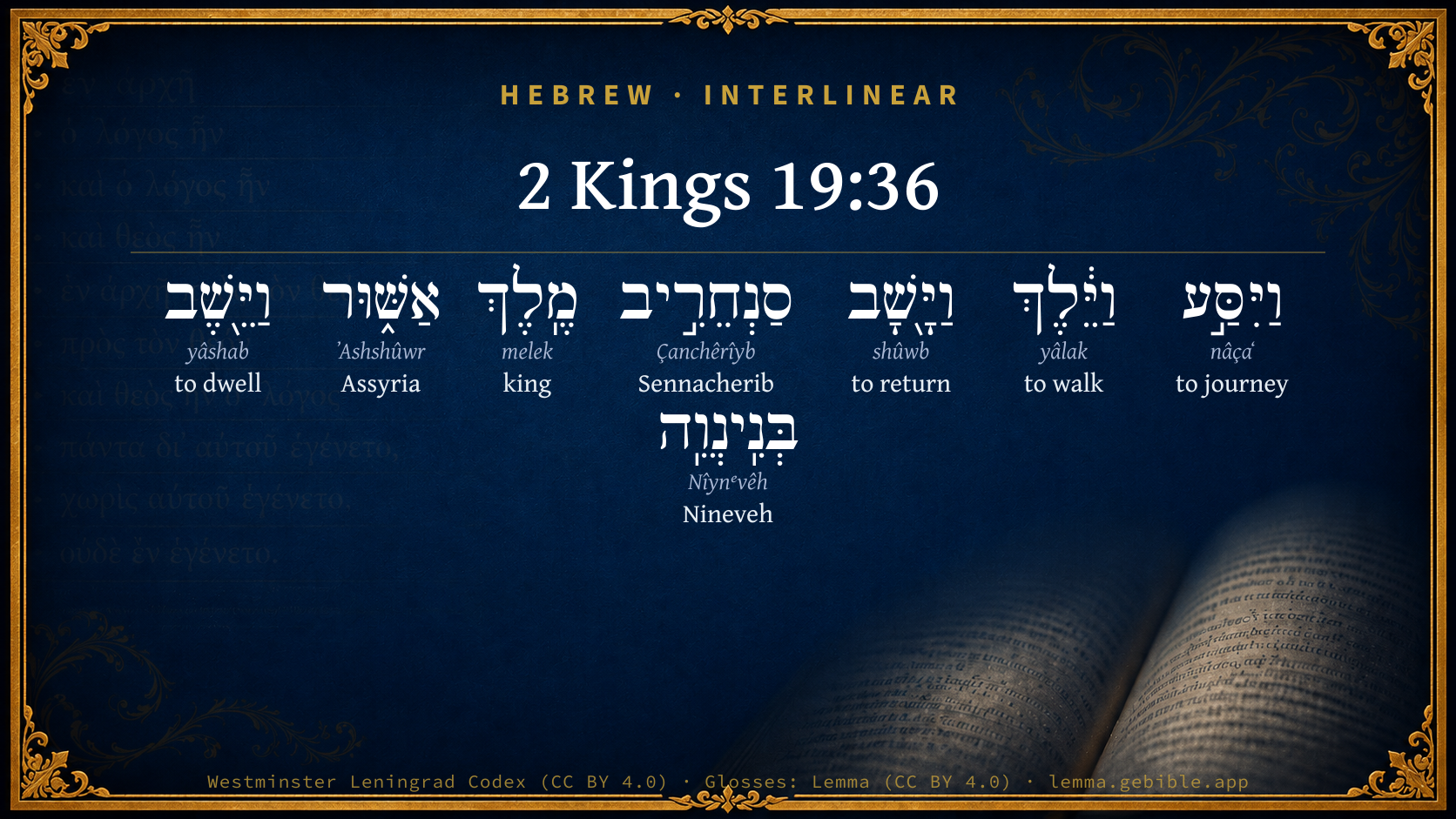
Hebrew (Westminster Leningrad Codex) 2 Kings 19:36 appears in the Hebrew Old Testament. The text above is from the Westminster Leningrad Codex. Each word links to its Strong’s number, a concise gloss, and parsing drawn from the Open Scriptures Hebrew Bible morphology. Click any word for its full Brown-Driver-Briggs (BDB) entry.
Download image
Cite this verse

2 Kings 19:36 (World English Bible). Public Domain. Lemma interlinear Bible study tool, https://lemma.gebible.app/v/2-kings/19/36.

Show BibTeX & RIS
BibTeX
RIS
English Translation
So Sennacherib king of Assyria departed, and went and returned, and lived at Nineveh.
World English Bible · Public Domain
Download a study sheet

One document with this verse’s original text, its word-by-word gloss line, the meaning frame, cross-references with their text, attributed commentary, and full source and license credits — printable, and it pastes into notes with its structure intact.

This verse Autodidact and up

Study sheet (.html) Plain text (.txt)

A passage Seminary Student

Up to 50 verses in one chapter. A passage sheet keeps up to 6 commentary sources and 12 cross-references per verse, in the order this page ranks them, and says so on the sheet whenever that leaves anything out. Ask for a single verse and you get the Autodidact verse sheet above.

Everything on this page stays free to read, with no account — the sheet is a download of what is already on screen, not access to it.

Want to remove ads? Support Godless Engineer
Compare translations 3

The same verse in 3 English versions, stacked beneath the original-language interlinear above. Click any original word for its lexicon entry.

Each is an independent rendering of the whole verse — the interlinear is not word-aligned to these translations.

Highlighted words mark where these versions differ — a whole-verse word diff, not a word-by-word alignment.

  • World English Bible Public Domain
    So Sennacherib king of Assyria departed, and went and returned, and lived at Nineveh.
  • King James Version Public Domain
    So Sennacherib king of Assyria departed, and went and returned, and dwelt at Nineveh.
  • unfoldingWord Literal Text CC BY-SA 4.0
    And he departed and went, and Sennacherib, the king of Assyria, returned and stayed in Nineveh.

unfoldingWord Literal Text — © unfoldingWord, licensed CC BY-SA 4.0. Word-aligned USFM3 via Door43 (git.door43.org/unfoldingWord/en_ult).

Versions to compare (up to 4)

3 of 4 selected

Show all 18 translations

Every available English version of this verse, each an independent rendering of the whole verse.

  • World English Bible Public Domain
    So Sennacherib king of Assyria departed, and went and returned, and lived at Nineveh.
  • Berean Standard Bible Public Domain
    So Sennacherib king of Assyria broke camp and withdrew. He returned to Nineveh and stayed there.
  • Majority Standard Bible Public Domain
    So Sennacherib king of Assyria broke camp and withdrew. He returned to Nineveh and stayed there.
  • King James Version Public Domain
    So Sennacherib king of Assyria departed, and went and returned, and dwelt at Nineveh.
  • American Standard Version (1901) Public Domain
    So Sennacherib king of Assyria departed, and went and returned, and dwelt at Nineveh.
  • Revised Version (1885) Public Domain
    So Sennacherib king of Assyria departed, and went and returned, and dwelt at Nineveh.
  • Geneva Bible (1599) Public Domain
    So Saneherib King of Asshur departed, and went his way, and returned, and dwelt in Nineueh.
  • Douay-Rheims (1899) Public Domain
    And Sennacherib king of the Assyrians departing went away, and he re- turned and abode in Ninive.
  • Young's Literal Translation Public Domain
    And Sennacherib king of Asshur journeyeth, and goeth, and turneth back, and dwelleth in Nineveh;
  • Literal Standard Version CC BY-SA 4.0
    And Sennacherib king of Asshur journeys, and goes, and turns back, and dwells in Nineveh;
  • Unlocked Literal Bible CC BY-SA 4.0
    So Sennacherib king of Assyria left Israel and went home and stayed in Nineveh.
  • unfoldingWord Literal Text CC BY-SA 4.0
    And he departed and went, and Sennacherib, the king of Assyria, returned and stayed in Nineveh.
  • Darby Bible Public Domain
    And Sennacherib king of Assyria departed, and went and returned, and abode at Nineveh.
  • World Messianic Bible Public Domain
    So Sennacherib king of Assyria departed, went home, and lived at Nineveh.
  • Webster's Bible Public Domain
    So Sennacherib king of Assyria departed, and went and returned, and dwelt at Nineveh.
  • Free Bible Version CC BY-SA 4.0
    Sennacherib, king of Assyria, gave up and left. He returned home to Nineveh and stayed there.
  • Bible in Basic English Public Domain
    So Sennacherib, king of Assyria, went back to his place at Nineveh.
  • JPS Tanakh (1917) Public Domain
    So Sennacherib king of Assyria departed, and went and returned, and dwelt at Nineveh.

Literal Standard Version (2020), Covenant Press — licensed CC BY-SA 4.0. Text via the HelloAO Bible API (eBible.org). Unlocked Literal Bible (unfoldingWord) — licensed CC BY-SA 4.0. Text via the HelloAO Bible API (eBible.org). unfoldingWord Literal Text — © unfoldingWord, licensed CC BY-SA 4.0. Word-aligned USFM3 via Door43 (git.door43.org/unfoldingWord/en_ult). Free Bible Version, Dr. Jonathan Gallagher — licensed CC BY-SA 4.0. Text via the HelloAO Bible API (eBible.org).

Word by word

More ways to search: Search by grammar → Find every occurrence → Compare this word →

Practice this passage: Drill this verse → Learn its vocabulary →

סַנְחֵרִ֣יב
Çanchêrîyb
H5576
“Sennacherib”
Noun, Proper
Part of Speech
Noun
Type
Proper
Full BDB Definition

Origin: of foreign origin

TWOT: None

Sennacherib = "Sin multiplied brothers" (Sin = the moon) - son of Sargon, father of Esarhaddon, and king of Assyria from 705-681 BC; attacked Judah during the reign of king Hezekiah and Judah was delivered when in response to the prayer of Hezekiah an angel smote 185,000 Assyrian soldiers
  1. וַיִּסַּ֣ע nâçaʻ H5265 “and · to journey” Conjunction + Verb, Qal, Sequential Imperfect, 3rd Person, Masculine, Singular
  2. וַיֵּ֔לֶךְ yâlak H3212 “and · to walk” Conjunction + Verb, Qal, Sequential Imperfect, 3rd Person, Masculine, Singular
  3. וַיָּ֖שָׁב shûwb H7725 “and · to return” Conjunction + Verb, Qal, Sequential Imperfect, 3rd Person, Masculine, Singular
  4. מֶֽלֶךְ melek H4428 “king of” Noun, Common, Masculine, Singular, Construct
  5. אַשּׁ֑וּר ʼAshshûwr H804 “Assyria” Noun, Proper
  6. וַיֵּ֖שֶׁב yâshab H3427 “and · to dwell” Conjunction + Verb, Qal, Sequential Imperfect, 3rd Person, Masculine, Singular
  7. בְּנִֽינְוֵֽה Nîynᵉvêh H5210 “in/at · Nineveh” Preposition + Noun, Proper

About this verse

These counts appear in no published source. They are computed here, from the morphology-tagged text and Lemma’s own curated glosses. What Lemma adds →

8
words
8
distinct lemmas
Historical
section

Notable vocabulary

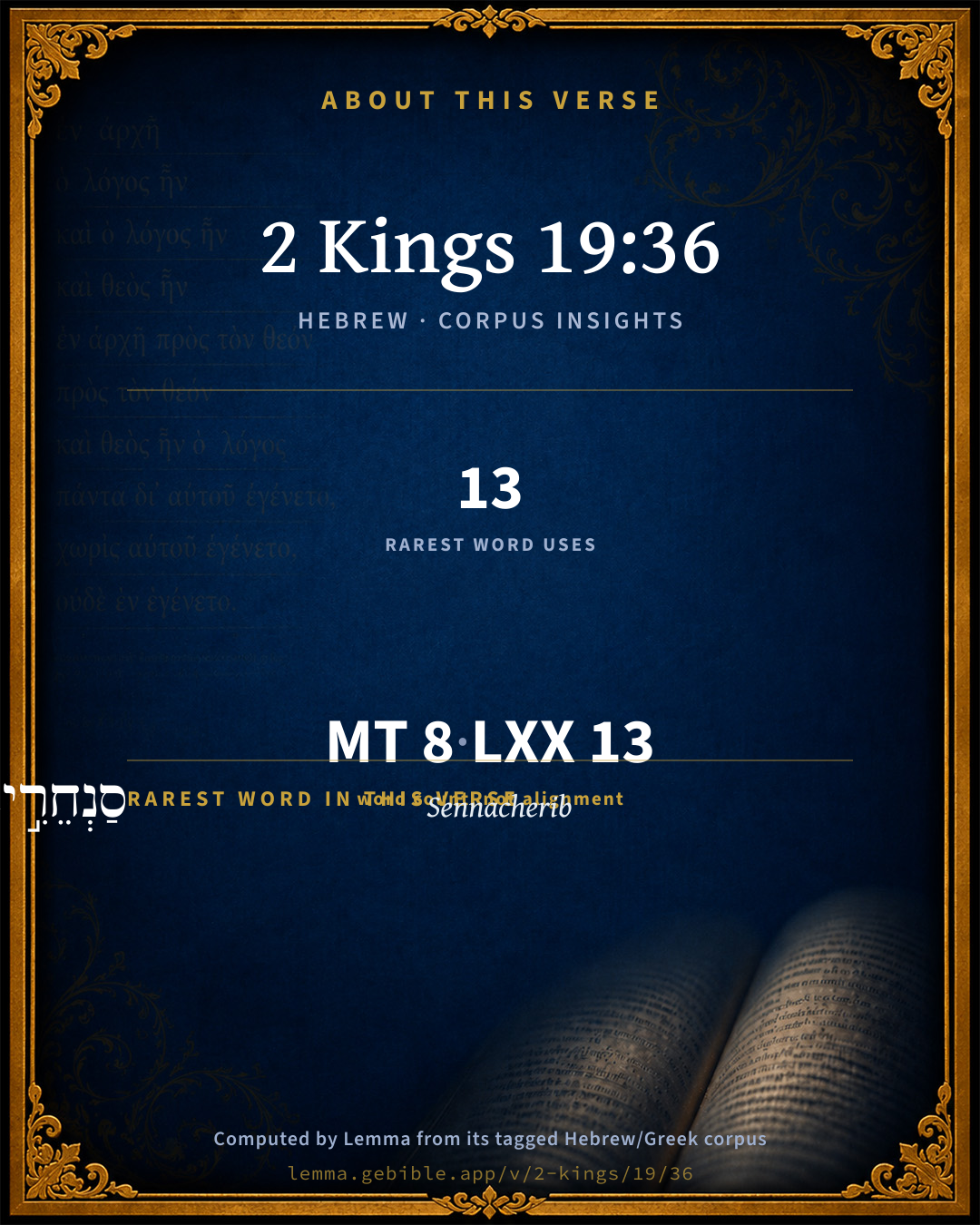
The rarest word here is סַנְחֵרִ֣יב Sennacherib H5576 — appearing just 13 times in the whole Hebrew Bible.

Shared distinctive vocabulary

סַנְחֵרִ֣יב Sennacherib H5576 occurs in 13 verses of the Hebrew Bible. Also found in:

Grammatical profile

  • 4 verbs
  • 4 nouns

Verb forms

  • וַיִּסַּ֣ע Qal · Sequential Imperfect
  • וַיֵּ֔לֶךְ Qal · Sequential Imperfect
  • וַיָּ֖שָׁב Qal · Sequential Imperfect
  • וַיֵּ֖שֶׁב Qal · Sequential Imperfect

Hebrew & Septuagint length

In English translation the verse runs 14 words from the Hebrew and 15 from the Septuagint (LXX English) — closely comparable.

A rough comparison of the two English renderings, which tokenize alike — not a word-level alignment.

Word counts can differ between the Hebrew and the Greek without any difference in meaning — e.g. the Hebrew direct-object marker אֵת has no separate Greek word, and Greek often adds the article ὁ.

In the original languages it is 8 Hebrew tokens and 13 Greek tokens — but the two are counted differently (Hebrew bundles its prefixes and suffixes into one token; the Greek is in lemma form), so that isn’t a like-for-like length.

Cross-references

9

Topical passages linked to 2 Kings 19:36 in the Treasury of Scripture Knowledge — connected by theme and wording, ordered by reader-vote popularity; previews shown in the World English Bible.

  • Jonah 1:2 "Arise, go to Nineveh, that great city, and preach against it, for their wickedness has come up before me."
  • 2 Kings 19:7 Behold, I will put a spirit in him, and he shall hear news, and shall return to his own land; and I will cause him to fall by the sword in his own land.
  • 2 Kings 19:28 Because of your raging against me, and because your arrogance is come up into my ears, therefore will I put my hook in your nose, and my bridle in your lips, and I will turn you back by the way by which you came.
  • 2 Kings 19:33 By the way that he came, by the same shall he return, and he shall not come to this city, says Yahweh.
  • Genesis 10:11–12 Out of that land he went forth into Assyria, and built Nineveh, Rehoboth Ir, Calah,
  • Jonah 3:2–10 "Arise, go to Nineveh, that great city, and preach to it the message that I give you."
  • Nahum 1:1 An oracle about Nineveh. The book of the vision of Nahum the Elkoshite.
  • Nahum 2:8 But Nineveh has been from of old like a pool of water, yet they flee away. "Stop! Stop!" they cry, but no one looks back.
  • Matthew 12:41 The men of Nineveh will stand up in the judgment with this generation, and will condemn it, for they repented at the preaching of Jonah; and behold, someone greater than Jonah is here.

Cross-references courtesy of OpenBible.info (CC BY 4.0).

Hebrew and Greek witnesses Masoretic Hebrew ↔ Greek Septuagint

The same verse in the two great witnesses to the Old Testament, shown verse-for-verse.

These are two independent witnesses, not word-aligned to each other, and the Septuagint is shown in lemma (dictionary) form.

Hebrew 2 Kings 19:36 Masoretic · Westminster Leningrad Codex

וַיִּסַּ֣ע וַיֵּ֔לֶךְ וַיָּ֖שָׁב סַנְחֵרִ֣יב מֶֽלֶךְ אַשּׁ֑וּר וַיֵּ֖שֶׁב בְּנִֽינְוֵֽה

So Sennacherib king of Assyria departed, and went and returned, and lived at Nineveh.

World English Bible · Public Domain

Greek LXX 2 Kings 19:36 Septuagint · lemma form

καί ἀποαἴρω καί πορεύομαι καί ἀποστρέφω σενναχηριμ βασιλεύς ἀσσύριος καί οἰκέω ἐν νινευη

And Sennacherim king of the Assyrians departed, and went and returned, and lived in Nineve.

LXX2012 (modern English Septuagint) · Public Domain

Hebrew: Westminster Leningrad Codex (CC BY 4.0). Greek: Septuagint (public domain); English from LXX2012 (modern English Septuagint) (Public Domain). How the Septuagint differs from the Hebrew →

Targum (Aramaic paraphrase)

1

The Targum is the ancient Jewish Aramaic paraphrase of the Hebrew Scriptures — an interpretive translation, not the Hebrew text itself. Onkelos (literal) and Pseudo-Jonathan (expansive) render the Torah, and Jonathan the Prophets. Coverage is partial: where no permissively-licensed English translation exists for a verse, only the Aramaic is shown. This is verse-level text, not a word-by-word alignment to the Hebrew.

  1. Targum Jonathan Prophets (Joshua–Malachi)
    וּנְטַל וַאֲזַל וְתַב סַנְחֵרִיב מַלְכָּא דְאַתּוּר וִיתֵיב בְּנִינְוֵה:

    (no public-domain English translation for this verse)

    Targum Jonathan — Aramaic: “Mikraot Gedolot” (public domain). English: “Sefaria Community Translation” (CC0 1.0 (public-domain dedication)); “London "Chaldee Paraphrase," 1871” (public domain). Text via Sefaria.

Commentary

Notes on 2 Kings 19:36 from classic Christian and Jewish commentators (each source and its license shown beneath its notes). The classic Christian expositions comment on the surrounding passage and are grouped to its opening verse, so a note may address several verses; the Jewish commentaries on the Tanakh (Rashi and others) are per-verse, so they appear only where the commentator wrote on this verse.

Lemma curates 59 commentaries, every one of them public domain or Creative Commons licensed, each selected and text-cleaned for this edition rather than reprinted as found. About our sources →

Trapp's Complete Commentary

John Trapp

2Ki 19:36 So Sennacherib king of Assyria departed, and went and returned, and dwelt at Nineveh.

Ver. 36. So Sennacherib king of Assyria departed.] Being glad he had escaped with the skin of his teeth, with the safeguard of his life. But his preservation was but a reservation only; and the rather, because he ascribed it to Nisroch his tutelar god, worshipping him still, notwithstanding his army’s overthrow.

And dwelt at Nineveh.] Where he had not lived fifty-five days before he was butchered, saith Tobit; {/APC Tob 1:21} who also telleth us, {/APC Tob 1:18} that at his return he in a rage slew many of the Israelites in Nineveh. The like whereunto we read of Selymus II, that in revenge of his loss at the battle of Lepanto, he would have put to death all the Christians in his dominions, and did many.

John Trapp, A Commentary or Exposition upon All the Books of the Old and New Testament (1647–1656) — public domain. Text from a community e-Sword module.

Joseph Benson's Commentary

2Ki 19:36. So Sennacherib departed — Ashamed to see himself, after all his proud boasts, thus defeated, and disabled to pursue his conquests, or even to secure what he had gained, the flower of his army being cut off; nay, and continually afraid of falling under the like stroke himself. The manner of the expression, He departed, and went, and returned, intimates the great disorder and distraction of mind he was in.

Joseph Benson's Commentary on the Old and New Testaments (1811–1818) — public domain. Text from a community e-Sword module.

Tyndale Open Study Notes

Tyndale Open Resources

19:36 Sennacherib . . . went home . . . and stayed there: Although this Assyrian king went on five more military campaigns, he did not return to attack Judah.

Tyndale Open Study Notes — © Tyndale Open Resources, licensed CC BY-SA 4.0. Text via the HelloAO Bible API.

Jamieson, Fausset & Brown

Robert Jamieson, A. R. Fausset & David Brown

So Sennacherib king of Assyria . . . went and returned--the same way as he came (Kg2 19:33). The route is described (Isa 10:28-32). The early chariot track near Beyrout is on the rocky edge of Lebanon, which is skirted by the ancient Lycus (Nahr-el Kelb). On the perpendicular face of the limestone rock, at different heights, are seen slabs with Assyrian inscriptions, which having been deciphered, are found to contain the name of Sennacherib. Thus, by the preservation of these tablets, the wrath of the Assyrian invaders is made to praise the Lord.

dwelt at Nineveh--This statement implies a considerable period of time, and his Annals carry on his history at least five years after his disastrous campaign at Jerusalem. No record of his catastrophe can be found, as the Assyrian practice was to record victories alone. The sculptures give only the sunny side of the picture.

Jamieson, Fausset & Brown — Commentary Critical and Explanatory on the Whole Bible (1871) — public domain (CC PDM 1.0). Text via the HelloAO Bible API.

Adam Clarke's Commentary

Verse 36. Dwelt at Nineveh.] This was the capital of the Assyrian empire.

Adam Clarke's Commentary on the Bible (1810–1826) — public domain. Text from a community e-Sword/MySword module.

Ellicott's Commentary for English Readers

(36) Departed, and went.—Broke up camp, and marched. There should be a stop at returned.

And dwelt at Nineveh.—Or, and he abode in Nineveh, implying that he did not again invade the west. Sennacherib records five subsequent expeditions to the east, north, and south of his dominions, but these obviously were nothing to the peoples of Palestine. (See Notes on 2Ki_20:12.)

Nineveh.—The capital of Assyria, now marked by large mounds on the east bank of the Tigris, opposite Mosul. (The Arabic version has “the king of Mosul,” instead of “the king of Assyria.”) It is usually called Ninua in the inscriptions; sometimes Ninâ, seldom Ninû (Greek, Nîvos.)

A Bible Commentary for English Readers, edited by Charles John Ellicott (1878–1897) — public domain. Text from a community e-Sword module.

The Cambridge Bible for Schools and Colleges

gen. ed. J. J. S. Perowne

36. and dwelt at Nineveh] Apparently, and very naturally, deterred from any of his grander schemes by the terrible calamity which had befallen him, Sennacherib went to his own capital. How long a time elapsed between this overthrow around Jerusalem and the death of the king, spoken of in the next verse, we have not sufficient data to decide. The canon of Ptolemy fixes the accession of Sennacherib in b.c. 702, his death in b.c. 680. These dates cannot be made to harmonize with the Scripture chronology.

The Cambridge Bible for Schools and Colleges (gen. ed. J. J. S. Perowne; Cambridge University Press, 1878–1918) — public domain. Text from a community e-Sword module.

Albert Barnes' Notes on the Bible

Dwelt at Nineveh - The meaning is not that Sennacherib made no more expeditions at all, which would he untrue, for his annals show us that he warred in Armenia, Babylonia, Susiana, and Cilicia, during his later years; but that he confined himself to his own part of Asia, and did not invade Palestine or threaten Jerusalem anymore. Nineveh, marked by some ruins opposite Mosul, appears here unmistakably as the Assyrian capital, which it became toward the close of the 9th century B.C. It has previously been mentioned only in Genesis (marginal reference). Sennacherib was the first king who made it his permanent residence. Its great size and large population are marked in the description of Jonah Jon 3:2-3; Jon 4:11, whose visit probably fell about 760 B.C.

Albert Barnes' Notes on the Bible (1834–1885) — public domain. Text from a community e-Sword/MySword module.

Matthew Poole's English Annotations

God spared

Sennacherib, not in mercy, but in wrath, reserving him to a more dreadful and shameful death by the hands of his own children.

Matthew Poole's English Annotations on the Holy Bible (1683–1685) — public domain. Text from a community e-Sword/MySword module.

The Pulpit Commentary

So Sennacherib King of Assyria departed, and went and returned. The, original is more lively, and more expressive of haste. Sennacherib, it is said, "decamped, and departed, and returned the heaping up of the verbs expressing the hurry of the march home (Keil); 1Ki_19:3. And dwelt at Nineveh. Nineveh was Sennacherib"s favorite residence. He had built himself a palace, there, marked by the modern mound of Koyunjik. Sargon, his father, had dwelt mainly at Dur-Sargina or Khorsabad, Tiglath-pileser and Shalmaueser at Calah or Nimrod. Sennacherib"s palace and his ether buildings at Nineveh are described in his annals at some length (see "Records of the Past," vol. 1. pp. 50-52). The expression, "dwelt at Nineveh," does not mean that he never quitted it, but merely implies that he dwelt there for some considerable time after his return, as he appears to have done by his annals. The Eponym Canon makes his last year B.C. 682.

The Pulpit Commentary (1880–1919), ed. H.D.M. Spence-Jones & Joseph S. Exell — public domain. Text from a community e-Sword module.

John Wesley's Explanatory Notes

So Sennacherib, &c. - The manner of the expression intimates the great disorder and distraction of mind he was in.

John Wesley, Explanatory Notes Upon the Whole Bible (1754–1765) — public domain. Text via the GEBible commentary corpus.

Rashi

Rabbi Shlomo Yitzchaki (Rashi)

And dwelt in Nineveh. It was the capital of Ashur.

Rashi on the Tanakh — English translations: “The Judaica Press complete Tanach with Rashi, translated by A. J. Rosenberg” (CC BY 4.0); “Pentateuch with Rashi's commentary by M. Rosenbaum and A.M. Silbermann, 1929-1934” (public domain); “The Metsudah Tanach series, Lakewood, N.J” (CC BY 4.0); and “The Book of Joshua, Metsudah Publications, 1997” (CC BY 4.0). Text via Sefaria.

Lesson kit

Teaching starters — assembled from the data on this page, not authored interpretation. Every prompt links to the verse data it draws on. Edit before teaching.

2 Kings, in the Historical, opens this verse with 8 words (8 distinct Hebrew lemmas). Its most distinctive word is Çanchêrîyb (“Sennacherib”). A historical commentator’s framing appears above. Read the whole chapter for the surrounding context.

Discussion questions

  1. What does “Sennacherib” (Çanchêrîyb) contribute to the verse as a whole?
  2. How does 2 Kings 18:13, which shares the word «Sennacherib», read alongside this verse?
  3. These translations render this verse differently. What is at stake in choosing one wording over another?
  4. «וַיִּסַּ֣ע» is a Qal Sequential Imperfect verb. How does that grammatical form shape the action described?
  5. Compare how Trapp's Complete Commentary and Joseph Benson's Commentary read this verse. Where do they agree or differ?

Things to notice

Reading settings

Reading text

Shown beneath each verse's original-language words.

Old Testament
Old Testament edition

Read the OT as the Masoretic Hebrew (MT) or the Greek Septuagint (LXX).

English shown for the Greek Septuagint (in the Hebrew ↔ Greek comparison).

Comparing translations? Open the Compare panel on any verse page to stack up to four side by side.