
Judges 16:14

Hebrew (Westminster Leningrad Codex) Judges 16:14 appears in the Hebrew Old Testament. The text above is from the Westminster Leningrad Codex. Each word links to its Strong’s number, a concise gloss, and parsing drawn from the Open Scriptures Hebrew Bible morphology. Click any word for its full Brown-Driver-Briggs (BDB) entry.
Download image
Cite this verse

Judges 16:14 (World English Bible). Public Domain. Lemma interlinear Bible study tool, https://lemma.gebible.app/v/judges/16/14.

Show BibTeX & RIS
BibTeX
RIS
English Translation
She fastened it with the pin, and said to him, The Philistines are on you, Samson. He awakened out of his sleep, and plucked away the pin of the beam, and the web.
World English Bible · Public Domain
Highlights Full analysis ↓
Download a study sheet

One document with this verse’s original text, its word-by-word gloss line, the meaning frame, cross-references with their text, attributed commentary, and full source and license credits — printable, and it pastes into notes with its structure intact.

This verse Autodidact and up

Study sheet (.html) Plain text (.txt)

A passage Seminary Student

Up to 50 verses in one chapter. A passage sheet keeps up to 6 commentary sources and 12 cross-references per verse, in the order this page ranks them, and says so on the sheet whenever that leaves anything out. Ask for a single verse and you get the Autodidact verse sheet above.

Everything on this page stays free to read, with no account — the sheet is a download of what is already on screen, not access to it.

Want to remove ads? Support Godless Engineer
Compare translations 3

The same verse in 3 English versions, stacked beneath the original-language interlinear above. Click any original word for its lexicon entry.

Each is an independent rendering of the whole verse — the interlinear is not word-aligned to these translations.

Highlighted words mark where these versions differ — a whole-verse word diff, not a word-by-word alignment.

  • World English Bible Public Domain
    She fastened it with the pin, and said to him, The Philistines are on you, Samson. He awakened out of his sleep, and plucked away the pin of the beam, and the web.
  • King James Version Public Domain
    And she fastened it with the pin, and said unto him, The Philistines be upon thee, Samson. And he awaked out of his sleep, and went away with the pin of the beam, and with the web.
  • unfoldingWord Literal Text CC BY-SA 4.0
    So she drove with the peg, and she said to him, “The Philistines upon you, Samson!” But he awoke from his sleep and pulled the peg the weaving and the warp.

unfoldingWord Literal Text — © unfoldingWord, licensed CC BY-SA 4.0. Word-aligned USFM3 via Door43 (git.door43.org/unfoldingWord/en_ult).

Versions to compare (up to 4)

3 of 4 selected

Show all 18 translations

Every available English version of this verse, each an independent rendering of the whole verse.

  • World English Bible Public Domain
    She fastened it with the pin, and said to him, The Philistines are on you, Samson. He awakened out of his sleep, and plucked away the pin of the beam, and the web.
  • Berean Standard Bible Public Domain
    So while he slept, Delilah took the seven braids of his hair and wove them into the web. Then she tightened it with a pin and called to him, “Samson, the Philistines are here!” But he awoke from his sleep and pulled out the pin with the loom and the web.
  • Majority Standard Bible Public Domain
    So while he slept, Delilah took the seven braids of his hair and wove them into the web. Then she tightened it with a pin and called to him, “Samson, the Philistines are here!” But he awoke from his sleep and pulled out the pin with the loom and the web.
  • King James Version Public Domain
    And she fastened it with the pin, and said unto him, The Philistines be upon thee, Samson. And he awaked out of his sleep, and went away with the pin of the beam, and with the web.
  • American Standard Version (1901) Public Domain
    And she fastened it with the pin, and said unto him, The Philistines are upon thee, Samson. And he awaked out of his sleep, and plucked away the pin of the beam, and the web.
  • Revised Version (1885) Public Domain
    And she fastened it with the pin, and said unto him, The Philistines be upon thee, Samson. And he awaked out of his sleep, and plucked away the pin of the beam, and the web.
  • Geneva Bible (1599) Public Domain
    And she fastened it with a pinne, and saide vnto him, The Philistims be vpon thee, Samson. And he awoke out of his sleepe, and went away with the pinne of the webbe and the woufe.
  • Douay-Rheims (1899) Public Domain
    And when Dalila had done this, she said to him: The Philistines are upon thee, Samson. And awaking out of his sleep he drew out the nail with the hairs and the lace.
  • Young's Literal Translation Public Domain
    And she fixeth `it' with the pin, and saith unto him, `Philistines `are' upon thee, Samson;' and he awaketh out of his sleep, and journeyeth with the pin of the weaving machine, and with the web.
  • Literal Standard Version CC BY-SA 4.0
    And she fixes [it] with the pin and says to him, “Philistines [are] on you, Samson!” And he awakens out of his sleep, and pulls out the pin of the loom, and with the web.
  • Unlocked Literal Bible CC BY-SA 4.0
    While he slept, Delilah wove seven locks of his hair into the fabric on the loom and nailed it to the loom, and she said to him, “The Philistines are upon you, Samson!” He woke from his sleep and he pulled out the fabric and the pin from the loom.
  • unfoldingWord Literal Text CC BY-SA 4.0
    So she drove with the peg, and she said to him, “The Philistines upon you, Samson!” But he awoke from his sleep and pulled the peg the weaving and the warp.
  • Darby Bible Public Domain
    So while he slept, Deli'lah took the seven locks of his head and wove them into the web. And she made them tight with the pin, and said to him, "The Philistines are upon you, Samson!" But he awoke from his sleep, and pulled away the pin, the loom, and the web.
  • World Messianic Bible Public Domain
    She fastened it with the pin, and said to him, “The Philistines are on you, Samson!” He awakened out of his sleep, and plucked away the pin of the beam and the fabric.
  • Webster's Bible Public Domain
    And she fastened it with the pin, and said to him, The Philistines are upon thee, Samson. And he awaked out of his sleep, and went away with the pin of the beam, and with the web.
  • Free Bible Version CC BY-SA 4.0
    and tightening the pin. She shouted out, “Samson, the Philistines are here to get you!” But Samson woke up and ripped out both the pin and the web from the loom.
  • Bible in Basic English Public Domain
    So while he was sleeping she got the seven twists of his hair worked into her cloth and fixed with the pin, and said to him, The Philistines are on you, Samson. Then awaking from his sleep, he got up quickly, pulling up cloth and machine together.
  • JPS Tanakh (1917) Public Domain
    And she fastened it with the pin, and said unto him: 'The Philistines are upon thee, Samson.' And he awoke out of his sleep, and plucked away the pin of the beam, and the web.

Literal Standard Version (2020), Covenant Press — licensed CC BY-SA 4.0. Text via the HelloAO Bible API (eBible.org). Unlocked Literal Bible (unfoldingWord) — licensed CC BY-SA 4.0. Text via the HelloAO Bible API (eBible.org). unfoldingWord Literal Text — © unfoldingWord, licensed CC BY-SA 4.0. Word-aligned USFM3 via Door43 (git.door43.org/unfoldingWord/en_ult). Free Bible Version, Dr. Jonathan Gallagher — licensed CC BY-SA 4.0. Text via the HelloAO Bible API (eBible.org).

Word by word

More ways to search: Search by grammar → Find every occurrence → Compare this word →

Practice this passage: Drill this verse → Learn its vocabulary →

הָאֶ֖רֶג
ʼereg
H708
“the · loom”
Particle, Definite Article + Noun, Common, Masculine, Singular, Absolute
Part of Speech
Particle + Noun
Type
Common
Gender
Masculine
Number
Singular
State
Absolute
Full BDB Definition

Origin: from H707

TWOT: 157a

loom, shuttle
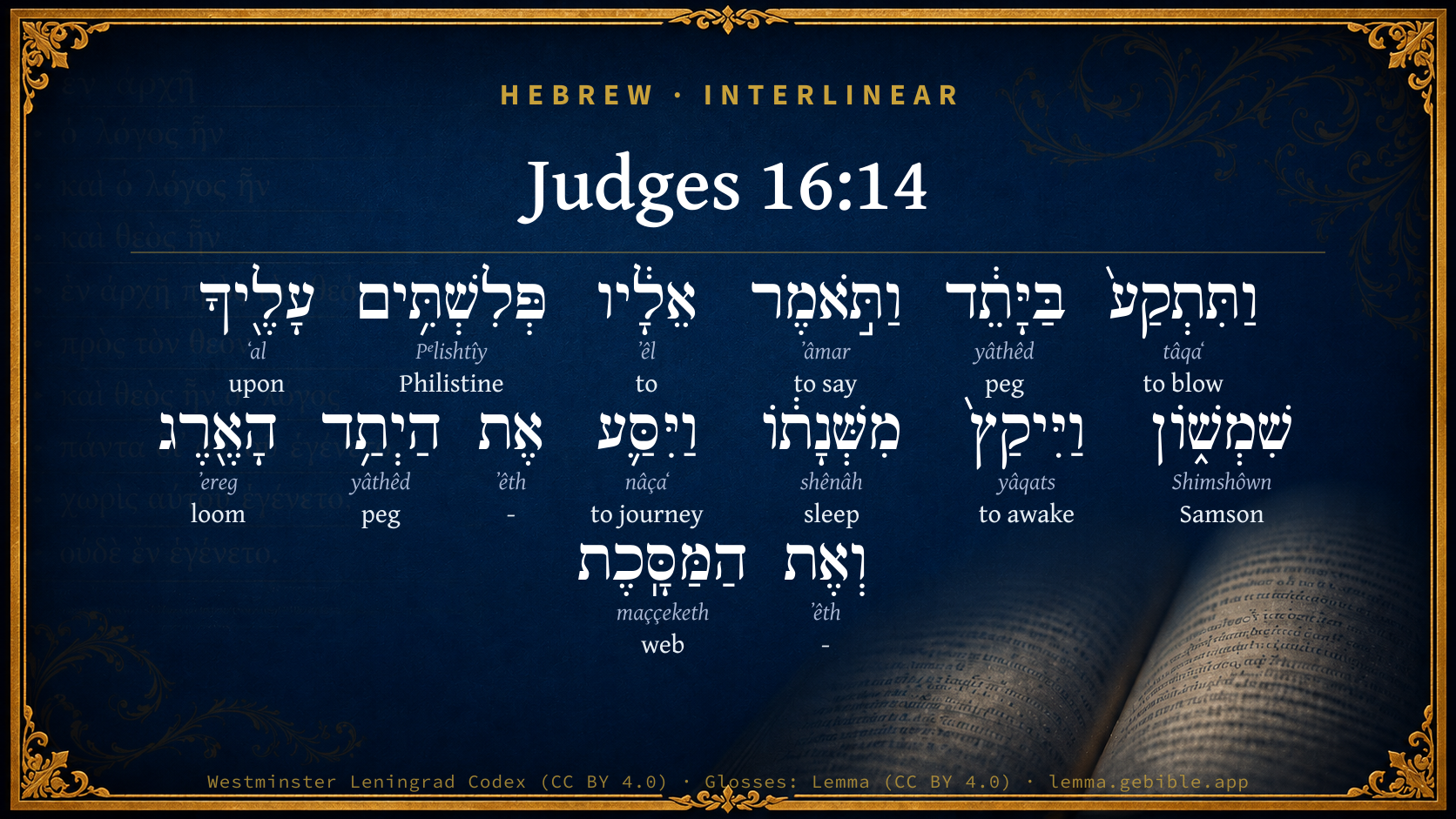
  1. וַתִּתְקַע֙ tâqaʻ H8628 “and · to blow” Conjunction + Verb, Qal, Sequential Imperfect, 3rd Person, Feminine, Singular
  2. בַּיָּתֵ֔ד yâthêd H3489 “in/at the · peg” Preposition, Determined + Noun, Common, Feminine, Singular, Absolute
  3. וַתֹּ֣אמֶר ʼâmar H559 “and · to say” Conjunction + Verb, Qal, Sequential Imperfect, 3rd Person, Feminine, Singular
  4. אֵלָ֔יו ʼêl H413 “to · him” Preposition + Suffix, Personal, 3rd Person, Masculine, Singular
  5. פְּלִשְׁתִּ֥ים Pᵉlishtîy H6430 “Philistines” Noun, Gentilic, Masculine, Plural, Absolute
  6. עָלֶ֖יךָ ʻal H5921 “upon · you” Preposition + Suffix, Personal, 2nd Person, Masculine, Singular
  7. שִׁמְשׁ֑וֹן Shimshôwn H8123 “Samson” Noun, Proper
  8. וַיִּיקַץ֙ yâqats H3364 “and · to awake” Conjunction + Verb, Qal, Sequential Imperfect, 3rd Person, Masculine, Singular
  9. מִשְּׁנָת֔וֹ shênâh H8142 “from · sleep · his” Preposition + Noun, Common, Feminine, Singular, Construct + Suffix, Personal, 3rd Person, Masculine, Singular
  10. וַיִּסַּ֛ע nâçaʻ H5265 “and · to journey” Conjunction + Verb, Qal, Sequential Imperfect, 3rd Person, Masculine, Singular
  11. אֶת ʼêth H853 “-” Particle, Direct Object
  12. הַיְתַ֥ד yâthêd H3489 “the · peg” Particle, Definite Article + Noun, Common, Feminine, Singular, Absolute
  13. וְאֶת ʼêth H853 “and · -” Conjunction + Particle, Direct Object
  14. הַמַּסָּֽכֶת maççeketh H4545 “the · web” Particle, Definite Article + Noun, Common, Feminine, Singular, Absolute

About this verse

These counts appear in no published source. They are computed here, from the morphology-tagged text and Lemma’s own curated glosses. What Lemma adds →

15
words
13
distinct lemmas
Historical
section

Notable vocabulary

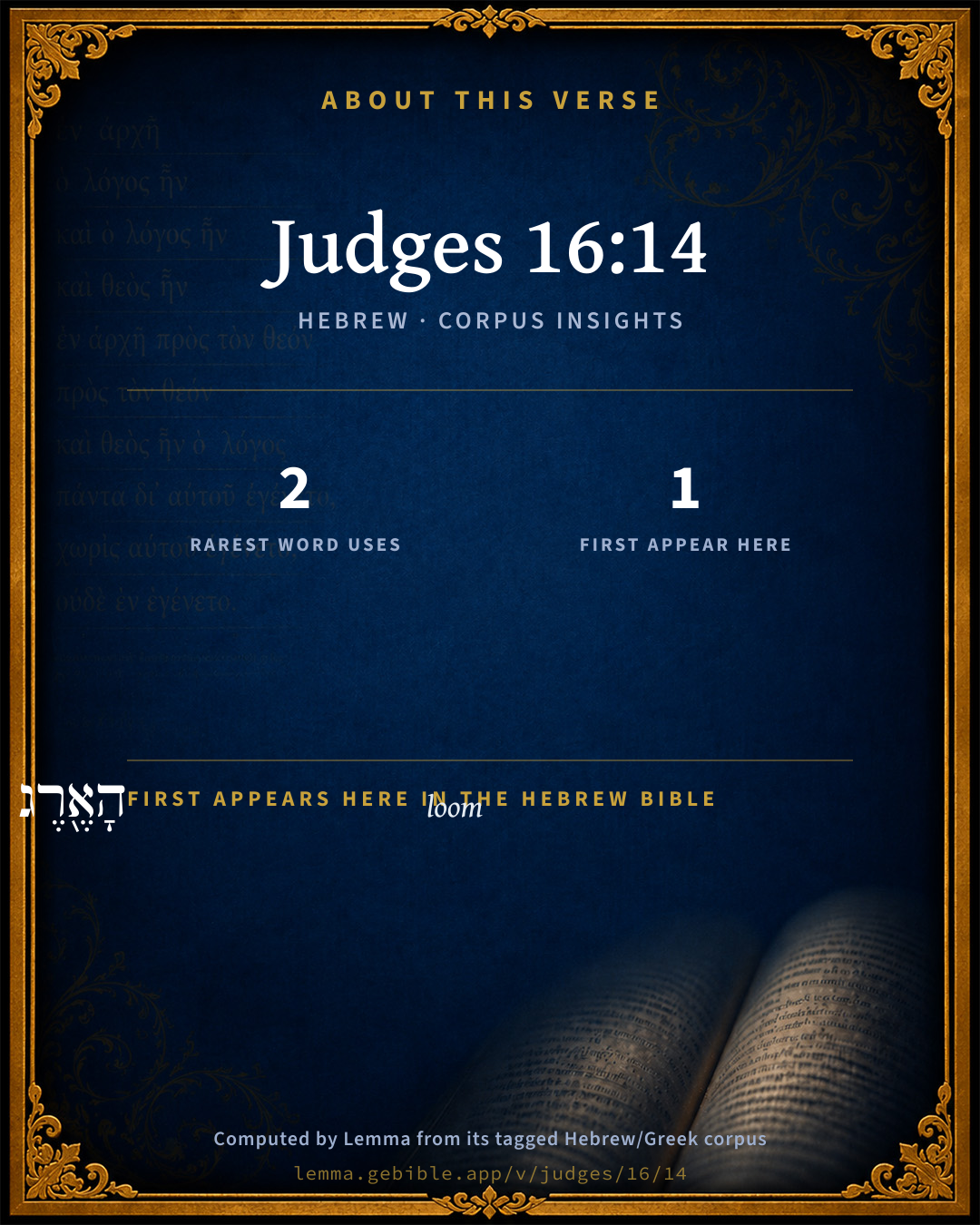
The rarest word here is הָאֶ֖רֶג loom H708 — appearing just 2 times in the whole Hebrew Bible.

First appearance in Scripture

This word makes its first canonical appearance in the Hebrew Bible here:

  • הָאֶ֖רֶג loom H708

Shared distinctive vocabulary

הָאֶ֖רֶג loom H708 occurs in 2 verses of the Hebrew Bible. Also found in:

Grammatical profile

  • 4 verbs
  • 7 nouns
  • 2 prepositions
  • 2 particles

Verb forms

  • וַתִּתְקַע֙ Qal · Sequential Imperfect
  • וַתֹּ֣אמֶר Qal · Sequential Imperfect
  • וַיִּיקַץ֙ Qal · Sequential Imperfect
  • וַיִּסַּ֛ע Qal · Sequential Imperfect

Repetition

A word recurs within this verse — often emphatic in Hebrew:

  • בַּיָּתֵ֔ד peg H3489 ×2

Hebrew & Septuagint length

In English translation the verse runs 33 words from the Hebrew and 61 from the Septuagint (LXX English) — the Septuagint runs noticeably longer here. See the side-by-side →

A rough comparison of the two English renderings, which tokenize alike — not a word-level alignment.

Word counts can differ between the Hebrew and the Greek without any difference in meaning — e.g. the Hebrew direct-object marker אֵת has no separate Greek word, and Greek often adds the article ὁ.

Cross-references

2

Topical passages linked to Judges 16:14 in the Treasury of Scripture Knowledge — connected by theme and wording, ordered by reader-vote popularity; previews shown in the World English Bible.

  • Ezra 9:13–14 After all that is come on us for our evil deeds, and for our great guilt, seeing that you our God have punished us less than our iniquities deserve, and have given us such a remnant,
  • Psalms 106:43 Many times he delivered them, But they were rebellious in their counsel, And were brought low in their iniquity.

Cross-references courtesy of OpenBible.info (CC BY 4.0).

Hebrew and Greek witnesses Masoretic Hebrew ↔ Greek Septuagint

The same verse in the two great witnesses to the Old Testament, shown verse-for-verse.

Here the Septuagint runs noticeably longer than the Hebrew — LXX2012 (modern English Septuagint) 61 words vs World English Bible 33. A rough length comparison of the two English translations, not a word-level alignment — read both below.

These are two independent witnesses, not word-aligned to each other, and the Septuagint is shown in lemma (dictionary) form.

Hebrew Judges 16:14 Masoretic · Westminster Leningrad Codex

וַתִּתְקַע֙ בַּיָּתֵ֔ד וַתֹּ֣אמֶר אֵלָ֔יו פְּלִשְׁתִּ֥ים עָלֶ֖יךָ שִׁמְשׁ֑וֹן וַיִּיקַץ֙ מִשְּׁנָת֔וֹ וַיִּסַּ֛ע אֶת הַיְתַ֥ד הָאֶ֖רֶג וְאֶת הַמַּסָּֽכֶת

She fastened it with the pin, and said to him, The Philistines are on you, Samson. He awakened out of his sleep, and plucked away the pin of the beam, and the web.

World English Bible · Public Domain

Greek LXX Judges 16:14 Septuagint · lemma form

καί γίγνομαι ἐν ὁ κοιμάω αὐτός καί λαμβάνω δαλιδα ὁ ἑπτά σειρά ὁ κεφαλή αὐτός καί ὑφαίνω ἐν ὁ δίασμα καί πήγνυμι ὁ πάσσαλος εἰς ὁ τοῖχος καί εἶπον ἀλλόφυλος ἐπί σύ σαμψων καί ἐκὑπνίζω ἐκ ὁ ὕπνος αὐτός καί ἐκαἴρω ὁ πάσσαλος ὁ ὕφασμα ἐκ ὁ τοῖχος

And it came to pass when he was asleep, that Dalida took the seven locks of his head, and wove them with the web, and fastened them with the pin into the wall, and she said, The Philistines are upon you, Sampson: and he awoke out of his sleep, and carried away the pin of the web out of the wall.

LXX2012 (modern English Septuagint) · Public Domain

On this verse, Ellicott's Commentary for English Readers discusses the Septuagint’s reading. Read the note in Commentary ↓

Hebrew: Westminster Leningrad Codex (CC BY 4.0). Greek: Septuagint (public domain); English from LXX2012 (modern English Septuagint) (Public Domain). How the Septuagint differs from the Hebrew →

Targum (Aramaic paraphrase)

1

The Targum is the ancient Jewish Aramaic paraphrase of the Hebrew Scriptures — an interpretive translation, not the Hebrew text itself. Onkelos (literal) and Pseudo-Jonathan (expansive) render the Torah, and Jonathan the Prophets. Coverage is partial: where no permissively-licensed English translation exists for a verse, only the Aramaic is shown. This is verse-level text, not a word-by-word alignment to the Hebrew.

  1. Targum Jonathan Prophets (Joshua–Malachi)
    וְנִקְשַׁת בְסִכְתָא וַאֲמַרַת לֵיהּ פְּלִשְׁתָּאֵי אֲתוֹ עֲלָךְ שִׁמְשׁוֹן וְאִתְעַר מִשִׁנְתֵיהּ וּנְטַל יַת אַכְסַן דְגַרְדָאִין וְיַת מַשְׁתֵּיתָא:

    (no public-domain English translation for this verse)

    Targum Jonathan — Aramaic: “Mikraot Gedolot” (public domain). English: “Sefaria Community Translation” (CC0 1.0 (public-domain dedication)); “London "Chaldee Paraphrase," 1871” (public domain). Text via Sefaria.

Commentary

Notes on Judges 16:14 from classic Christian and Jewish commentators (each source and its license shown beneath its notes). The classic Christian expositions comment on the surrounding passage and are grouped to its opening verse, so a note may address several verses; the Jewish commentaries on the Tanakh (Rashi and others) are per-verse, so they appear only where the commentator wrote on this verse.

Lemma curates 59 commentaries, every one of them public domain or Creative Commons licensed, each selected and text-cleaned for this edition rather than reprinted as found. About our sources →

Trapp's Complete Commentary

John Trapp

Jdg 16:14 And she fastened [it] with the pin, and said unto him, The Philistines [be] upon thee, Samson. And he awaked out of his sleep, and went away with the pin of the beam, and with the web.

Ver. 14:. And he awaked out of his sleep.] The Philistines durst not meddle with him though asleep: no more than men dare venture upon a sleeping lion.

John Trapp, A Commentary or Exposition upon All the Books of the Old and New Testament (1647–1656) — public domain. Text from a community e-Sword module.

Joseph Benson's Commentary

Jdg 16:14. She fastened it with a pin — She took the first opportunity when he was asleep of trying the experiment, and the weaving instrument being near the head of the bed where he lay, she interwove the locks of his hair with the web or woof, and fastened it with some pin or peg that belonged to the loom. She then alarmed him with the cry of the Philistines being upon him, when Samson, awaking and raising up his head, plucked out the pin that his hair was fastened with, and tore out, together with it, the web from the loom.

Joseph Benson's Commentary on the Old and New Testaments (1811–1818) — public domain. Text from a community e-Sword module.

Geneva Bible (1599)

Geneva Bible translators

Or, beam.

Geneva Bible (1599) marginal notes — public domain. Text via Bolls.life.

Jamieson, Fausset & Brown

Robert Jamieson, A. R. Fausset & David Brown

went away with the pin of the beam, and with the web--that is, the whole weaving apparatus.

Jamieson, Fausset & Brown — Commentary Critical and Explanatory on the Whole Bible (1871) — public domain (CC PDM 1.0). Text via the HelloAO Bible API.

Ellicott's Commentary for English Readers

(14) She fastened it with the pin.—Unless the additions of the Vulg. and the LXX. to the last verse were in the original text, she had not been told by Samson to do this, but did it to make assurance doubly sure. The versions add that she drove the pin “into the wall” (LXX.) or “into the ground” (Vulg.).

Went away with.—Rather, tore up, as in Jdg_16:3.

With the pin of the beam, and with the web.—The words are technical, but the “pin” or “plug” seems to be the wooden peg with which the web was fastened down; and the “beam” was certainly not the “weaver’s beam” of 1Sa_17:7, but apparently “the comb.” The loom was doubtless one of a simple kind in ordinary domestic use (like that described in Livingstone’s Travels), and Samson, startled from sleep, tore away his locks with the plug which fastened them down and the warp into which they were woven.

A Bible Commentary for English Readers, edited by Charles John Ellicott (1878–1897) — public domain. Text from a community e-Sword module.

The Cambridge Bible for Schools and Colleges

gen. ed. J. J. S. Perowne

14. the pin of the beam] The Hebrew is ungrammatical and gives the impression that the pin has been intruded. Instead of beam render loom (’ereg, Job_7:6). The general sense is clear: Samson pulled up the whole framework, warp and all, out of the ground by the hair of his head.

The Greek versions, understanding pin in its ordinary meaning of peg, construct a different arrangement of the apparatus: they imply that the end of the loom was fastened by pegs into the wall opposite, and that Samson’s hair was stretched horizontally with the warp. See the art. ‘Weaving’ by Prof. A. R. S. Kennedy in the Encycl. Bibl., upon which the foregoing notes are based.

The Cambridge Bible for Schools and Colleges (gen. ed. J. J. S. Perowne; Cambridge University Press, 1878–1918) — public domain. Text from a community e-Sword module.

John Gill's Exposition

And she fastened it with the pin,.... That is, after she had interwoven the locks of his hair into the warp, she fastened the beam on which it was with the pin, that it might not roll back; or else her machine or loom to the ground, that it might stand more firmly; or the web into which the hair was woven, with the hair itself; which of them is right, it is difficult to say: but if the addition of the Septuagint version can be admitted as genuine, which supplies some things which seem to be wanting, and which best agrees with what follows, the whole will be plain and easy, and which after the preceding verse runs thus;"and fastenest "them" with a pin to the wall, then shall I be weak as another man; and it came to pass when he slept, and Delilah took seven locks of his head, and wove "them" in the web, and fastened them with a pin to the wall;''and then it follows as here:

and said unto him, the Philistines be upon thee, Samson; as she had twice before:

and he awaked out of his sleep; in which he was during her weaving his locks into the web; and this makes it probable that he was in the same circumstances when she bound him both with withs and ropes, though it is not expressed:

and went away with the pin of the beam, and with the web; carried off not the pin of the beam only, but the beam itself, and the warp on it, and the whole web into which his hair was woven. The Septuagint version is, he took the pin of the web out of the wall; and the Vulgate Latin, the pin with the hairs and web.

John Gill's Exposition of the Whole Bible (1746–1763) — public domain (CC PDM 1.0). Text via the HelloAO Bible API.

Albert Barnes' Notes on the Bible

And she fastened it with the pin ... - The meaning of the verses seems to be that the seven long plaits, in which Samson’s hair was arranged, were to be woven as a woof into the threads of a warp which stood prepared on a loom in the chamber, which loom Delilah fastened down with a pin, so as to keep it firm and immoveable. But Samson, when he awoke, tore up the pin from its socket, and went away with the loom and the pin fastened to his hair.

The beam - Rather, the “loom,” or “frame.” The beam is the wooden revolving cylinder, on which the cloth is rolled as fast as it is woven, the Hebrew word for which 1Sa 17:7; 1Ch 11:23; 1Ch 20:5 is quite different from that here used.

Albert Barnes' Notes on the Bible (1834–1885) — public domain. Text from a community e-Sword/MySword module.

Matthew Poole's English Annotations

Having done what Samson directed, she adds this for sureness’ sake; she fastened the hair thus woven with a pin.

Matthew Poole's English Annotations on the Holy Bible (1683–1685) — public domain. Text from a community e-Sword/MySword module.

Whedon's Commentary on the Bible

Daniel D. Whedon

14. She fastened it with the pin — This was an effort to make him still more secure. Not only did she weave his hair fast in her woof and warp, but made it faster still in some way by the pin of the beam. The meaning of this latter expression is doubtful. Some think that this pin was a large nail by which she fastened the web to the wall or floor; others, that it was the roller or beam to which the threads of the warp were fastened, and round which the cloth was rolled when woven. Keil thinks it was “the comb or press itself, which was fastened to the loom, so that it could only be torn out by force.” Whatever it was, when he was again suddenly aroused by the startling cry, The Philistines be upon thee! he tore out with his hair both the web and the pin, and went off with them. Perhaps, as Bush suggests, “he took away the whole apparatus together.”

Daniel D. Whedon (gen. ed.), Commentary on the Old and New Testaments (1874–1909) — public domain. Text from a community e-Sword module.

The Pulpit Commentary

And she fastened it with the pin. The Septuagint and many commentators understand that she used the pin (it is the common word for a tent pin) to fasten the loom or frame to the ground, or to the wall. But a good sense comes out if we understand the phrase to mean, So she struck with the shuttle, i.e. she did what Samson told her to do, viz., wove his locks into the warp which was already prepared. This was done by successive strokes of the shuttle, to which the hair was fastened. To strike with the peg or shuttle may have been the technical phrase for throwing the shuttle with the woof into the warp; and it is a strong argument in favour of this interpretation that it makes her action the simple fulfilment of his directions. He said, "Weave my locks into the warp. So she struck with the shuttle." With the pin of the beam, and with the web. The Hebrew word ereg cannot mean the beam, as it is here translated; it is the substantive of the verb to weave in ver. 13. Its obvious meaning, therefore, is the woof. The pin of the woof, therefore, is the shuttle,with the woof attached to it, i.e. Samson"s hair, which was firmly woven into the warp. He went away with. This is the same word as was applied in ver. 3 to his plucking up the gateposts. Now, with the strength of his neck, he tore up the shuttle which fastened his hair to the warp, and so dragged the whole solid frame along with it. However, as we do not know the technical term of the art of the weaving among the Hebrews and Philistines, nor the precise construction of their looms, some obscurity necessarily attaches to this description.

The Pulpit Commentary (1880–1919), ed. H.D.M. Spence-Jones & Joseph S. Exell — public domain. Text from a community e-Sword module.

Lesson kit

Teaching starters — assembled from the data on this page, not authored interpretation. Every prompt links to the verse data it draws on. Edit before teaching.

Judges, in the Historical, opens this verse with 15 words (13 distinct Hebrew lemmas). Its most distinctive word is ʼereg (“loom”). The Greek Septuagint runs longer here. A historical commentator’s framing appears above. Read the whole chapter for the surrounding context.

Discussion questions

  1. How does “loom” (ʼereg) shape what this verse is saying?
  2. The word “loom” first appears here in Scripture. What is being introduced at this debut?
  3. Job 7:6 shares the word «loom» with this verse. How do the two illuminate each other?
  4. “peg” occurs 2× in this one verse. What is the effect of the repetition?
  5. Compared with the Hebrew, the Septuagint runs longer here. What questions does that raise?
  6. These translations render this verse differently. What is at stake in choosing one wording over another?
  7. The verb «וַתִּתְקַע֙» is Qal Sequential Imperfect. How does its form color the action?
  8. Reading how Trapp's Complete Commentary and Joseph Benson's Commentary read this verse, where do the two commentators agree and where do they part?

Things to notice

  • 1 word makes its first canonical appearance in Scripture here.
  • These translations choose different wording for 18 words in this verse.
  • “peg” occurs 2× in this single verse.
  • 13 distinct Hebrew lemmas span 15 words in this verse.

Reading settings

Reading text

Shown beneath each verse's original-language words.

Old Testament
Old Testament edition

Read the OT as the Masoretic Hebrew (MT) or the Greek Septuagint (LXX).

English shown for the Greek Septuagint (in the Hebrew ↔ Greek comparison).

Comparing translations? Open the Compare panel on any verse page to stack up to four side by side.