
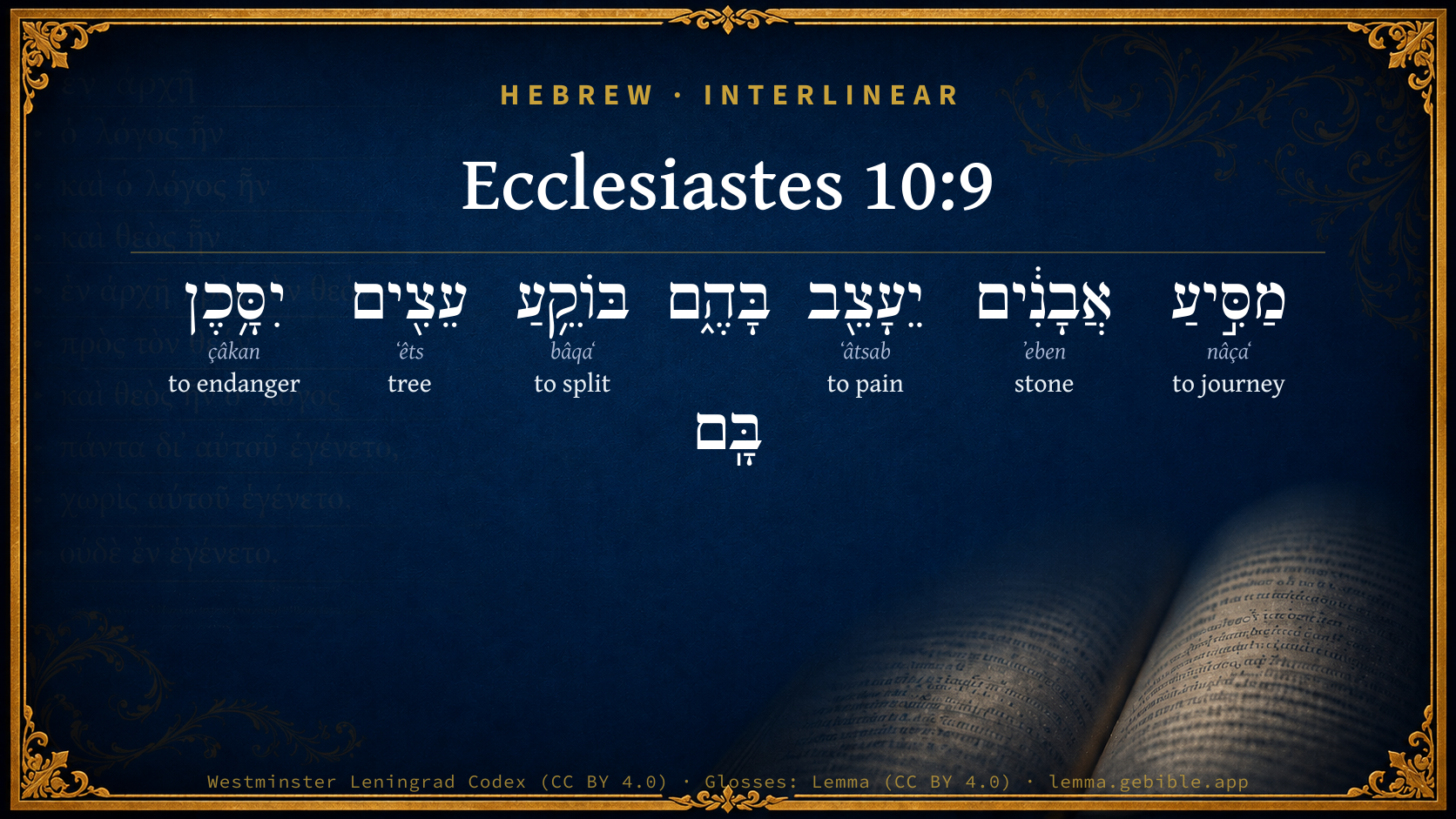
Ecclesiastes 10:9

Hebrew (Westminster Leningrad Codex) Ecclesiastes 10:9 appears in the Hebrew Old Testament. The text above is from the Westminster Leningrad Codex. Each word links to its Strong’s number, a concise gloss, and parsing drawn from the Open Scriptures Hebrew Bible morphology. Click any word for its full Brown-Driver-Briggs (BDB) entry.
Download image
Cite this verse

Ecclesiastes 10:9 (World English Bible). Public Domain. Lemma interlinear Bible study tool, https://lemma.gebible.app/v/ecclesiastes/10/9.

Show BibTeX & RIS
BibTeX
RIS
English Translation
Whoever carves out stones may be injured by them. Whoever splits wood may be endangered thereby.
World English Bible · Public Domain
Highlights
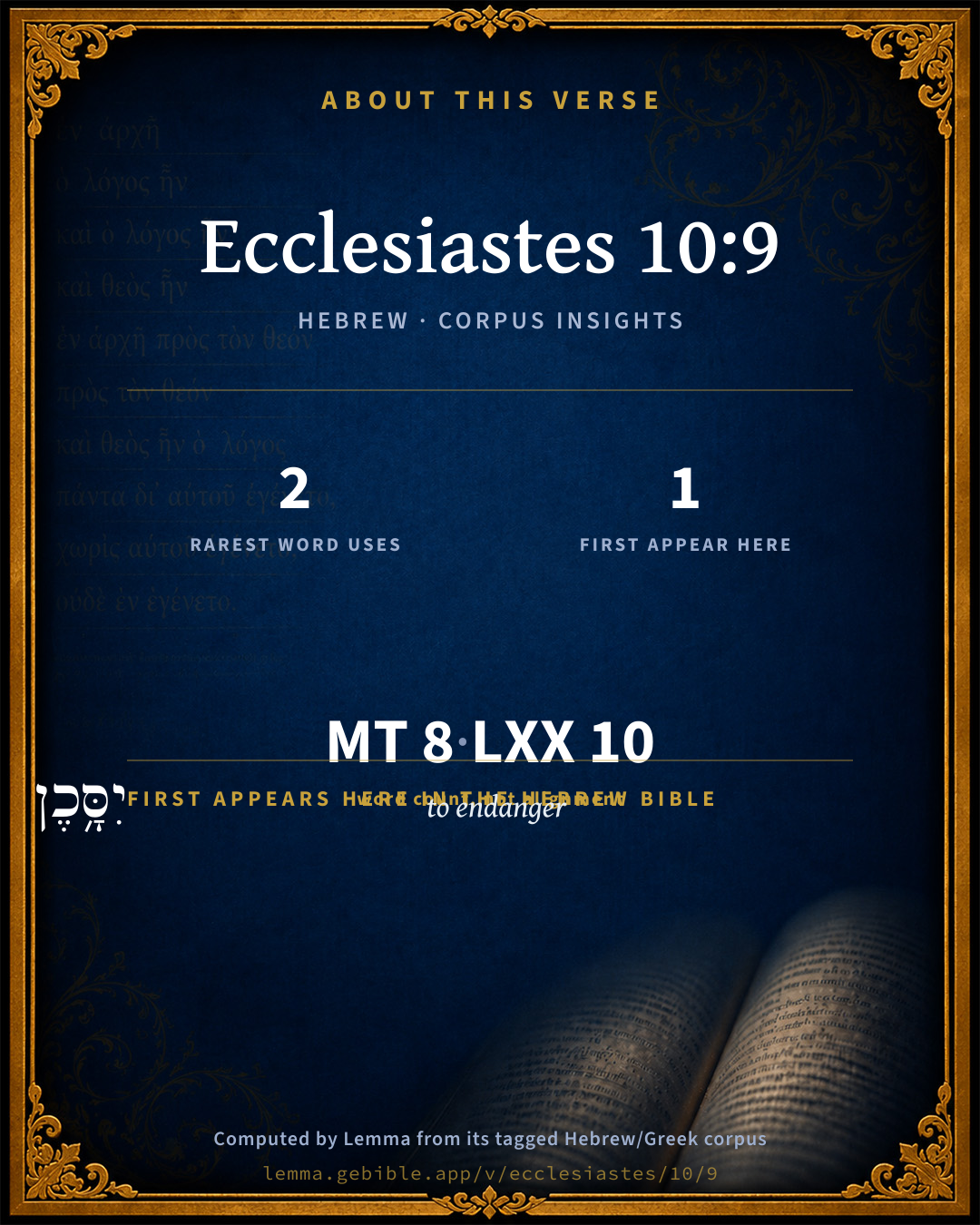
  • 1 first appearance in the Hebrew Bible
Full analysis ↓
Download a study sheet

One document with this verse’s original text, its word-by-word gloss line, the meaning frame, cross-references with their text, attributed commentary, and full source and license credits — printable, and it pastes into notes with its structure intact.

This verse Autodidact and up

Study sheet (.html) Plain text (.txt)

A passage Seminary Student

Up to 50 verses in one chapter. A passage sheet keeps up to 6 commentary sources and 12 cross-references per verse, in the order this page ranks them, and says so on the sheet whenever that leaves anything out. Ask for a single verse and you get the Autodidact verse sheet above.

Everything on this page stays free to read, with no account — the sheet is a download of what is already on screen, not access to it.

Want to remove ads? Support Godless Engineer
Compare translations 3

The same verse in 3 English versions, stacked beneath the original-language interlinear above. Click any original word for its lexicon entry.

Each is an independent rendering of the whole verse — the interlinear is not word-aligned to these translations.

Highlighted words mark where these versions differ — a whole-verse word diff, not a word-by-word alignment.

  • World English Bible Public Domain
    Whoever carves out stones may be injured by them. Whoever splits wood may be endangered thereby.
  • King James Version Public Domain
    Whoso removeth stones shall be hurt therewith; and he that cleaveth wood shall be endangered thereby.
  • unfoldingWord Literal Text CC BY-SA 4.0
    One who pulls up stones will be hurt by them; one who splits wood will be endangered by them.

unfoldingWord Literal Text — © unfoldingWord, licensed CC BY-SA 4.0. Word-aligned USFM3 via Door43 (git.door43.org/unfoldingWord/en_ult).

Versions to compare (up to 4)

3 of 4 selected

Show all 18 translations

Every available English version of this verse, each an independent rendering of the whole verse.

  • World English Bible Public Domain
    Whoever carves out stones may be injured by them. Whoever splits wood may be endangered thereby.
  • Berean Standard Bible Public Domain
    The one who quarries stones may be injured by them, and he who splits logs endangers himself.
  • Majority Standard Bible Public Domain
    The one who quarries stones may be injured by them, and he who splits logs endangers himself.
  • King James Version Public Domain
    Whoso removeth stones shall be hurt therewith; and he that cleaveth wood shall be endangered thereby.
  • American Standard Version (1901) Public Domain
    Whoso heweth out stones shall be hurt therewith; `and' he that cleaveth wood is endangered thereby.
  • Revised Version (1885) Public Domain
    Whoso heweth out stones shall be hurt therewith; and he that cleaveth wood is endangered thereby.
  • Geneva Bible (1599) Public Domain
    He that remooueth stones, shall hurt himselfe thereby, and hee that cutteth wood, shall be in danger thereby.
  • Douay-Rheims (1899) Public Domain
    He that removeth stones, shall be hurt by them: and he that cutteth trees, shall be wounded by them.
  • Young's Literal Translation Public Domain
    Whoso is removing stones is grieved by them, Whoso is cleaving trees endangered by them.
  • Literal Standard Version CC BY-SA 4.0
    Whoever is removing stones is grieved by them, || Whoever is cleaving trees endangered by them.
  • Unlocked Literal Bible CC BY-SA 4.0
    Whoever cuts out stones can be hurt by them, and the man who chops wood is endangered by it.
  • unfoldingWord Literal Text CC BY-SA 4.0
    One who pulls up stones will be hurt by them; one who splits wood will be endangered by them.
  • Darby Bible Public Domain
    Whoso removeth stones is hurt therewith; he that cleaveth wood is endangered thereby.
  • World Messianic Bible Public Domain
    Whoever carves out stones may be injured by them. Whoever splits wood may be endangered by it.
  • Webster's Bible Public Domain
    Whoever removeth stones shall be hurt by them; and he that cleaveth wood shall be endangered by it.
  • Free Bible Version CC BY-SA 4.0
    If you quarry stone, you could be injured. If you split logs, you could be hurt.
  • Bible in Basic English Public Domain
    He who gets out stones from the earth will be damaged by them, and in the cutting of wood there is danger.
  • JPS Tanakh (1917) Public Domain
    Whoso quarrieth stones shall be hurt therewith; and he that cleaveth wood is endangered thereby.

Literal Standard Version (2020), Covenant Press — licensed CC BY-SA 4.0. Text via the HelloAO Bible API (eBible.org). Unlocked Literal Bible (unfoldingWord) — licensed CC BY-SA 4.0. Text via the HelloAO Bible API (eBible.org). unfoldingWord Literal Text — © unfoldingWord, licensed CC BY-SA 4.0. Word-aligned USFM3 via Door43 (git.door43.org/unfoldingWord/en_ult). Free Bible Version, Dr. Jonathan Gallagher — licensed CC BY-SA 4.0. Text via the HelloAO Bible API (eBible.org).

Word by word

More ways to search: Search by grammar → Find every occurrence → Compare this word →

Practice this passage: Drill this verse → Learn its vocabulary →

יִסָּ֥כֶן
çâkan
H5533
“to endanger”
Verb, Niphal, Imperfect, 3rd Person, Masculine, Singular
Part of Speech
Verb
Stem
Niphal
Form
Imperfect
Person
3rd Person
Gender
Masculine
Number
Singular
Full BDB Definition

Origin: probably a denominative from H7915

TWOT: 1495 , 1496

to incur danger - (Niphal) to endanger oneself - to be poor - (Pual) to be impoverished
  1. מַסִּ֣יעַ nâçaʻ H5265 “journeying” Verb, Hiphil, Participle Active, Masculine, Singular, Absolute
  2. אֲבָנִ֔ים ʼeben H68 “stones” Noun, Common, Feminine, Plural, Absolute
  3. יֵעָצֵ֖ב ʻâtsab H6087 “to pain” Verb, Niphal, Imperfect, 3rd Person, Masculine, Singular
  4. בּוֹקֵ֥עַ bâqaʻ H1234 “splitting” Verb, Qal, Participle Active, Masculine, Singular, Absolute
  5. עֵצִ֖ים ʻêts H6086 “trees” Noun, Common, Masculine, Plural, Absolute

About this verse

These counts appear in no published source. They are computed here, from the morphology-tagged text and Lemma’s own curated glosses. What Lemma adds →

8
words
6
distinct lemmas
Wisdom
section

Notable vocabulary

The rarest word here is יִסָּ֥כֶן to endanger H5533 — appearing just 2 times in the whole Hebrew Bible.

First appearance in Scripture

This word makes its first canonical appearance in the Hebrew Bible here:

  • יִסָּ֥כֶן to endanger H5533

Shared distinctive vocabulary

יִסָּ֥כֶן to endanger H5533 occurs in 2 verses of the Hebrew Bible. Also found in:

Grammatical profile

  • 4 verbs
  • 2 nouns
  • 2 prepositions

Verb forms

  • מַסִּ֣יעַ Hiphil · Participle Active
  • יֵעָצֵ֖ב Niphal · Imperfect
  • בּוֹקֵ֥עַ Qal · Participle Active
  • יִסָּ֥כֶן Niphal · Imperfect

Hebrew & Septuagint length

In English translation the verse runs 16 words from the Hebrew and 16 from the Septuagint (LXX English) — the same length.

A rough comparison of the two English renderings, which tokenize alike — not a word-level alignment.

Word counts can differ between the Hebrew and the Greek without any difference in meaning — e.g. the Hebrew direct-object marker אֵת has no separate Greek word, and Greek often adds the article ὁ.

In the original languages it is 8 Hebrew tokens and 10 Greek tokens — but the two are counted differently (Hebrew bundles its prefixes and suffixes into one token; the Greek is in lemma form), so that isn’t a like-for-like length.

Hebrew and Greek witnesses Masoretic Hebrew ↔ Greek Septuagint

The same verse in the two great witnesses to the Old Testament, shown verse-for-verse.

These are two independent witnesses, not word-aligned to each other, and the Septuagint is shown in lemma (dictionary) form.

Hebrew Ecclesiastes 10:9 Masoretic · Westminster Leningrad Codex

מַסִּ֣יעַ אֲבָנִ֔ים יֵעָצֵ֖ב בָּהֶ֑ם בּוֹקֵ֥עַ עֵצִ֖ים יִסָּ֥כֶן בָּֽם

Whoever carves out stones may be injured by them. Whoever splits wood may be endangered thereby.

World English Bible · Public Domain

Greek LXX Ecclesiastes 10:9 Septuagint · lemma form

ἐκαἴρω λίθος διαπονέω ἐν αὐτός σχίζω ξύλον κινδυνεύω ἐν αὐτός

He that removes stones shall be troubled thereby; he that cleaves wood shall be endangered thereby.

LXX2012 (modern English Septuagint) · Public Domain

On this verse, The Pulpit Commentary discusses the Septuagint’s reading. Read the note in Commentary ↓

Hebrew: Westminster Leningrad Codex (CC BY 4.0). Greek: Septuagint (public domain); English from LXX2012 (modern English Septuagint) (Public Domain). How the Septuagint differs from the Hebrew →

Commentary

Notes on Ecclesiastes 10:9 from classic Christian and Jewish commentators (each source and its license shown beneath its notes). The classic Christian expositions comment on the surrounding passage and are grouped to its opening verse, so a note may address several verses; the Jewish commentaries on the Tanakh (Rashi and others) are per-verse, so they appear only where the commentator wrote on this verse.

Lemma curates 59 commentaries, every one of them public domain or Creative Commons licensed, each selected and text-cleaned for this edition rather than reprinted as found. About our sources →

Trapp's Complete Commentary

John Trapp

Ecc 10:9 Whoso removeth stones shall be hurt therewith; [and] he that cleaveth wood shall be endangered thereby.

Ver. 9. Whoso removeth stones shall be hurt therewith.] So he that attempteth to loose and remove the joints and pieces of a settled government, there is danger that, like Samson, he will be crushed in the ruin. So one {a} gives the sense of it: He that goeth about to remove a ruler out of his place, and to divide a settled government that is at unity in itself, undertaketh a dangerous piece of business. As he undertaketh a desperate work, such shall his reward be. It is evil meddling with edged tools, &c., saith another interpreter. {b} Some by "stones" here understand landmarks, which to remove was counted sacrilege among the Romans, and worthy of death. {c} What are they guilty and worthy of, then, that abrogate the good old laws of a land, or the good old ways of God, that have given rest to so many souls? {Jer 6:16} {See Trapp on "Pro 26:27"}

And he that cleaveth wood shall be in danger thereby,] viz., Of breaking his tools, if not his shins, especially if he be a bungler at it. This is to the same sense with the three former similitudes. Cyprian makes use of this text against schismatics, reading it thus: Scindens ligna periclitabitur in eo si exciderit ferrum, {d} He that cleaveth wood shall be endangered thereby, if that the iron fall off. Jerome by "wood" here understands heretics, as being unfruitful and unfit for God’s building, and makes this note upon it, Quamvis sit prudens et doctus vir, {e} &c. Although he be a wise and a learned man, who with the sword of his discourse cutteth this knotty wood, he will be endangered by it, unless he be very careful.

{a} Pemble.

{b} Granger.

{c} Dion. Halic.

{d} Test. ad Quirinum., lib.

{e} Jerome, in loc.

John Trapp, A Commentary or Exposition upon All the Books of the Old and New Testament (1647–1656) — public domain. Text from a community e-Sword module.

The Biblical Illustrator

Joseph S. Exell

Ecc_10:9

Whoso removeth stones shall be hurt therewith; and he that cleaveth wood shall be endangered thereby.

Raising stones and cleaving wood

The precise meaning of the maxim is not quite clear. Some think the stone is part of a cairn that marks a neighbours property, which a man tries to move. The tree, likewise, belongs to a neighbour; and the teaching is, that one who commits acts of aggression upon the property of others will receive his punishment out of the acts themselves. Others find a political reference. The reformer tries to move stones, to remove ancient grievances, or to cut down trees, the upas-trees of hoary abuses, and finds that ancient and deep-seated evils have a deadly power of striking at those who dare to meddle with them. Or, again--and this, the simplest explanation, is to me at least as likely as any other--the cynical author who has found vanity of vanities in every successive sphere of human life observes in these homely words that ordinary honest labour must pay its due of misfortune in this sad world: a man cannot quarry stones to build his house, or cut logs to make up his fire, without risking the misfortune which a cruel fate seems to bring alike on the evil and the good. This interpretation fits in well with the Preachers view of life. Christ came to teach that in His right hand were pleasures for evermore. He came to join in every kind of innocent enjoyment, to teach men that the Father in heaven rejoiced in His childrens joy. He lifted stones and cleft wood in the builders workshop at Nazareth for more than twenty years out of His short life, to show that honest toil brought something else besides danger--that the stone could become a Bethel, and the wood an altar which raiseth the consecrated soul. (J. H. Moulton, D. D.)

The Biblical Illustrator, edited by Joseph S. Exell (c. 1880s–1900s) — public domain. Text from a community e-Sword module.

Jamieson, Fausset & Brown

Robert Jamieson, A. R. Fausset & David Brown

removeth stones--namely, of an ancient building [WEISS]. His neighbor's landmarks [HOLDEN]. Cuts out from the quarry [MAURER].

endangered--by the splinters, or by the head of the hatchet, flying back on himself. Pithy aphorisms are common in the East. The sense is: Violations of true wisdom recoil on the perpetrators.

Jamieson, Fausset & Brown — Commentary Critical and Explanatory on the Whole Bible (1871) — public domain (CC PDM 1.0). Text via the HelloAO Bible API.

Adam Clarke's Commentary

Verse 9. Whoso removeth stones] This verse teaches care and caution. Whoever pulls down an old building is likely to be hurt by the stones; and in cleaving wood many accidents occur for want of sufficient caution.

Adam Clarke's Commentary on the Bible (1810–1826) — public domain. Text from a community e-Sword/MySword module.

Ellicott's Commentary for English Readers

(9) Removeth.—The nearest parallel is 1Ki_5:17, where the word is used with regard to the quarryings, not the removing of stones. For the latter sense, however, there is countenance in 2Ki_4:4, where the word is translated “set aside.”

Cleaveth wood.—Or, cutteth down trees, an operation not free from danger (Deu_19:5).

A Bible Commentary for English Readers, edited by Charles John Ellicott (1878–1897) — public domain. Text from a community e-Sword module.

The Cambridge Bible for Schools and Colleges

gen. ed. J. J. S. Perowne

9. Whoso removeth stones shall be hurt therewith] The words are referred by some commentators to an act like that of the previous verse, by others to hewing stone in the quarry. In the former case, however, we get but a tame repetition, in the latter there is nothing in the act that deserves retribution. We get a more natural meaning, if we think of the curse pronounced on him who “removes his neighbour’s landmark” (Deu_19:14; Deu_27:17). Such landmarks often consisted of cairns or heaps of stones, as in Gen_31:46-48, or a pillar, and the act of removing it would be one of wrongful aggression. For the stone to fall on a man so acting would be once more an instance of the Nemesis which is presented in these similitudes.

he that cleaveth wood shall be endangered thereby] Better, “he that cleaveth trees or logs,” as in Gen_1:11; Gen_2:16; Gen_23:16; Isa_40:20, and elsewhere. Here again the proverb seems to have a double edge. (1) On the one hand it might seem that an act of unjust aggression is contemplated. The special sacredness of trees as standing above most other forms of property is recognised in Deu_20:19-20, and the frequency of accidents in the process was provided for by the special legislation (Deu_19:5), which exempted from penalty one who in this way was the involuntary cause of his neighbour’s death. The primary thought in the saying, so taken, is, as before, that retribution comes on the evil-doer out of the very deed of evil. Out of our “pleasant vices” the gods “make whips to scourge us.” The attack on sacred and time-honoured institutions is not without peril. (2) On the other hand, eastern as well as western thought recognises in decayed trees the types of corrupt institutions that need to be reformed, and, as in the last proverb, the work of the reformer is not always a safe or easy one. Popular political rhetoric has made us familiar both with the appeal to “spare the tree” under the shadow of whose branches our fathers lived, and with that which bids men lop branch after branch from the “deadly Upas” of oppression and iniquity, especially of corrupt kingdoms (Isa_14:8; Jer_51:15; Eze_34:3; Dan_9:10; Dan_9:14; Mat_3:10; Luk_13:7; Luk_13:9).

The Cambridge Bible for Schools and Colleges (gen. ed. J. J. S. Perowne; Cambridge University Press, 1878–1918) — public domain. Text from a community e-Sword module.

John Gill's Exposition

Whoso removeth stones shall be hurt therewith,.... That carries them from the quarry, where they are dug; or takes them from a heap, where they lie; or that attempts to pull them out of a building, where they are put; or removes them from places, where they are set as boundaries and landmarks; all which is troublesome, and by which men get hurt; the stones fall upon them, or are too heavy for them, or they do what they should not do, and so bring themselves into trouble; as do all such persons who are for removing the boundaries of commonwealths and communities, and for changing laws, and altering constitutions;

and he that cleaveth wood shall be endangered thereby; of cutting himself: so he that soweth discord among brethren, that makes divisions in families, neighbourhoods, kingdoms, and churches; see Pro 6:16, Rom 16:18. Jarchi renders it, "shall be warmed" or "heated", according to the sense of the word, as he thinks, in Kg1 1:2; though he understands it of being profited by studying in the law and the commandments; of which he interprets the clause; and Ben Melech observes, that the word so signifies in the Arabic language; and Mr. Broughton renders it, "shall be heated thereby". The Targum paraphrases it,

"shall be burnt with fire, by the hand of the Angel of the Lord:''

or, however, he may be overheated and do himself hurt, as men, that kindle the flame of contention and strife, often do.

John Gill's Exposition of the Whole Bible (1746–1763) — public domain (CC PDM 1.0). Text via the HelloAO Bible API.

Haydock's Catholic Bible Commentary

Stones. Landmarks or walls, Proverbs xxii. 18. --- Them. God will punish his injustice, in meddling with another’s property.

George Leo Haydock (1774–1849), Haydock's Catholic Family Bible and Commentary, 1859 edition — public domain. Excludes Psalms (Douay-Rheims chapter numbering differs from Protestant) and Deuterocanonical books (Catholic canon only).

Matthew Poole's English Annotations

Whoso removeth stones; either,

1. The stones which belong to others, and limit or distinguish their grounds, of which see Deu 27:17. Or,

2. Great stones too heavy for them; which rashly attempt things too high and hard for them; which seems better to agree with the following clause than the former interpretation doth.

Shall be hurt therewith; may easily receive hurt by the stones falling unexpectedly and violently upon him.

He that cleaveth wood, with an iron instrument, as the manner is, he being unskilful in that art. Possibly he designs a man who causeth discord and mischief among friends, or in a family, or kingdom.

Shall be endangered thereby; may peradventure cut himself.

Matthew Poole's English Annotations on the Holy Bible (1683–1685) — public domain. Text from a community e-Sword/MySword module.

Whedon's Commentary on the Bible

Daniel D. Whedon

9. Whoso removeth stones — This removing of stones is probably to be referred to the tearing down of buildings, etc., which is always attended with some danger.

Cleaveth wood — Referring not to the simple preparation of wood for fuel, but to the taking down the timbers of a dwelling. The thought running through these connected illustrations is, that as to take down a building is a perilous process, much more to take down and reconstruct a government, in order to be rid of a tyrant, is a dangerous undertaking.

Daniel D. Whedon (gen. ed.), Commentary on the Old and New Testaments (1874–1909) — public domain. Text from a community e-Sword module.

The Pulpit Commentary

Whoso removeth stones shall be hurt therewith. It is natural to consider this clause as suggested by the breaking of a wall in the preceding verse; but as this would occasion a jejune repetition, it is better to take it of the work of the quarryman, as in 1Ki_5:17, where the same verb is used. The dangers to which such laborers are exposed are well known. Here, again, but unsuccessfully, some have seen a reference to the removal of landmarks, comparing 2Ki_4:4, where the word is translated "set aside." As before said, the paragraph does not speak of retribution, but advises caution, enforcing the lesson by certain homely, allusions to the accidents that may occur m customary occupations. He that cleaveth wood shall be endangered thereby. Cutting up logs of wood, a man may hurt himself with axe or saw, or be injured by splinters, etc. If we take the idea to be the felling of trees, there is the danger of being crushed in their fall, or, according to the tenor of sei Deu_19:5, of being killed inadvertently by a neighbor"s axe. Vulgate, Qui scindit ligna vulnerabitur ab eis, which is more definite than the general term "endangered;" but the Septuagint has, Kinduneu) ejn aujtoiv, as in the Authorized Version. Plumptre sees here, again, an intimation of the danger of attacking time-honored institutions, even when decaying and corrupt.

Vers. 9 (latter part), 10.

Good workmanship ourselves and our tools.

This much-debated passage may suggest to us some lessons which may not have been in the mind of the Preacher, but which are appropriate to our time and our circumstances. The question of how much work a man can do is one that depends on two things on his own strength and skill, and on the quality of the tools he is using. A weak and untried man with poor tools will not do half as much as a strong experienced man with good ones in his hand.

I THE FIELD OF WORK. This is very broad; it includes not only:

1. All manual labor, to which the passage more immediately applies; but:

2. All business transactions, all household activities, all matters of government in which men are often "the tools" with which work is done. And it includes that to which our attention may be especially directed:

1. All Christian work. This is a great field of its own, with a vast amount of work demanding to be done. Here is work

1. of vast magnitude;

2. of great delicacy;

3. of extreme difficulty,

for it means nothing less than that change of condition which results from a change of heart and life. In view of this particular field we regard

II THE CONDITIONS OF GOOD WORKMANSHIP. And these are:

1. Good tools. Of these tools are:

(1) Divine truth; and to be really good for the great purpose we have at heart we need to hold and to utter this truth in

(a) its integrity, not presenting or exaggerating one or two aspects only, but offering it in its fullness and symmetry;

(b) its purity, uncorrupted by the imaginations and accretions of our own mind;

(c) its adaptation to the special spiritual needs of those to whom we minister.

(2) An elastic organization; not such as will not admit of suiting the necessities of men as they arise, but one that is flexible, and that will lend itself to the ever-varying conditions, spiritual and temporal, in which men are found, and in which they have to be helped and healed.

2. Good workmen. Those that have:

(1) Wisdom "profitable to direct," that have tools, skill, discretion, a sound judgment, a comprehensive view.

(2) Strength; those who can use bad tools if good ones are not at hand, who can work on with sustained energy, who can "bear the burden and heat of the day," who can stand criticism and censoriousness, who will not be daunted by apparent failure or by occasional desertion, who can wait "with long patience" for the day of harvest.

1. Seek to be supplied with the most perfect tools in Christian work; for not only will good tools do much more work than poor ones, but bad tools will result in mischief to the workman. "He that cleaveth is endangered." Half-truths, or truth unbalanced by its complement, or a badly constructed organization, may do real and serious harm to those who preach the one or work through the other.

2. Put your whole strength physical, mental, spiritual into the work of the Lord. With the very best tools we can wield, we shall wish we had done more than we shall have accomplished, when our last blow has been struck for the Master and for mankind. C.

The Pulpit Commentary (1880–1919), ed. H.D.M. Spence-Jones & Joseph S. Exell — public domain. Text from a community e-Sword module.

John Wesley's Explanatory Notes

Whoso removeth - Stones too heavy for them: who rashly attempts things too high and hard for them.

John Wesley, Explanatory Notes Upon the Whole Bible (1754–1765) — public domain. Text via the GEBible commentary corpus.

Rashi

Rabbi Shlomo Yitzchaki (Rashi)

One who quarries stones shall be wearied by them One who takes stones from their quarry in the mountains is fatigued by them.

יִעָצֵב is an expression of weariness, like (Gen. 3:17): “with toil (בְּעִצָבוֹן) shall you eat it,” i.e., every man, according to his work is his weariness. So will he who commits evil reap according to what he sows.

shall be warmed by it יִסָכֶן בָּם, shall be warmed by it, like (I Kings 1:2): “and she shall be to him a warmer (סֹכֶנֶת).” So will one who engages in the Torah and in the precepts ultimately benefit from them.

Rashi on the Tanakh — English translations: “The Judaica Press complete Tanach with Rashi, translated by A. J. Rosenberg” (CC BY 4.0); “Pentateuch with Rashi's commentary by M. Rosenbaum and A.M. Silbermann, 1929-1934” (public domain); “The Metsudah Tanach series, Lakewood, N.J” (CC BY 4.0); and “The Book of Joshua, Metsudah Publications, 1997” (CC BY 4.0). Text via Sefaria.

Lesson kit

Teaching starters — assembled from the data on this page, not authored interpretation. Every prompt links to the verse data it draws on. Edit before teaching.

Ecclesiastes, in the Wisdom, opens this verse with 8 words (6 distinct Hebrew lemmas). Its most distinctive word is çâkan (“to endanger”). A historical commentator’s framing appears above. Read the whole chapter for the surrounding context.

Discussion questions

  1. How does “to endanger” (çâkan) shape what this verse is saying?
  2. The word “to endanger” first appears here in Scripture. What is being introduced at this debut?
  3. Isaiah 40:20 shares the word «to endanger» with this verse. How do the two illuminate each other?
  4. These translations render this verse differently; the difference is in the English rendering, not the original. What questions does that raise?
  5. The verb «מַסִּ֣יעַ» is Hiphil Participle Active. How does its form color the action?
  6. Reading how Trapp's Complete Commentary and The Biblical Illustrator read this verse, where do the two commentators agree and where do they part?

Things to notice

Reading settings

Reading text

Shown beneath each verse's original-language words.

Old Testament
Old Testament edition

Read the OT as the Masoretic Hebrew (MT) or the Greek Septuagint (LXX).

English shown for the Greek Septuagint (in the Hebrew ↔ Greek comparison).

Comparing translations? Open the Compare panel on any verse page to stack up to four side by side.