
Numbers 33:45

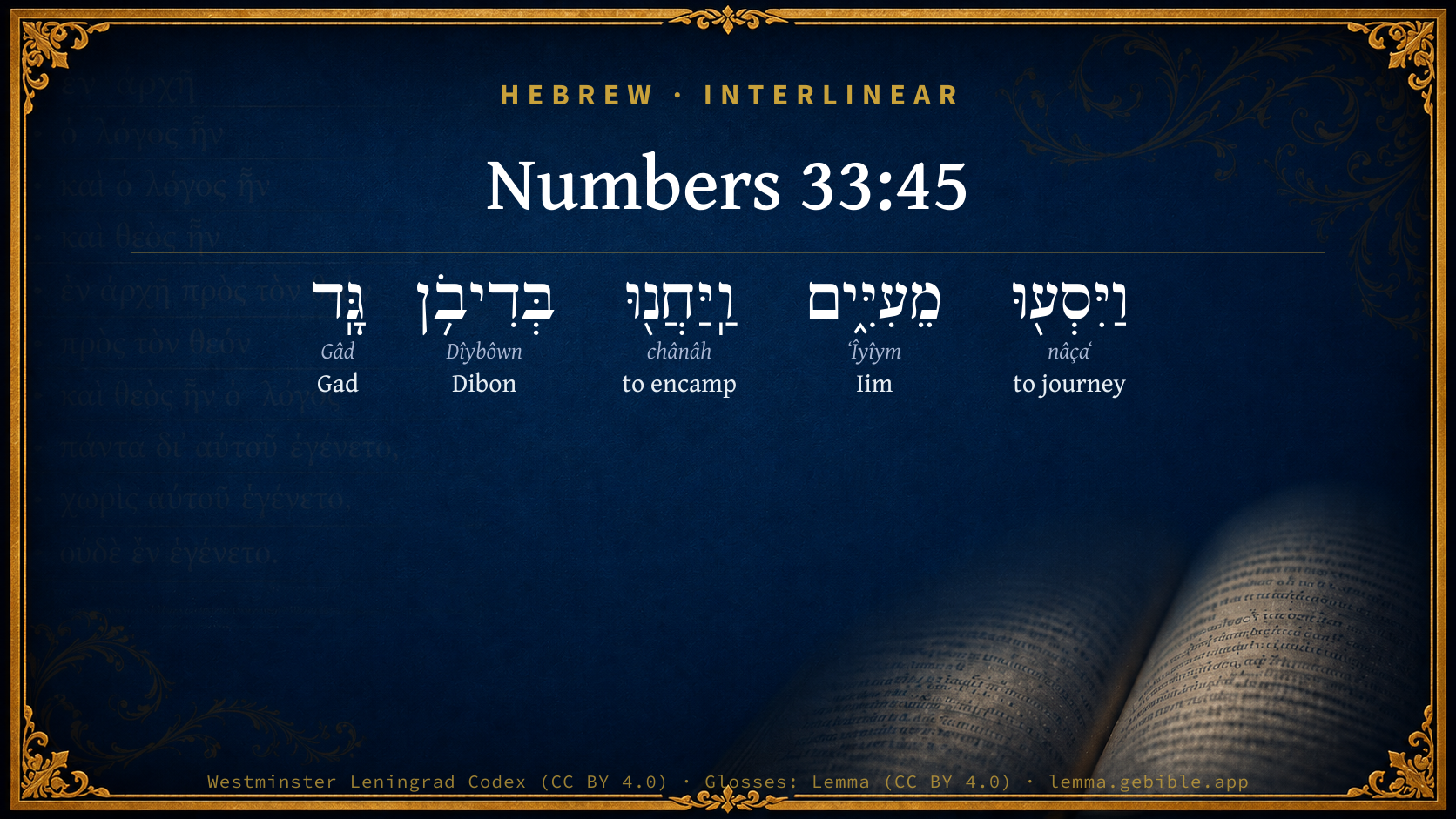
Hebrew (Westminster Leningrad Codex) Numbers 33:45 appears in the Hebrew Old Testament. The text above is from the Westminster Leningrad Codex. Each word links to its Strong’s number, a concise gloss, and parsing drawn from the Open Scriptures Hebrew Bible morphology. Click any word for its full Brown-Driver-Briggs (BDB) entry.
Download image
Cite this verse

Numbers 33:45 (World English Bible). Public Domain. Lemma interlinear Bible study tool, https://lemma.gebible.app/v/numbers/33/45.

Show BibTeX & RIS
BibTeX
RIS
English Translation
They traveled from Iyim, and encamped in Dibon-gad.
World English Bible · Public Domain
Highlights
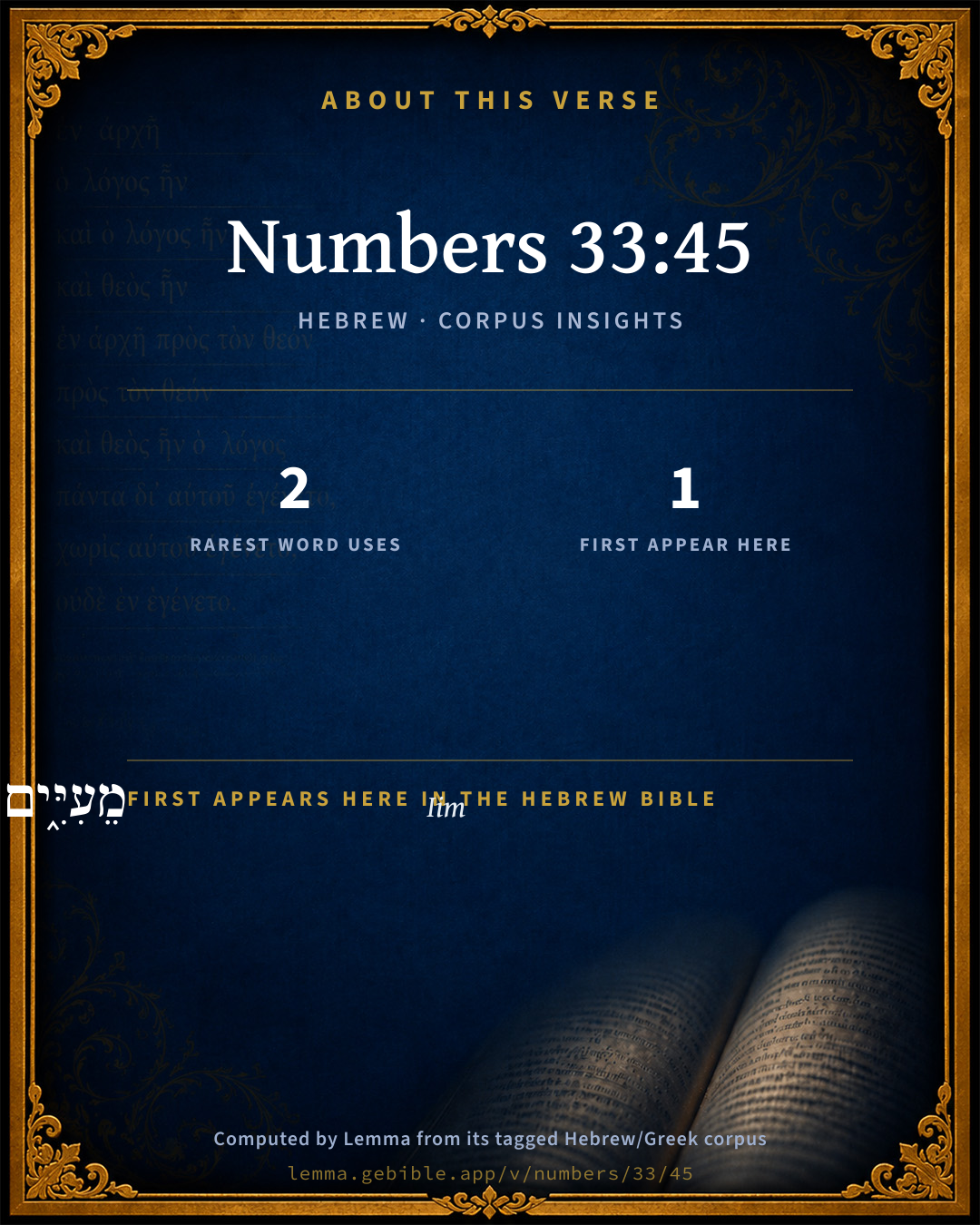
  • 1 first appearance in the Hebrew Bible
Full analysis ↓
Download a study sheet

One document with this verse’s original text, its word-by-word gloss line, the meaning frame, cross-references with their text, attributed commentary, and full source and license credits — printable, and it pastes into notes with its structure intact.

This verse Autodidact and up

Study sheet (.html) Plain text (.txt)

A passage Seminary Student

Up to 50 verses in one chapter. A passage sheet keeps up to 6 commentary sources and 12 cross-references per verse, in the order this page ranks them, and says so on the sheet whenever that leaves anything out. Ask for a single verse and you get the Autodidact verse sheet above.

Everything on this page stays free to read, with no account — the sheet is a download of what is already on screen, not access to it.

Want to remove ads? Support Godless Engineer
Compare translations 3

The same verse in 3 English versions, stacked beneath the original-language interlinear above. Click any original word for its lexicon entry.

Each is an independent rendering of the whole verse — the interlinear is not word-aligned to these translations.

Highlighted words mark where these versions differ — a whole-verse word diff, not a word-by-word alignment.

  • World English Bible Public Domain
    They traveled from Iyim, and encamped in Dibon-gad.
  • King James Version Public Domain
    And they departed from Iim, and pitched in Dibongad.
  • unfoldingWord Literal Text CC BY-SA 4.0
    And they set out from Iye and camped at Dibon Gad.

unfoldingWord Literal Text — © unfoldingWord, licensed CC BY-SA 4.0. Word-aligned USFM3 via Door43 (git.door43.org/unfoldingWord/en_ult).

Versions to compare (up to 4)

3 of 4 selected

Show all 18 translations

Every available English version of this verse, each an independent rendering of the whole verse.

  • World English Bible Public Domain
    They traveled from Iyim, and encamped in Dibon-gad.
  • Berean Standard Bible Public Domain
    They set out from Iyim and camped at Dibon-gad.
  • Majority Standard Bible Public Domain
    They set out from Iyim and camped at Dibon-gad.
  • King James Version Public Domain
    And they departed from Iim, and pitched in Dibongad.
  • American Standard Version (1901) Public Domain
    And they journeyed from Iyim, and encamped in Dibon-gad.
  • Revised Version (1885) Public Domain
    And they journeyed from Iyim, and pitched in Dibon-gad.
  • Geneva Bible (1599) Public Domain
    And they departed from Iim, and pitched in Dibon-gad.
  • Douay-Rheims (1899) Public Domain
    And departing from Ijeabarim they pitched their tents in Dibongab.
  • Young's Literal Translation Public Domain
    And they journey from Iim, and encamp in Dibon-Gad;
  • Literal Standard Version CC BY-SA 4.0
    And they journey from Iim and encamp in Dibon-Gad.
  • Unlocked Literal Bible CC BY-SA 4.0
    They set out from Iye Abarim and camped at Dibon Gad.
  • unfoldingWord Literal Text CC BY-SA 4.0
    And they set out from Iye and camped at Dibon Gad.
  • Darby Bible Public Domain
    And they removed from Ijim, and encamped in Dibon-Gad.
  • World Messianic Bible Public Domain
    They traveled from Iyim, and encamped in Dibon Gad.
  • Webster's Bible Public Domain
    And they departed from Iim, and encamped in Dibon-gad.
  • Free Bible Version CC BY-SA 4.0
    They moved on from Iye-abarim and set up camp at Dibon-gad.
  • Bible in Basic English Public Domain
    And they went on from Iyim, and put up their tents in Dibon-gad.
  • JPS Tanakh (1917) Public Domain
    And they journeyed from Ijim, and pitched in Dibon-gad.

Literal Standard Version (2020), Covenant Press — licensed CC BY-SA 4.0. Text via the HelloAO Bible API (eBible.org). Unlocked Literal Bible (unfoldingWord) — licensed CC BY-SA 4.0. Text via the HelloAO Bible API (eBible.org). unfoldingWord Literal Text — © unfoldingWord, licensed CC BY-SA 4.0. Word-aligned USFM3 via Door43 (git.door43.org/unfoldingWord/en_ult). Free Bible Version, Dr. Jonathan Gallagher — licensed CC BY-SA 4.0. Text via the HelloAO Bible API (eBible.org).

Word by word

More ways to search: Search by grammar → Find every occurrence → Compare this word →

Practice this passage: Drill this verse → Learn its vocabulary →

About this verse

These counts appear in no published source. They are computed here, from the morphology-tagged text and Lemma’s own curated glosses. What Lemma adds →

5
words
5
distinct lemmas
Pentateuch
section

Notable vocabulary

The rarest word here is מֵעִיִּ֑ים Iim H5864 — appearing just 2 times in the whole Hebrew Bible.

First appearance in Scripture

This word makes its first canonical appearance in the Hebrew Bible here:

  • מֵעִיִּ֑ים Iim H5864

Shared distinctive vocabulary

מֵעִיִּ֑ים Iim H5864 occurs in 2 verses of the Hebrew Bible. Also found in:

Grammatical profile

  • 2 verbs
  • 3 nouns

Verb forms

  • וַיִּסְע֖וּ Qal · Sequential Imperfect
  • וַֽיַּחֲנ֖וּ Qal · Sequential Imperfect

Hebrew & Septuagint length

In English translation the verse runs 8 words from the Hebrew and 10 from the Septuagint (LXX English) — closely comparable.

A rough comparison of the two English renderings, which tokenize alike — not a word-level alignment.

Word counts can differ between the Hebrew and the Greek without any difference in meaning — e.g. the Hebrew direct-object marker אֵת has no separate Greek word, and Greek often adds the article ὁ.

Hebrew and Greek witnesses Masoretic Hebrew ↔ Greek Septuagint

The same verse in the two great witnesses to the Old Testament, shown verse-for-verse.

These are two independent witnesses, not word-aligned to each other, and the Septuagint is shown in lemma (dictionary) form.

Hebrew Numbers 33:45 Masoretic · Westminster Leningrad Codex

וַיִּסְע֖וּ מֵעִיִּ֑ים וַֽיַּחֲנ֖וּ בְּדִיבֹ֥ן גָּֽד

They traveled from Iyim, and encamped in Dibon-gad.

World English Bible · Public Domain

Greek LXX Numbers 33:45 Septuagint · lemma form

καί ἀποαἴρω ἐκ γαι καί παρα ἐνβάλλω εἰς δαιβων γαδ

And they departed from Gai, and encamped in Daebon Gad.

LXX2012 (modern English Septuagint) · Public Domain

Hebrew: Westminster Leningrad Codex (CC BY 4.0). Greek: Septuagint (public domain); English from LXX2012 (modern English Septuagint) (Public Domain). How the Septuagint differs from the Hebrew →

Targum (Aramaic paraphrase)

2

The Targum is the ancient Jewish Aramaic paraphrase of the Hebrew Scriptures — an interpretive translation, not the Hebrew text itself. Onkelos (literal) and Pseudo-Jonathan (expansive) render the Torah, and Jonathan the Prophets. Coverage is partial: where no permissively-licensed English translation exists for a verse, only the Aramaic is shown. This is verse-level text, not a word-by-word alignment to the Hebrew.

  1. Targum Onkelos Torah (Genesis–Deuteronomy)
    וּנְטָלוּ מִמְגִזָתָא וּשְׁרוֹ בּדִיבוֹן גָד

    (no public-domain English translation for this verse)

    Targum Onkelos — Aramaic: “Onkelos Genesis” (public domain); “Onkelos Exodus” (public domain); “Onkelos Leviticus” (public domain); “Onkelos Numbers” (public domain); “Onkelos Deuteronomy” (public domain). English: “Sefaria Community Translation” (CC0 1.0 (public-domain dedication)); “J.W. Etheridge. The Targums of Onkelos and Jonathan Ben Uzziel on the Pentateuch. London: Longmans, Green, 1862” (public domain). Text via Sefaria.

  2. Targum Pseudo-Jonathan Torah (Genesis–Deuteronomy)
    וּנְטָלוּ מִמְגִיזְתָּא וּשְׁרוֹ בְּדִיבוֹן בֵּית מַזְלָא

    thence to Dibon, the place of fortune;

    Targum Pseudo-Jonathan — Aramaic: “Targum Jonathan on Genesis” (public domain); “Targum Jonathan on Exodus” (public domain); “Targum Jonathan on Leviticus” (public domain); “Targum Jonathan on Numbers” (public domain); “Targum Jonathan on Deuteronomy” (public domain). English: “The Targum of Jonathan ben Uzziel, trans. J. W. Etheridge, London, 1862” (public domain). Text via Sefaria.

Commentary

Notes on Numbers 33:45 from classic Christian and Jewish commentators (each source and its license shown beneath its notes). The classic Christian expositions comment on the surrounding passage and are grouped to its opening verse, so a note may address several verses; the Jewish commentaries on the Tanakh (Rashi and others) are per-verse, so they appear only where the commentator wrote on this verse.

Lemma curates 59 commentaries, every one of them public domain or Creative Commons licensed, each selected and text-cleaned for this edition rather than reprinted as found. About our sources →

Ellicott's Commentary for English Readers

(45) From Iim.—Instead of the seven intermediate stations between Ijim, or Iie-abarim, and the plains of Moab, which are mentioned in Num_21:11-20, we find only three mentioned in this chapter: viz., Dibon of Gad, Almon-diblathaim, and Mount Abarim before Nebo, none of which agree in name with the stations mentioned in Numbers 21. In regard to the number of stations, the diversity may probably be explained on the supposition that Numbers 21 mentions those stations only which were of historical importance—as, e.g., those from which any military expedition was made—whilst Numbers 33 appears to mention every place in which an organised camp was erected, and in which the Tent of Meeting was formally set up. If this supposition be correct, no difficulty is involved in the fact that fewer stations are named between Mount Hor and Ije-abarim in Numbers 21 than in Numbers 33, whilst more stations are. named between Ije-abarim and Arboth-Moab in Numbers 33 than in Numbers 21. There is a further diversity, however, in the two accounts as regards the names of the intermediate stations between Ije-abarim and the plains of Moab. In respect of the stations between Mount Hor and Ije-abarim, if we suppose Zalmonah to have been the station at which the brazen serpent was set up (see Num_21:10, and Note), the difference between the two accounts consists only in the insertion in Numbers 33 of the station at Punon, between Zalmonah and Oboth. In respect of the stations, however, between Ije-abarim and Arboth-Moab there is not only a difference in the number, but also in the names of the stations. But this difference is easily accounted for when it is remembered that a host consisting of 600,000 men, with their wives, children, and cattle, must have extended over a large area, and, in the case of an inhabited country in which towns and villages abounded, may have occupied more than one of these at the same time. (Comp. Num_33:49, where the Israelites are represented as encamping “from Beth-jesimoth even unto Abel-shittim.”) Hence there is no difficulty in connecting the formal encampment at Dibon of Gad (Num_33:45) with some one or more of the stations on the north of the Arnon mentioned in Num_23:13-19, or in connecting Almon-diblathaim, which appears to have been situated on the north or north-west of Dibon (Comp. Jer_48:22, where Beth-diblathaim is mentioned in conjunction with Dibon and Nebo) with Bamoth—i.e., heights—which, if identical with Bamoth-Baal (Num_22:4), is mentioned by Joshua (Jos_13:17) in immediate connection with Dibon. In regard to the last station named in this chapter before the encampment in the plains of Moab—viz., “the mountains of Abarim, before Nebo”—there can be no doubt as to the identity of the station with that in “the valley in the country (or, field) of Moab, at the top of Pisgah,” in Num_21:20. According to Deu_34:1, Mount Nebo was a peak of Pisgah, which, as we learn from Deu_32:49, was one of the mountains of Abarim; and the place of the burial of Moses, who died upon the top of Pisgah, is described as “the valley”—i.e., the well-known valley—“in the land of Moab” (Deu_34:6).

In Dibon-gad.—Or, Dibon of Gad. The reference is probably to the fact which has already been mentioned in Num_32:34, that the children of Gad rebuilt or fortified Dibon, which stood on the northern side of the river Arnon, and which is one of the towns named in Num_32:3 as situated in that portion of the country which the Reubenites and the Gadites desired to possess.

A Bible Commentary for English Readers, edited by Charles John Ellicott (1878–1897) — public domain. Text from a community e-Sword module.

Adam Clarke's Commentary

STAT. XXXVIII.

Verse 45. DIBON-GAD.] Supposed to be the same as Dibon, Nu 32:34, and to be situated on the brook Arnon.

Adam Clarke's Commentary on the Bible (1810–1826) — public domain. Text from a community e-Sword/MySword module.

John Gill's Exposition

Then ye shall drive out all the inhabitants of the land from before you,.... Not at once, but gradually; and the sense is, that they should use their utmost endeavours wholly to extirpate them:

and destroy all their pictures; their idolatrous ones; the pictures of their gods, or the statues and figured stones of them: the Targum of Jonathan interprets it,"all the temples of their worship;''and the Jerusalem Targum,"all their idols;''so called, as Jarchi notes, because they covered the floor with a pavement of marble stones, to worship upon them by the stretching out of their hands and feet, according to Lev 26:1,

and destroy all their molten images; of gold, silver, &c.

and quite pluck down all their high places; their temples, groves, and altars built upon them.

John Gill's Exposition of the Whole Bible (1746–1763) — public domain (CC PDM 1.0). Text via the HelloAO Bible API.

Haydock's Catholic Bible Commentary

Dibongad, is often called Dibon. Moses observes, (chap. xxi.) that the Hebrews passed by or encamped at various places, before they came to this town. It is sometimes attributed to Ruben, and at other times to Gad, being on the confines of both tribes. (Calmet)

George Leo Haydock (1774–1849), Haydock's Catholic Family Bible and Commentary, 1859 edition — public domain. Excludes Psalms (Douay-Rheims chapter numbering differs from Protestant) and Deuterocanonical books (Catholic canon only).

Matthew Poole's English Annotations

Iim, rather Ijim, i.e. the heaps, as the word signifies, even the heaps of Abarim, last mentioned; the Hebrew word is the same with Ije, Num 33:44, only there it is in the construed, and here in the absolute, form. Dibon-gad; so called partly by way of distinction of this from another Dibon, in the portion of Reuben, Jos 13:17, and partly, because it was rebuilt by the tribe of Gad.

Matthew Poole's English Annotations on the Holy Bible (1683–1685) — public domain. Text from a community e-Sword/MySword module.

Whedon's Commentary on the Bible

Daniel D. Whedon

45. Iim is Ije-abarim abbreviated.

Dibon-gad — Dibon, rebuilt by the Gadites after the conquest of the land, (Num_32:3; Num_32:34, notes,) and allotted to Reuben.

Daniel D. Whedon (gen. ed.), Commentary on the Old and New Testaments (1874–1909) — public domain. Text from a community e-Sword module.

The Pulpit Commentary

Dibon-gad. This encampment may have been the same as that previously called by the name of Nabaliel or Bamoth. (Num_21:19, and see on Num_33:34) Several stages are here passed over in the Itinerary. At a time when the conquest and partial occupation of large districts was going on, it would be hard to say what regular stages were made by the host as such (see note at end of chapter).

The Pulpit Commentary (1880–1919), ed. H.D.M. Spence-Jones & Joseph S. Exell — public domain. Text from a community e-Sword module.

Lesson kit

Teaching starters — assembled from the data on this page, not authored interpretation. Every prompt links to the verse data it draws on. Edit before teaching.

Numbers, in the Pentateuch, opens this verse with 5 words (5 distinct Hebrew lemmas). Its most distinctive word is ʻÎyîym (“Iim”). A historical commentator’s framing appears above. Read the whole chapter for the surrounding context.

Discussion questions

  1. What does “Iim” (ʻÎyîym) contribute to the verse as a whole?
  2. This is the first place “Iim” appears in Scripture (first appears here). What does its debut here establish?
  3. How does Joshua 15:29, which shares the word «Iim», read alongside this verse?
  4. The translations on this page render this verse differently — a whole-verse word diff, not a word-by-word alignment. What might account for the different wordings?
  5. «וַיִּסְע֖וּ» is a Qal Sequential Imperfect verb. How does that grammatical form shape the action described?
  6. Compare how Ellicott's Commentary for English Readers and Adam Clarke's Commentary read this verse. Where do they agree or differ?

Things to notice

Reading settings

Reading text

Shown beneath each verse's original-language words.

Old Testament
Old Testament edition

Read the OT as the Masoretic Hebrew (MT) or the Greek Septuagint (LXX).

English shown for the Greek Septuagint (in the Hebrew ↔ Greek comparison).

Comparing translations? Open the Compare panel on any verse page to stack up to four side by side.