Numbers 9:23

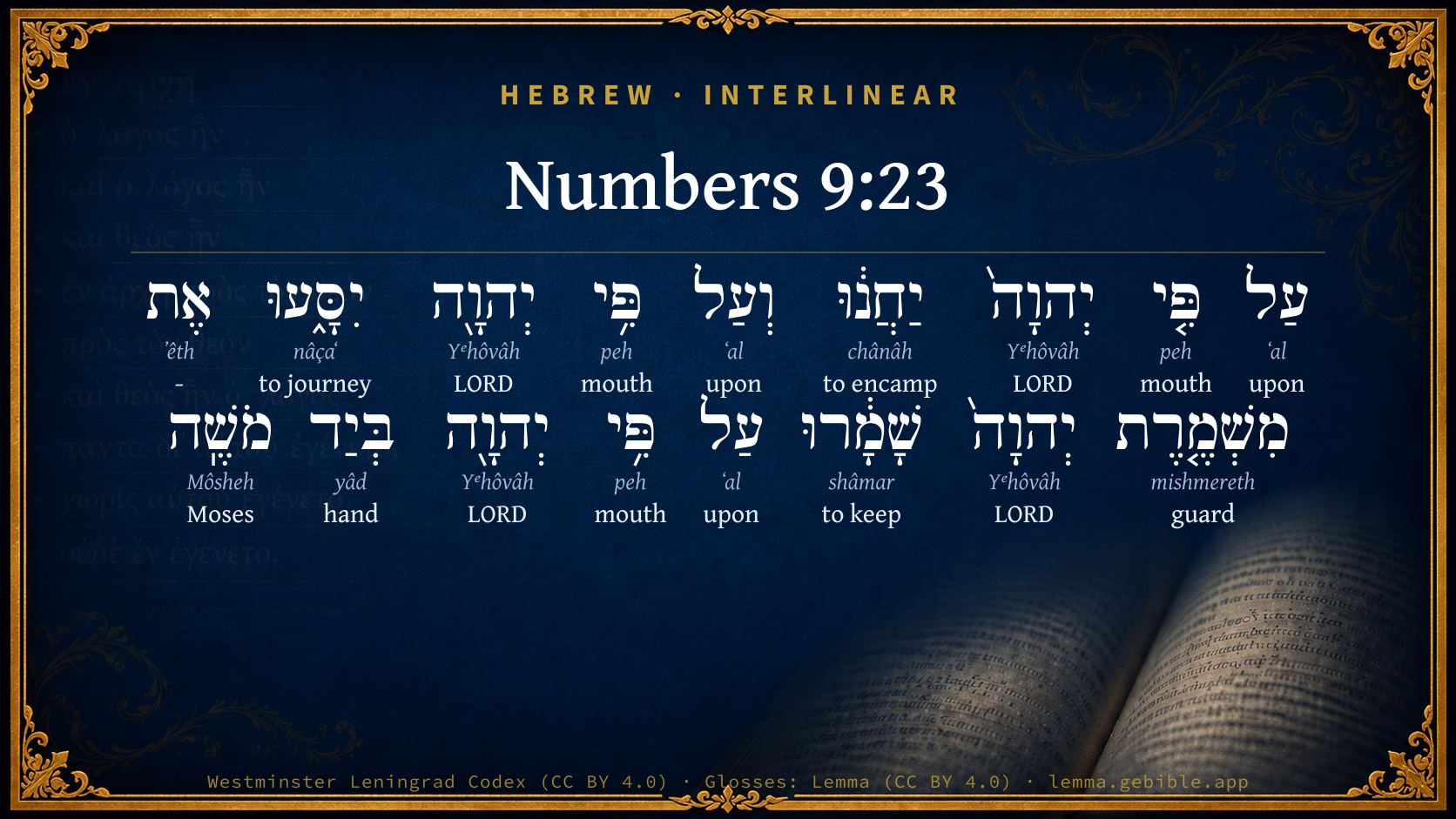
Hebrew (Westminster Leningrad Codex) Numbers 9:23 appears in the Hebrew Old Testament. The text above is from the Westminster Leningrad Codex. Each word links to its Strong’s number, a concise gloss, and parsing drawn from the Open Scriptures Hebrew Bible morphology. Click any word for its full Brown-Driver-Briggs (BDB) entry.
Download image
Cite this verse

Numbers 9:23 (World English Bible). Public Domain. Lemma interlinear Bible study tool, https://lemma.gebible.app/v/numbers/9/23.

Show BibTeX & RIS
BibTeX
RIS
English Translation
At the commandment of Yahweh they encamped, and at the commandment of Yahweh they traveled. They kept the charge of Yahweh, at the commandment of Yahweh by Moses.
World English Bible · Public Domain
Download a study sheet

One document with this verse’s original text, its word-by-word gloss line, the meaning frame, cross-references with their text, attributed commentary, and full source and license credits — printable, and it pastes into notes with its structure intact.

This verse Autodidact and up

Study sheet (.html) Plain text (.txt)

A passage Seminary Student

Up to 50 verses in one chapter. A passage sheet keeps up to 6 commentary sources and 12 cross-references per verse, in the order this page ranks them, and says so on the sheet whenever that leaves anything out. Ask for a single verse and you get the Autodidact verse sheet above.

Everything on this page stays free to read, with no account — the sheet is a download of what is already on screen, not access to it.

Want to remove ads? Support Godless Engineer
Compare translations 3

The same verse in 3 English versions, stacked beneath the original-language interlinear above. Click any original word for its lexicon entry.

Each is an independent rendering of the whole verse — the interlinear is not word-aligned to these translations.

Highlighted words mark where these versions differ — a whole-verse word diff, not a word-by-word alignment.

  • World English Bible Public Domain
    At the commandment of Yahweh they encamped, and at the commandment of Yahweh they traveled. They kept the charge of Yahweh, at the commandment of Yahweh by Moses.
  • King James Version Public Domain
    At the commandment of the LORD they rested in the tents, and at the commandment of the LORD they journeyed: they kept the charge of the LORD, at the commandment of the LORD by the hand of Moses.
  • unfoldingWord Literal Text CC BY-SA 4.0
    Upon the mouth of Yahweh they camp, and upon the mouth of Yahweh they set out. They kept the keeping of Yahweh upon the mouth of Yahweh in the hand of Moses.

unfoldingWord Literal Text — © unfoldingWord, licensed CC BY-SA 4.0. Word-aligned USFM3 via Door43 (git.door43.org/unfoldingWord/en_ult).

Versions to compare (up to 4)

3 of 4 selected

Show all 18 translations

Every available English version of this verse, each an independent rendering of the whole verse.

  • World English Bible Public Domain
    At the commandment of Yahweh they encamped, and at the commandment of Yahweh they traveled. They kept the charge of Yahweh, at the commandment of Yahweh by Moses.
  • Berean Standard Bible Public Domain
    They camped at the LORD’s command, and they set out at the LORD’s command; they carried out the LORD’s charge according to His command through Moses.
  • Majority Standard Bible Public Domain
    They camped at the LORD’s command, and they set out at the LORD’s command; they carried out the LORD’s charge according to His command through Moses.
  • King James Version Public Domain
    At the commandment of the LORD they rested in the tents, and at the commandment of the LORD they journeyed: they kept the charge of the LORD, at the commandment of the LORD by the hand of Moses.
  • American Standard Version (1901) Public Domain
    At the commandment of Jehovah they encamped, and at the commandment of Jehovah they journeyed: they kept the charge of Jehovah, at the commandment of Jehovah by Moses.
  • Revised Version (1885) Public Domain
    At the commandment of the LORD they encamped, and at the commandment of the LORD they journeyed: they kept the charge of the LORD, at the commandment of the LORD by the hand of Moses.
  • Geneva Bible (1599) Public Domain
    At the commandement of the Lord they pitched, and at the commandement of the Lord they iourneyed, keeping the watch of the Lord at the commandement of the Lord by the hand of Moses.
  • Douay-Rheims (1899) Public Domain
    By the word of the Lord they pitched their tents, and by his word they marched: and kept the watches of the Lord according to his commandment by the hand of Moses.
  • Young's Literal Translation Public Domain
    by the command of Jehovah they encamp, and by the command of Jehovah they journey; the charge of Jehovah they have kept, by the command of Jehovah in the hand of Moses.
  • Literal Standard Version CC BY-SA 4.0
    By the command of YHWH they encamp, and by the command of YHWH they journey; they have kept the charge of YHWH, by the command of YHWH in the hand of Moses.
  • Unlocked Literal Bible CC BY-SA 4.0
    They would camp at Yahweh's command, and they would travel at his command. They obeyed Yahweh's command given through Moses.
  • unfoldingWord Literal Text CC BY-SA 4.0
    Upon the mouth of Yahweh they camp, and upon the mouth of Yahweh they set out. They kept the keeping of Yahweh upon the mouth of Yahweh in the hand of Moses.
  • Darby Bible Public Domain
    At the commandment of Jehovah they encamped, and at the commandment of Jehovah they journeyed: they kept the charge of Jehovah according to the commandment of Jehovah through Moses.
  • World Messianic Bible Public Domain
    At the commandment of the LORD they encamped, and at the commandment of the LORD they traveled. They kept the LORD’s command, at the commandment of the LORD by Moses.
  • Webster's Bible Public Domain
    At the commandment of the LORD they rested in the tents, and at the commandment of the LORD they journeyed: they kept the charge of the LORD, at the commandment of the LORD by the hand of Moses.
  • Free Bible Version CC BY-SA 4.0
    They camped when the Lord told them to, and left when he told them to. They followed the Lord's instructions that he gave to Moses.
  • Bible in Basic English Public Domain
    At the word of the Lord they put up their tents, and at the word of the Lord they went forward on their journey: they kept the orders of the Lord as he gave them by Moses.
  • JPS Tanakh (1917) Public Domain
    At the commandment of the LORD they encamped, and at the commandment of the LORD they journeyed; they kept the charge of the LORD, at the commandment of the LORD by the hand of Moses.

Literal Standard Version (2020), Covenant Press — licensed CC BY-SA 4.0. Text via the HelloAO Bible API (eBible.org). Unlocked Literal Bible (unfoldingWord) — licensed CC BY-SA 4.0. Text via the HelloAO Bible API (eBible.org). unfoldingWord Literal Text — © unfoldingWord, licensed CC BY-SA 4.0. Word-aligned USFM3 via Door43 (git.door43.org/unfoldingWord/en_ult). Free Bible Version, Dr. Jonathan Gallagher — licensed CC BY-SA 4.0. Text via the HelloAO Bible API (eBible.org).

Word by word

More ways to search: Search by grammar → Find every occurrence → Compare this word →

Practice this passage: Drill this verse → Learn its vocabulary →

מִשְׁמֶ֤רֶת
mishmereth
H4931
“guard of”
Noun, Common, Feminine, Singular, Construct
Part of Speech
Noun
Type
Common
Gender
Feminine
Number
Singular
State
Construct
Full BDB Definition

Origin: from H4929

TWOT: 2414g

guard, charge, function, obligation, service, watch - guard, watch, house of detention or confinement - keeping, preserving - charge, injunction - office, function (ceremonial)
  1. עַל ʻal H5921 “upon” Preposition
  2. פִּ֤י peh H6310 “mouth of” Noun, Common, Masculine, Singular, Construct
  3. יְהוָה֙ Yᵉhôvâh H3068 “LORD” Noun, Proper
  4. יַחֲנ֔וּ chânâh H2583 “to encamp” Verb, Qal, Imperfect, 3rd Person, Masculine, Plural
  5. וְעַל ʻal H5921 “and · upon” Conjunction + Preposition
  6. פִּ֥י peh H6310 “mouth of” Noun, Common, Masculine, Singular, Construct
  7. יְהוָ֖ה Yᵉhôvâh H3068 “LORD” Noun, Proper
  8. יִסָּ֑עוּ nâçaʻ H5265 “to journey” Verb, Qal, Imperfect, 3rd Person, Masculine, Plural
  9. אֶת ʼêth H853 “-” Particle, Direct Object
  10. יְהוָה֙ Yᵉhôvâh H3068 “LORD” Noun, Proper
  11. שָׁמָ֔רוּ shâmar H8104 “to keep” Verb, Qal, Perfect, 3rd Person, Common, Plural
  12. עַל ʻal H5921 “upon” Preposition
  13. פִּ֥י peh H6310 “mouth of” Noun, Common, Masculine, Singular, Construct
  14. יְהוָ֖ה Yᵉhôvâh H3068 “LORD” Noun, Proper
  15. בְּיַד yâd H3027 “in/at · hand of” Preposition + Noun, Common, Both, Singular, Construct
  16. מֹשֶֽׁה Môsheh H4872 “Moses” Noun, Proper

About this verse

These counts appear in no published source. They are computed here, from the morphology-tagged text and Lemma’s own curated glosses. What Lemma adds →

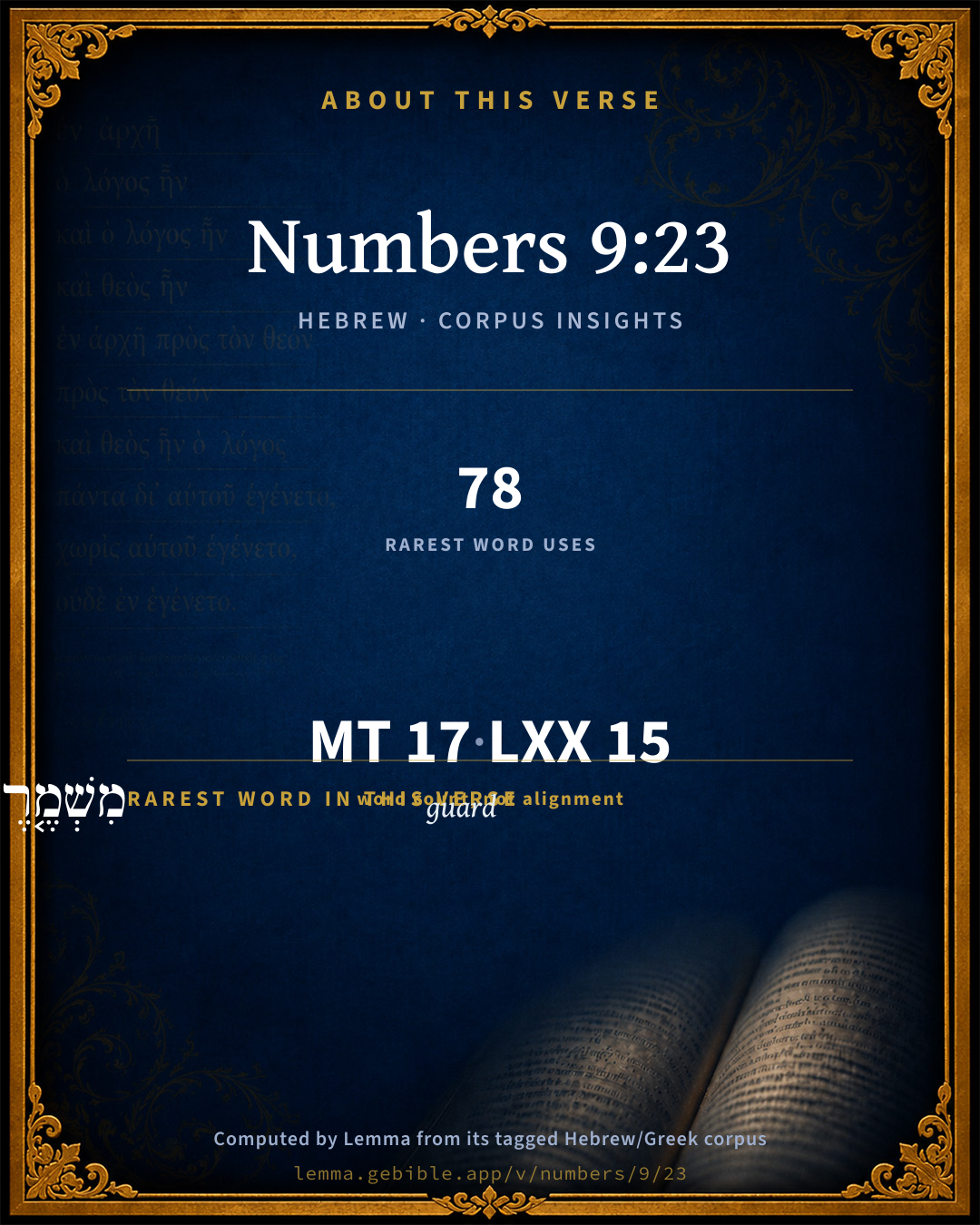
17
words
10
distinct lemmas
Pentateuch
section

Grammatical profile

  • 3 verbs
  • 10 nouns
  • 3 prepositions
  • 1 particle

Verb forms

  • יַחֲנ֔וּ Qal · Imperfect
  • יִסָּ֑עוּ Qal · Imperfect
  • שָׁמָ֔רוּ Qal · Perfect

Repetition

Words recur within this verse — often emphatic in Hebrew:

  • יְהוָה֙ LORD H3068 ×4
  • עַל upon H5921 ×3
  • פִּ֤י mouth H6310 ×3

Hebrew & Septuagint length

In the original languages it is 17 Hebrew tokens and 15 Greek tokens — but the two are counted differently (Hebrew bundles its prefixes and suffixes into one token; the Greek is in lemma form), so that isn’t a like-for-like length.

Cross-references

5

Topical passages linked to Numbers 9:23 in the Treasury of Scripture Knowledge — connected by theme and wording, ordered by reader-vote popularity; previews shown in the World English Bible.

  • Joshua 22:3 you have not left your brothers these many days to this day, but have kept the charge of the commandment of Yahweh your God.
  • Genesis 26:5 because Abraham obeyed my voice, and kept my charge, my commandments, my statutes, and my laws."
  • Numbers 9:19 When the cloud stayed on the tabernacle many days, then the children of Israel kept the charge of Yahweh, and didn't travel.
  • Ezekiel 44:8 You have not kept the charge of my holy things; but you have set keepers of my charge in my sanctuary for yourselves.
  • Zechariah 3:7 "Thus says Yahweh of hosts: 'If you will walk in my ways, and if you will keep my charge, then you also shall judge my house, and shall also keep my courts, and I will give you a place of access among these who stand by.

Cross-references courtesy of OpenBible.info (CC BY 4.0).

Hebrew and Greek witnesses Masoretic Hebrew ↔ Greek Septuagint

The same verse in the two great witnesses to the Old Testament, shown verse-for-verse.

These are two independent witnesses, not word-aligned to each other, and the Septuagint is shown in lemma (dictionary) form.

Hebrew Numbers 9:23 Masoretic · Westminster Leningrad Codex

עַל פִּ֤י יְהוָה֙ יַחֲנ֔וּ וְעַל פִּ֥י יְהוָ֖ה יִסָּ֑עוּ אֶת מִשְׁמֶ֤רֶת יְהוָה֙ שָׁמָ֔רוּ עַל פִּ֥י יְהוָ֖ה בְּיַד מֹשֶֽׁה

At the commandment of Yahweh they encamped, and at the commandment of Yahweh they traveled. They kept the charge of Yahweh, at the commandment of Yahweh by Moses.

World English Bible · Public Domain

Greek LXX Numbers 9:23 Septuagint · lemma form

ὅτι διά πρόσταγμα κύριος ἀποαἴρω ὁ φυλακή κύριος φυλάσσω διά πρόσταγμα κύριος ἐν χείρ μωυσῆς

No English rendering of this Greek verse — the small residue in the structurally divergent books.

Hebrew: Westminster Leningrad Codex (CC BY 4.0). Greek: Septuagint (public domain); English from a public-domain English Septuagint. How the Septuagint differs from the Hebrew →

Targum (Aramaic paraphrase)

2

The Targum is the ancient Jewish Aramaic paraphrase of the Hebrew Scriptures — an interpretive translation, not the Hebrew text itself. Onkelos (literal) and Pseudo-Jonathan (expansive) render the Torah, and Jonathan the Prophets. Coverage is partial: where no permissively-licensed English translation exists for a verse, only the Aramaic is shown. This is verse-level text, not a word-by-word alignment to the Hebrew.

  1. Targum Onkelos Torah (Genesis–Deuteronomy)
    עַל מֵימְרָא דַיְיָ שָׁרָן וְעַל מֵימְרָא דַיְיָ נָטְלִין יָת מַטְרַת מֵימְרָא דַיְיָ נָטְרִין עַל מֵימְרָא דַיְיָ בִּידָא דְמשֶׁה

    (no public-domain English translation for this verse)

    Targum Onkelos — Aramaic: “Onkelos Genesis” (public domain); “Onkelos Exodus” (public domain); “Onkelos Leviticus” (public domain); “Onkelos Numbers” (public domain); “Onkelos Deuteronomy” (public domain). English: “Sefaria Community Translation” (CC0 1.0 (public-domain dedication)); “J.W. Etheridge. The Targums of Onkelos and Jonathan Ben Uzziel on the Pentateuch. London: Longmans, Green, 1862” (public domain). Text via Sefaria.

  2. Targum Pseudo-Jonathan Torah (Genesis–Deuteronomy)
    עַל פּוּם מֵימְרָא דַיְיָ שָׁרָן וְעַל פּוּם מֵימְרָא דַיְיָ נַטְלִין יַת מַטְרַת מֵימְרָא דַיְיָ נַטְרִין עַל פּוּם מֵימְרָא דַיְיָ בִּידָא דְמשֶׁה

    By the mouth of the Word of the Lord they encamped, and by it they journeyed; they kept the observance of the Word of the Lord, by the mouth of the Word of the Lord through Mosheh.

    Targum Pseudo-Jonathan — Aramaic: “Targum Jonathan on Genesis” (public domain); “Targum Jonathan on Exodus” (public domain); “Targum Jonathan on Leviticus” (public domain); “Targum Jonathan on Numbers” (public domain); “Targum Jonathan on Deuteronomy” (public domain). English: “The Targum of Jonathan ben Uzziel, trans. J. W. Etheridge, London, 1862” (public domain). Text via Sefaria.

Commentary

Notes on Numbers 9:23 from classic Christian and Jewish commentators (each source and its license shown beneath its notes). The classic Christian expositions comment on the surrounding passage and are grouped to its opening verse, so a note may address several verses; the Jewish commentaries on the Tanakh (Rashi and others) are per-verse, so they appear only where the commentator wrote on this verse.

Lemma curates 59 commentaries, every one of them public domain or Creative Commons licensed, each selected and text-cleaned for this edition rather than reprinted as found. About our sources →

Trapp's Complete Commentary

John Trapp

Num 9:23 At the commandment of the LORD they rested in the tents, and at the commandment of the LORD they journeyed: they kept the charge of the LORD, at the commandment of the LORD by the hand of Moses.

Ver. 23. At the commandment of the Lord.] This signified that the saints are to rest, or go on, at the voice of Christ, {Joh 10:3-4} and that "whatsoever they do in word or deed, to do all in the name of the Lord Jesus," {Col 3:17} to seek and find all their perfection and defenee in him alone.

John Trapp, A Commentary or Exposition upon All the Books of the Old and New Testament (1647–1656) — public domain. Text from a community e-Sword module.

Geneva Bible (1599)

Geneva Bible translators

Under the charge and government of Moses.

Geneva Bible (1599) marginal notes — public domain. Text via Bolls.life.

Adam Clarke's Commentary

Verse 23. Kept the charge of the Lord] When we consider the strong disposition which this people ever testified to follow their own will in all things, we may be well surprised to find them, in these journeyings, so implicitly following the directions of God. There could be no trick or imposture here. Moses, had he been the most cunning of men, never could have imitated the appearances referred to in this chapter. The cloud, and every thing in its motion, was so evidently supernatural, that the people had no doubt of its being the symbol of the Divine presence.

GOD chose to keep this people so dependent upon himself, and so submissive to the decisions of his own will, that he would not even give them regular times of marching or resting; they were to do both when and where God saw best. Thus they were ever kept ready for their march, though perfectly ignorant of the time when they should commence it. But this was all well; they had the presence of God with them; the cloud by day and the fire by night demonstrated that God was amongst them. Reader, thou art here a tenant at will to God Almighty. How soon, in what place, or in what circumstances, he may call thee to march into the eternal world, thou knowest not. But this uncertainty cannot perplex thee, if thou be properly subject to the will of God, ever willing to lose thy own in it. But thou canst not be thus subject, unless thou have the testimony of the presence and approbation of God. How awful to be obliged to walk into the valley of the shadow of death without this! Reader, prepare to meet thy God.

Adam Clarke's Commentary on the Bible (1810–1826) — public domain. Text from a community e-Sword/MySword module.

The Cambridge Bible for Schools and Colleges

gen. ed. J. J. S. Perowne

Num_9:15-23

The fiery cloud upon the Tabernacle

After a reference (Num_9:15 a) to the event related in Exo_40:34 f., the section describes the invariable custom throughout the journeys of starting on the march when the cloud rose from the Tabernacle, and halting as long as it rested. It is an expansion of Exo_40:36-38. The characteristic redundancy of the priestly style is noticeable.

The different writers of the Pentateuch describe different features in the appearance of the cloud. In J Jehovah is represented as leading the people by moving in front of them in a column of cloud by day and of fire by night (see on Num_14:14), and this began at the departure from Egypt (Exo_13:21). In E the cloud is pictured similarly as a column, but its appearance is not mentioned until the sacred ‘tent of meeting’ had been erected, when it came down from time to time and stood at the door of the tent which was pitched outside the camp (Exo_33:7-11, Num_11:25; Num_12:5; Num_12:10, Deu_31:15). In P it is not described as a column, but (as in J ) it was fiery at night, and (as in E ) it did not appear till the Tabernacle was erected, except that it formed part of the theophany on Mt Sinai (Exo_24:15-18). It is not spoken of as a guide moving in front of the people, but it covered the Tabernacle which stood in the centre of the camp. It was the visible counterpart outside the sanctuary of the ‘Glory,’ the manifestation of the divine presence within.

The Cambridge Bible for Schools and Colleges (gen. ed. J. J. S. Perowne; Cambridge University Press, 1878–1918) — public domain. Text from a community e-Sword module.

Haydock's Catholic Bible Commentary

Watches, like sentinels, observing the signal of the cloud; and regulating the time and course of their marches by its direction. (Haydock)

George Leo Haydock (1774–1849), Haydock's Catholic Family Bible and Commentary, 1859 edition — public domain. Excludes Psalms (Douay-Rheims chapter numbering differs from Protestant) and Deuterocanonical books (Catholic canon only).

Whedon's Commentary on the Bible

Daniel D. Whedon

23. They kept the charge of the Lord — The lesson of trust in Jehovah and of patient waiting for his leadings was well learned, and always practised except on one memorable occasion, (Num_14:40-45,) when they presumed to advance without the guidance of the cloud, and met discomfiture and death. The term charge has special reference to following the guidance of Jehovah in marching and encamping, as is seen in Num_9:19. When we consider the proneness of men to lean upon their own understanding, and to direct their own steps, this record is highly creditable to the Israelites, especially in view of their long periods of encampment, when their entrance into the promised land seemed to be indefinitely postponed for reasons in the divine mind to them utterly incomprehensible. In this whole account of the cloud the fact of Jehovah’s guidance is reiterated again and again with emphasis. Maimonides says, that this particularity and repetition of statement was designed to confute the opinions of the Arabians and others, that the Israelites were so long detained in the “Wilderness of Wandering,” as Arabic writers style it, because they had lost their way, and therefore spent forty years in vaguely wandering over the desert. This, he observes, is a very idle conceit, as the way from Sinai to Kadesh-Barnea was a well known and frequented route, and not above eleven days’ journey, so that they could not be supposed to have missed it, and far less should have wandered in a bewildered condition forty years.

Daniel D. Whedon (gen. ed.), Commentary on the Old and New Testaments (1874–1909) — public domain. Text from a community e-Sword module.

Lesson kit

Teaching starters — assembled from the data on this page, not authored interpretation. Every prompt links to the verse data it draws on. Edit before teaching.

Numbers, in the Pentateuch, opens this verse with 17 words (10 distinct Hebrew lemmas). Its most distinctive word is mishmereth (“guard”). A historical commentator’s framing appears above. Read the whole chapter for the surrounding context.

Discussion questions

  1. How does “guard” (mishmereth) shape what this verse is saying?
  2. Joshua 22:3 shares this passage’s theme. How do the two illuminate each other?
  3. “LORD” occurs 4× in this one verse. What is the effect of the repetition?
  4. These translations render this verse differently; the difference is in the English rendering, not the original. What questions does that raise?
  5. The verb «יַחֲנ֔וּ» is Qal Imperfect. How does its form color the action?
  6. Reading how Trapp's Complete Commentary and Geneva Bible (1599) read this verse, where do the two commentators agree and where do they part?

Things to notice

Reading settings

Reading text

Shown beneath each verse's original-language words.

Old Testament
Old Testament edition

Read the OT as the Masoretic Hebrew (MT) or the Greek Septuagint (LXX).

English shown for the Greek Septuagint (in the Hebrew ↔ Greek comparison).

Comparing translations? Open the Compare panel on any verse page to stack up to four side by side.