
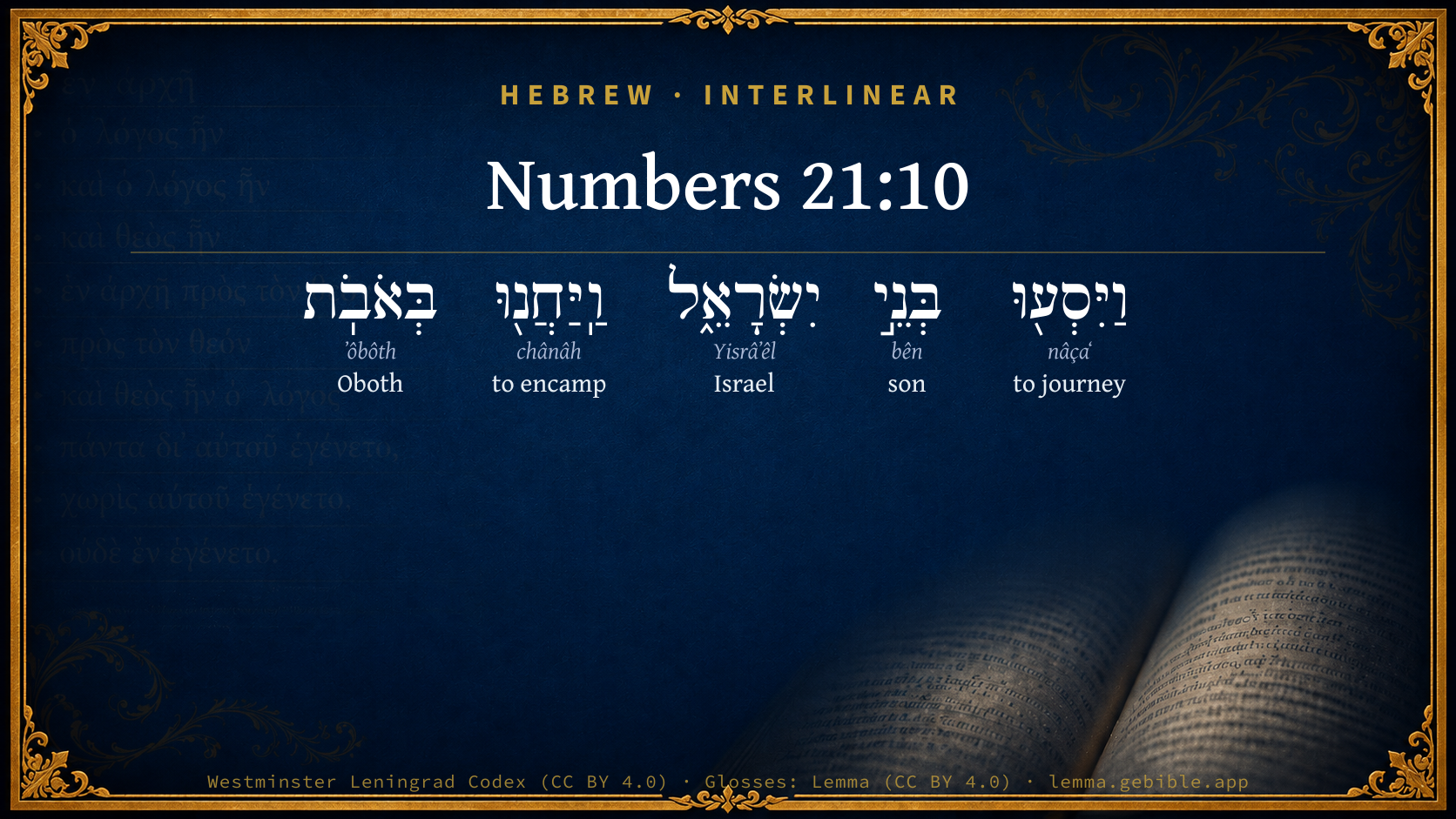
Numbers 21:10

Hebrew (Westminster Leningrad Codex) Numbers 21:10 appears in the Hebrew Old Testament. The text above is from the Westminster Leningrad Codex. Each word links to its Strong’s number, a concise gloss, and parsing drawn from the Open Scriptures Hebrew Bible morphology. Click any word for its full Brown-Driver-Briggs (BDB) entry.
Download image
Cite this verse

Numbers 21:10 (World English Bible). Public Domain. Lemma interlinear Bible study tool, https://lemma.gebible.app/v/numbers/21/10.

Show BibTeX & RIS
BibTeX
RIS
English Translation
The children of Israel traveled, and encamped in Oboth.
World English Bible · Public Domain
Highlights
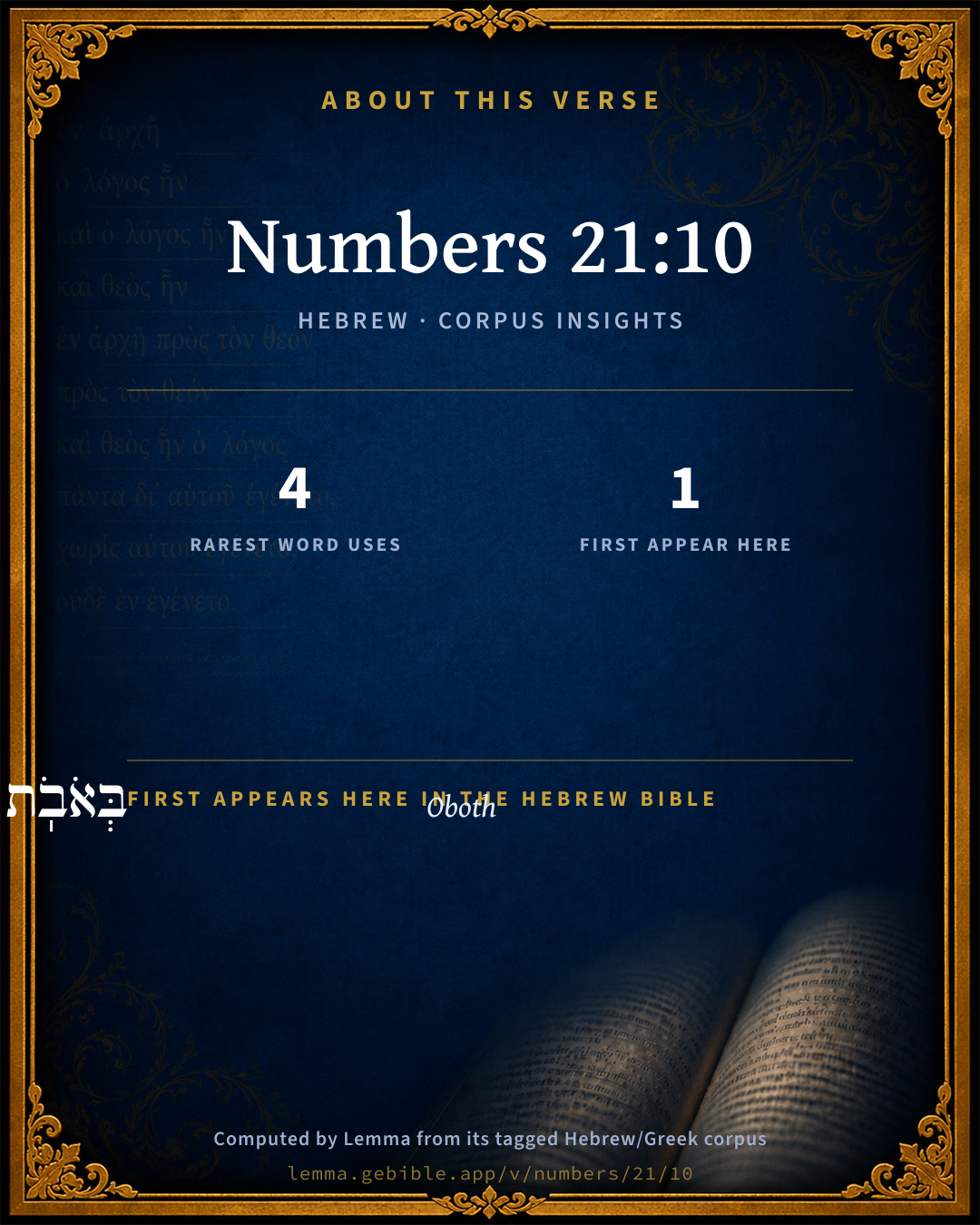
  • 1 first appearance in the Hebrew Bible
Full analysis ↓
Download a study sheet

One document with this verse’s original text, its word-by-word gloss line, the meaning frame, cross-references with their text, attributed commentary, and full source and license credits — printable, and it pastes into notes with its structure intact.

This verse Autodidact and up

Study sheet (.html) Plain text (.txt)

A passage Seminary Student

Up to 50 verses in one chapter. A passage sheet keeps up to 6 commentary sources and 12 cross-references per verse, in the order this page ranks them, and says so on the sheet whenever that leaves anything out. Ask for a single verse and you get the Autodidact verse sheet above.

Everything on this page stays free to read, with no account — the sheet is a download of what is already on screen, not access to it.

Want to remove ads? Support Godless Engineer
Compare translations 3

The same verse in 3 English versions, stacked beneath the original-language interlinear above. Click any original word for its lexicon entry.

Each is an independent rendering of the whole verse — the interlinear is not word-aligned to these translations.

Highlighted words mark where these versions differ — a whole-verse word diff, not a word-by-word alignment.

  • World English Bible Public Domain
    The children of Israel traveled, and encamped in Oboth.
  • King James Version Public Domain
    And the children of Israel set forward, and pitched in Oboth.
  • unfoldingWord Literal Text CC BY-SA 4.0
    And the sons of Israel set out and camped at Oboth.

unfoldingWord Literal Text — © unfoldingWord, licensed CC BY-SA 4.0. Word-aligned USFM3 via Door43 (git.door43.org/unfoldingWord/en_ult).

Versions to compare (up to 4)

3 of 4 selected

Show all 18 translations

Every available English version of this verse, each an independent rendering of the whole verse.

  • World English Bible Public Domain
    The children of Israel traveled, and encamped in Oboth.
  • Berean Standard Bible Public Domain
    Then the Israelites set out and camped at Oboth.
  • Majority Standard Bible Public Domain
    Then the Israelites set out and camped at Oboth.
  • King James Version Public Domain
    And the children of Israel set forward, and pitched in Oboth.
  • American Standard Version (1901) Public Domain
    And the children of Israel journeyed, and encamped in Oboth.
  • Revised Version (1885) Public Domain
    And the children of Israel journeyed, and pitched in Oboth.
  • Geneva Bible (1599) Public Domain
    And ye children of Israel departed thence, and pitched in Oboth.
  • Douay-Rheims (1899) Public Domain
    And the children of Israel setting forwards camped in Oboth.
  • Young's Literal Translation Public Domain
    And the sons of Israel journey, and encamp in Oboth.
  • Literal Standard Version CC BY-SA 4.0
    And the sons of Israel journey and encamp in Oboth.
  • Unlocked Literal Bible CC BY-SA 4.0
    Then the people of Israel traveled on and camped at Oboth.
  • unfoldingWord Literal Text CC BY-SA 4.0
    And the sons of Israel set out and camped at Oboth.
  • Darby Bible Public Domain
    And the children of Israel journeyed, and encamped in Oboth.
  • World Messianic Bible Public Domain
    The children of Israel traveled, and encamped in Oboth.
  • Webster's Bible Public Domain
    And the children of Israel moved forward, and pitched in Oboth.
  • Free Bible Version CC BY-SA 4.0
    The Israelites left and camped at Oboth.
  • Bible in Basic English Public Domain
    Then the children of Israel went on and put up their tents in Oboth.
  • JPS Tanakh (1917) Public Domain
    And the children of Israel journeyed, and pitched in Oboth.

Literal Standard Version (2020), Covenant Press — licensed CC BY-SA 4.0. Text via the HelloAO Bible API (eBible.org). Unlocked Literal Bible (unfoldingWord) — licensed CC BY-SA 4.0. Text via the HelloAO Bible API (eBible.org). unfoldingWord Literal Text — © unfoldingWord, licensed CC BY-SA 4.0. Word-aligned USFM3 via Door43 (git.door43.org/unfoldingWord/en_ult). Free Bible Version, Dr. Jonathan Gallagher — licensed CC BY-SA 4.0. Text via the HelloAO Bible API (eBible.org).

Word by word

More ways to search: Search by grammar → Find every occurrence → Compare this word →

Practice this passage: Drill this verse → Learn its vocabulary →

About this verse

These counts appear in no published source. They are computed here, from the morphology-tagged text and Lemma’s own curated glosses. What Lemma adds →

5
words
5
distinct lemmas
Pentateuch
section

Notable vocabulary

The rarest word here is בְּאֹבֹֽת Oboth H88 — appearing just 4 times in the whole Hebrew Bible.

First appearance in Scripture

This word makes its first canonical appearance in the Hebrew Bible here:

  • בְּאֹבֹֽת Oboth H88

Shared distinctive vocabulary

בְּאֹבֹֽת Oboth H88 occurs in 4 verses of the Hebrew Bible. Also found in:

Grammatical profile

  • 2 verbs
  • 3 nouns

Verb forms

  • וַיִּסְע֖וּ Qal · Sequential Imperfect
  • וַֽיַּחֲנ֖וּ Qal · Sequential Imperfect

Hebrew & Septuagint length

In English translation the verse runs 9 words from the Hebrew and 10 from the Septuagint (LXX English) — closely comparable.

A rough comparison of the two English renderings, which tokenize alike — not a word-level alignment.

Word counts can differ between the Hebrew and the Greek without any difference in meaning — e.g. the Hebrew direct-object marker אֵת has no separate Greek word, and Greek often adds the article ὁ.

Cross-references

1

Topical passages linked to Numbers 21:10 in the Treasury of Scripture Knowledge — connected by theme and wording, ordered by reader-vote popularity; previews shown in the World English Bible.

Cross-references courtesy of OpenBible.info (CC BY 4.0).

Hebrew and Greek witnesses Masoretic Hebrew ↔ Greek Septuagint

The same verse in the two great witnesses to the Old Testament, shown verse-for-verse.

These are two independent witnesses, not word-aligned to each other, and the Septuagint is shown in lemma (dictionary) form.

Hebrew Numbers 21:10 Masoretic · Westminster Leningrad Codex

וַיִּסְע֖וּ בְּנֵ֣י יִשְׂרָאֵ֑ל וַֽיַּחֲנ֖וּ בְּאֹבֹֽת

The children of Israel traveled, and encamped in Oboth.

World English Bible · Public Domain

Greek LXX Numbers 21:10 Septuagint · lemma form

καί ἀποαἴρω ὁ υἱός ἰσραήλ καί παρα ἐνβάλλω ἐν ωβωθ

And the children of Israel departed, and encamped in Oboth.

LXX2012 (modern English Septuagint) · Public Domain

Hebrew: Westminster Leningrad Codex (CC BY 4.0). Greek: Septuagint (public domain); English from LXX2012 (modern English Septuagint) (Public Domain). How the Septuagint differs from the Hebrew →

Targum (Aramaic paraphrase)

2

The Targum is the ancient Jewish Aramaic paraphrase of the Hebrew Scriptures — an interpretive translation, not the Hebrew text itself. Onkelos (literal) and Pseudo-Jonathan (expansive) render the Torah, and Jonathan the Prophets. Coverage is partial: where no permissively-licensed English translation exists for a verse, only the Aramaic is shown. This is verse-level text, not a word-by-word alignment to the Hebrew.

  1. Targum Onkelos Torah (Genesis–Deuteronomy)
    וּנְטָלוּ בְּנֵי יִשְׂרָאֵל וּשְׁרוֹ בְּאוֹבוֹת

    (no public-domain English translation for this verse)

    Targum Onkelos — Aramaic: “Onkelos Genesis” (public domain); “Onkelos Exodus” (public domain); “Onkelos Leviticus” (public domain); “Onkelos Numbers” (public domain); “Onkelos Deuteronomy” (public domain). English: “Sefaria Community Translation” (CC0 1.0 (public-domain dedication)); “J.W. Etheridge. The Targums of Onkelos and Jonathan Ben Uzziel on the Pentateuch. London: Longmans, Green, 1862” (public domain). Text via Sefaria.

  2. Targum Pseudo-Jonathan Torah (Genesis–Deuteronomy)
    וּנְטָלוּ מִתַּמָן בְּנֵי יִשְרָאֵל וּשְׁרוֹ בְּאוֹבוֹת

    And the children of Israel journeyed from thence, and pitched in Oboth;

    Targum Pseudo-Jonathan — Aramaic: “Targum Jonathan on Genesis” (public domain); “Targum Jonathan on Exodus” (public domain); “Targum Jonathan on Leviticus” (public domain); “Targum Jonathan on Numbers” (public domain); “Targum Jonathan on Deuteronomy” (public domain). English: “The Targum of Jonathan ben Uzziel, trans. J. W. Etheridge, London, 1862” (public domain). Text via Sefaria.

Commentary

Notes on Numbers 21:10 from classic Christian and Jewish commentators (each source and its license shown beneath its notes). The classic Christian expositions comment on the surrounding passage and are grouped to its opening verse, so a note may address several verses; the Jewish commentaries on the Tanakh (Rashi and others) are per-verse, so they appear only where the commentator wrote on this verse.

Lemma curates 59 commentaries, every one of them public domain or Creative Commons licensed, each selected and text-cleaned for this edition rather than reprinted as found. About our sources →

Matthew Henry's Commentary

We have here an account of the several stages and removals of the children of Israel, till they came into the plains of Moab, out of which they at length passed over Jordan into Canaan, as we read in the beginning of Joshua. Natural motions are quicker the nearer they are to their centre. The Israelites were now drawing near to the promised rest, and now they set forward, as the expression is, Num 21:10. It were well if we would do thus in our way to heaven, rid ground in the latter end of our journey, and the nearer we come to heaven be so much the more active and abundant in the work of the Lord. Two things especially are observable in the brief account here given of these removals: -

1. The wonderful success which God blessed his people with, near the brooks of Arnon, Num 21:13-15. They had now compassed the land of Edom (which they were not to invade, nor so much as to disturb, Deu 2:4, Deu 2:5), and had come to the border of Moab. It is well that there are more ways than one to Canaan. The enemies of God's people may retard their passage, but cannot prevent their entrance into the promised rest. Care is taken to let us know that the Israelites in their march religiously observed the orders which God gave them to use no hostility against the Moabites (Deu 2:9), because they were the posterity of righteous Lot; therefore they pitched on the other side of Arnon (Num 21:13), that side which was now in the possession of the Amorites, one of the devoted nations, though formerly it had belonged to Moab, as appears here, Num 21:26, Num 21:27. This care of theirs not to offer violence to the Moabites is pleaded by Jephtha long afterwards, in his remonstrance against the Ammonites (Jdg 11:15, etc.), and turned to them for a testimony. What their achievements were, now that they pitched on the banks of the river Arnon, we are not particularly told, but are referred to the book of the wars of the Lord, perhaps that book which was begun with the history of the war with the Amalekites, Exo 17:14. Write it (said God) for a memorial in a book, to which were added all the other battles which Israel fought, in order, and, among the rest, their actions on the river Arnon, at Vaheb in Suphah (as our margin reads it) and other places on that river. Or, it shall be said (as some read it) in the rehearsal, or commemoration, of the wars of the Lord, what he did in the Red Sea, when he brought Israel out of Egypt, and what he did in the brooks of Arnon, just before he brought them into Canaan. Note, In celebrating the memorials of God's favours to us, it is good to observe the series of them, and how divine goodness and mercy have constantly followed us, even from the Red Sea to the brooks of Arnon. In every stage of our lives, nay, in every step, we should take notice of what God has wrought for us; what he did at such a time, and what in such a place, ought to be distinctly remembered.

2. The wonderful supply which God blessed his people with at Beer (Num 21:16), which signifies the well or fountain. It is said (Num 21:10) they pitched in Oboth, which signifies bottles, so called perhaps because there they filled their bottles with water, which should last them for some time; but by this time, we may suppose, it was with them as it was with Hagar (Gen 21:15), The water was spent in the bottle; yet we do not find that they murmured, and therefore God, in compassion to them, brought them to a well of water, to encourage them to wait on him in humble silence and expectation and to believe that he would graciously take cognizance of their wants, though they did not complain of them. In this world, we do at the best but pitch in Oboth, where our comforts lie in close and scanty vessels; when we come to heaven we shall remove to Beer, the well of life, the fountain of living waters. Hitherto we have found, when they were supplied with water, they asked it in unjust discontent, and God gave it in just displeasure; but here we find, (1.) That God gave it in love (Num 21:16): Gather the people together, to be witnesses of the wonder, and joint-sharers in the favour, and I will give them water. Before they prayed, God granted, and anticipated them with the blessings of his goodness. (2.) That they received it with joy and thankfulness, which made the mercy doubly sweet to them, Num 21:17. Then they sang this song, to the glory of God and the encouragement of one another, Spring up, O well! Thus they pray that it may spring up, for promised mercies must be fetched in by prayer; they triumph that it does spring up, and meet it with their joyful acclamations. With joy must we draw water out of the wells of salvation, Isa 11:3. As the brazen serpent was a figure of Christ, who is lifted up for our cure, so is this well a figure of the Spirit, who is poured forth for our comfort, and from whom flow to us rivers of living waters, Joh 7:38. Does this well spring up in our souls? We should sing to it; take the comfort to ourselves, and give the glory to God; stir up this gift, sing to it, Spring up, O well! thou fountain of gardens, to water my soul (Sol 4:15), plead the promise, which perhaps alludes to this story (Isa 41:17, Isa 41:18), I will make the wilderness wells of water. (3.) That whereas before the remembrance of the miracle was perpetuated in the names given to the places, which signified the people's strife and murmuring, now it was perpetuated in a song of praise, which preserved on record the manner in which it was done (Num 21:18): The princes digged the well, the seventy elders, it is probable, by direction of the lawgiver (that is, Moses, under God) with their staves; that is, with their staves they made holes in the soft and sandy ground, and God caused the water miraculously to spring up in the holes which they made. Thus the pious Israelites long afterwards, passing through the valley of Baca, a dry and thirsty place, made wells, and God by rain from heaven filled the pools, Psa 84:6. Observe, [1.] God promised to give them water, but the must open the ground to receive it, and give it vent. God's favours must be expected in the use of such means as lie within our power, but still the excellency of the power is of God. [2.] The nobles of Israel were forward to set their hands to this work, and used their staves, probable those that were the ensigns of their honour and power, for the public service, and it is upon record to their honour. And we may suppose that it was a great confirmation to them in their offices, and a great comfort to the people, that they were made use of by the divine power as instruments to this miraculous supply. By this it appeared that the spirit of Moses, who must shortly die, rested in some measure upon the nobles of Israel. Moses did not strike the ground himself, as formerly the rock, but gave them direction to do it, that their staves might share in the honour of his rod, and they might comfortably hope that when he should leave them yet God would not, but that they also in their generation should be public blessings, and might expect the divine presence with them as long as they acted by the direction of the lawgiver. For comfort must be looked for only in the way of duty; and, if we would share in divine joys, we must carefully follow the divine direction.

Matthew Henry's Commentary on the Whole Bible (1708–1710) — public domain (CC PDM 1.0). Text via the HelloAO Bible API.

Joseph Benson's Commentary

Num 21:10-13. In Oboth — Not immediately, but after two other stations, mentioned chap. 33. The valley of Zared — Or rather, by the brook of Zared, which ran into the Dead sea. On the other side — Or rather, on this side of Arnon, for so it now was to the Israelites, who had not yet passed over it. Between Moab and the Amorites — Though formerly it and the land beyond it belonged to Moab, yet afterward it had been taken from them by Sihon. This is added to reconcile two seemingly contrary commands of God; the one, that of not meddling with the land of the Moabites, (Deu 2:9,) the other, that of going over Arnon and taking possession of the land beyond it, (Deu 2:24,) because, saith he, it is not now the land of the Moabites, but of the Amorites.

Joseph Benson's Commentary on the Old and New Testaments (1811–1818) — public domain. Text from a community e-Sword module.

Whedon's Commentary on the Bible

Daniel D. Whedon

THE CONTINUED ITINERARY OF ISRAEL, Num_21:10-20.

The journey from Mount Hor was southward to the end of Mount Seir, around which the Israelites swept, then marched northward along the eastward border of Edom. In this narrative there is at this point a wide gap. We are told nothing of the march along the eastern edge of Edom, but suddenly find ourselves transported to the borders of Moab. But we do not need to draw upon our imagination for a description of the journey, since the natural features of the country remain unchanged. In passing northward from a point a few hours north of Ezion-geber (the giant’s backbone) the Israelites would enter the mountains, marching to Moab by the road which runs between Edom and the limestone plateau of the great eastern desert. Comp. Deu_2:8. Their route was in part the same as that of the caravans from Mecca to Damascus. The researches of modern travellers enable us almost to accompany the Hebrew host on its march. “The wonderful tenacity with which the old names keep their hold in the far East helps us to discover the exact spots of biblical scenes, while the descriptions of the localities throw most vivid light on the scriptural narratives, and afford evidence of their trustworthiness.” — Edersheim.

10. Oboth — Hebrew, hollow passes. The exact site is unknown, but from the fact that the next station was in the border of Moab, it is probable that Oboth is east of Moab. In the full itinerary, Num_33:41-43, two stations, Zalmonah and Punon, of doubtful identification, intervene between Mount Hor and Oboth.

Daniel D. Whedon (gen. ed.), Commentary on the Old and New Testaments (1874–1909) — public domain. Text from a community e-Sword module.

Keil & Delitzsch

C. F. Keil & F. Delitzsch

March of Israel round Edom and Moab, to the Heights of Pisgah in the Field of Moab (cf. Num 33:41-47). - Num 21:10. From the camp in the Arabah, which is not more particularly described, where the murmuring people were punished by fiery serpents, Israel removed to Oboth. According to the list of stations in Num 33:41., they went from Hor to Zalmonah, the situation of which has not been determined; for C. v. Raumer's conjecture (der Zug der Israeliten, p. 45), that it was the same place as the modern Maan, has no firm basis in the fact that Maan is a station of the Syrian pilgrim caravans. From Zalmonah they went to Phunon, and only then to Oboth. The name Phunon is no doubt the same as Phinon, a tribe-seat of the Edomitish Phylarch (Gen 36:41); and according to Jerome (Onom. s. v. Fenon), it was "a little village in the desert, where copper was dug up by condemned criminals (see at Gen 36:41), between Petra and Zoar." This statement suits very well, provided we imagine the situation of Phunon to have been not in a straight line between Petra and Zoar, but more to the east, between the mountains on the edge of the desert. For the Israelites unquestionably went from the southern end of the Arabah to the eastern side of Idumaea, through the Wady el Ithm (Getum), which opens into the Arabah from the east, a few hours to the north of Akaba and the ancient Ezion-geber. They had then gone round the mountains of Edom, and begun to "turn to the north" (Deu 2:3), so that they now proceeded farther northwards, on the eastern side of the mountains of Edom, "through the territory of the sons of Esau," no doubt by the same road which is taken in the present day by the caravans which go from Gaza to Maan, through the Ghor. "This runs upon a grassy ridge, forming the western border of the coast of Arabia, and the eastern border of the cultivated land, which stretches from the land of Edom to the sources of the Jordan, on the eastern side of the Ghor" (v. Raumer, Zug, p. 45). On the western side of their mountains the Edomites had refused permission to the Israelites to pass through their land (Num 20:18.), as the mountains of Seir terminate towards the Ghor (the Arabah) in steep and lofty precipices, and there are only two or three narrow wadys which intersect them from west to east; and of these the Wady Ghuweir is the only one which is practicable for an army, and even this could be held so securely by a moderate army, that no enemy could force its way into the heart of the country (see Leake in Burckhardt, pp. 21, 22; and Robinson, ii. p. 583). It was different on the eastern side, where the mountains slope off into a wide extent of table-land, which is only slightly elevated above the desert of Arabia. Here, on the weaker side of their frontier, the Edomites lost the heart to make any attack upon the Israelites, who would now have been able to requite their hostilities. But the Lord had commanded Israel not to make war upon the sons of Esau; but when passing through their territory, to purchase food and water from them for money (Deu 2:4-6). The Edomites submitted to the necessity, and endeavoured to take advantage of it, by selling provisions, "in the same way in which, at the present day, the caravan from Mecca is supplied with provisions by the inhabitants of the mountains along the pilgrim road" (Leake in Burckhardt, p. 24). The situation of Oboth cannot be determined.

Num 21:11-12

The next encampment was "Ije-Abarim in the desert, which lies before Moab towards the sun-rising," i.e., on the eastern border of Moabitis (Num 33:44). As the Wady el Ahsy, which runs into the Dead Sea, in a deep and narrow rocky bed, from the south-east, and is called el Kerahy in its lower part (Burckhardt, Syr. pp. 673-4), separates Idumaea from Moabitis; Ije-Abarim (i.e., ruins of the crossings over) must be sought for on the border of Moab to the north of this wady, but is hardly to be found, as Knobel supposes, on the range of hills called el Tarfuye, which is known by the name of Orokaraye, still farther to the south, and terminates on the south-west of Kerek, whilst towards the north it is continued in the range of hills called el Ghoweithe and the mountain range of el Zoble; even supposing that the term Abarim, "the passages or sides," is to be understood as referring to these ranges of hills and mountains which skirt the land of the Amorites and Moabites, and form the enclosing sides. For the boundary line between the hills of el-Tarfuye and those of el-Ghoweithe is so near to the Arnon, that there is not the necessary space between it and the Arnon for the encampment at the brook Zared (Num 21:12). Ije-Abarim or Jim cannot have been far from the northern shore of the el Ahsy, and was probably in the neighbourhood of Kalaat el Hassa (Ahsa), the source of the Ahsy, and a station for the pilgrim caravans (Burckhardt, p. 1035). As the Moabites were also not to be attacked by the Israelites (Deu 2:9.), they passed along the eastern border of Moabitis as far as the brook Zared (Num 21:12). This can hardly have been the Wady el-Ahsy (Robinson, ii. p. 555; Ewald, Gesch. ii. p. 259; Ritter, Erdk. xv. p. 689); for that must already have been crossed when they came to the border of Moab (Num 21:11). Nor can it well have been "the brook Zaide, which runs from the south-east, passes between the mountain ranges of Ghoweithe and Tarfuye, and enters the Arnon, of which it forms the leading source," - the view adopted by Knobel, on the very questionable ground that the name is a corruption of Zared. In all probability it was the Wady Kerek, in the upper part of its course, not far from Katrane, on the pilgrim road (v. Raumer, Zug, p. 47: Kurtz, and others).

Num 21:13

The next encampment was "beyond (i.e., by the side of) the Arnon, which is in the desert, and that cometh out of the territory of the Amorites." The Arnon, i.e., the present Wady Mojeb, is formed by the union of the Seyl (i.e., brook or river) Sade, which comes from the south-east, not far from Katrane, on the pilgrim road, and the Lejum from the north-east, which receives the small rivers el Makhreys and Balua, the latter flowing from the pilgrim station Kalaat Balua, and then continues its course to the Dead Sea, through a deep and narrow valley, shut in by very steep and lofty cliffs, and covered with blocks of stone, that have been brought down from the loftier ground (Burckhardt, pp. 633ff.), so that there are only a few places where it is passable; and consequently a wandering people like the Israelites could not have crossed the Mojeb itself to force an entrance into the territory of the hostile Amorites.

(Note: It is utterly inconceivable that a whole people, travelling with all their possessions as well as with their flocks, should have been exposed without necessity to the dangers and enormous difficulties that would attend the crossing of so dreadfully wild and so deep a valley, and that merely for the purpose of forcing an entrance into an enemy's country. - Ritter, Erdk. xv. p. 1207.)

For the Arnon formed the boundary between Moab and the country of the Amorites. The spot where Israel encamped on the Arnon must be sought for in the upper part of its course, where it is still flowing "in the desert;" not at Wady Zade, however, although Burckhardt calls this the main source of the Mojeb, but at the Balua, which flows into the Lejum. In all probability these streams, of which the Lejum came from the north, already bore the name of Arnon; as we may gather from the expression, "that cometh out of the coasts of the Amorites." The place of Israel's encampment, "beyond the Arnon in the desert," is to be sought for, therefore, in the neighbourhood of Kalaat Balua, and on the south side of the Arnon (Balua). This is evident enough from Deu 2:24, Deu 2:26., where the Israelites are represented as entering the territory of the Amoritish king Sihon, when they crossed the Arnon, having first of all sent a deputation, with a peaceable request for permission to pass through his land (cf. Num 21:21.). Although this took place, according to Deu 2:26, "out of the wilderness of Kedemoth," an Amoritish town, it by no means follows that the Israelites had already crossed the Arnon and entered the territory of the Amorites, but only that they were standing on the border of it, and in the desert which took its name from Kedemoth, and ran up to this, the most easterly town, as the name seems to imply, of the country of the Amorites. After the conquest of the country, Kedemoth was allotted to the Reubenites (Jos 13:18), and made into a Levitical city (Jos 21:37; Ch1 6:64).

The Israelites now received instructions from the Lord, to cross the river Arnon, and make war upon the Amoritish king Sihon of Heshbon, and take possession of his land, with the assurance that the Lord had given Sihon into the hand of Israel, and would fill all nations before them with fear and trembling (Deu 2:24-25). This summons, with its attendant promises, not only filled the Israelites with courage and strength to enter upon the conflict with the mightiest of all the tribes of the Canaanites, but inspired poets in the midst of them to commemorate in odes the wars of Jehovah, and His victories over His foes. A few verses are given here out of one of these odes (Deu 2:14.), not for the purpose of verifying the geographical statement, that the Arnon touches the border of Moabitis, or that the Israelites had only arrived at the border of the Moabite and Amorite territory, but as an evidence that there, on the borders of Moab, the Israelites had been inspired through the divine promises with the firm assurance that they should be able to conquer the land of the Amorites which lay before them.

Num 21:14-15

"Therefore," sc., because the Lord had thus given king Sihon, with all his land, into the hand of Israel, "it is written in the book of the wars of the Lord: Vaheb (Jehovah takes) in storm, and the brooks of Arnon and the valley of the brooks, which turns to the dwelling of Ar, and leans upon the border of Moab." The book of the wars of Jehovah is neither an Amoritish book of the conflicts of Baal, in which the warlike feats performed by Sihon and other Amoritish heroes with the help of Baal were celebrated in verse, as G. Unruh fabulously asserts in his Zug der Isr. aus Aeg. nach Canaan (p. 130), nor a work "dating from the time of Jehoshaphat, containing the early history of the Israelites, from the Hebrew patriarchs till past the time of Joshua, with the law interwoven," which is the character that Knobel's critical fancy would stamp upon it, but a collection of odes of the time of Moses himself, in celebration of the glorious acts of the Lord to and for the Israelites; and "the quotation bears the same relation to the history itself, as the verses of Krner would bear to the writings of any historian of the wars of freedom, who had himself taken part in these wars, and introduced the verses into his own historical work" (Hengstenberg).

(Note: "That such a book should arise in the last days of Moses, when the youthful generation began for the first time to regard and manifest itself, both vigorously and generally, as the army of Jehovah, is so far from being a surprising fact, that we can scarcely imagine a more suitable time for the commencement of such a work" (Baumgarten). And if this is the case, the allusion to this collection of odes cannot be adduced as an argument against the Mosaic authorship of the Pentateuch, since Moses certainly did not write out the history of the journey from Kadesh to the Arboth Moab until after the two kings of the Amorites had been defeated, and the land to the east of the Jordan conquered, or till the Israelites had encamped in the steppes of Moab, opposite to Jericho.)

The strophe selected from the ode has neither subject nor verb in it, as the ode was well known to the contemporaries, and what had to be supplied could easily be gathered from the title, "Wars of Jehovah." Vaheb is no doubt the proper name of an Amoritish fortress; and בּסוּפה, "in storm," is to be explained according to Nah 1:3, "The Lord, in the storm is His way." "Advancing in storm, He took Vaheb and the brooks of Arnon," i.e., the different wadys, valleys cut by brooks, which open into the Arnon. הנּחלים אשׁד, lit., pouring of the brooks, from אשׁד, effusio, the pouring, then the place where brooks pour down, the slope of mountains or hills, for which the term אשׁדה is generally used in the plural, particularly to denote the slopes of the mountains of Pisgah (Deu 3:17; Deu 4:49; Jos 12:3; Jos 13:20), and the hilly region of Palestine, which formed the transition from the mountains to the plain (Jos 10:40 and Jos 12:8). שׁבת, the dwelling, used poetically for the dwelling-place, as in Sa2 23:7 and Oba 1:3. ער (Ar), the antiquated form for עיר, a city, is the same as Ar Moab in Num 21:28 and Isa 15:1, "the city of Moab, on the border of the Arnon, which is at the end of the (Moabitish) territory" (Num 22:36). It was called Areopolis by the Greeks, and was near to Aror (Deu 2:36 and Jos 13:9), probably standing at the confluence of the Lejum and Mojeb, in the "fine green pasture land, in the midst of which there is a hill with some ruins," and not far away the ruin of a small castle, with a heap of broken columns (Burckhardt, Syr. p. 636). This Ar is not to be identified with the modern Rabba, in the midst of the land of the Moabites, six hours to the south of Lejum, to which the name Areopolis was transferred in the patristic age, probably after the destruction of Ar, the ancient Areopolis, by an earthquake, of which Jerome gives an account in connection with his own childhood (see his Com. on Isa 15:1-9), possibly the earthquake which occurred in the year a.d. 342, and by which many cities of the East were destroyed, and among others Nicomedia (cf. Hengstenberg, Balaam, pp. 525-528; Ritter, Erdkunde, xv. pp. 1212ff.; and v. Raumer, Palstina, pp. 270, 271, Ed. 4).

Num 21:16-19

They proceeded thence to Beer (a well), a place of encampment which received its name from the fact that here God gave the people water, not as before by a miraculous supply from a rock, but by commanding wells to be dug. This is evident from the ode with which the congregation commemorated this divine gift of grace. "Then Israel sang this song: Spring up, O well! Sing ye to it! Well which princes dug, which the nobles of the people hollowed out, with the sceptre, with their staves." ענה, as in Exo 15:21 and Exo 32:18. מחקק, ruler's staff, cf. Gen 49:10. Beer, probably the same as Beer Elim (Isa 15:8), on the north-east of Moab, was in the desert; for the Israelites proceeded thence "from the desert to Mattanah" (Num 21:18), thence to Nahaliel, and thence to Bamoth. According to Eusebius (cf. Reland, Pal. ill. p. 495), Mattanah (Μαθθανέμ) was by the valley of the Arnon, twelve Roman miles to the east (or more properly south-east or south) of Medabah, and is probably to be seen in Tedun, a place now lying in ruins, near the source of the Lejum (Burckhardt, pp. 635, 636; Hengstenberg, Balaam, p. 530; Knobel, and others). The name of Nahaliel is still retained in the form Encheileh. This is the name given to the Lejum, after it has been joined by the Balua, until its junction with the Saide (Burckhardt, p. 635). Consequently the Israelites went from Beer in the desert, in a north-westerly direction to Tedun, then westwards to the northern bank of the Encheileh, and then still farther in a north-westerly and northerly direction to Bamoth. There can be no doubt that Bamoth is identical with Bamoth Baal, i.e., heights of Baal (Num 22:4). According to Jos 13:17 (cf. Isa 15:2), Bamoth was near to Dibon (Dibn), between the Wady Wale and Wady Mojeb, and also to Beth-Baal Meon, i.e., Myun, half a German mile (2 1/2 English) to the south of Heshbon; and, according to Num 22:41, you could see Bamoth Baal from the extremity of the Israelitish camp in the steppes of Moab. Consequently Bamoth cannot be the mountain to the south of Wady Wale, upon the top of which Burckhardt says there is a very beautiful plain (p. 632; see Hengstenberg, Balaam, p. 532); because the steppes of Moab cannot be seen at all from this plain, as they are covered by the Jebel Attarus. It is rather a height upon the long mountain Attarus, which runs along the southern shore of the Zerka Maein, and may possibly be a spot upon the summit of the Jebel Attarus, "the highest point in the neighbourhood," upon which, according to Burckhardt (p. 630), there is "a heap of stones overshadowed by a very large pistachio-tree." A little farther down to the south-west of this lies the fallen town Kereijat (called Krriat by Seetzen, ii. p. 342), i.e., Kerioth, Jer 48:24; Amo 2:2.

Num 21:20

From Bamoth they proceeded "to the valley, which (is) in the field of Moab, upon the top of Pisgah, and looks across the face of the desert." הפּסנּה ראשׁ, head, or height of the Pisgah, is in apposition to the field of Moab. The "field of Moab" was a portion of the table-land which stretches from Rabbath Ammn to the Arnon, which "is perfectly treeless for an immense distance in one part (viz., the neighbourhood of Eleale), but covered over with the ruins of towns that have been destroyed," and which "extends to the desert of Arabia towards the east, and slopes off to the Jordan and the Dead Sea towards the west" (v. Raumer, Pal. p. 71). It is identical with "the whole plain from Medeba to Dibon" (Jos 13:9), and "the whole plain by Medeba" (Num 21:16), in which Heshbon and its cities were situated (Num 21:17; cf. Num 21:21 and Deu 3:10). The valley in this tableland was upon the height of Pisgah, i.e., the northern part of the mountains of Abarim, and looked across the surface of the desert. Jeshimon, the desert, is the plain of Ghor el Belka, i.e., the valley of desolation on the north-eastern border of the Dead Sea, which stretches from the Wady Menshalla or Wady Ghuweir (el Guer) to the small brook el Szume (Wady es Suweimeh on Van de Velde's map) at the Dead Sea, and narrows it more and more at the northern extremity on this side. "Ghor el Belka consists in part of a barren, salt, and stony soil; though there are some portions which can be cultivated. To the north of the brook el Szume, the great plain of the Jordan begins, which is utterly without fertility till you reach the Nahr Hesbn, about two hours distant, and produces nothing but bitter, salt herbs for camels" (Seetzen, ii. pp. 373, 374), and which was probably reckoned as part of Jeshimon, since Beth-jeshimoth was situated within it (see at Num 23:28). The valley in which the Israelites were encamped in the field of Moab upon the top of Pisgah, is therefore to be sought for to the west of Heshbon, on the mountain range of Abarim, which slopes off into the Ghor el Belka. From this the Israelites advanced into the Arboth Moab (see Num 22:1).

If we compare the places of encampment named in Num 21:11-20 with the list of stations in Num 33:41-49, we find, instead of the seven places, mentioned here between Ijje Abarim and the Arboth Moab,-viz., Brook Zared, on the other side of the Arnon in the desert, Beer, Mattana, Nahaliel, Bamoth, and the valley in the field of Moab upon the top of Pisgah-only three places given, viz., Dibon of Gad, Almon Diblathaim, and Mount Abarim before Nebo. That the last of these is only another name for the valley in the field of Moab upon the top of Pisgah, is undoubtedly proved by the fact that, according to Deu 34:1 (cf. Num 3:27), Mount Nebo was a peak of Pisgah, and that it was situated, according to Deu 32:49, upon the mountains of Abarim, from which it is evident at once that the Pisgah was a portion of the mountains of Abarim, and in fact the northern portion opposite to Jericho (see at Num 27:12). The two other differences in the names may be explained from the circumstance that the space occupied by the encampment of the Israelites, an army of 600,000 men, with their wives, children, and cattle, when once they reached the inhabited country with its towns and villages, where every spot had its own fixed name, must have extended over several places, so that the very same encampment might be called by one or other of the places upon which it touched. If Dibon Gad (Num 33:45) was the Dibon built (i.e., rebuilt or fortified) by the Gadites after the conquest of the land (Num 32:3, Num 32:34), and allotted to the Reubenites (Jos 13:9, Jos 13:17), which is still traceable in the ruins of Dibn, an hour to the north of the Arnon (v. Raumer, Pal. p. 261), (and there is no reason to doubt it), then the place of encampment, Nahaliel (Encheile), was identical with Dibon of Gad, and was placed after this town in Num 33:45, because the camp of the Israelites extended as far as Dibon along the northern bank of that river. Almon Diblathaim also stands in the same relation to Bamoth. The two places do not appear to have been far from one another; for Almon Diblathaim is probably identical with Beth Diblathaim, which is mentioned in Jer 48:22 along with Dibon, Nebo, and other Moabite towns, and is to be sought for to the north or north-west of Dibon. For, according to Jerome (Onom. s. v. Jassa), Jahza was between Medaba and Deblatai, for which Eusebius has written Δηβούς by mistake for Διβών; Eusebius having determined the relative position of Jahza according to a more southerly place, Jerome according to one farther north. The camp of the Israelites therefore may easily have extended from Almon or Beth-diblathaim to Bamoth, and might very well take its name from either place.

(Note: Neither this difference in the names of the places of encampment, nor the material diversity, - viz., that in the chapter before us there are four places more introduced than in Num 33, whereas in every other case the list in Num 33 contains a larger number of stations than we read of in the historical account-at all warrants the hypothesis, that the present chapter is founded upon a different document from Num 33. For they may be explained in a very simple manner, as Kurtz has most conclusively demonstrated (vol. iii. pp. 383-5), from the diversity in the character of the two chapters. Num 33 is purely statistical. The catalogue given there "contains a complete list in regular order of all the stations properly so called, that is to say, of those places of encampment where Israel made a longer stay than at other times, and therefore not only constructed an organized camp, but also set up the tabernacle." In the historical account, on the other hand, the places mentioned are simply those which were of historical importance. For this reason there are fewer stations introduced between Mount Hor and Ijje Abarim than in Num 33, stations where nothing of importance occurred being passed over; but, on the other hand, there are a larger number mentioned between Ijje Abarim and Arboth Moab, and some of them places where no complete camp was constructed with the tabernacle set up, probably because they were memorable as starting-points for the expeditions into the two Amorite kingdoms.)

Keil & Delitzsch — Biblical Commentary on the Old Testament (1861–1891) — public domain (CC PDM 1.0). Text via the HelloAO Bible API. (Old Testament only.)

Tyndale Open Study Notes

Tyndale Open Resources

21:10 The location of Oboth is uncertain.

Tyndale Open Study Notes — © Tyndale Open Resources, licensed CC BY-SA 4.0. Text via the HelloAO Bible API.

Jamieson, Fausset & Brown

Robert Jamieson, A. R. Fausset & David Brown

the children of Israel set forward--along the eastern frontier of the Edomites, encamping in various stations.

Jamieson, Fausset & Brown — Commentary Critical and Explanatory on the Whole Bible (1871) — public domain (CC PDM 1.0). Text via the HelloAO Bible API.

Ellicott's Commentary for English Readers

(10) And pitched in Oboth.—The intermediate stations between Mount Hor and Oboth were Zalmonah and Punon (Num_33:41-43). The former of these places is thought by some to have derived its name from the Hebrew word zelem (image, or likeness), and to have been the place at which the likeness of the serpents which bit the Israelites was set up.

A Bible Commentary for English Readers, edited by Charles John Ellicott (1878–1897) — public domain. Text from a community e-Sword module.

John Gill's Exposition

And the children of Israel set forward,.... From Zalmonah, and came to Punon, which, according to the above writer, was twenty miles from it; though here indeed, some think, the brazen serpent was set up, here being, as before observed, brass mines to furnish with that metal:

and pitched in Oboth; which was twenty four miles from Punon, as says the same writer: the word signifies bottles; perhaps here the Israelites got water and filled their bottles, or, as others think, they filled them with the wine of Moab, and called the name of the place from thence; it is perhaps the same with the Eboda of Ptolemy (h), which he places in Arabia Petraea; and of which Pliny (i) also makes mention.

(h) Geograph. l. 5. c. 17. (i) Nat. Hist. l. 6. c. 28.

John Gill's Exposition of the Whole Bible (1746–1763) — public domain (CC PDM 1.0). Text via the HelloAO Bible API.

Albert Barnes' Notes on the Bible

The earlier stations in this part of their journey were Zalmonah and Punon Num 33:41-42. Oboth was north of Punon, east of the northern part of Edom, and is pretty certainly the same as the present pilgrim halting-place el-Ahsa. Ije (“ruinous heaps”) of Abarim, or Iim of Abarim, was so called to distinguish it from another Iim in southwestern Canaan Jos 15:29. Abarim denotes generally the whole upland country on the east of the Jordan. The Greek equivalent of the name is Peraea.

Albert Barnes' Notes on the Bible (1834–1885) — public domain. Text from a community e-Sword/MySword module.

Haydock's Catholic Bible Commentary

Oboth, where Obodas, an ancient king of the Nabatheans, was adored. Hither they came from Phunon, celebrated for its copper-mines, where Bochart believes the Hebrews were bitten by the serpents, though others say that judgment was inflicted upon them at Salmona; which may be derived from tselem enu, "our image."

George Leo Haydock (1774–1849), Haydock's Catholic Family Bible and Commentary, 1859 edition — public domain. Excludes Psalms (Douay-Rheims chapter numbering differs from Protestant) and Deuterocanonical books (Catholic canon only).

Matthew Poole's English Annotations

Not immediately, but after two other stations, mentioned Num 33.

Matthew Poole's English Annotations on the Holy Bible (1683–1685) — public domain. Text from a community e-Sword/MySword module.

The Pulpit Commentary

THE END OF JOURNEYS, THE BEGINNING OF VICTORIES (verse Nu 33, there occur two other stations, Zahnonah and Phunon, between Mount Hor and Oboth. Phunon may be the Pinou of Gen_36:41, but it is a mere conjecture.

All we can conclude with any certainty is that the Israelites passed round the southern end of the mountains of Edom by the Wady el Ithm, and then marched northwards along the eastern border of Edom by the route now followed between Mekba and Damascus. On this side the mountains are far less precipitous and defensible than on the other, and this circumstance must have abated the insolence of the Edomites. Moreover, they must now have seen enough of Israel to know that, while immensely formidable in number and discipline, he had no hostile designs against them. It is therefore not surprising to find from Deu_2:6 that on this side the mountaineers supplied Israel with bread and water, just as they supply the pilgrim caravans at the present day. That they exacted payment for what they supplied was perfectly reasonable: no one could expect a poor people to feed a nation of two million souls, however nearly related, for nothing. Oboth has been identified with the modern halting-place of el-Ahsa, on the pilgrim route above mentioned, on the ground of supposed similarity in the meaning of the names; but the true rendering of Oboth is doubtful, (see on Lev_19:31) and, apart from that, any such similarity of meaning is too vague and slight a ground for any argument to be built upon.

The Pulpit Commentary (1880–1919), ed. H.D.M. Spence-Jones & Joseph S. Exell — public domain. Text from a community e-Sword module.

John Wesley's Explanatory Notes

In Oboth - Not immediately, but after two other stations mentioned, chap. xxxiii, 43, 44.

John Wesley, Explanatory Notes Upon the Whole Bible (1754–1765) — public domain. Text via the GEBible commentary corpus.

Kretzmann's Popular Commentary

Paul E. Kretzmann

From Oboth to Jeshimon

v. 10. And the children of Israel set forward and pitched in Oboth, somewhere on the eastern side of the Land of Seir.

v. 11. And they journeyed from Oboth and pitched at Ijeabarim, in the wilderness which is before Moab, toward the sun rising, on the eastern boundary of the land of Moab.

v. 12. From thence they removed and pitched in the Valley of Zared, a small river which flows into the southeastern corner of the Dead Sea.

v. 13. From thence they removed and pitched on the other side of Arnon, a small river which flows into the Dead Sea from the east, midway between its northern and southern extremities, which is in the wilderness that cometh out of the coasts of the Amorites; for Arnon is the border of Moab, between Moab and the Amorites. Their camp here was beyond, that is, on the south side of, the river Arnon, and east of the territory of Moab.

v. 14. Wherefore it is said in the book of the wars of the Lord, probably a collection of epics dealing with the adventures of the children of Israel during their desert journey and until they gained possession of the Land of Promise, What He did in the Red Sea and in the brooks of Arnon, the various tributaries which unite to form the Arnon,

v. 15. and at the stream of the brooks that goeth down to the dwelling of Ar and lieth upon the border of Moab. The quotation offers some difficulties, since it is taken out of its connection, but may probably be rendered as follows: And onward (Jehovah led them) unto the Red Sea, and to the brooks of Arnon, and to the slope of the brooks which extends to the dwelling of Ar and flanks the boundary of Moab. The words reflect, in a measure, the heroic mood which possessed the children of Israel as they came near the end of their journey.

v. 16. And from thence they went to Beer; that is the well whereof the Lord spake unto Moses, Gather the people together, and I will give them water. The people, having dug a well under the direction of Moses, by the command of God, found excellent water, and therefore praised the Lord in a song of thanksgiving.

v. 17. Then Israel sang this song, Spring up, O well; sing ye unto it.

v. 18. The princes digged the well, or, well dug for the princes, the nobles of the people digged it, hollowed it out, by the direction of the lawgiver, that is, with their scepters, as the symbols of their authority, with their staves, since they directed the work. And from the wilderness they went to Mattanah,

v. 19. and from Mattanah to Nahaliel, and from Nahaliel to Bamoth,

v. 20. and from Bamoth in the valley, that is in the country of Moab, to the top of Pisgah, which looketh toward Jeshimon. So they reached the wide valley which is in the fields of Moab, a plateau which on the one side overlooks the desert on the other slopes down to the Dead Sea. While the location of these camps, for the most part, is a matter of conjecture, the text plainly shows that the army of Israel, having marched around the Land of Seir and skirted the extreme edge of the land of the Moabites, pretty well out in the Arabian Desert, now turned westward, along the southern banks of the tributaries of the Arnon, until the host reached the more thickly settled portions of the lands under Moabitish dominion. So God had made good His promise to the people and led them safely and well to the very boundaries of Canaan, although they were still on the eastern side of the Dead Sea and the river Jordan.

Paul E. Kretzmann, Popular Commentary of the Bible (1921–1924) — public domain. Text from a community e-Sword module.

unfoldingWord translationNotes

Door43 World Missions Community

that faces Moab

Here "faces" is an idiom that means "is across from" or "is next to." AT: "that is next to Moab" (See: Idiom)

translationWords

people group

Israel

desert

face

Moab

unfoldingWord translationNotes — © Distant Shores Media and the Door43 World Missions Community, licensed CC BY-SA 4.0. Source: git.door43.org/Door43/en_tn.

Lesson kit

Teaching starters — assembled from the data on this page, not authored interpretation. Every prompt links to the verse data it draws on. Edit before teaching.

Numbers, in the Pentateuch, opens this verse with 5 words (5 distinct Hebrew lemmas). Its most distinctive word is ʼôbôth (“Oboth”). A historical commentator’s framing appears above. Read the whole chapter for the surrounding context.

Discussion questions

  1. The word ʼôbôth carries the sense “Oboth.” How does it shape the verse?
  2. The word “Oboth” first appears here in Scripture. What is being introduced at this debut?
  3. Numbers 21:11 shares the word «Oboth» with this verse. How do the two illuminate each other?
  4. These translations render this verse differently. What is at stake in choosing one wording over another?
  5. The verb «וַיִּסְע֖וּ» is Qal Sequential Imperfect. How does its form color the action?
  6. Reading how Matthew Henry's Commentary and Joseph Benson's Commentary read this verse, where do the two commentators agree and where do they part?

Things to notice

  • 1 word makes its first canonical appearance in Scripture here.
  • These translations choose different wording for 9 words in this verse.
  • 5 distinct Hebrew lemmas span 5 words in this verse.

Reading settings

Reading text

Shown beneath each verse's original-language words.

Old Testament
Old Testament edition

Read the OT as the Masoretic Hebrew (MT) or the Greek Septuagint (LXX).

English shown for the Greek Septuagint (in the Hebrew ↔ Greek comparison).

Comparing translations? Open the Compare panel on any verse page to stack up to four side by side.