
Joshua 9:17

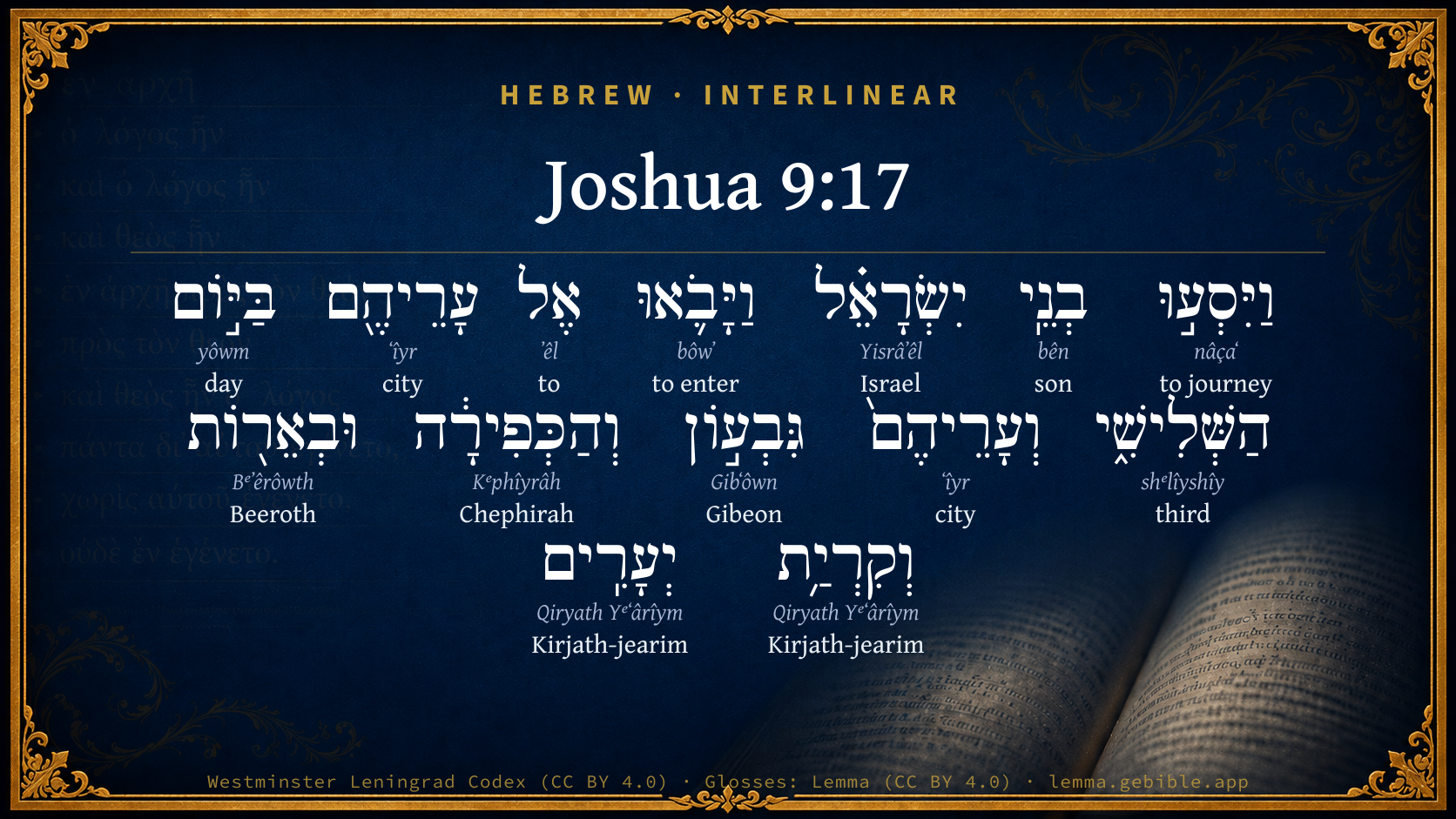
Hebrew (Westminster Leningrad Codex) Joshua 9:17 appears in the Hebrew Old Testament. The text above is from the Westminster Leningrad Codex. Each word links to its Strong’s number, a concise gloss, and parsing drawn from the Open Scriptures Hebrew Bible morphology. Click any word for its full Brown-Driver-Briggs (BDB) entry.
Download image
Cite this verse

Joshua 9:17 (World English Bible). Public Domain. Lemma interlinear Bible study tool, https://lemma.gebible.app/v/joshua/9/17.

Show BibTeX & RIS
BibTeX
RIS
English Translation
The children of Israel traveled, and came to their cities on the third day. Now their cities were Gibeon, and Chephirah, and Beeroth, and Kiriath Jearim.
World English Bible · Public Domain
Highlights
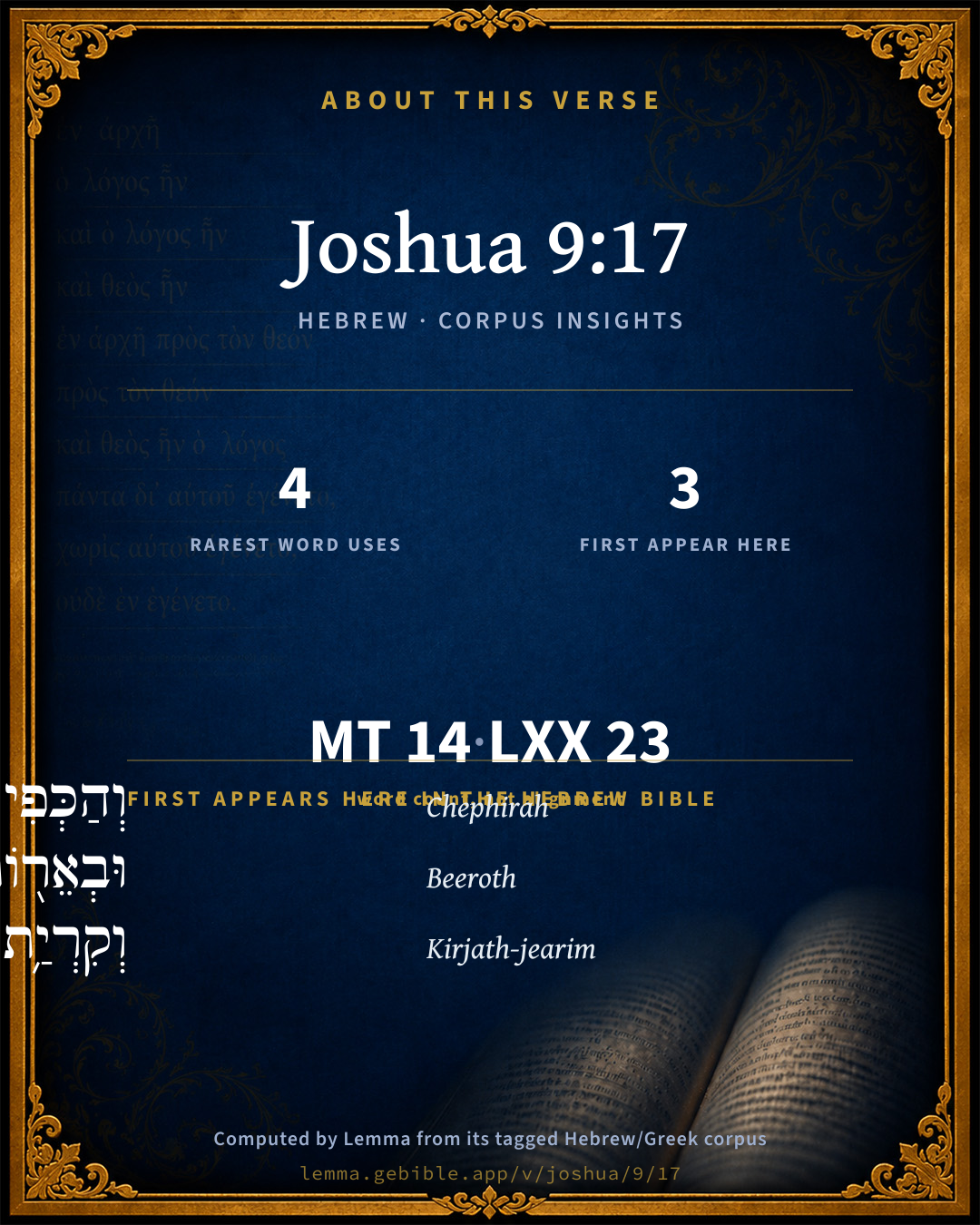
  • 3 first appearances in the Hebrew Bible
Full analysis ↓
Download a study sheet

One document with this verse’s original text, its word-by-word gloss line, the meaning frame, cross-references with their text, attributed commentary, and full source and license credits — printable, and it pastes into notes with its structure intact.

This verse Autodidact and up

Study sheet (.html) Plain text (.txt)

A passage Seminary Student

Up to 50 verses in one chapter. A passage sheet keeps up to 6 commentary sources and 12 cross-references per verse, in the order this page ranks them, and says so on the sheet whenever that leaves anything out. Ask for a single verse and you get the Autodidact verse sheet above.

Everything on this page stays free to read, with no account — the sheet is a download of what is already on screen, not access to it.

Want to remove ads? Support Godless Engineer
Compare translations 3

The same verse in 3 English versions, stacked beneath the original-language interlinear above. Click any original word for its lexicon entry.

Each is an independent rendering of the whole verse — the interlinear is not word-aligned to these translations.

Highlighted words mark where these versions differ — a whole-verse word diff, not a word-by-word alignment.

  • World English Bible Public Domain
    The children of Israel traveled, and came to their cities on the third day. Now their cities were Gibeon, and Chephirah, and Beeroth, and Kiriath Jearim.
  • King James Version Public Domain
    And the children of Israel journeyed, and came unto their cities on the third day. Now their cities were Gibeon, and Chephirah, and Beeroth, and Kirjathjearim.
  • unfoldingWord Literal Text CC BY-SA 4.0
    And the sons of Israel set out and came to their cities on the third day. And their cities Gibeon and Kephirah and Beeroth and Kiriath Jearim.

unfoldingWord Literal Text — © unfoldingWord, licensed CC BY-SA 4.0. Word-aligned USFM3 via Door43 (git.door43.org/unfoldingWord/en_ult).

Versions to compare (up to 4)

3 of 4 selected

Show all 18 translations

Every available English version of this verse, each an independent rendering of the whole verse.

  • World English Bible Public Domain
    The children of Israel traveled, and came to their cities on the third day. Now their cities were Gibeon, and Chephirah, and Beeroth, and Kiriath Jearim.
  • Berean Standard Bible Public Domain
    So the Israelites set out and on the third day arrived at their cities—Gibeon, Chephirah, Beeroth, and Kiriath-jearim.
  • Majority Standard Bible Public Domain
    So the Israelites set out and on the third day arrived at their cities—Gibeon, Chephirah, Beeroth, and Kiriath-jearim.
  • King James Version Public Domain
    And the children of Israel journeyed, and came unto their cities on the third day. Now their cities were Gibeon, and Chephirah, and Beeroth, and Kirjathjearim.
  • American Standard Version (1901) Public Domain
    And the children of Israel journeyed, and came unto their cities on the third day. Now their cities were Gibeon, and Chephirah, and Beeroth, and Kiriath-jearim.
  • Revised Version (1885) Public Domain
    And the children of Israel journeyed, and came unto their cities on the third day. Now their cities were Gibeon, and Chephirah, and Beeroth, and Kiriath-jearim.
  • Geneva Bible (1599) Public Domain
    And the children of Israel tooke their iourney, and came vnto their cities the third day, and their cities were Gibeon, and Chephirah, and Beeroth and Kiriath-iearim.
  • Douay-Rheims (1899) Public Domain
    And the children of Israel removed the camp, and came into their cities on the third day, the names of which are Gabaon, and Caphira, and Beroth, and Cariathiarim.
  • Young's Literal Translation Public Domain
    And the sons of Israel journey and come in unto their cities on the third day -- and their cities `are' Gibeon, and Chephirah, and Beeroth, and Kirjath-Jearim --
  • Literal Standard Version CC BY-SA 4.0
    And the sons of Israel journey and come to their cities on the third day—and their cities [are] Gibeon, and Chephirah, and Beeroth, and Kirjath-Jearim—
  • Unlocked Literal Bible CC BY-SA 4.0
    Then the people of Israel set out and came to their cities on the third day. Their cities were Gibeon, Kephirah, Beeroth, and Kiriath Jearim.
  • unfoldingWord Literal Text CC BY-SA 4.0
    And the sons of Israel set out and came to their cities on the third day. And their cities Gibeon and Kephirah and Beeroth and Kiriath Jearim.
  • Darby Bible Public Domain
    And the children of Israel journeyed, and came to their cities on the third day; and their cities were Gibeon, and Chephirah, and Beeroth, and Kirjath-jearim.
  • World Messianic Bible Public Domain
    The children of Israel traveled and came to their cities on the third day. Now their cities were Gibeon, Chephirah, Beeroth, and Kiriath Jearim.
  • Webster's Bible Public Domain
    And the children of Israel journeyed, and came to their cities on the third day. Now their cities were Gibeon, and Chephirah, and Beeroth, and Kirjath-jearim.
  • Free Bible Version CC BY-SA 4.0
    The Israelites left to go to the Gibeonite towns, and arrived there on the third day. The towns were Gibeon, Kephirah, Beeroth and Kiriath Jearim.
  • Bible in Basic English Public Domain
    And the children of Israel went forward on their journey, and on the third day came to their towns. Now their towns were Gibeon and Chephirah and Beeroth and Kiriath-jearim.
  • JPS Tanakh (1917) Public Domain
    And the children of Israel journeyed, and came unto their cities on the third day. Now their cities were Gibeon, and Chephirah, and Beeroth, and Kiriath-jearim.

Literal Standard Version (2020), Covenant Press — licensed CC BY-SA 4.0. Text via the HelloAO Bible API (eBible.org). Unlocked Literal Bible (unfoldingWord) — licensed CC BY-SA 4.0. Text via the HelloAO Bible API (eBible.org). unfoldingWord Literal Text — © unfoldingWord, licensed CC BY-SA 4.0. Word-aligned USFM3 via Door43 (git.door43.org/unfoldingWord/en_ult). Free Bible Version, Dr. Jonathan Gallagher — licensed CC BY-SA 4.0. Text via the HelloAO Bible API (eBible.org).

Word by word

More ways to search: Search by grammar → Find every occurrence → Compare this word →

Practice this passage: Drill this verse → Learn its vocabulary →

וְהַכְּפִירָ֔ה
Kᵉphîyrâh
H3716
“and · the · Chephirah”
Conjunction + Particle, Definite Article + Noun, Proper
Part of Speech
Conjunction + Particle + Noun
Type
Proper
Full BDB Definition

Origin: feminine of H3715

TWOT: None

Chephirah = "lioness" - a city of the Gibeonites subsequently assigned to the tribe of Benjamin
  1. וַיִּסְע֣וּ nâçaʻ H5265 “and · to journey” Conjunction + Verb, Qal, Sequential Imperfect, 3rd Person, Masculine, Plural
  2. בְנֵֽי bên H1121 “sons of” Noun, Common, Masculine, Plural, Construct
  3. יִשְׂרָאֵ֗ל Yisrâʼêl H3478 “Israel” Noun, Proper
  4. וַיָּבֹ֛אוּ bôwʼ H935 “and · to enter” Conjunction + Verb, Qal, Sequential Imperfect, 3rd Person, Masculine, Plural
  5. אֶל ʼêl H413 “to” Preposition
  6. עָרֵיהֶ֖ם ʻîyr H5892 “cities · their” Noun, Common, Feminine, Plural, Construct + Suffix, Personal, 3rd Person, Masculine, Plural
  7. בַּיּ֣וֹם yôwm H3117 “in/at the · day” Preposition, Determined + Noun, Common, Masculine, Singular, Absolute
  8. הַשְּׁלִישִׁ֑י shᵉlîyshîy H7992 “the · third” Particle, Definite Article + Adjective, Ordinal number, Masculine, Singular, Absolute
  9. וְעָרֵיהֶם֙ ʻîyr H5892 “and · cities · their” Conjunction + Noun, Common, Feminine, Plural, Construct + Suffix, Personal, 3rd Person, Masculine, Plural
  10. גִּבְע֣וֹן Gibʻôwn H1391 “Gibeon” Noun, Proper
  11. וּבְאֵר֖וֹת Bᵉʼêrôwth H881 “and · Beeroth” Conjunction + Noun, Proper
  12. וְקִרְיַ֥ת Qiryath Yᵉʻârîym H7157 “and · Kirjath-jearim” Conjunction + Noun, Proper
  13. יְעָרִֽים Qiryath Yᵉʻârîym H7157 “Kirjath-jearim” Noun, Proper

About this verse

These counts appear in no published source. They are computed here, from the morphology-tagged text and Lemma’s own curated glosses. What Lemma adds →

14
words
12
distinct lemmas
Historical
section

Notable vocabulary

The rarest word here is וְהַכְּפִירָ֔ה Chephirah H3716 — appearing just 4 times in the whole Hebrew Bible.

First appearance in Scripture

These words make their first canonical appearance in the Hebrew Bible here:

  • וְהַכְּפִירָ֔ה Chephirah H3716
  • וּבְאֵר֖וֹת Beeroth H881
  • וְקִרְיַ֥ת Kirjath-jearim H7157

Shared distinctive vocabulary

וְהַכְּפִירָ֔ה Chephirah H3716 occurs in 4 verses of the Hebrew Bible. Also found in:

Grammatical profile

  • 2 verbs
  • 10 nouns
  • 1 adjective
  • 1 preposition

Verb forms

  • וַיִּסְע֣וּ Qal · Sequential Imperfect
  • וַיָּבֹ֛אוּ Qal · Sequential Imperfect

Repetition

Words recur within this verse — often emphatic in Hebrew:

  • עָרֵיהֶ֖ם city H5892 ×2
  • וְקִרְיַ֥ת Kirjath-jearim H7157 ×2

Hebrew & Septuagint length

In English translation the verse runs 26 words from the Hebrew and 25 from the Septuagint (LXX English) — closely comparable.

A rough comparison of the two English renderings, which tokenize alike — not a word-level alignment.

Word counts can differ between the Hebrew and the Greek without any difference in meaning — e.g. the Hebrew direct-object marker אֵת has no separate Greek word, and Greek often adds the article ὁ.

In the original languages it is 14 Hebrew tokens and 23 Greek tokens — but the two are counted differently (Hebrew bundles its prefixes and suffixes into one token; the Greek is in lemma form), so that isn’t a like-for-like length.

Cross-references

11

Topical passages linked to Joshua 9:17 in the Treasury of Scripture Knowledge — connected by theme and wording, ordered by reader-vote popularity; previews shown in the World English Bible.

  • Joshua 18:25–28 Gibeon, and Ramah, and Beeroth,
  • Ezra 2:25 The children of Kiriath Arim, Chephirah, and Beeroth, seven hundred forty-three.
  • Joshua 10:2 that they feared greatly, because Gibeon was a great city, as one of the royal cities, and because it was greater than Ai, and all the men of it were mighty.
  • Joshua 15:9 and the border extended from the top of the mountain to the spring of the waters of Nephtoah, and went out to the cities of Mount Ephron; and the border extended to Baalah (the same is Kiriath Jearim);
  • Joshua 15:60 Kiriath Baal (the same is Kiriath Jearim), and Rabbah; two cities with their villages.
  • Joshua 18:14 The border extended [there], and turned about on the west quarter southward, from the mountain that lies before Beth Horon southward; and the goings out of it were at Kiriath Baal (the same is Kiriath Jearim), a city of the children of Judah: this was the west quarter.
  • 1 Samuel 7:1 The men of Kiriath Jearim came, and fetched up the ark of Yahweh, and brought it into the house of Abinadab in the hill, and sanctified Eleazar his son to keep the ark of Yahweh.
  • 1 Chronicles 13:5–6 So David assembled all Israel together, from the Shihor [the brook] of Egypt even to the entrance of Hamath, to bring the ark of God from Kiriath Jearim.
  • 1 Chronicles 21:29 For the tent of Yahweh, which Moses made in the wilderness, and the altar of burnt offering, were at that time in the high place at Gibeon.
  • 2 Chronicles 1:3–4 So Solomon, and all the assembly with him, went to the high place that was at Gibeon; for there was the tent of meeting of God, which Moses the servant of Yahweh had made in the wilderness.
  • Nehemiah 7:29 The men of Kiriath Jearim, Chephirah, and Beeroth, seven hundred forty-three.

Cross-references courtesy of OpenBible.info (CC BY 4.0).

Hebrew and Greek witnesses Masoretic Hebrew ↔ Greek Septuagint

The same verse in the two great witnesses to the Old Testament, shown verse-for-verse.

These are two independent witnesses, not word-aligned to each other, and the Septuagint is shown in lemma (dictionary) form.

Hebrew Joshua 9:17 Masoretic · Westminster Leningrad Codex

וַיִּסְע֣וּ בְנֵֽי יִשְׂרָאֵ֗ל וַיָּבֹ֛אוּ אֶל עָרֵיהֶ֖ם בַּיּ֣וֹם הַשְּׁלִישִׁ֑י וְעָרֵיהֶם֙ גִּבְע֣וֹן וְהַכְּפִירָ֔ה וּבְאֵר֖וֹת וְקִרְיַ֥ת יְעָרִֽים

The children of Israel traveled, and came to their cities on the third day. Now their cities were Gibeon, and Chephirah, and Beeroth, and Kiriath Jearim.

World English Bible · Public Domain

Greek LXX Joshua 9:17 Septuagint · lemma form

καί ἀποαἴρω ὁ υἱός ἰσραήλ καί ἔρχομαι εἰς ὁ πόλις αὐτός ὁ δέ πόλις αὐτός γαβαων καί κεφιρα καί βηρωθ καί πόλις ιαριν

And the children of Israel departed and came to their cities; and their cities were Gabaon, and Kephira, and Berot, and the cities of Jarin.

LXX2012 (modern English Septuagint) · Public Domain

Hebrew: Westminster Leningrad Codex (CC BY 4.0). Greek: Septuagint (public domain); English from LXX2012 (modern English Septuagint) (Public Domain). How the Septuagint differs from the Hebrew →

Targum (Aramaic paraphrase)

1

The Targum is the ancient Jewish Aramaic paraphrase of the Hebrew Scriptures — an interpretive translation, not the Hebrew text itself. Onkelos (literal) and Pseudo-Jonathan (expansive) render the Torah, and Jonathan the Prophets. Coverage is partial: where no permissively-licensed English translation exists for a verse, only the Aramaic is shown. This is verse-level text, not a word-by-word alignment to the Hebrew.

  1. Targum Jonathan Prophets (Joshua–Malachi)
    וּנְטָלוּ בְנֵי יִשְׂרָאֵל וַאֲתוֹ לְקִרְוֵיהוֹן בְּיוֹמָא תְלִיתָאָה וְקִרְוֵיהוֹן גִבְעוֹן וּכְפִירָה וּבְאֵרוֹת וְקִרְיַת יְעָרִים:

    (no public-domain English translation for this verse)

    Targum Jonathan — Aramaic: “Mikraot Gedolot” (public domain). English: “Sefaria Community Translation” (CC0 1.0 (public-domain dedication)); “London "Chaldee Paraphrase," 1871” (public domain). Text via Sefaria.

Commentary

Notes on Joshua 9:17 from classic Christian and Jewish commentators (each source and its license shown beneath its notes). The classic Christian expositions comment on the surrounding passage and are grouped to its opening verse, so a note may address several verses; the Jewish commentaries on the Tanakh (Rashi and others) are per-verse, so they appear only where the commentator wrote on this verse.

Lemma curates 59 commentaries, every one of them public domain or Creative Commons licensed, each selected and text-cleaned for this edition rather than reprinted as found. About our sources →

Trapp's Complete Commentary

John Trapp

Jos 9:17 And the children of Israel journeyed, and came unto their cities on the third day. Now their cities [were] Gibeon, and Chephirah, and Beeroth, and Kirjathjearim.

Ver. 17. And Kirjathjearim.] Or, The city of woods; famous afterwards for the birth of the prophet Uriah there, who prophesied against Jerusalem, and suffered for speaking truth. {Jer 26:20-22} Veritas odium parit.

John Trapp, A Commentary or Exposition upon All the Books of the Old and New Testament (1647–1656) — public domain. Text from a community e-Sword module.

Tyndale Open Study Notes

Tyndale Open Resources

9:17 Gibeon, Kephirah, Beeroth, and Kiriath-jearim were on the plateau northwest of Jerusalem and southwest of Bethel and Ai (see study note on 7:2).

Tyndale Open Study Notes — © Tyndale Open Resources, licensed CC BY-SA 4.0. Text via the HelloAO Bible API.

Geneva Bible (1599)

Geneva Bible translators

From Gilgal.

Geneva Bible (1599) marginal notes — public domain. Text via Bolls.life.

Jamieson, Fausset & Brown

Robert Jamieson, A. R. Fausset & David Brown

Chephirah-- (Jos 18:26; Ezr 2:25; Neh 7:29).

Beeroth-- (Sa2 4:2), now El Berich, about twenty minutes' distance from El Jib (Gibeon).

Kirjath-jearim--"the city of forests," now Kuryet-el-Enab [ROBINSON].

Jamieson, Fausset & Brown — Commentary Critical and Explanatory on the Whole Bible (1871) — public domain (CC PDM 1.0). Text via the HelloAO Bible API.

Adam Clarke's Commentary

Verse 17. The children of Israel - came unto their cities] Probably when the fraud was discovered, Joshua sent out a detachment to examine their country, and to see what use could be made of it in the prosecution of their war with the Canaanites. Some of the cities mentioned here were afterwards in great repute among the Israelites: and God chose to make one of them, Kirjath-jearim, the residence of the ark of the covenant for twenty years, in the reigns of Saul and David. There is no evidence that the preservation of the Gibeonites was displeasing to Jehovah.

Adam Clarke's Commentary on the Bible (1810–1826) — public domain. Text from a community e-Sword/MySword module.

Ellicott's Commentary for English Readers

(17) Gibeon, and Chephirah, and Beeroth, and Kirjath-jearim.—The first three of these were assigned to Benjamin (Jos_18:25-26), the last to Judah (15:60), in the division of the land. The fact that the larger portion of the territory of the Gibeonites was in the tribe of Benjamin explains how Saul was tempted to confiscate their possessions for the purpose of supplying his followers with fields and vineyards (1Sa_22:7). He appears to have carried out his purpose in the case of Beeroth (2Sa_4:2-3), but not as regards all the Gibeonite towns. Gibeon became a city of the priests (Jos_21:17), and also a principal place of worship and the seat of the tabernacle (as Kirjath-jearim was of the ark) in later times. (See 1Sa_6:21; 1Sa_7:1, &c.; 1 Chron. 20:29; and 2Ch_1:3-6.) The fact that the Gibeonites were dedicated to the service of the sanctuary may partly account for this. In Gibeon, Solomon asked and received the wisdom which Joshua and Israel at this time did not ask.

A Bible Commentary for English Readers, edited by Charles John Ellicott (1878–1897) — public domain. Text from a community e-Sword module.

The Cambridge Bible for Schools and Colleges

gen. ed. J. J. S. Perowne

17. on the third day] A three days’ journey it might well be “according to the slow pace of eastern armies and caravans.” Stanley’s S. & P. p. 209.

Chephirah] “a village,” afterwards allotted to Benjamin (Jos_18:26). It was an inhabited city in the times of Ezra and Nehemiah (Ezr_2:25; Neh_7:29). On the western declivity of the mountain range, 11 miles from Jerusalem, and 4 from Kirjath-jearim, is a ruined village called Kefîr, which doubtless marks the site of the old city of Chephirah. After remaining unknown, or at least unnoticed, for more than 2000 years, its site was discovered by Dr Robinson in 1852. See Robinson, Bible Res. III. 146.

Beeroth] Mentioned afterwards along with other Benjamite cities among the places whose inhabitants returned with Zerubbabel (Ezr_2:25; Neh_7:29). It is commonly identified with the large village of El-Birch between Jerusalem and Bethel.

Kirjath-jearim i.e. “the city of woods,” or “groves,” written Kirjath-arim in Ezr_2:25, and Kiriathiarius in 1Es_5:19. It derived its name from its olive, fig, and other plantations, as its modern representative, Kuriet-el-Enab, “the city of grapes,” does from its vineyards. It was afterwards allotted to Judah, and here the Ark remained from the time of its return from the Philistines to the reign of David (1Sa_7:2; 2Sa_6:2; 1Ch_13:5-6; Psa_132:6), where David is said to have found the Ark in “the fields of the wood.” Before the Israelitish conquest it was known as Baalah and Kirjath-baal (Jos_15:9; Jos_15:60), names which point to its early sanctity as one of the special seats of the worship of Baal.

The Cambridge Bible for Schools and Colleges (gen. ed. J. J. S. Perowne; Cambridge University Press, 1878–1918) — public domain. Text from a community e-Sword module.

John Gill's Exposition

And the children of Israel journeyed,.... Not the whole camp, for that still remained at Gilgal, and continued there until the Gibeonites in distress sent to them for assistance in virtue of the league, as appears from the following chapter; but a party of them, who were sent along with some of the princes, to know the truth whether the Gibeonites were their neighbours or not, as had been reported to them:

and came unto their cities on the third day; not on the third day from their setting out on their journey, for it was but one night's march from Gilgal to them, Jos 10:9; but on the third day from the making of the league; it is very probable it was early on the third day they heard of their being their neighbours, upon which a party was sent out at once to know the truth of it, who arrived thither the same day:

now their cities were Gibeon and Chephirah, and Beeroth and Kirjathjearim; Gibeon was the metropolis, and the other three were subject to it; the three first fell to the lot of Benjamin, and the last to the tribe of Judah; we shall meet with them again in the lots of the several tribes, in Jos 15:60.

John Gill's Exposition of the Whole Bible (1746–1763) — public domain (CC PDM 1.0). Text via the HelloAO Bible API.

Albert Barnes' Notes on the Bible

Chephirah (Kefir) is situated eight or nine miles west of Gibeon, and was an inhabited city in the days of Ezra and Nehemiah Ezr 2:25; Neh 7:29.

Beeroth (Birch), about eight miles north of Jerusalem. Kirjath-jearim, i. e. “city of woods,” is identified by Robinson with the modern Kuriet el Enab, nine miles from Jerusalem on the road to Jaffa (and by Conder with Soba). The town was numbered among those belonging to Judah, and was in the northern boundary of that tribe. Beyond this city the six hundred Danites encamped on their famous expedition to Laish Jdg 18:12. Kirjath-jearim was also, and probably before the Israelite conquests exclusively, called Baalah and Kirjath-baal Jos 15:9, Jos 15:60, names which seem to point to its early sanctity as a special seat of Baal-worship. To this place also the ark was brought from Beth-shemesh after it was sent back by the Philistines, and here it remained for twenty years 1Sa 6:20-21; 1Sa 7:2. It was fetched thence by David and deposited in the house of Obed-edom 2Sa 6:2. Hence, the allusion, Psa 132:6, where David is said to have found the ark “in the fields of the wood.”

Albert Barnes' Notes on the Bible (1834–1885) — public domain. Text from a community e-Sword/MySword module.

Matthew Poole's English Annotations

Cities which were subject to Gibeon, which was the royal city, Jos 10:2.

Matthew Poole's English Annotations on the Holy Bible (1683–1685) — public domain. Text from a community e-Sword/MySword module.

Whedon's Commentary on the Bible

Daniel D. Whedon

17. Gibeon — See Jos_9:3, note. There were three other cities on federal relations with Gibeon.

Chephira, literally, the village, is in the mountains on the western confines of Benjamin, east of Nicopolis, and about two miles east of Yalo, the ancient Aijalon. Dr. Robinson discovered it under the scarcely altered name of Kefir.

Beeroth, a Hebrew word for wells, was known to Eusebius, and his description of its position agrees perfectly with that of the modern el-Bireh, ten miles north of Jerusalem, on the great road to Shechem. It is a favourite resting-place for caravans at the end of the first day’s journey from Jerusalem, and contains a population of about seven hundred.

Kirjath-jearim — City of forests, called also, in Jos_18:14, City of Baal, the great Canaanite deity. It was celebrated as the abode of the ark for twenty years, (1Sa_7:2,) and is still a resort of pilgrims from all Judea. Dr. Robinson identifies it with the modern Kuriet-el-Enab, city of grapes, on the road from Jaffa to Jerusalem, and about ten miles northwest of the latter city. In Jos_18:28, it is called merely Kirjath.

Daniel D. Whedon (gen. ed.), Commentary on the Old and New Testaments (1874–1909) — public domain. Text from a community e-Sword module.

The Pulpit Commentary

On the third day. After the trick was discovered. Keil remarks that we need not suppose that the three days were consumed on the march. Not only did Joshua, when celerity was necessary, perform the journey in a single night, but the whole distance was not more than eighteen or twenty miles, if we accept the hypothesis of a second Gilgal. Now their cities were. Beeroth still exists, we are told, as el-Bireh (Rom 2:132. So also Vaudcvelde and Conder). Jerome identified it with a place only seven miles from Jerusalem, which is an obvious error. It contains nearly 700 inhabitants, and is only about twenty minutes" walk from el-Jib, or Gibeon. Kirjath-jearim (the name means the city of forests) is well known in the history of Israel. (e.g., Jud_1:18:12) But it is, chiefly remarkable for the twenty years sojourn of the ark there. (1Sa_7:2) It was also known by the name of Baalah, Kirjath-Baal. (Jos_15:9, 60 2Sa_6:2) The Hivites seem to have been removed thence (probably to Gibeon), for there is no trace of any non-Jewish element in the population in the account of the reception of the ark among them. (see 1Sa 6) It is called Baale of Judah in 2Sa_6:2. (cf. Jos_18:15) The Jewish population seems to be due to one of the posterity of Caleb. (see 1Ch_2:50-53) Modern explorers, with the exception of Lieut. Conder, have identified Kirjath-jearim with Kuriet-el-Enab, "the city of the grape," about four miles from el-Jib, or Gibeon. This is the opinion of Robinson and Vandevelde. Supposing it to be near Beth-shemesh, on the authority of Josephus, Lieut. Conder places it at "Arma, west of Bethlehem, and identifies the waters of Nepbtoah with a fountain nearly due south of the valley of giants or Rephaim. (see Jos_15:9) But this is too far from Gibeon. He identifies Kuriet-el-Enab with Kirjath in Jos_18:28, and regards this as one of the cities of Benjamin within the border. But this Kirjath may be Kirjath-jearim, and may as reasonably, standing on the border, be accounted to belong to both tribes, as Zorah, Eshtaol (mentioned in the boundaries of Judah and Dan), Beth-arahah, possibly Gibeah or Gibeath (belonging to Judah and Benjamin), and even Jerusalem itself. (see Jos_15:53) The identification of Kirjath-jearim with Kuriet-el-Enab, of the waters of Nephtoah with Ain Lifta, giving a line running northwestward from the valley of Rephaim, seems more probable as the border of Judah and Benjamin, and the word "compassed," or rather deflected, adds probability to this interpretation. (see Jos_15:9, Jos_15:10, and notes)

The Pulpit Commentary (1880–1919), ed. H.D.M. Spence-Jones & Joseph S. Exell — public domain. Text from a community e-Sword module.

John Wesley's Explanatory Notes

And Kirjath-jearim - Which cities were subject to Gibeon, the royal city, chap. x, 2.

John Wesley, Explanatory Notes Upon the Whole Bible (1754–1765) — public domain. Text via the GEBible commentary corpus.

Lesson kit

Teaching starters — assembled from the data on this page, not authored interpretation. Every prompt links to the verse data it draws on. Edit before teaching.

Joshua, in the Historical, opens this verse with 14 words (12 distinct Hebrew lemmas). Its most distinctive word is Kᵉphîyrâh (“Chephirah”). A historical commentator’s framing appears above. Read the whole chapter for the surrounding context.

Discussion questions

  1. What does “Chephirah” (Kᵉphîyrâh) contribute to the verse as a whole?
  2. 3 words make their first appearance in Scripture here. What does this debut establish?
  3. How does Joshua 18:26, which shares the word «Chephirah», read alongside this verse?
  4. What does the repetition of “city” (2× in this one verse) do in this verse?
  5. These translations render this verse differently. What is at stake in choosing one wording over another?
  6. «וַיִּסְע֣וּ» is a Qal Sequential Imperfect verb. How does that grammatical form shape the action described?
  7. Compare how Trapp's Complete Commentary and Tyndale Open Study Notes read this verse. Where do they agree or differ?

Things to notice

Reading settings

Reading text

Shown beneath each verse's original-language words.

Old Testament
Old Testament edition

Read the OT as the Masoretic Hebrew (MT) or the Greek Septuagint (LXX).

English shown for the Greek Septuagint (in the Hebrew ↔ Greek comparison).

Comparing translations? Open the Compare panel on any verse page to stack up to four side by side.