
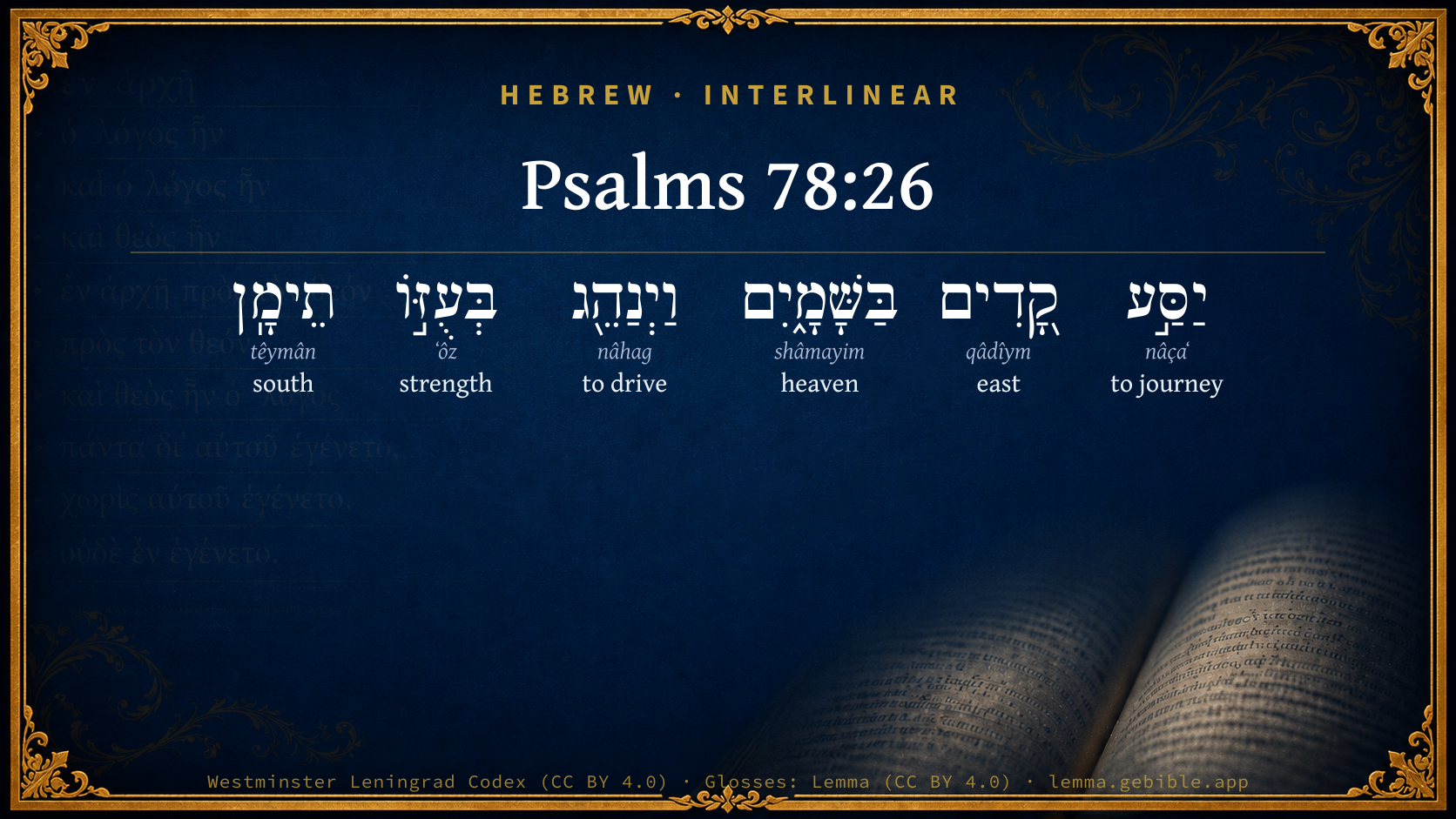
Psalms 78:26

Hebrew (Westminster Leningrad Codex) Psalms 78:26 appears in the Hebrew Old Testament. The text above is from the Westminster Leningrad Codex. Each word links to its Strong’s number, a concise gloss, and parsing drawn from the Open Scriptures Hebrew Bible morphology. Click any word for its full Brown-Driver-Briggs (BDB) entry.
Download image
Cite this verse

Psalms 78:26 (World English Bible). Public Domain. Lemma interlinear Bible study tool, https://lemma.gebible.app/v/psalms/78/26.

Show BibTeX & RIS
BibTeX
RIS
English Translation
He caused the east wind to blow in the sky. By his power he guided the south wind.
World English Bible · Public Domain
Download a study sheet

One document with this verse’s original text, its word-by-word gloss line, the meaning frame, cross-references with their text, attributed commentary, and full source and license credits — printable, and it pastes into notes with its structure intact.

This verse Autodidact and up

Study sheet (.html) Plain text (.txt)

A passage Seminary Student

Up to 50 verses in one chapter. A passage sheet keeps up to 6 commentary sources and 12 cross-references per verse, in the order this page ranks them, and says so on the sheet whenever that leaves anything out. Ask for a single verse and you get the Autodidact verse sheet above.

Everything on this page stays free to read, with no account — the sheet is a download of what is already on screen, not access to it.

Want to remove ads? Support Godless Engineer
Compare translations 3

The same verse in 3 English versions, stacked beneath the original-language interlinear above. Click any original word for its lexicon entry.

Each is an independent rendering of the whole verse — the interlinear is not word-aligned to these translations.

Highlighted words mark where these versions differ — a whole-verse word diff, not a word-by-word alignment.

  • World English Bible Public Domain
    He caused the east wind to blow in the sky. By his power he guided the south wind.
  • King James Version Public Domain
    He caused an east wind to blow in the heaven: and by his power he brought in the south wind.
  • unfoldingWord Literal Text CC BY-SA 4.0
    He caused the east wind to blow in the sky, and by his power he guided the south wind.

unfoldingWord Literal Text — © unfoldingWord, licensed CC BY-SA 4.0. Word-aligned USFM3 via Door43 (git.door43.org/unfoldingWord/en_ult).

Versions to compare (up to 4)

3 of 4 selected

Show all 18 translations

Every available English version of this verse, each an independent rendering of the whole verse.

  • World English Bible Public Domain
    He caused the east wind to blow in the sky. By his power he guided the south wind.
  • Berean Standard Bible Public Domain
    He stirred the east wind from the heavens and drove the south wind by His might.
  • Majority Standard Bible Public Domain
    He stirred the east wind from the heavens and drove the south wind by His might.
  • King James Version Public Domain
    He caused an east wind to blow in the heaven: and by his power he brought in the south wind.
  • American Standard Version (1901) Public Domain
    He caused the east wind to blow in the heavens; And by his power he guided the south wind.
  • Revised Version (1885) Public Domain
    He caused the east wind to blow in the heaven: and by his power he guided the south wind.
  • Geneva Bible (1599) Public Domain
    He caused the Eastwinde to passe in the heauen, and through his power he brought in the Southwinde.
  • Douay-Rheims (1899) Public Domain
    He removed the south wind from heaven: and by his power brought in the southwest wind.
  • Young's Literal Translation Public Domain
    He causeth an east wind to journey in the heavens, And leadeth by His strength a south wind,
  • Literal Standard Version CC BY-SA 4.0
    He causes an east wind to journey in the heavens, || And leads a south wind by His strength,
  • Unlocked Literal Bible CC BY-SA 4.0
    He caused the east wind to blow in the sky, and by his power he guided the south wind.
  • unfoldingWord Literal Text CC BY-SA 4.0
    He caused the east wind to blow in the sky, and by his power he guided the south wind.
  • Darby Bible Public Domain
    He caused the east wind to rise in the heavens, and by his strength he brought the south wind;
  • World Messianic Bible Public Domain
    He caused the east wind to blow in the sky. By his power he guided the south wind.
  • Webster's Bible Public Domain
    He caused an east wind to blow in the heaven: and by his power he brought in the south wind.
  • Free Bible Version CC BY-SA 4.0
    He sent the east wind blowing across the sky; by his power he drove the south wind.
  • Bible in Basic English Public Domain
    He sent an east wind from heaven, driving on the south wind by his power.
  • JPS Tanakh (1917) Public Domain
    He caused the east wind to set forth in heaven; and by His power He brought on the south wind.

Literal Standard Version (2020), Covenant Press — licensed CC BY-SA 4.0. Text via the HelloAO Bible API (eBible.org). Unlocked Literal Bible (unfoldingWord) — licensed CC BY-SA 4.0. Text via the HelloAO Bible API (eBible.org). unfoldingWord Literal Text — © unfoldingWord, licensed CC BY-SA 4.0. Word-aligned USFM3 via Door43 (git.door43.org/unfoldingWord/en_ult). Free Bible Version, Dr. Jonathan Gallagher — licensed CC BY-SA 4.0. Text via the HelloAO Bible API (eBible.org).

Word by word

More ways to search: Search by grammar → Find every occurrence → Compare this word →

Practice this passage: Drill this verse → Learn its vocabulary →

About this verse

These counts appear in no published source. They are computed here, from the morphology-tagged text and Lemma’s own curated glosses. What Lemma adds →

6
words
6
distinct lemmas
Wisdom
section

Notable vocabulary

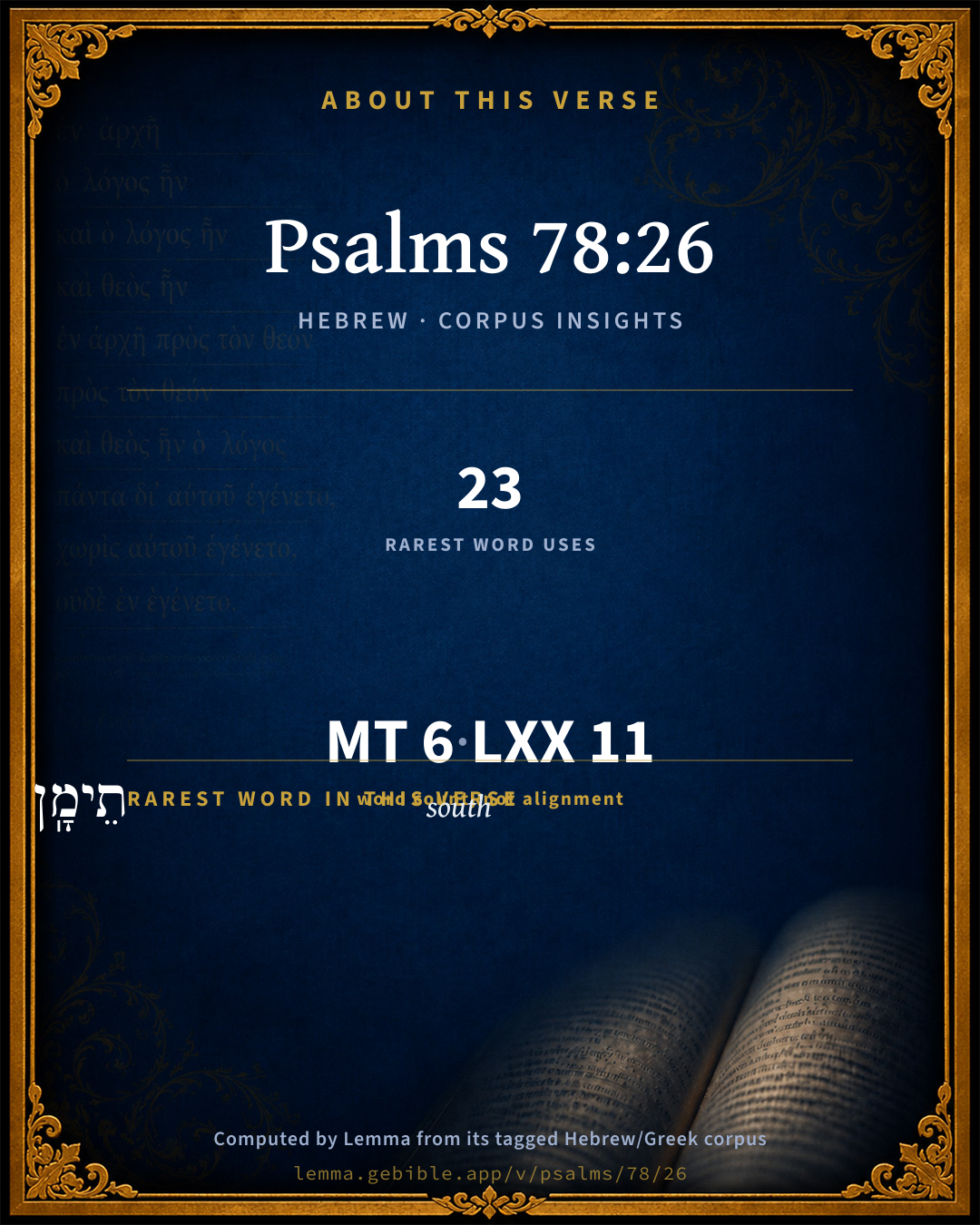
The rarest word here is תֵימָֽן south H8486 — appearing just 23 times in the whole Hebrew Bible.

Shared distinctive vocabulary

תֵימָֽן south H8486 occurs in 22 verses of the Hebrew Bible. Also found in:

Grammatical profile

  • 2 verbs
  • 4 nouns

Verb forms

  • יַסַּ֣ע Hiphil · Imperfect
  • וַיְנַהֵ֖ג Piel · Sequential Imperfect

Hebrew & Septuagint length

In English translation the verse runs 18 words from the Hebrew and 17 from the Septuagint (LXX English) — closely comparable.

A rough comparison of the two English renderings, which tokenize alike — not a word-level alignment.

Word counts can differ between the Hebrew and the Greek without any difference in meaning — e.g. the Hebrew direct-object marker אֵת has no separate Greek word, and Greek often adds the article ὁ.

In the original languages it is 6 Hebrew tokens and 11 Greek tokens — but the two are counted differently (Hebrew bundles its prefixes and suffixes into one token; the Greek is in lemma form), so that isn’t a like-for-like length.

Cross-references

2

Topical passages linked to Psalms 78:26 in the Treasury of Scripture Knowledge — connected by theme and wording, ordered by reader-vote popularity; previews shown in the World English Bible.

  • Numbers 11:31 There went forth a wind from Yahweh, and brought quails from the sea, and let them fall by the camp, about a day's journey on this side, and a day's journey on the other side, round about the camp, and about two cubits above the surface of the earth.
  • Psalms 135:7 Who causes the clouds to rise from the ends of the earth; Who makes lightnings with the rain; Who brings forth the wind out of his treasuries;

Cross-references courtesy of OpenBible.info (CC BY 4.0).

Hebrew and Greek witnesses Masoretic Hebrew ↔ Greek Septuagint

The same verse in the two great witnesses to the Old Testament, shown verse-for-verse.

You’re reading Greek Psalm 77 (Hebrew Psalm 78). The Septuagint counts the superscription, so verse numbers can differ from the Hebrew — chapter-level alignment, not verse-by-verse. Numbering follows Rahlfs.

These are two independent witnesses, not word-aligned to each other, and the Septuagint is shown in lemma (dictionary) form.

Hebrew Psalms 78:26 Masoretic · Westminster Leningrad Codex

יַסַּ֣ע קָ֭דִים בַּשָּׁמָ֑יִם וַיְנַהֵ֖ג בְּעֻזּ֣וֹ תֵימָֽן

He caused the east wind to blow in the sky. By his power he guided the south wind.

World English Bible · Public Domain

Greek LXX Greek Psalm 77:26 Septuagint · lemma form

ἀποαἴρω νότος ἐκ οὐρανός καί ἐπιἄγω ἐν ὁ δυναστεία αὐτός λίψ

He removed the south wind from heaven; and by his might he brought in the southwest wind.

LXX2012 (modern English Septuagint) · Public Domain

On this verse, Whedon's Commentary on the Bible discusses the Septuagint’s reading. Read the note in Commentary ↓

Hebrew: Westminster Leningrad Codex (CC BY 4.0). Greek: Septuagint (public domain); English from LXX2012 (modern English Septuagint) (Public Domain). How the Septuagint differs from the Hebrew →

Commentary

Notes on Psalms 78:26 from classic Christian and Jewish commentators (each source and its license shown beneath its notes). The classic Christian expositions comment on the surrounding passage and are grouped to its opening verse, so a note may address several verses; the Jewish commentaries on the Tanakh (Rashi and others) are per-verse, so they appear only where the commentator wrote on this verse.

Lemma curates 59 commentaries, every one of them public domain or Creative Commons licensed, each selected and text-cleaned for this edition rather than reprinted as found. About our sources →

Trapp's Complete Commentary

John Trapp

Psa 78:26 He caused an east wind to blow in the heaven: and by his power he brought in the south wind.

Ver. 26. He caused an east wind to blow] Pergere, to go, to pass away, and to give place to the south wind.

And by his power he brought in the south wind] That it might bring in the quails. Now Pliny writeth (lib. 10, c. 23), that quails, though they love to fly with the wind, because of their heavy bodies and small strength, yet not with the south wind, because it is moist, and so more heavy than the north wind, which therefore they rather delight in. And if this be true, here is another miracle, saith an expositor, that these quails were brought in by that wind, which, when it bloweth, they commonly rest and hide themselves.

John Trapp, A Commentary or Exposition upon All the Books of the Old and New Testament (1647–1656) — public domain. Text from a community e-Sword module.

Joseph Benson's Commentary

Psa 78:26-29. He caused an east wind to blow, &c. — First an eastern, and afterward a southern wind. He rained flesh, &c., and feathered fowls like as the sand — Hebrew, עוŠ כנŠ, gnoph chanap, fowl of wing, or winged fowl; but God took away from them the use of their wings, and made them fall into the hands of the Israelites. And let it fall in the midst of their camp — Hebrew, מחנהו, machanehu, his camp; that is, either Israel’s camp, or God’s camp; for, seeing Israel was God’s people, and he dwelt among them, their camp was his camp. He gave them their own desire — What they desired, both for quality and quantity.

Joseph Benson's Commentary on the Old and New Testaments (1811–1818) — public domain. Text from a community e-Sword module.

J. A. Alexander on Psalms

Joseph Addison Alexander

26. (Psa 78:26) He rouses an east-wind in the heavens, and guides by his power a south-wind. The first verb is a causative of that used in Num 11:31, which strictly means to strike a tent or break up an encampment, and then to set out upon a march or journey, but is there applied to the sudden rise of a particular wind. The east and south are here named as the points from which the strongest winds were known to blow in that part of the world. The history itself contains no such specification. Guides, directs it in the course required for this purpose.

Joseph Addison Alexander, The Psalms Translated and Explained (1850) — public domain. Text from a community e-Sword module.

Tyndale Open Study Notes

Tyndale Open Resources

78:26-31 God powerfully satisfied the people’s desires, but they did not respond with gratitude or faith. Therefore, God exercised his justice.

Tyndale Open Study Notes — © Tyndale Open Resources, licensed CC BY-SA 4.0. Text via the HelloAO Bible API.

Geneva Bible (1599)

Geneva Bible translators

God used the means of the wind to teach them that all elements were at his commandment, and that no distance or place could let his working.

Geneva Bible (1599) marginal notes — public domain. Text via Bolls.life.

Adam Clarke's Commentary

Verse 26. He caused an east wind to blow] See Clarke on Nu 11:31.

Adam Clarke's Commentary on the Bible (1810–1826) — public domain. Text from a community e-Sword/MySword module.

John Calvin's Commentaries

26. He caused an east wind to blow in the heavens. We have here related how God granted the request of his people. This does not imply that he favourably regarded their fretful desires, but that he showed by the effect that it was in his power to do what they believed it to be impossible for him to accomplish. From this, we may perceive how injudiciously some expositors here join together the flesh and the manna. The reason why the flesh was given was altogether different from that for which the manna was given. God, in giving the manna, performed the office of a father; but by the flesh, he satisfied their gluttonous desires, that their very greediness in devouring it might choke them. It would not have been a difficult matter for God to have created quails in the midst of the wilderness; but he chose rather to bring them by the force of the winds, to teach the Israelites that all the elements are obedient to his command, and that the distance of places cannot prevent his power from immediately penetrating from the east even to the west. That unbelieving people, therefore, were furnished with an undoubted proof of the power of God, from which they had malignantly detracted, in seeing all the elements of nature ready to obey and promptly to execute whatever he has commanded. Besides, he no doubt raised the winds according to the situation of the camp, although it would have been easy for him, without any means, to have presented flesh before them. It is stated, that they did eat and were filled, not only to intimate that God brought to them a large supply of birds, with which their bellies might be stuffed to the full; but also, that it was ungovernable lust which led them to ask flesh, and not a solicitude for having provision on which to live. It has been said above, that manna had been given them in the greatest abundance, but here it is intended expressly to censure their gluttony, in which they gave manifest proof of their unbridled appetite. God promises, in Psalm 145:19, as a peculiar privilege to those who fear him, that “he will fulfill their desire;” but it is in a different way that he is here said to have yielded to the perverse desires of the people, who had cast off all fear of him; for that which his favor and loving-kindness would have led him to refuse, he now granted them in his wrath. This is an example well worthy of our attention, that we may not complain if our desires are frowned upon and crossed by the secret providence of God when they break forth beyond bounds. God then truly hears us, when, instead of yielding to our foolish inclinations, he regulates his beneficence according to the measure of our welfare; even as in lavishing upon the wicked more than is good for them, he cannot, properly speaking, be said to hear them: he rather loads them with a deadly burden, which serves to cast them down headlong into destruction.

John Calvin's Commentaries (1540-1563) — public domain. Text from the Calvin Translation Society English edition (1840s-50s) via the Christian Classics Ethereal Library (ccel.org). Calvin's coverage is partial (roughly two-thirds of the Bible); uncommented books and verses are honest gaps, never fabricated. The 19th-century editor's footnotes and remarks are omitted so the notes are faithfully Calvin's own voice.

Ellicott's Commentary for English Readers

(26) East wind . . . south wind.—Probably the very winds that brought the flights of quails, and not merely poetical details. (See Smith’s Biblical Dictionary, art. “Quails.”)

A Bible Commentary for English Readers, edited by Charles John Ellicott (1878–1897) — public domain. Text from a community e-Sword module.

The Cambridge Bible for Schools and Colleges

gen. ed. J. J. S. Perowne

26. He led forth the east wind In the heaven:

And by his power he guided the south wind:

The Cambridge Bible for Schools and Colleges (gen. ed. J. J. S. Perowne; Cambridge University Press, 1878–1918) — public domain. Text from a community e-Sword module.

John Gill's Exposition

He rained flesh also upon them as dust,.... By "flesh" is meant fowl, as the following clause shows; for there is flesh of birds, as well as of other creatures, see Co1 15:39 and the quails which are here meant may be very fitly called flesh, since they are, for their size, a very plump, fat, and fleshy bird:

and feathered fowls like as the sand of the sea; or "fowl of wing" (h): winged fowls, so the Targum; fowl that flies; and therefore it was the more remarkable that these should be rained and fall, and be taken by the Israelites; and which fell in great numbers, as is signified by these phrases, the dust and the sand of the sea; for there fell enough to feed six hundred thousand men, beside women and children, for a month together; they lay in heaps, two cubits high, on one another, and everyone that gathered them brought in ten homers; see Num 11:19, which is the history referred to; and quails are used to fly together in large bodies; and sometimes, as Pliny (i) relates, will light on ships at sea, and sink them with their numbers. Some think one sort of locusts is meant, which were used for food, and was very delicious food; and the circumstances of bringing them with an east or southeast wind, their falling in heaps, and being gathered in bushels, and spread about to be dried in the sun, seem to favour such a sense; See Gill on Num 11:19; see Gill on Num 11:20; see Gill on Num 11:21; see Gill on Num 11:31; see Gill on Num 11:32. The ancients interpret this mystically of the flesh of Christ, whose flesh is meat indeed, delicious food for faith, as the quails were a rich food; and as they were rained down from heaven, so Christ is the bread of life which came down from heaven, and the bread he gave for the life of the world was his flesh: and as these came up, however the first quails, in the evening, Exo 16:13, so Christ came in the flesh, in the evening or end of the world, to put away sin by the sacrifice of himself; to which may be added, that these creatures sit upon their young, and cherish and protect them, as an hen her chickens (k) with which compare Mat 23:37, but seeing the quails are never called spiritual meat, as the manna is, Co1 10:3, but were given in wrath and judgment, they are rather an emblem of riches, or worldly goods, things given to carnal men; these are of God, as the quails were, and are by some persons enjoyed without care or trouble, as these were; their meat, as it is sometimes said, falls into their mouth, as these quails did into the mouths of the Israelites, as it were; and are in wrath, their blessings are cursed to them, and, while they have a great affluence of worldly things, have leanness in their souls, as the Israelites now had, Psa 106:15, moreover, as these were feathered or winged fowl, so riches have wings, and sometimes flee away, and are very uncertain things to trust to, Pro 23:5.

(h) "volucres alatas", Tigurine version, Junius & Tremellius, Piscator, Cocceius. (i) Hist. l. 10. c. 23. (k) Arist. de Hist. Animal. l. 9. c. 8.

John Gill's Exposition of the Whole Bible (1746–1763) — public domain (CC PDM 1.0). Text via the HelloAO Bible API.

Albert Barnes' Notes on the Bible

He caused an east wind to blow in the heaven - See Num 11:31. In the history, the quarter from which the wind came is not mentioned, except as it might be indicated by the statement that the “quails were brought from the sea;” - that is, evidently, the Red Sea. This wind would have come from the southeast. The phrase “in the heaven” means in the air, or from above.

And by his power ... - By his direct agency. It was a wind which he caused to blow for the purpose; a miracle.

Albert Barnes' Notes on the Bible (1834–1885) — public domain. Text from a community e-Sword/MySword module.

Matthew Poole's English Annotations

Either he brought in first an eastern, and afterwards a southern wind, or the wind was south-east; from which quarter these quails might come as well as from the west, where their more common abode is; this work being confessedly miraculous.

Matthew Poole's English Annotations on the Holy Bible (1683–1685) — public domain. Text from a community e-Sword/MySword module.

The Treasury of David

Charles H. Spurgeon

Ver. 26. He caused an east wind to blow in the heaven. He is Lord Paramount, above the prince of the power of the air: storms arise and tempests blow at his command. Winds sleep till God arouses them, and then, like Samuel, each one answers, "Here am I, for thou didst call me."

And by his power he brought in the south wind. Either these winds followed each other, and so blew the birds in the desired direction, or else they combined to form a south east wind; in either case they fulfilled the design of the Lord, and illustrated his supreme and universal power. If one wind will not serve, another shall; and if need be, they shall both blow at once. We speak of fickle winds, but their obedience to their Lord is such that they deserve a better word. If we ourselves were half as obedient as the winds, we should be far superior to what we are now.

Ver. 26. He caused an east wind to blow in the heaven: and by his power he brought in the south wind. Here, on examining the geographical position of the Israelites, we see exactly how the south east wind would bring the quails. The Israelites had just passed by the Red Sea, and had began to experience a foretaste of the privations which they were to expect in the desert, through which they had to pass. Passing northwards in their usual migrations, the birds would come to the coast of the Red Sea, and there would wait until a favourable wind enabled them to cross the water. The south east wind afforded them just the very assistance which they needed, and they would naturally take advantage of it. J. G. Wood, in "Bible Animals." 1869.

None.

Psalms 78:27*

Charles H. Spurgeon's The Treasury of David (1869–1885) — public domain. Psalms only. Text from a community e-Sword/MySword module.

Whedon's Commentary on the Bible

Daniel D. Whedon

26. East wind—This refers to the second supply of quails, Num_11:31. For the first supply, see Psa_105:40. According to the Hebrew text, two “winds,” from the east and south, were called into action jointly, meeting at the Israelitish camp. The history simply says, “a wind from the Lord.” According to Hebrew usage, a south “wind” might come from any point between southeast and southwest. The Septuagint and Vulgate have “southwest wind.” This would bring the quails migrating northward from southern Arabia, and the interior of Africa, directly over the camp, and being weary of wing, and baffled by an easterly “wind,” they would fall at the point required. It is not uncommon for quails to fly thus in large numbers, and, when weary, they are easily killed with a stick by Arab boys. In this case the miracle was in giving strength and direction to the “winds” to assist their flight to the given time and place, and then there to arrest it. The quail is a round and plump bird, about the size of the turtle-dove, (see on Psa_105:40,) of low and heavy flight, much dependent on favorable “winds” in its migratory passages. In Num_11:31, “Upon the face of the earth” refers to their low flight over, or above, “the face of the earth.”

Daniel D. Whedon (gen. ed.), Commentary on the Old and New Testaments (1874–1909) — public domain. Text from a community e-Sword module.

The Pulpit Commentary

He caused an east wind to blow in the heaven: and by his power he brought in the south wind. Here, again, tradition seems to speak. The narrative in the Pentateuch has only, "There went forth a wind from the Lord". (Num_11:31)

The Pulpit Commentary (1880–1919), ed. H.D.M. Spence-Jones & Joseph S. Exell — public domain. Text from a community e-Sword module.

John Wesley's Explanatory Notes

South wind - First an eastern, and afterwards a southern wind.

John Wesley, Explanatory Notes Upon the Whole Bible (1754–1765) — public domain. Text via the GEBible commentary corpus.

Keil & Delitzsch

C. F. Keil & F. Delitzsch

Passing over to the giving of the quails, the poet is thinking chiefly of the first occasion mentioned in Ex. 16, which directly preceded the giving of the manna. But the description follows the second: יסּע (He caused to depart, set out) after Num 11:31. "East" and "south" belong together: it was a south-east wind from the Aelanitic Gulf. "To rain down" is a figurative expression for a plentiful giving of dispensing from above. "Its camp, its tents," are those of Israel, Num 11:31, cf. Exo 16:13. The תּעוה, occurring twice, Psa 78:29-30 (of the object of strong desire, as in Psa 21:3), points to Kibroth-hattaavah, the scene of this carnal lusting; הביא is the transitive of the בּוא in Pro 13:12. In Psa 78:30-31 even in the construction the poet closely follows Num 11:33 (cf. also זרוּ with לזרא, aversion, loathing, Num 11:20). The Waw unites what takes place simultaneously; a construction which presents the advantage of being able to give special prominence to the subject. The wrath of God consisted in the breaking out of a sickness which was the result of immoderate indulgence, and to which even the best-nourished and most youthfully vigorous fell a prey. When the poet goes on in Psa 78:32 to say that in spite of these visitations (בּכל־זאת) they went on sinning, he has chiefly before his mind the outbreak of "fat" rebelliousness after the return of the spies, cf. Psa 78:32 with Num 14:11. And Psa 78:33 refers to the judgment of death in the wilderness threatened at that time to all who had come out of Egypt from twenty years old and upward (Num 14:28-34). Their life devoted to death vanished from that time onwards בּהבל, in breath-like instability, and בּבּהלה, in undurable precipitancy; the mode of expression in Psa 31:11; Job 36:1 suggests to the poet an expressive play of words. When now a special judgment suddenly and violently thinned the generation that otherwise was dying off, as in Num 21:6., then they inquired after Him, they again sought His favour, those who were still preserved in the midst of this dying again remembered the God who had proved Himself to be a "Rock" (Deu 32:15, Deu 32:18, Deu 32:37) and to be a "Redeemer" (Gen 48:16) to them. And what next? Psa 78:36-37

(Note: According to the reckoning of the Masora this Psa 78:36 is the middle verse of the 2527 verses of the Psalter (Buxtorf, Tiberias, 1620, p. 133).)

tell us what effect they gave to this disposition to return to God. They appeased Him with their mouth, is meant to say: they sought to win Him over to themselves by fair speeches, inasmuch as they thus anthropopathically conceived of God, and with their tongue they played the hypocrite to Him; their heart, however, was not sincere towards Him (עם like את in Psa 78:8), i.e., not directed straight towards Him, and they proved themselves not stedfast (πιστοί, or properly βέβαιοι) in their covenant-relationship to Him.

Keil & Delitzsch — Biblical Commentary on the Old Testament (1861–1891) — public domain (CC PDM 1.0). Text via the HelloAO Bible API. (Old Testament only.)

unfoldingWord translationNotes

Door43 World Missions Community

He caused

"God caused"

He rained down meat on them like dust

The writer speaks of Yahweh causing birds to fall from the sky as if the birds were rain that Yahweh caused to fall. He compares the large amount of birds to dust. AT: "He caused meat to fall from the sky like rain, and there was so much of it that it covered the ground like dust" (See: Metaphor and Simile)

meat

birds

as numerous as the sands of the sea

No one can count the grains of sand. There were more birds than anyone could count, but this is an exaggeration: there were probably not literally the same number of birds as grains of sand. (See: Hyperbole and Generalization)

translationWords

power

tent

unfoldingWord translationNotes — © Distant Shores Media and the Door43 World Missions Community, licensed CC BY-SA 4.0. Source: git.door43.org/Door43/en_tn.

Rashi

Rabbi Shlomo Yitzchaki (Rashi)

He caused the east wind to set forth (Num. 11:31): “And a wind set forth from the Lord, and it made quails fly.”

Rashi on the Tanakh — English translations: “The Judaica Press complete Tanach with Rashi, translated by A. J. Rosenberg” (CC BY 4.0); “Pentateuch with Rashi's commentary by M. Rosenbaum and A.M. Silbermann, 1929-1934” (public domain); “The Metsudah Tanach series, Lakewood, N.J” (CC BY 4.0); and “The Book of Joshua, Metsudah Publications, 1997” (CC BY 4.0). Text via Sefaria.

Lesson kit

Teaching starters — assembled from the data on this page, not authored interpretation. Every prompt links to the verse data it draws on. Edit before teaching.

Psalms, in the Wisdom, opens this verse with 6 words (6 distinct Hebrew lemmas). Its most distinctive word is têymân (“south”). A historical commentator’s framing appears above. Read the whole chapter for the surrounding context.

Discussion questions

  1. The word têymân carries the sense “south.” How does it shape the verse?
  2. How does Exodus 26:18, which shares the word «south», read alongside this verse?
  3. These translations render this verse differently. What is at stake in choosing one wording over another?
  4. «יַסַּ֣ע» is a Hiphil Imperfect verb. How does that grammatical form shape the action described?
  5. Compare how Trapp's Complete Commentary and Joseph Benson's Commentary read this verse. Where do they agree or differ?

Things to notice

Reading settings

Reading text

Shown beneath each verse's original-language words.

Old Testament
Old Testament edition

Read the OT as the Masoretic Hebrew (MT) or the Greek Septuagint (LXX).

English shown for the Greek Septuagint (in the Hebrew ↔ Greek comparison).

Comparing translations? Open the Compare panel on any verse page to stack up to four side by side.