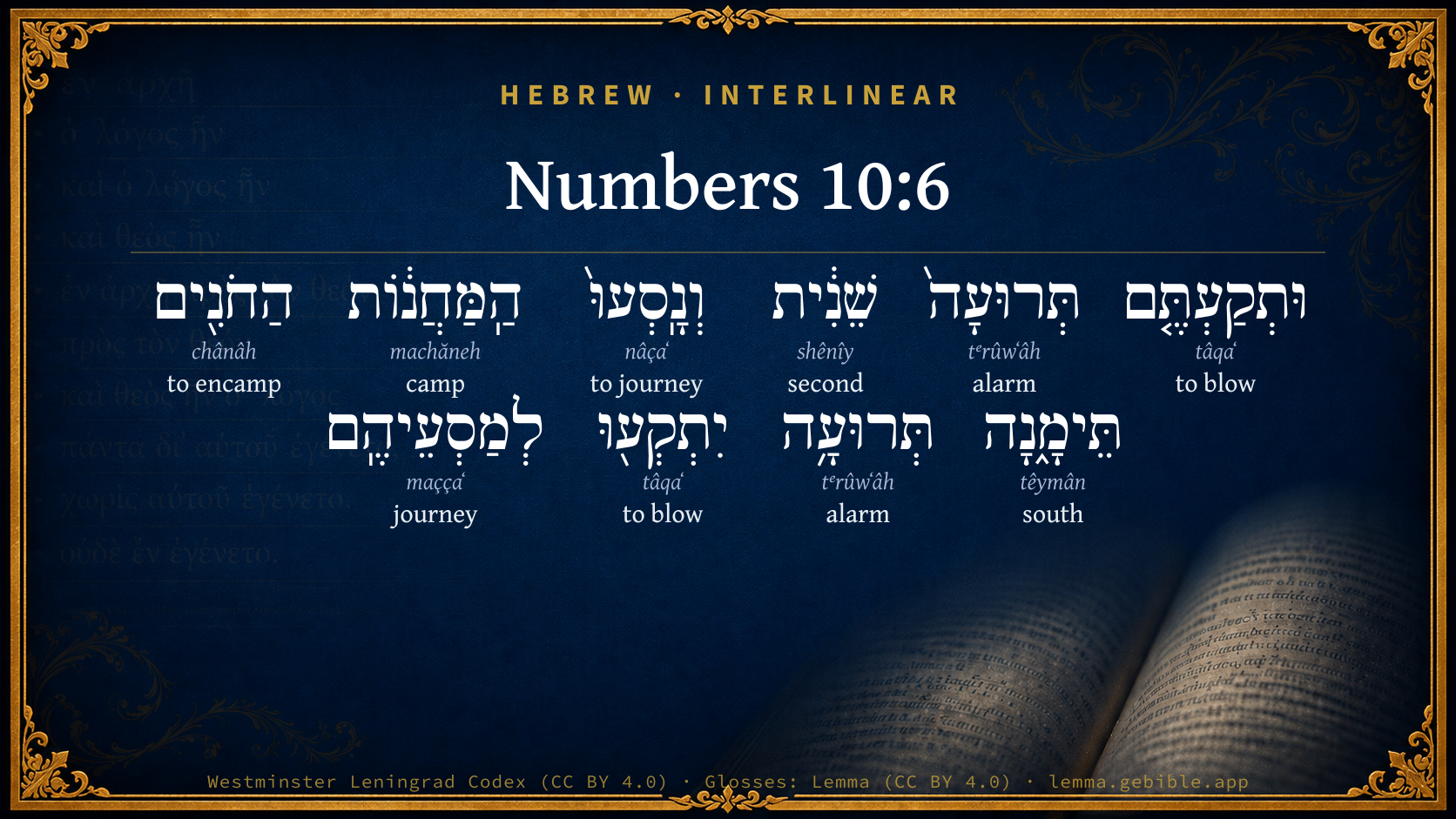
Numbers 10:6

Hebrew (Westminster Leningrad Codex) Numbers 10:6 appears in the Hebrew Old Testament. The text above is from the Westminster Leningrad Codex. Each word links to its Strong’s number, a concise gloss, and parsing drawn from the Open Scriptures Hebrew Bible morphology. Click any word for its full Brown-Driver-Briggs (BDB) entry.
Download image
Cite this verse

Numbers 10:6 (World English Bible). Public Domain. Lemma interlinear Bible study tool, https://lemma.gebible.app/v/numbers/10/6.

Show BibTeX & RIS
BibTeX
RIS
English Translation
When you blow an alarm the second time, the camps that lie on the south side shall take their journey: they shall blow an alarm for their journeys.
World English Bible · Public Domain
Download a study sheet

One document with this verse’s original text, its word-by-word gloss line, the meaning frame, cross-references with their text, attributed commentary, and full source and license credits — printable, and it pastes into notes with its structure intact.

This verse Autodidact and up

Study sheet (.html) Plain text (.txt)

A passage Seminary Student

Up to 50 verses in one chapter. A passage sheet keeps up to 6 commentary sources and 12 cross-references per verse, in the order this page ranks them, and says so on the sheet whenever that leaves anything out. Ask for a single verse and you get the Autodidact verse sheet above.

Everything on this page stays free to read, with no account — the sheet is a download of what is already on screen, not access to it.

Want to remove ads? Support Godless Engineer
Compare translations 3

The same verse in 3 English versions, stacked beneath the original-language interlinear above. Click any original word for its lexicon entry.

Each is an independent rendering of the whole verse — the interlinear is not word-aligned to these translations.

Highlighted words mark where these versions differ — a whole-verse word diff, not a word-by-word alignment.

  • World English Bible Public Domain
    When you blow an alarm the second time, the camps that lie on the south side shall take their journey: they shall blow an alarm for their journeys.
  • King James Version Public Domain
    When ye blow an alarm the second time, then the camps that lie on the south side shall take their journey: they shall blow an alarm for their journeys.
  • unfoldingWord Literal Text CC BY-SA 4.0
    and you shall blow a second alarm, and the camps camping to the south shall set out. They shall blow an alarm for their setting out.

unfoldingWord Literal Text — © unfoldingWord, licensed CC BY-SA 4.0. Word-aligned USFM3 via Door43 (git.door43.org/unfoldingWord/en_ult).

Versions to compare (up to 4)

3 of 4 selected

Show all 18 translations

Every available English version of this verse, each an independent rendering of the whole verse.

  • World English Bible Public Domain
    When you blow an alarm the second time, the camps that lie on the south side shall take their journey: they shall blow an alarm for their journeys.
  • Berean Standard Bible Public Domain
    When you sound the short blasts a second time, the camps that lie on the south side are to set out. The blasts are to signal them to set out.
  • Majority Standard Bible Public Domain
    When you sound the short blasts a second time, the camps that lie on the south side are to set out. The blasts are to signal them to set out.
  • King James Version Public Domain
    When ye blow an alarm the second time, then the camps that lie on the south side shall take their journey: they shall blow an alarm for their journeys.
  • American Standard Version (1901) Public Domain
    And when ye blow an alarm the second time, the camps that lie on the south side shall take their journey: they shall blow an alarm for their journeys.
  • Revised Version (1885) Public Domain
    And when ye blow an alarm the second time, the camps that lie on the south side shall take their journey: they shall blow an alarm for their journeys.
  • Geneva Bible (1599) Public Domain
    If ye blowe an alarme the second time, then the hoste of them that lie on the Southside shall march: for they shall blowe an alarme when they remoue.
  • Douay-Rheims (1899) Public Domain
    And at the second sounding and like noise of the trumpet, they who lie on the south side shall take up their tents. And after this manner shall the rest do, when the trumpets shall sound for a march.
  • Young's Literal Translation Public Domain
    `And ye have blown -- a second shout, and the camps which are encamping southward have journeyed; a shout they blow for their journeys.
  • Literal Standard Version CC BY-SA 4.0
    And you have blown—a second shout, and the camps which are encamping southward have journeyed; they blow a shout for their journeys.
  • Unlocked Literal Bible CC BY-SA 4.0
    When you blow a loud signal the second time, the camps on the south side must begin their journey. They must blow a loud signal for their journeys.
  • unfoldingWord Literal Text CC BY-SA 4.0
    and you shall blow a second alarm, and the camps camping to the south shall set out. They shall blow an alarm for their setting out.
  • Darby Bible Public Domain
    And when ye blow an alarm the second time, the camps that lie southward shall set forward; they shall blow an alarm on their setting forward.
  • World Messianic Bible Public Domain
    When you blow an alarm the second time, the camps that lie on the south side shall go forward. They shall blow an alarm for their journeys.
  • Webster's Bible Public Domain
    When ye blow an alarm the second time, then the camps that lie on the south side shall take their journey: they shall blow an alarm for their journeys.
  • Free Bible Version CC BY-SA 4.0
    When you blow the trumpet loudly the second time, the camps on the south side are to march out. That's their signal to start moving.
  • Bible in Basic English Public Domain
    At the sound of a second loud note, the tents on the south side are to go forward: the loud note will be the sign to go forward.
  • JPS Tanakh (1917) Public Domain
    And when ye blow an alarm the second time, the camps that lie on the south side shall set forward; they shall blow an alarm for their journeys.

Literal Standard Version (2020), Covenant Press — licensed CC BY-SA 4.0. Text via the HelloAO Bible API (eBible.org). Unlocked Literal Bible (unfoldingWord) — licensed CC BY-SA 4.0. Text via the HelloAO Bible API (eBible.org). unfoldingWord Literal Text — © unfoldingWord, licensed CC BY-SA 4.0. Word-aligned USFM3 via Door43 (git.door43.org/unfoldingWord/en_ult). Free Bible Version, Dr. Jonathan Gallagher — licensed CC BY-SA 4.0. Text via the HelloAO Bible API (eBible.org).

Word by word

More ways to search: Search by grammar → Find every occurrence → Compare this word →

Practice this passage: Drill this verse → Learn its vocabulary →

לְמַסְעֵיהֶֽם
maççaʻ
H4550
“to/for · journeys · their”
Preposition + Noun, Common, Masculine, Plural, Construct + Suffix, Personal, 3rd Person, Masculine, Plural
Part of Speech
Preposition + Noun
Type
Common
Gender
Masculine
Number
Plural
State
Construct
Full BDB Definition

Origin: from H5265

TWOT: 1380a

a pulling up (of stakes), breaking camp, setting out, journey - pulling up, breaking camp - setting out - station, stage, journey
  1. וּתְקַעְתֶּ֤ם tâqaʻ H8628 “and · to blow” Conjunction + Verb, Qal, Sequential Perfect, 2nd Person, Masculine, Plural
  2. תְּרוּעָה֙ tᵉrûwʻâh H8643 “alarm” Noun, Common, Feminine, Singular, Absolute
  3. שֵׁנִ֔ית shênîy H8145 “second” Adjective, Adjective, Feminine, Singular, Absolute
  4. וְנָֽסְעוּ֙ nâçaʻ H5265 “and · to journey” Conjunction + Verb, Qal, Sequential Perfect, 3rd Person, Common, Plural
  5. הַֽמַּחֲנ֔וֹת machăneh H4264 “the · camps” Particle, Definite Article + Noun, Common, Both, Plural, Absolute
  6. הַחֹנִ֖ים chânâh H2583 “the · encamping” Particle, Definite Article + Verb, Qal, Participle Active, Masculine, Plural, Absolute
  7. תֵּימָ֑נָה têymân H8486 “south · toward” Noun, Common, Feminine, Singular, Absolute + Suffix, Demonstrative
  8. תְּרוּעָ֥ה tᵉrûwʻâh H8643 “alarm” Noun, Common, Feminine, Singular, Absolute
  9. יִתְקְע֖וּ tâqaʻ H8628 “to blow” Verb, Qal, Imperfect, 3rd Person, Masculine, Plural

About this verse

These counts appear in no published source. They are computed here, from the morphology-tagged text and Lemma’s own curated glosses. What Lemma adds →

10
words
8
distinct lemmas
Pentateuch
section

Notable vocabulary

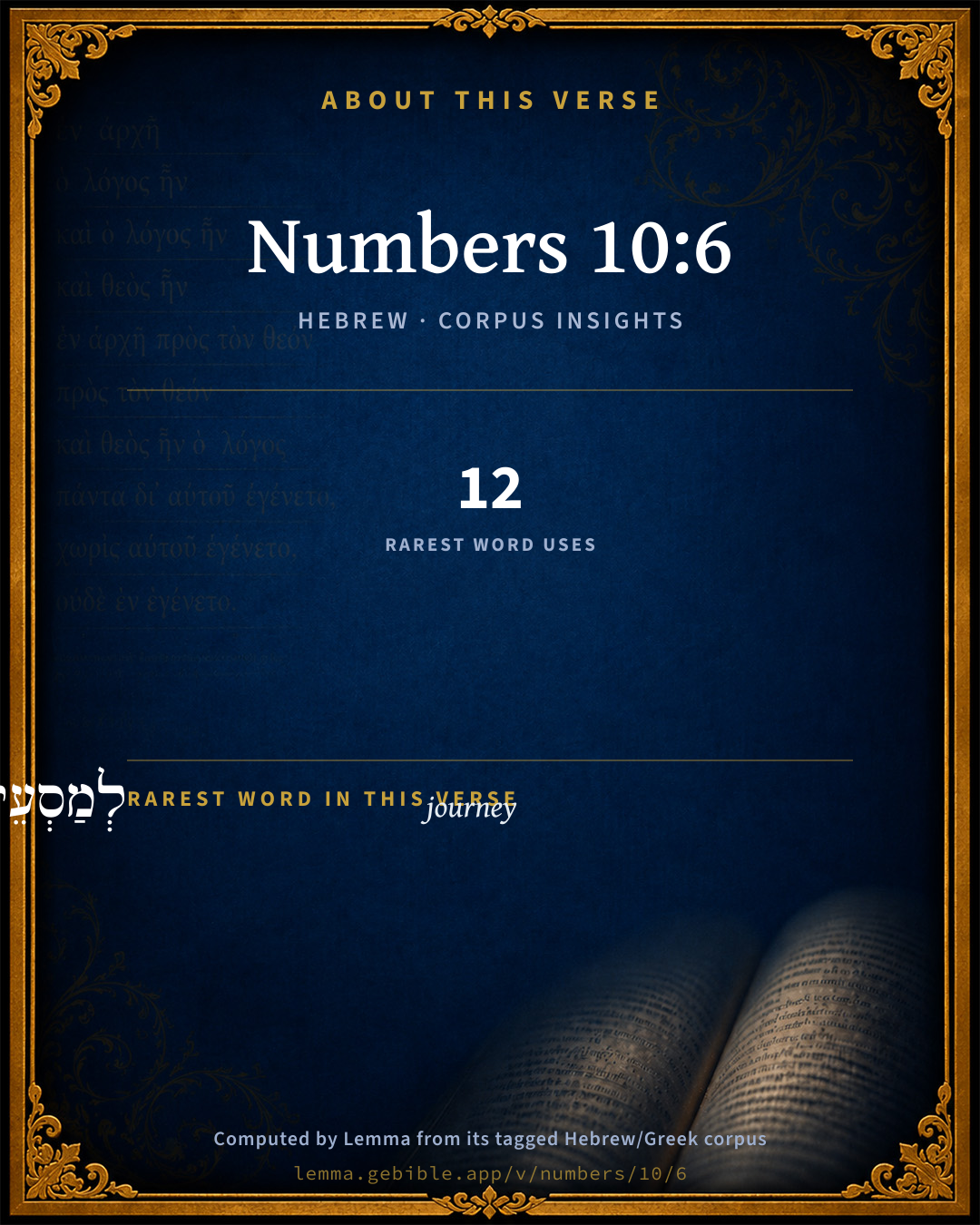
The rarest word here is לְמַסְעֵיהֶֽם journey H4550 — appearing just 12 times in the whole Hebrew Bible.

Shared distinctive vocabulary

לְמַסְעֵיהֶֽם journey H4550 occurs in 11 verses of the Hebrew Bible. Also found in:

Grammatical profile

  • 4 verbs
  • 5 nouns
  • 1 adjective

Verb forms

  • וּתְקַעְתֶּ֤ם Qal · Sequential Perfect
  • וְנָֽסְעוּ֙ Qal · Sequential Perfect
  • הַחֹנִ֖ים Qal · Participle Active
  • יִתְקְע֖וּ Qal · Imperfect

Repetition

Words recur within this verse — often emphatic in Hebrew:

  • וּתְקַעְתֶּ֤ם to blow H8628 ×2
  • תְּרוּעָה֙ alarm H8643 ×2

Hebrew & Septuagint length

In English translation the verse runs 28 words from the Hebrew and 54 from the Septuagint (LXX English) — the Septuagint runs noticeably longer here. See the side-by-side →

A rough comparison of the two English renderings, which tokenize alike — not a word-level alignment.

Word counts can differ between the Hebrew and the Greek without any difference in meaning — e.g. the Hebrew direct-object marker אֵת has no separate Greek word, and Greek often adds the article ὁ.

Cross-references

2

Topical passages linked to Numbers 10:6 in the Treasury of Scripture Knowledge — connected by theme and wording, ordered by reader-vote popularity; previews shown in the World English Bible.

  • Numbers 2:10–16 "On the south side shall be the standard of the camp of Reuben according to their divisions. The prince of the children of Reuben shall be Elizur the son of Shedeur.
  • Numbers 10:18 The standard of the camp of Reuben set forward according to their hosts: and over his host was Elizur the son of Shedeur.

Cross-references courtesy of OpenBible.info (CC BY 4.0).

Hebrew and Greek witnesses Masoretic Hebrew ↔ Greek Septuagint

The same verse in the two great witnesses to the Old Testament, shown verse-for-verse.

Here the Septuagint runs noticeably longer than the Hebrew — LXX2012 (modern English Septuagint) 54 words vs World English Bible 28. A rough length comparison of the two English translations, not a word-level alignment — read both below.

These are two independent witnesses, not word-aligned to each other, and the Septuagint is shown in lemma (dictionary) form.

Hebrew Numbers 10:6 Masoretic · Westminster Leningrad Codex

וּתְקַעְתֶּ֤ם תְּרוּעָה֙ שֵׁנִ֔ית וְנָֽסְעוּ֙ הַֽמַּחֲנ֔וֹת הַחֹנִ֖ים תֵּימָ֑נָה תְּרוּעָ֥ה יִתְקְע֖וּ לְמַסְעֵיהֶֽם

When you blow an alarm the second time, the camps that lie on the south side shall take their journey: they shall blow an alarm for their journeys.

World English Bible · Public Domain

Greek LXX Numbers 10:6 Septuagint · lemma form

καί σαλπίζω σημασία δεύτερος καί ἐκαἴρω ὁ παρεμβολή ὁ παρα ἐνβάλλω λίψ καί σαλπίζω σημασία τρίτος καί ἐκαἴρω ὁ παρεμβολή ὁ παρα ἐνβάλλω παρά θάλασσα καί σαλπίζω σημασία τέταρτος καί ἐκαἴρω ὁ παρεμβολή ὁ παρα ἐνβάλλω πρός βορέας σημασία σαλπίζω ἐν ὁ ἔξαρσις αὐτός

And you⌃ shall sound a second alarm, and the camps pitched southward shall move; and you⌃ shall sound a third alarm, and the camps pitched westward shall move forward; and you⌃ shall sound a fourth alarm, and they that encamp toward the north shall move forward: they shall sound an alarm at their departure.

LXX2012 (modern English Septuagint) · Public Domain

On this verse, Adam Clarke's Commentary discusses the Septuagint’s reading. Read the note in Commentary ↓

Hebrew: Westminster Leningrad Codex (CC BY 4.0). Greek: Septuagint (public domain); English from LXX2012 (modern English Septuagint) (Public Domain). How the Septuagint differs from the Hebrew →

Targum (Aramaic paraphrase)

2

The Targum is the ancient Jewish Aramaic paraphrase of the Hebrew Scriptures — an interpretive translation, not the Hebrew text itself. Onkelos (literal) and Pseudo-Jonathan (expansive) render the Torah, and Jonathan the Prophets. Coverage is partial: where no permissively-licensed English translation exists for a verse, only the Aramaic is shown. This is verse-level text, not a word-by-word alignment to the Hebrew.

  1. Targum Onkelos Torah (Genesis–Deuteronomy)
    וְתִתְקְעוּן יַבֶּבְתָּא תִּנְיָנוּת וְיִטְלוּן מַשִׁרְיָתָא דְשָׁרָן דָרוֹמָא יַבָּבָא יִתְקְעוּן לְמַטְלָנֵיהוֹן

    (no public-domain English translation for this verse)

    Targum Onkelos — Aramaic: “Onkelos Genesis” (public domain); “Onkelos Exodus” (public domain); “Onkelos Leviticus” (public domain); “Onkelos Numbers” (public domain); “Onkelos Deuteronomy” (public domain). English: “Sefaria Community Translation” (CC0 1.0 (public-domain dedication)); “J.W. Etheridge. The Targums of Onkelos and Jonathan Ben Uzziel on the Pentateuch. London: Longmans, Green, 1862” (public domain). Text via Sefaria.

  2. Targum Pseudo-Jonathan Torah (Genesis–Deuteronomy)
    וְתִתְקְעוּן יַבֶּבְתָּא תִּנְיָינוּת וְיִטְלוּן מַשִׁרְיָתָא דְשָׁרַן דָרוֹמְתָּא יַבֶּבְתָּא יִתְקְעוּן לְמַטְלָנֵיהוֹן

    and when they blow a second alarm, the camps on the south shall go forward; they shall blow the alarm for their journeys.

    Targum Pseudo-Jonathan — Aramaic: “Targum Jonathan on Genesis” (public domain); “Targum Jonathan on Exodus” (public domain); “Targum Jonathan on Leviticus” (public domain); “Targum Jonathan on Numbers” (public domain); “Targum Jonathan on Deuteronomy” (public domain). English: “The Targum of Jonathan ben Uzziel, trans. J. W. Etheridge, London, 1862” (public domain). Text via Sefaria.

Commentary

Notes on Numbers 10:6 from classic Christian and Jewish commentators (each source and its license shown beneath its notes). The classic Christian expositions comment on the surrounding passage and are grouped to its opening verse, so a note may address several verses; the Jewish commentaries on the Tanakh (Rashi and others) are per-verse, so they appear only where the commentator wrote on this verse.

Lemma curates 59 commentaries, every one of them public domain or Creative Commons licensed, each selected and text-cleaned for this edition rather than reprinted as found. About our sources →

Joseph Benson's Commentary

Num 10:6. For their journeys — As a sign for them to march forward, and consequently for the rest to follow them.

Joseph Benson's Commentary on the Old and New Testaments (1811–1818) — public domain. Text from a community e-Sword module.

Geneva Bible (1599)

Geneva Bible translators

Meaning, the host of Reuben.

Geneva Bible (1599) marginal notes — public domain. Text via Bolls.life.

Adam Clarke's Commentary

Verse 6. When ye blow an alarm the second time] A single alarm, as above stated, was a signal for the eastward division to march; two such alarms, the signal for the south division; and probably three for the west division, and four for the north. It is more likely that this was the case, than that a single alarm served for each, with a small interval between them.

The camps, or grand divisions of this great army, always lay, as we have already seen, to the east, south, west, and north: and here the east and south camps alone are mentioned; the first containing Judah, Issachar, and Zebulun; the second, Reuben, Simeon, and Gad. The west and north divisions are not named, and yet we are sure they marched in consequence of express orders or signals, as well as the other two. There appears therefore a deficiency here in the Hebrew text, which is thus supplied by the Septuagint: Και σαλπιειτε σημασιαν τριτην, και εξαρουσιν αἱ παρεμβολαι αἱ παρεμβαλλουσαι παρα θαλασσαν· και σαλπιειτε σημασιαν τεταρτην, και εξαρουσιν αἱ παρεμβολαι αἱ παρεμβαλλουσαι προς βορῥαν. "And when ye blow a third alarm or signal, the camps on the west shall march: and when ye blow a fourth alarm or signal, the camps on the north shall march." This addition, however, is not acknowledged by the Samaritan, nor by any of the other versions but the Coptic. Nor are there any various readings in the collections of Kennicott and De Rossi, which countenance the addition in the above versions. Houbigant thinks this addition so evidently necessary, that he has inserted the Latin in his text, and in a note supplied the Hebrew words, and thinks that these words were originally in the Hebrew text, but happened to be omitted in consequence of so many similar words occurring so often in the same verse, which might dazzle and deceive the eye of a transcriber.

Adam Clarke's Commentary on the Bible (1810–1826) — public domain. Text from a community e-Sword/MySword module.

The Cambridge Bible for Schools and Colleges

gen. ed. J. J. S. Perowne

6. they shall blow an alarm for their journeys] i.e. for their startings. This is apparently intended as a brief way of saying that for each of the four groups of tribes a separate alarm shall be blown as a signal to start. It might be expected that the priestly writer, with his love of repetition, would continue his statement in similar language for the other three groups. In the LXX. this is actually done, the order being East, South, West, North. This statement has very possibly dropped out of the Heb. text. In the Vulg. there is the short sentence ‘and according to this manner shall the rest do.’

The Cambridge Bible for Schools and Colleges (gen. ed. J. J. S. Perowne; Cambridge University Press, 1878–1918) — public domain. Text from a community e-Sword module.

John Gill's Exposition

When ye blow an alarm the second time,.... Another "tara-tan-tara":

then the camps that lie on the south side shall take their journey; the camps of Reuben, Simeon, and Gad, which were encamped on the south side of the tabernacle, Num 2:10; and, as Josephus (k) says, at the third sounding of the alarm, that part of the camp which lay to the west moved, which were the camps of Ephraim, Manasseh, and Benjamin, Num 2:18; and at the fourth sounding, as he says, those which were at the north, the camps of Dan, Asher, and Naphtali, Num 2:25; which, though not expressed in the Hebrew text, are added in the Septuagint version, as they are to be understood:

they shall blow an alarm for their journeys; for the journeys of the said camps, as a signal or token when they should begin to march.

(k) Ut supra. (Antiq. l. 3. c. 12. sect. 6.)

John Gill's Exposition of the Whole Bible (1746–1763) — public domain (CC PDM 1.0). Text via the HelloAO Bible API.

Haydock's Catholic Bible Commentary

And, &c. Hebrew, "they shall blow an alarm for their marches." This must be referred to the camps on the west, which proceeded forward at the third sounding, as those on the north did at the fourth, according to the Septuagint. (Haydock)

George Leo Haydock (1774–1849), Haydock's Catholic Family Bible and Commentary, 1859 edition — public domain. Excludes Psalms (Douay-Rheims chapter numbering differs from Protestant) and Deuterocanonical books (Catholic canon only).

Matthew Poole's English Annotations

As a sign for them to march forward, and consequently for the rest to follow them, which is easily understood out of these words.

Matthew Poole's English Annotations on the Holy Bible (1683–1685) — public domain. Text from a community e-Sword/MySword module.

John Wesley's Explanatory Notes

For their journeys - As a sign for them to march forward, and consequently for the rest to follow them.

John Wesley, Explanatory Notes Upon the Whole Bible (1754–1765) — public domain. Text via the GEBible commentary corpus.

unfoldingWord translationNotes

Door43 World Missions Community

When you blow a loud signal

Here the word "you" is plural. Yahweh is speaking to Moses, but he is referring to the priests. The priests will blow the trumpets, Moses will not. AT: "When they blow a loud signal" (See: Forms of You and Metonymy)

the second time

"time number 2" or "again" (See: Ordinal Numbers)

When the community gathers together

"To gather the community together"

They must blow a loud signal for their journeys

"They" refers to the priests and the word "their" refers to the people of Israel.

be a regulation for you

"be a rule for you." Here "you" is plural and refers to the people of Israel. (See: Forms of You)

translationWords

son

Aaron

people group

generation

unfoldingWord translationNotes — © Distant Shores Media and the Door43 World Missions Community, licensed CC BY-SA 4.0. Source: git.door43.org/Door43/en_tn.

Ramban (Nachmanides)

Rabbi Moshe ben Nachman (Ramban / Nachmanides)

AND THE CAMPS THAT LIE ON THE SOUTH SIDE SHALL SET FORWARD. Scripture explained the purpose of the two t’ruoth, is a succession of nine tremulous or quavering sounds. A t’kiah is a continuous plain sound. The sh’varim are broken disconnected sounds, but they are not as broken as those of the t’ruah. The three broken sounds of the sh’varim are equal [in length of time] to the nine quavering sounds of the t’ruah. the first one being [the sign] for those encamped eastward to go forward, and the second one for those encamped southward to set out on the journey. And it states [in the verse before us], a ‘t’ruah’ is a succession of nine tremulous or quavering sounds. A t’kiah is a continuous plain sound. The sh’varim are broken disconnected sounds, but they are not as broken as those of the t’ruah. The three broken sounds of the sh’varim are equal [in length of time] to the nine quavering sounds of the t’ruah. they shall blow for their journeys, meaning that they should blow [this quavering alarm] for all their journeys, that is to say, they should blow a third t’ruah for the camps on the west side to set forth, and a fourth one for the camps on the north side to set out on the journey, for each standard journeyed by itself, as He explains: And the standard of the camp of the children of Ephraim set forward; And the standard of the camp of the children of Dan set forward., Verse 25. And thus it is taught in the Beraitha of the Work of the Tabernacle., Chapter 13. But in the Sifre the Rabbis have taught: 73. “I might think that just as he blows for the camps in the east and the south to set forward [as Scripture clearly explains], so he is to blow for [those that were encamped in] the west and the north; Scripture therefore states [in the verse before us], a ‘t’ruah’ they shall blow for their journeys, that is, one blowing for the two [remaining standards]. And some Rabbis say that there were three [sounds, i.e., t’kiah, t’ruah, t’kiah] is a succession of nine tremulous or quavering sounds. A t’kiah is a continuous plain sound. The sh’varim are broken disconnected sounds, but they are not as broken as those of the t’ruah. The three broken sounds of the sh’varim are equal [in length of time] to the nine quavering sounds of the t’ruah. for [the camps in] each and every direction.” Thus far [the language of the Sifre], and such indeed is the plain meaning of Scripture, that they should blow [for the camps] in each direction, as I have explained.

A ‘T’RUAH’ THEY SHALL BLOW FOR THEIR JOURNEYS. I have already explained in Seder ‘Emor El Hakohanim’ (Speak unto the priests), 23:24. that the t’ruah alludes to the [Divine] attribute of justice, for so it is written concerning the journeyings that they were ‘al pi Hashem’ (at the commandment of the Eternal) by the hand of Moses, alludes to the attribute of justice (Abusaula). and it is that [attribute] which brings victory in war, as it is written, And when ye go to war in your land … ‘vahareiothem’ (ye shall sound a ‘t’ruah’). Therefore Moses said, and let them that hate Thee flee ‘mipanecha’ (before Thee), Verse 35. Literally: “from before Thy face.” and I have already explained the secret of the panim (face) in the Ten Commandments. And similarly you see that the wall of Jericho fell to the sound of a t’ruah, for it is written, Ye shall not shout … until the day I bid you ‘hari’u’ (sound a ‘t’ruah’); ‘vahari’othem’ (then shall you sound it), and it is written, and the people sounded a great ‘t’ruah,’ and the wall fell down., Verse 20. It was for this reason that it [the city of Jericho] was declared cheirem (devoted) [to the Eternal, and prohibited for private use.]., Verse 17. But when the assembly is to be gathered together ‘tithke’u’ — they are deserving that the t’kiah is a succession of nine tremulous or quavering sounds. A t’kiah is a continuous plain sound. The sh’varim are broken disconnected sounds, but they are not as broken as those of the t’ruah. The three broken sounds of the sh’varim are equal [in length of time] to the nine quavering sounds of the t’ruah. be sounded, for the ‘p’shutah’ [plain long and continuous sound] alludes to the [Divine] attribute of mercy, for “His right hand is p’shutah (stretched out) to receive the penitent” [as it is stated at the Closing Service on the Day of Atonement — a time of mercy]. Therefore, when the ark rested, Moses said, ‘Return, O Eternal, unto the myriads of thousands of Israel.’ And it is written, And in the day of your gladness and in your appointed seasons … ‘uthkatem’ (ye shall blow a ‘t’kiah’), Verse 10. since war is [suitable] for t’ruah [which alludes to the attribute of justice, as explained above], and the appointed seasons and joyous occasions are for mercy [i.e., for the sound of t’kiah, which alludes to mercy]. And our Rabbis have received by tradition that there should be a long continuous sound before [the t’ruah] and a long continuous sound after it and the t’ruah in the middle, on the New Year, the Day of Atonement [of the Jubilee year], and at the bringing of the offerings, in order not “to mutilate the shoots” [of faith]. But as far as their purpose is concerned, the one is for t’kiah [which alludes to mercy] and the other for t’ruah [which alludes to judgment]. The student learned [in the mystic lore of the Cabala] will understand.

Ramban (Nachmanides) on the Tanakh — English translation: “Commentary on the Torah by Ramban (Nachmanides). Translated and annotated by Charles B. Chavel. New York, Shilo Pub. House, 1971-1976” (CC BY 4.0). Text via Sefaria.

Lesson kit

Teaching starters — assembled from the data on this page, not authored interpretation. Every prompt links to the verse data it draws on. Edit before teaching.

Numbers, in the Pentateuch, opens this verse with 10 words (8 distinct Hebrew lemmas). Its most distinctive word is maççaʻ (“journey”). The Greek Septuagint runs longer here. A historical commentator’s framing appears above. Read the whole chapter for the surrounding context.

Discussion questions

  1. What does “journey” (maççaʻ) contribute to the verse as a whole?
  2. How does Genesis 13:3, which shares the word «journey», read alongside this verse?
  3. What does the repetition of “to blow” (2× in this one verse) do in this verse?
  4. The Septuagint runs longer here than the Hebrew. What might account for the difference?
  5. The translations on this page render this verse differently — a whole-verse word diff, not a word-by-word alignment. What might account for the different wordings?
  6. «וּתְקַעְתֶּ֤ם» is a Qal Sequential Perfect verb. How does that grammatical form shape the action described?
  7. Compare how Joseph Benson's Commentary and Geneva Bible (1599) read this verse. Where do they agree or differ?

Things to notice

Reading settings

Reading text

Shown beneath each verse's original-language words.

Old Testament
Old Testament edition

Read the OT as the Masoretic Hebrew (MT) or the Greek Septuagint (LXX).

English shown for the Greek Septuagint (in the Hebrew ↔ Greek comparison).

Comparing translations? Open the Compare panel on any verse page to stack up to four side by side.