Isaiah 37:8

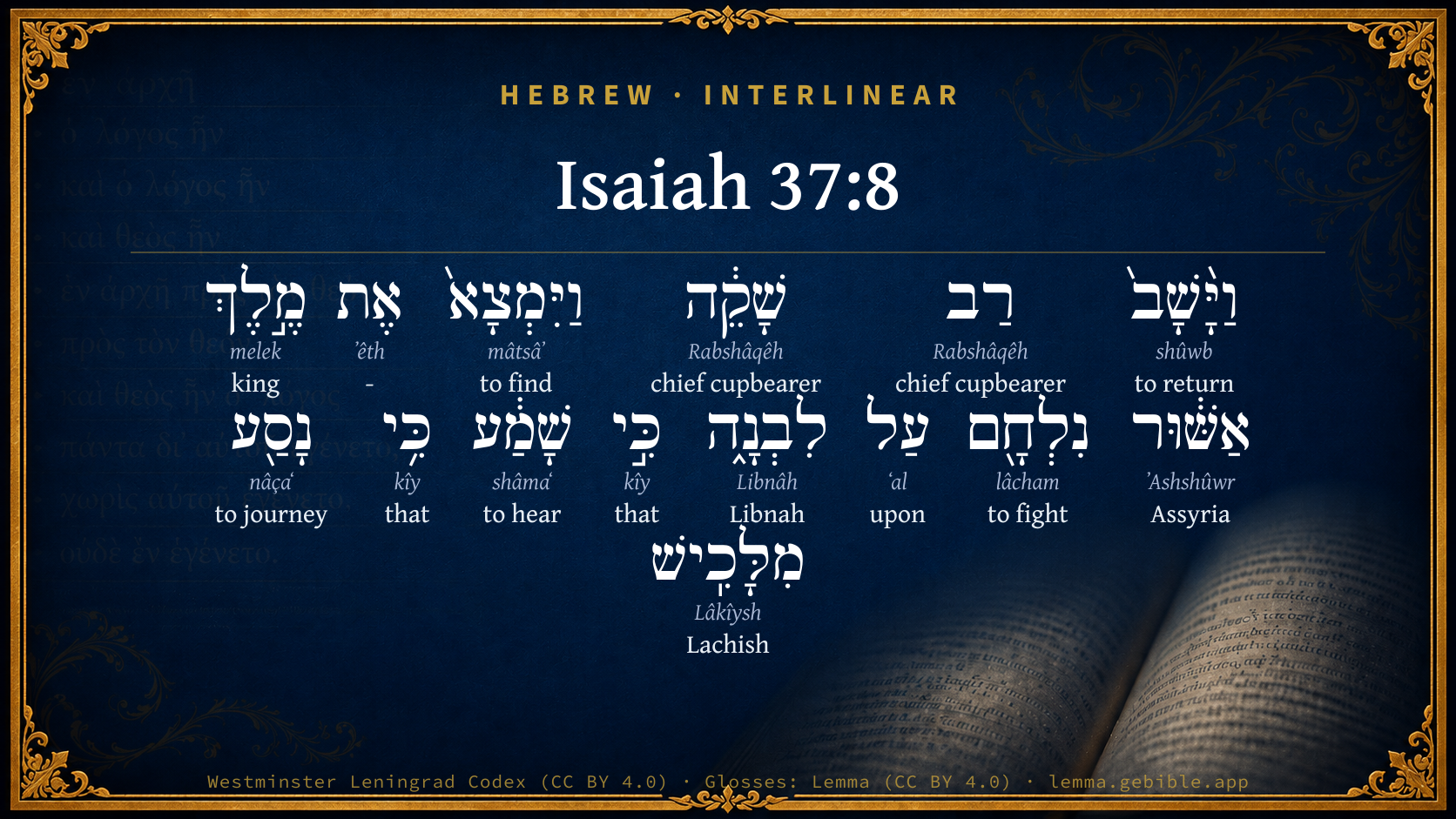
Hebrew (Westminster Leningrad Codex) Isaiah 37:8 appears in the Hebrew Old Testament. The text above is from the Westminster Leningrad Codex. Each word links to its Strong’s number, a concise gloss, and parsing drawn from the Open Scriptures Hebrew Bible morphology. Click any word for its full Brown-Driver-Briggs (BDB) entry.
Download image
Cite this verse

Isaiah 37:8 (World English Bible). Public Domain. Lemma interlinear Bible study tool, https://lemma.gebible.app/v/isaiah/37/8.

Show BibTeX & RIS
BibTeX
RIS
English Translation
So Rabshakeh returned, and found the king of Assyria warring against Libnah; for he had heard that he was departed from Lachish.
World English Bible · Public Domain
Download a study sheet

One document with this verse’s original text, its word-by-word gloss line, the meaning frame, cross-references with their text, attributed commentary, and full source and license credits — printable, and it pastes into notes with its structure intact.

This verse Autodidact and up

Study sheet (.html) Plain text (.txt)

A passage Seminary Student

Up to 50 verses in one chapter. A passage sheet keeps up to 6 commentary sources and 12 cross-references per verse, in the order this page ranks them, and says so on the sheet whenever that leaves anything out. Ask for a single verse and you get the Autodidact verse sheet above.

Everything on this page stays free to read, with no account — the sheet is a download of what is already on screen, not access to it.

Want to remove ads? Support Godless Engineer
Compare translations 3

The same verse in 3 English versions, stacked beneath the original-language interlinear above. Click any original word for its lexicon entry.

Each is an independent rendering of the whole verse — the interlinear is not word-aligned to these translations.

Highlighted words mark where these versions differ — a whole-verse word diff, not a word-by-word alignment.

  • World English Bible Public Domain
    So Rabshakeh returned, and found the king of Assyria warring against Libnah; for he had heard that he was departed from Lachish.
  • King James Version Public Domain
    So Rabshakeh returned, and found the king of Assyria warring against Libnah: for he had heard that he was departed from Lachish.
  • unfoldingWord Literal Text CC BY-SA 4.0
    And the Rabshakeh returned, and he found the king of Assyria fighting against Libnah, for he had heard that he had departed from Lachish.

unfoldingWord Literal Text — © unfoldingWord, licensed CC BY-SA 4.0. Word-aligned USFM3 via Door43 (git.door43.org/unfoldingWord/en_ult).

Versions to compare (up to 4)

3 of 4 selected

Show all 18 translations

Every available English version of this verse, each an independent rendering of the whole verse.

  • World English Bible Public Domain
    So Rabshakeh returned, and found the king of Assyria warring against Libnah; for he had heard that he was departed from Lachish.
  • Berean Standard Bible Public Domain
    When the Rabshakeh heard that the king of Assyria had left Lachish, he withdrew and found the king fighting against Libnah.
  • Majority Standard Bible Public Domain
    When the Rabshakeh heard that the king of Assyria had left Lachish, he withdrew and found the king fighting against Libnah.
  • King James Version Public Domain
    So Rabshakeh returned, and found the king of Assyria warring against Libnah: for he had heard that he was departed from Lachish.
  • American Standard Version (1901) Public Domain
    So Rabshakeh returned, and found the king of Assyria warring against Libnah; for he had heard that he was departed from Lachish.
  • Revised Version (1885) Public Domain
    So Rabshakeh returned, and found the king of Assyria warring against Libnah: for he had heard that he was departed from Lachish.
  • Geneva Bible (1599) Public Domain
    So Rabshakeh returned, and found the King of Asshur fighting against Libnah: for he had heard that he was departed from Lachish.
  • Douay-Rheims (1899) Public Domain
    And Rabsaces returned, end found the king of the Assyrians besieging Lobna. W For he had heard that he was departed from Lachis.
  • Young's Literal Translation Public Domain
    And Rabshakeh turneth back and findeth the king of Asshur fighting against Libnah, for he hath heard that he hath journeyed from Lachish.
  • Literal Standard Version CC BY-SA 4.0
    And Rabshakeh turns back and finds the king of Asshur fighting against Libnah, for he has heard that he has journeyed from Lachish.
  • Unlocked Literal Bible CC BY-SA 4.0
    Then the chief commander returned and found the king of Assyria fighting against Libnah, for he had heard that the king had gone away from Lachish.
  • unfoldingWord Literal Text CC BY-SA 4.0
    And the Rabshakeh returned, and he found the king of Assyria fighting against Libnah, for he had heard that he had departed from Lachish.
  • Darby Bible Public Domain
    And Rab-shakeh returned, and found the king of Assyria warring against Libnah; for he had heard that he had departed from Lachish.
  • World Messianic Bible Public Domain
    So Rabshakeh returned, and found the king of Assyria warring against Libnah, for he heard that he had departed from Lachish.
  • Webster's Bible Public Domain
    So Rabshakeh returned, and found the king of Assyria warring against Libnah: for he had heard that he had departed from Lachish.
  • Free Bible Version CC BY-SA 4.0
    The Assyrian army commander left and went back to join the king of Assyria, having heard the king had left Lachish and was attacking Libnah.
  • Bible in Basic English Public Domain
    So the Rab-shakeh went back, and when he got there the king of Assyria was making war against Libnah: for it had come to his ears that the king of Assyria had gone away from Lachish.
  • JPS Tanakh (1917) Public Domain
    So Rab-shakeh returned, and found the king of Assyria warring against Libnah; for he had heard that he was departed from Lachish.

Literal Standard Version (2020), Covenant Press — licensed CC BY-SA 4.0. Text via the HelloAO Bible API (eBible.org). Unlocked Literal Bible (unfoldingWord) — licensed CC BY-SA 4.0. Text via the HelloAO Bible API (eBible.org). unfoldingWord Literal Text — © unfoldingWord, licensed CC BY-SA 4.0. Word-aligned USFM3 via Door43 (git.door43.org/unfoldingWord/en_ult). Free Bible Version, Dr. Jonathan Gallagher — licensed CC BY-SA 4.0. Text via the HelloAO Bible API (eBible.org).

Word by word

More ways to search: Search by grammar → Find every occurrence → Compare this word →

Practice this passage: Drill this verse → Learn its vocabulary →

לִבְנָ֑ה
Libnâh
H3841
“Libnah”
Noun, Proper
Part of Speech
Noun
Type
Proper
Full BDB Definition

Origin: the same as H3839

TWOT: None

Libnah = "pavement" - a royal city of the Canaanites in the southwest captured by Joshua; allocated to Judah and made a Levitical city; site unknown - a station between Sinai and Kadesh of Israel during their wilderness wanderings
  1. וַיָּ֨שָׁב֙ shûwb H7725 “and · to return” Conjunction + Verb, Qal, Sequential Imperfect, 3rd Person, Masculine, Singular
  2. רַב Rabshâqêh H7262 “chief cupbearer” Noun, Proper
  3. שָׁקֵ֔ה Rabshâqêh H7262 “chief cupbearer” Noun, Proper
  4. וַיִּמְצָא֙ mâtsâʼ H4672 “and · to find” Conjunction + Verb, Qal, Sequential Imperfect, 3rd Person, Masculine, Singular
  5. אֶת ʼêth H853 “-” Particle, Direct Object
  6. מֶ֣לֶךְ melek H4428 “king of” Noun, Common, Masculine, Singular, Construct
  7. אַשּׁ֔וּר ʼAshshûwr H804 “Assyria” Noun, Proper
  8. נִלְחָ֖ם lâcham H3898 “fighting” Verb, Niphal, Participle Active, Masculine, Singular, Absolute
  9. עַל ʻal H5921 “upon” Preposition
  10. כִּ֣י kîy H3588 “that” Conjunction
  11. שָׁמַ֔ע shâmaʻ H8085 “to hear” Verb, Qal, Perfect, 3rd Person, Masculine, Singular
  12. כִּ֥י kîy H3588 “that” Conjunction
  13. נָסַ֖ע nâçaʻ H5265 “to journey” Verb, Qal, Perfect, 3rd Person, Masculine, Singular
  14. מִלָּכִֽישׁ Lâkîysh H3923 “from · Lachish” Preposition + Noun, Proper

About this verse

These counts appear in no published source. They are computed here, from the morphology-tagged text and Lemma’s own curated glosses. What Lemma adds →

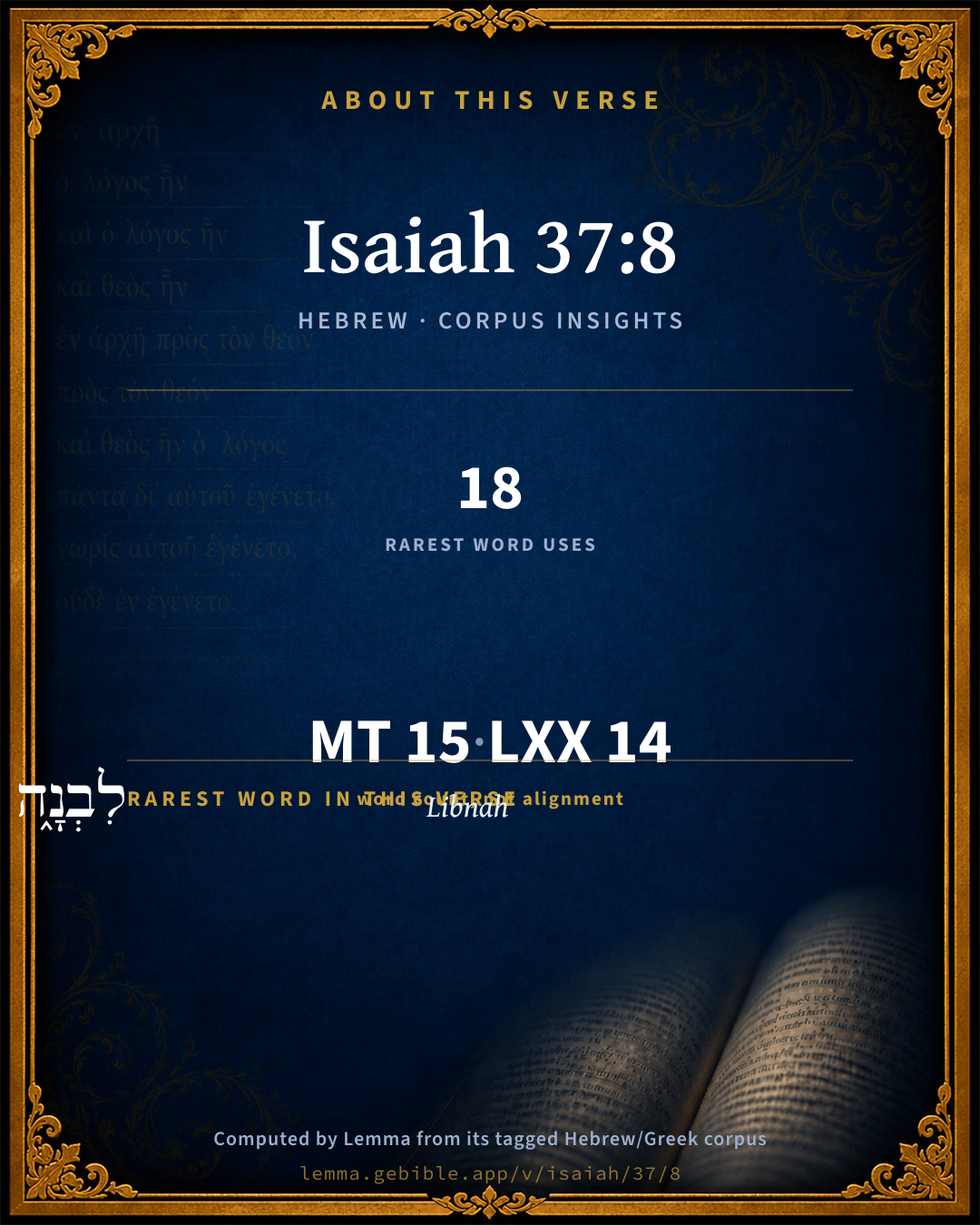
15
words
13
distinct lemmas
Prophets
section

Notable vocabulary

The rarest word here is לִבְנָ֑ה Libnah H3841 — appearing just 18 times in the whole Hebrew Bible.

Shared distinctive vocabulary

לִבְנָ֑ה Libnah H3841 occurs in 17 verses of the Hebrew Bible. Also found in:

Grammatical profile

  • 5 verbs
  • 6 nouns
  • 1 preposition
  • 2 conjunctions
  • 1 particle

Verb forms

  • וַיָּ֨שָׁב֙ Qal · Sequential Imperfect
  • וַיִּמְצָא֙ Qal · Sequential Imperfect
  • נִלְחָ֖ם Niphal · Participle Active
  • שָׁמַ֔ע Qal · Perfect
  • נָסַ֖ע Qal · Perfect

Repetition

Words recur within this verse — often emphatic in Hebrew:

  • רַב chief cupbearer H7262 ×2
  • כִּ֣י that H3588 ×2

Hebrew & Septuagint length

In English translation the verse runs 22 words from the Hebrew and 22 from the Septuagint (LXX English) — the same length.

A rough comparison of the two English renderings, which tokenize alike — not a word-level alignment.

Word counts can differ between the Hebrew and the Greek without any difference in meaning — e.g. the Hebrew direct-object marker אֵת has no separate Greek word, and Greek often adds the article ὁ.

In the original languages it is 15 Hebrew tokens and 14 Greek tokens — but the two are counted differently (Hebrew bundles its prefixes and suffixes into one token; the Greek is in lemma form), so that isn’t a like-for-like length.

Cross-references

9

Topical passages linked to Isaiah 37:8 in the Treasury of Scripture Knowledge — connected by theme and wording, ordered by reader-vote popularity; previews shown in the World English Bible.

  • Joshua 10:29 Joshua passed from Makkedah, and all Israel with him, to Libnah, and fought against Libnah:
  • Numbers 33:20–21 They traveled from Rimmon Perez, and encamped in Libnah.
  • Joshua 10:31–34 Joshua passed from Libnah, and all Israel with him, to Lachish, and encamped against it, and fought against it:
  • Joshua 12:11 the king of Jarmuth, one; the king of Lachish, one;
  • Joshua 15:39 Lachish, and Bozkath, and Eglon,
  • Joshua 21:13 To the children of Aaron the priest they gave Hebron with its suburbs, the city of refuge for the manslayer, and Libnah with its suburbs,
  • 2 Kings 8:22 So Edom revolted from under the hand of Judah to this day. Then did Libnah revolt at the same time.
  • 2 Kings 19:8–9 So Rabshakeh returned, and found the king of Assyria warring against Libnah; for he had heard that he was departed from Lachish.
  • 2 Chronicles 21:10 So Edom revolted from under the hand of Judah to this day: then did Libnah revolt at the same time from under his hand, because he had forsaken Yahweh, the God of his fathers.

Cross-references courtesy of OpenBible.info (CC BY 4.0).

Hebrew and Greek witnesses Masoretic Hebrew ↔ Greek Septuagint

The same verse in the two great witnesses to the Old Testament, shown verse-for-verse.

These are two independent witnesses, not word-aligned to each other, and the Septuagint is shown in lemma (dictionary) form.

Hebrew Isaiah 37:8 Masoretic · Westminster Leningrad Codex

וַיָּ֨שָׁב֙ רַב שָׁקֵ֔ה וַיִּמְצָא֙ אֶת מֶ֣לֶךְ אַשּׁ֔וּר נִלְחָ֖ם עַל לִבְנָ֑ה כִּ֣י שָׁמַ֔ע כִּ֥י נָסַ֖ע מִלָּכִֽישׁ

So Rabshakeh returned, and found the king of Assyria warring against Libnah; for he had heard that he was departed from Lachish.

World English Bible · Public Domain

Greek LXX Isaiah 37:8 Septuagint · lemma form

καί ἀποστρέφω ραψακης καί καταλαμβάνω πολιορκέω ὁ βασιλεύς λομνα καί ἀκούω βασιλεύς ἀσσύριος ὅτι

So Rabsaces returned, and found the king of the Assyrians besieging Lobna: for he had heard that he had departed from Lachis.

LXX2012 (modern English Septuagint) · Public Domain

On this verse, Lange's Commentary on the Holy Scriptures discusses the Septuagint’s reading. Read the note in Commentary ↓

Hebrew: Westminster Leningrad Codex (CC BY 4.0). Greek: Septuagint (public domain); English from LXX2012 (modern English Septuagint) (Public Domain). How the Septuagint differs from the Hebrew →

Targum (Aramaic paraphrase)

1

The Targum is the ancient Jewish Aramaic paraphrase of the Hebrew Scriptures — an interpretive translation, not the Hebrew text itself. Onkelos (literal) and Pseudo-Jonathan (expansive) render the Torah, and Jonathan the Prophets. Coverage is partial: where no permissively-licensed English translation exists for a verse, only the Aramaic is shown. This is verse-level text, not a word-by-word alignment to the Hebrew.

  1. Targum Jonathan Prophets (Joshua–Malachi)
    וְתַב רַבְשָׁקֵה וְאַשְׁכַּח יַת מַלְכָּא דְאַתּוּר מֵגִיחַ קְרָבָא עַל לִבְנָה אֲרֵי שְׁמַע אֲרֵי נְטַל מִלָכִישׁ:

    So Rabshakeh returned, and found the king of Assyria waging war against Libnah: for he had heard that he had departed from Lachish.

    Targum Jonathan — Aramaic: “Mikraot Gedolot” (public domain). English: “Sefaria Community Translation” (CC0 1.0 (public-domain dedication)); “London "Chaldee Paraphrase," 1871” (public domain). Text via Sefaria.

Commentary

Notes on Isaiah 37:8 from classic Christian and Jewish commentators (each source and its license shown beneath its notes). The classic Christian expositions comment on the surrounding passage and are grouped to its opening verse, so a note may address several verses; the Jewish commentaries on the Tanakh (Rashi and others) are per-verse, so they appear only where the commentator wrote on this verse.

Lemma curates 59 commentaries, every one of them public domain or Creative Commons licensed, each selected and text-cleaned for this edition rather than reprinted as found. About our sources →

Lange's Commentary on the Holy Scriptures

3. THE WRITING OF SENNACHERIB TO HEZEKIAH

Isa_37:8-13

8So Rabshakeh returned, and found the king of Assyria 11warring against Libnah: for he had heard that he 12was departed from Lacish. 9And he heard say concerning Tirhakah king of Ethiopia, He is come forth to make war with thee. And when he heard it, he sent messengers to Hezekiah, saying, 10Thus shall ye speak to Hezekiah king of Judah, saying, Let not thy God, in whom thou trustest, deceive thee, saying, Jerusalem shall not be given into the hand of the king of Assyria. 11Behold, thou hast heard what the kings of Assyria have done to all lands by destroying them utterly; 13and shalt thou be delivered? 12Have the gods of the nations delivered them which my fathers have destroyed, as Gozan, and Haran, and Rezeph, 13and the children of Eden which were in Telassar? Where is the king of Hamath, and the king of Arphad, and the king of the city of Sepharvaim, Hena, and Ivah?

TEXTUAL AND GRAMMATICAL

Isa_37:9. The variations from 2Ki_19:9 are slight; על here instead of אל, and a second וישׁמע instead of וישׁב 2 Kings 19; which latter is doubtless the correct reading. That second וישׁמע seems to be merely a copyist’s error, unless the reviser of the Isaiah text overlooked the familiar adverbial meaning that the word has here.

Isa_37:10. On השׁיא, comp. on Isa_36:14.—בוטח בו see on Isa_36:7.—לא תנתך ו׳ see on Isa_36:15.

Isa_37:11. להחרימם (see Isa_11:15; Isa_34:5) is that verbal form which we translate by the ablative of the gerund.

Isa_37:13. The words הנע ועוה are difficult. The Masorets seem to have regarded them as verbs, seeing that they have punctuated the former as perf. Hiph., and the latter as perf. Piel. So also the Chald. (expulerunt eos et in captivitatcm duxcrunt) and Symmachus (ἀνεστάτωσεν καὶ ἐταπείνωσεν). But the context demands names of localities. The LXX. translates 2Ki_19:13 Ἀνὰ καὶ Ἀουά; also the Vulg. both 2 Kings and our text.

In Isa_37:11-13 the variations from the text in 2 Kings 19 are inconsiderable. But such as they are they also give evidence of an effort at simplification and accommodation to the prevalent usus loquendi. For example Isaiah, תְּלַשָּׂר (according to sound) instead of 2 Kings תְּלַאשָּׂר (which would correspond to the Assyrian Tul-Assuri, i.e., hill of Assyria).

EXEGETICAL AND CRITICAL

1. While the events narrated Isa_37:1-7 were taking place, Rabshakeh returned to report to his master, whom he found at Libnah. The news received there of the movement of the king of Ethiopia made it impossible to undertake anything against Jerusalem just then. In the event of a prolonged siege, Sennacherib might find himself in the bad situation of having the Jews in his front, and Tirhakah in his rear. This he must not risk. But to check the triumph of Hezekiah, he sends the message of Isa_37:10-13, which is virtually a repetition of Rabshakeh’s words Isa_36:18-20, except that while the latter warned the people against Hezekiah Sennacherib warns Hezekiah not to let his God deceive him.

2. So Rabshakeh—saying.

Isa_37:8-9. Rabshakeh it seems did not tarry long before Jerusalem for a reply. The silence (Isa_36:21) that followed his words was itself an answer. He returned, therefore, to his master to report that neither in king nor people did he meet with any disposition to make a voluntary submission. Libnah, in the siege of which he found his master engaged, was an ancient Canaanite royal city (Jos_10:29 sqq.). It belonged (Jos_15:42) to the low country of Judah, and was later (Jos_21:13; 1Ch_6:42) a Levitical and free city. It must have been near to Lacish (Jos_10:29 sqq.), and between that place and Makkedah. Van de Velde supposes it is identical with the Tell of ‘Arâk-el-Menschîjeh, because “this is the only place in the plain between Sumeil (Makkedah) and Um-Lakhis, that can be recognized as an ancient fortified place” (Herz., R.-Encycl., XIV. p. 753). Isa_37:9. The subject of “he heard” beginning Isa_37:9 is, of course, Sennacherib. Tirhakah was the third and last king of the twenty-fifth or Ethiopic dynasty. Sabako, or Sevechos, I. and II. were his predecessors. He resided in Thebes, where, on the left bank of the Nile, in the palace of Medenet-Habu, sculptures still exist, that represent Tirhakah wielding the war-mace over bearded Asiatics. See Wilkinson, “Popular Account of the Ancient Egyptians,” I. p. 393 sqq. According to Herod., II., 141, there appears as his contemporary, probably as subordinate king (comp. Ewald,Gesch., d. V. Isr. III. p. 678), Sethon, a priest of Hephastos, who ruled over middle and lower Egypt. According to the Assyrian monuments, Sargon conquered Seveh (Sevechos) king of Egypt in the year 720 B. C. at Rephia (comp. on 20). Again in 715, the canon of regents mentions a payment of tribute by the Pharaoh of Egypt. In the arrow-headed inscriptions of Sennacherib’s time, the name of Tirhakah has not been found as yet. But Asurbanipal (Sardanapalus), the grandson of Sennacherib, and successor of his son Esarhaddon, relates, that he directed his first expedition against the rebellious Tar-ku-u of Egypt and Meroe (Schrader, p. 202 sq.). As Sennacherib reigned till 681, and Esarhaddon till 668, the statement of Manetho, that Tirhakah arose 366 years before Alexander’s conquest of Egypt, agrees, of course, better with the Assyrian statement, according to which Sennacherib came to the throne in 705, and undertook the expedition against Egypt in 700, than with the chronology hitherto accepted, that places this expedition in 714 B. C.

3. Thus shall ye—and Ivah?

Isa_37:10-13. [The design to destroy, not the people’s confidence in Hezekiah, but Hezekiah’s confidence in God, makes Sennacherib’s blasphemy much more open and direct than that of Rabshakeh.—J. A. Alex.]. The servant could in flattery ascribe conquests to his master (Isa_36:18-20) which the latter (Isa_37:11 sqq.), more honestly acknowledges as the deed of his predecessors. [“Others, with more probability, infer that the singular form, employed by Rabshakeh, is itself to be understood collectively, like “king of Babylon” in chap. 14”—J. A. Alex.]. Gozan, in the form Guzanu, is often mentioned in the Assyrian inscriptions, and that as a city (Schrader, p. 323, 9), and a province (ibid. p. 327, 11, 12; p. 331, 8). But opinions differ as to its location, some taking it for a Mesopotamian locality (Gesen., Knobel, on the authority of Ptolemaeus V.18, 4, also Schrader, p. 161, because, in an Assyrian list of geographical contents, Guzana is named along with Nisibis, and in our text with Haran and Rezeph. But others, on the authority of Arab geographers, seek for Gozan in the mountainous region northeast of Nineveh. There is a river Chabur there, flowing from the mountain region of Zuzan. This Chabur, a left branch of the Tigris, appears to be the חָבוֹר נְהַר גּוֹזָן mentioned 2Ki_17:6; 2Ki_18:11, and must be distinguished from the כְּבָר or Chaboras (Chebar) Eze_1:3, etc., that is a branch of the Euphrates. Comp. Delitzschin loc.Ewald,Gesch. d. V. Isr. III. p. 638, Isaiah 658: “The Nestorians, or the Lost Tribes,” by Asahel Grant. According to 2Ki_17:6; 2Ki_18:11, Gozan belongs to the lands into which the Israelites were deported. Now we find these (Eze_1:3; Eze_3:15; Eze_3:23; Eze_10:15; Eze_10:22) settled on the כְּבָר, i.e., Chebar. The subject is not yet cleared up. Haran, occurs often as Harran in the inscriptions as a Mesopotamian city (Schrader, p. 45). It is a very ancient city (Gen_11:31; Gen_12:5; Gen_27:43, etc.), and well-known to Greeks and Romans under the name Κάῤῥαι, Carrae [famous for the great defeat of Crassus.—Tr.], (see Plutarch,vit. Crassi, 25, 27 sq.). Rezeph, too, is a Mesopotamian city, west of the Euphrates, that frequently appears in the inscriptions as Ra-sa-ap-pa or Ra-sap-pa. Later it appears under the name Resafa, or Rosafa (comp. Ewald,l. c. III. p. 639). Regarding the “B’ne Eden in Telasser,” it must be noted that Eze_27:23 mentions a people עֶדֶז, that were merchants dealing between Sheba, i.e., Arabia and Tyre, along with חָרָן and כַּנֵּהi.e., כַּלְנֵה or כַּלְנוֹIsa_10:9). Moreover Amo_1:5 mentions a בית עדן that, as part of the people of Syria, was to emigrate to Kir. Telasser is mentioned only once in the inscriptions, where it is related, that Tiglath-Pileser brought an offering in Tul-Assuri to the god “Marduk (i.e., Merodach) that dwelt at Telassar” (Schrader, p. 203 sq.). We must thus consider Eden and Telassar as Mesopotamian localities, though views differ much as to their precise locations. The question (Isa_37:13) “where is the king of Hamath,” etc., is a repetition of Isa_36:19, excepting that we have here “king” instead of “the gods.” It is moreover remarkable that here it reads: מֶלֶד לָעִיר ם׳. The reason for this form of expression, if it is not a mere variation, is not clear. For analogies see Jos_12:18; Num_22:4, and in the Chaldee Ezr_5:11. [“Another explanation of these words is that suggested by Luzzatto, who regards them as names of the deities worshipped at Hamath, Arpad and Sepharvaim, and takes מלך in the sense of idol or tutelary deity, which last idea is as old as Clericus. This ingenious hypothesis Luzzatto endeavors to sustain by the analogy of Adrammelech, and Anamelech, the gods of Sepharvaim (2Ki_17:31), the second of which names he regarded as essentially identical with Hena. In favor of this exposition, besides the fact already mentioned that the names, as names of places, occur nowhere else, it may be urged that it agrees not only with the context in this place, but also with 2Ki_18:34, in which the explanation of the words as verbs or nouns is inadmissible.”—J. A. Alex.].

DOCTRINAL AND ETHICAL

1. On Isa_36:4 sqq. “Haec proprie est Satanae lingua et sunt non Rabsacis sed ipsissimi Diaboli verba, quibus non muros urbis, sed medullam Ezechiae, hoc est, tenerrimam ejus fidem oppugnat.”—Luther. “In this address the chief-butler, Satan performs in the way he uses when he would bring about our apostacy. 1) He urges that we are divested of all human support, Isa_36:5; Isaiah 2) We are deprived of divine support, Isa_36:7; Isaiah 3) God is angry with us because we have greatly provoked Him by our sins, Isa_36:7; Isaiah 4) He decks out the splendor, and power of the wicked, Isa_36:8-9; Isaiah 5) He appeals to God’s word, and knows how to turn and twist it to his uses. Such poisonous arrows were used by Satan against Christ in the desert, and may be compared with this light (Mat_4:2 sqq.). One needs to arm himself against Satan’s attack by God’s word, and to resort to constant watching and prayer.”—Cramer.

The Assyrian urges four particulars by which he would destroy Hezekiah’s confidence, in two of which he was right and in two wrong. He was right in representing that Hezekiah could rely neither on Egypt, nor on his own power. In this respect he was a messenger of God and announcer of divine truth. For everywhere the word of God preaches the same (Isa_30:1-3; Isa_31:1-3; Jer_17:5; Psa_118:8-9; Psa_146:3, etc.). But it is a merited chastisement if rude and hostile preachers must preach to us what we were unwilling to believe at the mild and friendly voice of God. But in two particulars the Assyrian was wrong, and therein lay Hezekiah’s strength. For just on this account the Lord is for him and against the Assyrian. These two things are, that the Assyrian asserts that Hezekiah cannot put his trust in the Lord, but rather he, the Assyrian is counseled by the Lord against Hezekiah. That, however, was a lie, and because of this lie, the corresponding truth makes all the deeper impression on Hezekiah, and reminds him how assuredly he may build on the Lord and importune Him. And when the enemy dares to say, that he is commissioned by the Lord to destroy the Holy Land, just that must bring to lively remembrance in the Israelite, that the Lord, who cannot lie, calls the land of Israel His land (Joel 4:2; Jer_2:7; Jer_16:18, etc.), and the people of Israel His people (Exo_3:7; Exo_3:10; Exo_5:1, etc.).

2. On Isa_36:12. [“In regard to the indelicacy of this passage we may observe: 1) The Masorets in the Hebrew text have so printed the words used, that in reading it the offensiveness would be considerably avoided. 2) The customs, habits and modes of expression of people in different nations and times, differ. What appears indelicate at one time or in one country, may not only be tolerated, but common in another. 3) Isaiah is not at all responsible for the indelicacy of the language here. He is simply an historian. 4) It was of importance to give the true character of the attack which was made on Jerusalem. The coming of Sennacherib was attended with pride, insolence and blasphemy; and it was important to state the true character of the transaction, and to record just what was said and done. Let him who used the language, and not him who recorded it bear the blame.”—Barnes in loc.].

3. On Isa_36:18 sqq. “Observandum hic, quod apud gentes olim viguerit πολύθεια adeo, ut quaevis etiam urbs peculiarem habuerit Deum tutelarem. Cujus ethnicismi exemplum vivum et spirans adhuc habemus apud pontificios, quibus non inscite objici potest illud Jeremiae: Quot civitates tibi, tot etiam Dei (Jer_2:28).”—Foerster.

4. On Isa_36:21. Answer not a fool according to his folly (Pro_26:4), much less the blasphemer, lest the flame of his wickedness be blown into the greater rage (Sir_8:3). Did not Christ the Lord answer His enemies, not always with words, but also with silence (Mat_26:62; Mat_27:14, etc.)? One must not cast pearls before swine (Mat_7:6). After Foerster and Cramer.

5. On Isa_36:21. “Est aureus textus, qui docet nos, ne cum Satana disputemus. Quando enim videt, quod sumus ejus spectatores et auditores, tum captat occasionem majoris fortitudinis et gravius premit. Petrus dicit, eum circuire et quaerere, quem devoret. Nullum facit insidiarum finem. Tutissimum autem est non respondere, sed contemnere eum.”—Luther.

6. [On Isa_37:1-7. “Rabshakeh intended to frighten Hezekiah from the Lord, but it proves that he frightens him to the Lord. The wind, instead of forcing the traveler’s coat from him, makes him wrap it the closer about him. The more Rabshakeh reproaches God, the more Hezekiah studies to honor Him.” On Isa_37:3. “When we are most at a plunge we should be most earnest in prayer. When pains are most strong, let prayers be most lively. Prayer is the midwife of mercy, that helps to bring it forth.”—M. Henry, in loc.]

7. On Isa_37:2 sqq. Hezekiah here gives a good example. He shows all princes, rulers and peoples what one ought to do when there is a great and common distress, and tribulation. One ought with sackcloth, i. e., with penitent humility, to bring prayers, and intercessions to the Lord that He would look on and help.

8. On Isa_37:6 sq. “God takes to Himself all the evil done to His people. For as when one does a great kindness to the saints, God appropriates it to Himself, so, too, when one torments the saints, it is an injury done to God, and He treats sin no other way than as if done to Himself. He that torments them torments Him (Isa_64:9). Therefore the saints pray: ‘Arise, O God, plead thine own cause: remember how the foolish man reproacheth thee daily’ (Psa_74:22).”—Cramer.

9. On Isa_37:7. “God raises up against His enemies other enemies, and thus prepares rest for His own people. Example: the Philistines against Saul who pursued David, 1Sa_23:27.”—Cramer.

10. On Isa_37:14. Vitringa here cites the following from Bonfin Rerum Hungar. Dec. III. Lib. VI. p. 464, ad annum Isaiah 1444: “Amorathes, cum suos laborare cerneret et ab Vladislao rege non sine magna caede fugari, depromtum e sinu codicem initi sanctissime foederis explicat intentis in coelum oculis. Haec sunt, inquit ingeminans, Jesu Christe, foedera, quae Christiani tui mecum percussere. Per numen tuum sanctum jurarunt, datamque sub nomine tuo fidem violarunt, perfide suum Deum abnegarunt. Nunc Christe, si Deus es (ut ajunt et nos hallucinamur), tuas measque hic injurias, te quaeso, ulciscere et his, qui sanctum tuum nomen nondum agnovere, violatae fidei poenas ostende. Vix haec dixerat .… cum proelium, quod anceps ac dubium diu fuerat, inclinare coepit, etc.”

[The desire of Hezekiah was not primarily his own personal safety, or the safety of his kingdom. It was that Jehovah might vindicate His great and holy name from reproach, and that the world might know that He was the only true God. We have here a beautiful model of the object which we should have in view when we come before God. This motive of prayer is one that is with great frequency presented in the Bible. Comp. Isa_42:8; Isa_43:10; Isa_43:13; Isa_43:25; Deu_32:39; Psa_83:18; Psa_46:10; Neh_9:6; Dan_9:18-19. Perhaps there could have been furnished no more striking proof that Jehovah was the true God, than would be by the defeat of Sennacherib. The time had come when the great Jehovah could strike a blow which would be felt on all nations, and carry the terror of His name, and the report of His power throughout the earth. Perhaps this was one of the main motives of the destruction of that mighty army.”—Barnes, on Isa_37:2].

11. On Isa_37:15. “Fides Ezechiae verba confirmata magis ac magis crescit. Ante non ausus est orare, jam orat et confutat blasphemias omnes Assyrii. Adeo magna vis verbi est, ut longe alius per verbum, quod Jesajas ei nunciari jussit, factus sit.”—Luther.

12. On Isa_37:17. [“It is bad to talk proudly and profanely, but it is worse to write so, for this argues more deliberation and design, and what is written spreads further and lasts longer, and does the more mischief. Atheism and irreligion, written, will certainly be reckoned for another day.”—M. Henry].

13. On Isa_37:21 sqq. [“Those who receive messages of terror from men with patience, and send messages of faith to God by prayer, may expect messages of grace and peace from God for their comfort, even when they are most cast down. Isaiah sent a long answer to Hezekiah’s prayer in God’s name, sent it in writing (for it was too long to be sent by word of mouth), and sent it by way of return to his prayer, relation being thereunto had: ‘Whereas thou hast prayed to me, know, for thy comfort, that thy prayer is heard.’ Isaiah might have referred him to the prophecies he had delivered (particularly to that of chap. 10), and bid him pick out an answer from thence. The correspondence between earth and heaven is never let fall on God’s side.”—M. Henry.].

14. On Isa_37:31 sqq. “This is a promise of great extent. For it applies not only to those that then remained, and were spared the impending destruction and captivity by the Assyrians, but to all subsequent times, when they should enjoy a deliverance; as after the Babylonish captivity, and after the persecutions of Antiochus. Yea, it applies even to New Testament times from the first to the last, since therein, in the order of conversion to Christ, the Jews will take root and bring forth fruit, and thus in the Jews (as also in the converted Gentiles) will appear in a spiritual and corporal sense, what God at that time did to their fields in the three following years.”—Starke.

15. On Isa_38:1. “Isaiah, although of a noble race and condition, does not for that regard it disgraceful, but rather an honor, to be a pastor and visitor of the sick, I would say, a prophet, teacher and comforter of the sick. God save the mark! How has the world become so different in our day, especially in our evangelical church Let a family be a little noble, and it is regarded as a reproach and injury to have a clergyman among its relations and friends, not to speak of a son studying theology and becoming a servant of the church. I speak not of all; I know that some have a better mind; yet such is the common course. Jeroboam’s maxim must rather obtain, who made priests of the lowest of the people (1Ki_12:31). For thus the parsons may be firmly held in rein (sub ferula) and in political submission. It is not at all good where the clergy have a say, says an old state-rule of our Politicorum.” Feuerlein, pastor in Nuremberg, in his Novissimorum primum, 1694, p. 553. The same quotes Spener: “Is it not so, that among the Roman Catholics the greatest lords are not ashamed to stand in the spiritual office, and that many of them even discharge the spiritual functions? Among the Reformed, too, persons born of the noblest families are not ashamed of the office of preacher. But, it seems, we Lutherans are the only ones that hold the service of the gospel so low, that, where from a noble or otherwise prominent family an ingenium has an inclination to theological study, almost every one seeks to hinder him, or, indeed, afterwards is ashamed of his friendship, as if it were something much too base for such people, by which more harm comes to our church than one might suppose. That is to be ashamed of the gospel.”

16. On Isa_38:1. [“We see here the boldness and fidelity of a man of God. Isaiah was not afraid to go in freely and tell even a monarch that he must die. The subsequent part of the narrative would lead us to suppose that, until this announcement, Hezekiah did not regard himself as in immediate danger. It is evident here, that the physician of Hezekiah had not informed him of it—perhaps from the apprehension that his disease would be aggravated by the agitation of his mind on the subject. The duty was, therefore, left, as it is often, to the minister of religion—a duty which even many ministers are slow to perform, and which many physicians are reluctant to have performed.

No danger is to be apprehended commonly from announcing to those who are sick their true condition. Physicians and friends often err in this. There is no species of cruelty greater than to suffer a friend to lie on a dying bed under a delusion. There is no sin more aggravated than that of designedly deceiving a dying man, and flattering him with the hope of recovery, when there is a moral certainty that he will not and cannot recover. And there is evidently no danger to be apprehended from communicating to the sick their true condition. It should be done tenderly and with affection; but it should be done faithfully. I have had many opportunities of witnessing the effect of apprising the sick of their situation, and of the moral certainty that they must die. And I cannot now recall an instance in which the announcement has had any unhappy effect on the disease. Often, on the contrary, the effect is to calm the mind, and to lead the dying to look up to God, and peacefully to repose on Him. And the effect of that is always salutary.” Barnes in loc.]

17. On Isa_38:2. It is an old opinion, found even in the Chald., that by the wall is meant the wall of the temple as a holy direction in which to pray, as the Mahometans pray in the direction of Mecca. But הקיר cannot mean that. Rather that is correct which is said by Forerius: “Nolunt pii homines testes habere suarum lacrymarum, ut eas liberius fundant, neque sensu distrahi, cum orare Deum ex animo volunt.”

18. On Isa_38:8 :—

Non Deus est numen Parcarum carcere clausum.

Quale putabatur Stoicus esse Deus.

Ille potest Solis cursus inhibere volantes,

At veluti scopulos flumina stare facit.”

—Melanchthon.

19. On Isa_38:12. “Beautiful parables that picture to us the transitoriness of this temporal life. For the parable of the shepherd’s tent means how restless a thing it is with us, that we have here no abiding place, but are driven from one locality to another, until at last we find a resting-spot in the church-yard. The other parable of the weaver’s thread means how uncertain is our life on earth. For how easily the thread breaks.” Cramer. “When the weaver’s work is progressing best, the thread breaks before he is aware. Thus when a man is in his best work, and supposes he now at last begins really to live, God breaks the thread of his life and lets him die. The rational heathen knew something of this when they, so to speak, invented the three goddesses of life (the three Parcas minime parcas) and included them in this little verse:

Clotho colum gestat, Lachesis trahit,

Atropos occat

But what does the weaver when the thread breaks? Does he stop his work at once? O no! He knows how to make a clever weaver’s knot, so that one cannot observe the break. Remember thereby that when thy life is broken off, yet the Lord Jesus, as a master artisan, can bring it together again at the last day. He will make such an artful, subtle weaver’s-knot as shall make us wonder through all eternity. It will do us no harm to have died.” Ibid.—Omnia sunt hominum tenui pendentia filo.

[“As suddenly as the tent of a shepherd is taken down, folded up, and transferred to another place. There is doubtless the idea here that he would continue to exist, but in another place, as the shepherd would pitch his tent in another place. He was to be cut off from the earth, but he expected to dwell among the dead. The whole passage conveys the idea that he expected to dwell in another state.” Barnes in loc.].

20. On Isa_38:17. [“Note 1) When God pardons sin, He casts it behind His back as not designing to look upon it with an eye of justice and jealousy. He remembers it no more, to visit for it. The pardon does not make the sin not to have been, or not to have been sin, but not to be punished as it deserves. When we cast our sins behind our back, and take no care to repent of them, God sets them before His face, and is ready to reckon for them; but when we set them before our face in true repentance, as David did when his sin was ever before him, God casts them behind His back. 2) When God pardons sin, He pardons all, casts them all behind His back, though they have been as scarlet and crimson. 3) The pardoning of sin is the delivering the soul from the pit of corruption. 4) It is pleasant indeed to think of our recoveries from sickness when we see them flowing from the remission of sin; then the cause is removed, and then it is in love to the soul.” M. Henry in loc.]

21. On Isa_38:18. [Cannot hope for thy truth. “They are shut out from all the means by which Thy truth is brought to mind, and the offers of salvation are presented. Their probation is at an end; their privileges are closed; their destiny is sealed up. The idea is, it is a privilege to live because this is a world where the offers of salvation are made, and where those who are conscious of guilt may hope in the mercy of God.” Barnes in loc.] God is not willing that any should perish, but that all should come to repentance (2Pe_3:9). Such is the New Testament sense of these Old Testament words. For though Hezekiah has primarily in mind the preferableness of life in the earthly body to the life in Hades, yet this whole manner of representation passes away with Hades itself. But Hezekiah’s words still remain true so far as they apply to heaven and hell. For of course in hell, the place of the damned, one does not praise God. But those that live praise Him. These, however, are in heaven. Since then God wills rather that men praise Him than not praise Him, so He is not willing that men should perish, but that all should turn to repentance and live.

22. On Isa_39:2. “Primo (Deus) per obsidionem et bellum, deinde per gravem morbum Ezechiam servaverat, ne in praesumtionem laberetur. Nondum tamen vinci potuit antiquus serpens, sed redit et levat caput suum. Adeo non possumus consistere, nisi Deos nos affligat. Vides igitur hic, quis sit afflictionum usus, ut mortificent scilicet carnem, quae non potest res ferre secundas.” Luther.

23. On Isa_39:7. “God also punishes the misdeeds of the parents on the children (Exo_20:5) because the children not only follow the misdeeds of their parents, but they also increase and heap them up, as is seen in the posterity of Hezekiah, viz.: Manasseh and Amon.”—Cramer.

HOMILETICAL HINTS

[The reader is referred to the ample hints covering the same matter to be found in the volume on 2 Kings 18-20. It is expedient to take advantage of that for the sake of keeping the present volume within reasonable bounds. Therefore but a minimum is here given of what the Author offers, much of which indeed is but the repetition in another form of matter already given.—Tr.]

1. On Isa_37:36. “1) The scorn and mockery of the visible world. 2) The scorn and mockery of the unseen world.” Sermon of Domprediger Zahn in Halle, 1870.

2. On the entire 38. chapter, beside the 22 sermons in FEUERLEIN’S Novissimorum primum, there is a great number of homiletical elaborations of an early date; Walther Magirus, Idea mortis et vitae in two parts, the second of which contains 20 penitential and consolatory sermons on Isaiah 38. Danzig, 1640 and 1642. Daniel Schaller (Stendal) 4 sermons on the sick Hezekiah, on Isaiah 38. Magdeburg, 1611. Peter Siegmund Pape in “Gott geheilighte Wochenpredigten,” Berlin, 1701, 4 sermons. Jacob Tichlerus (Elburg) Hiskiae Aufrichtigkeit bewiesen in Gesundheit, Krankheit und Genesung, 18 sermons on Isaiah 38. (Dutch), Campen, 1636. These are only the principal ones.

3. On Isa_38:1. “I will set my house in order. This, indeed, will not be hard for me to do. My debt account is crossed out; my best possession I take along with me; my children I commit to the great Father of orphans, to whom heaven and earth belongs, and my soul to the Lord, who has sued for it longer than a human age, and bought it with His blood. Thus I am eased and ready for the journey.” Tholuck, Stunden der Andacht, p. 620.

4. On Isa_38:1. “Now thou shouldest know that our word ‘order his house’ has a very broad meaning. It comprehends reconciliation to God by faith, the final confession of sin, the last Lord’s Supper, the humble committing of the soul to the grace of the Lord, and to death and the grave in the hope of the resurrection. In one word: There is an ordering of the house above. In reliance on the precious merit of my Saviour, I order my house above in which I wish to dwell. Moreover taking leave of loved ones, and the blessing of them belongs to ordering the house. And finally order must be taken concerning the guardianship of children, the abiding of the widow, and the friend on whom she must especially lean in her loneliness, also concerning earthly bequests.” Ahlfeld, Das Leben im Lichte des Wortes Gottes, Halle, 1867, p. 522.

5. On Isa_38:2-8. This account has much that seems strange to us Christians, but much, too, that quite corresponds to our Christian consciousness. Let us contemplate the difference between an Old Testament, and a New Testament suppliant, by noticing the differences and the resemblances. I. The resemblances. 1) Distress and grief there are in the Old, as in the New Testament (Isa_38:3). 2) Ready and willing to help beyond our prayers or comprehension (Isa_38:5-6) is the Lord in the Old as in the New Testament. II. The differences. 1) The Old Testament suppliant appealed to his having done nothing bad (Isa_38:3). The New Testament suppliant says: “God be merciful to me a sinner,” and “Give me through grace for Christ’s sake what it pleases Thee to give me.” 2) The Old Testament suppliant demands a sign (Isa_38:7-8; comp. Isa_38:22); the New Testament suppliant requires no sign but that of the crucified Son of man, for He knows that to those who bear this sign is given the promise of the hearing of all their prayers (Joh_16:23). 3) In Hezekiah’s case, the prayer of the Old Testament suppliant is indeed heard (Isa_38:5), yet in general it has not the certainty of being heard, whereas the New Testament suppliant has this certainty.

Footnotes:

[11]fighting.

[12]had decamped.

[13]and thou wilt be delivered.

Lange's Commentary on the Holy Scriptures (Critical, Doctrinal, and Homiletical), ed. John Peter Lange, English translation edited by Philip Schaff (1864–1880) — public domain. Text from a community e-Sword module.

Tyndale Open Study Notes

Tyndale Open Resources

37:8 Libnah was a city on the Philistine plain near Lachish. Sennacherib was preparing to fight both Egypt and Jerusalem when he sent word to Hezekiah.

Tyndale Open Study Notes — © Tyndale Open Resources, licensed CC BY-SA 4.0. Text via the HelloAO Bible API.

Geneva Bible (1599)

Geneva Bible translators

Which was a city toward Egypt, thinking thereby to have stayed the force of his enemies.

Geneva Bible (1599) marginal notes — public domain. Text via Bolls.life.

Matthew Henry's Commentary

We may observe here, 1. That, if God give us inward satisfaction in his promise, this may confirm us in our silently bearing reproaches. God answered Hezekiah, but it does not appear that he, after deliberation, sent any answer to Rabshakeh; but, God having taken the work into his own hands, he quietly left the matter with him. So Rabshakeh returned to the king his master for fresh instructions. 2. Those that delight in war shall have enough of it. Sennacherib, without provocation given to him or warning given by him, went forth to war against Judah; and now with as little ceremony the king of Ethiopia goes forth to war against him, Isa 37:9. Those that are quarrelsome may expect to be quarrelled with; and God sometimes checks the rage of his enemies by giving it a powerful diversion. 3. It is bad to talk proudly and profanely, but it is worse to write so, for this argues more deliberation and design, and what is written spreads further, lasts longer, and does the more mischief. Atheism and irreligion, written, will certainly be reckoned for another day. 4. Great successes often harden sinners' hearts in their sinful ways and make them the more daring. Because the kings of Assyria have destroyed all lands (though, in fact, they were but a few that fell within their reach), therefore they doubt not but to destroy God's land; because the gods of the nations were unable to help they conclude the God of Israel is so; because the idolatrous kings of Hamath and Arphad became an easy prey to them therefore they doubt not but to destroy God's land; because the idolatrous kings of Hamath and Arphad became an easy prey to them therefore the religious reforming king of Judah must needs be so too. Thus is this proud man ripened for ruin by the sunshine of prosperity. 5. Liberty of access to the throne of grace, and liberty of speech there, are the unspeakable privilege of the Lord's people at all times, especially in times of distress and danger. Hezekiah took Sennacherib's letter, and spread it before the Lord, not designing to make any complaints against him but those grounded upon his own handwriting. Let the thing speak itself; here it is in black and white: Open thy eyes, O Lord! and see. God allows his praying people to be humbly free with him, to utter all their words, as Jephthah did, before him, to spread the letter, whether of a friend or an enemy, before him, and leave the contents, the concern of it, with him. 6. The great and fundamental principles of our religion, applied by faith and improved in prayer, will be of sovereign use to us in our particular exigencies and distresses, whatever they are; to them therefore we must have recourse, and abide by them; so Hezekiah did here. He encouraged himself with this, that the God of Israel is the Lord of hosts, of all hosts, of the hosts of Israel, to animate him, of the hosts of their enemies, to dispirit and restrain them, - that he is God alone, and there is none that can stand in competition with him, - that he is the God of all the kingdoms of the earth, and disposes of them all as he pleases; for he made heaven and earth, and therefore both can do any thing and does every thing. 7. When we are afraid of men that are great destroyers we may with humble boldness appeal to God as the great Saviour. They have indeed destroyed the nations, who had thrown themselves out of the protection of the true God by worshipping false gods, but the Lord, the God alone, is our God, our King, our lawgiver, and he will save us, who is the Saviour of those that believe. 8. We have enough to take hold of, in our wrestling with God by prayer, if we can but plead that his glory is interested in our case, that his name will be profaned if we are run down and glorified if we are relieved. Thence therefore will our most prevailing pleas be drawn: "Do it for thy glory's sake."

Matthew Henry's Commentary on the Whole Bible (1708–1710) — public domain (CC PDM 1.0). Text via the HelloAO Bible API.

Jamieson, Fausset & Brown

Robert Jamieson, A. R. Fausset & David Brown

returned--to the camp of his master.

Libnah--meaning "whiteness," the Blanche-garde of the Crusaders [STANLEY]. EUSEBIUS and JEROME place it more south, in the district of Eleutheropolis, ten miles northwest of Lachish, which Sennacherib had captured (see on Isa 36:2). Libnah was in Judea and given to the priests (Ch1 6:54, Ch1 6:57).

Jamieson, Fausset & Brown — Commentary Critical and Explanatory on the Whole Bible (1871) — public domain (CC PDM 1.0). Text via the HelloAO Bible API.

Adam Clarke's Commentary

Verse 8. Rabshakeh returned] From Isa 36:2, we learn that the king of Assyria had sent Rabshakeh from Lachish to Jerusalem; now it is likely that Rabshakeh had besieged that place, and that the king of Assyria had taken his station before this city, and despatched Rabshakeh against Jerusalem. But, as in the verse above it is said, "he had departed from Lachish," probably he had been obliged to raise the siege, and sat down before Libnah, which promised an easier conquest.

Adam Clarke's Commentary on the Bible (1810–1826) — public domain. Text from a community e-Sword/MySword module.

Ellicott's Commentary for English Readers

(8) Warring against Libnah . . . Lachish.—Both names occur in Jos_15:39; Jos_15:42, as belonging to Judah. The step would seem to indicate a strategic movement, intended to check the march of Tirhakah’s army; but in our ignorance of the topography, we can settle nothing further. By some writers Libnah has been identified with Pelusium, or some other town in the Delta of the Nile. The narrative seems, perhaps, to suggest something more than a transfer of the attack from one small fortress in Judah to another; but that is all that can be said.

A Bible Commentary for English Readers, edited by Charles John Ellicott (1878–1897) — public domain. Text from a community e-Sword module.

The Cambridge Bible for Schools and Colleges

gen. ed. J. J. S. Perowne

8. Libnah] another of the “defenced cities” of Judah (Jos_10:29). Its situation is not known.

The Cambridge Bible for Schools and Colleges (gen. ed. J. J. S. Perowne; Cambridge University Press, 1878–1918) — public domain. Text from a community e-Sword module.

John Gill's Exposition

And he heard say concerning Tirhakah king of Ethiopia,.... Not Rabshakeh, but the king of Assyria heard a rumour of this Ethiopian king coming out to war against him: his name, in Josephus (w), is Tharsices; in the Septuagint version it is Tharaca; and by Africanus (x) he is called Taracus; and is the same, who, by Strabo (y), out of Megasthenes, is named Tearcon the Ethiopian: the Ethiopia of which he was king was either the upper Ethiopia or that beyond Egypt; to which agrees the Arabic version, which calls him Tharatha king of the Abyssines; but others take it for Cush, or rather Ethiopia in the land of Midian, or Arabia, as Bochart; which lay nearer to Judea than the other Ethiopia. Now the report that was brought to the king of Assyria of him was,

he is come forth to make war with thee; not by assisting the Egyptians, as Josephus, but rather the Jews; or by making an irruption into the king of Assyria's country in his absence: this some think to be the rumour predicted, Isa 37:7.

and when he heard it, he sent messengers to Hezekiah; with terrifying letters, to frighten him into an immediate surrender of the city, that he might withdraw his army, and meet the king of Ethiopia with the greater force; and the rather he dispatched these messengers in all haste to Hezekiah, that his letters might reach him before he had knowledge of the king of Ethiopia, asking a diversion in his favour, which would encourage him to hold out the siege the longer: saying; as follows:

(w) Antiqu. l. 10. c. 1. sect. 4. (x) Apud Euseb. Chron. (y) Geograph. l. 15. p. 472.

John Gill's Exposition of the Whole Bible (1746–1763) — public domain (CC PDM 1.0). Text via the HelloAO Bible API.

Albert Barnes' Notes on the Bible

So Rabshakeh returned - Returned from Jerusalem to the camp of his master. He had received no answer to his insulting message Isa 36:21; he saw there was no prospect that the city would surrender; and he therefore returned again to the camp.

And found the king of Assyria warring against Libnah - He had departed from Lachish. Why he had done this is unknown. It is possible that he had taken it, though this is not recorded anywhere in history. Or it is possible that he had found it impracticable to subdue it as speedily as he had desired; and had withdrawn from it for the purpose of subduing other places that would offer a more feeble resistance. Libnah was a city in the south of Judah Jos 15:42, given to the priests, and declared a city of refuge 1Ch 6:54, 1Ch 6:57. Eusebius and Jerome say it was in the district of Eleutheropolis (Calmet). It was about ten miles to the northwest of Lachish. This city was taken by Joshua, and all its inhabitants put to the sword After taking this. Joshua next assaulted and took Lachish Jos 10:29-32.

Albert Barnes' Notes on the Bible (1834–1885) — public domain. Text from a community e-Sword/MySword module.

Whedon's Commentary on the Bible

Daniel D. Whedon

8, 9. Seeing no fruit of his commission, Rabshakeh returns to find Sennacherib, for some reason, not now at Lachish but invading Libnah, a city of the plain southwest of Jerusalem. It was assigned originally as a city of refuge and residence of the Levites. See Jos_21:13. Only Rabshakeh is mentioned as going down, probably to report to Sennacherib, while the other officers and the great host, (see Isa_36:17,) doubtless remained encamped against Jerusalem.

He heard say — The rumour or report, referred to in Isa_37:7, of powerful preparations made by Tirhakah of Egypt to meet him. Respecting Egyptian monarchs at this time, the perplexities are not yet unravelled. But Tirhakah, one of the three constituting the twenty-fifth dynasty of Manetho, is the principal figure here against Sennacherib. (See RAWLINSON’S Monarchies, vol. ii, and GEORGE SMITH’S Assyrian Inscriptions, page 311.) On hearing this report, and before Hezekiah should hear of it, and so take advantage to hold out with increased courage, Sennacherib sends back to Hezekiah to surrender, in terms very like to the first message by Rabshakeh to the people on the wall.

Daniel D. Whedon (gen. ed.), Commentary on the Old and New Testaments (1874–1909) — public domain. Text from a community e-Sword module.

The Pulpit Commentary

Rabshakeh... found the King of Assyria warring against Libnah. Libnah was a town at no great distance from Lachish. (Jos_10:31 Jos_15:39-42) It was also near Mareshah, (Jos_15:42-44) and must therefore have belonged to the more southern portion of the Shefeleh, and probably to the eastern region, where the hills sink down into the plain. The exact site is very uncertain, and still remains to be discovered. Sennacherib"s object in moving upon Libnah is doubtful; hut it would seem, from his monuments, that he had captured Lachish (Layard, "Nineveh and Babylon," pp. 149-152), and had gone on to Libnah, as the next stronghold on the way to Egypt.

The Pulpit Commentary (1880–1919), ed. H.D.M. Spence-Jones & Joseph S. Exell — public domain. Text from a community e-Sword module.

Keil & Delitzsch

C. F. Keil & F. Delitzsch

Rabshakeh, who is mentioned alone in both texts as the leading person engaged, returns to Sennacherib, who is induced to make a second attempt to obtain possession of Jerusalem, as a position of great strength and decisive importance. "Rabshakeh thereupon returned, and found the king of Asshur warring against Libnah: for he had heard that he had withdrawn from Lachish. And he heard say concerning Tirhakah king of Ethiopia, (K. Behold), he has come out to make war with thee; and heard, and sent (K. and repeated, and sent) messengers to Hizkiyahu, saying." Tirhakah was cursorily referred to in Isa 18:1-7. The twenty-fifth dynasty of Manetho contained three Ethiopian rulers: Sabakon, Sebichōs (סוא = סוא), although, so far as we know, the Egyptian names begin with Sh), and Tarakos (Tarkos), Egypt. Taharka, or Heb. with the tone upon the penultimate, Tirhâqâh. The only one mentioned by Herodotus is Sabakon, to whom he attributes a reign of fifty years (ii. 139), i.e., as much as the whole three amount to, when taken in a round sum. If Sebichos is the biblical So', to whom the lists attribute from twelve to fourteen years, it is perfectly conceivable that Tirhakah may have been reigning in the fourteenth year of Hezekiah. But if this took place, as Manetho affirms, 366 years before the conquest of Egypt by Alexander, i.e., from 696 onwards (and the Apis-stele, No. 2037, as deciphered by Vic. de Roug, Revue archol. 1863, confirms it), it would be more easily reconcilable with the Assyrian chronology, which represents Sennacherib as reigning from 702-680 (Oppert and Rawlinson), than with the current biblical chronology, according to which Hezekiah's fourteenth year is certainly not much later than the year 714.

(Note: On the still prevailing uncertainty with regard to the synchronism, see Keil on Kings; and Duncker, Geschichte des Alterthums. pp. 713-4.)

It is worthy of remark also, that Tirhakah is not described as Pharaoh here, but as the king of Ethiopia (melekh Kūsh; see at Isa 37:36). Libnah, according to the Onom. a place in regione Eleutheropolitana, is probably the same as Tell es-Safieh ("hill of the pure" = of the white), to the north-west of Bet Gibrin, called Alba Specula (Blanche Garde) in ten middle ages. The expression ויּשׁמע ("and he heard"), which occurs twice in the text, points back to what is past, and also prepares the way for what follows: "having heard this, he sent," etc. At the same time it appears to have been altered from ויּשׁב.

Keil & Delitzsch — Biblical Commentary on the Old Testament (1861–1891) — public domain (CC PDM 1.0). Text via the HelloAO Bible API. (Old Testament only.)

J. A. Alexander on Isaiah

Joseph Addison Alexander

“And Rabshakeh returned and found the king of Assyria fighting against (i.e., besieging) Libnah, for he heard that he had decamped from Lachish.” Both these towns were in the plain or lowlands of Judah south-west of Jerusalem (Jos 15:39; Jos 15:42), originally seats of Canaanitish kings or chiefs, conquered by Joshua (Jos 12:11; Jos 12:15). Lachish was one of the fifteen places fortified by Rehoboam (2Chron l1:9), and one of the last towns taken by Nebuchadnezzar (Jer 34:7). It was still in existence after the exile (Neh 11:30). Libnah was a city of the Levites and of refuge (Jos 21:13), and appears to have been nearer to Jerusalem. The last verb in this verse properly denotes the removal of a tent or an encampment.

Joseph Addison Alexander, The Prophecies of Isaiah (1846–1847; New York: Scribner, 1870–1878) — public domain. Text from a community e-Sword module.

unfoldingWord translationNotes

Door43 World Missions Community

Lachish

See how you translated the name of this city in Isaiah 36:2. (See: How to Translate Names)

Sennacherib

See how you translated this man's name in Isaiah 36:1. (See: How to Translate Names)

Libnah

This is a city in southern Judah. (See: How to Translate Names)

Tirhakah king of Cush and Egypt had mobilized to fight against him

"Tirhakah" is the name of a man. He had mobilized his army so that they were ready to fight. The full meaning of this statement can be made clear. AT: "Tirhakah king of Cush and Egypt had mobilized his army" (See: How to Translate Names and Assumed Knowledge and Implicit Information)

to fight against him

The word "him" represents Sennacherib. Here Sennacherib represents his army. AT: "to fight against the army of Sennacherib" (See: Metonymy)

Jerusalem will not be given into the hand of the king of Assyria

This can be stated in active form. The word "hand" refers to the king's military power. AT: "The king of Assyria and his army will not conquer you in Jerusalem" (See: Metonymy and Active or Passive)

translationWords

king

Assyria

Ethiopia

Egypt

Hezekiah

Judah

God

trust

Jerusalem

hand

unfoldingWord translationNotes — © Distant Shores Media and the Door43 World Missions Community, licensed CC BY-SA 4.0. Source: git.door43.org/Door43/en_tn.

Lesson kit

Teaching starters — assembled from the data on this page, not authored interpretation. Every prompt links to the verse data it draws on. Edit before teaching.

Isaiah, in the Prophets, opens this verse with 15 words (13 distinct Hebrew lemmas). Its most distinctive word is Libnâh (“Libnah”). A historical commentator’s framing appears above. Read the whole chapter for the surrounding context.

Discussion questions

  1. How does “Libnah” (Libnâh) shape what this verse is saying?
  2. How does Numbers 33:20, which shares the word «Libnah», read alongside this verse?
  3. What does the repetition of “chief cupbearer” (2× in this one verse) do in this verse?
  4. These translations render this verse differently. What is at stake in choosing one wording over another?
  5. «וַיָּ֨שָׁב֙» is a Qal Sequential Imperfect verb. How does that grammatical form shape the action described?
  6. Compare how Lange's Commentary on the Holy Scriptures and Tyndale Open Study Notes read this verse. Where do they agree or differ?

Things to notice

Reading settings

Reading text

Shown beneath each verse's original-language words.

Old Testament
Old Testament edition

Read the OT as the Masoretic Hebrew (MT) or the Greek Septuagint (LXX).

English shown for the Greek Septuagint (in the Hebrew ↔ Greek comparison).

Comparing translations? Open the Compare panel on any verse page to stack up to four side by side.