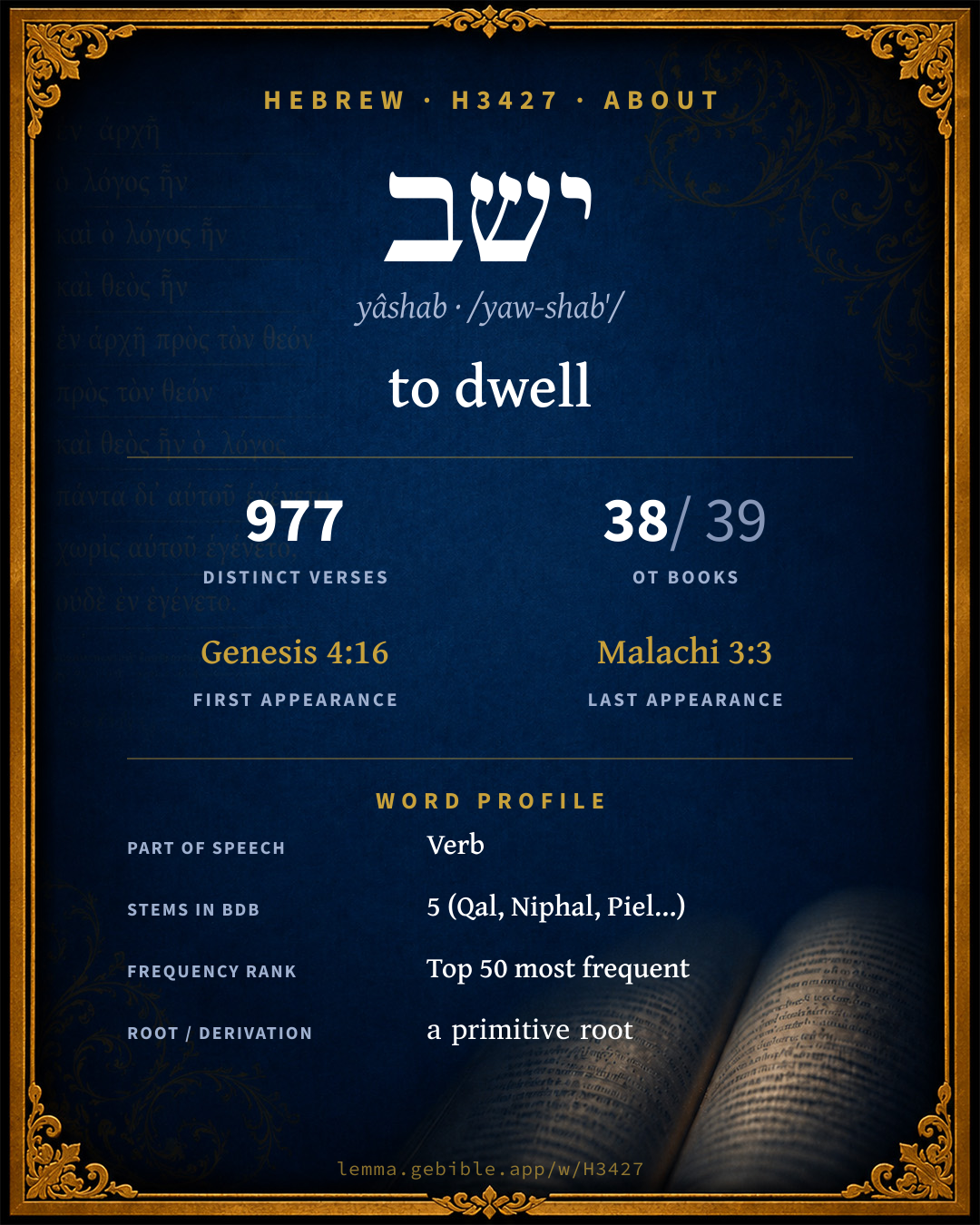
יָשַׁב
to dwell
also: remain, sit, abide fuller range ↓
Full lexicon entry — Brown-Driver-Briggs (BDB)
From Brown-Driver-Briggs (BDB)
Where this word appears
Grammar key — what these labels mean
Part of speech
- Verb
- An action or state-of-being word.
Noun type
- Common
- A common noun — a general class of person, place, or thing (“king,” “city,” “water”), not a specific name.
Stem
- Qal
- The basic, simple active stem — the plain form of the verb (“he wrote”). Here: ‘sit on’
- Hiphil
- The causative active stem (“he caused / brought about”). Here: ‘cause to sit c. acc. pers. +’
- Niphal
- Usually the simple passive or reflexive of the Qal (“he was written”).
- Hophal
- The passive counterpart of the Hiphil (“he was caused to…”).
- Piel
- An intensive or resultative active stem.
Form
- Participle Active
- A verbal adjective expressing ongoing or characteristic action (“writing / one who writes”).
- Sequential Imperfect
- An imperfect with prefixed waw — the standard past-narrative form (waw-consecutive imperfect).
- Infinitive Construct
- A bound verbal noun, frequently with prepositions (“to write / in writing”).
- Perfect
- A completed action or state — Hebrew marks aspect (completeness) more than strict tense (“he wrote”).
- Imperfect
- An incomplete, ongoing, or future action (“he will / would write”).
- Sequential Perfect
- A perfect with prefixed waw continuing a preceding imperfect or command (waw-consecutive perfect).
- Imperative
- A direct command (“write!”).
- Cohortative
- A first-person volitional form expressing wish or resolve (“let me / let us write”).
- Participle Passive
- A verbal adjective expressing action received (“written”).
- Jussive
- A third- or second-person volitional form expressing wish or command (“let him write”).
- Infinitive Absolute
- An unbound verbal noun, often intensifying or standing in for a finite verb.
State
- Construct
- A noun bound to a following noun in a possessive / “of” relationship (the construct chain).
- Absolute
- The independent form of a noun, not bound to a following word.
Person
- 3rd Person
- The one spoken about (“he / she / it / they”).
- 2nd Person
- The one addressed (“you”).
- 1st Person
- The speaker (“I / we”).
Gender
- Masculine
- Grammatically masculine.
- Common
- Either gender — not distinguished for this form.
- Feminine
- Grammatically feminine.
Number
- Plural
- More than one (in Hebrew, generally three or more).
- Singular
- One.
Every verse where H3427 appears in the Book of Proverbs — 8 distinct verses. Click any verse to open its interlinear word-by-word view. Verse text shown in the World English Bible for context — . Each verse’s Hebrew form is shown with its reference; the English is not keyword-highlighted, since the data carries no word-level English alignment. Use “Compare translations” on any verse to read it across multiple English versions. This concordance covers the Hebrew Bible; Septuagint (Greek Old Testament) occurrences are not indexed here.
Proverbs
- Proverbs 3:29 יוֹשֵׁ֖ב Qal ptcp.act ms Don't devise evil against your neighbor, Seeing he dwells securely by you.
- Proverbs 9:14 וְֽ֭/יָשְׁבָה conj + Qal pf 3fs She sits at the door of her house, On a seat in the high places of the city,
- Proverbs 20:8 יוֹשֵׁ֥ב Qal ptcp.act ms A king who sits on the throne of judgment Scatters away all evil with his eyes.
- Proverbs 21:9 לָ/שֶׁ֥בֶת prep + Qal inf.cs It is better to dwell in the corner of the housetop, Than to share a house with a contentious woman.
- Proverbs 21:19 שֶׁ֥בֶת Qal inf.cs It is better to dwell in a desert land, Than with a contentious and fretful woman.
- Proverbs 23:1 תֵ֭שֵׁב Qal impf 2ms When you sit to eat with a ruler, Consider diligently what is before you;
- Proverbs 25:24 שֶׁ֥בֶת Qal inf.cs It is better to dwell in the corner of the housetop, Than to share a house with a contentious woman.
- Proverbs 31:23 בְּ֝/שִׁבְתּ֗/וֹ prep + Qal inf.cs + sfx pers 3ms Her husband is respected in the gates, When he sits among the elders of the land.
About this entry
At a glance — auto-summarized from this page’s data, not written by a person. Every figure links to its source below. This summary describes the numbers; it doesn’t interpret them.
ישב — transliterated yâshab — is a Hebrew verb carrying the sense “to dwell.” The King James Version usually renders it “dwelt,” while modern versions prefer “lived” (Berean Standard Bible) and “dwellers of” (unfoldingWord Literal Text) — see the renderings breakdown. Spanning 977 verses in 38 books, it ranks among the most common words of the Hebrew Bible. Debuting at Genesis 4:16, it then recurs through the corpus. Different stems carry different senses — BDB groups them under 5 stems, among them Qal and Niphal. Each statement above links to its evidence; the full detail follows below.
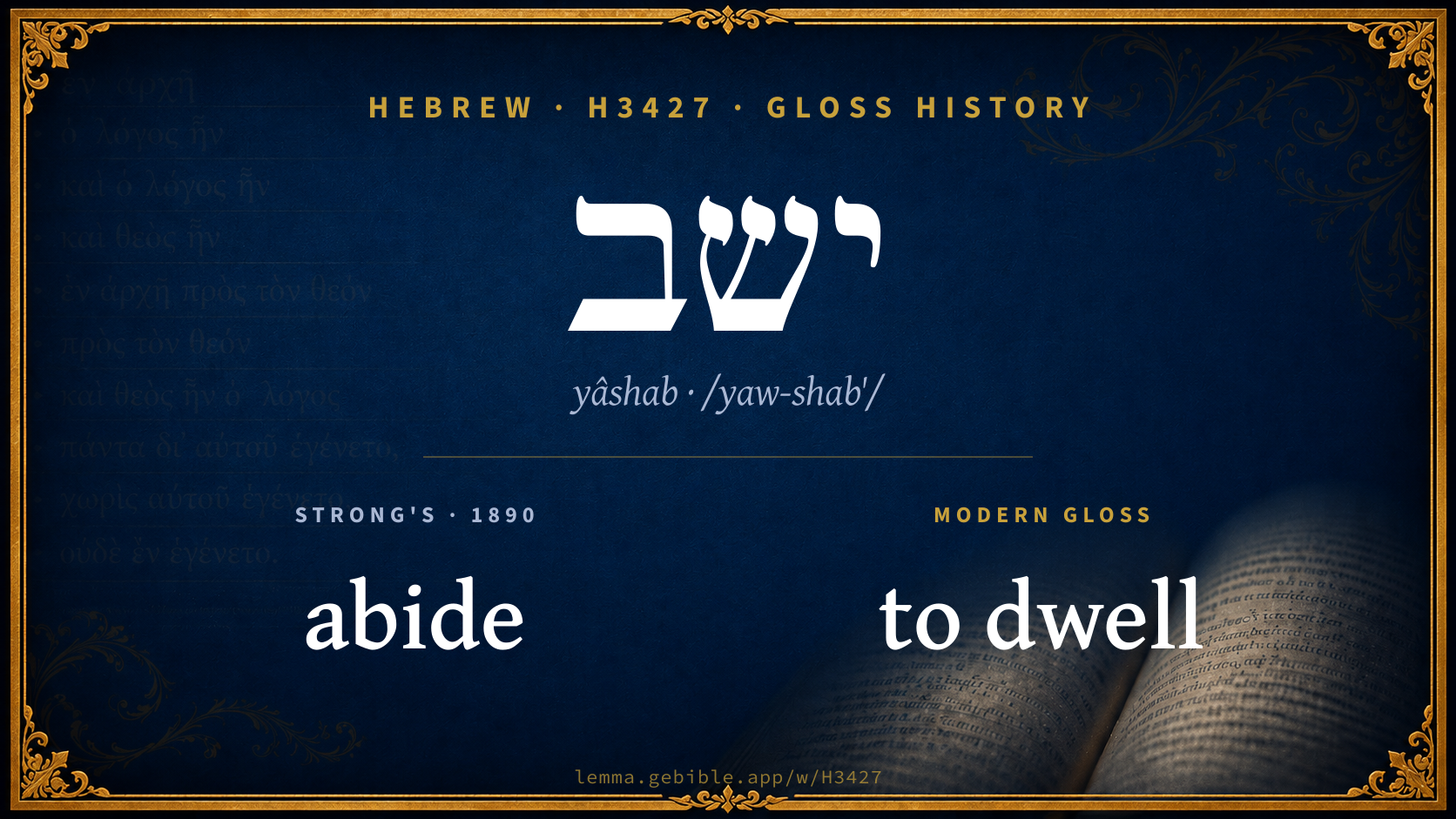
Gloss history
Strong's 1890 vs modern scholarship
About this word
Strong's H3427 catalogs a Hebrew word from the Hebrew Old Testament.
These counts are not copied from any lexicon or concordance. They are computed here, from the morphology-tagged Hebrew Old Testament. What Lemma adds →
- 977
- distinct verses
- The word appears in 977 distinct verses.
- 38 / 39
- OT books
- The word appears in 38 of 39 Old Testament books.
- #36
- by frequency
- Top 50 most frequent Hebrew words (rank 36 of 8,640 Hebrew words by occurrence).
View all 977 occurrences in the concordance →
By section of the Old Testament
By traditional corpus
Conventional, traditional groupings — biblical authorship is debated, so this is a traditional corpus grouping, not an authorship claim. Each share is this word’s portion of its verses in that division of the Hebrew canon. Each figure is a share of the word’s 977 distinct verses.
- Prophets (Nevi'im) 574 verses · 59%
- Writings (Ketuvim) 227 verses · 23%
- Torah (Pentateuch) 176 verses · 18%
How translations render this word
Counts come from each version’s own published word-to-Strong’s tagging or interlinear alignment — an approximate guide to how each version renders this word, not a word-level alignment the data otherwise carries. Because each total is that version’s own tagged count, the per-version totals vary from one another and need not match the appearance or distinct-verse counts above. These counts may also differ from a printed concordance because Lemma counts each distinctly tagged rendering and does not collapse phrase taggings into a single head-word total. This is a fixed set of word-tagged versions (KJV, ASV, BSB, ULT) and does not change with the reading translation you choose elsewhere. Each version’s license is shown beside its name below (and on Sources).
BDB lists this Strong’s number as 2 distinct words (homographs). Each count above pools all of them and is not split by sense — see the Senses section below. A low-frequency rendering may belong to a different one of those words, not the primary meaning.
- King James Version†: Dwelt 144×, Inhabitants 114×, Dwell 87×
- American Standard Version†: Dwelt 129×, Inhabitants 101×, Dwell 75×
- Berean Standard Bible†: Lived 76×, Live 62×, People 53×
- unfoldingWord Literal Text†: Dwellers of 80×, Inhabitants of 43×, And 42×
King James Version Public Domain
Renders H3427 across 1,085† tagged occurrences — most commonly:
Plus other, less common renderings. Plus 246 renderings that appear only once — usually multi-word phrases or single function words the recovered tagging swept in, not distinct renderings. Not rendered by a distinct English word in 4 further occurrences.
American Standard Version Public Domain
Renders H3427 across 1,079† tagged occurrences — most commonly:
Plus other, less common renderings. Plus 287 renderings that appear only once — usually multi-word phrases or single function words the recovered tagging swept in, not distinct renderings.
Berean Standard Bible Public Domain
Renders H3427 across 1,049† tagged occurrences — most commonly:
Plus other, less common renderings. Plus 208 renderings that appear only once — usually multi-word phrases or single function words the recovered tagging swept in, not distinct renderings. Not rendered by a distinct English word in 28 further occurrences.
unfoldingWord Literal Text CC BY-SA 4.0
Renders H3427 across 1,102† tagged occurrences — most commonly:
Plus other, less common renderings. Plus 156 renderings that appear only once — usually multi-word phrases or single function words the recovered tagging swept in, not distinct renderings.
20 senses and sub-senses in the full BDB
Hebrew verbs can shift meaning by stem (binyan): Qal is the basic action, Niphal is often passive or reflexive, Piel often intensifies or makes it factitive, and Hiphil is typically causative. The senses below are grouped under the stem BDB assigns to each. This entry also uses Hophal (the passive of Hiphil).
What do BDB’s symbols mean?
BDB uses these scholarly abbreviations:
| Symbol | Meaning |
|---|---|
| 𝔊 | the Septuagint (the ancient Greek translation, LXX) |
| 𝔙 | the Vulgate (the Latin translation) |
| 𝔖 | the Syriac version (the Peshitta) |
| 𝔗 | the Targum (the Aramaic translation) |
| ψ | the Psalms |
| √ | root (the underlying root or stem) |
| ‖ | parallel passage (a synonymous or contrasted parallel) |
| † | the dagger: every passage where the word occurs is cited |
The 20 senses and sub-senses the full Brown-Driver-Briggs lexicon distinguishes for this word, in lexicon order (not ranked by frequency), with BDB’s own verbatim wording and sub-sense lettering. Shown in Hebrew script with BDB’s own scholarly abbreviations. The condensed entry is in the Lexicon Entry tab. See also the Forms in the corpus table below.
ישב I sit, remain, dwell (NH id.
Qal
- Pf. 3 ms. יָשַׁב Gn 13:12 +; 2 ms. יָשַׁבְתָּ Ju 5:16, וְיָשַׁבְתָּה בָ֑הּ consec. Dt 17:14; 2 mpl. יְשַׁבְתֶּם Dt 1:46 Lv 18:3, וִישַׁבְתֶּם consec. Lv 25:18 + 7 times, etc.; Impf. יֵשֵׁב 1 S 5:7 +, יֵשֶׁב־ Gn 44:33; Ez 44:3, יֵ֫שֶׁב before monosyll. 1 K 7:8; Jb 22:8; וַיֵּ֫שֶׁב Gn 4:16 +; וַיֵּשֵֽׁב Ru 4:1; 1 s. אֵשֵׁב Ju 6:18 +, וָאֵשֵׁב Dt 9:9 + 3 times + Ez 3:15b (but Co אשׁר Kt); אֵשְׁבָה 1 S 27:5; אֵשֵׁ֑בָה Is 49:20; וָאֵשְׁבָה Ez 9:3; 3 mpl. יֵשְׁבוּ Gn 47:4 +; 3 fpl. תישׁבנה Ez 35:9 Kt (i.e. תֵּישַׁבְנָה Ol§ 242 d Köi. 401), Qr תָּשׁוֹבְנָה (√ שׁוב), Co proposes תִּוָּשַׁבְנָה; 1 pl. נֵשֵׁב Je 42:13, 14, וַנֵּ֫שֶׁב Nu 20:15 + 5 times; Imv. ms. שֵׁב Gn 20:15 +, שֶׁב־ Gn 35:1; שְׁבָה Gn 27:19 +; fs. שְׁבִי Gn 38:11 +; mpl. שְׁבוּ Gn 22:5 +, etc.; Inf. abs. יָשֹׁב־ 1 S 20:5; cstr. שֶׁ֫בֶת 1 S 7:2 +; שָׁ֑בֶת Is 40:22 +; sf. שִׁבְתִּי 2 S 7:5 +, etc.; Pt. m. י(וֹ)שֵׁב Gn 4:20; 24:3 +, etc.; f. ישְׁבָה Na 3:8; י(וֹ)שֶׁבֶת Ju 4:5 +; י(וֹ)שָׁ֑בֶת Jos 2:5; 2 K 4:13; ישַׁבְתְּ֯י Je 22:23, י(וֹ)שֶׁבֶת֯י Je 10:17; La 4:21; Ez 27:3 (Kt preferable in all these, v. Ol§ 123 d Ges§ 90.3a); fpl. ישְׁבוֹת 1 S 27:8;— e.g. Genesis 13:12
- 1.
- a. sit on (עַל) a seat 1 S 20:25, stone Ex 17:12, teraphim Gn 31:34, couch 48:2 (all E), Ez 23:41, knees 2 K 4:20; throne Ex 11:5; 12:29 (J), Dt 17:18; 1 S 1:9; 4:13; 1 K 1:13, 17, 20 +, v. abs. infr.; of י׳, הַיּשֵׁב עַל־חוּג הָאָרֶץ Is 40:22; dust Is 47:1, ground (אֶרֶץ) Ez 26:16, ashes Jon 3:6 (these in token of humiliation); sit down by (עַל) a well Ex 2:15 or pool 2 S 2:13; c. אֶל 1 S 28:23; sit in (ב) house, street, doorway, assembly, etc. 2 S 7:1; Ju 19:15 Gn 38:14 (J), Je 15:17; 26:10 ψ 1:1 Ct 2:3 so Ez 31:6, 17 (fig.); of No of Amon (personif. city) הַוּשְׁבָה בַּיְאֹרִים Na 3:8 she who sate amid the rivers; c. לְ sit on to (pregn.) לָאָרֶץ Is 3:26; 47:1 La 2:10, לְכִסֵּא ψ 9:5, at, לְפֶתַח בית Pr 9:14, לִימִינוֹ(י) 1 K 2:19, ψ 110:1; לַמַּבּוּל ψ 29:10; c. לִפְנֵי Gn 43:33 (J), + שָׁם Ju 20:26; 21:2; 2 S 7:18 = 1 Ch 17:16; c. עִם 1 S 20:5 Pr 31:22; c. אֶת־ Je 16:8; Jb 2:13; c. תַּחַת Ju 6:11; Mi 4:4, וַיֵּשֶׁב תַּחְתֶּיהָ בַּצֵּל Jon 4:5; c. מִנֶּגֶד Gn 21:16(×2) (E), נֶגֶד Is 47:14, מִקֶּדֶם לָעִיר Jon 4:5; מִצַּד 1 S 20:25; Ru 2:14; c. acc. cogn. Ez 28:2; לִשְׁפֹּט Ex 18:13; Jo 4:12 (cf. ψ 9:5; Is 28:6); hence abs. of sitting as king or judge Ex 18:14 ψ 61:8 Mal 3:3, יושׁבים Is 10:13, perhaps Am 1:5, 8, especially of י׳ sitting (enthroned), ψ 2:4; 9:8; 29:10; 55:20; 102:13 La 5:19, so in ישֵׁב (הַ)כְּרוּבִים 1 S 4:4; 2 S 6:2 = 1 Ch 13:6, 2 K 19:15 ψ 99:1; ישֵׁב תְּהִלּוֹת יִשְׂרָאֵל ψ 22:4 (v. c. עַל, supr.); by meton. of thrones, for the judges sitting on them שָׁמָּה יָֽשְׁבוּ כִסְאוֹת לְמִשְׁפָּט ψ 122:5; הַיּשְׁבִים Ru 4:14, i.e. in the gate (cf. v 11), those in whose presence purchase of land took place. e.g. 1 Samuel 20:25
- b. sit, sit down, abs., Ju 19:6; Ru 4:1, 2; Ne 1:4; Je 36:15 (sq. cl. of purpose, to eat, etc.) Gn 37:25 Est 3:15 +; opp. קוּם Ex 32:6 (JE) ψ 139:2, מְאַחֲרֵי שֶׁבֶת ψ 127:2 (opp. מַשְׁכִּימֵי קוּם); so Is 37:28 = 2 K 19:27 (read לְפָנַי קֻמְךָ at end of v 27 = 2 K 19:26 We in BlEinl. 4, 257 RSProph. 351, and n. 9); but also קוּמִי שְׁבִי Is 52:2, expl. by (וַיָּקָם מֵהָאָרֶץ וַיֵּשֶׁב אֶל־הַמִּטָּה 1 S 28:23 and) 2 S 19:9. e.g. Judges 19:6
- c. sit down outside (חוּץ), i.e. perform a necessity of nature Dt 23:14. e.g. Deuteronomy 23:14
- d. sit = be set (as a jewel), ישְׁבוֹת עַל־מִלֵּאת Ct 5:12 set on a filling (i.e. in a setting, De al.), in description of eyes; (> others sitting by full streams). e.g. Song of Solomon 5:12
- 2.
- a. remain, stay, tarry (for a limited or indef. time), c. אֶת pers. Gn 24:55 (J), Ju 19:4; 2 S 16:8; c. עִם pers. Gn 27:44 (J), עִמָּדִי 29:19 (E), Ju 17:10; c. בְ loc. 1 S 7:2 (of ark), 13:16; 14:2; 24:4 (23:25 read אֲשֶׁר for וַיֵּשֶׁב 𝔊 We Dr Klo Kit Bu), 2 S 10:5; 19:25 (where read שִׁבְתּוֹ for שִׁיבָתוֹ Dr Klo Bu, v. We), Nu 35:25 (P), Jb 24:13; c. שָׁם 1 K 11:16, שָׁם עַד־עוֹלָם 1 S 1:22; c. על (by) 1 S 25:13; 30:24; פֹּה 2 K 7:4; שְׁבוּ לָכֶם פֹּה עִם־הַחֲמוֹר Gn 22:5 (E); c. בֵּין Ju 5:16, מִחוּץ לְ Lv 14:8 (P), אֵצֶל 1 S 20:19; c. acc. בית 2 S 6:11; 13:20; Ru 2:7; abs. 1 S 1:23(×2); abide, endure Mi 5:3, וִיהוּדָה לְעוֹלָם תֵּשֵׁב Jo 4:20, so of Mt. Zion ψ 121:1. e.g. Genesis 24:55
- b. with special emphasis on qualifying phr., וַתֵּשֶׁב בְּאֵיתָן קַשְׁתּוֹ Gn 49:24 and his bow abode as a firm one (poem in J); 1 K 22:1 and they continued three years without war; of woman remaining בִּדְמֵי טָהֳרָה Lv 12:4, על־דמי וגו׳ v 5. e.g. Genesis 49:24
- 3. dwell, have one’s abode in (ב) a land, city, house, etc., Gn 4:16; 13:7, 12(×2); 19:29; 24:37, 62; Dt 1:4; 3:2; Jos 20:6; 2 S 7:6 + often (on 2 S 21:16 v. ישׁבו בְנֹב, p. 444); in tents Je 35:7, 10; 1 Ch 5:10; fig. of justice (צְדָקָה) Is 32:16 (‖ וְשָׁכֵן מִשְׁפָּט); in the midst of (בְּקֶרֶב) Gn 24:3; Jos 13:13; 16:10; Ju 1:30, 32, 33; 3:5; so c. בְּתוֹךְ Gn 23:10 (P); c. עַל + הארץ, of God 1 K 8:27 = 2 Ch 6:18; of people Lv 25:18, 19; 26:35 (H); c. לְ Jb 15:28; c. בֵּין Gn 20:1 (E); dwell with (אֶת) Gn 34:16, 22 (P), Ex 2:21 (E), Jos 15:63 (JE), Ju 1:16, 21; 17:11; יֵשְׁבוּ יְשָׁרִים אֶת־פָּנֶיךָ ψ 140:14; so c. עִם Jos 20:4 Dt 23:17 (+ בקרב), ψ 26:4 (i.e. assoc. with); c. יַחְדָּו Gn 13:6(×2) (J), 36:7 (P), Dt 25:5; שֶׁבֶת גַּם־יָ֑חַד ψ 133:1; dwell in their stead (תַּחְתָּם) Dt 2:12, 21, 22, 23; 1 Ch 4:41; 5:22; abs. לָשֶׁבֶת יְצָרָהּ Is 45:18 for dwelling he formed it (the earth); (thy) dwelling-place is מְקוֹם שִׁבְתְּךָ 1 K 8:30 = 2 Ch 6:21, also מְכוֹן שׁ׳ 1 K 8:39, 43, 49 = 2 Ch 6:30, 33, 39, so ψ 33:14; מָכוֹן לְשׁ׳ Ex 15:17 1 K 8:13 = 2 Ch 6:2. Pt. ישֵׁב = subst., dweller, inhabitant, very often (c. 215 times): e.g. ישֵׁב אהלים Gn 25:27 (J); often coll. ישֵׁב אהל Gn 4:20 (J), ישׁב הָאָרֶץ 34:30; 50:11 (both J), Ex 34:12, 15 (JE); also poet. f., (as coll.; v. Dr on 1 S 17:21) יוֹשֶׁבֶת שָׁפִיר etc., Mi 1:11(×2), 12, 13, 15; יוֹשֶׁבֶת צִיּוֹן †Is 12:6; Je 51:35; similarly †10:17; 21:13; 22:23; 48:19; cf. La 4:21) Zc 2:11; with בת in app. (Da§ 28 R. 6), יוֹשֶׁבֶת בַּת־מִצְרַיִם †Je 46:19, so 48:18; more usually pl. ישְׁבֵי הֶעָרִים Gn 19:25 (J), cf. Dt 13:14; ישְׁבֵי הָאָרֶץ Ex 23:21 (JE), cf. Ex 15:14, 15 (poem in E); ישְׁבֵי תֵבֵל Is 18:3, יוֹשְׁבֵי חָ֑דֶל 38:11, etc.; ישְׁבֶיהָ Lv 18:25; 25:10 (H), Nu 13:32 (P); abs. יוֹשֵׁב (coll.) Am 1:5, 8; Is 49:19; הַיּוֹשְׁבִים 1 Ch 9:2; also (strangely) ישְׁבוֹת הארץ 1 S 27:8 = the populations of the land We Dr (elsewhere in this sense only fs. and poet., v. supr.); freq. in phr. without inhabitant (i.e. so that there shall be no inhab.), מֵאֵין ישׁב Is 5:9; 6:4; Je 4:7; 26:9; 33:10; 34:22; 44:22; 46:19; 51:29, 37; Zp 2:5; 3:6; מֵאֵין יוֹשֵׁב בָּהֶן Je 48:9; מִבְּלִי ישֵׁב 2:15; 9:10; לֹא יִהְיֶה יוֹשֵב בָּהּ 50:3; לְבִלְתִּי הֱיוֹת־בּוֹ יוֹשֵׁב 51:62. e.g. Genesis 4:16
- 4. of a land or city, sit, abide seated in its place, fig. for be inhabited Je 17:6, 25; 50:13, 39; Ez 26:20; 29:11; 36:35; Is 13:20 (‖ לֹא תִּשְׁכּוֹן), Zc 2:8; 9:5; 14:11; יָֽשְׁבָה תַּחְתֶּיהָ 12:6; 14:10; Ez 35:9; Kt is תישׁבנה, Qr תָּשׁוֹבְנָה; Co תושׁבנה, i.e. Niph. תִּוָּשַׁבְנָה (cf. 36:10), or Hoph. תּוּשַׁבְנָה (cf. Is 44:26); of palace, וְאַרְמוֹן עַל־מִשְׁפָּטוֹ יֵשֵׁב Je 30:18. e.g. Jeremiah 17:6
Niphal
- Pf. 3 fs. נוֹשָׁ֑בָה Je 6:8; 3 pl. וְנֽשְׁבוּ consec. Ez 36:10, נוֹשָׁ֑בוּ Ez 26:19, נוֹשָׁ֑בֻ֯ה Je 22:6; Pt. f. נוֹשֶׁבֶת Ez 26:17 (נִשְׁבַּתְּ 𝔊 Co, √ שׁבת), נוֹשָׁ֑בֶת Ex 16:35; pl. נוֹשָׁבוֹת Ez 12:20; 38:12;—be inhabited, of land Ex 16:35 (perhaps = be habitable), Je 6:3; of cities Je 22:6 Ez 12:20; 26:19; 36:10; חֳרָבוֹת נוֹשָׁבוֹת Ez 38:12;—Ez 26:17 v. supr.; 35:9 v. Qal 4. e.g. Jeremiah 6:8
Piel
- Pf. 3 mpl. וְיִשְּׁבוּ טִירוֹתֵיהֶם בָּ֑ךְ Ez 25:4 and they shall set their encampments in thee (𝔊 𝔖 Co וְיֵשְׁבוּ inhabit). e.g. Ezekiel 25:4
Hiphil
- Pf. 3 ms. הֹשִׁיב Ezr 10:14, sf. הוֹשִׁיבַנִי La 3:6 ψ 143:3; 1 s. הוֹשַׁבְתִּי Lv 23:33, וְה(וֹ)שַׁבְתִּים consec. Ho 11:11; Je 32:37; וְהוֹשְׁבוֹתִים consec. Zc 10:6 (Köi, 413; but prob. text error, vid. Thes and GesLgb 464; read prob. וַהֲשִׁבוֹתִים as v 10, so StaZAW, 1881, 21 We), etc.; Impf. 3 ms. וַיּוֹשֵׁב Gn 47:11, וַיּוֹ֫שֶׁב 2 Ch 8:2 ψ 107:36; sf. וַיּוֹשִׁיבַי֯נִי 1 K 2:24 (Köi, 414, 224); וַיּשִׁיבֵם Jb 36:7; 1 pl. וַנּ֫שֶׁב Ezr 10:2, etc.; Imv. ms. הוֹשֵׁב Gn 47:6; mpl. ה(וֹ)שִׁיבוּ 1 K 21:9, 10; Inf. cstr. ה(וֹ)שִׁיב 1 S 2:8; Ne 13:27; הוֹשִׁיבִי ψ 113:8 (Ol§ 123 d; read -בוֹ, v. Che); Pt. abs. מוֹשִׁיב ψ 68:7, cstr. מוֹשִׁיבִי ψ 113:9 (Oll.c. Gesl.c.);— e.g. Ezra 10:14
- 1. cause to sit c. acc. pers. + על כסא 1 K 2:24; 2 Ch 23:20 so (without על כסא) + לָנֶצַח Jb 36:7; set, place c. acc. pers. + נֶגְדּוֹ 1 K 21:10, also v 9, 12 (בְּרֹאשׁ הָעָם). e.g. 1 Kings 2:24
- 2. cause to abide (acc. pers.) at (ב) 1 S 30:21. e.g. 1 Samuel 30:21
- 3.
- a. cause to dwell, c. acc. pers. + ב loc. 1 S 12:8; 2 K 17:6 Ho 12:10, Gn 47:6, 11 (P), Lv 23:43 (H), La 3:6 ψ 143:3; בְּאֶרֶץ תַּחְתִּיּוֹת Ez 26:20; acc. pers. om. 2 K 17:24, 26; acc. pers. + שָׁם 2 Ch 8:2 ψ 107:36; acc. pers. + עַל־הַבָּתִּים Ho 11:11 (but read וַהֲשִׁבֹתִים We); acc. pers. om., c. עם pers. 1 S 2:8 ψ 113:8; מוֹשִׁיב יְחִידִים בַּ֫יְתֶה ψ 68:7 causing solitary ones to dwell in a house (or is מוֹשִׁיב for מֵשִׁיב Bae?); c. acc. pers. only מושׁ׳ עֲקֶרֶת הַבַּיִת ψ 113:9 giving a dwelling to her that is barren of house; abs. c. לָבֶ֫טַח Je 32:37 ψ 4:9; abs. c. כְּקַדְמוֹתֵיכֶם Ez 36:11. On Zc 10:6, v. supr. e.g. 1 Samuel 12:8
- b. cause cities (עָרִים) to be inhabited Ez 36:33; Is 54:3. e.g. Ezekiel 36:33
- 4. marry (proposes give a dwelling to, cf. ψ 113:9), only Ezr Ne, and only c. acc. נָשִׁים נָכְרִיּוֹת strange or foreign women Ezr 10:2, 10, 14, 17, 18 Ne 13:27; so הֹשִׁיבוּ נָשִׁים אַשְׁדֳּו֯רִיּוֹת Ne 13:23. e.g. Psalms 113:9
Hophal
- Pf. וְהוּשַׁבְתֶּם לְבַדְּכֶם בְּקֶרֶב הָאָ֑רֶץ Is 5:8 and ye be made to dwell alone in the midst of the land. Impf. הָאֹמֵר לִירוּשָׁלַם תּוּשָׁ֑ב Is 44:26 he who saith of Jerusalem, she shall be inhabited. Ez 35:9 v. Qal 4. e.g. Isaiah 5:8
ישב II m. usually Ιασουβ
- 1. in Issachar Nu 26:24 (P) 1 Ch 7:1 Qr (Kt ישיב). e.g. Numbers 26:24
- 2. one with foreign wife Ezr 10:29.—Is 7:3 v. שְׁאָר יָשׁוּב. e.g. Ezra 10:29
Senses from the full Brown-Driver-Briggs lexicon (Brown, Driver, Briggs; Oxford 1906 — public domain), digitized via Sefaria, supplemented by the OpenScriptures HebrewLexicon (CC BY 4.0). Full attribution on Sources.
Word origin
I. vb. sit, remain, dwell (NH id.; Aramaic יְתֵיב, ܝܺܬܶܒ; MI10.31 ישב, l8. 19 וישב, l13 ואשב, dwell; Ph. ישב dwell; Zinj. ישב sit DHMSendsch. 58; Assyrian ašâbu, sit, dwell, DlHWB 244; Arabic وَثَبَ leap, jump, Ḥimyer. dial. sit, Lane2919; Ethiopic አውሰበ ii. i secum cohabitare facere, marry, consummate marriage, cf. Hiph. 4)—
II. n.pr.m. usually Ιασουβ;—
— Brown-Driver-Briggs (Oxford 1906, public domain), digitized via Sefaria, supplemented by the OpenScriptures HebrewLexicon (CC BY 4.0). See Sources.
Origin: a primitive root
Jastrow Dictionary
A second Hebrew/Aramaic lexicon for comparison, covering Aramaic and post-biblical (Talmudic, Targumic, Midrashic) usage that the biblical-Hebrew BDB does not. Matched by lemma rather than by Strong’s number, so a lemma may carry more than one Jastrow headword (shown separately below), and the entries cover usage well beyond the Bible.
יָשַׁב
- (b. h.)
- 1. to sit down, rest; to dwell, remain; to be inactive. Macc. III, 15 כל חיוֹשֵׁב ולא עבר וכ׳ whoever is inactive and commits no sin, i.e. omits to do wrong; Kidd. 39ᵇ.—Erub. 100ᵃ שֵׁב ואל תעשה עדיף ‘sit and do nothing’, i.e. not to act in doubtful cases, is better, opp. קום ועשה. Ber. 20ᵃ שב ואל תעשה שאני with an omission it is different. Tosef. Snh. VII, 8 ולא יֵשְׁבוּ … להם שֵׁבוּ and they must not sit down until he says to them, Be seated; Hor. 13ᵇ; Y. Bicc. III, 65ᶜ bot.—Y. Dem. II, 23ᵃ top שי׳ בישיבח who has a seat in the scholars’ meetings. Snh. 10ᵇ; Tosef. ib. II, 1 אחד אומר לֵישֵׁב if one is in favor of sitting (holding deliberation in court). Zeb. II, 1 יוֹשֵׁב in a sitting position. Ber. 28ᵇ מיוֹשְׁבֵי בה"מ one of the attendants at college, יושבי קרנות those placed at street corners (traders, idlers). Gen. R. s 75 יושבי קרנות (corr. קרונות) sitting in chariots; a. v. fr.
- 2. to be settled (v. יִישּׁוּב), be inhabited. Num. R. s. 4 הגבעה … יוֹשְׁבִים Gibeah and Kiryath Jearim were settled at the same time.—Erub. 86ᵃ (ref. to Ps. LXI, 8) אימתי יושב עולם לפני וכ׳ (Rashi a. Ar. יֵשֵׁב) when is the world settled (evenly balanced) before God? When kindness and truth are appointed to guard it (differ. in Rashi; v. infra). e.g. Psalms 61:8
- 1. to settle, put in place, to arrange evenly. Y. Sabb. XII, beg. 13ᶜ הבנאי י׳ את האבן וכ׳ the builder that placed a stone on top of the row (v. דִּימוֹס I). Ib.ᵈ top; Y. Pes. VIII, 33ᵇ top מפני שהוא כמְיַישֵּׁב בידו because it is like settling the web with one’s own hand. Lev. R. s. 37 [read:] יָשַׁב וְיִ׳ להם סבלותם וכ׳ he sat down (as a judge) and arranged their burdens in proper proportions between man and woman. Ib. אתה עתיד ליַישֵּׁב וכ׳ thou art designated to settle and explain to my children their vows &c. Ex. R. s. 31 (ref. to Ps. LXI, 8, v. supra) יַשֵּׁב עולמך make thy world evenly balanced (as to property); Tanḥ. Mishp. 9 תיישר עולמך בשוה (read: תְּיַישֵּׁב). Ex. R. s. 52 לא היו יודעין ליַישְּׁבוֹ they knew not how to put its parts together; a. fr.—Trnsf. to set the mind at ease, to quiet. Sabb. 87ᵃ דברים שמְיַישְּׁבִין לבו וכ׳ Ms. M. (ed. שמושכין) words which quiet the mind of man &c.; Gen. R. s. 80 דברים שמְיַישְּׁבִים את הלב. Y. Pes. V, end, 32ᵈ (expl. וישב, II Sam. VII, 18) וַיַישֶּׁב עצמו לתפלה he quieted his mind for prayer; a. e. e.g. Psalms 61:8
- 2. to settle, cultivate, populate. Ber. 58ᵇ … עתיד להחזירו וליַישְּׁבוֹ Ms. M. (ed. ליִישּׁוּבוֹ) the Lord will again people it. Sot. 22ᵃ מְיַישְּׁבֵי עולם cultivators of the world.—Part. pass. מְיוּשָּׁב, f. מְיוּשֶּׁבֶת a) seated. Meg. 21ᵃ. Y. Gitt. VII, 48ᵈ top; a. fr.—b) sedate, at ease. Y. Ber. IV, 8ᵇ bot. לבו מי׳ his mind is at ease (about his animal); Bab. Ber. 30ᵃ לפי שאין דעתו מי׳ עליו because his mind is not at ease without it. Sifré Num. 131 היה … בקי ומי׳ the polemarch was experienced and cool-headed; a. fr.
- to seat, place, appoint; to settle. Yoma 38ᵃ sq.; Tosef. ib. II, 7 במקומך יוֹשִׁיבוּךָ people will finally seat thee in the place which thou deservest. Tosef. Sabb. VI (VII), 17 (among superstitious practices) חמוֹשֶׁבֶת אפרוחים (ו)אמרה איני מוֹשַׁבְתָּן וכ׳ a woman who sets hens to brood and says I will not set them except in pairs (v. ed. Zuck. note). Snh. IV, 4 מוֹשִׁיבִין אותו וכ׳ a seat is assigned to him in the third row. Macc. 10ᵃ ואין מוֹשִׁיבִין אותם וכ׳ and we must not lay them out except on a river; (Tosef. ib. III (II), 8 בונין).—Tosef. l. c. מביאין … ומושיבין וכ׳ other people are imported and settled in their place. B. Kam. 16ᵇ bot. הוֹשִׁיבוּ ישיבה וכ׳ they held scholars’ meetings by his grave. Snh. 17ᵃ אין מושיבין בסנהדרי וכ׳ none can be appointed members of the Sanhedrin except &c.; a. v. fr.
- to be inhabited. Pirké d’R. El. ch. XLIII ארץ נוֹשֶׁבֶת an inhabited land, settlement; (Koh. R. to I, 15 יִישּׁוּכ).
- , Nithpa. נִתְיַישֵּׁב
- 1. to be settled, colonized. Ber. 31ᵃ כל ארץ שגזר … ליישוב נִתְיַישְּׁבָה every land which Adam designated for settlement, has been settled.
- 2. to be at ease, to be refreshed, to come to. Yoma 82ᵃ אם נִתְיַשְּׁבָה דעתה if she feels that her craving has been gratified. Lam. R. to I, 11 (ref. to להשיב נפש, ib.) עד כמה מִתְיַישֶּׁבֶת נפש how much is required for one fainting from hunger (v. בּוֹלִימוֹס) to come to himself again?—Ḥag. 3ᵇ לאחר שנתיישבה דעתו after his excitement had subsided. Erub. 65ᵃ כל המתיישב ביינו he who remains clear-minded when drinking wine. Kinnim III, 6 כל זמן … דעתם מתישבת עליהם the older they grow, the more clear-minded do they become, opp. מיטרפת; a. fr.
יְשַׁב
- Ithpa. אִתְיַישַּׁב, contr. אִיַּישַּׁב as preced. Hithpa. 2. Ber. 58ᵇ חזייה דלא מִיַּישְּׁבָא דעתיה ed. (Ms. מִתְיַישְּׁבָא) he saw that he was not comforted.—V. יְתֵב.
A Dictionary of the Targumim, the Talmud Babli and Yerushalmi, and the Midrashic Literature (Marcus Jastrow; London, Luzac, 1903) — Public Domain. Digitized via Sefaria. Digitized via Sefaria. Full attribution on Sources.
Forms in the corpus
The 481 distinct written forms H3427 takes in the Hebrew Bible, most frequent first — each parse links to that stem’s occurrences in the concordance. Hebrew forms include their vowel points and cantillation, so a single lemma takes many written forms.
The 60 most common forms are shown; 421 rarer forms follow in the full concordance.
Same root — word family
Other BDB entries built from the same root as H3427, grouped by Strong’s listed origin. These share a root / origin per the lexicon — not necessarily a shared meaning. Each links to that word’s own entry.
Derived from this word
- יתב yᵉthib H3488 to sit
- מושב môwshâb H4186 dwelling place
- שבת shebeth H7675 seat
- שיבה shîybâh H7871 sojourn
- תושב tôwshâb H8453 sojourner
Proper names from this root
People and places named from this root — a name, not an additional meaning of the word.
- יושביה Yôwshibyâh H3143 Josibiah
- ישבאב Yeshebʼâb H3428 Jeshebeab
- ישב בשבת Yôshêb bash-Shebeth H3429 Josheb-basshebeth
- ישבו בנב Yishbôw bᵉ-Nôb H3430 Ishbi-benob
- ישבקשה Yoshbᵉqâshâh H3436 Joshbekashah
Compare all same-root words → Showing 4 of 11 — not the complete family. 5 of the same-root words are proper names (people or places). They share a root, not necessarily a meaning.
Septuagint verse parallels
This word appears in 908 verses that also exist in the Greek Old Testament (Septuagint), out of the 977 Hebrew verses it occurs in. You can read those verses in Greek by switching the Old Testament edition to the Septuagint.
Read these verses in the Septuagint
- Genesis 4:16
- Exodus 2:15
- Leviticus 8:35
- Numbers 13:18
- Deuteronomy 1:4
- Joshua 1:14
- Judges 1:9
- Ruth 1:4
- 1 Samuel 1:9
- 2 Samuel 1:1
- 1 Kings 1:13
- 2 Kings 1:9
This is a verse-level parallel only — the same verses exist in both the Hebrew and Greek Old Testaments. No word-level Hebrew↔Greek correspondence is claimed: the data carries no such alignment, so no Greek word is shown as this Hebrew word’s translation. Coverage is not total — the Septuagint omits the deuterocanon and renumbers the Psalms, so some Hebrew verses have no direct Greek parallel.