
Psalms 61:8

Hebrew (Westminster Leningrad Codex) Psalms 61:8 appears in the Hebrew Old Testament. The text above is from the Westminster Leningrad Codex. Each word links to its Strong’s number, a concise gloss, and parsing drawn from the Open Scriptures Hebrew Bible morphology. Click any word for its full Brown-Driver-Briggs (BDB) entry.
Download image
Cite this verse

Psalms 61:8 (World English Bible). Public Domain. Lemma interlinear Bible study tool, https://lemma.gebible.app/v/psalms/61/8.

Show BibTeX & RIS
BibTeX
RIS
English Translation
So I will sing praise to your name forever, That I may fulfill my vows daily.
World English Bible · Public Domain
Download a study sheet

One document with this verse’s original text, its word-by-word gloss line, the meaning frame, cross-references with their text, attributed commentary, and full source and license credits — printable, and it pastes into notes with its structure intact.

This verse Autodidact and up

Study sheet (.html) Plain text (.txt)

A passage Seminary Student

Up to 50 verses in one chapter. A passage sheet keeps up to 6 commentary sources and 12 cross-references per verse, in the order this page ranks them, and says so on the sheet whenever that leaves anything out. Ask for a single verse and you get the Autodidact verse sheet above.

Everything on this page stays free to read, with no account — the sheet is a download of what is already on screen, not access to it.

Want to remove ads? Support Godless Engineer
Compare translations 3

The same verse in 3 English versions, stacked beneath the original-language interlinear above. Click any original word for its lexicon entry.

Each is an independent rendering of the whole verse — the interlinear is not word-aligned to these translations.

Highlighted words mark where these versions differ — a whole-verse word diff, not a word-by-word alignment.

  • World English Bible Public Domain
    So I will sing praise to your name forever, That I may fulfill my vows daily.
  • King James Version Public Domain
    So will I sing praise unto thy name for ever, that I may daily perform my vows.
  • unfoldingWord Literal Text CC BY-SA 4.0
    Thus let me make music your name forever, that I may pay my vows day, day.

unfoldingWord Literal Text — © unfoldingWord, licensed CC BY-SA 4.0. Word-aligned USFM3 via Door43 (git.door43.org/unfoldingWord/en_ult).

Versions to compare (up to 4)

3 of 4 selected

Show all 18 translations

Every available English version of this verse, each an independent rendering of the whole verse.

  • World English Bible Public Domain
    So I will sing praise to your name forever, That I may fulfill my vows daily.
  • Berean Standard Bible Public Domain
    Then I will ever sing praise to Your name and fulfill my vows day by day.
  • Majority Standard Bible Public Domain
    Then I will ever sing praise to Your name and fulfill my vows day by day.
  • King James Version Public Domain
    So will I sing praise unto thy name for ever, that I may daily perform my vows.
  • American Standard Version (1901) Public Domain
    So will I sing praise unto thy name for ever, That I may daily perform my vows. Psalm 62 For the Chief Musician; after the manner of Jeduthan. A Psalm of David.
  • Revised Version (1885) Public Domain
    So will I sing praise unto thy name for ever, that I may daily perform my vows.
  • Geneva Bible (1599) Public Domain
    So will I alway sing prayse vnto thy Name in performing dayly my vowes.
  • Douay-Rheims (1899) Public Domain
    He abideth for ever in the sight of God: his mercy and truth who shall search?
  • Young's Literal Translation Public Domain
    So do I praise Thy name for ever, When I pay my vows day by day!
  • Literal Standard Version CC BY-SA 4.0
    So I praise Your Name forever, || When I pay my vows day by day!
  • Unlocked Literal Bible CC BY-SA 4.0
    I will sing praise to your name forever so that I may perform my vows every day.
  • unfoldingWord Literal Text CC BY-SA 4.0
    Thus let me make music your name forever, that I may pay my vows day, day.
  • Darby Bible Public Domain
    So will I sing forth thy name for ever, performing my vows from day to day.
  • World Messianic Bible Public Domain
    So I will sing praise to your name forever, that I may fulfill my vows daily.
  • Webster's Bible Public Domain
    \\61:7\\He shall abide before God for ever: O prepare mercy and truth, which may preserve him.
  • Free Bible Version CC BY-SA 4.0
    Then I will always sing praises to you, and every day I will keep my promises to you.
  • Bible in Basic English Public Domain
    So will I make songs in praise of your name for ever, giving to God that which is right day by day.
  • JPS Tanakh (1917) Public Domain
    (61-9) So will I sing praise unto Thy name for ever, that I may daily perform my vows.

Literal Standard Version (2020), Covenant Press — licensed CC BY-SA 4.0. Text via the HelloAO Bible API (eBible.org). Unlocked Literal Bible (unfoldingWord) — licensed CC BY-SA 4.0. Text via the HelloAO Bible API (eBible.org). unfoldingWord Literal Text — © unfoldingWord, licensed CC BY-SA 4.0. Word-aligned USFM3 via Door43 (git.door43.org/unfoldingWord/en_ult). Free Bible Version, Dr. Jonathan Gallagher — licensed CC BY-SA 4.0. Text via the HelloAO Bible API (eBible.org).

Word by word

More ways to search: Search by grammar → Find every occurrence → Compare this word →

Practice this passage: Drill this verse → Learn its vocabulary →

אֲזַמְּרָ֣ה
zâmar
H2167
“to sing”
Verb, Piel, Cohortative, 1st Person, Common, Singular
Part of Speech
Verb
Stem
Piel
Form
Cohortative
Person
1st Person
Gender
Common
Number
Singular
Full BDB Definition

Origin: a primitive root [perhaps ident. with H2168 through the idea of striking with the fingers]

TWOT: 558

to sing, sing praise, make music - (Piel) - to make music, sing - to play a musical instrument
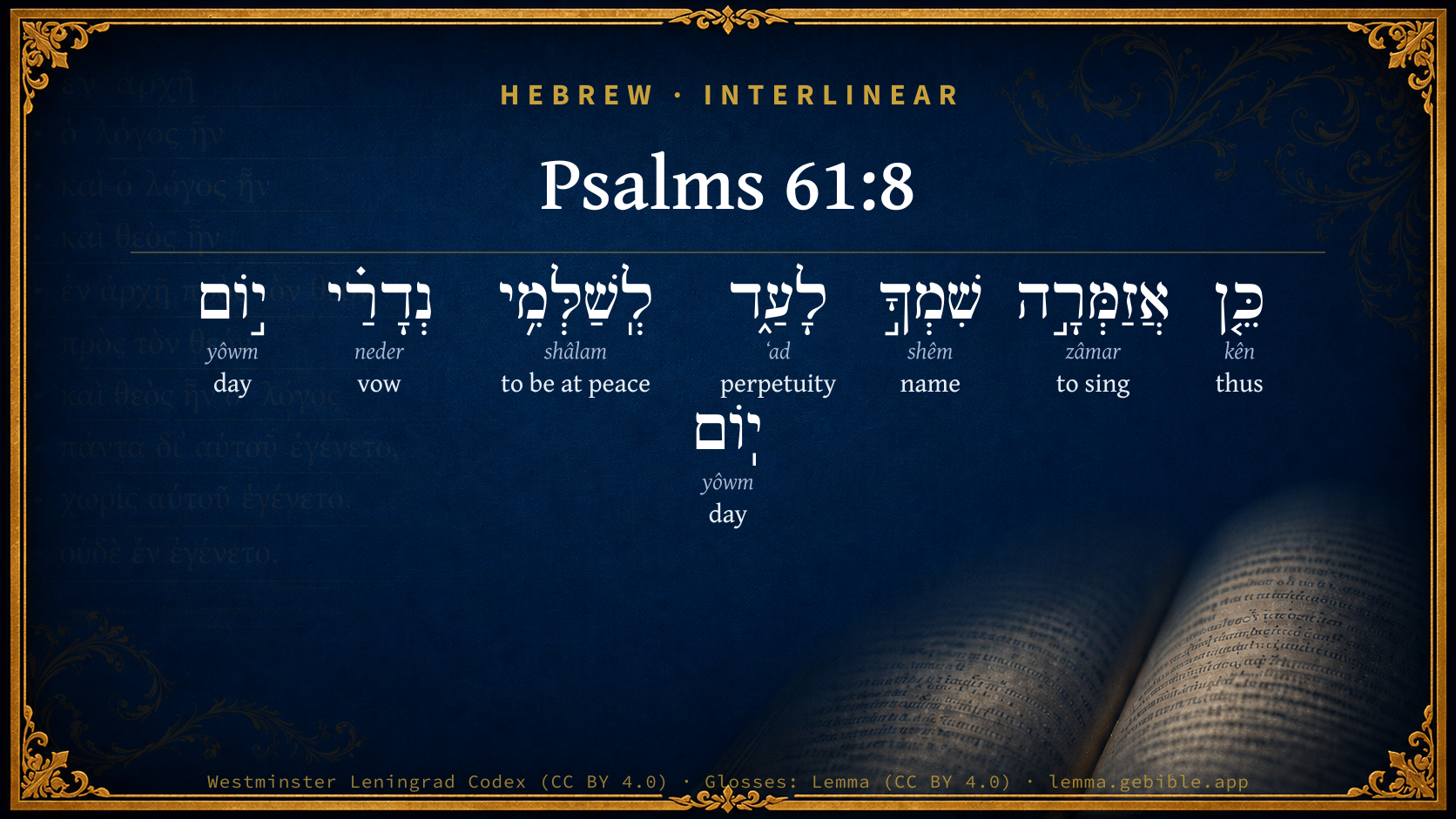
  1. כֵּ֤ן kên H3651 “thus” Particle, Demonstrative
  2. שִׁמְךָ֣ shêm H8034 “name · your” Noun, Common, Masculine, Singular, Construct + Suffix, Personal, 2nd Person, Masculine, Singular
  3. לָעַ֑ד ʻad H5703 “to/for · perpetuity” Preposition + Noun, Common, Masculine, Singular, Absolute
  4. לְֽשַׁלְּמִ֥י shâlam H7999 “to be at peace · me” Preposition + Verb, Piel, Infinitive Construct + Suffix, Personal, 1st Person, Common, Singular
  5. נְדָרַ֗י neder H5088 “vows · my” Noun, Common, Masculine, Plural, Construct + Suffix, Personal, 1st Person, Common, Singular
  6. י֣וֹם yôwm H3117 “day” Noun, Common, Masculine, Singular, Absolute
  7. יֽוֹם yôwm H3117 “day” Noun, Common, Masculine, Singular, Absolute

About this verse

These counts appear in no published source. They are computed here, from the morphology-tagged text and Lemma’s own curated glosses. What Lemma adds →

8
words
7
distinct lemmas
Wisdom
section

Shared distinctive vocabulary

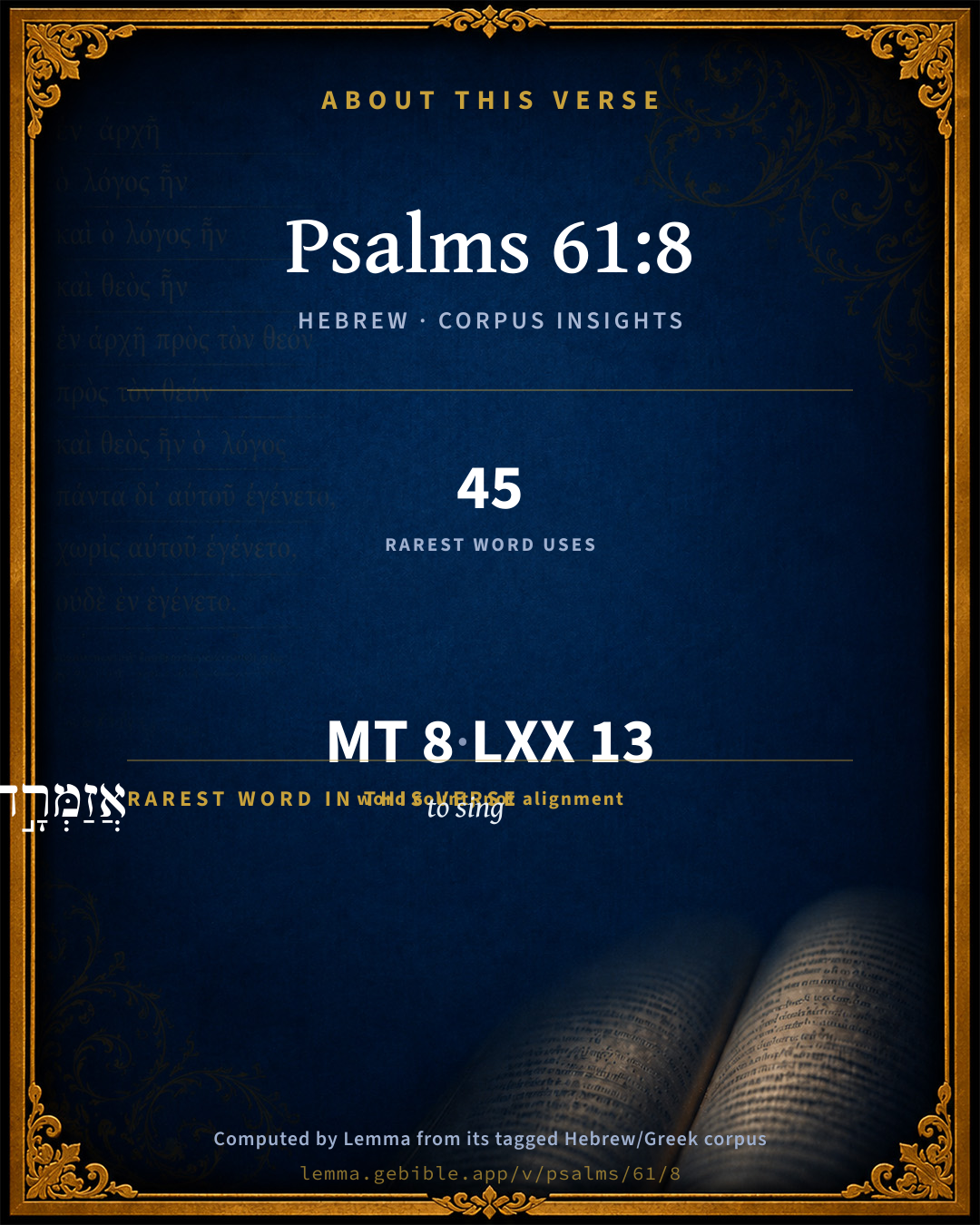
אֲזַמְּרָ֣ה to sing H2167 occurs in 41 verses of the Hebrew Bible. Also found in:

Grammatical profile

  • 2 verbs
  • 5 nouns
  • 1 particle

Verb forms

  • אֲזַמְּרָ֣ה Piel · Cohortative
  • לְֽשַׁלְּמִ֥י Piel · Infinitive Construct

Repetition

A word recurs within this verse — often emphatic in Hebrew:

  • י֣וֹם day H3117 ×2

Hebrew & Septuagint length

In English translation the verse runs 16 words from the Hebrew and 18 from the Septuagint (LXX English) — closely comparable.

A rough comparison of the two English renderings, which tokenize alike — not a word-level alignment.

Word counts can differ between the Hebrew and the Greek without any difference in meaning — e.g. the Hebrew direct-object marker אֵת has no separate Greek word, and Greek often adds the article ὁ.

In the original languages it is 8 Hebrew tokens and 13 Greek tokens — but the two are counted differently (Hebrew bundles its prefixes and suffixes into one token; the Greek is in lemma form), so that isn’t a like-for-like length.

Cross-references

7

Topical passages linked to Psalms 61:8 in the Treasury of Scripture Knowledge — connected by theme and wording, ordered by reader-vote popularity; previews shown in the World English Bible.

  • Psalms 65:1 Praise waits for you, God, in Zion. To you shall vows be performed.
  • Psalms 145:1–2 I will exalt you, my God, the King. I will praise your name forever and ever.
  • Psalms 66:13–16 I will come into your temple with burnt offerings. I will pay my vows to you,
  • Psalms 71:22 I will also praise you with the harp for your faithfulness, my God. I sing praises to you with the lyre, Holy One of Israel.
  • Psalms 79:13 So we, your people and sheep of your pasture, Will give you thanks forever. We will praise you forever, to all generations.
  • Psalms 146:2 While I live, I will praise Yahweh. I will sing praises to my God as long as I exist.
  • Psalms 30:12 To the end that my heart may sing praise to you, and not be silent. Yahweh my God, I will give thanks to you forever!

Cross-references courtesy of OpenBible.info (CC BY 4.0).

Hebrew and Greek witnesses Masoretic Hebrew ↔ Greek Septuagint

The same verse in the two great witnesses to the Old Testament, shown verse-for-verse.

You’re reading Greek Psalm 60 (Hebrew Psalm 61). The Septuagint counts the superscription, so verse numbers can differ from the Hebrew — chapter-level alignment, not verse-by-verse. Numbering follows Rahlfs.

These are two independent witnesses, not word-aligned to each other, and the Septuagint is shown in lemma (dictionary) form.

Hebrew Psalms 61:8 Masoretic · Westminster Leningrad Codex

כֵּ֤ן אֲזַמְּרָ֣ה שִׁמְךָ֣ לָעַ֑ד לְֽשַׁלְּמִ֥י נְדָרַ֗י י֣וֹם יֽוֹם

So I will sing praise to your name forever, That I may fulfill my vows daily.

World English Bible · Public Domain

Greek LXX Greek Psalm 60:8 Septuagint · lemma form

διαμένω εἰς ὁ αἰών ἐνώπιον ὁ θεός ἔλεος καί ἀλήθεια αὐτός τίς ἐκζητέω

So will I sing to your name for ever and ever, that I may daily perform my vows.

LXX2012 (modern English Septuagint) · Public Domain

Hebrew: Westminster Leningrad Codex (CC BY 4.0). Greek: Septuagint (public domain); English from LXX2012 (modern English Septuagint) (Public Domain). How the Septuagint differs from the Hebrew →

Commentary

Notes on Psalms 61:8 from classic Christian and Jewish commentators (each source and its license shown beneath its notes). The classic Christian expositions comment on the surrounding passage and are grouped to its opening verse, so a note may address several verses; the Jewish commentaries on the Tanakh (Rashi and others) are per-verse, so they appear only where the commentator wrote on this verse.

Lemma curates 59 commentaries, every one of them public domain or Creative Commons licensed, each selected and text-cleaned for this edition rather than reprinted as found. About our sources →

Trapp's Complete Commentary

John Trapp

Psa 61:8 So will I sing praise unto thy name for ever, that I may daily perform my vows.

Ver. 8. So will I sing praise unto thy name for ever] Conclusio votiva. Praise is so pleasing a service to God, that he indented with his people for it, Psa 50:15, and they, knowing his mind therein, do usually restipulate that they will perform it; as holding it the least that they in conscience can do, and knowing it the most that they are able to do. They present it, therefore, to God, as that Grecian did his small gift to Augustus, saying, Eι πλεον ειχον πλεον εδιδουν, If I had a better thing I could well beteem it thee.

That I may daily perform my vows] Which, till they be paid, a true-hearted votary is in pain; for he accounteth them due debts to God.

John Trapp, A Commentary or Exposition upon All the Books of the Old and New Testament (1647–1656) — public domain. Text from a community e-Sword module.

J. A. Alexander on Psalms

Joseph Addison Alexander

9. (Psa 61:8). So will I celebrate thy name for ever, that I may pay my vows day (by) day. The so at the beginning may mean, on this condition, when this prayer is granted; or more probably, in this assurance, in the confident expectation of this issue. Celebrate musically, both with instrument and voice. See above, on Psa 57:7, and compare Psa 59:17. That I may pay, literally to (or for) my paying, or, as some explain it, by my paying, which, however, is a rare and dubious use of the infinitive. Day (by) day or day (and) day, i.e. one day with or after another, implying not only frequency but regularity. The Vulgate version of this idiomatic phrase is de die in diem.

Joseph Addison Alexander, The Psalms Translated and Explained (1850) — public domain. Text from a community e-Sword module.

Jamieson, Fausset & Brown

Robert Jamieson, A. R. Fausset & David Brown

Thus for new blessings will new vows of praise ever be paid.

Next: Psalms Chapter 62

Jamieson, Fausset & Brown — Commentary Critical and Explanatory on the Whole Bible (1871) — public domain (CC PDM 1.0). Text via the HelloAO Bible API.

Adam Clarke's Commentary

Verse 8. So will I sing praise unto thy name for ever] For the benefits which I have received, and hope to receive endlessly from thee, I will to all perpetuity praise thee.

That I may daily perform my vows.] While I live, I shall יום יום yom, yom, "day by day," each day as it succeeds, render to thee my vows - act according to what I have often purposed, and as often promised. The Chaldee ends remarkably: "Thus I will praise thy name for ever, when I shall perform my vows in the day of the redemption of Israel; and in the day in which the King Messiah shall be anointed, that he may reign."

The ancient Jews were full of the expectation of the Messiah; the Jews of the present day have given up their hope.

ANALYSIS OF THE SIXTY-FIRST PSALM

The author of this Psalm prays and vows perpetual service to God. It is composed of two parts: -

I. His prayer, Ps 61:1-3.

II. His vow, Ps 61:4-8.

He begins with a prayer, in which he begs, -

1. Audience: "Hear my cry, O God; attend unto my prayer," Ps 61:1.

2. The reason to enforce it.

1. He was in banishment, in the farther part of the land of Judah: "From the end of the earth will I cry unto thee."

2. He was in extremity: "When my heart is overwhelmed."

3. For defence: "Lead me to the rock that is higher than I;" that is, To some safe and defenced place to which my enemies may have no access, whither without thy help I cannot ascend.

And he adds a reason to this part of his prayer drawn from his own experience: "For thou hast been a shelter for me, and a strong tower from the enemy."

His faith now presents him as delivered; and, therefore, he vows, -

1. "I will abide in thy tabernacle for ever." I will return, and adore thee in thy temple.

2. "I will trust in the covert of thy wings." He alludes to the cherubim, whose wings cover the ark.

And for this he assigns many reasons also: -

1. "For thou, O God, hast heard my vows," i.e., my prayers.

2. "Thou hast given me the heritage of those that fear thy name; " made me king over thy people, and more fully performed to me the promise made to Abraham, in the land of Canaan.

3. "Thou wilt prolong the king's life."

4. "And his years," i.e., in his posterity, "as many generations;" of which the beginning of the next verse is the prediction. "He shall abide before God for ever."

And now David, assuring himself of the crown, and that his posterity should inherit it, puts forth an earnest vote for that which should establish it: "O prepare mercy and truth, which may preserve him; i.e., me thy king;" for these two virtues, mercy, i.e., clemency, and truth, do commend a king, and make him dear to his subjects; for in the practice of these it is not possible that his government should be harsh, unjust, or tyrannical.

Which if it please God to bestow upon him, then he makes a new vow: "So will I sing praise unto thy name for ever."

Though here this appears to be a new vow, yet he had vowed it before, and engaged to discharge; for in singing praise to God's name, he should but pay what by vow he had often undertaken: "I will sing praise unto thy name for ever, that I may daily perform my vows."

Adam Clarke's Commentary on the Bible (1810–1826) — public domain. Text from a community e-Sword/MySword module.

The Cambridge Bible for Schools and Colleges

gen. ed. J. J. S. Perowne

8. The preservation of a life demands lifelong thanksgiving. Cp. Psa_50:14. If David is the speaker in Psa_61:6-7, the return to the first person in this resolution is entirely natural: otherwise the transition is harsh.

Very pathetic is the paraphrase of the Targum. “So will I pay my vows in the day of the redemption of Israel, even in the day when King Messiah is anointed to reign.”

The Cambridge Bible for Schools and Colleges (gen. ed. J. J. S. Perowne; Cambridge University Press, 1878–1918) — public domain. Text from a community e-Sword module.

John Gill's Exposition

So will I sing praise unto thy name for ever,.... Or constantly; and not only in this world, but in that to come, for the favours before mentioned; for hearing his prayers; giving him a goodly heritage; prolonging the King's life; and preparing mercy and truth to preserve him;

that I may daily perform vows; which is done by praising the Lord, giving him the glory of all mercies, as vowed and promised; see Psa 50:14. The Targum adds,

"in the day of the redemption of Israel, and in the day that the King Messiah shall be anointed, that he may reign.''

Next: Psalms Chapter 62

John Gill's Exposition of the Whole Bible (1746–1763) — public domain (CC PDM 1.0). Text via the HelloAO Bible API.

Albert Barnes' Notes on the Bible

So will I sing praise unto thy name for ever - As the result of this gracious interposition. Compare the notes at Isa 38:20. The meaning is, that he would do this constantly. It would be the regular business of his life.

That I may daily perform my vows - The solemn promises which I have made in my exile; the purposes which I have expressed to devote myself to thee. Or, the language may have been used in a more general sense, denoting that, as a religious man, the vows of God were constantly on him, or that he had pledged himself to serve God faithfully and always, and that he could better perform this duty at the tabernacle - in the place consecrated to public worship - than he could in exile. He desired, therefore, to be restored to the sanctuary, that he might keep up the performance of the daily duties of religion without interruption or hindrance. The whole psalm indicates a fervent desire to be engaged in the worship and service of God; a desire to be with Him and to enjoy His favor on earth; a confident hope that he would be permitted to enjoy His presence forever.

Albert Barnes' Notes on the Bible (1834–1885) — public domain. Text from a community e-Sword/MySword module.

Matthew Poole's English Annotations

That so I may pay unto thee those services and sacrifices which I vowed to thee when I was in trouble.

Matthew Poole's English Annotations on the Holy Bible (1683–1685) — public domain. Text from a community e-Sword/MySword module.

The Treasury of David

Charles H. Spurgeon

Ver. 8. So will I sing praise unto thy name for ever. Because my prayer is answered, my song shall be perpetual; because Jesus for ever sits at thy right hand, it shall be acceptable; because I am preserved in him, it shall be grateful. David had given vocal utterance to his prayer by a cry; he will now give expression to his praise by a song: there should be a parallel between our supplications and our thanksgivings. We ought not to leap in prayer, and limp in praise. The vow to celebrate the divine name for ever is no hyperbolical piece of extravagance, but such as grace and glory shall enable us to carry out to the letter.

That I may daily perform my vows. To God who adds days to our days we will devote all our days. We vowed perpetual praise, and we desire to render it without intermission. We would worship God de die in diem, going right on as the days roll on. We ask no vacation from this heavenly vocation; we would make no pause in this sacred service. God daily performs his promises, let us daily perform our vows: he keeps his covenant, let us not forget ours. Blessed be the name of the Lord from this time forth, even for evermore.

Ver. 8. They that are godly are oppressed and vexed in the church or congregation for this purpose: that when they are pressed, they should cry; and when they cry, that they should be heard; and when they are heard, that they should laud and praise God. Augustine.

Charles H. Spurgeon's The Treasury of David (1869–1885) — public domain. Psalms only. Text from a community e-Sword/MySword module.

Whedon's Commentary on the Bible

Daniel D. Whedon

8. So will I sing praise—The particle “so” indicates the agreement of what follows with what precedes. As if he would say, In accordance with these my petitions and their gracious fulfilment, I will sing praise to thy name for ever, etc. Neither prayer nor the answer of prayer will avail anything if the response of our lives and thanksgivings be not in harmony therewith.

That I may daily perform my vows—To the end, or with the aim, of performing my vows daily. Thus the goodly effect of all grace given, and all afflictions endured, shall culminate in a devout and obedient life.

Daniel D. Whedon (gen. ed.), Commentary on the Old and New Testaments (1874–1909) — public domain. Text from a community e-Sword module.

The Pulpit Commentary

So will I sing praise unto thy Name forever. This, if thou doest, then I, for my part, so long as I have my being, will praise thy Name, thus performing day by day what I have vowed. The writer"s continuance in life, and retention of consciousness, though not actually asserted, is implied.

The Pulpit Commentary (1880–1919), ed. H.D.M. Spence-Jones & Joseph S. Exell — public domain. Text from a community e-Sword module.

unfoldingWord translationNotes

Door43 World Missions Community

I will sing praise to your name forever

Here "name" stands for God himself. AT: "I will always sing praise to you" (See: Metonymy)

my vows

These refer to the promise to offer sacrifices to God every day.

translationWords

praise

vow

unfoldingWord translationNotes — © Distant Shores Media and the Door43 World Missions Community, licensed CC BY-SA 4.0. Source: git.door43.org/Door43/en_tn.

Rashi

Rabbi Shlomo Yitzchaki (Rashi)

May he dwell [May] the king dwell forever before God.

kindness and truth with which he engages himself will be prepared to guard him.

should be prepared Heb. מן. Preparation, as (Jonah 4:6): “And the Lord...appointed (וימן) a kikayon.”

Rashi on the Tanakh — English translations: “The Judaica Press complete Tanach with Rashi, translated by A. J. Rosenberg” (CC BY 4.0); “Pentateuch with Rashi's commentary by M. Rosenbaum and A.M. Silbermann, 1929-1934” (public domain); “The Metsudah Tanach series, Lakewood, N.J” (CC BY 4.0); and “The Book of Joshua, Metsudah Publications, 1997” (CC BY 4.0). Text via Sefaria.

Lesson kit

Teaching starters — assembled from the data on this page, not authored interpretation. Every prompt links to the verse data it draws on. Edit before teaching.

Psalms, in the Wisdom, opens this verse with 8 words (7 distinct Hebrew lemmas). Its most distinctive word is zâmar (“to sing”). A historical commentator’s framing appears above. Read the whole chapter for the surrounding context.

Discussion questions

  1. What does “to sing” (zâmar) contribute to the verse as a whole?
  2. How does Judges 5:3, which shares the word «to sing», read alongside this verse?
  3. What does the repetition of “day” (2× in this one verse) do in this verse?
  4. The translations on this page render this verse differently — a whole-verse word diff, not a word-by-word alignment. What might account for the different wordings?
  5. «אֲזַמְּרָ֣ה» is a Piel Cohortative verb. How does that grammatical form shape the action described?
  6. Compare how Trapp's Complete Commentary and J. A. Alexander on Psalms read this verse. Where do they agree or differ?

Things to notice

Reading settings

Reading text

Shown beneath each verse's original-language words.

Old Testament
Old Testament edition

Read the OT as the Masoretic Hebrew (MT) or the Greek Septuagint (LXX).

English shown for the Greek Septuagint (in the Hebrew ↔ Greek comparison).

Comparing translations? Open the Compare panel on any verse page to stack up to four side by side.