
Proverbs 20:8

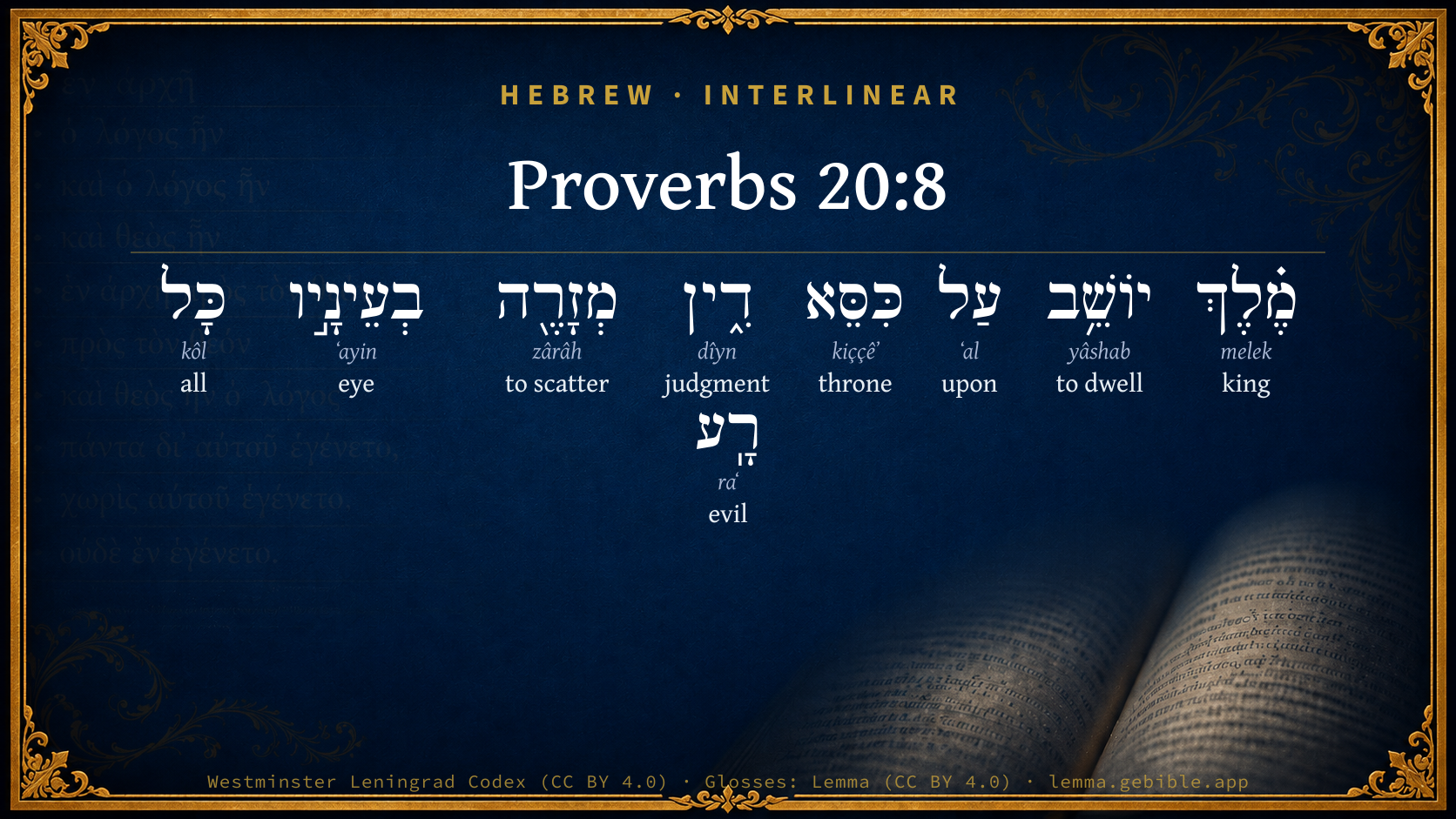
Hebrew (Westminster Leningrad Codex) Proverbs 20:8 appears in the Hebrew Old Testament. The text above is from the Westminster Leningrad Codex. Each word links to its Strong’s number, a concise gloss, and parsing drawn from the Open Scriptures Hebrew Bible morphology. Click any word for its full Brown-Driver-Briggs (BDB) entry.
Download image
Cite this verse

Proverbs 20:8 (World English Bible). Public Domain. Lemma interlinear Bible study tool, https://lemma.gebible.app/v/proverbs/20/8.

Show BibTeX & RIS
BibTeX
RIS
English Translation
A king who sits on the throne of judgment Scatters away all evil with his eyes.
World English Bible · Public Domain
Download a study sheet

One document with this verse’s original text, its word-by-word gloss line, the meaning frame, cross-references with their text, attributed commentary, and full source and license credits — printable, and it pastes into notes with its structure intact.

This verse Autodidact and up

Study sheet (.html) Plain text (.txt)

A passage Seminary Student

Up to 50 verses in one chapter. A passage sheet keeps up to 6 commentary sources and 12 cross-references per verse, in the order this page ranks them, and says so on the sheet whenever that leaves anything out. Ask for a single verse and you get the Autodidact verse sheet above.

Everything on this page stays free to read, with no account — the sheet is a download of what is already on screen, not access to it.

Want to remove ads? Support Godless Engineer
Compare translations 3

The same verse in 3 English versions, stacked beneath the original-language interlinear above. Click any original word for its lexicon entry.

Each is an independent rendering of the whole verse — the interlinear is not word-aligned to these translations.

Highlighted words mark where these versions differ — a whole-verse word diff, not a word-by-word alignment.

  • World English Bible Public Domain
    A king who sits on the throne of judgment Scatters away all evil with his eyes.
  • King James Version Public Domain
    A king that sitteth in the throne of judgment scattereth away all evil with his eyes.
  • unfoldingWord Literal Text CC BY-SA 4.0
    A king who sits on the throne of judgment one who winnows all evil with his eyes.

unfoldingWord Literal Text — © unfoldingWord, licensed CC BY-SA 4.0. Word-aligned USFM3 via Door43 (git.door43.org/unfoldingWord/en_ult).

Versions to compare (up to 4)

3 of 4 selected

Show all 18 translations

Every available English version of this verse, each an independent rendering of the whole verse.

  • World English Bible Public Domain
    A king who sits on the throne of judgment Scatters away all evil with his eyes.
  • Berean Standard Bible Public Domain
    A king who sits on a throne to judge sifts out all evil with his eyes.
  • Majority Standard Bible Public Domain
    A king who sits on a throne to judge sifts out all evil with his eyes.
  • King James Version Public Domain
    A king that sitteth in the throne of judgment scattereth away all evil with his eyes.
  • American Standard Version (1901) Public Domain
    A king that sitteth on the throne of judgment Scattereth away all evil with his eyes.
  • Revised Version (1885) Public Domain
    A king that sitteth on the throne of judgment scattereth away all evil with his eyes.
  • Geneva Bible (1599) Public Domain
    A King that sitteth in the throne of iudgement, chaseth away all euill with his eyes.
  • Douay-Rheims (1899) Public Domain
    The king, that sitteth on the throne of judgment, scattereth away all evil with his look.
  • Young's Literal Translation Public Domain
    A king sitting on a throne of judgment, Is scattering with his eyes all evil,
  • Literal Standard Version CC BY-SA 4.0
    A king sitting on a throne of judgment, || Is scattering all evil with his eyes,
  • Unlocked Literal Bible CC BY-SA 4.0
    A king who sits on the throne performing the duties of a judge is winnowing with his eyes all the evil that is before him.
  • unfoldingWord Literal Text CC BY-SA 4.0
    A king who sits on the throne of judgment one who winnows all evil with his eyes.
  • Darby Bible Public Domain
    A king sitting on the throne of judgment scattereth away all evil with his eyes.
  • World Messianic Bible Public Domain
    A king who sits on the throne of judgment scatters away all evil with his eyes.
  • Webster's Bible Public Domain
    A king that sitteth on the throne of judgment scattereth away all evil with his eyes.
  • Free Bible Version CC BY-SA 4.0
    When a king sits in judgment he recognizes all that isn't right.
  • Bible in Basic English Public Domain
    A king on the seat of judging puts to flight all evil with his eyes.
  • JPS Tanakh (1917) Public Domain
    A king that sitteth on the throne of judgment scattereth away all evil with his eyes.

Literal Standard Version (2020), Covenant Press — licensed CC BY-SA 4.0. Text via the HelloAO Bible API (eBible.org). Unlocked Literal Bible (unfoldingWord) — licensed CC BY-SA 4.0. Text via the HelloAO Bible API (eBible.org). unfoldingWord Literal Text — © unfoldingWord, licensed CC BY-SA 4.0. Word-aligned USFM3 via Door43 (git.door43.org/unfoldingWord/en_ult). Free Bible Version, Dr. Jonathan Gallagher — licensed CC BY-SA 4.0. Text via the HelloAO Bible API (eBible.org).

Word by word

More ways to search: Search by grammar → Find every occurrence → Compare this word →

Practice this passage: Drill this verse → Learn its vocabulary →

About this verse

These counts appear in no published source. They are computed here, from the morphology-tagged text and Lemma’s own curated glosses. What Lemma adds →

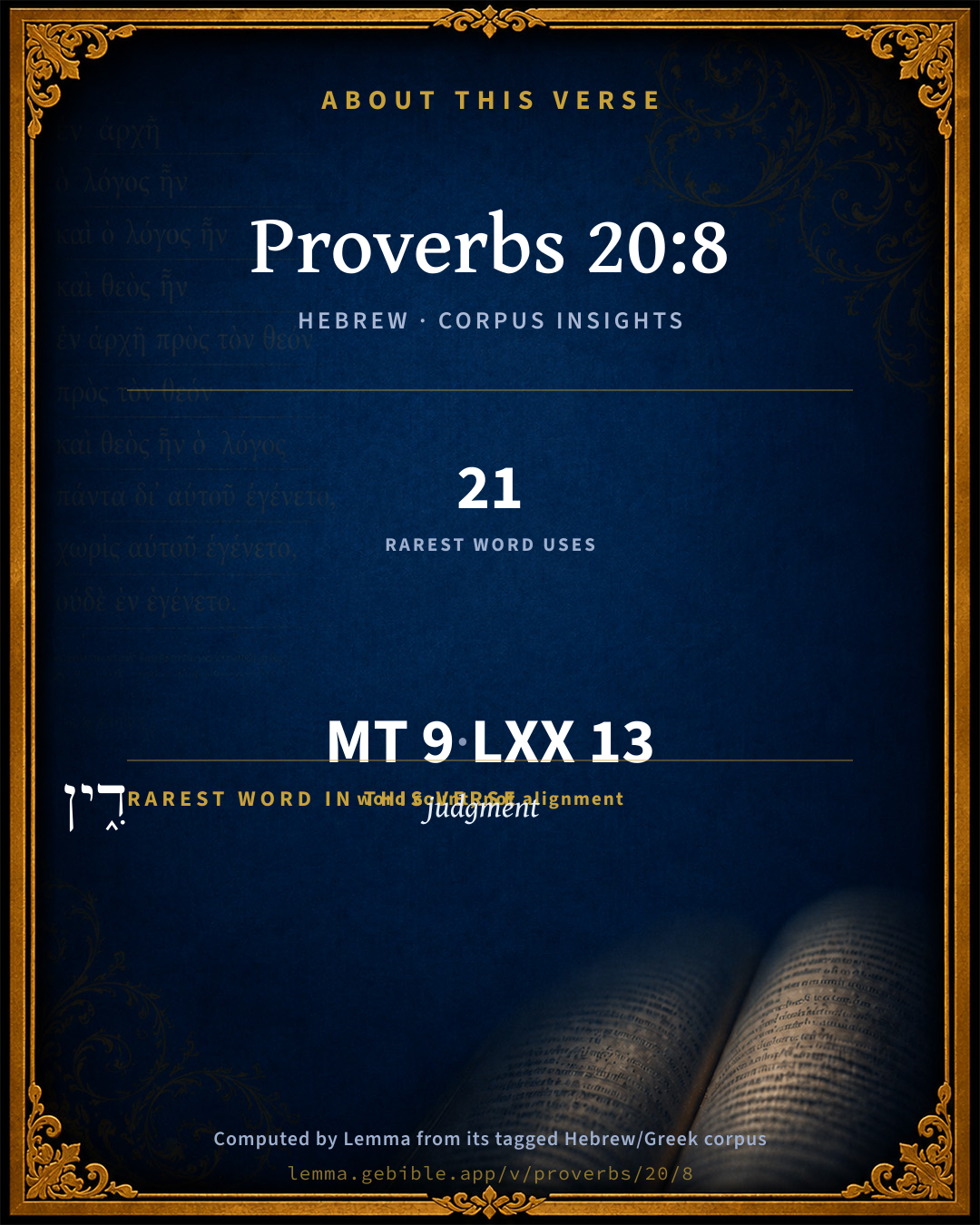
9
words
9
distinct lemmas
Wisdom
section

Notable vocabulary

The rarest word here is דִ֑ין judgment H1779 — appearing just 21 times in the whole Hebrew Bible.

Shared distinctive vocabulary

דִ֑ין judgment H1779 occurs in 17 verses of the Hebrew Bible. Also found in:

Grammatical profile

  • 2 verbs
  • 5 nouns
  • 1 adjective
  • 1 preposition

Verb forms

  • יוֹשֵׁ֥ב Qal · Participle Active
  • מְזָרֶ֖ה Piel · Participle Active

Hebrew & Septuagint length

In English translation the verse runs 16 words from the Hebrew and 16 from the Septuagint (LXX English) — the same length.

A rough comparison of the two English renderings, which tokenize alike — not a word-level alignment.

Word counts can differ between the Hebrew and the Greek without any difference in meaning — e.g. the Hebrew direct-object marker אֵת has no separate Greek word, and Greek often adds the article ὁ.

In the original languages it is 9 Hebrew tokens and 13 Greek tokens — but the two are counted differently (Hebrew bundles its prefixes and suffixes into one token; the Greek is in lemma form), so that isn’t a like-for-like length.

Cross-references

11

Topical passages linked to Proverbs 20:8 in the Treasury of Scripture Knowledge — connected by theme and wording, ordered by reader-vote popularity; previews shown in the World English Bible.

  • Proverbs 25:5 Take away the wicked from the king's presence, And his throne will be established in righteousness.
  • Proverbs 20:26 A wise king winnows out the wicked, And drives the threshing wheel over them.
  • Psalms 99:4 The King's strength also loves justice. You do establish equity. You execute justice and righteousness in Jacob.
  • Proverbs 29:14 The king who fairly judges the poor, His throne shall be established forever.
  • Psalms 92:9 For, behold, your enemies, Yahweh, For, behold, your enemies shall perish. All the evil-doers will be scattered.
  • 1 Samuel 23:3–4 David's men said to him, Behold, we are afraid here in Judah: how much more then if we go to Keilah against the armies of the Philistines?
  • 2 Samuel 23:4 [He shall be] as the light of the morning, when the sun rises, A morning without clouds, [When] the tender grass [springs] out of the earth, Through clear shining after rain.
  • Psalms 72:4 He will judge the poor of the people. He will save the children of the needy, And will break the oppressor in pieces.
  • Psalms 101:6–8 My eyes will be on the faithful of the land, That they may dwell with me. He who walks in a perfect way, He will serve me.
  • Proverbs 16:12 It is an abomination for kings to do wrong, For the throne is established by righteousness.
  • Isaiah 32:1 Behold, a king shall reign in righteousness, and princes shall rule in justice.

Cross-references courtesy of OpenBible.info (CC BY 4.0).

Hebrew and Greek witnesses Masoretic Hebrew ↔ Greek Septuagint

The same verse in the two great witnesses to the Old Testament, shown verse-for-verse.

These are two independent witnesses, not word-aligned to each other, and the Septuagint is shown in lemma (dictionary) form.

Hebrew Proverbs 20:8 Masoretic · Westminster Leningrad Codex

מֶ֗לֶךְ יוֹשֵׁ֥ב עַל כִּסֵּא דִ֑ין מְזָרֶ֖ה בְעֵינָ֣יו כָּל רָֽע

A king who sits on the throne of judgment Scatters away all evil with his eyes.

World English Bible · Public Domain

Greek LXX Proverbs 20:8 Septuagint · lemma form

ὅταν βασιλεύς δίκαιος καταἵζω ἐπί θρόνος οὐ ἐνἀντιόομαι ἐν ὀφθαλμός αὐτός πᾶς πονηρός

Whenever a righteous king sits on the throne, no evil thing can stand before his presence.

LXX2012 (modern English Septuagint) · Public Domain

On this verse, The Pulpit Commentary discusses the Septuagint’s reading. Read the note in Commentary ↓

Hebrew: Westminster Leningrad Codex (CC BY 4.0). Greek: Septuagint (public domain); English from LXX2012 (modern English Septuagint) (Public Domain). How the Septuagint differs from the Hebrew →

Commentary

Notes on Proverbs 20:8 from classic Christian and Jewish commentators (each source and its license shown beneath its notes). The classic Christian expositions comment on the surrounding passage and are grouped to its opening verse, so a note may address several verses; the Jewish commentaries on the Tanakh (Rashi and others) are per-verse, so they appear only where the commentator wrote on this verse.

Lemma curates 59 commentaries, every one of them public domain or Creative Commons licensed, each selected and text-cleaned for this edition rather than reprinted as found. About our sources →

Trapp's Complete Commentary

John Trapp

Pro 20:8 A king that sitteth in the throne of judgment scattereth away all evil with his eyes.

Ver. 8. A king that sitteth in the throne of judgment, &c.] Kings in their own persons should sit and judge causes sometimes, to take knowledge, at least, what is done by their officers of justice: I have seen the king of Persia many times to alight from his horse, saith a late traveller, {a} only to do justice to a poor body. He punisheth theft and manslaughter so severely, that in an age a man shall hardly hear either of the one or of the other.

{a} The Preacher’s Travels, by John Cartwright.

John Trapp, A Commentary or Exposition upon All the Books of the Old and New Testament (1647–1656) — public domain. Text from a community e-Sword module.

Joseph Benson's Commentary

Pro 20:8. A king that sitteth in the throne of judgment — That makes it his great care and business to execute justice and judgment among his people, especially if he do this in his own person, as it was usual for kings to do in ancient times, and see things with his own eyes; scattereth away all evil — Effectually suppresses, or removes, all wickedness; with his eyes — With his very looks, or by his diligent inspection.

Joseph Benson's Commentary on the Old and New Testaments (1811–1818) — public domain. Text from a community e-Sword module.

Tyndale Open Study Notes

Tyndale Open Resources

20:8 The king should be the epitome of wisdom and justice.

Tyndale Open Study Notes — © Tyndale Open Resources, licensed CC BY-SA 4.0. Text via the HelloAO Bible API.

Geneva Bible (1599)

Geneva Bible translators

Where righteous judgment is executed, there sin ceaseth, and vice dare not appear.

Geneva Bible (1599) marginal notes — public domain. Text via Bolls.life.

Matthew Henry's Commentary

Here is, 1. The character of a good governor: He is a king that deserves to be called so who sits in the throne, not as a throne of honour, to take his ease, and take state upon him, and oblige men to keep their distance, but as a throne of judgment, that he may do justice, give redress to the injured and punish the injurious, who makes his business his delight and loves no pleasure comparably to it, who does not devolve the whole care and trouble upon others, but takes cognizance of affairs himself and sees with his own eyes as much as may be, Kg1 10:9. 2. The happy effect of a good government. The presence of the prince goes far towards the putting of wickedness out of countenance; if he inspect his affairs himself, those that are employed under him will be kept in awe and restrained from doing wrong. If great men be good men, and will use their power as they may and ought, what good may they do and what evil may they prevent!

Matthew Henry's Commentary on the Whole Bible (1708–1710) — public domain (CC PDM 1.0). Text via the HelloAO Bible API.

Jamieson, Fausset & Brown

Robert Jamieson, A. R. Fausset & David Brown

As in Pro 14:35; Pro 16:10, Pro 16:15, this is the character of a good king, not of all kings.

Jamieson, Fausset & Brown — Commentary Critical and Explanatory on the Whole Bible (1871) — public domain (CC PDM 1.0). Text via the HelloAO Bible API.

Adam Clarke's Commentary

Verse 8. A king that sitteth in the throne of judgment] Kings should see to the administration of the laws, as well as of the state transactions, of their kingdom. In the British constitution there is a court for the king, called the King's Bench, where he should sit, and where he is always supposed to be sitting. The eyes - the presence, of the monarch in such a place, scatter evil - he sees into the case himself, and gives right judgment, for he can have no self-interest. Corrupt judges, and falsifying counsellors, cannot stand before him; and the villain is too deeply struck with the majesty and state of the monarch, to face out iniquity before him.

Adam Clarke's Commentary on the Bible (1810–1826) — public domain. Text from a community e-Sword/MySword module.

Ellicott's Commentary for English Readers

(8) A king that sitteth in the throne of judgment . . .—See note on Pro_16:12.

A Bible Commentary for English Readers, edited by Charles John Ellicott (1878–1897) — public domain. Text from a community e-Sword module.

The Cambridge Bible for Schools and Colleges

gen. ed. J. J. S. Perowne

8. scattereth] or winnoweth, R.V. marg., as the same Heb. word is rendered (as suggested by the parallelism) in Pro_20:26.

The Cambridge Bible for Schools and Colleges (gen. ed. J. J. S. Perowne; Cambridge University Press, 1878–1918) — public domain. Text from a community e-Sword module.

John Gill's Exposition

A king that sitteth in the throne of judgment,.... That executes judgment himself, as David and Solomon did; who ascends the throne, and sits personally there, and hears and tries causes himself, and not by his servants:

scattereth away all evil with his eyes; all evil men, as the Targum; everyone that is evil, as Aben Ezra: he will easily and quickly discern who is evil, or who is in a bad cause before him, and will pass sentence on him, and drive him away from him with shame and disgrace, and to receive deserved punishment; or he will terrify persons from coming before him with false witness against their neighbour, or with a wrong cause. This may be applied to Christ, the King of kings, and Judge of all; whose eyes are as a flame of fire; who will clearly see into all hearts and actions, when he shall sit on his throne of judgment; and shall pass the righteous and definitive sentence, and shall drive the wicked into hell, into everlasting punishment.

John Gill's Exposition of the Whole Bible (1746–1763) — public domain (CC PDM 1.0). Text via the HelloAO Bible API.

Haydock's Catholic Bible Commentary

Look. It is the duty of kings to administer justice.

George Leo Haydock (1774–1849), Haydock's Catholic Family Bible and Commentary, 1859 edition — public domain. Excludes Psalms (Douay-Rheims chapter numbering differs from Protestant) and Deuterocanonical books (Catholic canon only).

Matthew Poole's English Annotations

A king that sitteth in the throne of judgment; that makes it his great care and business to execute judgment and justice among his people, especially if he do this in his own person, as was usual in ancient times, and sees things with his own eyes. As for the phrase, the sign or gesture is here put for the thing signified by it.

Scattereth away all evil, effectually punisheth and suppresseth all wickedness, with his eyes; with his very looks, or by his diligent inspection into affairs.

Matthew Poole's English Annotations on the Holy Bible (1683–1685) — public domain. Text from a community e-Sword/MySword module.

Whedon's Commentary on the Bible

Daniel D. Whedon

8. A king… scattereth — Searches, or winnows out. Meaning, probably, that the ruler who does his duty in his office; who acts justly, impartially, faithfully and energetically, not trusting too much to others, but as far as possible looking to the careful administration of the laws by his subordinates — will scatter iniquity as with the flash of his eye. Compare Pro_16:10; Isa_11:4 — where the same thing is predicated of a wise king.

Daniel D. Whedon (gen. ed.), Commentary on the Old and New Testaments (1874–1909) — public domain. Text from a community e-Sword module.

The Pulpit Commentary

A royal and right noble maxim. A king that sitteth in the throne of judgment scattereth away all evil with his eyes. The king, sitting on the tribunal and executing his judiciary office, sees through all devices and pretences which cloak evil, and scatters them to the winds, as the chaff flies before the winnowing fan. Nothing unrighteous can abide in his presence. (comp. ver. 26; Pro_16:10, etc.) See here an adumbration of the characteristic of the Messiah, the great King whose "eyes behold, whose eyelids try, the children of men": (Psa_11:4) who is "of purer eyes than to behold evil"; (Hab_1:13) who "with righteousness shall judge the poor and reprove with equity for the meek of the earth: and shall smite the earth with the rod of his mouth; and with the breath of his lips shall slay the wicked". (Isa_11:4; comp. Mat_3:12) Septuagint, "When the righteous king shall sit upon his throne, nothing that is evil shall offer itself before his eyes."

The Pulpit Commentary (1880–1919), ed. H.D.M. Spence-Jones & Joseph S. Exell — public domain. Text from a community e-Sword module.

John Wesley's Explanatory Notes

His eyes - With his very looks, or by his diligent inspection into affairs.

John Wesley, Explanatory Notes Upon the Whole Bible (1754–1765) — public domain. Text via the GEBible commentary corpus.

Keil & Delitzsch

C. F. Keil & F. Delitzsch

The following group begins with a royal proverb, which expresses what a king does with his eyes. Two proverbs, of the seeing eye and the necessary opening of the eyes, close it.

8 A king sitting on the seat of justice,

Scattereth asunder all evil with his eyes.

Excellently the Venet. ἐπὶ θρόνου δίκης, for כּסּא־דין is the name of the seat of rectitude (the tribunal), as the "throne of grace," Heb. 4:17, is the name of the capporeth as the seat of mercy; the seat of the judge is merely called כסא; on the other hand, כסא־דין is the contrast of כּסּא הוּות fo, Psa 94:20 : the seat from which the decision that is in conformity with what is right (cf. e.g., Jer 5:28) goes forth, and where it is sought. As little here as at Pro 20:26 is there need for a characterizing adj. to melek; but the lxx hits the meaning for it, understands such to דין: ὅταν βασιλεὺς δίκαιος καθίσῃ ἐπὶ θρόνου. By the "eyes" are we then to understand those of the mind: he sifts, dignoscit, with the eyes of the mind all that is evil, i.e., distinguishes it subjectively from that which is not evil? Thus Hitzig by a comparison of Psa 11:4; Psa 139:3 (where Jerome has eventilasti, the Vulg. investigasti). Scarcely correctly, for it lies nearer to think on the eyes in the king's head (vid., Pro 16:15); in that case: to winnow (to sift) means to separate the good and the bad, but first mediately: to exclude the bad; finally, Pro 20:26 leads to the conclusion that מזרה is to be understood, not of a subjective, but of an actual scattering, or separating, or driving away. Thus the penetrating, fear-inspiring eyes of the king are meant, as Immanuel explains: בראיית עיניו מבריחם מפניו ומפזר אותם בכל פיאה. But in this explanation the personal rendering of כּל־רע is incorrect; for mezareh, meant of the driving asunder of persons, requires as its object a plur. (cf. 26a). Col-ra is understood as neut. like Pro 5:14. Before the look of a king to whom it belongs to execute righteousness and justice (Isa 16:5), nothing evil stands; criminal acts and devices seen through, and so also judged by these eyes, are broken up and scattered to all the winds, along with the danger that thereby threatened the community. It is the command: "put away the evil" (Deu 13:6 [5]), which the king carries into effect by the powerful influence of his look. With col-ra there is connected the thought that in the presence of the heavenly King no one is wholly free from sin.

Keil & Delitzsch — Biblical Commentary on the Old Testament (1861–1891) — public domain (CC PDM 1.0). Text via the HelloAO Bible API. (Old Testament only.)

Bridges on Proverbs

Charles Bridges

This is the picture of a godly king, such as the wise man’s father described and exemplified; "just, ruling in the fear of God;"†1 making it his great care and business to execute judgment. In those days he sat himself on the throne of judgment, and decided the law.†2 And such might be conceived to be his influence, that the wicked dared not come and sin in his presence. "Will he force the queen also before me? " (Est 7:8 ) — was the indignant exclamation of a sovereign, on feeling not only his own rights, but the reverence for royalty, grossly outraged. David, as a man of God, and a sovereign of his people, could not endure the wicked in his presence. (Psa 101:3-8 .)

At present, "God standeth in the congregation of princes" (Psa 82:1 ), observing the manner, in which they execute the power delegated to them; but hereafter he shall sit as "a judge" even of them, who, by reason of that delegated power, are styled "gods." The care then of the Magistrate, when he goeth up to the judgment-seat, will be to put on righteousness as a glorious and beautiful robe, and to render his tribunal a fit emblem of that eternal "throne," of which "justice and judgment are the habitation."†3 And always in proportion as the ruler realizes his solemn responsibility, evil will be made to flee, and scattered away from him.†4

But what is to be ever standing before the Great King, who scattereth away all evil with his eyes? "Thou art of purer eyes than to behold evil, and cannot look on iniquity. The foolish shall not stand in thy sight. All things are naked and opened unto the eyes of him with whom we have to do." (Heb 1:13 . Psa 5:5 . Heb 4:13 .) May the High Priest ever stand between the sinner and the Holy God, that, while we walk in reverence, we "may not be afraid with any amazement!"

Footnotes:

†1 2Sa 23:3, with 2Sa 8:15 . 1Ki 15:5 .

†2 1Ki 3:16-28, with 1Ki 10:9 . A Roman commentator (Corn. à Lapide) mentions the custom of St. Louis of France to sit twice a-week in the throne of judgment, and his dying charge to his successor, not only to appoint the most upright judges, but to overlook them in the discharge of their office. Does not the Court of the Queen’s Bench suppose the Sovereign to be sitting there in determination of judgment?

†3 Psa 89:14. Bishop Horne’s Sermon on the Great Assize.

†4 Pro 20:26; Pro 25:4-5 . Compare 2Ch 15:16 . Plutarch relates of Cato, that such was the reverence of his character, that the bad women of Rome could not bear his look.

Charles Bridges, An Exposition of the Book of Proverbs (1846) — public domain. Text from a community e-Sword module.

Kretzmann's Popular Commentary

Paul E. Kretzmann

v. 8. A king that sitteth in the throne of judgment, dispensing justice in his capacity of sovereign, scattereth away all evil with his eyes, he searches out, he sifts by winnowing, and so separates the evil from the good, the right from the wrong.

Paul E. Kretzmann, Popular Commentary of the Bible (1921–1924) — public domain. Text from a community e-Sword module.

Rashi

Rabbi Shlomo Yitzchaki (Rashi)

A king sits upon a throne of judgment This may be explained as referring to the Holy One, blessed be He, or it may be explained as referring to the true judges.

Rashi on the Tanakh — English translations: “The Judaica Press complete Tanach with Rashi, translated by A. J. Rosenberg” (CC BY 4.0); “Pentateuch with Rashi's commentary by M. Rosenbaum and A.M. Silbermann, 1929-1934” (public domain); “The Metsudah Tanach series, Lakewood, N.J” (CC BY 4.0); and “The Book of Joshua, Metsudah Publications, 1997” (CC BY 4.0). Text via Sefaria.

Lesson kit

Teaching starters — assembled from the data on this page, not authored interpretation. Every prompt links to the verse data it draws on. Edit before teaching.

Proverbs, in the Wisdom, opens this verse with 9 words (9 distinct Hebrew lemmas). Its most distinctive word is dîyn (“judgment”). A historical commentator’s framing appears above. Read the whole chapter for the surrounding context.

Discussion questions

  1. The word dîyn carries the sense “judgment.” How does it shape the verse?
  2. How does Deuteronomy 17:8, which shares the word «judgment», read alongside this verse?
  3. The translations on this page render this verse differently — a whole-verse word diff, not a word-by-word alignment. What might account for the different wordings?
  4. «יוֹשֵׁ֥ב» is a Qal Participle Active verb. How does that grammatical form shape the action described?
  5. Compare how Trapp's Complete Commentary and Joseph Benson's Commentary read this verse. Where do they agree or differ?

Things to notice

Reading settings

Reading text

Shown beneath each verse's original-language words.

Old Testament
Old Testament edition

Read the OT as the Masoretic Hebrew (MT) or the Greek Septuagint (LXX).

English shown for the Greek Septuagint (in the Hebrew ↔ Greek comparison).

Comparing translations? Open the Compare panel on any verse page to stack up to four side by side.