
Proverbs 21:19

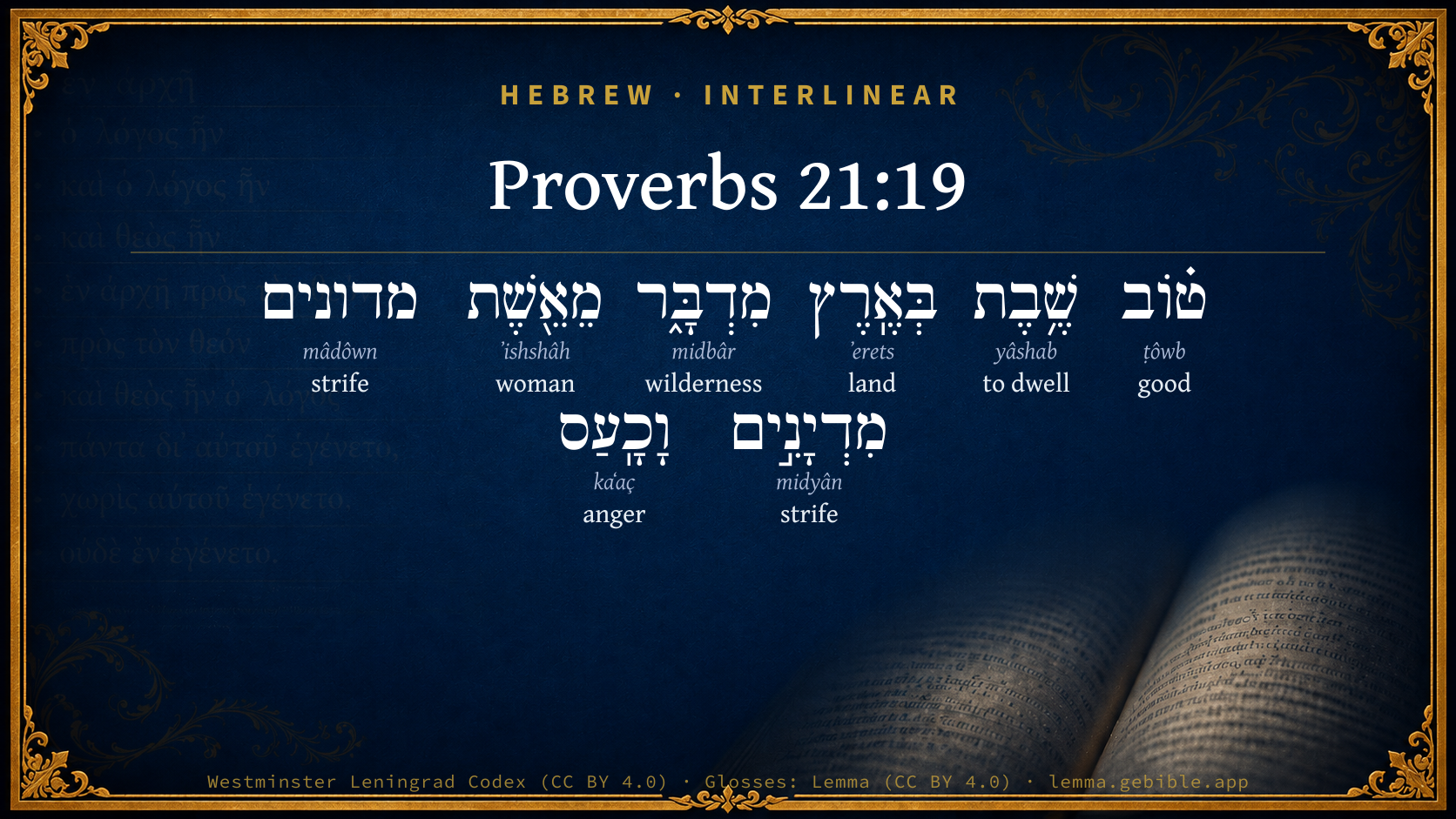
Hebrew (Westminster Leningrad Codex) Proverbs 21:19 appears in the Hebrew Old Testament. The text above is from the Westminster Leningrad Codex. Each word links to its Strong’s number, a concise gloss, and parsing drawn from the Open Scriptures Hebrew Bible morphology. Click any word for its full Brown-Driver-Briggs (BDB) entry.
Download image
Cite this verse

Proverbs 21:19 (World English Bible). Public Domain. Lemma interlinear Bible study tool, https://lemma.gebible.app/v/proverbs/21/19.

Show BibTeX & RIS
BibTeX
RIS
English Translation
It is better to dwell in a desert land, Than with a contentious and fretful woman.
World English Bible · Public Domain
Download a study sheet

One document with this verse’s original text, its word-by-word gloss line, the meaning frame, cross-references with their text, attributed commentary, and full source and license credits — printable, and it pastes into notes with its structure intact.

This verse Autodidact and up

Study sheet (.html) Plain text (.txt)

A passage Seminary Student

Up to 50 verses in one chapter. A passage sheet keeps up to 6 commentary sources and 12 cross-references per verse, in the order this page ranks them, and says so on the sheet whenever that leaves anything out. Ask for a single verse and you get the Autodidact verse sheet above.

Everything on this page stays free to read, with no account — the sheet is a download of what is already on screen, not access to it.

Want to remove ads? Support Godless Engineer
Compare translations 3

The same verse in 3 English versions, stacked beneath the original-language interlinear above. Click any original word for its lexicon entry.

Each is an independent rendering of the whole verse — the interlinear is not word-aligned to these translations.

Highlighted words mark where these versions differ — a whole-verse word diff, not a word-by-word alignment.

  • World English Bible Public Domain
    It is better to dwell in a desert land, Than with a contentious and fretful woman.
  • King James Version Public Domain
    It is better to dwell in the wilderness, than with a contentious and an angry woman.
  • unfoldingWord Literal Text CC BY-SA 4.0
    Better to dwell in a land of wilderness than a woman of quarrels and vexation.

unfoldingWord Literal Text — © unfoldingWord, licensed CC BY-SA 4.0. Word-aligned USFM3 via Door43 (git.door43.org/unfoldingWord/en_ult).

Versions to compare (up to 4)

3 of 4 selected

Show all 18 translations

Every available English version of this verse, each an independent rendering of the whole verse.

  • World English Bible Public Domain
    It is better to dwell in a desert land, Than with a contentious and fretful woman.
  • Berean Standard Bible Public Domain
    Better to live in the desert than with a contentious and ill-tempered wife.
  • Majority Standard Bible Public Domain
    Better to live in the desert than with a contentious and ill-tempered wife.
  • King James Version Public Domain
    It is better to dwell in the wilderness, than with a contentious and an angry woman.
  • American Standard Version (1901) Public Domain
    It is better to dwell in a desert land, Than with a contentious and fretful woman.
  • Revised Version (1885) Public Domain
    It is better to dwell in a desert land, than with a contentious and fretful woman.
  • Geneva Bible (1599) Public Domain
    It is better to dwell in the wildernesse, then with a contentious and angry woman.
  • Douay-Rheims (1899) Public Domain
    It is better to dwell in a wilderness, than with a quarrelsome and passionate woman.
  • Young's Literal Translation Public Domain
    Better to dwell in a wilderness land, Than `with' a woman of contentions and anger.
  • Literal Standard Version CC BY-SA 4.0
    Better to dwell in a wilderness land, || Than [with] a woman of contentions and anger.
  • Unlocked Literal Bible CC BY-SA 4.0
    It is better to live in the desert than with a quarreling and angry wife.
  • unfoldingWord Literal Text CC BY-SA 4.0
    Better to dwell in a land of wilderness than a woman of quarrels and vexation.
  • Darby Bible Public Domain
    It is better to dwell in a desert land. than with a contentious and irritable woman.
  • World Messianic Bible Public Domain
    It is better to dwell in a desert land, than with a contentious and fretful woman.
  • Webster's Bible Public Domain
    It is better to dwell in the wilderness, than with a contentious and an angry woman.
  • Free Bible Version CC BY-SA 4.0
    It's better to live in a desert than with an argumentative and bad-tempered wife.
  • Bible in Basic English Public Domain
    It is better to be living in a waste land, than with a bitter-tongued and angry woman.
  • JPS Tanakh (1917) Public Domain
    It is better to dwell in a desert land, than with a contentious and fretful woman.

Literal Standard Version (2020), Covenant Press — licensed CC BY-SA 4.0. Text via the HelloAO Bible API (eBible.org). Unlocked Literal Bible (unfoldingWord) — licensed CC BY-SA 4.0. Text via the HelloAO Bible API (eBible.org). unfoldingWord Literal Text — © unfoldingWord, licensed CC BY-SA 4.0. Word-aligned USFM3 via Door43 (git.door43.org/unfoldingWord/en_ult). Free Bible Version, Dr. Jonathan Gallagher — licensed CC BY-SA 4.0. Text via the HelloAO Bible API (eBible.org).

Word by word

More ways to search: Search by grammar → Find every occurrence → Compare this word →

Practice this passage: Drill this verse → Learn its vocabulary →

About this verse

These counts appear in no published source. They are computed here, from the morphology-tagged text and Lemma’s own curated glosses. What Lemma adds →

8
words
8
distinct lemmas
Wisdom
section

Notable vocabulary

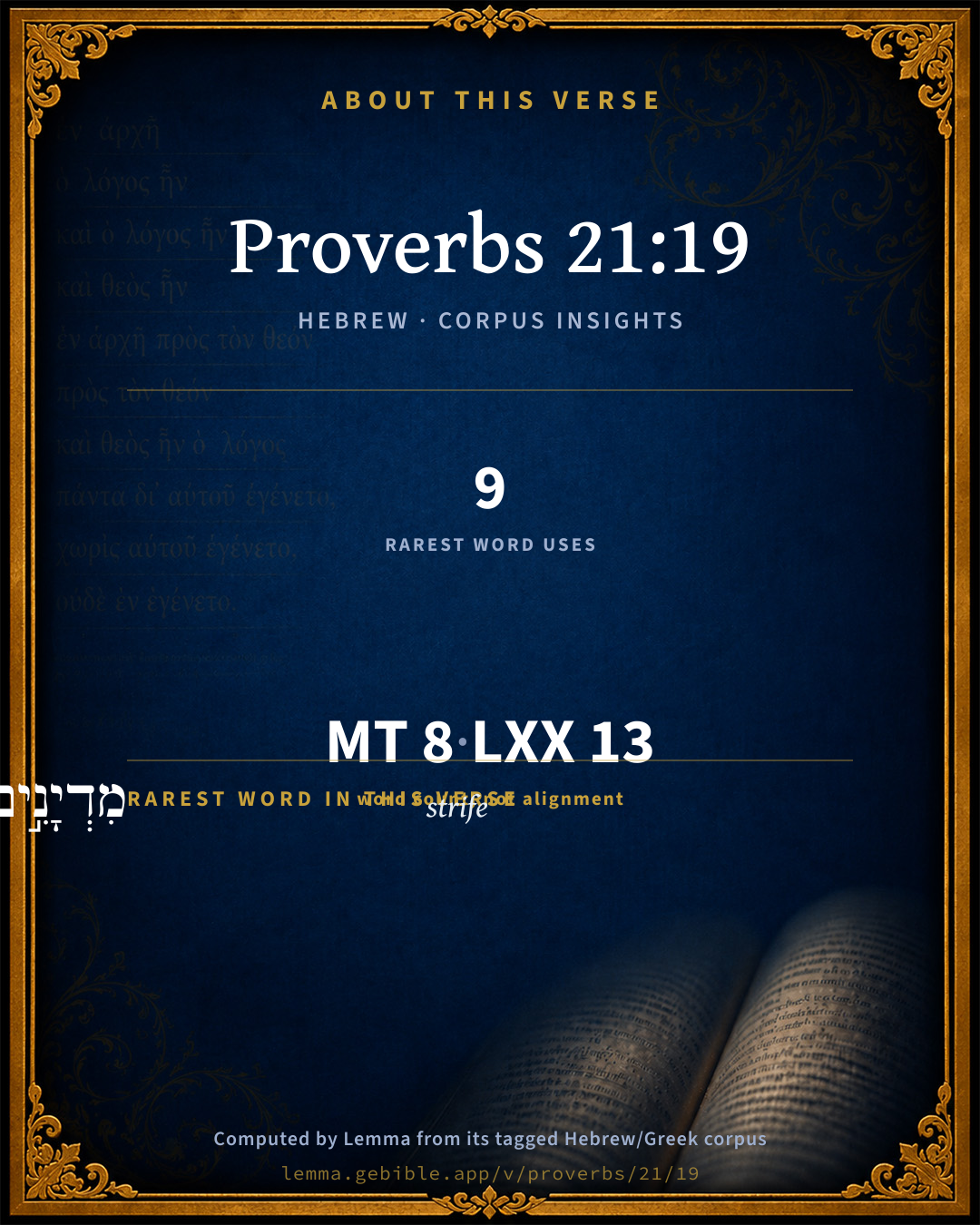
The rarest word here is מִדְיָנִ֣ים strife H4079 — appearing just 9 times in the whole Hebrew Bible.

Shared distinctive vocabulary

מִדְיָנִ֣ים strife H4079 occurs in 9 verses of the Hebrew Bible. Also found in:

Grammatical profile

  • 1 verb
  • 6 nouns
  • 1 adjective

Verb forms

  • שֶׁ֥בֶת Qal · Infinitive Construct

Hebrew & Septuagint length

In English translation the verse runs 16 words from the Hebrew and 17 from the Septuagint (LXX English) — closely comparable.

A rough comparison of the two English renderings, which tokenize alike — not a word-level alignment.

Word counts can differ between the Hebrew and the Greek without any difference in meaning — e.g. the Hebrew direct-object marker אֵת has no separate Greek word, and Greek often adds the article ὁ.

In the original languages it is 8 Hebrew tokens and 13 Greek tokens — but the two are counted differently (Hebrew bundles its prefixes and suffixes into one token; the Greek is in lemma form), so that isn’t a like-for-like length.

Cross-references

4

Topical passages linked to Proverbs 21:19 in the Treasury of Scripture Knowledge — connected by theme and wording, ordered by reader-vote popularity; previews shown in the World English Bible.

  • Proverbs 21:9 It is better to dwell in the corner of the housetop, Than to share a house with a contentious woman.
  • Psalms 55:6–7 I said, "Oh that I had wings like a dove! Then I would fly away, and be at rest.
  • Psalms 120:5–6 Woe is me, that I live in Meshech, That I dwell among the tents of Kedar!
  • Jeremiah 9:2 Oh that I had in the wilderness a lodging-place of wayfaring men; that I might leave my people, and go from them! for they are all adulterers, an assembly of treacherous men.

Cross-references courtesy of OpenBible.info (CC BY 4.0).

Hebrew and Greek witnesses Masoretic Hebrew ↔ Greek Septuagint

The same verse in the two great witnesses to the Old Testament, shown verse-for-verse.

These are two independent witnesses, not word-aligned to each other, and the Septuagint is shown in lemma (dictionary) form.

Hebrew Proverbs 21:19 Masoretic · Westminster Leningrad Codex

ט֗וֹב שֶׁ֥בֶת בְּאֶֽרֶץ מִדְבָּ֑ר מֵאֵ֖שֶׁת מדונים מִדְיָנִ֣ים וָכָֽעַס

It is better to dwell in a desert land, Than with a contentious and fretful woman.

World English Bible · Public Domain

Greek LXX Proverbs 21:19 Septuagint · lemma form

κρείσσων οἰκέω ἐν γῆ ἔρημος ἤ μετά γυνή μάχιμος καί γλωσσώδης καί ὀργίλος

It is better to dwell in a wilderness than with a quarrelsome and talkative and passionate woman.

LXX2012 (modern English Septuagint) · Public Domain

On this verse, The Cambridge Bible for Schools and Colleges discusses the Septuagint’s reading. Read the note in Commentary ↓

Hebrew: Westminster Leningrad Codex (CC BY 4.0). Greek: Septuagint (public domain); English from LXX2012 (modern English Septuagint) (Public Domain). How the Septuagint differs from the Hebrew →

Commentary

Notes on Proverbs 21:19 from classic Christian and Jewish commentators (each source and its license shown beneath its notes). The classic Christian expositions comment on the surrounding passage and are grouped to its opening verse, so a note may address several verses; the Jewish commentaries on the Tanakh (Rashi and others) are per-verse, so they appear only where the commentator wrote on this verse.

Lemma curates 59 commentaries, every one of them public domain or Creative Commons licensed, each selected and text-cleaned for this edition rather than reprinted as found. About our sources →

Trapp's Complete Commentary

John Trapp

Pro 21:19 [It is] better to dwell in the wilderness, than with a contentious and an angry woman.

Ver. 19. It is better to dwell in the wilderness.] Among ravenous beasts and venomous serpents, in greatest danger, and want of all necessary accommodation. This is so much worse than the housetop, as an angry and vexatious woman - which, like a mad dog, bites all about her, and makes them as mad as herself - is worse than her that is not so much angry as unquiet, brawling (as dogs bark sometimes in the night) of custom or fancy, and not provoked by any. {See Trapp on "Pro 21:9"}

John Trapp, A Commentary or Exposition upon All the Books of the Old and New Testament (1647–1656) — public domain. Text from a community e-Sword module.

The Biblical Illustrator

Joseph S. Exell

Pro_21:19

It is better to dwell in the wilderness than with a contentious and an angry woman.

An angry woman

I. No social discomfort is to be compared to that of an ill-tempered wife. A corner of the housetop would be exposed to the rain and to the storm, both of which, in Eastern countries, are generally of a violent character. Neither is the wilderness a pleasant place of abode. But it is better to dwell in either of these places than with a brawling or even with an angry woman.

1. Because one might enjoy intervals of repose.

2. Because, whatever may be the discomforts of a housetop or wilderness dwelling, they may leave the soul at rest. They can but reach the body, and the mind may be so absolutely calm or absorbed in thought as to be almost unconscious of what is passing without.

II. External good-fortune is no proof against this domestic curse. The wide house or the house of companionship suggests a goodly mansion. (W. Harris.)

The Biblical Illustrator, edited by Joseph S. Exell (c. 1880s–1900s) — public domain. Text from a community e-Sword module.

The Preacher's Complete Homiletical Commentary

Joseph S. Exell (gen. ed.)

CRITICAL NOTES.—

Pro_21:9. Wide house. Literally a house of companionship, i.e., to share the house with her.

MAIN HOMILETICS OF Pro_21:9; Pro_21:19

AN ANGRY WOMAN

I. No social discomfort is to be compared to that of an ill-tempered wife. A corner of the housetop would be exposed to the rain and to the storm, both of which, in eastern countries, are generally of a violent character; and although it is not uncommon for orientals sometimes to pass the night there, it would be most undesirable to be obliged at all seasons, and under all circumstances, to have no other place of refuge. He who had to dwell there would at one time be subjected to the intense heat of the mid-day sun, and at another would be chilled by the midnight air. Neither is the wilderness a pleasant place of abode. In addition to all the drawbacks of the housetop arising from exposure to the weather, a wilderness is a place of dreary solitude, and often of danger from wild beasts and lawless men. But it is better to dwell in either of these places than with a brawling or even with an angry woman.

1. Because one might enjoy intervals of repose. The rain would not always descend, neither would the storm-wind be always blowing; the sun would sometimes give forth only an agreeable warmth, and the night-wind bring only a refreshing coolness. Even in the wilderness the solitude would sometimes be enjoyable, and life there would not always be in peril. But the woman pictured here is one whose ill-temper is always ruling her and casting gloom over the home, and when there is no storm of passion actually raging there is one brewing and ready to burst forth. The unhappy partner of her life can never look forward to an hour of ease, for the lulls in the storm are but momentary, and the rifts in the clouds obscured again immediately.

2. Because, whatever may be the discomforts of a housetop or wilderness dwelling, they may leave the soul at rest. They can but reach the body, and the mind may be so absolutely calm or absorbed in thought as to be almost unconscious of what is passing without. To some men solitude has such charms that they are willing to forego many bodily comforts in order to obtain it. There have been and are those whose own thoughts are the only company they desire, and who would gladly brave the drawbacks of the housetop or the wilderness, if by so doing they could be left undisturbed to indulge their own speculations, or pursue their meditations. But the sharp tongue of a contentious woman leaves no corner of the soul undisturbed. It is vain for the subject of it to seek refuge in reflection upon more agreeable topics, to endeavour to banish the actual present by calling up images of the future, or of unseen though distant realities. All the powers of the mind are paralyzed by such an incubus, and the soul cannot wing its flight into pleasanter regions, as it can do sometimes when the suffering only touches the outer man.

II. External good fortune is no proof against this domestic curse. The “wide house” or the “house of companionship,” suggests a goodly mansion—a dwelling which might be the centre of social gatherings, and whose owner is able to indulge in hospitality on a large scale. It calls up before us not the top-story garret of the very poor, or even the narrow dwelling of a struggling man, where the fight for bread, and the effort to make both ends meet, may have something to do with spoiling the temper of the housewife. But the angry and contentious woman is not confined to these abodes—Solomon almost seems to speak here from experience, but even if he did not, we know that even palace walls cannot keep out the curse, and that there is often such a skeleton at the most sumptuous feast.

OUTLINES AND SUGGESTIVE COMMENTS

The family is sometimes a fierce fire. It comprehends the greatest portion of our world. It is to us the most interesting, and therefore is capable of becoming the most trying portion.—Cecil.

Everyone has known some pair chained together by human laws where the heart’s union has either never existed or been rent asunder. Two ships at sea are bound together by strong, short chains. As long as the sea remains perfectly calm all may be well with both; though they do each other no good, they may not inflict much evil. But the sea never rests long, and seldom rests at all. Woe to these two ships when the waves begin to roll. There are two conditions in which they might be safe. If they were either brought more closely together, or more widely separated, it might yet be well with them. If they were from stern to stern riveted into one, or if the chain were broken and the two left to follow independently their several courses, there would be no further cause of anxiety on their account. If they are so united that they shall move as one body, they are safe; if they move far apart, they are safe. The worst possible position is to be chained together, and yet have separate and independent motion in the waves. They will rasp each other’s sides off, and tear open each other’s heart, and go down together.—Arnot.

Better to retire into a corner of the housetop than to quit the house and go into bad company for diversion, as many who, like Adam, make their wife’s sin the excuse of their own.—Henry.

The Preacher's Complete Homiletical Commentary (gen. ed. Joseph S. Exell; Funk & Wagnalls, c. 1892) — public domain (pre-1929). A full-Bible homiletical/sermon-outline anthology covering 65 of 66 books (2 John is absent from the source module). Text from a community e-Sword module.

Tyndale Open Study Notes

Tyndale Open Resources

21:19 It’s better to live alone: Cp. 21:9; 25:24.

Tyndale Open Study Notes — © Tyndale Open Resources, licensed CC BY-SA 4.0. Text via the HelloAO Bible API.

Matthew Henry's Commentary

Note, 1. Unbridled passions embitter and spoil the comfort of all relations. A peevish angry wife makes her husband's life uneasy, to whom she should be a comfort and a meet help. Those cannot dwell in peace and happiness that cannot dwell in peace and love. Even those that are one flesh, if they be not withal one spirit, have no joy of their union. 2. It is better to have no company than bad company. The wife of thy covenant is thy companion, and yet, if she be peevish and provoking, it is better to dwell in a solitary wilderness, exposed to wind and weather, than in company with her. A man may better enjoy God and himself in a wilderness than among quarrelsome relations and neighbours. See Pro 21:9.

Matthew Henry's Commentary on the Whole Bible (1708–1710) — public domain (CC PDM 1.0). Text via the HelloAO Bible API.

Jamieson, Fausset & Brown

Robert Jamieson, A. R. Fausset & David Brown

(Compare Pro 21:9).

wilderness--pasture, though uninhabitable ground (Psa 65:12).

Jamieson, Fausset & Brown — Commentary Critical and Explanatory on the Whole Bible (1871) — public domain (CC PDM 1.0). Text via the HelloAO Bible API.

The Cambridge Bible for Schools and Colleges

gen. ed. J. J. S. Perowne

19. wilderness] regarded, as the parallel requires, not as a barren, but as a solitary place.

angry] Or, fretful, R.V. text; or, a contentious woman and vexation, R.V. marg. The LXX. introduce a third characteristic, chattering, γλωσσώδης.

The Cambridge Bible for Schools and Colleges (gen. ed. J. J. S. Perowne; Cambridge University Press, 1878–1918) — public domain. Text from a community e-Sword module.

John Gill's Exposition

It is better to dwell in the wilderness,.... Where persons live without shelter, and are not only exposed to storms and tempests, but to beasts of prey; where is want of the necessaries of life, and no society; where no "speech" is, as the word (e) for wilderness may signify; yet it is better to dwell in such a place, where no human voice is heard,

than with a contentious and an angry woman; that is always brawling and scolding, ever in a quarrelsome and angry disposition, and provoking to anger all about her; See Gill on Pro 21:9. In a mystical sense, it is better to be with the church in the wilderness, Rev 12:14; than with the furious, bloodthirsty, and persecuting church of Rome, in all its worldly glory and splendour.

(e) "a" "loqui".

John Gill's Exposition of the Whole Bible (1746–1763) — public domain (CC PDM 1.0). Text via the HelloAO Bible API.

Matthew Poole's English Annotations

Than, understand, in a wide house, as it is expressed above, Pro 21:9, and as the opposition here requires.

Matthew Poole's English Annotations on the Holy Bible (1683–1685) — public domain. Text from a community e-Sword/MySword module.

Whedon's Commentary on the Bible

Daniel D. Whedon

19. In… wilderness — בארצ מדבר, (beerets midhbar,) in the pasture lands, the uncultivated regions, those not occupied by the dwellings of man.

Angry woman — A fretful, morose, or contentious woman. Compare Pro_21:9; Pro_19:13; Pro_27:15; Pro_25:26.

Daniel D. Whedon (gen. ed.), Commentary on the Old and New Testaments (1874–1909) — public domain. Text from a community e-Sword module.

The Pulpit Commentary

A variant of ver. 9. Here, instead of the "corner of the roof," we have a wilderness, a desert land, as the refuge to which the persecuted man must flee. Than with a contentious and an angry (fretful) woman . So the Vulgate. But it seems better, with many modern commentators, to take not as another epithet, but as equivalent to "and vexation," i.e. a quarrelsome wife, and the vexation that accompanies such an infliction.

The LXX adds a word to the text, as being at the root of the matter, "Than with a quarrelsome, talkative, and passionate woman."

The Pulpit Commentary (1880–1919), ed. H.D.M. Spence-Jones & Joseph S. Exell — public domain. Text from a community e-Sword module.

Keil & Delitzsch

C. F. Keil & F. Delitzsch

With this verse, a doublet to Pro 21:9 (Pro 25:24), the collector makes a new addition; in Pro 21:29 he reaches a proverb which resembles the closing proverb of the preceding group, in its placing in contrast the רשׁע and ישׁר; -

It is better to dwell in a waste land,

Than a contentious wife and vexation.

The corner of the roof, Hitzig remarks, has been made use of, and the author must look further out for a lonely seat. But this is as piquant as it is devoid of thought; for have both proverbs the same author, and if so, were they coined at the same time? Here also it is unnecessary to regard מאשׁת as an abbreviation for משּׁבת עם אשׁת. Hitzig supplies שׁכן, by which אשׁת, as the accus.-obj., is governed; but it is not to be supplied, for the proverb places as opposite to one another dwelling in a waste land (read שׁבת בּארץ־מדבּר, with Codd. and correct Ed.) and a contentious wife (Chethı̂b, מדונים, Kerı̂, מדינים) and vexation, and says the former is better than the latter. For וכעס [and vexation] is not, as translated by the ancients, and generally received, a second governed genitive to אשׁת, but dependent on מן, follows "contentious woman" (cf. 9b): better that than a quarrelsome wife, and at the same time vexation.

Keil & Delitzsch — Biblical Commentary on the Old Testament (1861–1891) — public domain (CC PDM 1.0). Text via the HelloAO Bible API. (Old Testament only.)

Bridges on Proverbs

Charles Bridges

Another (Pro 21:9 ), perhaps even a stronger, picture of the misery of domestic dissension! It is better to be destitute altogether of the communion of social life, if it must be purchased at so dear a rate as the companionship of one, whose contentions will turn every comfort into bitterness. It is better to dwell, not only "upon the house-top," where there might be alleviation, but even in the wilderness; giving up all social indulgences for desolation, solitude, and even dangers.†1 Oh! it is the poison in ’the sweetest cup of earth’s best joy,’ where "two are joined to each other, and made one flesh" (Mat 19:5 ); yet not "joined to the Lord," and so "made one spirit." (1Co 6:17 .) The woman only is mentioned. Yet the disruption is as frequent, and at least as guilty, from an imperious husband, as from a scolding wife.†2 Surely our gracious God here teaches his children a lesson too often neglected to their cost — put their necks into this sacred yoke, ’reverently, discreetly, advisedly, solemnly, and in the fear of God.’†3 Let them carefully ponder the fact, that a choice influenced by the fascination of beauty, manners, or disposition, by intellect or accomplishments, if made without reference to godliness, can give no promise of the divine blessing, or of individual happiness. Often indeed it issues in a state of degradation, too painful to dwell upon, into which one or both parties are content to plunge, making themselves odious for the sake of indulging their angry passions. Nor does this apply only to the matrimonial yoke. All members of the family circle, bound together by natural ties, and living together by providential arrangements, may do not a little towards embittering each other’s happiness. The subjects of these uncontrolled tempers must, however, reap the natural harvest of their seed sown, and suffer under the mortifying consciousness, that others recoil from their society, and would readily embrace, if need be, the alternative of the wilderness, as a welcome change from perpetual irritation.

’The family,’ as Mr. Cecil justly observes, ’is sometimes a fierce fire. Our family comprehends the greatest portion of our world. It is to us the most interesting, and therefore is capable of becoming the most trying portion.’†4 The child of God is bound indeed to recognize effectual and fatherly discipline in his trials from the tempers of those around him. Yet not less strange the fact, that even among Canaan’s pilgrims, words are often uttered, that must produce pain; and thus thorns, which our heavenly Father hath not planted, are strewn in our brother’s or sister’s path. Effects still more lamentable are to be traced in impressions made upon the young, or on others watching the exhibition of such inconsistencies, where better things might have been expected.

The matrimonial "thorn in the flesh" may be a needful chastening, overruled as a preventive against self-confidence (2Co 12:7 ), and for the exercise of adorning Christian graces.†5 Yet much prayer and forbearance are required, to avoid being put out of frame with every trifle; to refrain from needless occasion and subjects of irritation; to keep aloof from the immediate bursting of ungoverned passion; and to realize present support under this heavy cross, in the assured prospect and intense longing for the home of everlasting peace.†6

Footnotes:

†1 See Mar 1:13 . "I had rather" — said the wise son of Sirach — "dwell with a lion and a dragon, than keep house with a wicked woman." — Sir 25:16 . Sir 26:7, Sir 26:27 .

†2 ’There is somewhat (as I may say) of a particular cut or fashion of the garment of wives towards their husbands. But men ought to wear of the same stuff; yea, so if I may speak, of the same peace, for it is in all one and the same spirit.’ — Leighton on 1Pe 3:3-4 .

†3 Marriage Service.

†4 See his Sermon on Hannah.

†5 Hooker’s meek endurance of the continual dropping (Pro 19:13 ) must have read to George Cranmer and others who witnessed it, a striking lesson on the influence of practical religion. Buxtorf quoted a Jewish saying — ’How will a man prove his spirit? By enduring a bad wife.’ When Socrates was asked — ’Why he endured his wife? By this means’ — he replied — ’I have a schoolmaster at home, and an example how I should behave myself abroad. For I shall’ — said he — ’be the more quiet with others, being thus daily exercised and taught in the forbearing of her.’ Homily on Matrimony. Chrysostom gives the story, like the Homilist, with a striking application. Homily on 1Co 11:16 .

†6 It is not a grave question — whether divorces or conventional separations, such as we hear of even in the Church of God, are not rather the flinching from, than the enduring and honoring, the cross? The supposition that it is better to dwell in the wilderness implies, that the worse alternative of the contentious and angry woman may be appointed. This was Job’s lot. ’The devil’ (as M. Henry observed) ’spared his wife to him, not only to be his tempter, but his tormentor.’ Yet did he not put away his matrimonial cross. The endurance of it was doubtless a component part of that patience, which is commended to our imitation, and which was honored with a double increase of family blessing. (Jas 5:11 ; Job 42:12-13 .) Our Lord, in restoring this ordinance to its original sternness of obligation, admits but one exception, thereby excluding every other. (Mat 5:32 ; Mat 19:1-9 .) According to this rule, an unfaithful wife must be put away as a sin; but a contentious wife restrained, and endured as a cross. The Apostle, in discussing the question of casuistry submitted to him (1Co 7:2-5 ), lays down the general law, and admits no revulsion of taste or feeling, much less pretense of religion, to put asunder (save for a time, by mutual consent, and for a spiritual purpose, (1Co 7:5 ) what God hath joined together. If in an extremity the unbeliever was suffered to depart (1Co 7:15 ), no analogy can be applied from an heathen marriage, where the light of Revelation has never shewn the obligation, to that of Christian professors, where its full force was intelligently understood, and voluntarily recognized. Constrained providential separations, where the hearts are in unity, maintain the principle of the bond. But willful settled separation rejects the distinct ground, on which the ordinance stands. The woman (save where the primary law of nature — self-preservation — dictates) is obviously bound by the same indissoluble tie. (1Co 7:10 .) If on the other side it be defended, as avoiding the open scandal of continual contention; let the duty of humiliation and mortification of the sins, which have produced this painful extremity, be first of all instantly and habitually applied. Let the high offense of the direct infraction of God’s ordinance be deeply pondered. And let it be considered, whether such infractions do not shake the foundation of an appointment, expressly framed to "make of twain one flesh," (Gen 2:24 ; Mat 19:5 ); ordained as a type of the unchangeable relation betwixt Christ and his church (Eph 5:32 ); and of which "the LORD, the God of Israel," saith, "that He hateth putting away." (Mal 2:16 .)

Charles Bridges, An Exposition of the Book of Proverbs (1846) — public domain. Text from a community e-Sword module.

Kretzmann's Popular Commentary

Paul E. Kretzmann

v. 19. It is better to dwell in the wilderness, far from the habitations of men, than with a contentious and an angry woman. Cf v. 9.

Paul E. Kretzmann, Popular Commentary of the Bible (1921–1924) — public domain. Text from a community e-Sword module.

unfoldingWord translationNotes

Door43 World Missions Community

wise

This nominal adjective can be translated as a noun phrase. AT: "wise person" (See: Nominal Adjectives)

swallows it all up

"uses it all for no good purpose" or "wastes it"

translationWords

desert

strife

precious

oil

wise

fool

unfoldingWord translationNotes — © Distant Shores Media and the Door43 World Missions Community, licensed CC BY-SA 4.0. Source: git.door43.org/Door43/en_tn.

Rashi

Rabbi Shlomo Yitzchaki (Rashi)

It is better to dwell in a desert land This too was stated regarding the withdrawal of the Shechinah.

Rashi on the Tanakh — English translations: “The Judaica Press complete Tanach with Rashi, translated by A. J. Rosenberg” (CC BY 4.0); “Pentateuch with Rashi's commentary by M. Rosenbaum and A.M. Silbermann, 1929-1934” (public domain); “The Metsudah Tanach series, Lakewood, N.J” (CC BY 4.0); and “The Book of Joshua, Metsudah Publications, 1997” (CC BY 4.0). Text via Sefaria.

Lesson kit

Teaching starters — assembled from the data on this page, not authored interpretation. Every prompt links to the verse data it draws on. Edit before teaching.

Proverbs, in the Wisdom, opens this verse with 8 words (8 distinct Hebrew lemmas). Its most distinctive word is midyân (“strife”). A historical commentator’s framing appears above. Read the whole chapter for the surrounding context.

Discussion questions

  1. How does “strife” (midyân) shape what this verse is saying?
  2. Proverbs 18:18 shares the word «strife» with this verse. How do the two illuminate each other?
  3. The translations on this page render this verse differently — a whole-verse word diff, not a word-by-word alignment. What might account for the different wordings?
  4. The verb «שֶׁ֥בֶת» is Qal Infinitive Construct. How does its form color the action?
  5. Reading how Trapp's Complete Commentary and The Biblical Illustrator read this verse, where do the two commentators agree and where do they part?

Things to notice

Reading settings

Reading text

Shown beneath each verse's original-language words.

Old Testament
Old Testament edition

Read the OT as the Masoretic Hebrew (MT) or the Greek Septuagint (LXX).

English shown for the Greek Septuagint (in the Hebrew ↔ Greek comparison).

Comparing translations? Open the Compare panel on any verse page to stack up to four side by side.