Genesis 13:12

Hebrew (Westminster Leningrad Codex) Genesis 13:12 appears in the Hebrew Old Testament. The text above is from the Westminster Leningrad Codex. Each word links to its Strong’s number, a concise gloss, and parsing drawn from the Open Scriptures Hebrew Bible morphology. Click any word for its full Brown-Driver-Briggs (BDB) entry.
Download image
Cite this verse

Genesis 13:12 (World English Bible). Public Domain. Lemma interlinear Bible study tool, https://lemma.gebible.app/v/genesis/13/12.

Show BibTeX & RIS
BibTeX
RIS
English Translation
Abram lived in the land of Canaan, and Lot lived in the cities of the plain, and moved his tent as far as Sodom.
World English Bible · Public Domain
Highlights Full analysis ↓
Download a study sheet

One document with this verse’s original text, its word-by-word gloss line, the meaning frame, cross-references with their text, attributed commentary, and full source and license credits — printable, and it pastes into notes with its structure intact.

This verse Autodidact and up

Study sheet (.html) Plain text (.txt)

A passage Seminary Student

Up to 50 verses in one chapter. A passage sheet keeps up to 6 commentary sources and 12 cross-references per verse, in the order this page ranks them, and says so on the sheet whenever that leaves anything out. Ask for a single verse and you get the Autodidact verse sheet above.

Everything on this page stays free to read, with no account — the sheet is a download of what is already on screen, not access to it.

Want to remove ads? Support Godless Engineer
Compare translations 3

The same verse in 3 English versions, stacked beneath the original-language interlinear above. Click any original word for its lexicon entry.

Each is an independent rendering of the whole verse — the interlinear is not word-aligned to these translations.

Highlighted words mark where these versions differ — a whole-verse word diff, not a word-by-word alignment.

  • World English Bible Public Domain
    Abram lived in the land of Canaan, and Lot lived in the cities of the plain, and moved his tent as far as Sodom.
  • King James Version Public Domain
    Abram dwelled in the land of Canaan, and Lot dwelled in the cities of the plain, and pitched his tent toward Sodom.
  • unfoldingWord Literal Text CC BY-SA 4.0
    Abram settled in the land of Canaan, and Lot settled in the cities of the plain and moved his tents as far as Sodom.

unfoldingWord Literal Text — © unfoldingWord, licensed CC BY-SA 4.0. Word-aligned USFM3 via Door43 (git.door43.org/unfoldingWord/en_ult).

Versions to compare (up to 4)

3 of 4 selected

Show all 18 translations

Every available English version of this verse, each an independent rendering of the whole verse.

  • World English Bible Public Domain
    Abram lived in the land of Canaan, and Lot lived in the cities of the plain, and moved his tent as far as Sodom.
  • Berean Standard Bible Public Domain
    Abram lived in the land of Canaan, but Lot settled in the cities of the plain and pitched his tent toward Sodom.
  • Majority Standard Bible Public Domain
    Abram lived in the land of Canaan, but Lot settled in the cities of the plain and pitched his tent toward Sodom.
  • King James Version Public Domain
    Abram dwelled in the land of Canaan, and Lot dwelled in the cities of the plain, and pitched his tent toward Sodom.
  • American Standard Version (1901) Public Domain
    Abram dwelt in the land of Canaan, and Lot dwelt in the cities of the Plain, and moved his tent as far as Sodom.
  • Revised Version (1885) Public Domain
    Abram dwelled in the land of Canaan, and Lot dwelled in the cities of the Plain, and moved his tent as far as Sodom.
  • Geneva Bible (1599) Public Domain
    Abram dwelled in the lande of Canaan, and Lot abode in the cities of the plaine, and pitched his tent euen to Sodom.
  • Douay-Rheims (1899) Public Domain
    Abram dwelt in the land of Chanaan; and Lot abode in the towns that were about the Jordan, and dwelt in Sodom.
  • Young's Literal Translation Public Domain
    Abram hath dwelt in the land of Canaan, and Lot hath dwelt in the cities of the circuit, and tenteth unto Sodom;
  • Literal Standard Version CC BY-SA 4.0
    Abram has dwelt in the land of Canaan, and Lot has dwelt in the cities of the circuit, and moves [his] tent to Sodom;
  • Unlocked Literal Bible CC BY-SA 4.0
    Abram lived in the land of Canaan, and Lot lived among the cities of the plain. He set up his tents as far away as Sodom.
  • unfoldingWord Literal Text CC BY-SA 4.0
    Abram settled in the land of Canaan, and Lot settled in the cities of the plain and moved his tents as far as Sodom.
  • Darby Bible Public Domain
    Abram dwelt in the land of Canaan; and Lot dwelt in the cities of the plain, and pitched tents as far as Sodom.
  • World Messianic Bible Public Domain
    Abram lived in the land of Canaan, and Lot lived in the cities of the plain, and moved his tent as far as Sodom.
  • Webster's Bible Public Domain
    Abram dwelt in the land of Canaan, and Lot dwelt in the cities of the plain, and pitched his tent towards Sodom.
  • Free Bible Version CC BY-SA 4.0
    Abram went to live in the land of Canaan, while Lot settled down among the towns in the valley, setting up his tents near Sodom.
  • Bible in Basic English Public Domain
    Abram went on living in the land of Canaan, and Lot went to the lowland towns, moving his tent as far as Sodom.
  • JPS Tanakh (1917) Public Domain
    Abram dwelt in the land of Canaan, and Lot dwelt in the cities of the Plain, and moved his tent as far as Sodom.

Literal Standard Version (2020), Covenant Press — licensed CC BY-SA 4.0. Text via the HelloAO Bible API (eBible.org). Unlocked Literal Bible (unfoldingWord) — licensed CC BY-SA 4.0. Text via the HelloAO Bible API (eBible.org). unfoldingWord Literal Text — © unfoldingWord, licensed CC BY-SA 4.0. Word-aligned USFM3 via Door43 (git.door43.org/unfoldingWord/en_ult). Free Bible Version, Dr. Jonathan Gallagher — licensed CC BY-SA 4.0. Text via the HelloAO Bible API (eBible.org).

Word by word

More ways to search: Search by grammar → Find every occurrence → Compare this word →

Practice this passage: Drill this verse → Learn its vocabulary →

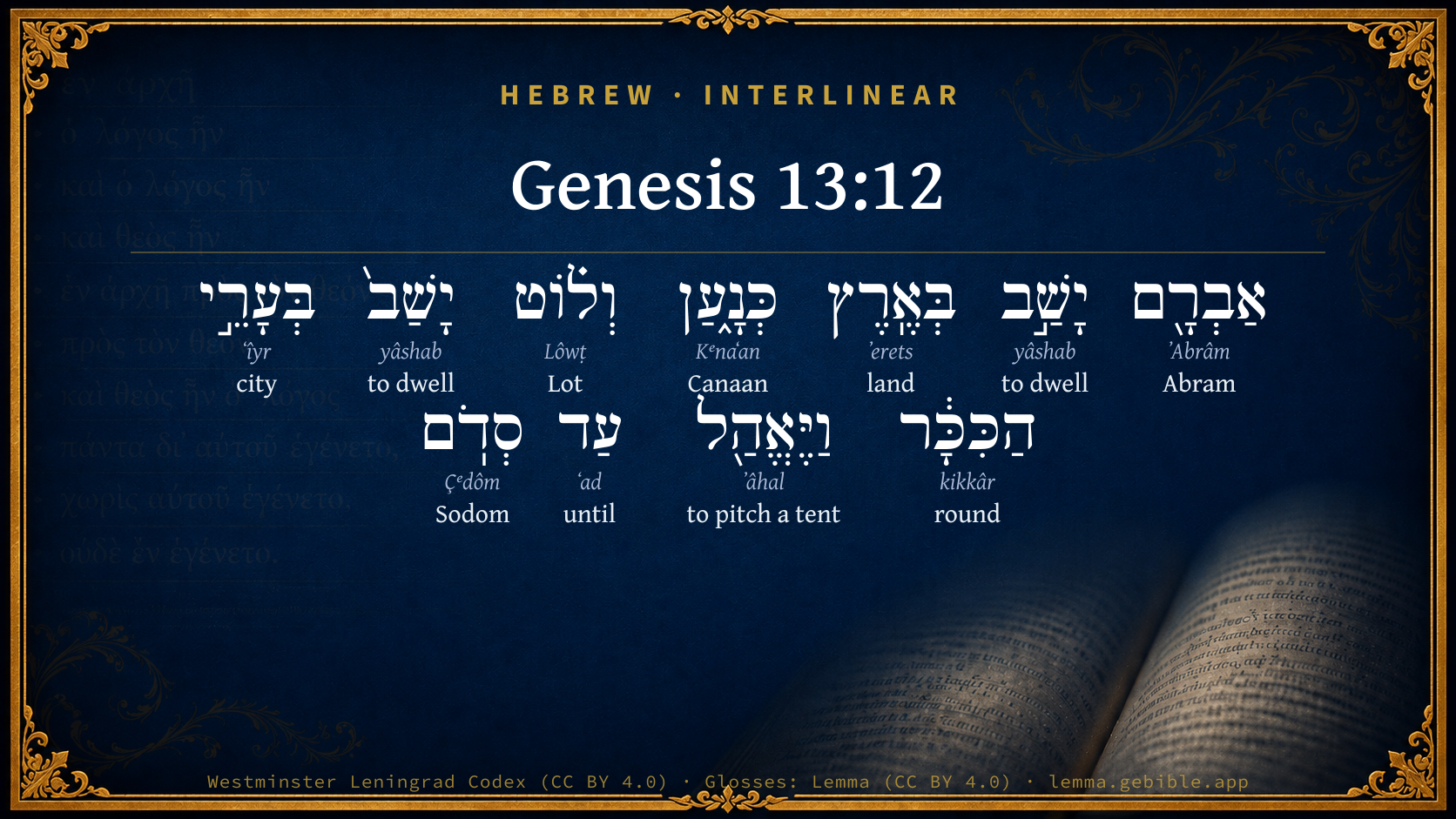
וַיֶּאֱהַ֖ל
ʼâhal
H167
“and · to pitch a tent”
Conjunction + Verb, Qal, Sequential Imperfect, 3rd Person, Masculine, Singular
Part of Speech
Conjunction + Verb
Stem
Qal
Form
Sequential Imperfect
Person
3rd Person
Gender
Masculine
Number
Singular
Full BDB Definition

Origin: a denominative from H168

TWOT: 32

to pitch a tent, to move a tent - (Qal) pitch or remove a tent - (Piel) to pitch one's tent
  1. אַבְרָ֖ם ʼAbrâm H87 “Abram” Noun, Proper
  2. יָשַׁ֣ב yâshab H3427 “to dwell” Verb, Qal, Perfect, 3rd Person, Masculine, Singular
  3. בְּאֶֽרֶץ ʼerets H776 “in/at · land of” Preposition + Noun, Common, Both, Singular, Construct
  4. כְּנָ֑עַן Kᵉnaʻan H3667 “Canaan” Noun, Proper
  5. וְל֗וֹט Lôwṭ H3876 “and · Lot” Conjunction + Noun, Proper
  6. יָשַׁב֙ yâshab H3427 “to dwell” Verb, Qal, Perfect, 3rd Person, Masculine, Singular
  7. בְּעָרֵ֣י ʻîyr H5892 “in/at · cities of” Preposition + Noun, Common, Feminine, Plural, Construct
  8. הַכִּכָּ֔ר kikkâr H3603 “the · round” Particle, Definite Article + Noun, Common, Both, Singular, Absolute
  9. עַד ʻad H5704 “until” Preposition
  10. סְדֹֽם Çᵉdôm H5467 “Sodom” Noun, Proper

About this verse

These counts appear in no published source. They are computed here, from the morphology-tagged text and Lemma’s own curated glosses. What Lemma adds →

11
words
10
distinct lemmas
Pentateuch
section

Notable vocabulary

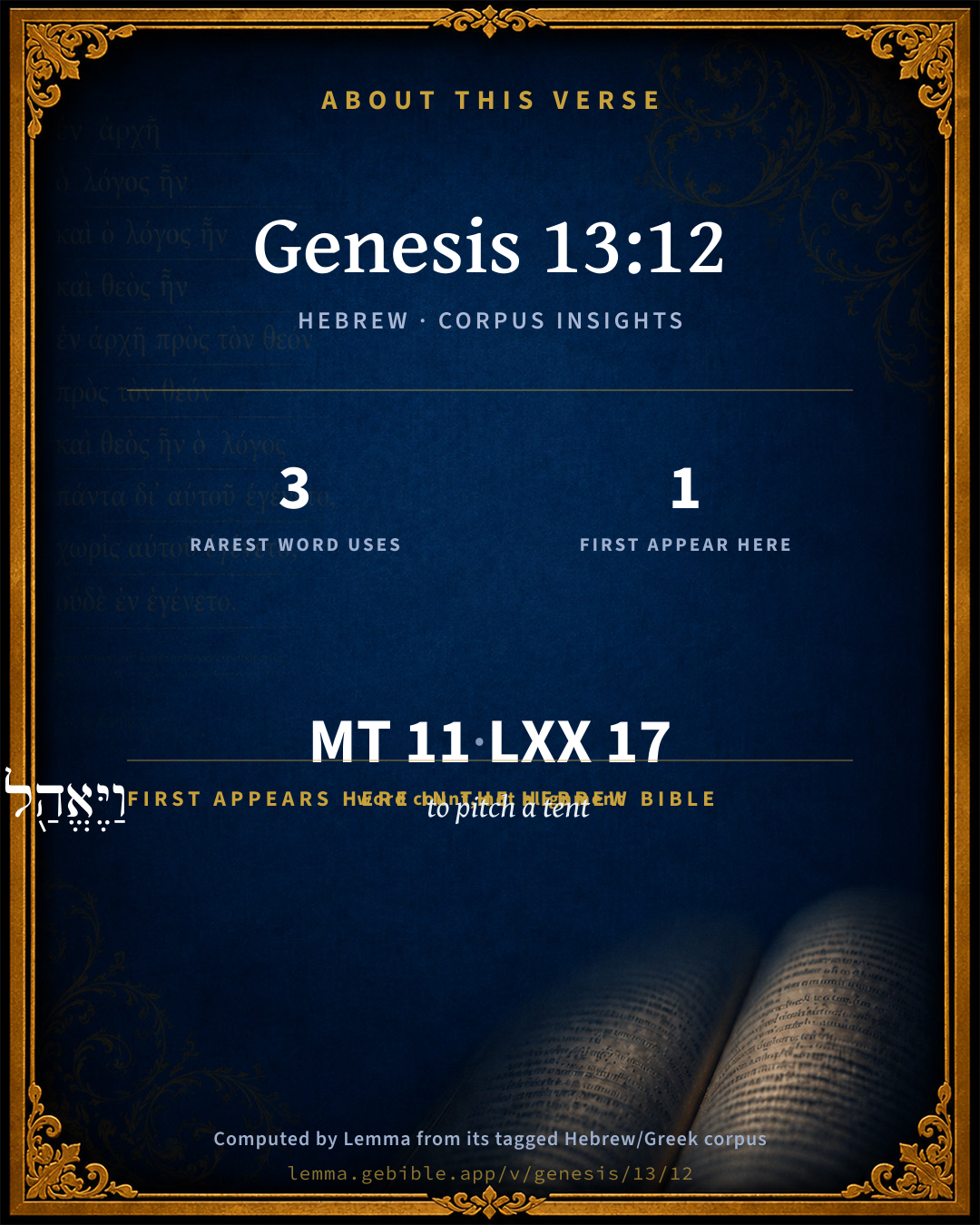
The rarest word here is וַיֶּאֱהַ֖ל to pitch a tent H167 — appearing just 3 times in the whole Hebrew Bible.

First appearance in Scripture

This word makes its first canonical appearance in the Hebrew Bible here:

  • וַיֶּאֱהַ֖ל to pitch a tent H167

Shared distinctive vocabulary

וַיֶּאֱהַ֖ל to pitch a tent H167 occurs in 3 verses of the Hebrew Bible. Also found in:

Grammatical profile

  • 3 verbs
  • 7 nouns
  • 1 preposition

Verb forms

  • יָשַׁ֣ב Qal · Perfect
  • יָשַׁב֙ Qal · Perfect
  • וַיֶּאֱהַ֖ל Qal · Sequential Imperfect

Repetition

A word recurs within this verse — often emphatic in Hebrew:

  • יָשַׁ֣ב to dwell H3427 ×2

Hebrew & Septuagint length

In English translation the verse runs 24 words from the Hebrew and 16 from the Septuagint (LXX English) — the Septuagint runs noticeably shorter here. See the side-by-side →

A rough comparison of the two English renderings, which tokenize alike — not a word-level alignment.

Word counts can differ between the Hebrew and the Greek without any difference in meaning — e.g. the Hebrew direct-object marker אֵת has no separate Greek word, and Greek often adds the article ὁ.

In the original languages it is 11 Hebrew tokens and 17 Greek tokens — but the two are counted differently (Hebrew bundles its prefixes and suffixes into one token; the Greek is in lemma form), so that isn’t a like-for-like length.

Cross-references

7

Topical passages linked to Genesis 13:12 in the Treasury of Scripture Knowledge — connected by theme and wording, ordered by reader-vote popularity; previews shown in the World English Bible.

  • Genesis 19:29 It happened, when God destroyed the cities of the plain, that God remembered Abraham, and sent Lot out of the midst of the overthrow, when he overthrew the cities in which Lot lived.
  • Genesis 14:12 They took Lot, Abram's brother's son, who lived in Sodom, and his goods, and departed.
  • Genesis 19:1 The two angels came to Sodom at evening. Lot sat in the gate of Sodom. Lot saw them, and rose up to meet them. He bowed himself with his face to the earth,
  • Genesis 19:25 He overthrew those cities, all the plain, all the inhabitants of the cities, and that which grew on the ground.
  • Psalms 26:5 I hate the assembly of evil-doers, And will not sit with the wicked.
  • 1 Corinthians 15:33 Don't be deceived! "Evil companionships corrupt good morals."
  • 2 Peter 2:7–8 and delivered righteous Lot, who was very distressed by the lustful life of the wicked

Cross-references courtesy of OpenBible.info (CC BY 4.0).

Hebrew and Greek witnesses Masoretic Hebrew ↔ Greek Septuagint

The same verse in the two great witnesses to the Old Testament, shown verse-for-verse.

Here the Septuagint runs noticeably shorter than the Hebrew — LXX2012 (modern English Septuagint) 16 words vs World English Bible 24. A rough length comparison of the two English translations, not a word-level alignment — read both below.

These are two independent witnesses, not word-aligned to each other, and the Septuagint is shown in lemma (dictionary) form.

Hebrew Genesis 13:12 Masoretic · Westminster Leningrad Codex

אַבְרָ֖ם יָשַׁ֣ב בְּאֶֽרֶץ כְּנָ֑עַן וְל֗וֹט יָשַׁב֙ בְּעָרֵ֣י הַכִּכָּ֔ר וַיֶּאֱהַ֖ל עַד סְדֹֽם

Abram lived in the land of Canaan, and Lot lived in the cities of the plain, and moved his tent as far as Sodom.

World English Bible · Public Domain

Greek LXX Genesis 13:12 Septuagint · lemma form

αβραμ δέ καταοἰκέω ἐν γῆ χανααν λωτ δέ καταοἰκέω ἐν πόλις ὁ περίχωρος καί σκηνόω ἐν σοδομα

And Lot lived in a city of the neighbouring people, and pitched his tent in Sodom.

LXX2012 (modern English Septuagint) · Public Domain

Hebrew: Westminster Leningrad Codex (CC BY 4.0). Greek: Septuagint (public domain); English from LXX2012 (modern English Septuagint) (Public Domain). How the Septuagint differs from the Hebrew →

Targum (Aramaic paraphrase)

2

The Targum is the ancient Jewish Aramaic paraphrase of the Hebrew Scriptures — an interpretive translation, not the Hebrew text itself. Onkelos (literal) and Pseudo-Jonathan (expansive) render the Torah, and Jonathan the Prophets. Coverage is partial: where no permissively-licensed English translation exists for a verse, only the Aramaic is shown. This is verse-level text, not a word-by-word alignment to the Hebrew.

  1. Targum Onkelos Torah (Genesis–Deuteronomy)
    אַבְרָם יָתֵיב בְּאַרְעָא דִכְנָעַן וְלוֹט יָתֵיב בְּקִרְוֵי מֵישְׁרָא וּפְרַס עַד סְדוֹם

    Abram dwelt in the land of Kenaan, and Lot dwelt in the cities of the plain, and extended unto Sedom.

    Targum Onkelos — Aramaic: “Onkelos Genesis” (public domain); “Onkelos Exodus” (public domain); “Onkelos Leviticus” (public domain); “Onkelos Numbers” (public domain); “Onkelos Deuteronomy” (public domain). English: “Sefaria Community Translation” (CC0 1.0 (public-domain dedication)); “J.W. Etheridge. The Targums of Onkelos and Jonathan Ben Uzziel on the Pentateuch. London: Longmans, Green, 1862” (public domain). Text via Sefaria.

  2. Targum Pseudo-Jonathan Torah (Genesis–Deuteronomy)
    אַבְרָם יָתֵיב בְּאַרְעָא דִכְנָעַן וְלוֹט יָתֵיב בְּקִרְוֵוי מֵישְׁרָא וּפְרַס לְמַשְׁכְּנֵיהּ עַד סְדוֹם

    Abram dwelt in the land of Kenaan, and Lot dwelt in the towns of the plain, and spread his tabernacle towards Sedom.

    Targum Pseudo-Jonathan — Aramaic: “Targum Jonathan on Genesis” (public domain); “Targum Jonathan on Exodus” (public domain); “Targum Jonathan on Leviticus” (public domain); “Targum Jonathan on Numbers” (public domain); “Targum Jonathan on Deuteronomy” (public domain). English: “The Targum of Jonathan ben Uzziel, trans. J. W. Etheridge, London, 1862” (public domain). Text via Sefaria.

Commentary

Notes on Genesis 13:12 from classic Christian and Jewish commentators (each source and its license shown beneath its notes). The classic Christian expositions comment on the surrounding passage and are grouped to its opening verse, so a note may address several verses; the Jewish commentaries on the Tanakh (Rashi and others) are per-verse, so they appear only where the commentator wrote on this verse.

Lemma curates 59 commentaries, every one of them public domain or Creative Commons licensed, each selected and text-cleaned for this edition rather than reprinted as found. About our sources →

Trapp's Complete Commentary

John Trapp

Gen 13:12 Abram dwelled in the land of Canaan, and Lot dwelled in the cities of the plain, and pitched [his] tent toward Sodom.

Ver. 12. And Lot dwelled in the cities of the plain.] Not in the land of Canaan with Abram, and his seed: God had a holy hand in that.

Lot pitched his tent towards Sodom.] A good place to pass through, but an ill place to take up in: as one once said of Athens.

John Trapp, A Commentary or Exposition upon All the Books of the Old and New Testament (1647–1656) — public domain. Text from a community e-Sword module.

Ellicott's Commentary for English Readers

(12, 13) Lot dwelled in the cities of the plain.—Heb., of the Ciccar. Not as yet within their walls, but in their neighbourhood, and evidently with a longing “toward Sodom,” where, in Genesis 19, we find him sitting in the gate as a citizen, and with his tent changed to a house. While, then, Abram continued to lead a hardy life as a stranger upon the bracing hills, Lot sighed for the less self-denying habits of the city; and probably, when he had descended into the Ghor, the enervating climate, which so developed the sensual vices of the people as to make them “sinners before Jehovah” (see on Gen_10:9), disposed Lot also to quit his tent, and yield himself to a luxurious and easy manner of living.

A Bible Commentary for English Readers, edited by Charles John Ellicott (1878–1897) — public domain. Text from a community e-Sword module.

John Gill's Exposition

Abram dwelt in the land of Canaan,.... In that part of the land strictly so called, where the family of the Canaanites had their abode; for otherwise taking Canaan in a more general sense, the plain of Jordan, and cities of Sodom and Gomorrah, were in the land of Canaan.

And Lot dwelt in the cities of the plain; in the neighbourhood of them, or near those cities, which were built on the plain of Jordan, for he could not dwell in more than one, if in one; for it looks as if at his first settlement he did not dwell in any, but near them all, especially Sodom: since it follows:

and pitched his tent toward Sodom, or "even unto Sodom" (a); and it may be rendered, as it is by some, "he pitched his tents" (b), for himself, his family, and his servants, his shepherds and his herdsmen, which reached unto Sodom, and where he afterwards dwelt, at least at the gate of it.

(a) "usque Sodom", Pagninus, Montanus, Tigurine version, Junius & Tremellius, Piscator, Schmidt. (b) "movens tentoria", Junius & Tremellius, Piscator & Tigurine version; so Jarchi.

John Gill's Exposition of the Whole Bible (1746–1763) — public domain (CC PDM 1.0). Text via the HelloAO Bible API.

Whedon's Commentary on the Bible

Daniel D. Whedon

12. Lot dwelt in the cities… and pitched his tent — He seems to have divided his interests between city and country. Having pitched his tent toward Sodom, (עד סדם, unto Sodom, or at Sodom,) and leaving his flocks and herds in charge of herd-men, he himself “dwelt in Sodom.”

Gen_14:12. It is thought that he was not married until after his separation from Abram, and that then he took a woman of Sodom for his wife, thus mingling himself with the ungodly.

Daniel D. Whedon (gen. ed.), Commentary on the Old and New Testaments (1874–1909) — public domain. Text from a community e-Sword module.

The Pulpit Commentary

Abram dwelled in the land of Canaan. Strictly so called; in its larger sense Canaan included the circle of the Jordan. And Lot dwelled in the cities of the plain. Being desirous of a permanent settlement within the gates, or at least in the immediate neighborhood, of the wealthy cities of the laud; in contrast to his uncle, who remained a wanderer throughout its borders, sojourning as in a strange country. (Heb_11:9) And (with this purpose in contemplation), he pitched his tent toward (i.e. in the direction of, and as far as to) Sodom.

HOMILIES BY W. ROBERTS Ver. 12.

Going to Sodom.

I How IT MAY HAVE LOOKED TO LOT.

1. As a matter of business it was good.

2. In its moral aspects the step was dangerous. But

3. Doubtless at first Lot did not intend entering the city. And perhaps

4. Lot may have justified his doubtful conduct by hoping that he would have opportunities of doing good to the Sodomites.

II How IT MUST HAVE LOOKED TO THE SODOMITES. It must have

1. Surprised them to see a good man like Lot coming to a neighborhood so bad.

2. Led them to think adversely of a religion that preferred worldly advantage to spiritual interest.

3. Rendered them impervious to any influence for good from Lot"s example.

Lessons:

1. It is perilous to go towards Sodom if one wants to keep out of Sodom.

2. It is useless preaching to Sodomites while gathering wealth in Sodom. W.

Going towards Sodom.

1. An inviting journey.

2. A gradual journey.

3. A sinful journey.

4. A dangerous journey. W.

The Pulpit Commentary (1880–1919), ed. H.D.M. Spence-Jones & Joseph S. Exell — public domain. Text from a community e-Sword module.

unfoldingWord translationNotes

Door43 World Missions Community

Abram lived

"Abram made his home" or "Abram stayed"

the land of Canaan

"the land of the Canaanites"

He set up his tents as far away as Sodom

Possible meanings are 1) "He set up his tents near Sodom" or 2) "He moved his tents around in an area that reached all the way to Sodom."

translationWords

Abraham

Canaan

Lot

Sodom

evil

sin

Yahweh

unfoldingWord translationNotes — © Distant Shores Media and the Door43 World Missions Community, licensed CC BY-SA 4.0. Source: git.door43.org/Door43/en_tn.

Rashi

Rabbi Shlomo Yitzchaki (Rashi)

ויאהל means he pitched tents for his shepherds and cattle עד סדום throughout the whole district extending AS FAR AS SODOM.

Rashi on the Tanakh — English translations: “The Judaica Press complete Tanach with Rashi, translated by A. J. Rosenberg” (CC BY 4.0); “Pentateuch with Rashi's commentary by M. Rosenbaum and A.M. Silbermann, 1929-1934” (public domain); “The Metsudah Tanach series, Lakewood, N.J” (CC BY 4.0); and “The Book of Joshua, Metsudah Publications, 1997” (CC BY 4.0). Text via Sefaria.

Ramban (Nachmanides)

Rabbi Moshe ben Nachman (Ramban / Nachmanides)

ABRAM DWELT IN THE LAND OF CANAAN. The meaning thereof is that he dwelt in the remainder of the entire land of Canaan; he did not stay in one place but abode in the entire land of Canaan while Lot settled in one place thereof, namely, the cities of the Plain, for the cities of the Plain are part of the land of Canaan. The meaning of [the plural “cities” in the expression, and Lot dwelt in] the cities of the Plain, is that he dwelt for a time in this city and a time in the other on account of his many cattle. This is the reason that the verse says, So Lot chose him all the plain of the Jordan; he made a condition with Abram that he [Abram] should not come into the entire Plain.

Ramban (Nachmanides) on the Tanakh — English translation: “Commentary on the Torah by Ramban (Nachmanides). Translated and annotated by Charles B. Chavel. New York, Shilo Pub. House, 1971-1976” (CC BY 4.0). Text via Sefaria.

Radak

Rabbi David Kimhi (Radak)

ויאהל עד סדום, he moved his tent from place to place, almost as far as the city of Sodom.

Radak on the Tanakh — English translations: “Sefaria Community Translation” (CC0 1.0 (public-domain dedication)); “Eliyahu Munk, HaChut Hameshulash” (CC BY 4.0); “Rabbi Mike Feuer, Jerusalem Anthology” (CC BY 4.0); and “R. David Kimhi on the first book of Psalms, Translated by R.G. Finch, London, 1919” (public domain). Text via Sefaria.

Lesson kit

Teaching starters — assembled from the data on this page, not authored interpretation. Every prompt links to the verse data it draws on. Edit before teaching.

Genesis, in the Pentateuch, opens this verse with 11 words (10 distinct Hebrew lemmas). Its most distinctive word is ʼâhal (“to pitch a tent”). The Greek Septuagint runs shorter here. A historical commentator’s framing appears above. Read the whole chapter for the surrounding context.

Discussion questions

  1. What does “to pitch a tent” (ʼâhal) contribute to the verse as a whole?
  2. This is the first place “to pitch a tent” appears in Scripture (first appears here). What does its debut here establish?
  3. How does Genesis 13:18, which shares the word «to pitch a tent», read alongside this verse?
  4. What does the repetition of “to dwell” (2× in this one verse) do in this verse?
  5. The Septuagint runs shorter here than the Hebrew. What might account for the difference?
  6. These translations render this verse differently. What is at stake in choosing one wording over another?
  7. «יָשַׁ֣ב» is a Qal Perfect verb. How does that grammatical form shape the action described?
  8. Compare how Trapp's Complete Commentary and Ellicott's Commentary for English Readers read this verse. Where do they agree or differ?

Things to notice

Reading settings

Reading text

Shown beneath each verse's original-language words.

Old Testament
Old Testament edition

Read the OT as the Masoretic Hebrew (MT) or the Greek Septuagint (LXX).

English shown for the Greek Septuagint (in the Hebrew ↔ Greek comparison).

Comparing translations? Open the Compare panel on any verse page to stack up to four side by side.