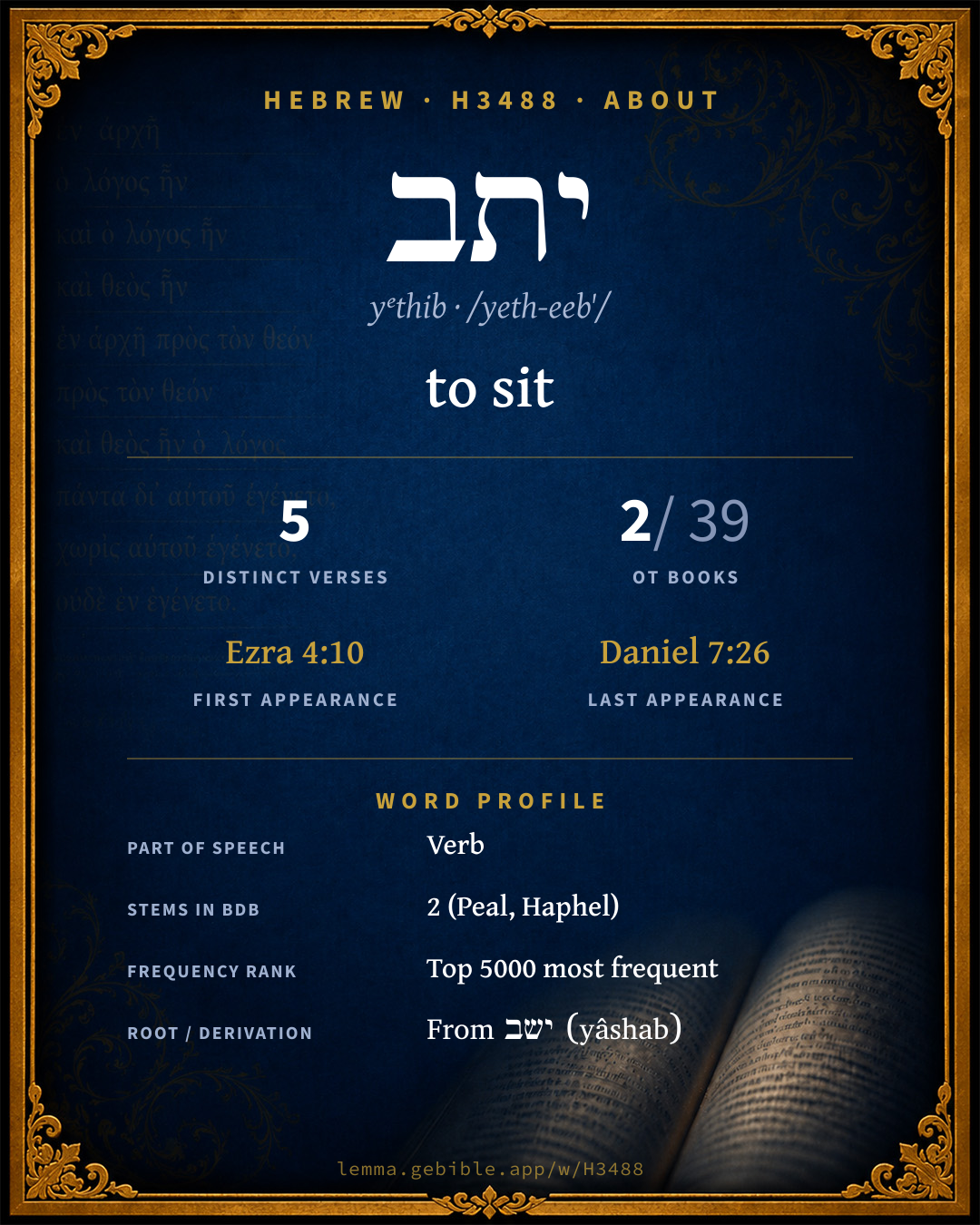
יְתִב
to sit
‘to sit’ is one of 3 main senses fuller range ↓
Full lexicon entry — Brown-Driver-Briggs (BDB)
From Brown-Driver-Briggs (BDB)
Where this word appears
See every Qal verb in the Hebrew Bible →
Grammar key — what these labels mean
Part of speech
- Verb
- An action or state-of-being word.
Stem
- Qal
- The basic, simple active stem — the plain form of the verb (“he wrote”).
- Hiphil
- The causative active stem (“he caused / brought about”).
Form
- Perfect
- A completed action or state — Hebrew marks aspect (completeness) more than strict tense (“he wrote”).
- Imperfect
- An incomplete, ongoing, or future action (“he will / would write”).
- Participle Active
- A verbal adjective expressing ongoing or characteristic action (“writing / one who writes”).
State
- Absolute
- The independent form of a noun, not bound to a following word.
Person
- 3rd Person
- The one spoken about (“he / she / it / they”).
Gender
- Masculine
- Grammatically masculine.
Number
- Singular
- One.
- Plural
- More than one (in Hebrew, generally three or more).
Grammatical forms
- Verb, Qal, Perfect, 3rd Person, Masculine, Singular 2 times (40%)
- Verb, Hiphil, Perfect, 3rd Person, Masculine, Singular 1 time (20%)
- Verb, Qal, Imperfect, 3rd Person, Masculine, Singular 1 time (20%)
- Verb, Qal, Participle Active, Masculine, Plural, Absolute 1 time (20%)
Parsed forms decoded from the imported morphology (morphhb / Westminster Leningrad Codex — WLC text public domain, morphhb tagging CC BY 4.0), counted across 5 parsed occurrences — not distinct verses.
Every verse where H3488 appears — 5 distinct verses across 2 books. Click any verse to open its interlinear word-by-word view. Verse text shown in the World English Bible for context — . Each verse’s Hebrew form is shown with its reference; the English is not keyword-highlighted, since the data carries no word-level English alignment. Use “Compare translations” on any verse to read it across multiple English versions. This concordance covers the Hebrew Bible; Septuagint (Greek Old Testament) occurrences are not indexed here.
Ezra 2 verses
- Ezra 4:10 וְ/הוֹתֵ֣ב conj + Hiphil pf 3ms and the rest of the nations whom the great and noble Osnappar brought over, and set in the city of Samaria, and in the rest [of the country] beyond the River, and so forth.
- Ezra 4:17 יָתְבִ֖ין Qal ptcp.act mp [Then] sent the king an answer to Rehum the chancellor, and to Shimshai the scribe, and to the rest of their companions who dwell in Samaria, and in the rest [of the country] beyond the River: Peace, and so forth.
Daniel 3 verses
- Daniel 7:9 יְתִ֑ב Qal pf 3ms I saw until thrones were placed, and one who was ancient of days sat: his clothing was white as snow, and the hair of his head like pure wool; his throne was fiery flames, [and] the wheels of it burning fire.
- Daniel 7:10 יְתִ֖ב Qal pf 3ms A fiery stream issued and came forth from before him: thousands of thousands ministered to him, and ten thousand times ten thousand stood before him: the judgment was set, and the books were opened.
- Daniel 7:26 יִתִּ֑ב Qal impf 3ms But the judgment shall be set, and they shall take away his dominion, to consume and to destroy it to the end.
About this entry
At a glance — auto-summarized from this page’s data, not written by a person. Every figure links to its source below. This summary describes the numbers; it doesn’t interpret them.
יתב — transliterated yᵉthib — is a Hebrew verb carrying the sense “to sit.” With only 5 verses it sits in the long tail of Hebrew Bible vocabulary. Its uses cluster heavily in Daniel (60% of all occurrences). Debuting at Ezra 4:10, it then recurs through the corpus. Different stems carry different senses — BDB groups them under 2 stems, among them Peal and Haphel. Each statement above links to its evidence; the full detail follows below.
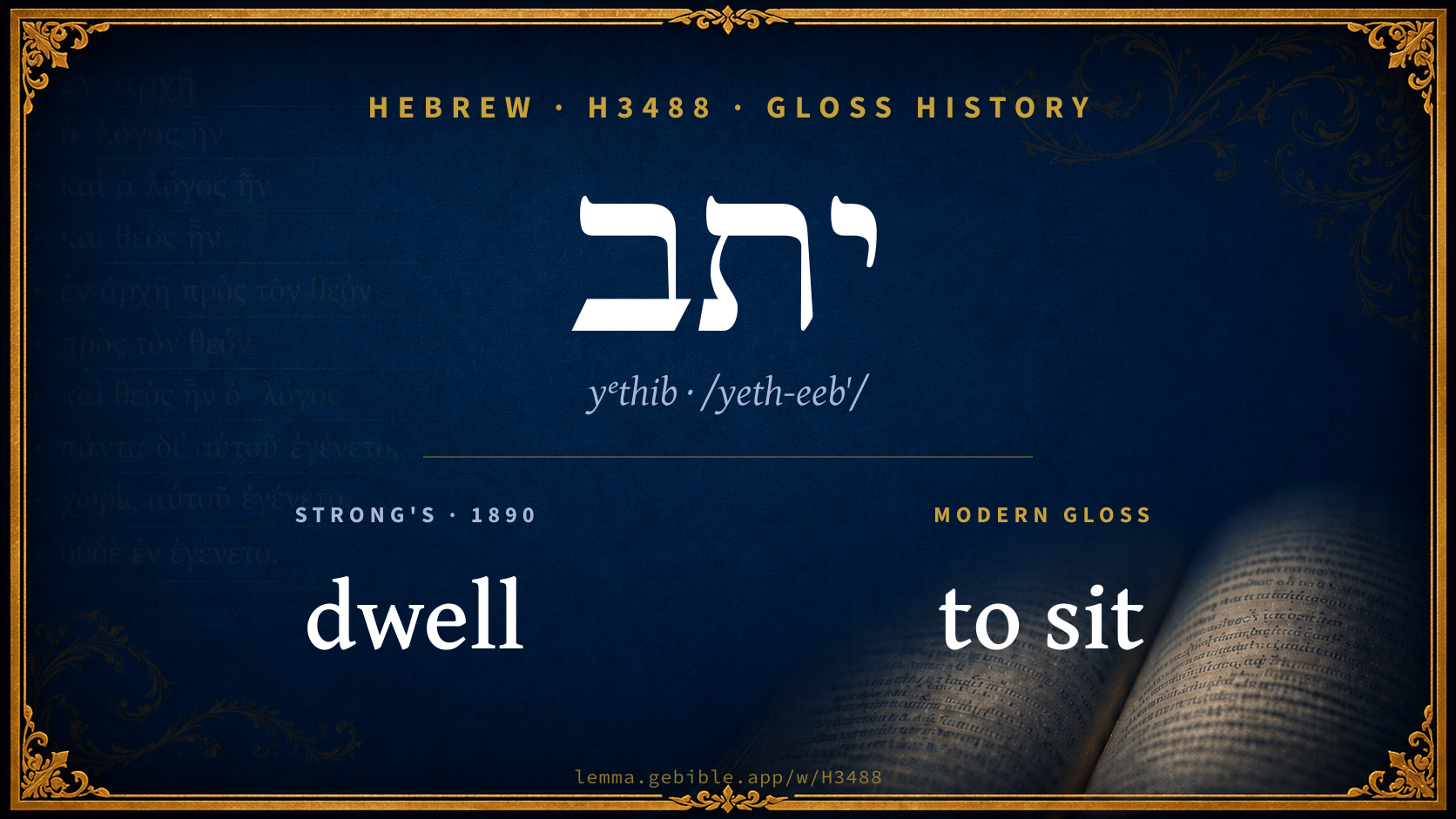
Gloss history
Strong's 1890 vs modern scholarship
About this word
Strong's H3488 catalogs a Hebrew word from the Hebrew Old Testament.
These counts are not copied from any lexicon or concordance. They are computed here, from the morphology-tagged Hebrew Old Testament. What Lemma adds →
- 5
- distinct verses
- The word appears in 5 distinct verses.
- 2 / 39
- OT books
- The word appears in 2 of 39 Old Testament books.
- #3,337
- by frequency
- Top 5000 most frequent Hebrew words (rank 3,337 of 8,640 Hebrew words by occurrence).
View all 5 occurrences in the concordance →
By traditional corpus
Conventional, traditional groupings — biblical authorship is debated, so this is a traditional corpus grouping, not an authorship claim. Each share is this word’s portion of its verses in that division of the Hebrew canon. Each figure is a share of the word’s 5 distinct verses.
- Writings (Ketuvim) 5 verses · 100%
How translations render this word
Counts come from each version’s own published word-to-Strong’s tagging or interlinear alignment — an approximate guide to how each version renders this word, not a word-level alignment the data otherwise carries. Because each total is that version’s own tagged count, the per-version totals vary from one another and need not match the appearance or distinct-verse counts above. These counts may also differ from a printed concordance because Lemma counts each distinctly tagged rendering and does not collapse phrase taggings into a single head-word total. This is a fixed set of word-tagged versions (KJV, ASV, BSB, ULT) and does not change with the reading translation you choose elsewhere. Each version’s license is shown beside its name below (and on Sources).
- King James Version: Did sit 1×, Dwell 1×, Set 1×
- American Standard Version: Did sit 1×, Dwell 1×, Judgment was set 1×
- Berean Standard Bible: Living 1×, Settled 1×, Took his seat 1×
- unfoldingWord Literal Text: Dwell 2×
King James Version Public Domain
Renders H3488 across 5 tagged occurrences — most commonly:
American Standard Version Public Domain
Renders H3488 across 5 tagged occurrences — most commonly:
Berean Standard Bible Public Domain
Renders H3488 across 5 tagged occurrences — most commonly:
unfoldingWord Literal Text CC BY-SA 4.0
Renders H3488 across 6 tagged occurrences — most commonly:
Plus 4 renderings that appear only once — usually multi-word phrases or single function words the recovered tagging swept in, not distinct renderings.
Senses in the full BDB
Hebrew verbs can shift meaning by stem (binyan): Qal is the basic action, Niphal is often passive or reflexive, Piel often intensifies or makes it factitive, and Hiphil is typically causative. The senses below are grouped under the stem BDB assigns to each. This entry also uses Peal (the basic Aramaic stem, parallel to Qal) and Haphel (the causative Aramaic stem, parallel to Hiphil).
What do BDB’s symbols mean?
BDB uses these scholarly abbreviations:
| Symbol | Meaning |
|---|---|
| 𝔊 | the Septuagint (the ancient Greek translation, LXX) |
| 𝔙 | the Vulgate (the Latin translation) |
| 𝔖 | the Syriac version (the Peshitta) |
| 𝔗 | the Targum (the Aramaic translation) |
| ψ | the Psalms |
| √ | root (the underlying root or stem) |
| ‖ | parallel passage (a synonymous or contrasted parallel) |
| † | the dagger: every passage where the word occurs is cited |
The 3 senses and sub-senses the full Brown-Driver-Briggs lexicon distinguishes for this word, in lexicon order (not ranked by frequency), with BDB’s own verbatim wording and sub-sense lettering. Shown in Hebrew script with BDB’s own scholarly abbreviations. The condensed entry is in the Lexicon Entry tab. See also the Forms in the corpus table below.
Peal
- 1. sit, be seated
- 2. dwell
Haphel
- . cause to dwell
Senses from the full Brown-Driver-Briggs lexicon (Brown, Driver, Briggs; Oxford 1906 — public domain), digitized via Sefaria, supplemented by the OpenScriptures HebrewLexicon (CC BY 4.0). Full attribution on Sources.
Word origin
יְתִב vb. sit, dwell
— Brown-Driver-Briggs (Oxford 1906, public domain), digitized via Sefaria, supplemented by the OpenScriptures HebrewLexicon (CC BY 4.0). See Sources.
Derived from ישב (yâshab) (H3427) — to dwell.
Jastrow Dictionary
A second Hebrew/Aramaic lexicon for comparison, covering Aramaic and post-biblical (Talmudic, Targumic, Midrashic) usage that the biblical-Hebrew BDB does not. Matched by lemma rather than by Strong’s number, so a lemma may carry more than one Jastrow headword (shown separately below), and the entries cover usage well beyond the Bible.
יתֵב
- , to sit, dwell &c.; to be inhabited, settled. Targ. O. Gen. XXXVI, 7 מִיתַּב ed. Berl. (oth. ed. a. Y. מֵיתַב). Targ. O. Ex. XVI, 35 יָתֵיבְתָּא (Y. מֵיתִיבָא) inhabited; a. v. fr.—Imper. תִּיב, תִּיבִי. Targ. Gen. XX, 15. Targ. Is. LII, 2 (ed. Wil. תְּבִי); a. fr.—Yeb. 109ᵃ יָתְבָא תותיה she lives under (with) him. Ber. 6ᵃ עד דיַתְבֵי when they are seated. Ib. 48ᵃ ורחמנא היכא י׳ and where does the Lord reside?—M. Kat. 9ᵇ ליחרוב ביתך ולֵיתוּב אושפיזך may thy house (grave) be vacant, and thy inn (temporary home on earth) be inhabited; Tanḥ. B’resh. 13; a fr.—י׳ … וקאמר N. N. sat down (lecturing) and said &c. Bets. 20ᵃ; a. fr.
- 1. to set down, place. Y. Kil. IX, 32ᶜ top; Y. Keth. XII, 35ᵇ top י׳ ליה ולא וכ׳ he set him down (let his coffin down) and would not take him back again (v. תּוּב); a. e.
- 2. to settle, establish. Targ. Is. XLIII, 20 אֲיַתֵּיב (ed. Wil. אַיְתֵב Af.).—Targ. Ps. XXII, 4; a. e.
- 3. to quiet, set at rest. Targ. Ps. XXIII, 3 יְיַתִּיב (ed. Wil. יְתִיב, v. תּוּב).—Ber. 28ᵃ ליַתּוּבֵי דעתיה to set his mind at ease. Yoma 81ᵃ יַתּוּבֵי דעתא making one come to. B. Bath. 3ᵇ ליַתּוּבֵיה ליצריה in order to gratify his passion. Lev. R. s. 19 [read:] תִּתְיַתַּב ליך נפשיך היך כמה דיַתְּבַת לנפשי may thy soul be restored to thee as thou hast restored my soul; a. e.—Part. pass. מְיַתַּב, מְיַתְּבָא, מְיַתְבָא a) inhabited. Targ. Ps. CVII, 4.—b) quieted. Tam. 32ᵃ נחותי ימא לא מְיַ׳ דעתיהון וכ׳ (or מִיַּתְּבָא, v. infra) sea-farers do not feel at ease until they reach land.
- to place, seat, settle (v. יָשַׁבHif.). Targ. I Kings XXI, 9. Targ. Gen. XLVII, 6; a. fr.—Y. Kidd. I, 58ᵈ אַיְיתִיבוּנִי על גיף וכ׳ bury, me at the bank of the river; Y. Keth. VI, end, 31ᵃ אייתבון (corr. acc.). Ḥull. 59ᵃ נֵיתְבֵיה בתנורא … אוֹתְבֵיה let it be put in the oven; … he put it in. Yoma 69ᵇ אוֹתִיבוּ בתעניתא וכ׳ they made (people) sit fasting, they ordered a fast of three days &c.; a. fr. [אוֹתִיב for אָתֵיב, v. תּוּב.]
- , אִיתִּיב; Ittaf. אִיתּוֹתַב
- 1. to be allowed to dwell, to sojourn (h. גּוּר). Targ. O. Gen. XX, 1 (Y. אתנתב, corr. acc.). Targ. Jer. XLIX, 33; a. fr.—Sabb. 33ᵇ אִיתְּבוּ תריסר וכ׳ they dwelt in the cave twelve years.
- 2. to be inhabited. Targ. Is. XLIV, 26. Targ. Jer. L, 13; a. fr.
- 3. to be set at ease, be gratified. Targ. Is. LXII, 5.—B. Mets. 83ᵇ bot. לא מִיַּיתְּבָא דעתיה he was not satisfied. Yoma 80ᵇ; מי׳ דעתיה he will come to again.—Sabb. 51ᵇ, sq. כי היכי דתִיתּוֹתַב דעתיה Ms. O. (Ms. M. דתייב, ed. דאיתותב, v. Rabb. D. S. a. l. note) that he may be reconciled. Lev. R. s. 19, v. supra; a. fr. [אִתּוֹתַב for אִתָּתַב, v. תּוּב.]
יְתֵב II
- (v. preced.; cmp. יהב to give and to place) to give (not used in perf. tense). Sabb. 19ᵃ במשחא נִיתֵּיב ליה וכ׳ (Ms. M. נמשח ונ׳) let him measure when giving (the goods to wash) and when receiving it back. Kidd. 78ᵇ אי בעי מִיתְּבָא … לא יהיב ליה (not יהבי) if he desired to give it to him as a donation, could he not do it? Keth. 106ᵇ וליכא למיתבא ליה and he will have nothing to give him. B. Kam. 83ᵇ; a. e.—B. Bath. 13ᵇ למיתב Ms. M. (ed. למִיתַּן).
יָתֵב
- (יְתַב I) inhabitant. Targ. O. Gen. XXXIV, 30 יָתֵיב ed. Berl. (ed. יַתְבֵי pl.). Targ. O. Num. XIV, 14. Targ. Is. VI, 11; a. fr.—Pl. יָתְבַיָּא, יַתְבֵי. Targ. Y. Num. l. c.; a. fr.
A Dictionary of the Targumim, the Talmud Babli and Yerushalmi, and the Midrashic Literature (Marcus Jastrow; London, Luzac, 1903) — Public Domain. Digitized via Sefaria. Digitized via Sefaria. Full attribution on Sources.
Forms in the corpus
The 5 distinct written forms H3488 takes in the Hebrew Bible, most frequent first — each parse links to that stem’s occurrences in the concordance. Hebrew forms include their vowel points and cantillation, so a single lemma takes many written forms.
| Form | Parsing | Example | Uses |
|---|---|---|---|
| וְ/הוֹתֵ֣ב | Verb, Hiphil, Perfect, 3rd Person, Masculine, Singular | Ezra 4:10 | 1 |
| יְתִ֑ב | Verb, Qal, Perfect, 3rd Person, Masculine, Singular | Daniel 7:9 | 1 |
| יְתִ֖ב | Verb, Qal, Perfect, 3rd Person, Masculine, Singular | Daniel 7:10 | 1 |
| יִתִּ֑ב | Verb, Qal, Imperfect, 3rd Person, Masculine, Singular | Daniel 7:26 | 1 |
| יָתְבִ֖ין | Verb, Qal, Participle Active, Masculine, Plural, Absolute | Ezra 4:17 | 1 |
Same root — word family
Other BDB entries built from the same root as H3488, grouped by Strong’s listed origin. These share a root / origin per the lexicon — not necessarily a shared meaning. Each links to that word’s own entry.
Derives from
Shares the same root
- מושב môwshâb H4186 dwelling place
- שבת shebeth H7675 seat
- שיבה shîybâh H7871 sojourn
- תושב tôwshâb H8453 sojourner
Proper names from this root
People and places named from this root — a name, not an additional meaning of the word.
- יושביה Yôwshibyâh H3143 Josibiah
- ישבאב Yeshebʼâb H3428 Jeshebeab
- ישב בשבת Yôshêb bash-Shebeth H3429 Josheb-basshebeth
- ישבו בנב Yishbôw bᵉ-Nôb H3430 Ishbi-benob
- ישבקשה Yoshbᵉqâshâh H3436 Joshbekashah
Compare all same-root words → Showing 4 of 11 — not the complete family. 5 of the same-root words are proper names (people or places). They share a root, not necessarily a meaning.
Septuagint verse parallels
This word appears in 5 verses that also exist in the Greek Old Testament (Septuagint), out of the 5 Hebrew verses it occurs in. You can read those verses in Greek by switching the Old Testament edition to the Septuagint.
Read these verses in the Septuagint
This is a verse-level parallel only — the same verses exist in both the Hebrew and Greek Old Testaments. No word-level Hebrew↔Greek correspondence is claimed: the data carries no such alignment, so no Greek word is shown as this Hebrew word’s translation. Coverage is not total — the Septuagint omits the deuterocanon and renumbers the Psalms, so some Hebrew verses have no direct Greek parallel.