Jeremiah 2:15

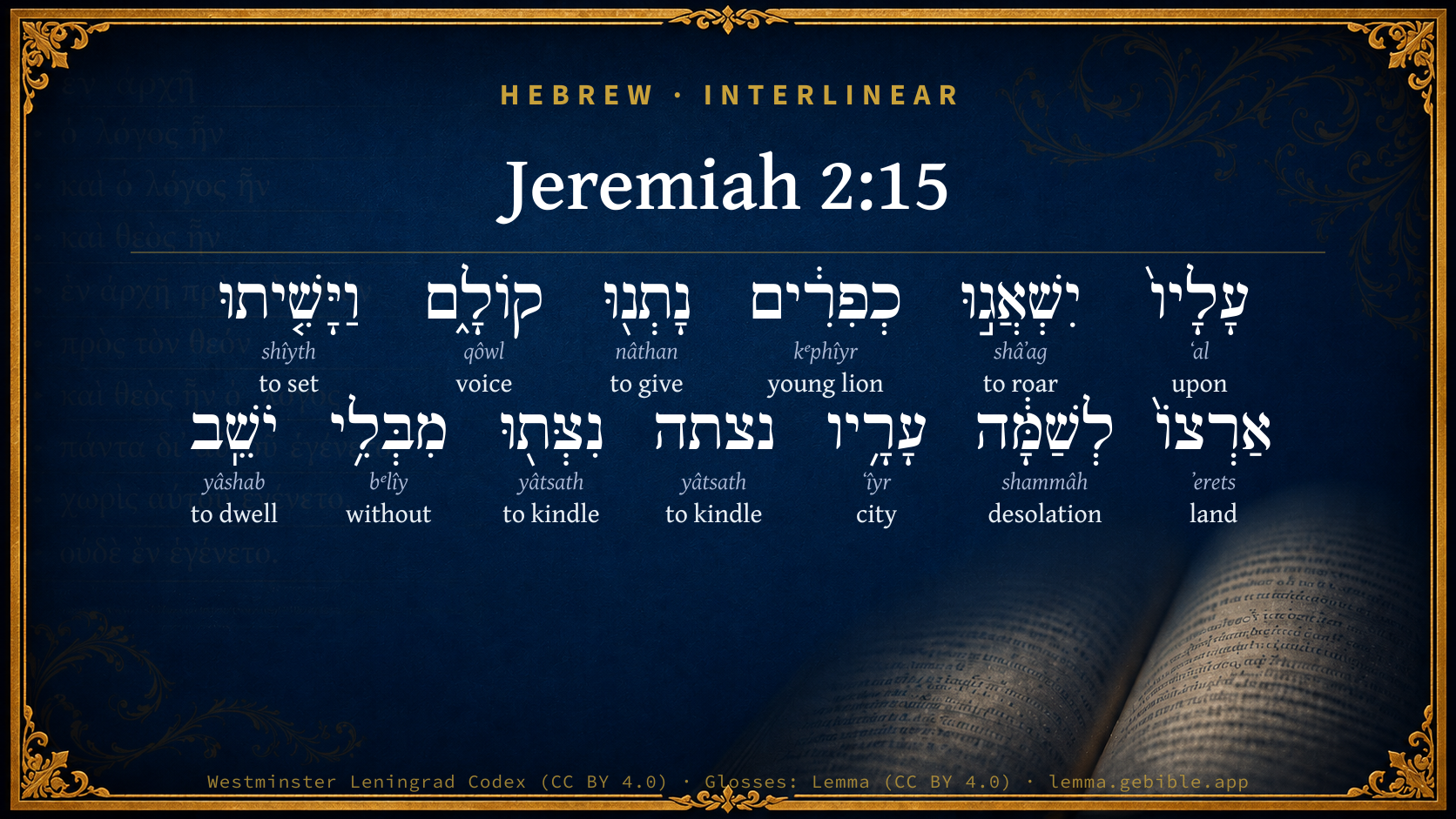
Hebrew (Westminster Leningrad Codex) Jeremiah 2:15 appears in the Hebrew Old Testament. The text above is from the Westminster Leningrad Codex. Each word links to its Strong’s number, a concise gloss, and parsing drawn from the Open Scriptures Hebrew Bible morphology. Click any word for its full Brown-Driver-Briggs (BDB) entry.
Download image
Cite this verse

Jeremiah 2:15 (World English Bible). Public Domain. Lemma interlinear Bible study tool, https://lemma.gebible.app/v/jeremiah/2/15.

Show BibTeX & RIS
BibTeX
RIS
English Translation
The young lions have roared on him, and yelled; and they have made his land waste: his cities are burned up, without inhabitant.
World English Bible · Public Domain
Download a study sheet

One document with this verse’s original text, its word-by-word gloss line, the meaning frame, cross-references with their text, attributed commentary, and full source and license credits — printable, and it pastes into notes with its structure intact.

This verse Autodidact and up

Study sheet (.html) Plain text (.txt)

A passage Seminary Student

Up to 50 verses in one chapter. A passage sheet keeps up to 6 commentary sources and 12 cross-references per verse, in the order this page ranks them, and says so on the sheet whenever that leaves anything out. Ask for a single verse and you get the Autodidact verse sheet above.

Everything on this page stays free to read, with no account — the sheet is a download of what is already on screen, not access to it.

Want to remove ads? Support Godless Engineer
Compare translations 3

The same verse in 3 English versions, stacked beneath the original-language interlinear above. Click any original word for its lexicon entry.

Each is an independent rendering of the whole verse — the interlinear is not word-aligned to these translations.

Highlighted words mark where these versions differ — a whole-verse word diff, not a word-by-word alignment.

  • World English Bible Public Domain
    The young lions have roared on him, and yelled; and they have made his land waste: his cities are burned up, without inhabitant.
  • King James Version Public Domain
    The young lions roared upon him, and yelled, and they made his land waste: his cities are burned without inhabitant.
  • unfoldingWord Literal Text CC BY-SA 4.0
    Young lions roared against him; they gave their voice. And they made his land into a desolation; his cities became ruins without an inhabitant.

unfoldingWord Literal Text — © unfoldingWord, licensed CC BY-SA 4.0. Word-aligned USFM3 via Door43 (git.door43.org/unfoldingWord/en_ult).

Versions to compare (up to 4)

3 of 4 selected

Show all 18 translations

Every available English version of this verse, each an independent rendering of the whole verse.

  • World English Bible Public Domain
    The young lions have roared on him, and yelled; and they have made his land waste: his cities are burned up, without inhabitant.
  • Berean Standard Bible Public Domain
    The young lions have roared at him; they have growled with a loud voice. They have laid waste his land; his cities lie in ruins, without inhabitant.
  • Majority Standard Bible Public Domain
    The young lions have roared at him; they have sounded their voices. They have laid waste his land; his cities lie in ruins, without inhabitant.
  • King James Version Public Domain
    The young lions roared upon him, and yelled, and they made his land waste: his cities are burned without inhabitant.
  • American Standard Version (1901) Public Domain
    The young lions have roared upon him, and yelled; and they have made his land waste: his cities are burned up, without inhabitant.
  • Revised Version (1885) Public Domain
    The young lions have roared upon him, and yelled: and they have made his land waste; his cities are burned up, without inhabitant.
  • Geneva Bible (1599) Public Domain
    The lions roared vpon him and yelled, and they haue made his land waste: his cities are burnt without an inhabitant.
  • Douay-Rheims (1899) Public Domain
    The lions have roared upon him, and have made a noise, they have made his land a wilderness: his cities are burnt down and there is none to dwell in them.
  • Young's Literal Translation Public Domain
    Against him roar do young lions, They have given forth their voice, And make his land become a desolation, His cities have been burnt without inhabitant.
  • Literal Standard Version CC BY-SA 4.0
    Young lions roar against him, || They have given forth their voice, || And make his land become a desolation, || His cities have been burned without inhabitant.
  • Unlocked Literal Bible CC BY-SA 4.0
    Young lions roared against him. They made a lot of noise and made his land a horror. His cities are destroyed without any inhabitants.
  • unfoldingWord Literal Text CC BY-SA 4.0
    Young lions roared against him; they gave their voice. And they made his land into a desolation; his cities became ruins without an inhabitant.
  • Darby Bible Public Domain
    The young lions roared against him, they gave forth their voice, and they made his land desolate: his cities are burned, without inhabitant.
  • World Messianic Bible Public Domain
    The young lions have roared at him and raised their voices. They have made his land waste. His cities are burned up, without inhabitant.
  • Webster's Bible Public Domain
    The young lions roared upon him, and yelled, and they made his land waste: his cities are burned without inhabitant.
  • Free Bible Version CC BY-SA 4.0
    The young lions roared at you; they growled loudly. They have devastated your country; your towns lie in ruins. No one lives there.
  • Bible in Basic English Public Domain
    The young lions have made an outcry against him with a loud voice: they have made his land waste; his towns are burned up, with no one living in them.
  • JPS Tanakh (1917) Public Domain
    The young lions have roared upon him, and let their voice resound; and they have made his land desolate, his cities are laid waste, without inhabitant.

Literal Standard Version (2020), Covenant Press — licensed CC BY-SA 4.0. Text via the HelloAO Bible API (eBible.org). Unlocked Literal Bible (unfoldingWord) — licensed CC BY-SA 4.0. Text via the HelloAO Bible API (eBible.org). unfoldingWord Literal Text — © unfoldingWord, licensed CC BY-SA 4.0. Word-aligned USFM3 via Door43 (git.door43.org/unfoldingWord/en_ult). Free Bible Version, Dr. Jonathan Gallagher — licensed CC BY-SA 4.0. Text via the HelloAO Bible API (eBible.org).

Word by word

More ways to search: Search by grammar → Find every occurrence → Compare this word →

Practice this passage: Drill this verse → Learn its vocabulary →

יִשְׁאֲג֣וּ
shâʼag
H7580
“to roar”
Verb, Qal, Imperfect, 3rd Person, Masculine, Plural
Part of Speech
Verb
Stem
Qal
Form
Imperfect
Person
3rd Person
Gender
Masculine
Number
Plural
Full BDB Definition

Origin: a primitive root

TWOT: 2300

(Qal) to roar - of lion, conqueror, Jehovah, cry of distress
  1. עָלָיו֙ ʻal H5921 “upon · him” Preposition + Suffix, Personal, 3rd Person, Masculine, Singular
  2. כְפִרִ֔ים kᵉphîyr H3715 “young lions” Noun, Common, Masculine, Plural, Absolute
  3. נָתְנ֖וּ nâthan H5414 “to give” Verb, Qal, Perfect, 3rd Person, Common, Plural
  4. קוֹלָ֑ם qôwl H6963 “voice · their” Noun, Common, Masculine, Singular, Construct + Suffix, Personal, 3rd Person, Masculine, Plural
  5. וַיָּשִׁ֤יתוּ shîyth H7896 “and · to set” Conjunction + Verb, Qal, Sequential Imperfect, 3rd Person, Masculine, Plural
  6. אַרְצוֹ֙ ʼerets H776 “land · his” Noun, Common, Both, Singular, Construct + Suffix, Personal, 3rd Person, Masculine, Singular
  7. לְשַׁמָּ֔ה shammâh H8047 “to/for · desolation” Preposition + Noun, Common, Feminine, Singular, Absolute
  8. עָרָ֥יו ʻîyr H5892 “cities · his” Noun, Common, Feminine, Plural, Construct + Suffix, Personal, 3rd Person, Masculine, Singular
  9. נצתה yâtsath H3341 “to kindle” Verb, Niphal, Perfect, 3rd Person, Feminine, Singular
  10. נִצְּת֖וּ yâtsath H3341 “to kindle” Verb, Niphal, Perfect, 3rd Person, Common, Plural
  11. מִבְּלִ֥י bᵉlîy H1097 “from · without of” Preposition + Noun, Common, Masculine, Singular, Construct
  12. יֹשֵֽׁב yâshab H3427 “dwelling” Verb, Qal, Participle Active, Masculine, Singular, Absolute

About this verse

These counts appear in no published source. They are computed here, from the morphology-tagged text and Lemma’s own curated glosses. What Lemma adds →

13
words
12
distinct lemmas
Prophets
section

Notable vocabulary

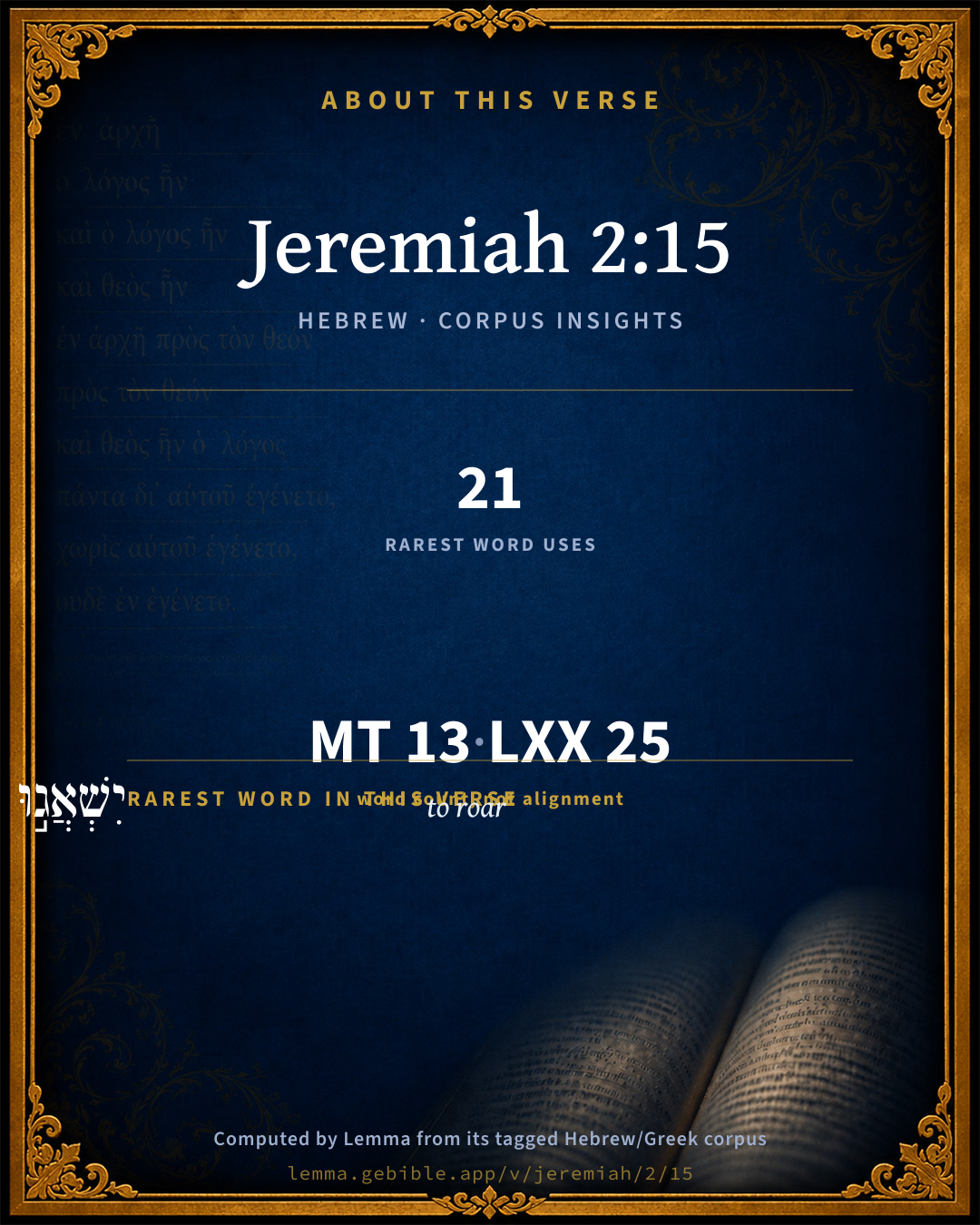
The rarest word here is יִשְׁאֲג֣וּ to roar H7580 — appearing just 21 times in the whole Hebrew Bible.

Shared distinctive vocabulary

יִשְׁאֲג֣וּ to roar H7580 occurs in 17 verses of the Hebrew Bible. Also found in:

Grammatical profile

  • 6 verbs
  • 6 nouns
  • 1 preposition

Verb forms

  • יִשְׁאֲג֣וּ Qal · Imperfect
  • נָתְנ֖וּ Qal · Perfect
  • וַיָּשִׁ֤יתוּ Qal · Sequential Imperfect
  • נצתה Niphal · Perfect
  • נִצְּת֖וּ Niphal · Perfect
  • יֹשֵֽׁב Qal · Participle Active

Repetition

A word recurs within this verse — often emphatic in Hebrew:

  • נצתה to kindle H3341 ×2

Hebrew & Septuagint length

In the original languages it is 13 Hebrew tokens and 25 Greek tokens — but the two are counted differently (Hebrew bundles its prefixes and suffixes into one token; the Greek is in lemma form), so that isn’t a like-for-like length.

Cross-references

28

Topical passages linked to Jeremiah 2:15 in the Treasury of Scripture Knowledge — connected by theme and wording, ordered by reader-vote popularity; previews shown in the World English Bible.

  • Jeremiah 4:7 A lion is gone up from his thicket, and a destroyer of nations; he is on his way, he is gone forth from his place, to make your land desolate, that your cities be laid waste, without inhabitant.
  • Jeremiah 50:17 Israel is a hunted sheep; the lions have driven him away: first, the king of Assyria devoured him; and now at last Nebuchadrezzar king of Babylon has broken his bones.
  • Isaiah 1:7 Your country is desolate. Your cities are burned with fire. Strangers devour your land in your presence, And it is desolate, As overthrown by strangers.
  • Isaiah 5:29 Their roaring will be like a lioness. They will roar like young lions. Yes, they shall roar, And seize their prey and carry it off, And there will be no one to deliver.
  • Jeremiah 9:11 I will make Jerusalem heaps, a dwelling-place of jackals; and I will make the cities of Judah a desolation, without inhabitant.
  • Judges 14:5 Then went Samson down, and his father and his mother, to Timnah, and came to the vineyards of Timnah: and, behold, a young lion roared against him.
  • Job 4:10 The roaring of the lion, and the voice of the fierce lion, The teeth of the young lions, are broken.
  • Psalms 57:4 My soul is among lions. I lie among those who are set on fire, Even the sons of men, whose teeth are spears and arrows, And their tongue a sharp sword.
  • Isaiah 5:9 In my ears, Yahweh of Hosts says: "Surely many houses will be desolate, Even great and beautiful, unoccupied.
  • Isaiah 6:11 Then I said, "Lord, how long?" He answered, "Until cities are waste without inhabitant, And houses without man, And the land becomes utterly waste,
  • Isaiah 24:1 Behold, Yahweh makes the earth empty, and makes it waste, and turns it upside down, and scatters abroad the inhabitants of it.
  • Jeremiah 5:6 Therefore a lion out of the forest shall kill them, a wolf of the evenings shall destroy them, a leopard shall watch against their cities; everyone who goes out there shall be torn in pieces; because their transgressions are many, [and] their backsliding is increased.
  • Jeremiah 25:30 Therefore prophesy you against them all these words, and tell them, Yahweh will roar from on high, and utter his voice from his holy habitation; he will mightily roar against his fold; he will give a shout, as those who tread [the grapes], against all the inhabitants of the earth.
  • Jeremiah 26:9 Why have you prophesied in the name of Yahweh, saying, This house shall be like Shiloh, and this city shall be desolate, without inhabitant? All the people were gathered to Jeremiah in the house of Yahweh.
  • Jeremiah 33:10 Thus says Yahweh: Yet again there shall be heard in this place, about which you say, It is waste, without man and without animal, even in the cities of Judah, and in the streets of Jerusalem, that are desolate, without man and without inhabitant and without animal,
  • Jeremiah 34:22 Behold, I will command, says Yahweh, and cause them to return to this city; and they shall fight against it, and take it, and burn it with fire: and I will make the cities of Judah a desolation, without inhabitant.
  • Jeremiah 44:22 so that Yahweh could no longer bear, because of the evil of your doings, and because of the abominations which you have committed; therefore is your land become a desolation, and an astonishment, and a curse, without inhabitant, as it is this day.
  • Ezekiel 5:14 Moreover I will make you a desolation and a reproach among the nations that are round about you, in the sight of all that pass by.
  • Hosea 5:14 For I will be to Ephraim like a lion, And like a young lion to the house of Judah. I myself will tear in pieces and go away. I will carry off, and there will be no one to deliver.
  • Hosea 11:10 They will walk after Yahweh, Who will roar like a lion; For he will roar, and the children will come trembling from the west.
  • Hosea 13:7–8 Therefore am I to them like a lion; Like a leopard I will lurk by the path.
  • Amos 3:4 Will a lion roar in the thicket, When he has no prey? Does a young lion cry out of his den, If he has caught nothing?
  • Amos 3:8 The lion has roared. Who will not fear? The Lord Yahweh has spoken. Who can but prophesy?
  • Amos 3:12 Thus says Yahweh: "As the shepherd rescues out of the mouth of the lion two legs, Or a piece of an ear, So shall the children of Israel be rescued who sit in Samaria on the corner of a couch, And on the silken cushions of a bed."
  • Nahum 2:11 Where is the den of the lions, and the feeding-place of the young lions, where the lion and the lioness walked, the lion's cubs, and no one made them afraid?
  • Zephaniah 1:18 Neither their silver nor their gold will be able to deliver them in the day of Yahweh's wrath, but the whole land will be devoured by the fire of his jealousy; for he will make an end, yes, a terrible end, of all those who dwell in the land.
  • Zephaniah 2:5 Woe to the inhabitants of the sea coast, the nation of the Cherethites! The word of Yahweh is against you, Canaan, the land of the Philistines. I will destroy you, that there will be no inhabitant.
  • Zephaniah 3:6 I have cut off nations. Their battlements are desolate. I have made their streets waste, so that no one passes by. Their cities are destroyed, so that there is no man, so that there is no inhabitant.

Cross-references courtesy of OpenBible.info (CC BY 4.0).

Hebrew and Greek witnesses Masoretic Hebrew ↔ Greek Septuagint

The same verse in the two great witnesses to the Old Testament, shown verse-for-verse.

These are two independent witnesses, not word-aligned to each other, and the Septuagint is shown in lemma (dictionary) form.

Hebrew Jeremiah 2:15 Masoretic · Westminster Leningrad Codex

עָלָיו֙ יִשְׁאֲג֣וּ כְפִרִ֔ים נָתְנ֖וּ קוֹלָ֑ם וַיָּשִׁ֤יתוּ אַרְצוֹ֙ לְשַׁמָּ֔ה עָרָ֥יו נצתה נִצְּת֖וּ מִבְּלִ֥י יֹשֵֽׁב

The young lions have roared on him, and yelled; and they have made his land waste: his cities are burned up, without inhabitant.

World English Bible · Public Domain

Greek LXX Structure differs

In the Septuagint, Jeremiah is about an eighth shorter than the Hebrew and arranges its material differently — the Oracles Against the Nations (Hebrew chapters 46–51) appear in the middle of the Greek book, after 25:13. Because the chapter and verse boundaries do not line up, a verse-for-verse comparison with the Hebrew is not shown.

A verse-for-verse comparison isn’t shown here because the chapters and verses don’t line up. Switch to the LXX edition with the MT / LXX toggle above to read the Greek directly.

On this verse, John Gill's Exposition discusses the Septuagint’s reading. Read the note in Commentary ↓

Hebrew: Westminster Leningrad Codex (CC BY 4.0). Greek: Septuagint (public domain); English from a public-domain English Septuagint. How the Septuagint differs from the Hebrew →

Targum (Aramaic paraphrase)

1

The Targum is the ancient Jewish Aramaic paraphrase of the Hebrew Scriptures — an interpretive translation, not the Hebrew text itself. Onkelos (literal) and Pseudo-Jonathan (expansive) render the Torah, and Jonathan the Prophets. Coverage is partial: where no permissively-licensed English translation exists for a verse, only the Aramaic is shown. This is verse-level text, not a word-by-word alignment to the Hebrew.

  1. Targum Jonathan Prophets (Joshua–Malachi)
    עֲלוֹהִי יַכְלִין מַלְכַיָא יְרִימוּן קָלְהוֹן וְשַׁווֹ אַרְעֵיהּ לְצַדוּ קִרְווֹהִי צַדְיָן מִבְּלִי יָתֵיב:

    (no public-domain English translation for this verse)

    Targum Jonathan — Aramaic: “Mikraot Gedolot” (public domain). English: “Sefaria Community Translation” (CC0 1.0 (public-domain dedication)); “London "Chaldee Paraphrase," 1871” (public domain). Text via Sefaria.

Commentary

Notes on Jeremiah 2:15 from classic Christian and Jewish commentators (each source and its license shown beneath its notes). The classic Christian expositions comment on the surrounding passage and are grouped to its opening verse, so a note may address several verses; the Jewish commentaries on the Tanakh (Rashi and others) are per-verse, so they appear only where the commentator wrote on this verse.

Lemma curates 59 commentaries, every one of them public domain or Creative Commons licensed, each selected and text-cleaned for this edition rather than reprinted as found. About our sources →

Trapp's Complete Commentary

John Trapp

Jer 2:15 The young lions roared upon him, [and] yelled, and they made his land waste: his cities are burned without inhabitant.

Ver. 15. The young lions roared upon him, and yelled,] i.e., The King of Babylon and his forces, more fierce and fell than young lions. Would any take the Church’s picture? saith Luther; {a} then let him paint a silly, poor maid, sitting in a wood or wilderness, compassed about with hungry lions, wolves, boars, and bears; for this is her condition in the world.

And they made his land waste,] i.e., They shall shortly so make it.

{a} Loc. com. tit. de persecut. verae Ecclesia.

John Trapp, A Commentary or Exposition upon All the Books of the Old and New Testament (1647–1656) — public domain. Text from a community e-Sword module.

The Biblical Illustrator

Joseph S. Exell

Jer_2:15

The young lions roared upon him, and yelled.

Dangers outside the Divine bounds

That comes of going from home, leaving sacred discipline, taking life into ones own hand, assuming the mastership of ones own fortune and destiny. Woe betide the man who goes beyond the bounds which God has fixed! Immediately outside those bounds the lion waits, or the plague, or the pestilence, or the pit hardly hidden but deep immeasurable. Luther said: Who would paint a picture of the present condition of the Church, let him paint a young woman in a wilderness or in some desert place; and round about her let him figure hungry lions whose eyes are glaring upon her and whoso mouths are open to devour her substance and her beauty. Is the Church in a much better condition today? That is the natural condition of the Church. The Church always challenges the lion, tempts the devourer, excites the passions of evil men. When an evil generation tolerates the Church, applauds its dogmas, and flatters its ministry, it is because that Church has surrendered her prerogatives and trampled her functions in the dust. All that will live godly in Christ Jesus shall suffer persecution. Know that the Church of the living God is alive, and is fulfilling her destiny, when all round about her are men more cruel than ravenous beasts. Israel, the home-born slave, who ought to have walked arm-in-arm with the son of the house, left the precincts of the family and plunged into the way of lions. (J. Parker, D. D.)

The Biblical Illustrator, edited by Joseph S. Exell (c. 1880s–1900s) — public domain. Text from a community e-Sword module.

Joseph Benson's Commentary

Jer 2:15-16. The young lions roared upon them — Lions, in the figurative style of prophecy, denote powerful princes and conquerors; see Jer 50:17; where the king of Assyria is mentioned as one of those lions which had devoured him, and Nebuchadnezzar as another. If we consider the prophet as speaking here of what was past, by the young lions he probably means the kings of Syria and Assyria, who laid the country waste, not only of the ten tribes, but also Judah and Benjamin; and carried the Israelites into captivity; see Isa 1:7. But the words כפרים ישׁאגוare more properly rendered, The young lions shall roar upon him; and so may be understood of Pharaoh-necho, king of Egypt, and Nebuchadnezzar, whose successive hostilities against the kingdom of Judah were foreseen by the prophet, and are probably here foretold. It is true, the following verbs of this verse are in the past time, but the context favours interpreting them of the future. Nor is it unusual for the prophets to speak of events yet to come, and foreseen by them, as if they had been already accomplished. They made his land waste, his cities are burned, &c.

That Jeremiah speaks here of the future, and not of the past, appears from this: that in the time of Josiah, when this prophecy was uttered, the country was not in the condition here described; the land had not been reduced to desolation, nor the cities burned with fire; but the determination of the Lord was past, and the prophet clearly foresaw that these calamities would come. Also the children of Noph, &c., have broken the crown of thy head — By the children of Noph and Tahapanes are meant the Egyptians, these being the two principal cities of Egypt, called by heathen writers Memphis and Taphanes, or Daphnæ Pelusicæ. “This no doubt alludes,” says Blaney, “to the severe blow which the nation received in a capital part, when the good King Josiah was defeated by the Egyptians, and slain in battle; or when, afterward, upon the deposition of Jehoahaz, the glory of the monarchy was debased, by its being changed into a tributary and dependant kingdom, 2Ki 23:29-34, and 2Ch 35:20.

Joseph Benson's Commentary on the Old and New Testaments (1811–1818) — public domain. Text from a community e-Sword module.

Tyndale Open Study Notes

Tyndale Open Resources

2:15 Jeremiah portrays the Assyrians who destroyed the northern kingdom (2 Kgs 17:5-23; Nah 2:11-12) as lions.

Tyndale Open Study Notes — © Tyndale Open Resources, licensed CC BY-SA 4.0. Text via the HelloAO Bible API.

Geneva Bible (1599)

Geneva Bible translators

Not one shall be left to dwell there.

The Babylonians, Chaldeans, and Assyrians.

Geneva Bible (1599) marginal notes — public domain. Text via Bolls.life.

Jamieson, Fausset & Brown

Robert Jamieson, A. R. Fausset & David Brown

lions--the Babylonian princes (Jer 4:7; compare Amo 3:4). The disaster from the Babylonians in the fourth year of Jehoiakim's reign, and again three years later when, relying on Egypt, he revolted from Nebuchadnezzar, is here referred to (Jer 46:2; Kg2 24:1-2).

Jamieson, Fausset & Brown — Commentary Critical and Explanatory on the Whole Bible (1871) — public domain (CC PDM 1.0). Text via the HelloAO Bible API.

Adam Clarke's Commentary

Verse 15. The young lions roared upon him] The Assyrians, who have sacked and destroyed the kingdom of Israel, with a fierceness like that of pouncing upon their prey.

Adam Clarke's Commentary on the Bible (1810–1826) — public domain. Text from a community e-Sword/MySword module.

John Calvin's Commentaries

He afterwards adds, Over him roar the lions. The Prophet seems not simply to compare the enemies of Israel to lions on account of their cruelty, but also by way of contempt, as though he had said, that Israel found that not only men were incensed against them, but also wild beasts: and it is more degrading when God permits us to be torn by the beasts of the field. It is then the same, as though he had said, that Israel were so miserably treated, that they were not only slain by the hands of enemies, but were also exposed to the beasts of prey. And then he adds, they have sent forth their voice; which is the same as to say, that Israel, whom God was wont to protect by his powerful band, were become the food of wild beasts, and that lions, as it were in troops, were roaring against them.

He then adds, without a metaphor, that his land was laid waste, and his cities burnt without an inhabitant This language cannot be suitably applied to lions or to any other wild beasts; but what he had figuratively said before, he now explains in a plain manner, and says, that the land was desolate, that the cities were cut off or burnt up. Now this, as we have said, could not have been the case, had not Israel departed from God, and had been on this account deprived of his help.

John Calvin's Commentaries (1540-1563) — public domain. Text from the Calvin Translation Society English edition (1840s-50s) via the Christian Classics Ethereal Library (ccel.org). Calvin's coverage is partial (roughly two-thirds of the Bible); uncommented books and verses are honest gaps, never fabricated. The 19th-century editor's footnotes and remarks are omitted so the notes are faithfully Calvin's own voice.

Ellicott's Commentary for English Readers

(15) The young lions roared . . .—The real answer to the question, that Israel had forsaken its true master, is given in Jer_2:17. Here it is implied in the description of what the runaway slave had suffered. Lions had attacked him; not figuratively only, as symbolising invaders, but in the most literal sense, they had made his land waste (2Ki_17:25).

Are burned.—Better, levelled with the ground.

A Bible Commentary for English Readers, edited by Charles John Ellicott (1878–1897) — public domain. Text from a community e-Sword module.

The Cambridge Bible for Schools and Colleges

gen. ed. J. J. S. Perowne

15. The young lions have roared upon him, and yelled] referring to the frequent Assyrian invasions. The lion was the symbol of Assyria (Nah_2:12 f.). Cp. Isa_5:29 (of an attacking host).

burned up] Many prefer to render, slightly altering MT., are laid waste, desolated, as in Jer_4:7.

The Cambridge Bible for Schools and Colleges (gen. ed. J. J. S. Perowne; Cambridge University Press, 1878–1918) — public domain. Text from a community e-Sword module.

John Gill's Exposition

Also the children of Noph and Tahapanes,.... These were cities in Egypt. Noph is the same with Moph in Hos 9:6 and which we there rightly render Memphis; as Noph is here by the Targum, Septuagint, Vulgate Latin, Syriac, and Arabic versions; and was formerly, as Pliny (g) says, the palace of the kings of Egypt. It is the same that is now called Alcairo, or Grand Cairo. According to Herodotus (h), it was built by Menes, the first king of Egypt; and who also makes mention of a city of Egypt, called Momemphis (i). Tahapanes is the same with Hanes in Isa 30:4, and here, in the Arabic version, is called Daphnes; and is thought by some to be the same with Daphnae Pelusiae, a city in Egypt. This Tahapanes was the metropolis of Egypt, and the seat of their kings; mention is made of Pharaoh's house in it, in Jer 43:9, now the inhabitants of these, called the children of them, and who are put for the people of Egypt in general, were the allies of the Jews, and in whom they trusted for help, when attacked by their enemies, Isa 30:2 and yet

even these have broken the crown of thy head; which is interpreted, by the Targum, of slaying their mighty men, and spoiling their goods; perhaps it had its accomplishment when Pharaohnecho king of Egypt came out against the king of Assyria, and Josiah king of Judah went out to meet him, and was slain by him at Megiddo; and his son Jehoahaz he put in bonds, and carried him to Egypt, and put his brother upon the throne, and took tribute of gold and silver of him, Kg2 23:29.

(g) Nat. Hist. l. 5. c. 9. (h) L. 2. vel Euterpe, c. 99. (i) lb. c. 163, 169.

John Gill's Exposition of the Whole Bible (1746–1763) — public domain (CC PDM 1.0). Text via the HelloAO Bible API.

Albert Barnes' Notes on the Bible

Upon him - Rather, against him. Israel has run away from his master’s house, but only to find himself exposed to the beasts of prey in the wilderness.

They made his land waste - The prophet points to the actual results of Israel’s until the multiplication of wild beasts rendered human life unsafe 2Ki 17:25, but the Assyrian invasions had reduced Judaea to almost as sad a state.

Burned - Others render, “leveled to the ground.”

Albert Barnes' Notes on the Bible (1834–1885) — public domain. Text from a community e-Sword/MySword module.

Haydock's Catholic Bible Commentary

Lions; kings of Assyria, &c. The decree for the devastation of Juda had already passed, though it was not put in execution.

George Leo Haydock (1774–1849), Haydock's Catholic Family Bible and Commentary, 1859 edition — public domain. Excludes Psalms (Douay-Rheims chapter numbering differs from Protestant) and Deuterocanonical books (Catholic canon only).

Matthew Poole's English Annotations

The young lions; understand the Assyrians, Babylonians, and Egyptians, &c., called

lions from their fierceness, and young from their strength. See this Jer 4:7; 50:17.

Roared upon him, and yelled; noting the terrible voice that the lion puts forth, either in the seizing the prey, some say in sport, Lam 2:7; or the devouring it, Isa 5:29. A metaphor, noting the cruelty of the enemy, Psa 74:4.

Burned without inhabitant, i.e. so consumed and wasted that they are uninhabitable, or shortly shall so consume and waste them. See Jer 2:14.

Matthew Poole's English Annotations on the Holy Bible (1683–1685) — public domain. Text from a community e-Sword/MySword module.

Whedon's Commentary on the Bible

Daniel D. Whedon

15. Lions roared upon him — “Lions” stand for enemies thirsting for plunder. Mic_5:8; Isa_5:29, etc. They “roared,” not “upon,” but against, him; a symbolical statement of the calamities already experienced as well as of those yet in reserve. The last sentence in the verse sets forth in plain language the present condition of the kingdom of Israel. But while this is the foreground of the picture, the swiftly-coming calamities of Judah are also present in prophetic vision.

Daniel D. Whedon (gen. ed.), Commentary on the Old and New Testaments (1874–1909) — public domain. Text from a community e-Sword module.

The Pulpit Commentary

The young lions, etc. A fresh figure, and a most natural one in Judaea; (comp. 1Sa_17:34) already applied to the Assyrians by Isaiah (v. 29, 30). Burned; rather, made ruinous. (comp. "ruinous heaps," 2Ki_19:25)

The Pulpit Commentary (1880–1919), ed. H.D.M. Spence-Jones & Joseph S. Exell — public domain. Text from a community e-Sword module.

John Wesley's Explanatory Notes

Lions - Understand the Assyrians, Babylonians, and Egyptians, called lions from their fierceness, and young from their strength. Yelled - Noting the terrible voice that the lion puts forth, either in seizing the prey, or devouring it.

John Wesley, Explanatory Notes Upon the Whole Bible (1754–1765) — public domain. Text via the GEBible commentary corpus.

Rashi

Rabbi Shlomo Yitzchaki (Rashi)

roar roar, a present tense.

young lions Symbolic of kings.

were burnt were burnt with fire.

Rashi on the Tanakh — English translations: “The Judaica Press complete Tanach with Rashi, translated by A. J. Rosenberg” (CC BY 4.0); “Pentateuch with Rashi's commentary by M. Rosenbaum and A.M. Silbermann, 1929-1934” (public domain); “The Metsudah Tanach series, Lakewood, N.J” (CC BY 4.0); and “The Book of Joshua, Metsudah Publications, 1997” (CC BY 4.0). Text via Sefaria.

Lesson kit

Teaching starters — assembled from the data on this page, not authored interpretation. Every prompt links to the verse data it draws on. Edit before teaching.

Jeremiah, in the Prophets, opens this verse with 13 words (12 distinct Hebrew lemmas). Its most distinctive word is shâʼag (“to roar”). A historical commentator’s framing appears above. Read the whole chapter for the surrounding context.

Discussion questions

  1. How does “to roar” (shâʼag) shape what this verse is saying?
  2. How does Judges 14:5, which shares the word «to roar», read alongside this verse?
  3. What does the repetition of “to kindle” (2× in this one verse) do in this verse?
  4. The translations on this page render this verse differently — a whole-verse word diff, not a word-by-word alignment. What might account for the different wordings?
  5. «יִשְׁאֲג֣וּ» is a Qal Imperfect verb. How does that grammatical form shape the action described?
  6. Compare how Trapp's Complete Commentary and The Biblical Illustrator read this verse. Where do they agree or differ?

Things to notice

Reading settings

Reading text

Shown beneath each verse's original-language words.

Old Testament
Old Testament edition

Read the OT as the Masoretic Hebrew (MT) or the Greek Septuagint (LXX).

English shown for the Greek Septuagint (in the Hebrew ↔ Greek comparison).

Comparing translations? Open the Compare panel on any verse page to stack up to four side by side.