Deuteronomy 2:23

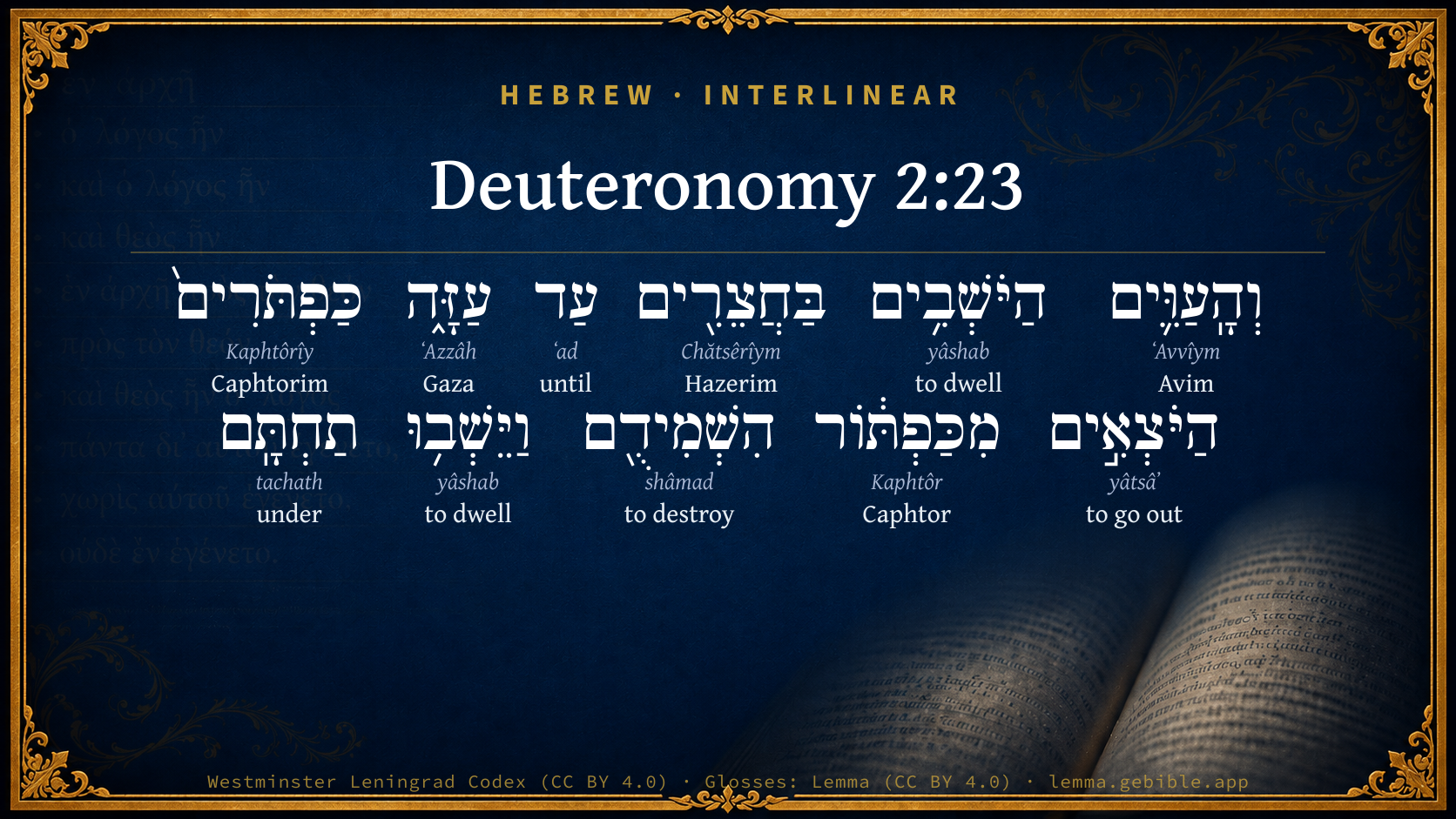
Hebrew (Westminster Leningrad Codex) Deuteronomy 2:23 appears in the Hebrew Old Testament. The text above is from the Westminster Leningrad Codex. Each word links to its Strong’s number, a concise gloss, and parsing drawn from the Open Scriptures Hebrew Bible morphology. Click any word for its full Brown-Driver-Briggs (BDB) entry.
Download image
Cite this verse

Deuteronomy 2:23 (World English Bible). Public Domain. Lemma interlinear Bible study tool, https://lemma.gebible.app/v/deuteronomy/2/23.

Show BibTeX & RIS
BibTeX
RIS
English Translation
and the Avvim, who lived in villages as far as Gaza, the Caphtorim, who came forth out of Caphtor, destroyed them, and lived in their place.)
World English Bible · Public Domain
Highlights
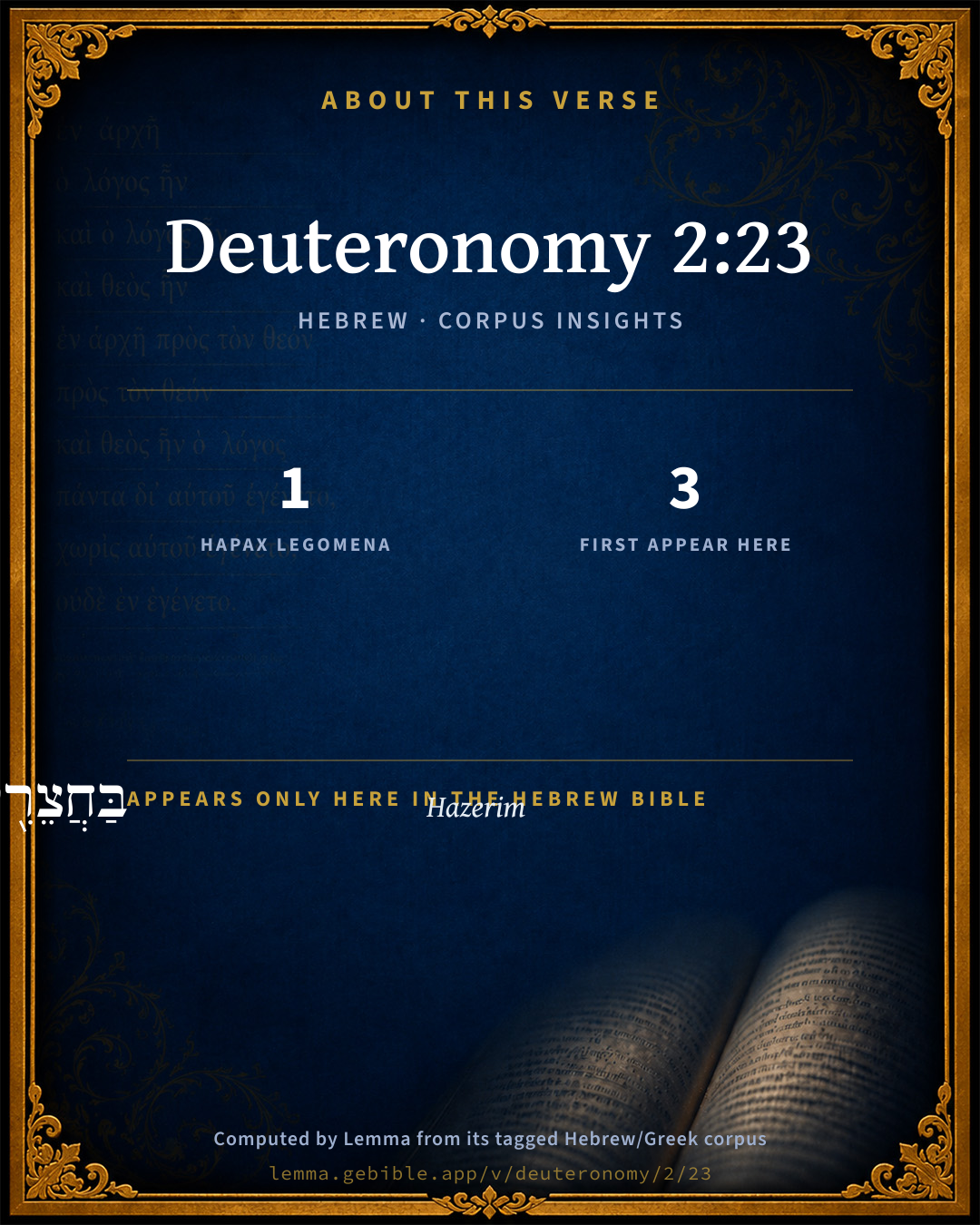
  • 1 hapax legomenon — only here in the Hebrew Bible
  • 3 first appearances in the Hebrew Bible
Full analysis ↓
Download a study sheet

One document with this verse’s original text, its word-by-word gloss line, the meaning frame, cross-references with their text, attributed commentary, and full source and license credits — printable, and it pastes into notes with its structure intact.

This verse Autodidact and up

Study sheet (.html) Plain text (.txt)

A passage Seminary Student

Up to 50 verses in one chapter. A passage sheet keeps up to 6 commentary sources and 12 cross-references per verse, in the order this page ranks them, and says so on the sheet whenever that leaves anything out. Ask for a single verse and you get the Autodidact verse sheet above.

Everything on this page stays free to read, with no account — the sheet is a download of what is already on screen, not access to it.

Want to remove ads? Support Godless Engineer
Compare translations 3

The same verse in 3 English versions, stacked beneath the original-language interlinear above. Click any original word for its lexicon entry.

Each is an independent rendering of the whole verse — the interlinear is not word-aligned to these translations.

Highlighted words mark where these versions differ — a whole-verse word diff, not a word-by-word alignment.

  • World English Bible Public Domain
    and the Avvim, who lived in villages as far as Gaza, the Caphtorim, who came forth out of Caphtor, destroyed them, and lived in their place.)
  • King James Version Public Domain
    And the Avims which dwelt in Hazerim, even unto Azzah, the Caphtorims, which came forth out of Caphtor, destroyed them, and dwelt in their stead.)
  • unfoldingWord Literal Text CC BY-SA 4.0
    And the Avvites who lived in villages as far as Gaza, the Caphtorites, who came from Caphtor, destroyed them and lived in their place.)

unfoldingWord Literal Text — © unfoldingWord, licensed CC BY-SA 4.0. Word-aligned USFM3 via Door43 (git.door43.org/unfoldingWord/en_ult).

Versions to compare (up to 4)

3 of 4 selected

Show all 18 translations

Every available English version of this verse, each an independent rendering of the whole verse.

  • World English Bible Public Domain
    and the Avvim, who lived in villages as far as Gaza, the Caphtorim, who came forth out of Caphtor, destroyed them, and lived in their place.)
  • Berean Standard Bible Public Domain
    And the Avvim, who lived in villages as far as Gaza, were destroyed by the Caphtorites, who came out of Caphtor and settled in their place.)
  • Majority Standard Bible Public Domain
    And the Avvim, who lived in villages as far as Gaza, were destroyed by the Caphtorites, who came out of Caphtor and settled in their place.)
  • King James Version Public Domain
    And the Avims which dwelt in Hazerim, even unto Azzah, the Caphtorims, which came forth out of Caphtor, destroyed them, and dwelt in their stead.)
  • American Standard Version (1901) Public Domain
    and the Avvim, that dwelt in villages as far as Gaza, the Caphtorim, that came forth out of Caphtor, destroyed them, and dwelt in their stead.)
  • Revised Version (1885) Public Domain
    and the Avvim which dwelt in villages as far as Gaza, the Caphtorim, which came forth out of Caphtor, destroyed them, and dwelt in their stead.)
  • Geneva Bible (1599) Public Domain
    And the Auims which dwelt in Hazarim euen vnto Azzah, the Caphtorims which came out of Caphtor destroyed them, and dwelt in their steade.
  • Douay-Rheims (1899) Public Domain
    The Hevites also, that dwelt in Haserim as far as Gaza, were expelled by the Cappadocians: who came out of Cappadocia, and destroyed them, and dwelt in their stead.
  • Young's Literal Translation Public Domain
    `As to the Avim who are dwelling in Hazerim unto Azzah, the Caphtorim -- who are coming out from Caphtor -- have destroyed them, and dwell in their stead.
  • Literal Standard Version CC BY-SA 4.0
    As for the Avim who are dwelling in villages as far as Gaza, the Caphtorim—who are coming out from Caphtor—have destroyed them, and dwell in their stead.
  • Unlocked Literal Bible CC BY-SA 4.0
    As for the Avvites who lived in villages as far as Gaza, the Caphtorim, who came from Caphtor, destroyed them and settled in their place.)
  • unfoldingWord Literal Text CC BY-SA 4.0
    And the Avvites who lived in villages as far as Gaza, the Caphtorites, who came from Caphtor, destroyed them and lived in their place.)
  • Darby Bible Public Domain
    And the Avvites who dwelt in the hamlets as far as Gazah -- the Caphtorim, who came out of Caphtor, destroyed them, and dwelt in their stead.)
  • World Messianic Bible Public Domain
    Then the Avvim, who lived in villages as far as Gaza: the Caphtorim, who came out of Caphtor, destroyed them and lived in their place.)
  • Webster's Bible Public Domain
    And the Avims who dwelt in Hazerim even to Azzah, the Caphtorims, who came forth from Caphtor, destroyed them, and dwelt in their stead.)
  • Free Bible Version CC BY-SA 4.0
    The Avvim, living in villages as far away as Gaza, were destroyed by the Philistines, who came from Crete, and settled where they used to live.)
  • Bible in Basic English Public Domain
    And the Avvim, living in the small towns as far as Gaza, came to destruction by the hands of the Caphtorim who came out from Caphtor and took their land.)
  • JPS Tanakh (1917) Public Domain
    and the Avvim, that dwelt in villages as far as Gaza, the Caphtorim, that came forth out of Caphtor, destroyed them, and dwelt in their stead. —

Literal Standard Version (2020), Covenant Press — licensed CC BY-SA 4.0. Text via the HelloAO Bible API (eBible.org). Unlocked Literal Bible (unfoldingWord) — licensed CC BY-SA 4.0. Text via the HelloAO Bible API (eBible.org). unfoldingWord Literal Text — © unfoldingWord, licensed CC BY-SA 4.0. Word-aligned USFM3 via Door43 (git.door43.org/unfoldingWord/en_ult). Free Bible Version, Dr. Jonathan Gallagher — licensed CC BY-SA 4.0. Text via the HelloAO Bible API (eBible.org).

Word by word

More ways to search: Search by grammar → Find every occurrence → Compare this word →

Practice this passage: Drill this verse → Learn its vocabulary →

בַּחֲצֵרִ֖ים
Chătsêrîym
H2699
“in/at · Hazerim”
Preposition + Noun, Common, Masculine, Plural, Absolute
Part of Speech
Preposition + Noun
Type
Common
Gender
Masculine
Number
Plural
State
Absolute
Full BDB Definition

Origin: pl. masc. of H2691

TWOT: None

Hazerim = "villages" - settlements of Ishmaelites
  1. וְהָֽעַוִּ֛ים ʻAvvîym H5761 “and · the · Avim” Conjunction + Particle, Definite Article + Noun, Proper
  2. הַיֹּשְׁבִ֥ים yâshab H3427 “the · dwelling” Particle, Definite Article + Verb, Qal, Participle Active, Masculine, Plural, Absolute
  3. עַד ʻad H5704 “until” Preposition
  4. עַזָּ֑ה ʻAzzâh H5804 “Gaza” Noun, Proper
  5. כַּפְתֹּרִים֙ Kaphtôrîy H3732 “Caphtorim” Noun, Gentilic, Masculine, Plural, Absolute
  6. הַיֹּצְאִ֣ים yâtsâʼ H3318 “the · going out” Particle, Definite Article + Verb, Qal, Participle Active, Masculine, Plural, Absolute
  7. מִכַּפְתּ֔וֹר Kaphtôr H3731 “from · Caphtor” Preposition + Noun, Proper
  8. הִשְׁמִידֻ֖ם shâmad H8045 “to destroy · them” Verb, Hiphil, Perfect, 3rd Person, Common, Plural + Suffix, Personal, 3rd Person, Masculine, Plural
  9. וַיֵּשְׁב֥וּ yâshab H3427 “and · to dwell” Conjunction + Verb, Qal, Sequential Imperfect, 3rd Person, Masculine, Plural
  10. תַחְתָּֽם tachath H8478 “under · them” Preposition + Suffix, Personal, 3rd Person, Masculine, Plural

About this verse

These counts appear in no published source. They are computed here, from the morphology-tagged text and Lemma’s own curated glosses. What Lemma adds →

11
words
10
distinct lemmas
Pentateuch
section

Notable vocabulary

1 hapax legomenon — a word that appears only here in the entire Hebrew Bible:

  • בַּחֲצֵרִ֖ים Hazerim H2699

First appearance in Scripture

These words make their first canonical appearance in the Hebrew Bible here:

  • וְהָֽעַוִּ֛ים Avim H5761
  • בַּחֲצֵרִ֖ים Hazerim H2699
  • מִכַּפְתּ֔וֹר Caphtor H3731

Shared distinctive vocabulary

וְהָֽעַוִּ֛ים Avim H5761 occurs in 2 verses of the Hebrew Bible. Also found in:

Grammatical profile

  • 4 verbs
  • 5 nouns
  • 2 prepositions

Verb forms

  • הַיֹּשְׁבִ֥ים Qal · Participle Active
  • הַיֹּצְאִ֣ים Qal · Participle Active
  • הִשְׁמִידֻ֖ם Hiphil · Perfect
  • וַיֵּשְׁב֥וּ Qal · Sequential Imperfect

Repetition

A word recurs within this verse — often emphatic in Hebrew:

  • הַיֹּשְׁבִ֥ים to dwell H3427 ×2

Hebrew & Septuagint length

In English translation the verse runs 26 words from the Hebrew and 24 from the Septuagint (LXX English) — closely comparable.

A rough comparison of the two English renderings, which tokenize alike — not a word-level alignment.

Word counts can differ between the Hebrew and the Greek without any difference in meaning — e.g. the Hebrew direct-object marker אֵת has no separate Greek word, and Greek often adds the article ὁ.

Cross-references

9

Topical passages linked to Deuteronomy 2:23 in the Treasury of Scripture Knowledge — connected by theme and wording, ordered by reader-vote popularity; previews shown in the World English Bible.

  • Genesis 10:14 Pathrusim, Casluhim (which the Philistines descended from), and Caphtorim.
  • Joshua 13:3 from the Shihor, which is before Egypt, even to the border of Ekron northward, [which] is reckoned to the Canaanites; the five lords of the Philistines; the Gazites, and the Ashdodites, the Ashkelonites, the Gittites, and the Ekronites; also the Avvim,
  • Amos 9:7 Are you not like the children of the Ethiopians to me, children of Israel?" says Yahweh. "Haven't I brought up Israel out of the land of Egypt, and the Philistines from Caphtor, and the Syrians from Kir?
  • Jeremiah 25:20 and all the mixed people, and all the kings of the land of the Uz, and all the kings of the Philistines, and Ashkelon, and Gaza, and Ekron, and the remnant of Ashdod;
  • Jeremiah 47:4 because of the day that comes to destroy all the Philistines, to cut off from Tyre and Sidon every helper who remains: for Yahweh will destroy the Philistines, the remnant of the isle of Caphtor.
  • 1 Kings 4:24 For he had dominion over all [the region] on this side the River, from Tiphsah even to Gaza, over all the kings on this side the River: and he had peace on all sides round about him.
  • Zephaniah 2:4 For Gaza will be forsaken, and Ashkelon a desolation. They will drive out Ashdod at noonday, and Ekron will be rooted up.
  • Zechariah 9:5 Ashkelon will see it, and fear; Gaza also, and will writhe in agony; As will Ekron, for her expectation will be disappointed; And the king will perish from Gaza, And Ashkelon will not be inhabited.
  • Acts 17:26 He made from one blood every nation of men to dwell on all the surface of the earth, having determined appointed seasons, and the boundaries of their dwellings,

Cross-references courtesy of OpenBible.info (CC BY 4.0).

Hebrew and Greek witnesses Masoretic Hebrew ↔ Greek Septuagint

The same verse in the two great witnesses to the Old Testament, shown verse-for-verse.

These are two independent witnesses, not word-aligned to each other, and the Septuagint is shown in lemma (dictionary) form.

Hebrew Deuteronomy 2:23 Masoretic · Westminster Leningrad Codex

וְהָֽעַוִּ֛ים הַיֹּשְׁבִ֥ים בַּחֲצֵרִ֖ים עַד עַזָּ֑ה כַּפְתֹּרִים֙ הַיֹּצְאִ֣ים מִכַּפְתּ֔וֹר הִשְׁמִידֻ֖ם וַיֵּשְׁב֥וּ תַחְתָּֽם

and the Avvim, who lived in villages as far as Gaza, the Caphtorim, who came forth out of Caphtor, destroyed them, and lived in their place.)

World English Bible · Public Domain

Greek LXX Deuteronomy 2:23 Septuagint · lemma form

καί ὁ ευαῖος ὁ καταοἰκέω ἐν ασηρωθ ἕως γάζα καί ὁ καππάδοκες ὁ ἐκἔρχομαι ἐκ καππαδοκία ἐκτρίβω αὐτός καί καταοἰκίζω ἀντί αὐτός

And the Evites who dwell in Asedoth to Gaza, and the Cappadocians who came out of Cappadocia, destroyed them, and lived in their room.

LXX2012 (modern English Septuagint) · Public Domain

On this verse, John Gill's Exposition discusses the Septuagint’s reading. Read the note in Commentary ↓

Hebrew: Westminster Leningrad Codex (CC BY 4.0). Greek: Septuagint (public domain); English from LXX2012 (modern English Septuagint) (Public Domain). How the Septuagint differs from the Hebrew →

Targum (Aramaic paraphrase)

2

The Targum is the ancient Jewish Aramaic paraphrase of the Hebrew Scriptures — an interpretive translation, not the Hebrew text itself. Onkelos (literal) and Pseudo-Jonathan (expansive) render the Torah, and Jonathan the Prophets. Coverage is partial: where no permissively-licensed English translation exists for a verse, only the Aramaic is shown. This is verse-level text, not a word-by-word alignment to the Hebrew.

  1. Targum Onkelos Torah (Genesis–Deuteronomy)
    וְעַוָאֵי דְיָתְבִין בִּדְפִיחַ עַד עַזָה קַפּוּטְּקָאֵי דִנְפָקוּ מִקַפּוּטְקַיָא שֵׁצָיוּנוּן וִיתִיבוּ בְאַתְרֵיהוֹן

    (no public-domain English translation for this verse)

    Targum Onkelos — Aramaic: “Onkelos Genesis” (public domain); “Onkelos Exodus” (public domain); “Onkelos Leviticus” (public domain); “Onkelos Numbers” (public domain); “Onkelos Deuteronomy” (public domain). English: “Sefaria Community Translation” (CC0 1.0 (public-domain dedication)); “J.W. Etheridge. The Targums of Onkelos and Jonathan Ben Uzziel on the Pentateuch. London: Longmans, Green, 1862” (public domain). Text via Sefaria.

  2. Targum Pseudo-Jonathan Torah (Genesis–Deuteronomy)
    וּשְׁאָר פְּלֵיטַת כְּנַעֲנָאֵי דַּהֲווֹ שָׁרָן בְּכוּפְרָנַיָא דִפְרִיעַ עַד עַזָּה קַפּוּטְקָאֵי דִנְפָקוּ מִן קַפּוּטְקְיָאָה שֵׁיצֵיאוּנוּן וִיתִיבוּ בְּאַתְרֵיהוֹן

    And the rest of the escaped of the Kenaanah which dwelt in the cities of Dephia to Gaza, the Kapotkaee who came out of Kapotkaia destroyed them, and dwelt in their place.

    Targum Pseudo-Jonathan — Aramaic: “Targum Jonathan on Genesis” (public domain); “Targum Jonathan on Exodus” (public domain); “Targum Jonathan on Leviticus” (public domain); “Targum Jonathan on Numbers” (public domain); “Targum Jonathan on Deuteronomy” (public domain). English: “The Targum of Jonathan ben Uzziel, trans. J. W. Etheridge, London, 1862” (public domain). Text via Sefaria.

Commentary

Notes on Deuteronomy 2:23 from classic Christian and Jewish commentators (each source and its license shown beneath its notes). The classic Christian expositions comment on the surrounding passage and are grouped to its opening verse, so a note may address several verses; the Jewish commentaries on the Tanakh (Rashi and others) are per-verse, so they appear only where the commentator wrote on this verse.

Lemma curates 59 commentaries, every one of them public domain or Creative Commons licensed, each selected and text-cleaned for this edition rather than reprinted as found. About our sources →

Trapp's Complete Commentary

John Trapp

Deu 2:23 And the Avims which dwelt in Hazerim, [even] unto Azzah, the Caphtorims, which came forth out of Caphtor, destroyed them, and dwelt in their stead.)

Ver. 23. And the Avims, which dwelt in Hazeroth.] These are ancient things, as it is said in another case, {1Ch 4:22} such, as whereof there is no record but this extant in the world. Well might that Egyptian priest say to Solon, that wise man of Greece, You Greeks are very babies - γερων δε ελλην ουκ εστι - neither is there an ancient writer amongst you. {a}

{a} Diod. Sic.

John Trapp, A Commentary or Exposition upon All the Books of the Old and New Testament (1647–1656) — public domain. Text from a community e-Sword module.

Joseph Benson's Commentary

Deu 2:23. And the Avims which dwelt in Hazerim — This is another instance of God’s disposal of countries unto what people he pleases. The Avims are mentioned Jos 13:3, as the ancient inhabitants of Palestine. The Caphtorims — A people akin to, or a branch of, the Philistines, so called, probably, from their founder, who settled in Caphtor, a country in or about Egypt, see Gen 10:14. By producing these instances of God’s displacing one people, and settling another in their stead, Moses designed to strengthen the faith of the Israelites in the divine promise of giving them the victory over all their enemies, and settling them in the land of Canaan.

Joseph Benson's Commentary on the Old and New Testaments (1811–1818) — public domain. Text from a community e-Sword module.

Tyndale Open Study Notes

Tyndale Open Resources

2:23 The Caphtorites were descendants of Ham and were originally from Crete, a large island south of the Greek peninsula. The Caphtorites are usually identified with the Philistines (see Gen 10:6-14; 1 Chr 1:8-12). The Philistine presence in Canaan resulted from two separate movements, one in the time of the Hebrew patriarchs (see study note on Gen 21:32) and another that began about 1200 BC (see study notes on Josh 13:2; Judg 3:3). This passage apparently refers to the earlier settlement. • The Avvites were indigenous inhabitants of the lower Mediterranean coastal plain; they were supplanted in Gaza by the early wave of Philistines (cp. Josh 13:2-4).

Tyndale Open Study Notes — © Tyndale Open Resources, licensed CC BY-SA 4.0. Text via the HelloAO Bible API.

Geneva Bible (1599)

Geneva Bible translators

Or, Gaza.

Geneva Bible (1599) marginal notes — public domain. Text via Bolls.life.

Ellicott's Commentary for English Readers

(23) The Avims which dwelt in Hazerim, even unto Azzah, the Caphtorims . . . destroyed.—“In Hazerim” should apparently be rendered “in villages.” It does not occur elsewhere as a proper name; it is plural in form, and is found in this sense in some other places. “Azzah,” i.e., Gaza. The Caphtorim: comp. Amo_9:7 : “The Philistines from Caphtor.” (See Gen_10:14.) Some make the country of Caphtor to be Cyprus or Crete. But at least this statement makes Philistia the scene of a conquest, and the Philistines of the time of Joshua would thus appear to be a mixed race.

A Bible Commentary for English Readers, edited by Charles John Ellicott (1878–1897) — public domain. Text from a community e-Sword module.

John Gill's Exposition

And the Avim, which dwelt in Hazerim, even unto Azzah,.... The same with the Avites, who appear to have inhabited some part of the land of the Philistines, in which Azzah or Gaza was, which was one of the five lordships of the Philistines, Jos 13:3. The word Hazerim signifies courts, and a learned man (e) interprets it of tents or huts placed in a square or circular form, so as to have an area in the middle; and in such the Avim may be supposed to dwell, while in Palestine, as far as Gaza:

the Caphtorim, which came from out of Caphtor, destroyed them; according to the Targums of Onkelos and Jonathan, and the Septuagint and Vulgate Latin versions, these were Cappadocians, that came out of Cappadocia; but it seems manifest that they were originally of Egypt, see Gen 10:14 and Bochart (f) thinks they went from thence into that part of Cappadocia that was near Colchis; but things not answering their expectations, they returned, and drove out the Avim from their country:

and dwelt in their stead; See Gill on Jer 47:4, Amo 9:7. Though it seems as if they were not utterly destroyed, but some escaped into Assyria, and settled there, where was a place called Ava from them; and from whence they were sent by the king of Assyria to repeople the cities of Samaria, after the captivity of the ten tribes; see Kg2 17:24. Now these several instances are observed to encourage the children of Israel to hope and believe that they should be able to dispossess the Canaanites, and inherit their land; such dispossessions having been very frequent, when it was the will of God they should take place.

(e) Clayton's Chronology of the Hebrew Bible, p. 65. (f) Phaleg. l. 4. c. 32. col. 291, 292.

John Gill's Exposition of the Whole Bible (1746–1763) — public domain (CC PDM 1.0). Text via the HelloAO Bible API.

Haydock's Catholic Bible Commentary

Haserim, the same as Haseroth, Numbers xxxiii. 17. --- Gaza belonged to the Philistines. The intermediate country, or the south part of Chanaan, occupied by the Hevites, was seized by invaders from the isle of Cyprus, (Hebrew, Caphtorum; Calmet; Genesis x. 14,) or from Egypt, which the Nile intersects, forming many islands, in the Delta, Jeremias xlvii. 4. The Cappadocians, who dwelt in Asia Minor, on the Euxine sea, were a different nation, and sprung from Japhet. (Tirinus)

George Leo Haydock (1774–1849), Haydock's Catholic Family Bible and Commentary, 1859 edition — public domain. Excludes Psalms (Douay-Rheims chapter numbering differs from Protestant) and Deuterocanonical books (Catholic canon only).

Matthew Poole's English Annotations

Caphtorims, a people akin to the Philistines, Gen 10:14, and confederate with them in this enterprise, and so dwelling together, and by degrees were probably united together by marriages or other ways, and became one people, the Caphtorims being at last swallowed up in the Philistines. See Jer 47:4; Amo 9:7.

Caphtor is by the learned thought to be Cappadocia; whither these people might make an expedition out of Egypt, either because of the report of the great riches of part of that country, which drew others thither from places equally remote, or after the manner of those ancient times, or for some other reason now unknown.

Matthew Poole's English Annotations on the Holy Bible (1683–1685) — public domain. Text from a community e-Sword/MySword module.

Whedon's Commentary on the Bible

Daniel D. Whedon

23. The Avim are identified with the Avites of Jos_13:3. Azzah is the Hebrew form of Gaza, one of the chief cities of the Philistines.

Caphtorim — Caphtor (Gen_10:14) has been identified with the Egyptian name of the northern delta, from which the Phoenicians emigrated into Asia. These four verses may have been introduced by a later editor.

Daniel D. Whedon (gen. ed.), Commentary on the Old and New Testaments (1874–1909) — public domain. Text from a community e-Sword module.

The Pulpit Commentary

So also the Caphtorim, who came from Caphtor, (Gen_10:14) probably the island of Crete (Ritter, 3:262), drove out the Avim, a Canaanitish race, who dwelt in villages (Hazerim, as far as Gaza (Azzah), and took possession of their land; though it would appear some of them still remained among the Philistines (who were Caphtorites, (Jer_47:4) and were among the tribes not subdued by the Israelites under Joshua. (Jos_13:3) These Caphtorim were, like the Israelites, immigrants, who drove out the original occupants of the country; and on this account, probably, are referred to by Moses here. "This is so often repeated, to possess the minds of the Israelites with a sense of God"s providence, which rules everywhere; displacing one people, and settling another in their stead, and fixing their bounds, also, which they shall not pass without leave" (Patrick).

The Pulpit Commentary (1880–1919), ed. H.D.M. Spence-Jones & Joseph S. Exell — public domain. Text from a community e-Sword module.

John Wesley's Explanatory Notes

The Caphtorim - A people a-kin to the Philistines, Gen. x, 14, and confederate with them in this enterprize, and so dwelling together, and by degrees uniting together by marriages, they became one people. Caphtor - Which is by the learned thought to be Cappadocia: whither these people might make an expedition out of Egypt, either because of the report of the great riches of part of that country which drew others thither from places equally remote, or for some other reason now unknown.

John Wesley, Explanatory Notes Upon the Whole Bible (1754–1765) — public domain. Text via the GEBible commentary corpus.

unfoldingWord translationNotes

Door43 World Missions Community

General Information:

The writer finishes describing how God enabled Esau to conquer the land Esau is now inhabiting.

Avvites ... Caphtorim

These are names of people groups. (See: How to Translate Names)

Caphtor

This is the name of a place. It may be another name for the island of Crete located in the Mediterranean Sea. (See: How to Translate Names)

destroyed them

"destroyed the Avvim"

settled in their place

"lived where the Avvim had lived"

translationWords

Gaza

unfoldingWord translationNotes — © Distant Shores Media and the Door43 World Missions Community, licensed CC BY-SA 4.0. Source: git.door43.org/Door43/en_tn.

Rashi

Rabbi Shlomo Yitzchaki (Rashi)

והעוים הישבים בחצרים וגו׳ BUT THE AVIM WHO DWELL IN HAZERIM etc. —The Avim are part of the Philistine people, for they are enumerated together with them in the Book of Joshua (Joshua 13:3), as it is said, “The five lords of the Philistines, the Gazathites, and the Ashdothites, and the Eshkalonites, the Gittites, and the Ekronites; also the Avim”. But because of the oath which Abraham had sworn to Abimelech, king of the Philistines (Genesis 21:24), Israel would have been unable to take their land out of their possession; but, says God, I brought the Caphtorites against them and they destroyed them and dwelt in their stead, and now you are permitted to take it (that land) from their (the Caphtorites) possession (Chullin 60b).

Rashi on the Tanakh — English translations: “The Judaica Press complete Tanach with Rashi, translated by A. J. Rosenberg” (CC BY 4.0); “Pentateuch with Rashi's commentary by M. Rosenbaum and A.M. Silbermann, 1929-1934” (public domain); “The Metsudah Tanach series, Lakewood, N.J” (CC BY 4.0); and “The Book of Joshua, Metsudah Publications, 1997” (CC BY 4.0). Text via Sefaria.

Ramban (Nachmanides)

Rabbi Moshe ben Nachman (Ramban / Nachmanides)

AND THE AVIM THAT DWELT IN VILLAGES. Scripture is stating of the Avim that dwelt in villages — without a wall around them as far as Gaza which was the Canaanite border, as it is said, And the border of the Canaanite was from Zidon, as thou goest toward Gerar, unto Gaza — the Caphtorim that came forth out of Caphtor destroyed them and they dwelt in their stead. Now the Caphtorim were descendants of Mitzraim, Verses 13-14. and their land was not part of the gift given to Abraham; nevertheless their land was possessed by Israel because the Caphtorim had conquered it from the children of Canaan. The verse stating with reference to the land of the Philistines, for unto thee [Isaac], and unto thy seed, I will give all these lands, 26:3. was said for this reason: that the land [of the Philistines] originally belonged to the children of Canaan. Therefore, in the days of Joshua Israel drove out the five lords of the Philistines: the Gazite, the Ashdodite, the Ashkelonite, the Gittite, and the Ekronite; also the Avim, for they all dwelled within the Canaanite border — in Gaza, Ashkelon, Ashdod, and in Ekron. They [the lords] were called by the name of their place [i.e., the Gazite, the Ashdodite etc. because, although they were foreigners, after their conquest of these five Canaanite towns, they adopted their names], for they destroyed the Avim who were of the children of Canaan who dwelled within the border of the Canaanite from Zidon, as thou goest toward Gerar, unto Gaza, and they abode in their stead. Zidon also belonged to the Philistines, as it is written, And also what are ye to Me, O Tyre, and Zidon, and all the regions of Philistia? In my opinion the Avim are identical with the Hivites [who were of the children of Canaan], for such is the customary way of Scripture to alter names, as we have said, so long as they indicate the same meaning, and “the serpent” (the Hivites), which is of the term chivah — a snake. ye’aveit (curves) itself.. Thus the Chivim are identical with the Avim, as both names suggest the snake and its characteristic of crawling crookedly. And in Bereshith Rabbah [we find the following text]: “Said Rabbi Eleazar the son of Rabbi Shimon: They were as expert in [tasting] earth [to determine which crops it is capable of producing] as the serpent [whose only food is the earth]. In the Galilee they call chivya (a serpent) ivya.” The Sages used to call it achna, and also chachina. that such was the reading in the Talmud. Thus it is clear that the letters a’yin and cheth are interchangeable, which explains why the name “Avim” is identical with “Chivim.” The Rabbis have interpreted: “‘Vayei’ather’ (and He was entreated) of him, and heard his supplication. Said Rabbi Levi: In Arabia they call chatirah (an opening) atirah” [and the meaning of the verse is thus: “and the Eternal made ‘an opening’ for his prayer to be accepted”].. Ramban uses this text to prove that the letter a’yin [in the word vayei’ather — “and He was entreated”] interchanges with the cheth [vayeichather — and He made “an opening”]. This is an additional support to Ramban’s thesis that the Avim are identical with the Chivim — the Hivites. Ramban will go on to cite several further examples of the interchangeability of the letters a’yin and cheth. — In conclusion it should be noted that the episode with Menasheh, king of Judah, illustrates the efficacy of repentance under all circumstances, for even when all the “gates” were closed to his supplication, Menasheh’s prayers were yet accepted through a special “opening” in the “Throne of the Almighty.” The Rabbis have also said: “How hath the Eternal ‘ya’iv’ (a cloud): How hath the Eternal ‘covered with a cloud’ … The Midrash will explain it as though it were written with a cheth, as Ramban continues. the daughter of Zion in His anger! Rabbi Chama the son of Rabbi Chanina explained it as follows: how has the Eternal chiyeiv (assigned guilt) in His anger! There are places where they call chiva (guilt) iva.” Chavkim (rungs) are called avkim. (rungs).” See also Vol. I, p. 350. Such [interchangeability of the letters a’yin and cheth] is common in the language. Of Rabbi “Chiya” [the Rabbis say], “And what does ‘Iya’ say of this matter?” Our Rabbis were also accustomed to speak of heisei’ach hada’ath (distractedness or absent-mindedness) instead of hisa hada’ath [changing the a’yin of hisa to cheth of heisei’ach]. In the Jerusalem Talmud, they always [use the term] hisiya [to signify “distractedness”]. And in the Mishnah we also find: “[If someone was clean] v’heisia (and had given up the thought of) eating.” Commentators have also said of the verse ‘ushu’ and come all ye nations that it is like chushu (hasten ye). And in the Mechilta we find: 7. “Ufasachti, Rabbi Yashiya says: Do not read ufasachti (and I will protect), but read ufusati (and I will step over), meaning that G-d, blessed be He, will ‘pass over’ the houses of the children of Israel.” He [Rabbi Yashiya] made ufasachti refer to the word p’sioth (steps) by interchanging the cheth with an a’yin.Scripture now finished informing us about the entire land of the Hivites that was lost [to them]. Part of it was taken by [the children of] Esau and that is forbidden to us, and part of it was taken by the Caphtorim and we may take it from them.And in Bereshith Rabbah I have found that the Avim are identical with Rephaim [and not with the Hivites as we have stated hitherto]. Thus the Rabbis comment on the verse, The Nephilim were in the earth: “The Rephaim are the Avim. They were called Rephaim [of the root raphoh — weak] because the heart of anyone who beheld them became weak as wax. They were called Avim [of the term ivya — serpent] because they were as expert as a serpent [whose food is the earth] in [tasting] earth [to determine which crops it is capable of producing].” The Rabbis further said there with reference to G-d’s gift to Abraham: “Rabbi Dostoie in the name of Rabbi Shmuel said: Because He does not mention here [among the lands of the ten nations given to Abraham] the Hivite, therefore, He introduced the Rephaim in their place.” Now when I pondered this text, I found the matter to be true and authentic, correct and affirmed. For Moses our teacher mentioned to them the seven nations [whose lands] Israel inherited, as he said, and He shalt cast out many nations before thee, the Hittite, and the Girgashite, and the Amorite, and the Canaanite, and the Perizzite, and the Hivite, and the Jebusite, seven nations greater and mightier than thou. Now six of these are mentioned in the gift given to Abraham, but the Hivite is not mentioned there! Then he [the Hivite] must in any case be either the Rephaim or of the Kenite, Kenizzite, and Kadmonite, Verse 19. [all of whom are mentioned in the gift to Abraham]. All our Rabbis say that Israel did not inherit [the lands of] the Kenite, Kenizzite and Kadmonite, but that He will make them inherit [those lands] in the future, and about them it is said, And when the Eternal thy G-d enlarge thy boundary, as He hath sworn unto thy fathers, and give thee all the land which He promised to give unto thy fathers. And so also it is not mentioned anywhere that they inherited them in the days of Joshua. If so, the Rephaim given by Him to Abraham must be the Hivite, who was the sixth son of Canaan, and who was called Hivi by his father; while in the days of Abraham they surnamed him Rephaim. In my opinion the name Rephaim is derived from that of the Chivi [Hivite — which as explained above denotes “a serpent”], related to the expression on the lair of the asp and on the viper’s den, for things that are hidden in the earth [like the serpent], the [Hebrew] language calls ‘rephaim’, for example: ‘ha’rephaim’ (the dead) tremble beneath the waters and the inhabitants thereof; and the earth shall bring to life ‘rephaim’ (the dead). Now the children of this Hivite were very numerous and, when the families of the Canaanite spread abroad, this family took possession of large territories, some of them called “the land of Rephaim;” others, [“the land of] Horites;” and some, [“the land of] Avim;” and generally they were all Hivites, and they were all Rephaim, just as, among our people [there are] Ephraim, Judah, Israel — but generally speaking, all are [called] Israel. Now, these names [Rephaim, Horites, Avim] are all descriptives derived from the name Chivi [Hivite — which denotes “a serpent”] since his name was Chivi they surnamed him Rephaim from chivya (a serpent) because the serpent dwells in the holes of the earth [and things that lie hidden in the earth are called “Rephaim,” as explained above]. They were likewise called “the Horite” and “the Avim” because of their association with the term serpent, as I have explained above. and a’yin interchange. Now since chivya is a snake, the word “Avim” likewise denotes the same. Ramban did not explain the name Chorim (Horites) above; but it is obvious that his intent is that the name is derived from the word chur (a hole), since the serpent dwells in a lair in the ground. Now the Holy One, blessed be He, gave to Abraham [the land of] the Rephaim in general, and Moses mentioned to Israel “the Hivite” which was the first name by which his father [Canaan] called him, for the land of Rephaim was already divided in the days of Moses and parts of it [i.e., that belonging to Moab, Ammon, and the children of Esau] were forbidden to Israel. Thus Scripture comes here to mention the subject of the entire land of the Hivites, who are Rephaim, and all that was done with it. First it states that the Emim were also of the Rephaim and the Moabites succeeded them. Then it states that the children of Esau succeeded the Horites, who were also of the Rephaim. And then it repeats that the land of Ammon was also the land of Rephaim, and all this was forbidden to Israel. He also narrated that the Caphtorim who came from Caphtor took part of their land [i.e., of the Avim who are also Rephaim] and that [on account of the Caphtorim’s prior conquest] it was permissible for Israel. Thus Joshua mentioned [to the children of Joseph] the land of the Perizzites and of the Rephaim [wherein they were to settle].However, Rashi wrote: “The Avim were of the Philistine people, Verse 6). But only the land of the children of Canaan was given to Abraham. How Rashi’s opinion affects the subject under consideration will be made clear in the text which follows. for they are enumerated together with them in the Book of Joshua: [the five lords of the Philistines:] the Gazite, and the Ashdodite, the Ashkelonite, the Gittite, and the Ekronite, also the Avim. But, because of the oath that Abraham had sworn to Abimelech, 21:24. Israel could not go into their land to remove them from their territory. Therefore, I brought upon them the Caphtorim and they destroyed them [i.e., the Avim who were Philistines] and they dwelled in their stead; now you are permitted to take it from them [i.e., the Caphtorim].” But the intent of Rashi’s words are not clear to me. For Scripture [in the verse from Joshua quoted above] does not enumerate the Avim among the Philistines; instead it refers to the five lords of the Philistines and lists them — and then mentions the Avim as a separate people. The verse states that from the Shihor, which is before Egypt, even unto the border of Ekron northward — all this is accounted the land of Canaan; [the lands of] the five lords of the Philistines that it lists, with the Avim who are another people. But according to the Rabbi [Rashi] the land of the Avim became permissible to Israel because the Caphtorim had taken it from them, but who made permissible [the lands of] the other lords of the Philistines? Canaanites and, consequently, their land is permissible to Israel. The same was true of the five lords of the Philistines who had taken the land away from the Canaanites; hence Joshua was permitted to take it from them. All this explains Ramban’s interpretation. Rashi, however, wrote that the Avim were part of the Philistine people, and Verse 23 before us informs us that their land was made permissible to Israel because the Caphtorim had taken it from them. On this Ramban asks: if so, what made the lands of the five lords of the Philistines permissible to Israel? There are other questions as well, which Ramban raises on Rashi’s interpretation. And why did the Israelites conquer all of them, for Joshua was the one who suppressed the Philistines and the Avim! Moreover, [according to Rashi] why should the land of the Philistines belong to Abraham altogether and why did Abimelech find it necessary to make his covenant [with Abraham], 21:24. in this matter, when the Philistines are of the children of Mitzraim, and so were the Caphtorim, and they were not of the ten nations [given to Abraham]?, 15:19-21. — The question on Rashi is thus made all the stronger: If the Avim and the Caphtorim were Philistines, why should the land of the Avim have become permissible to Israel as a result of its conquest by the Caphtorim? Whichever of the two held the land, it was a Philistine possession and Philistia was not permissible to Israel. But the [fact of the] matter is the opposite! For the Caphtorim and the Philistines [children of Mitzraim] destroyed the Canaanites, as indicated by the fact that Abimelech [a Philistine, not a Canaanite] was the king of Gerar, [indicating that the Canaanites had been driven out], 20:2. and the Gazite dwelled in Gaza, and Zidon was a Philistine city. All these were part of the Canaanite territories, as it is said, And the border of the Canaanite was from Zidon, as thou goest toward Gerar, unto Gaza., 10:19.Now it appears to me that the Philistines and Caphtorim [children of Mitzraim] were considered one people, and so Scripture states, For the Eternal will spoil the Philistines, the remnant of the isle of Caphtor. And this is the sense of the expression [in the verse before us], the Caphtorim that came forth out of Caphtor. It was out of Caphtor that a small [band of] people came forth to sojourn where they could find a place. They destroyed the Avim who were of the seed of Canaan that dwelled as far as Gaza, and the Caphtorim dwelled in their stead in Gaza, Ashkelon, Ashdod, Gath, and Ekron — all these places being within the borders of the land of Canaan and they divided it among their five lords. The name of these districts was Philistia and they were called Philistines. The Avim were left with the remainder of their land as Joshua mentioned. According to Ramban this indicates that the Philistines [who are identical with the Caphtorim, as explained] took but part of the land of the Avim [as stated in Verse 23 before us] while the Avim were still left with part of their land. Now, since the Avim are identical with the Hivites who were of the children of Canaan, Joshua was permitted to take the entire original land of the Avim — what had been conquered by the five lords of the Philistines, as well as what was still in the hands of the Avim. It is this which is meant by the verse the Philistines, the remnant of the isle of Caphtor, for the Caphtorim were Philistines. This is also the meaning of the expression, whence went forth the Philistines and the Caphtorim, as I have explained there., Vol. I, pp. 149-150. As to what Scripture states, Have I not brought up Israel out of Egypt, and the Philistines from Caphtor, and Aram from Kir? — [which would seem to indicate that the Philistines were a separate nation that was redeemed from Caphtor just as Israel was a separate nation that was redeemed from Egypt — thus contradicting Ramban’s thesis that the Philistines and the Caphtorim were one nation — the explanation is as follows:] The verse there is speaking of the wars of the Eternal. It was He Who brought up Israel from the land of Egypt by signs, and by wonders, and by war, and He brought up the Philistines from Caphtor, their land, because He brought them forth from there, to deliver unto them the Avim through a great miracle and they destroyed them, and dwelt in their stead [as stated in Verse 23 before us] and they left the land of Caphtor to their brothers. Or the matter may have been as I have mentioned, that the Avim, the children of Canaan who first dwelled in the land, were known as Philistines because the name of the land was Philistia. When the Caphtorim that came forth out of Caphtor subdued them, they exiled some of them to their land Caphtor which was part of the land of Egypt, settling them among their brothers [the Caphtorim]. G-d redeemed them [i.e., the Avim who were known as Philistines] from there and they returned to their original place [in the land of Canaan]. We know not in which generation this happened. Thus the Philistines were inhabitants of the land of Canaan, and, therefore, Scripture states, The word of the Eternal is against you, O Canaan, the land of the Philistines; I will even destroy thee, that there shall be no inhabitant. And so Israel did not drive out the Philistines until the time of the oath had expired, when three generations [Abraham] wilt not deal falsely with me, nor with my son, nor with my son’s son (Genesis 21:23). of Philistines in that land of Abimelech had died. And so the Rabbis have said in the Midrash: 1. “For that was ‘near,’ [meaning] the oath which Abraham had sworn to Abimelech was yet ‘near’ [i.e., was still in effect, because] his grandson was still living” [and therefore G-d did not lead the people through Philistia after the exodus from Egypt]. This is a fitting and correct interpretation of this subject.However, in the Gemara [of Tractate Chullin] in the Chapter V’eilu Treifoth ” among cattle. It is the third chapter of Tractate Chullin. The text quoted is on 60b. the Rabbis have cited an opinion in a dispute agreeing with the words of Rashi [that the Avim were Philistines]. Rav in Babylon, laid the foundation for the great Yeshivoth in Babylon. He was a pupil of Rabbi Yehudah Hanasi, also called Rabbeinu Hakadosh, the redactor of the Mishnah in Eretz Yisrael. Rav returned to his native Babylon where he founded the Academy of Sura which existed for about eight hundred years without interruption. His real name was Abba, but because of the great respect accorded to him he was called “Rav,” as Rabbi Yehudah Hanasi was called simply “Rabbi.” said there that the Avim came from Teman, and we learned a Beraitha that concurs with him. Teman is of the seed of Edom, as it is written, Of Edom, thus said the Eternal of hosts: Is wisdom no more in Teman? This is possible, and, [if so] Scripture is stating of the Avim, who are of the children of Esau, [that] part of their land was made permissible [to Israel] through the Caphtorim [who took it from the Avim], just as [parts of the lands of] Ammon and Moab were made permissible by Sihon [conquering them]. And what I have written is good and upright.

Ramban (Nachmanides) on the Tanakh — English translation: “Commentary on the Torah by Ramban (Nachmanides). Translated and annotated by Charles B. Chavel. New York, Shilo Pub. House, 1971-1976” (CC BY 4.0). Text via Sefaria.

Lesson kit

Teaching starters — assembled from the data on this page, not authored interpretation. Every prompt links to the verse data it draws on. Edit before teaching.

Deuteronomy, in the Pentateuch, opens this verse with 11 words (10 distinct Hebrew lemmas). Its most distinctive word is Chătsêrîym (“Hazerim”). A historical commentator’s framing appears above. Read the whole chapter for the surrounding context.

Discussion questions

  1. The word Chătsêrîym carries the sense “Hazerim.” How does it shape the verse?
  2. This verse holds 1 word here found nowhere else in the Hebrew Bible. What might the rare word draw attention to?
  3. 3 words here appear for the first time in Scripture. What is being introduced at this debut?
  4. Joshua 18:23 shares the word «Avim» with this verse. How do the two illuminate each other?
  5. “to dwell” occurs 2× in this one verse. What is the effect of the repetition?
  6. These translations render this verse differently; the difference is in the English rendering, not the original. What questions does that raise?
  7. The verb «הַיֹּשְׁבִ֥ים» is Qal Participle Active. How does its form color the action?
  8. Reading how Trapp's Complete Commentary and Joseph Benson's Commentary read this verse, where do the two commentators agree and where do they part?

Things to notice

  • 1 word in this verse appears nowhere else in the Hebrew Bible.
  • 3 words make their first canonical appearance in Scripture here.
  • These translations choose different wording for 20 words in this verse.
  • “to dwell” occurs 2× in this single verse.
  • 10 distinct Hebrew lemmas span 11 words in this verse.

Reading settings

Reading text

Shown beneath each verse's original-language words.

Old Testament
Old Testament edition

Read the OT as the Masoretic Hebrew (MT) or the Greek Septuagint (LXX).

English shown for the Greek Septuagint (in the Hebrew ↔ Greek comparison).

Comparing translations? Open the Compare panel on any verse page to stack up to four side by side.