Exodus 12:40

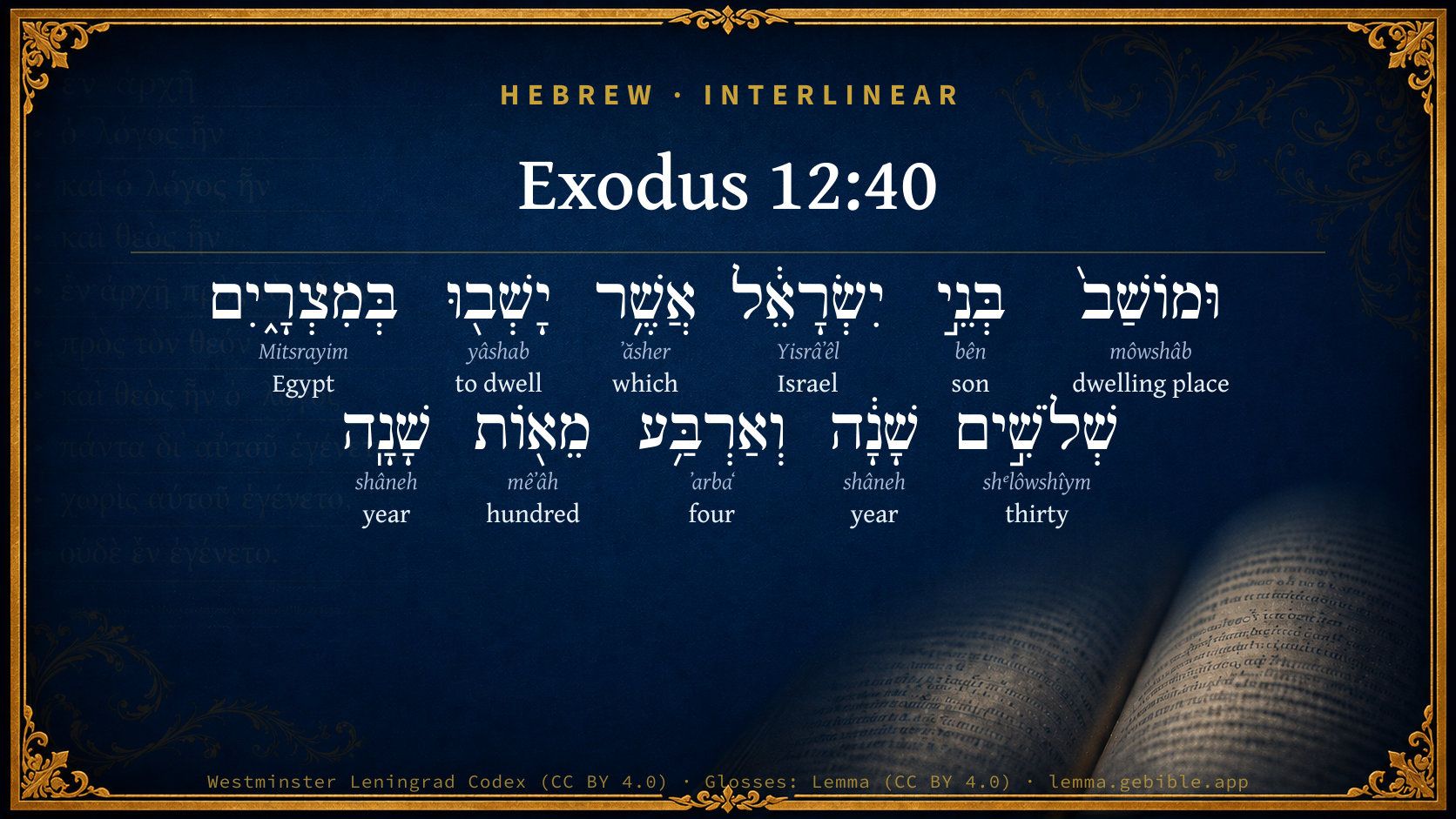
Hebrew (Westminster Leningrad Codex) Exodus 12:40 appears in the Hebrew Old Testament. The text above is from the Westminster Leningrad Codex. Each word links to its Strong’s number, a concise gloss, and parsing drawn from the Open Scriptures Hebrew Bible morphology. Click any word for its full Brown-Driver-Briggs (BDB) entry.
Download image
Cite this verse

Exodus 12:40 (World English Bible). Public Domain. Lemma interlinear Bible study tool, https://lemma.gebible.app/v/exodus/12/40.

Show BibTeX & RIS
BibTeX
RIS
English Translation
Now the time that the children of Israel lived in Egypt was four hundred thirty years.
World English Bible · Public Domain
Download a study sheet

One document with this verse’s original text, its word-by-word gloss line, the meaning frame, cross-references with their text, attributed commentary, and full source and license credits — printable, and it pastes into notes with its structure intact.

This verse Autodidact and up

Study sheet (.html) Plain text (.txt)

A passage Seminary Student

Up to 50 verses in one chapter. A passage sheet keeps up to 6 commentary sources and 12 cross-references per verse, in the order this page ranks them, and says so on the sheet whenever that leaves anything out. Ask for a single verse and you get the Autodidact verse sheet above.

Everything on this page stays free to read, with no account — the sheet is a download of what is already on screen, not access to it.

Want to remove ads? Support Godless Engineer
Compare translations 3

The same verse in 3 English versions, stacked beneath the original-language interlinear above. Click any original word for its lexicon entry.

Each is an independent rendering of the whole verse — the interlinear is not word-aligned to these translations.

Highlighted words mark where these versions differ — a whole-verse word diff, not a word-by-word alignment.

  • World English Bible Public Domain
    Now the time that the children of Israel lived in Egypt was four hundred thirty years.
  • King James Version Public Domain
    Now the sojourning of the children of Israel, who dwelt in Egypt, was four hundred and thirty years.
  • unfoldingWord Literal Text CC BY-SA 4.0
    And the residence of the sons of Israel, during which they resided in Egypt, was 430 years.

unfoldingWord Literal Text — © unfoldingWord, licensed CC BY-SA 4.0. Word-aligned USFM3 via Door43 (git.door43.org/unfoldingWord/en_ult).

Versions to compare (up to 4)

3 of 4 selected

Show all 18 translations

Every available English version of this verse, each an independent rendering of the whole verse.

  • World English Bible Public Domain
    Now the time that the children of Israel lived in Egypt was four hundred thirty years.
  • Berean Standard Bible Public Domain
    Now the duration of the Israelites’ stay in Egypt was 430 years.
  • Majority Standard Bible Public Domain
    Now the duration of the Israelites’ stay in Egypt was 430 years.
  • King James Version Public Domain
    Now the sojourning of the children of Israel, who dwelt in Egypt, was four hundred and thirty years.
  • American Standard Version (1901) Public Domain
    Now the time that the children of Israel dwelt in Egypt was four hundred and thirty years.
  • Revised Version (1885) Public Domain
    Now the sojourning of the children of Israel, which they sojourned in Egypt, was four hundred and thirty years.
  • Geneva Bible (1599) Public Domain
    So the dwelling of the children of Israel, while they dwelled in Egypt, was foure hundreth and thirtie yeres.
  • Douay-Rheims (1899) Public Domain
    And the abode of the children of Israel that they made in Egypt, was four hundred and thirty years.
  • Young's Literal Translation Public Domain
    And the dwelling of the sons of Israel which they have dwelt in Egypt `is' four hundred and thirty years;
  • Literal Standard Version CC BY-SA 4.0
    And the dwelling of the sons of Israel [in] which they have dwelt in Egypt [is] four hundred and thirty years;
  • Unlocked Literal Bible CC BY-SA 4.0
    The Israelites had lived in Egypt for 430 years.
  • unfoldingWord Literal Text CC BY-SA 4.0
    And the residence of the sons of Israel, during which they resided in Egypt, was 430 years.
  • Darby Bible Public Domain
    And the residence of the children of Israel that they resided in Egypt was four hundred and thirty years.
  • World Messianic Bible Public Domain
    Now the time that the children of Israel lived in Egypt was four hundred thirty years.
  • Webster's Bible Public Domain
    Now the sojourning of the children of Israel who dwelt in Egypt, was four hundred and thirty years.
  • Free Bible Version CC BY-SA 4.0
    The Israelites had lived in Egypt for 430 years.
  • Bible in Basic English Public Domain
    Now the children of Israel had been living in Egypt for four hundred and thirty years.
  • JPS Tanakh (1917) Public Domain
    Now the time that the children of Israel dwelt in Egypt was four hundred and thirty years.

Literal Standard Version (2020), Covenant Press — licensed CC BY-SA 4.0. Text via the HelloAO Bible API (eBible.org). Unlocked Literal Bible (unfoldingWord) — licensed CC BY-SA 4.0. Text via the HelloAO Bible API (eBible.org). unfoldingWord Literal Text — © unfoldingWord, licensed CC BY-SA 4.0. Word-aligned USFM3 via Door43 (git.door43.org/unfoldingWord/en_ult). Free Bible Version, Dr. Jonathan Gallagher — licensed CC BY-SA 4.0. Text via the HelloAO Bible API (eBible.org).

Word by word

More ways to search: Search by grammar → Find every occurrence → Compare this word →

Practice this passage: Drill this verse → Learn its vocabulary →

וּמוֹשַׁב֙
môwshâb
H4186
“and · dwelling place of”
Conjunction + Noun, Common, Masculine, Singular, Construct
Part of Speech
Conjunction + Noun
Type
Common
Gender
Masculine
Number
Singular
State
Construct
Full BDB Definition

Origin: from H3427 ; a seat

TWOT: 922c

seat, assembly, dwelling-place, dwelling, dwellers - seat, sitting, those sitting, sitting company or assembly - dwelling place, dwelling - situation, location - time of dwelling - those dwelling, dweller
  1. בְּנֵ֣י bên H1121 “sons of” Noun, Common, Masculine, Plural, Construct
  2. יִשְׂרָאֵ֔ל Yisrâʼêl H3478 “Israel” Noun, Proper
  3. אֲשֶׁ֥ר ʼăsher H834 “which” Particle, Relative
  4. יָשְׁב֖וּ yâshab H3427 “to dwell” Verb, Qal, Perfect, 3rd Person, Common, Plural
  5. בְּמִצְרָ֑יִם Mitsrayim H4714 “in/at · Egypt” Preposition + Noun, Proper
  6. שְׁלֹשִׁ֣ים shᵉlôwshîym H7970 “thirty” Adjective, Cardinal number, Both, Plural, Absolute
  7. שָׁנָ֔ה shâneh H8141 “year” Noun, Common, Feminine, Singular, Absolute
  8. וְאַרְבַּ֥ע ʼarbaʻ H702 “and · four” Conjunction + Adjective, Cardinal number, Feminine, Singular, Absolute
  9. מֵא֖וֹת mêʼâh H3967 “hundred” Adjective, Cardinal number, Both, Plural, Absolute
  10. שָׁנָֽה shâneh H8141 “year” Noun, Common, Feminine, Singular, Absolute

About this verse

These counts appear in no published source. They are computed here, from the morphology-tagged text and Lemma’s own curated glosses. What Lemma adds →

11
words
10
distinct lemmas
Pentateuch
section

Shared distinctive vocabulary

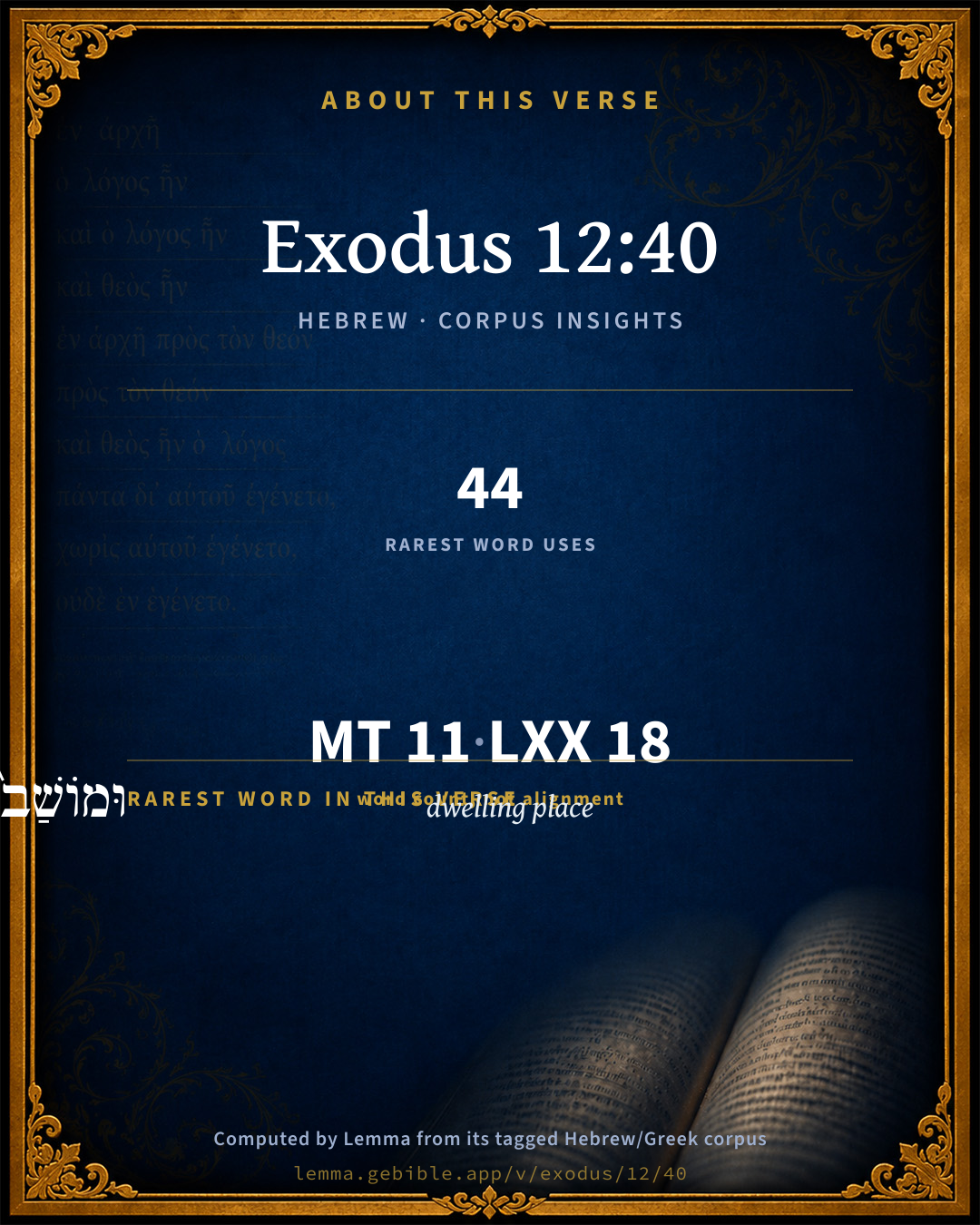
וּמוֹשַׁב֙ dwelling place H4186 occurs in 43 verses of the Hebrew Bible. Also found in:

Grammatical profile

  • 1 verb
  • 6 nouns
  • 3 adjectives
  • 1 particle

Verb forms

  • יָשְׁב֖וּ Qal · Perfect

Repetition

A word recurs within this verse — often emphatic in Hebrew:

  • שָׁנָ֔ה year H8141 ×2

Hebrew & Septuagint length

In English translation the verse runs 16 words from the Hebrew and 27 from the Septuagint (LXX English) — the Septuagint runs noticeably longer here. See the side-by-side →

A rough comparison of the two English renderings, which tokenize alike — not a word-level alignment.

Word counts can differ between the Hebrew and the Greek without any difference in meaning — e.g. the Hebrew direct-object marker אֵת has no separate Greek word, and Greek often adds the article ὁ.

In the original languages it is 11 Hebrew tokens and 18 Greek tokens — but the two are counted differently (Hebrew bundles its prefixes and suffixes into one token; the Greek is in lemma form), so that isn’t a like-for-like length.

Cross-references

6

Topical passages linked to Exodus 12:40 in the Treasury of Scripture Knowledge — connected by theme and wording, ordered by reader-vote popularity; previews shown in the World English Bible.

  • Genesis 15:13 He said to Abram, "Know for sure that your seed will live as foreigners in a land that is not theirs, and will serve them. They will afflict them four hundred years.
  • Acts 7:6 God spoke in this way: that his seed would live as aliens in a strange land, and that they would be enslaved and mistreated for four hundred years.
  • Acts 13:17 The God of this people chose our fathers, and exalted the people when they stayed as aliens in the land of Egypt, and with an uplifted arm, he led them out of it.
  • Genesis 12:1–3 Now Yahweh said to Abram, "Get out of your country, and from your relatives, and from your father's house, to the land that I will show you.
  • Galatians 3:16–17 Now the promises were spoken to Abraham and to his seed. He doesn't say, "To seeds," as of many, but as of one, "To your seed," which is Christ.
  • Hebrews 11:9 By faith, he lived as an alien in the land of promise, as in a land not his own, dwelling in tents, with Isaac and Jacob, the heirs with him of the same promise.

Cross-references courtesy of OpenBible.info (CC BY 4.0).

Hebrew and Greek witnesses Masoretic Hebrew ↔ Greek Septuagint

The same verse in the two great witnesses to the Old Testament, shown verse-for-verse.

Here the Septuagint runs noticeably longer than the Hebrew — LXX2012 (modern English Septuagint) 27 words vs World English Bible 16. A rough length comparison of the two English translations, not a word-level alignment — read both below.

These are two independent witnesses, not word-aligned to each other, and the Septuagint is shown in lemma (dictionary) form.

Hebrew Exodus 12:40 Masoretic · Westminster Leningrad Codex

וּמוֹשַׁב֙ בְּנֵ֣י יִשְׂרָאֵ֔ל אֲשֶׁ֥ר יָשְׁב֖וּ בְּמִצְרָ֑יִם שְׁלֹשִׁ֣ים שָׁנָ֔ה וְאַרְבַּ֥ע מֵא֖וֹת שָׁנָֽה

Now the time that the children of Israel lived in Egypt was four hundred thirty years.

World English Bible · Public Domain

Greek LXX Exodus 12:40 Septuagint · lemma form

ὁ δέ κατοίκησις ὁ υἱός ἰσραήλ ὅς καταοἰκέω ἐν γῆ αἴγυπτος καί ἐν γῆ χανααν ἔτος τετρακόσιοι τριάκοντα

And the sojourning of the children of Israel, while they sojourned in the land of Egypt and the land of Chanaan, was four hundred and thirty years.

LXX2012 (modern English Septuagint) · Public Domain

On this verse, Joseph Benson's Commentary discusses the Septuagint’s reading. Read the note in Commentary ↓

Hebrew: Westminster Leningrad Codex (CC BY 4.0). Greek: Septuagint (public domain); English from LXX2012 (modern English Septuagint) (Public Domain). How the Septuagint differs from the Hebrew →

Targum (Aramaic paraphrase)

2

The Targum is the ancient Jewish Aramaic paraphrase of the Hebrew Scriptures — an interpretive translation, not the Hebrew text itself. Onkelos (literal) and Pseudo-Jonathan (expansive) render the Torah, and Jonathan the Prophets. Coverage is partial: where no permissively-licensed English translation exists for a verse, only the Aramaic is shown. This is verse-level text, not a word-by-word alignment to the Hebrew.

  1. Targum Onkelos Torah (Genesis–Deuteronomy)
    וּמוֹתַב בְּנֵי יִשְׂרָאֵל דִי יְתִיבוּ בְּמִצְרָיִם אַרְבַּע מְאָה וּתְלָתִין שְׁנִין:

    (no public-domain English translation for this verse)

    Targum Onkelos — Aramaic: “Onkelos Genesis” (public domain); “Onkelos Exodus” (public domain); “Onkelos Leviticus” (public domain); “Onkelos Numbers” (public domain); “Onkelos Deuteronomy” (public domain). English: “Sefaria Community Translation” (CC0 1.0 (public-domain dedication)); “J.W. Etheridge. The Targums of Onkelos and Jonathan Ben Uzziel on the Pentateuch. London: Longmans, Green, 1862” (public domain). Text via Sefaria.

  2. Targum Pseudo-Jonathan Torah (Genesis–Deuteronomy)
    וְיוֹמַיָא דְיָתִיבוּ בְּנֵי יִשְרָאֵל בְּמִצְרַיִם תְּלָתִין שְׁמִיטִין דִּשְׁנִין דִּסְכוּמְהוֹן מָאתָן וְעֶשֶר שְׁנִין וּמִנְיַן אַרְבַּע מְאָה וּתְלָתִין שְׁנִין מִן דְּמַלֵּיל יְיָ לְאַבְרָהָם מִן שַׁעְתָּא דְמַלֵּיל עִמֵּיהּ בַּחֲמֵיסַר בְּנִיסָן בֵּינֵי פְּסוּגַיָיא עַד יוֹמָא דִּנְפָקוּ מִמִּצְרַיִם

    And the days of the dwelling of the sons of Israel in Mizraim were thirty weeks of years, (thirty times seven years,) which is the sum of two hundred and ten years. But the number of four hundred and thirty years (had passed away since) the Lord spake to Abraham, in the hour that He spake with him on the fifteenth of Nisan, between the divided parts, until the day that they went out of Mizraim.

    Targum Pseudo-Jonathan — Aramaic: “Targum Jonathan on Genesis” (public domain); “Targum Jonathan on Exodus” (public domain); “Targum Jonathan on Leviticus” (public domain); “Targum Jonathan on Numbers” (public domain); “Targum Jonathan on Deuteronomy” (public domain). English: “The Targum of Jonathan ben Uzziel, trans. J. W. Etheridge, London, 1862” (public domain). Text via Sefaria.

Commentary

Notes on Exodus 12:40 from classic Christian and Jewish commentators (each source and its license shown beneath its notes). The classic Christian expositions comment on the surrounding passage and are grouped to its opening verse, so a note may address several verses; the Jewish commentaries on the Tanakh (Rashi and others) are per-verse, so they appear only where the commentator wrote on this verse.

Lemma curates 59 commentaries, every one of them public domain or Creative Commons licensed, each selected and text-cleaned for this edition rather than reprinted as found. About our sources →

Trapp's Complete Commentary

John Trapp

Exo 12:40 Now the sojourning of the children of Israel, who dwelt in Egypt, [was] four hundred and thirty years.

Ver. 40. Was four hundred and thirty years,] sc., From the time that Abraham began to sojourn in the land of Canaan, and to pass into Egypt. {Gen 12:10} See Gal 3:17, {See Trapp on "Gal 3:17"}

John Trapp, A Commentary or Exposition upon All the Books of the Old and New Testament (1647–1656) — public domain. Text from a community e-Sword module.

The Biblical Illustrator

Joseph S. Exell

Exo_12:40-41

All the hosts of the Lord went out.

The Exodus

I. We cannot treat the Exodus as an isolated fact in history. Egypt is the type of the cunning, careless, wanton world, out of which in all ages God is calling His sons. The Exodus remained a living fact in history. The infant Jesus went down into Egypt, as the infant Israel went down, not to repeat the Exodus, but to illume afresh its fading lines.

1. The Children of Israel were an elect race, because they were of the seed of Abraham: that constituted their distinctity. You are of the race of the second Adam, of the same flesh and blood as Jesus; and all who wear a human form and understand a human voice, God calls forth from Egypt; His voice calls to His sons, Come forth to freedom, life, and heaven.

2. You, like the Israelites, are called forth to the desert, the fiery pillar, the manna, the spiritual rock; and while you aim at Canaan, His will, His heart, are on your side.

II. Note the moral features of the Exodus.

1. There was a life in Egypt which had become insupportable to a man. That bondage is the picture of a soul round which the devils toils are closing.

2. The Israelites saw the stroke of heaven fall oil all that adorns, enriches, and nourishes a worldly life.

3. They had a Divine leader, a man commissioned and inspired by God. We have the Apostle and High Priest of our profession, Christ Jesus, who, in the house and the work in which Moses wrought as a servant, represents God as the Son.

4. We discern a condition of utter dependence on the strength and faithfulness of God. They and we were delivered by a Divine work.

5. Notice, lastly, the freedom of the delivered Israelites; a broad, deep sea flowing between them and the ]and of bondage, and the tyrants dead upon the shore. Such is the glorious sense of liberty, of wealth, of life, when the deep sea of Divine forgiving love sweeps over the past and obliterates its shame. (J. B. Brown, B. A.)

The Exodus

I. First, consider the mode of their going out.

1. When the Children of Israel went out of Egypt it is a remarkable thing that they were forced out by the Egyptians. The dove fleeth not to his cote unless the eagle doth pursue it; so sins, like eagles, pursue the timid soul, making it fly into the clefts of the Rock Christ Jesus to hide itself. Once, our sins kept us from Christ; but now every sin drives us to Him for pardon. I had not known Christ if I had not known sin; I had not known a deliverer, if I had not smarted under the Egyptians. The Holy Spirit drives us to Christ, just as the Egyptians drove the people out of Egypt.

2. Again: the Children of Israel went out of Egypt covered with jewels and arranged in their best garments. Ah! that is just how a child of God comes out of Egypt. He does not come out of his bondage with his old garments of self-righteousness on: oh! no; as long as he wears those he will always keep in Egypt; but he marches out with the blood and righteousness of Jesus Christ upon him, and adorned with the goodly graces of the Holy Spirit.

3. Note, moreover, that these people obtained their jewels from the Egyptians. Gods people never lose anything by going to the house of bondage. They win their choicest jewels from the Egyptians. Strangely true it is, sins do me good, said an old writer once, because they drive me to the Saviour; and so I get good by them. Ask the humble Christian where he get his humility, and ten to one he will say that he got it in the furnace of deep sorrow on account of sin. See another who is tender in conscience: where did he get that jewel from? It came from Egypt, Ill be bound. We get more by being in bondage, under conviction of sin, than we often do by liberty.

4. They came out in haste. I never met with a poor sinner under a sense of sin who was not in haste to get his burden off his back. No man has a broken heart, unless he wants to have it bound up directly. To-day if ye will hear His voice, harden not your heart, says the Holy Ghost; He never says to-morrow; to-day is His continual cry, and every true-born Israelite will pant to get out of Egypt, whenever he has the opportunity.

II. The magnitude of this deliverance. I would have you particularly remember one thing; and that is, that great as this emigration was, and enormous as were the multitudes that quitted Egypt, it was only one Passover that set them all free. One agonizing sacrifice, one death on Calvary, one bloody sweat on Gethsemane, one shriek of It is finished consummated all the work of redemption.

III. The completeness of their deliverance. As Moses said, Not an hoof shall be left behind. They were to have all their goods, as well as their persons. What does this teach us? Why, not only that all Gods people shall be saved, but that all that Gods people ever had shall be restored. All that Jacob ever took down to Egypt shall be brought out again. Have I lost a perfect righteousness in Adam? I shall have a perfect righteousness in Christ. Have I lost happiness on earth in Adam? God will give me much happiness here below in Christ. Have I lost heaven in Adam? I shall have heaven in Christ; for Christ came not only to seek and to save the people that were lost, but that which was lost: that is, all the inheritance, as well as the people; all their property.

IV. The time when the israelites came out of Egypt. God had promised to Abraham that His people should be in bondage four hundred and thirty years, and they were not in bondage one day more. As soon as Gods bond became due, though it had been drawn four hundred and thirty years before, He paid the bill; He required no more time to do it in, but He did it at once. Christopher Ness says, they had to tarry for the fulfilment of the promise till the night came; for though He fulfilled it the selfsame day, He made them stay to the end of it, to prove their faith. He was wrong there, because Scripture days begin at night. The evening and the morning were the second day. So that God did not make them wait, but paid them at once. As soon as the day came, beginning with our night, as the Jewish day does now, and the Scriptural day always did--as soon as the clock struck--God paid His bond. (C. H. Spurgeon.)

The Biblical Illustrator, edited by Joseph S. Exell (c. 1880s–1900s) — public domain. Text from a community e-Sword module.

Joseph Benson's Commentary

Exo 12:40. Who dwelt in Egypt — Or sojourned. We must observe, that it is not said, The sojourning of the children of Israel in Egypt was four hundred and thirty years; but the sojourning of the children of Israel, who dwelt in Egypt — That is, the sojourning of the Israelitish nation, from the time that Abraham left his native country to sojourn in Canaan, to the release of his posterity, who were long sojourners in Egypt, was four hundred and thirty years. Therefore, the Samaritan copy hath it, Who dwelt in the land of Canaan and in Egypt. So the Vatican edition of the LXX. It was just four hundred and thirty years from the promise made to Abraham (as the apostle explains it, Gal 3:17) at his first coming into Canaan, during all which time the Hebrews were sojourners in a land that was not theirs, either Canaan or Egypt. So long the promise God made to Abraham lay dormant and unfulfilled, but now it revived, and things began to work toward the accomplishment of it. The first day of the march of Abraham’s seed toward Canaan was four hundred and thirty years (it should seem, to a day) from the promise made to Abraham, Gen 12:2, “I will make of thee a great nation.” What reason have we then to admire the exact accomplishment of God’s promise! Notwithstanding the various revolutions and changes of all worldly affairs that must necessarily have happened in the space of four hundred and thirty years, yet God’s promise stands sure amidst them all. Yes, God’s word will stand fast for ever and ever! Heaven and earth may pass away, but his word cannot pass away.

Joseph Benson's Commentary on the Old and New Testaments (1811–1818) — public domain. Text from a community e-Sword module.

The Preacher's Complete Homiletical Commentary

Joseph S. Exell (gen. ed.)

MAIN HOMILETICS OF THE PARAGRAPH.—Exo_12:40-42

THE PILGRIM CONDITION OF GODLY SOULS IN THE PRESENT LIFE

I. That the pilgrim condition of godly souls in this life often involves long-continued suffering and bondage. The Israelites were slaves in Egypt, and this was part of the discipline through which they had to pass prior to their entrance on the promised land. Their bondage was severe, and it was long-continued. It was somewhat inexplicable that the heirs of promise should be called to endure such pain; but the children of God are not exempt from even the most painful discipline of life. The time of such discipline is Divinely ordered and arranged, and at the longest soon comes to an end, though the hours and days are lengthened when spent in sorrow and woe. But even in this condition the pilgrim soul has rich promises on which it can rely and which tend to brighten its future with hope. This captivity is productive of moral growth, as it was of the numerical growth of Israel. Hence godly souls in the present life are in a pilgrim condition; they are passing through great sorrows, they are subject to much painful discipline, but the time will come when they shall be free from all such oppression and woe.

II. That the pilgrim condition of godly souls in this life is often called into the glad experience of freedom, and to realise the fulfilment of rich promise. The Israelites are now freed from the bondage of Egypt; by a wondrous providence they are led out from the tyranny of Pharaoh. They realise the promise of God concerning them. And so the pilgrim condition of the soul does not preclude moments of glad release from suffering, even though the suffering may come in another way, for the pilgrim only exchanges the perils of Egypt for those of the wilderness. The conditions of pilgrimage change in this life, though the fact of pilgrimage is unalterable. But kind Heaven makes ample and welcome provision for all the needs and exigencies of the pilgrim life. The soul is guided in its wilderness march. It has manna given. It has the refreshing waters of Horeb. But many souls faint and fail in the desert life; only two of the great multitude of the Israelites were permitted to enter Canaan. The journey of life is a test of character.

III. That the pilgrim condition of godly souls is frequently associated with religious ordinances of a pious character. The Israelites were to celebrate their deliverance from the bondage of Egypt by the observance of the Passover. The night was to be much remembered by them in all the generations of the future, and was to be consecrated by the strict performance of religious ceremonies. And so the soul in its pilgrim condition has many pious ordinances established by Heaven to remind it of glad experiences, and to inspire it with continued hope. In the journey of life there are many feasts unto the Lord, in which a pious soul can take a part.

SUGGESTIVE COMMENTS ON THE VERSES

Exo_12:40-42. The heirs of Canaan may sojourn in Egypt.

The time of sojourning is determined by God for His Church below.

The longest time of suffering here has its appointed end.

The night and day of the Church’s redemption is a time of observation toward God.

The children of the Church are obligated to observe God’s redemption of His people.

ILLUSTRATIONS

BY

REV. WM. ADAMSON

Affliction! Exo_12:40. When Moses and Aaron failed in their first attempt with Pharaoh, and brought increased oppression upon them, the Israelites looked at their position as dark indeed. Thus, when from a distance we look upon a thick forest, it appears one mass of gloomy shade—dark, unbroken, impenetrable. But as we draw near and enter it, we find it intersected by paths, rugged perhaps, and narrow, yet safe. So was it with Israel, as they passed within the dark wood of adversity; they found paths in the plagues of Egypt—winding and rugged for them, it may be, but safe. They looked up, and the light from above struggled through like a soft, green twilight; while here and there brilliant sunbeams of Divine truth and love glanced like diamond-shafts through the foliage, and showed them that what once appeared all gloom, was instinct with life and liberty—less with bane than blessing. So that

“Dull is the heart that loves not then

The deep recess of the wildwood glen,

Where roc and red-deer find sheltering den,

When the sun is in his power.”

—Scott.

Prompt Obedience! Exo_12:41. When a general commands his army to march at the midnight hour, and stand their chance of finding shelter and sustenance on the morrow, if the soldiers refuse, they are not an obedient, disciplined host. But if, at the reading of the orders, they at once break up quarters, however dark the night, and however dreary the prospect, then they march in obedience. The obedience must not be forced, but cheerful. It must be rendered with alacrity, not amid discontent and murmuring. Israel’s host received their orders to march at the midnight hour, and they at once yielded. However apparently unreasonable the requirement of the father, it is the little child’s duty to obey; and so God’s children readily obey the pilgrim-call—

“Only guided by His light,

Only mighty in His might.”

—Wesley.

The Preacher's Complete Homiletical Commentary (gen. ed. Joseph S. Exell; Funk & Wagnalls, c. 1892) — public domain (pre-1929). A full-Bible homiletical/sermon-outline anthology covering 65 of 66 books (2 John is absent from the source module). Text from a community e-Sword module.

Tyndale Open Study Notes

Tyndale Open Resources

12:40 According to the Septuagint and the Samaritan Pentateuch, 430 years would cover the full period from the promise to Abraham (Gen 12; 15) until the Exodus. Cp. Gal 3:17; see further Exodus Book Introduction, The Date of the Exodus.

Tyndale Open Study Notes — © Tyndale Open Resources, licensed CC BY-SA 4.0. Text via the HelloAO Bible API.

Jamieson, Fausset & Brown

Robert Jamieson, A. R. Fausset & David Brown

the sojourning of the children of Israel . . . four hundred and thirty years--The Septuagint renders it thus: "The sojourning of the children and of their fathers, which they sojourned in the land of Canaan and in the land of Egypt." These additions are important, for the period of sojourn in Egypt did not exceed two hundred fifteen years; but if we reckon from the time that Abraham entered Canaan and the promise was made in which the sojourn of his posterity in Egypt was announced, this makes up the time to four hundred thirty years.

Jamieson, Fausset & Brown — Commentary Critical and Explanatory on the Whole Bible (1871) — public domain (CC PDM 1.0). Text via the HelloAO Bible API.

Adam Clarke's Commentary

Verse 40. Now the sojourning of the children of Israel, c.] The statement in this verse is allowed on all hands to be extremely difficult, and therefore the passage stands in especial need of illustration. "That the descendants of Israel did not dwell 430 years in Egypt," says Dr. Kennicott, "may be easily proved, and has often been demonstrated. Some therefore imagine that by Egypt here both it and Canaan are to be understood. But this greater latitude of place will not solve the difficulty, since the Israelites, including Israel their father, did not sojourn 430 years in both countries previous to their departure from Egypt. Others, sensible of the still remaining deficiency, would not only have Egypt in the text to signify it and Canaan, but by a figure more comprehensive would have the children of Israel to mean Israel's children, and Israel their father, and Isaac the father of Israel, and part of the life of Abraham, the father of Isaac.

"Thus indeed," says Dr. Kennicott, "we arrive at the exact sum, and by this method of reckoning we might arrive at any thing but truth, which we may presume was never thus conveyed by an inspired writer." But can the difficulty be removed without having recourse to such absurd shifts? Certainly it can. The Samaritan Pentateuch, in all its manuscripts and printed copies, reads the place thus: -

[Samaritan]

Umoshab beney Yishrael veabotham asher yashebu baarets Cenaan, ubaarets mitsraim sheloshim shanah vearba meoth shanah.

"Now the sojourning of the children of Israel, and of their fathers, which they sojourned in the land of Canaan and in the land of Egypt, was 430 years." This same sum is given by St. Paul, Ga 3:17, who reckons from the promise made to Abraham, when God commanded him to go to Canaan, to the giving of the law, which soon followed the departure from Egypt and this chronology of the apostle is concordant with the Samaritan Pentateuch, which, by preserving the two passages, they and their fathers, and in the land of Canaan, which are lost out of the present copies of the Hebrew text, has rescued this passage from all obscurity and contradiction. It may be necessary to observe that the Alexandrian copy of the Septuagint has the same reading as that in the Samaritan. The Samaritan Pentateuch is allowed by many learned men to exhibit the most correct copy of the five books of Moses; and the Alexandrian copy of the Septuagint must also be allowed to be one of the most authentic as well as most ancient copies of this version which we possess. As to St. Paul, no man will dispute the authenticity of his statement; and thus in the mouth of these three most respectable witnesses the whole account is indubitably established. That these three witnesses have the truth, the chronology itself proves: for from Abraham's entry into Canaan to the birth of Isaac was 25 years, Ge 12:4; Ge 17:1-21; Isaac was 60 years old at the birth of Jacob, Ge 25:26; and Jacob was 130 at his going down into Egypt, Ge 47:9; which three sums make 215 years. And then Jacob and his children having continued in Egypt 215 years more, the whole sum of 430 years is regularly completed. See Kennicott's Dissertation on the Hebrew Text.

Adam Clarke's Commentary on the Bible (1810–1826) — public domain. Text from a community e-Sword/MySword module.

Ellicott's Commentary for English Readers

(40) The sojourning of the children of Israel, who dwelt in Egypt.—Heb., which they sojourned in Egypt

Was four hundred and thirty years.—Comp. the prophecy:—“Thy seed shall be a stranger in a land that is not theirs [Egypt, not Canaan], and shall serve them; and they shall afflict them four hundred years and also that nation whom they shall serve will I judge” (Gen_15:13-14). The genealogy of Joshua (1Ch_7:22-27), which places him in the eleventh generation from Jacob, accords well with this term of years. The other genealogies are more or less abbreviated.

A Bible Commentary for English Readers, edited by Charles John Ellicott (1878–1897) — public domain. Text from a community e-Sword module.

The Cambridge Bible for Schools and Colleges

gen. ed. J. J. S. Perowne

40. four hundred and thirty years] cf. the round number 400 in Gen_15:13 (hence Act_7:6, Jos. Ant. ii. 9.1, BJ. v. 9. 4). Whether it is historically correct is more than we can say: not only is Egyptian chronology itself uncertain, but we do not know the Eg. king under whom Jacob went down into Egypt; hence we have no independent data for fixing with precision the interval between Jacob’s migration into Egypt and the Exodus. The chronology of P (from whom all systematic dates in the Pent. are derived) is artificial, and in many of its particulars entirely undeserving of confidence: still this figure may itself be correct. It is however inconsistent with the many passages of P (see on Exo_6:27), which place Moses and his contemporaries in the fourth generation from Jacob’s sons. P himself may have been unconscious of the inconsistency; for he may have reckoned—of course, falsely—a generation at 100 years (cf. Gen_15:16, comp. with 13). In a later age it appears to have been noticed; and in all probability the reading of LXX. Sam. here ‘in the land of Egypt, and in the land of Canaan, was 430 years,’ originated in an endeavour to lessen it: for, as the period from Abraham’s migration into Canaan to Jacob’s descent into Egypt was (according to P) 215 years (Gen_12:4; Gen_21:5; Gen_25:26; Gen_47:9), this reading reduces the period of the sojourn in Egypt to half of that stated in the Heb. text. The reading of Sam. LXX. was followed by St Paul in Gal_3:17, by Jos. Ant. ii. 15. 2, and by many ancient Jewish and Christian authorities; but it cannot be the original text; not only has Israel’s sojourn in Egypt alone to do with the present context, but until the birth of Jacob’s sons there were no ‘children of Israel’ to dwell in Canaan at all. Cf. the Introd. p. xlv.

40, 41. The length of Israel’s sojourn in Egypt.

The Cambridge Bible for Schools and Colleges (gen. ed. J. J. S. Perowne; Cambridge University Press, 1878–1918) — public domain. Text from a community e-Sword module.

John Gill's Exposition

It is a night to be much observed unto the Lord,.... Or "a night of observations" (t), in which many things are to be observed to the honour and glory of God, as done by him, wherein his power, wisdom, goodness, truth and faithfulness, are displayed; partly by the destruction of the Egyptian firstborn, and particularly

for bringing them, the children of Israel:

out from the land of Egypt: with the leave, and even pressing importunity of the Egyptians, and with so much wealth and riches, having found great favour in their sight, which was from the Lord:

this is that night of the Lord to be much observed of all the children of Israel in their generations in successive ages unto the coming of the Messiah, for the reasons before given; and the selfsame night is worthy the remembrance of all the spiritual Israel of God, of all true believers in Christ; for that very night after Christ had ate the passover with his disciples, he was betrayed by one of them; and to perpetuate the memory of this, and of his sufferings and death, an ordinance is appointed to be observed until his second coming, see Co1 11:23, and the ancient Jews themselves have had some notion of the appearance of the Messiah at this time; for they not only expect his coming at the time of the passover, and speak of their redemption by him in the month of Nisan, as before observed on Exo 12:14, but of this very night, among the four observable things in it, the fourth they say is, Moses shall go out of the midst of the wilderness, and the King Messiah out of Rome; so it is said in the Jerusalem Targum on the place.

(t) "nox observantiarum", Munster, Fagius, Vatablus, so Drusius, Piscator, Cartwright, Ainsworth.

John Gill's Exposition of the Whole Bible (1746–1763) — public domain (CC PDM 1.0). Text via the HelloAO Bible API.

Albert Barnes' Notes on the Bible

Who dwelt - Read, which they sojourned. The obvious intention of Moses is to state the duration of the sojourn in Egypt.

Albert Barnes' Notes on the Bible (1834–1885) — public domain. Text from a community e-Sword/MySword module.

Haydock's Catholic Bible Commentary

Egypt. Samaritan and Septuagint add, "and in the land of Chanaan, they and their fathers," dating from the departure of Abraham from Haran in his 75th year; from which period, till Jacob’s going into Egypt, 215 years elapsed. Kennicott produces this instance, as a proof that the Hebrew text is defective: Dis. 1. p. 399. Josephus, [Antiquities?] ii. 15; St. Augustine, q. 47. and others, admit this addition as genuine; which, however we have observed on Genesis, is rejected by Ayrolus, Tournemine, &c. (Haydock)

George Leo Haydock (1774–1849), Haydock's Catholic Family Bible and Commentary, 1859 edition — public domain. Excludes Psalms (Douay-Rheims chapter numbering differs from Protestant) and Deuterocanonical books (Catholic canon only).

Matthew Poole's English Annotations

It is plain that those years are to be computed from the first promise made to Abraham, Gen 12:1,2, to the giving of the law, from Gal 3:17, where this is affirmed. And although it doth not plainly appear when that promise was made, because the Scripture mentions not Abraham’s age, neither when it was made, nor when Abraham came to Haran with his father, Gen 11:31, but only when he went out of Haran, being seventy-five years old, Gen 12:4; yet a good while after it was made, and, as it may seem more than probable, thirty years afterward, it is manifest there were only four hundred years of this time to come, Gen 15:13. And many more years passed ere there was such a man as Israel or Jacob, and more ere there were any children of Israel, or of Jacob, and yet more ere they came into Egypt. How then can this be true which is here said?

Answ. 1. Some affirm that they were in Egypt four hundred and thirty years, which is sooner said than proved.

2. Some ancient Hebrew copies are said to have had more words than ours now have; for the LXX. and Samaritan interpreters after the words in Egypt, read, and in the land of Canaan. And some other copies after the word who, add, together with their fathers, or, and their fathers. And so rite difficulty vanisheth. And if it should be granted that there were some few such errors in our present copies in matters irately historical or chronological, which God might permit to be there for many wise and holy reasons, yet this is no prejudice to our faith, or to God’s providence, which hath been pleased to have so special a care of those texts which concern the essentials of faith and a good life, that all copies are agreed in them.

3. These four hundred and thirty years are not by the text confined to Egypt, but may be extended to any place where they were sojourners; and the Hebrew word asher is not to be rendered which, as relating to the time of their sojourning, but who, as belonging to the persons sojourning, as our translation well renders it; and the sense is, that they were sojourners, or, which is all one, strangers, or dwellers in a land that was not theirs, as it is said Gen 15:13, for four hundred and thirty years. And the emphasis lies in the Hebrew word moshab, which is here fitly rendered sojourning; as toshab, coming from the same root, is commonly used for a sojourner, or one that lives in a place or land which is not his, as Lev 22:10; 25:35,40; Num 35:15; Psa 39:12. There is now but one difficulty remains, How the children of Israel can be said to be sojourners so long, seeing much of this time passed before they were born?

Answ. As Levi is said to pay tithes in Abraham, Heb 7:9, because he was in the loins of Abraham when Abraham paid tithes; with much more reason might the children of Israel be said to sojourn so long, because they sojourned a great part of it in their own persons, and the rest in the loins of their parents. And as ofttimes when the parents only are men- tioned, the children are included or intended, as Gen 12:3, in thee, i.e. in thy seed; and Gen 13:17, I will give it (the land) unto thee, i.e. to thy seed; and Jacob is said to be brought up again out of Egypt, Gen 46:4, to wit, in his posterity; and David is oft put for his posterity, as 1Ki 12:16; Eze 34:23; 37:24,25; why may not parents also be understood sometimes when the children only are mentioned? But we need not make suppositions, seeing we have examples; the persecution in Egypt, and deliverance out of it, which happened to the parents only, being attributed to their posterity, who neither felt the one, nor saw the other, Deu 26:5, &c. Compare Psa 16:6; Jdg 10:11,12. And the souls of the house of Jacob, (i.e. of the children of Israel, for by house it is evident he means only children,) which came with Jacob into Egypt, are said to be threescore and ten souls, Gen 46:26,27. In which number and title Jacob himself is confessedly included. And therefore upon the very same ground, under this title of the children of Israel, we must understand Israel himself, who being the chief author and subject of this sojourning in Egypt, it were unreasonable to exclude him from the number of those sojourners. And this phrase being once extended to their immediate parent, may by a parity of reason be extended to their great grandfather Abraham, as being the first author of that famous peregrination or sojourning, which being begun in Canaan, ended in Egypt. Add to this, that the word Israel, as it is put for the people or children of Israel, is elsewhere used for the whole church of God, as Rom 9:6, and therefore may well include Abraham as the father, and, under God, the founder of it. And the title of

the children of Israel might well be given to all that people, and to the family from which they descended, because they were now known by that name. And that this indeed was Moses’s meaning, which is here produced, may be further gathered from hence, that otherwise Moses had contradicted himself; for by the years of the lives of Jacob, and Levi, and Kohath, and Amram, and Moses himself, which he precisely sets down, it appears that the sojourning of the children of Israel, strictly so called, in Egypt, was not above two hundred and fifteen years. And it is absurd to think that so wise and learned a man, as all acknowledge Moses to have been, should commit so gross an error, especially seeing that generation could easily have confuted him.

Matthew Poole's English Annotations on the Holy Bible (1683–1685) — public domain. Text from a community e-Sword/MySword module.

Whedon's Commentary on the Bible

Daniel D. Whedon

40. The sojourning of the children of Israel, who dwelt in Egypt — Or, as in Septuagint, The sojourning which they sojourned. This much-controverted passage forms one of the pivots of biblical chronology. The question is simply as to the point from which the four hundred and thirty years are to be reckoned. The Septuagint (Vatican Codex) has an important addition, and reads, “The sojourning of the children of Israel which they sojourned in Egypt and in Canaan;” while in the Alexandrian Codex there is still another addition, making it read, “which they and their fathers sojourned in Egypt and in Canaan.” Thus the Alexandrian translators of this book of Exodus (about 280 B.C.) clearly understood that this “sojourn” dated from Abraham’s call, and included the time when the “fathers” of Israel, Abraham, Isaac, and Jacob, “sojourned in the Land of Promise as in a strange country,” as well as the time of the bondage of their children in Egypt. The Samaritan has the same reading. (See Introd., (2,) chap. 11.) But the Hebrew text is without doubt correct, and these additions are to be understood as explanatory emendations by these translators, who wished to show how the three patriarchs might be included with the “children of Israel,” and the sojourn in Canaan be united with that in Egypt. These translations have evidently only the authority of explanatory comments, and the question is, Do they correctly explain our text? Is the sojourning of the “fathers,” Abraham, Isaac, and Jacob, in Canaan, included in the sojourning of the children of Israel which they sojourned in Egypt?

The first strong impression clearly is, that the text declares the Egyptian sojourn to have been four hundred and thirty years, for we have the phrase “which they sojourned in Egypt;” and “the children of Israel” only are spoken of. But we are to consider that the Hebrew idiom is much more pliant than ours in the use of terms. Fathers are included in children, as in Matthew xxiii, 35, “Ye slew;” and children in fathers, as in Heb_7:9, “Levi paid tithes in Abraham.” The Hebrew race might have been freely styled the “children of Israel” from Abraham downwards, and the whole sojourning period of the race might have been in the writer’s mind, though he specifies the most remarkable part of that period as peculiarly characteristic of it as a whole, which they sojourned in Egypt. That is, although they had also sojourned in Canaan, yet their Egyptian life, having been the epoch of God’s remarkable providences in their behalf, gave the whole period character. This history, thus interpreted, is also well illustrated by the prophecy to Abraham, (Gen_15:13; Gen_15:16,) “Thy seed shall be a stranger in a land that is not theirs, and shall serve them, and they shall afflict them four hundred years.” Now this doubtless refers to the Egyptian bondage, yet, as shown in the notes on Exodus i, the real bondage or affliction did not begin till shortly before the birth of Moses, and so could not have lasted over eighty years. Yet this eighty years gives the character of “affliction” to the whole period. Now it is probable that the historical statement in our text spreads the Egyptian “sojourn” over the four centuries, just as the prophetic statement in Genesis does the Egyptian bondage and affliction. St. Paul expressly declares that the four-hundred-and-thirty years period is to be reckoned from the covenant with Abraham. Gal_3:17.

If this be the correct view, then just one half of this period, or two hundred and fifteen years, was spent in the Egyptian sojourn. This may be thus seen: Abraham was seventy-five when he left Haran, (Gen_12:4,) and one hundred when Isaac was born, (Gen_21:5,) and therefore from the call of Abraham to the birth of Isaac was twenty-five years. From the birth of Isaac to that of Jacob was sixty years, (Gen_25:26,) and from the birth of Jacob to the descent into Egypt was one hundred and thirty, (Gen_47:9,) and so from the call of Abraham to the descent into Egypt was two hundred and fifteen years, since 25+60+130=215. The genealogy of Moses and Aaron, as given in Exo_6:16-20, points to the short period, or a sojourn of two hundred and fifteen years in Egypt, and we must suppose that several generations are omitted if the long period be taken, since four generations cannot be made to span four hundred and thirty years. This supposition is adopted by many, (Tiele, Kurtz, Keil, Thompson, etc.;) but all the events of the “bondage” can be brought within the short period, or two hundred and fifteen years. See Concluding Note.

Daniel D. Whedon (gen. ed.), Commentary on the Old and New Testaments (1874–1909) — public domain. Text from a community e-Sword module.

The Pulpit Commentary

Vers. 40-42. The narrative of the departure from Egypt is followed, not unnaturally, by a notification of the length of the sojourn, which is declared to have been a space of four hundred and thirty years. In the "Introduction" to the Book, we have examined the question, which here arises,

1. As to the soundness; and

2. As to the true meaning, of the Hebrew text, and have arrived at theconclusion that it is sound, and that it means what it says, viz., that 430 years elapsed between the arrival of Jacob in Egypt, with his sons, and sons" sons, and their families, as related in Gen_46:1-27, and the commencement of the exodus. The time is required by the genealogy of Joshua. (1Ch_7:22-27) It is in remarkable accordance with the traditions that Joseph was the minister of Apspi, and that the Jews went out under Menephthah. If not absolutely required for the multiplication of the race from "seventy souls" to above two millions, it is at any rate more in accord with that fact than the alternative number, 215. It is twice repeated, so that "the mistake of a copyist" is almost impossible.

The sojourning of the children of Israel, which dwelt in Egypt. Rather, "Which they sojourned in Egypt." (Compare the Septuagint hJ katoikhsiv hn katwkhsan.) Four hundred and thirty years. Literally "thirty years and four hundred years.

Vers. 40-42. God"s discipline of his chosen ones.

I THE TRIALS OF GOD"S PEOPLE APE SEVERE, BUT HAVE A JOYFUL END AT LAST, The sojourn in Egypt was from first to last an affliction. (Gen_15:13) It was only on account of the famine in Canaan that Jacob consented to change his abode and his condition. In Canaan he and his had been free; had "served" no one; had lived like the sons of the desert. But in Egypt, even during the lifetime of Joseph, they entered on a species of servitude. Not only were they Pharaoh"s subjects, but to some extent his servants. (Gen_47:6) They were no longer free to come and go as they chose. They had a certain province assigned to them. They had, it is probable, to pay rent for their lands. (Gen_47:26) After a certain time, during which they suffered only this "light affliction," the severe oppression began. Their lives were "made bitter with hard bondage, in mortar and in brick, and in all manner of service in the field"; (Exo_1:14) then their children were massacred (ib. ver. 22); lastly, they were required to "make bricks without straw". (Exo_5:7-19) So with God"s people generally. They are given a time of suffering. They have to learn to "endure hardness." But God afflicts them as a discipline, and makes even their worst afflictions tend to their growth in grace. At last their trial time is over. Sometimes in this world, oftener in another, they find their Canaan, and "enter into rest.

II THE TRIAL-TIME SEEMS LONG; BUT GOD DETERMINES ITS LENGTH, AND APPORTIONS IT TO THE NEEDS OF THE PARTICULAR CASE. Four hundred and thirty years is a long space, even in the life of a nation. It is about the period of time which separates us from the rebellion of Jack Cade and the commencement of the "Wars of the Roses." The severe oppression of Israel was not, however, nearly so long as this. Perhaps it lasted only about a century. In any case, times and seasons are in God"s hands, and as he fixed four centuries for the entire servitude many years before it began, (Gen_15:13) so, we may be sure, he fixed the term in his own counsels for the severe oppression. And it is doubtless the same with individuals. God knows what kind and length of chastisement they need, and assigns to each of his chosen ones the term of suffering that is needful for him.

III IF THE TRIAL-TIME ENDS HERE, AND A SEASON OF HAPPINESS SUPERVENES, IT IS WELL TO OBSERVE YEARLY THE DAY OF THE CHANGE AS A DAY OF THANKSGIVING TO GOD. As national mercies are rightfully commemorated by national "days of thanksgiving," so the special blessings vouchsafed to individuals should receive private commemoration. The day, or night, that brought us out of the Egypt of sin, is especially worthy of such honour. Wherever known, it should be "observed unto the Lord.

HOMILIES BY J. ORR Vers. 40-43. The Exodus.

View it in three lights.

I AS AN EMANCIPATION OF SLAVES. God is the sworn foe of the slave-holder. Only in a very modified sense was slavery tolerated in Israel; and the laws were such as gradually to undermine the system. Historically, God"s religion has proved itself the great slave-liberator.

1. In Egypt. Here were two millions of a slave population set free in a single night.

2. In Israel. Consider the effect on the abolition of the slave system of the single precept in ver. 44 of this chapter. The slave sat down with his master on equal terms at the board of the passover. The same thing happened in the Christian Church. When the Lord"s Supper was dispensed, the Christian slave remained; the master, if he was only a catechumen or a penitent, retired.

3. In Christian countries. Christianity, it is true, did not preach a crusade against slavery a course which would only have led to a slave-revolt but it inculcated truths and principles which undermined the system. Slavery was the corner-stone of the ancient civilisations. Philosophers defended it. The pagan religions did nothing to overthrow it. But the Christian Church took up from the very first the cause of the slave. The master who ill-treated his slave was excommunicated. He was compelled to marry the female slave whom he had seduced. He sat with his slave at the Lord"s table. The slave might hold office in the church, and thus become, in a spiritual point of view, the superior of his master. The influence of the Church was used to secure the liberation of the slave. Under Domitian, a prefect of Rome, named Chromatius, freed one thousand four hundred slaves who had become Christians, saying, "Those who have become the children of God ought to be no longer slaves of men." Says J. S. Mill, "In an age when the weak were prostrate at the feet of the strong, who was there but the Church to plead to the strong for the weak?" (Dissert. 2:155). The emancipation of four millions of American slaves so long a blot on a so-called Christian civilisation has been accomplished in our sight, a second exodus. "We can say to-day that, with some trifling exceptions, the soil of Christian nations is free from the disgrace of slavery. Under what influences have the efforts been produced which have brought about such a result? We have only to look at recent facts, and we see the whole clearly. What men, in the middle of last century, were the first to advocate and emancipate slaves? The Quakers of America, who held that bondage was contrary to the Gospel. What men have pleaded the cause of the negroes in the English Parliament with the most power and perseverance? Decided Christians Wilberforce and Buxton. What spirit animated the book called Uncle Tom, which acted so powerfully upon opinion in favour of the negroes? A spirit steadfastly Christian. To what sentiment did the Czar of Russia appeal, when he gave liberty to twenty millions of men? Read his proclamation of Feb. 19th, 1864." (Ernest Naville.) Revealed religion the religion of the Bible, is thus the great liberator of the slave.

II As, TEMPORAL DELIVERANCE OF THE CHURCH. Many such deliverances has the Church, both in Old and in New Testament times, experienced since. Deliverances under the Judges; destruction of Sennacherib; edict of Cyrus, and return from captivity; Maccabaean Era. Read Christian Church history. See the Church emerging triumphant, laden with the spoils of the foe, from the days of persecution under the Roman Emperors. Later instances in the Albigenses, in the Lollards of England, in the Huguenots of France, in the Covenanters of Scotland, etc.

III As A TYPE OF A GREATER DELIVERANCE THAN ITSELF. Redemption from sin and wrath through Christ. See previous Homilies. J.O.

The Pulpit Commentary (1880–1919), ed. H.D.M. Spence-Jones & Joseph S. Exell — public domain. Text from a community e-Sword module.

John Wesley's Explanatory Notes

It was just four hundred and thirty years from the promise made to Abraham (as the Apostle explains it, Gal. iii, 17,) at his first coming into Canaan, during all which time the Hebrews, were sojourners in a land that was not theirs, either Canaan or Egypt. So long the promise God made to Abraham lay dormant and unfulfilled, but now, it revived, and things began to work towards the accomplishment of it. The first day of the march of Abraham's seed towards Canaan was four hundred and thirty years (it should seem, to a day) from the promise made to Abraham, Gen. xii, 2. I will make of thee a great nation.

John Wesley, Explanatory Notes Upon the Whole Bible (1754–1765) — public domain. Text via the GEBible commentary corpus.

Kretzmann's Popular Commentary

Paul E. Kretzmann

Further Precepts Concerning the Passover

v. 40. Now the sojourning of the children of Israel who dwelt in Egypt was four hundred and thirty years, four long or ten short generations as they were then reckoned.

v. 41. And it came to pass at the end of the four hundred and thirty years, even the selfsame day it came to pass, that all the hosts of the Lord, the great armies that were to wage His wars, went out from the land of Egypt. The departure of them all took place on the same day, on the fifteenth of Abib, the day after the Passover Festival.

v. 42. It is a night to be much observed unto the Lord for bringing them out from the land of Egypt; this is that night of the Lord to be observed, year after year, of all the children of Israel in their generations.

v. 43. And the Lord said unto Moses and Aaron, This is the ordinance of the Passover: There shall no stranger eat thereof. The statute of the Lord confined participation strictly to the members of the children of Israel.

v. 44. But every man’s servant that is bought for money, when thou hast circumcised him, whereby he became a member of the Jewish nation and church, then shall he eat thereof.

v. 45. A foreigner, a non-Israelite merely living in the country, and an hired servant, one merely engaged for a while, shall not eat thereof.

v. 46. In one house shall it be eaten. Thou shalt not carry forth aught of the flesh abroad out of the house, neither shall ye break a bone thereof. The idea of the communion and of the union was to be maintained, and the fact that no bone was broken pointed forward to Christ, Joh 19:36.

v. 47. All the congregation of Israel shall keep it, shall do and observe what God had here instituted.

v. 48. And when a stranger shall sojourn with thee, and will keep the Passover to the Lord, let all his males be circumcised and thus be received into the Jewish Church, and then let him come near and keep it; and he shall be as one that is born in the land; for no uncircumcised person shall eat thereof; the privilege was limited to such as had accepted the Jewish doctrines, that believed in the God of the Jews.

v. 49. One law shall be to him that is home-born, and unto the stranger that sojourneth among you.

v. 50. Thus did all the children of Israel; as the Lord commanded Moses and Aaron, so did they; that became the custom among them in after-years, Num 9:5; Jos 5:10.

v. 51. And it came to pass the selfsame day, this fifteenth day of Abib, that the Lord did bring the children of Israel out of the land of Egypt by their armies. Herewith ends the story of the Exodus proper, and the story of the events following is next taken up. The people were now separated unto the Lord, to be unto Him a kingdom of priests and a holy nation. This is true also of the New Testament Church until the end of time, as Peter shows, 1Pe 2:9.

Paul E. Kretzmann, Popular Commentary of the Bible (1921–1924) — public domain. Text from a community e-Sword module.

Rashi

Rabbi Shlomo Yitzchaki (Rashi)

אשר ישבו במצרים WHO ABODE IN EGYPT after the other settlements (i. e. including those also) which they had made as strangers in a land that was not theirs (cf. Mekhilta).

שלשים שנה וארבע מאות שנה FOUR HUNDRED AND THIRTY YEARS — Altogether from the birth of Isaac until now were 400 years, and we must reckon from that event, for only from the time when Abraham had offspring from Sarah could the prophecy (Genesis 15:13) “Thy offspring shall be a stranger” be fulfilled; and there had been 30 years since that decree made at “the convenant between the parts” until the birth of Isaac. It is impossible to say that this means that they were 430 years in the land of Egypt alone, for Kohath was one of those who came into Egypt with Jacob (Genesis 46:11); go and reckon all his years and all the years of Amram his son and the whole eighty years of Moses, the latter’s son, until the Exodus and you will not find that they total to so many; and you must admit that Kohath had already lived many years before he went down to Egypt, and that many of Amram’s years are included in the years of his father Kohath, and that many of the 80 years of Moses are included in the years of his father Amram, so that you see that you will not find 400 years from the time of Israel’s coming into Egypt until the Exodus. You are compelled to admit, even though unwillingly, that the other settlements which the patriarchs made in lands other than Egypt come also under the name of “sojourning as a stranger” (גרות), including also that at Hebron, even though it was in Canaan itself, because it is said, (Genesis 35:27) “[Hebron] where Abraham and Isaac sojourned”, and it says, (Exodus 6:4) “[the land Canaan], the land of their sojournings wherein they sojourned”. Consequently you must necessarily say that the prophecy, “thy offspring shall be strangers… [four hundred years]” began only from the time when he had offspring. And only if you reckon the 400 years from the birth of Isaac will you find that from the time they came into Egypt until the time they left it, was 210 years (as alluded to in Genesis 15:13). This was one of the passages which they altered for king Ptolemy (Mekhilta; Megillah 9a).

Rashi on the Tanakh — English translations: “The Judaica Press complete Tanach with Rashi, translated by A. J. Rosenberg” (CC BY 4.0); “Pentateuch with Rashi's commentary by M. Rosenbaum and A.M. Silbermann, 1929-1934” (public domain); “The Metsudah Tanach series, Lakewood, N.J” (CC BY 4.0); and “The Book of Joshua, Metsudah Publications, 1997” (CC BY 4.0). Text via Sefaria.

Ramban (Nachmanides)

Rabbi Moshe ben Nachman (Ramban / Nachmanides)

NOW THE TIME THAT THE CHILDREN OF ISRAEL DWELT IN EGYPT WAS FOUR HUNDRED AND THIRTY YEARS. “From the birth of Isaac till now there were four hundred years. [We must reckon from that event, for only] from the time that Abraham had a child [from Sarah] could the prophecy, that thy seed shall be a stranger in a land that is not theirs,. be fulfilled. And there had been thirty years since that decree made at the ‘covenant between the parts’, Verse 18. until the birth of Isaac. And when you will reckon the four hundred years from the birth of Isaac, you will find that from the time they came into Egypt, until the time they left, it was two hundred and ten years.” Thus the language of Rashi, and it is also the opinion of our Rabbis.. This means [that the four-hundred year period will begin] from the time seed will be seen by you.”The explanation, however, is not correct in every detail. It is written, And Abram was seventy and five years old when he departed out of Haran, and the event of the “covenant between the parts”, Verse 18. took place a long time after that. We must therefore explain the case satisfactorily in accordance with what we have been taught in the Seder Olam: “Our father Abraham was seventy years old when G-d spoke to him at the ‘covenant between the parts,’ as it is said, And it came to pass at the end of four hundred and thirty years … that all the hosts of the Eternal went out from the land of Egypt. Then he returned to Haran and stayed there five years, as it is said, And Abram was seventy and five years old when he departed out of Haran.” The sense of the verse then is to state that when Abraham finally left Haran, his native land, never to return again to his father’s house, he was seventy-five years old. In line with the plain meaning of Scripture, it is my opinion that G-d said to Abraham, “Know of a surety that before I give you this land, thy seed shall be a stranger in a land that is not theirs for a long time — four hundred years.” He did not care to mention the additional thirty years to him [i.e., Abraham], because He told him further on, And in the fourth generation they shall come back hither, thereby informing him that they will not come back immediately at the end of four hundred years until the fourth generation when the sin of the Amorite will be full. Thus He alluded to these thirty years, for the Israelites’ staying in the desert for forty years was not on account of the sin of the Amorite not yet being full, [since the four hundred and thirty years were completed at the time of the exodus; their stay in the desert was on account of their own misdeeds].Accordingly, the purport of the verse [before us] is as follows: Now the time that the children of Israel dwelt in Egypt was until four hundred and thirty years, since they lived there in order to fulfill the period of time set [for Abraham’s seed] to live in a land that is not theirs. Thus Scripture informed us that now when they went forth from Egypt, the exile decreed upon them was completed. He brought them forth from servitude to [complete] freedom, and it was not that He took them out from Egypt and they were yet to be strangers in a land not their own. Now because He has already mentioned this matter and informed us thereof [in the section of the “covenant between the parts”], there was no need to prolong it [here], for this verse [here] is intended only to inform us of the thirty years that were added to [the four hundred years mentioned specifically to Abraham]. This is why He says it briefly, i.e., that in Egypt were completed the four hundred years mentioned to their father Abraham and known to them, and an additional thirty years. Then He reverts and says, And it came to pass at the end of four hundred and thirty years of their exile, they went out from the land of Egypt to perpetual freedom.A similar case is the verse, And the days in which we came from Kadesh — barnea, until we were come over the brook Zered were thirty and eight years. This is to complete the reckoning. The journey from Kadesh–barnea to the brook Zered did not take thirty-eight years. Instead, they abode in Kadesh many years, 1:46. and then they journeyed from there and turned back by the way to the Red Sea, 2:1. and in the thirty-eighth year they went over the brook Zered. The purport of the verse is thus: and the days in which we came from Kadesh-barnea, until we were come over the brook Zered were until thirty and eight years had passed. Similarly: Happy is he that waiteth, and cometh to the thousand three hundred and five and thirty days means [happy is he who waits and reaches] the end of those days, not the days themselves.

Ramban (Nachmanides) on the Tanakh — English translation: “Commentary on the Torah by Ramban (Nachmanides). Translated and annotated by Charles B. Chavel. New York, Shilo Pub. House, 1971-1976” (CC BY 4.0). Text via Sefaria.

Lesson kit

Teaching starters — assembled from the data on this page, not authored interpretation. Every prompt links to the verse data it draws on. Edit before teaching.

Exodus, in the Pentateuch, opens this verse with 11 words (10 distinct Hebrew lemmas). Its most distinctive word is môwshâb (“dwelling place”). The Greek Septuagint runs longer here. A historical commentator’s framing appears above. Read the whole chapter for the surrounding context.

Discussion questions

  1. How does “dwelling place” (môwshâb) shape what this verse is saying?
  2. How does Genesis 10:30, which shares the word «dwelling place», read alongside this verse?
  3. What does the repetition of “year” (2× in this one verse) do in this verse?
  4. The Septuagint runs longer here than the Hebrew. What might account for the difference?
  5. These translations render this verse differently. What is at stake in choosing one wording over another?
  6. «יָשְׁב֖וּ» is a Qal Perfect verb. How does that grammatical form shape the action described?
  7. Compare how Trapp's Complete Commentary and The Biblical Illustrator read this verse. Where do they agree or differ?

Things to notice

Reading settings

Reading text

Shown beneath each verse's original-language words.

Old Testament
Old Testament edition

Read the OT as the Masoretic Hebrew (MT) or the Greek Septuagint (LXX).

English shown for the Greek Septuagint (in the Hebrew ↔ Greek comparison).

Comparing translations? Open the Compare panel on any verse page to stack up to four side by side.