
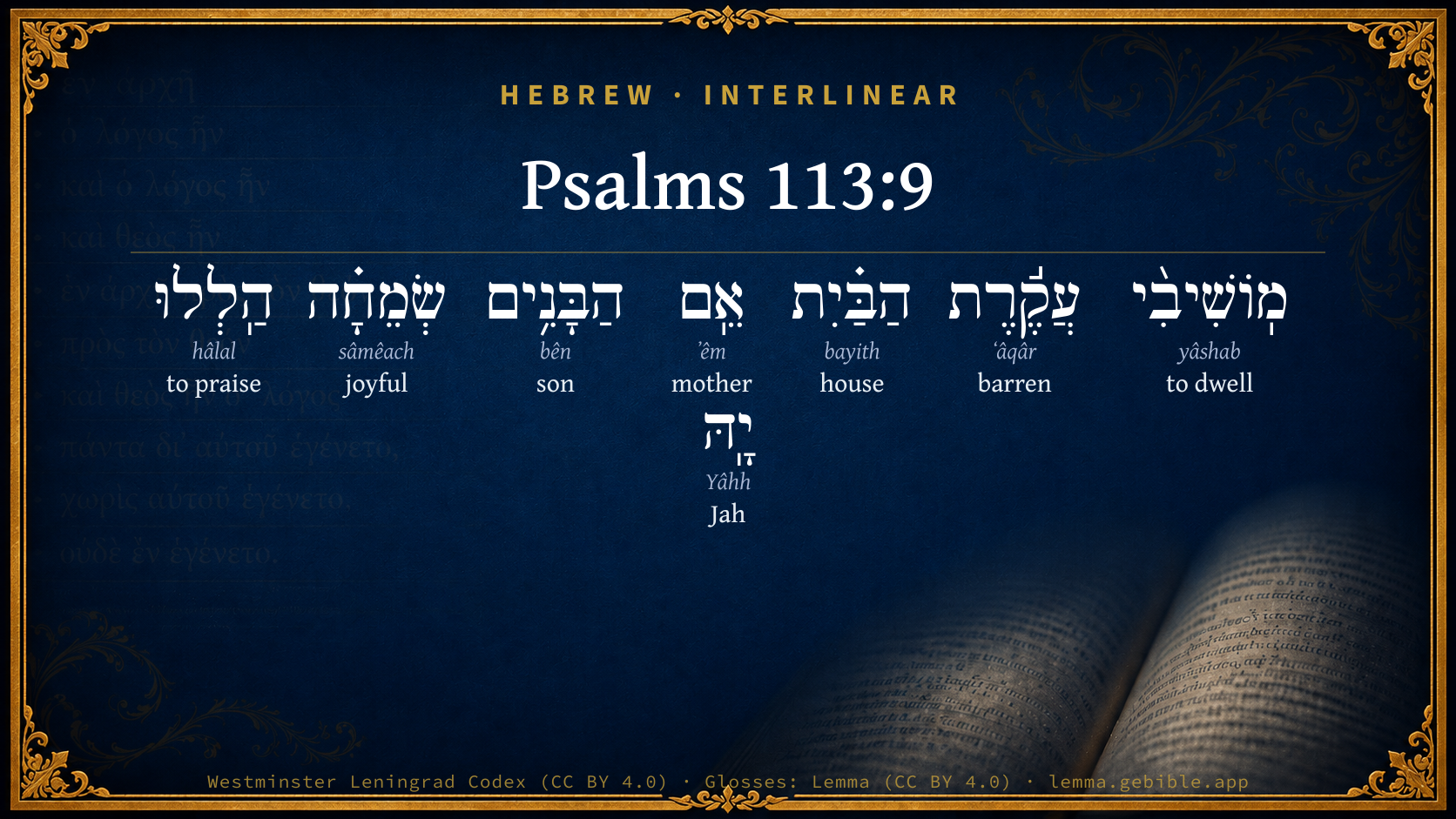
Psalms 113:9

Hebrew (Westminster Leningrad Codex) Psalms 113:9 appears in the Hebrew Old Testament. The text above is from the Westminster Leningrad Codex. Each word links to its Strong’s number, a concise gloss, and parsing drawn from the Open Scriptures Hebrew Bible morphology. Click any word for its full Brown-Driver-Briggs (BDB) entry.
Download image
Cite this verse

Psalms 113:9 (World English Bible). Public Domain. Lemma interlinear Bible study tool, https://lemma.gebible.app/v/psalms/113/9.

Show BibTeX & RIS
BibTeX
RIS
English Translation
He settles the barren woman in her home, As a joyful mother of children. Praise Yah!
World English Bible · Public Domain
Download a study sheet

One document with this verse’s original text, its word-by-word gloss line, the meaning frame, cross-references with their text, attributed commentary, and full source and license credits — printable, and it pastes into notes with its structure intact.

This verse Autodidact and up

Study sheet (.html) Plain text (.txt)

A passage Seminary Student

Up to 50 verses in one chapter. A passage sheet keeps up to 6 commentary sources and 12 cross-references per verse, in the order this page ranks them, and says so on the sheet whenever that leaves anything out. Ask for a single verse and you get the Autodidact verse sheet above.

Everything on this page stays free to read, with no account — the sheet is a download of what is already on screen, not access to it.

Want to remove ads? Support Godless Engineer
Compare translations 3

The same verse in 3 English versions, stacked beneath the original-language interlinear above. Click any original word for its lexicon entry.

Each is an independent rendering of the whole verse — the interlinear is not word-aligned to these translations.

Highlighted words mark where these versions differ — a whole-verse word diff, not a word-by-word alignment.

  • World English Bible Public Domain
    He settles the barren woman in her home, As a joyful mother of children. Praise Yah!
  • King James Version Public Domain
    He maketh the barren woman to keep house, and to be a joyful mother of children. Praise ye the LORD.
  • unfoldingWord Literal Text CC BY-SA 4.0
    He causes the barren woman of the house to dwell, the joyful mother of children! Hallelu Yah!

unfoldingWord Literal Text — © unfoldingWord, licensed CC BY-SA 4.0. Word-aligned USFM3 via Door43 (git.door43.org/unfoldingWord/en_ult).

Versions to compare (up to 4)

3 of 4 selected

Show all 18 translations

Every available English version of this verse, each an independent rendering of the whole verse.

  • World English Bible Public Domain
    He settles the barren woman in her home, As a joyful mother of children. Praise Yah!
  • Berean Standard Bible Public Domain
    He settles the barren woman in her home as a joyful mother to her children. Hallelujah!
  • Majority Standard Bible Public Domain
    He settles the barren woman in her home as a joyful mother to her children. Hallelujah!
  • King James Version Public Domain
    He maketh the barren woman to keep house, and to be a joyful mother of children. Praise ye the LORD.
  • American Standard Version (1901) Public Domain
    He maketh the barren woman to keep house, `And to be' a joyful mother of children. Praise ye Jehovah.
  • Revised Version (1885) Public Domain
    He maketh the barren woman to keep house, and to be a joyful mother of children. Praise ye the LORD.
  • Geneva Bible (1599) Public Domain
    He maketh the barren woman to dwell with a familie, and a ioyfull mother of children. Prayse ye the Lord.
  • Douay-Rheims (1899) Public Domain
    Who maketh a barren woman to dwell in a house, the joyful mother of children.
  • Young's Literal Translation Public Domain
    Causing the barren one of the house to sit, A joyful mother of sons; praise ye Jah!
  • Literal Standard Version CC BY-SA 4.0
    Causing the barren one of the house to sit, || A joyful mother of sons; praise YAH!
  • Unlocked Literal Bible CC BY-SA 4.0
    He gives a home to the barren woman of the house, he makes her a joyful mother of children. Praise Yahweh!
  • unfoldingWord Literal Text CC BY-SA 4.0
    He causes the barren woman of the house to dwell, the joyful mother of children! Hallelu Yah!
  • Darby Bible Public Domain
    He maketh the barren woman to keep house, [as] a joyful mother of sons. Hallelujah!
  • World Messianic Bible Public Domain
    He settles the barren woman in her home as a joyful mother of children. Praise the LORD!
  • Webster's Bible Public Domain
    He maketh the barren woman to keep house, and to be a joyful mother of children. Praise ye the LORD.
  • Free Bible Version CC BY-SA 4.0
    He makes the childless woman happy in her home by giving her children. Praise the Lord!
  • Bible in Basic English Public Domain
    He gives the unfertile woman a family, making her a happy mother of children. Give praise to the Lord.
  • JPS Tanakh (1917) Public Domain
    Who maketh the barren woman to dwell in her house as a joyful mother of children. Hallelujah.

Literal Standard Version (2020), Covenant Press — licensed CC BY-SA 4.0. Text via the HelloAO Bible API (eBible.org). Unlocked Literal Bible (unfoldingWord) — licensed CC BY-SA 4.0. Text via the HelloAO Bible API (eBible.org). unfoldingWord Literal Text — © unfoldingWord, licensed CC BY-SA 4.0. Word-aligned USFM3 via Door43 (git.door43.org/unfoldingWord/en_ult). Free Bible Version, Dr. Jonathan Gallagher — licensed CC BY-SA 4.0. Text via the HelloAO Bible API (eBible.org).

Word by word

More ways to search: Search by grammar → Find every occurrence → Compare this word →

Practice this passage: Drill this verse → Learn its vocabulary →

About this verse

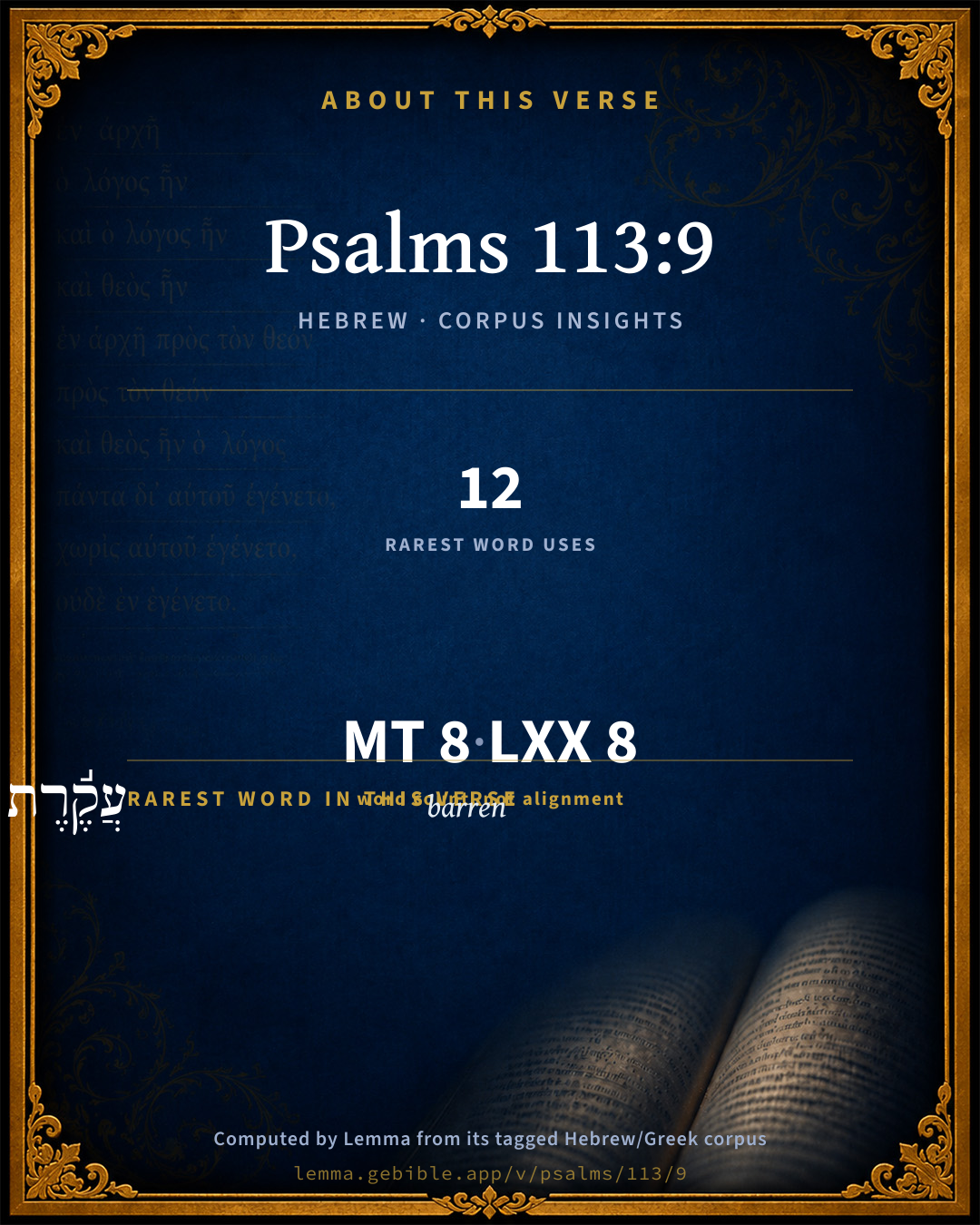
These counts appear in no published source. They are computed here, from the morphology-tagged text and Lemma’s own curated glosses. What Lemma adds →

8
words
8
distinct lemmas
Wisdom
section

Notable vocabulary

The rarest word here is עֲקֶ֬רֶת barren H6135 — appearing just 12 times in the whole Hebrew Bible.

Shared distinctive vocabulary

עֲקֶ֬רֶת barren H6135 occurs in 11 verses of the Hebrew Bible. Also found in:

Grammatical profile

  • 2 verbs
  • 4 nouns
  • 2 adjectives

Verb forms

  • מֽוֹשִׁיבִ֨י Hiphil · Participle Active
  • הַֽלְלוּ Piel · Imperative

Hebrew & Septuagint length

In English translation the verse runs 16 words from the Hebrew and 14 from the Septuagint (LXX English) — closely comparable.

A rough comparison of the two English renderings, which tokenize alike — not a word-level alignment.

Word counts can differ between the Hebrew and the Greek without any difference in meaning — e.g. the Hebrew direct-object marker אֵת has no separate Greek word, and Greek often adds the article ὁ.

In the original languages it is 8 Hebrew tokens and 8 Greek tokens — but the two are counted differently (Hebrew bundles its prefixes and suffixes into one token; the Greek is in lemma form), so that isn’t a like-for-like length.

Cross-references

8

Topical passages linked to Psalms 113:9 in the Treasury of Scripture Knowledge — connected by theme and wording, ordered by reader-vote popularity; previews shown in the World English Bible.

  • Psalms 68:6 God sets the lonely in families. He brings out the prisoners with singing, But the rebellious dwell in a sun-scorched land.
  • Genesis 21:5–7 Abraham was one hundred years old when his son, Isaac, was born to him.
  • Genesis 30:22–23 God remembered Rachel, and God listened to her, and opened her womb.
  • 1 Samuel 2:5 Those who were full have hired out themselves for bread; Those who were hungry have ceased [to hunger]: Yes, the barren has borne seven; She who has many children languishes.
  • Isaiah 54:1 Sing, barren, you who didn't bear; break forth into singing, and cry aloud, you who did not travail with child: for more are the children of the desolate than the children of the married wife, says Yahweh.
  • Luke 1:13–15 But the angel said to him, "Don't be afraid, Zacharias, because your request has been heard, and your wife, Elizabeth, will bear you a son, and you shall call his name John.
  • Genesis 25:21 Isaac entreated Yahweh for his wife, because she was barren. Yahweh was entreated by him, and Rebekah his wife conceived.
  • Galatians 4:27 For it is written, "Rejoice, you barren who don't bear. Break forth and shout, you that don't travail. For more are the children of the desolate than of her who has a husband."

Cross-references courtesy of OpenBible.info (CC BY 4.0).

Hebrew and Greek witnesses Masoretic Hebrew ↔ Greek Septuagint

The same verse in the two great witnesses to the Old Testament, shown verse-for-verse.

You’re reading Greek Psalm 112 (Hebrew Psalm 113). The Septuagint counts the superscription, so verse numbers can differ from the Hebrew — chapter-level alignment, not verse-by-verse. Numbering follows Rahlfs.

These are two independent witnesses, not word-aligned to each other, and the Septuagint is shown in lemma (dictionary) form.

Hebrew Psalms 113:9 Masoretic · Westminster Leningrad Codex

מֽוֹשִׁיבִ֨י עֲקֶ֬רֶת הַבַּ֗יִת אֵֽם הַבָּנִ֥ים שְׂמֵחָ֗ה הַֽלְלוּ יָֽהּ

He settles the barren woman in her home, As a joyful mother of children. Praise Yah!

World English Bible · Public Domain

Greek LXX Greek Psalm 112:9 Septuagint · lemma form

ὁ καταοἰκίζω στεῖρα ἐν οἶκος μήτηρ τέκνον εὐφραίνω

who settles the barren woman in a house, as a mother rejoicing over children.

LXX2012 (modern English Septuagint) · Public Domain

On this verse, The Cambridge Bible for Schools and Colleges discusses the Septuagint’s reading. Read the note in Commentary ↓

Hebrew: Westminster Leningrad Codex (CC BY 4.0). Greek: Septuagint (public domain); English from LXX2012 (modern English Septuagint) (Public Domain). How the Septuagint differs from the Hebrew →

Commentary

Notes on Psalms 113:9 from classic Christian and Jewish commentators (each source and its license shown beneath its notes). The classic Christian expositions comment on the surrounding passage and are grouped to its opening verse, so a note may address several verses; the Jewish commentaries on the Tanakh (Rashi and others) are per-verse, so they appear only where the commentator wrote on this verse.

Lemma curates 59 commentaries, every one of them public domain or Creative Commons licensed, each selected and text-cleaned for this edition rather than reprinted as found. About our sources →

Trapp's Complete Commentary

John Trapp

Psa 113:9 He maketh the barren woman to keep house, [and to be] a joyful mother of children. Praise ye the LORD.

Ver. 9. He maketh the barren woman to keep house] Heb. to dwell in a house, that is, to have a house full of children, and so to build her husband’s house, Rth 4:11. This is applied to the Church (which is the theatre of the world, wherein God showeth his special providence and power), Isa 54:1 Gal 4:26-27.

John Trapp, A Commentary or Exposition upon All the Books of the Old and New Testament (1647–1656) — public domain. Text from a community e-Sword module.

The Biblical Illustrator

Joseph S. Exell

Psa_113:9

He makoth the barren woman to keep house, and to be a joyful mother of children.

Influence

The psalmist must have been thinking surely of the many modes in which the powers are called out and the affections exercised. The guidance of the household, the care of children,--these are certainly the commonest ways in which the affections and the powers of one half the human race are brought into free and full play. But there may be no house to guide, and no children to love and tend and educate; and yet the words may be made true, He maketh the barren woman to keep house, and to be a joyful mother of children. I take the words, then, as telling us, first of all, this: That no powers and no affections were intended by the Giver of all to lie fallow and waste. He, from whom these, as well as all other good and perfect gifts, come, has, we may be sure, in His view also a field for their exercise--a field, into which He is prepared, by His providence and His Spirit, to guide the owner. There is room and need, depend upon it, for every power and every affection that the Creator has implanted in us. Now, I may be speaking to some who have not yet found their place in the world, and who suffer from the heartache and the restlessness which come of unused faculties and dormant affections. It is to such cases as these that the words of the psalmist should come home with a special message to rouse and comfort and invigorate. The matter is really in their own hands. They have but to look around them, and they will soon perceive that the literal meaning of the psalmists words is not the only, nor in many ways the most satisfying, meaning. It will be strange if they cannot find, within the circle of their own acquaintance, more than one life which looks at the first glance very lonely, very dull, very uninviting; in which the nearest and dearest ties of husband, wife, and children have no place; and yet which on closer inspection turns out to be full of interests, full of affections, full of duties, full of good works and heavenly charities. It may be the life of some poor widow living amidst a crowd of neighbours as poor as herself, of whom she is the loved and trusted friend, counsellor, and comforter. Or it may be the life of some daughter and sister at home, who is the link between all the widely-scattered members of the old household. Or it may be the life of some poor helpless and hopeless sufferer on a sick-bed, whose couch of pain is the meeting-point of many hearts, which are cheered and elevated by the sight of Christian endurance, and soothed and softened by the warm tide of Christian affection. (D. J. Vaughan, M.A.)

.

Psa_114:1-8

The Biblical Illustrator, edited by Joseph S. Exell (c. 1880s–1900s) — public domain. Text from a community e-Sword module.

Joseph Benson's Commentary

Psa 113:9. He maketh the barren woman to keep house — Hebrew, מושׁיבי הבית, moshibi habaith, to dwell in a house, or family, or among children, namely, born of her. In the sacred history of the Old Testament, we find many instances of barren women, who were miraculously made to bear children. Isaac, Joseph, Samson, Samuel, and John the Baptist were thus born of mothers who had been barren. “These examples,” says Dr. Horne, “may be considered as preludes to that marvellous exertion of divine power, whereby the Gentile Church, after so many years of barrenness, became, in her old age, a fruitful parent of children, and the mother of us all. Wherefore it is written, Sing, O barren, thou that didst not bear, &c., Isa 54:1.”

Joseph Benson's Commentary on the Old and New Testaments (1811–1818) — public domain. Text from a community e-Sword module.

J. A. Alexander on Psalms

Joseph Addison Alexander

9. (Psa 113:9) Making the barren (one) of the house to sit a joyful mother of children. Hallelujah! The common version (to keep house) is founded upon Psa 68:6, but is here at variance both with Hebrew usage and the masoretic accents, which require barren and the house to be closely united in construction, as above. The form of expression is like one in Psa 68:12. To sit might be rendered to dwell without any material change of sense; but the former keeps up the uniformity with Psa 113:5; Psa 113:8, where the same Hebrew word is used. The historical allusion is to Hannah who, with other long childless mothers mentioned in the sacred history, was a type of the Church in its low estate, and more especially in exile. Compare Isa 54:1.

Joseph Addison Alexander, The Psalms Translated and Explained (1850) — public domain. Text from a community e-Sword module.

Tyndale Open Study Notes

Tyndale Open Resources

113:9 A childless woman was customarily treated with disdain (Gen 16:4); the Lord has the power to make her a happy mother, as he made Sarah (Gen 21:2), Rebekah (Gen 25:21), Rachel (Gen 30:23), and Hannah (1 Sam 1:20). • God’s greatness and goodness provide ample reason to praise him.

Tyndale Open Study Notes — © Tyndale Open Resources, licensed CC BY-SA 4.0. Text via the HelloAO Bible API.

Adam Clarke's Commentary

Verse 9. He maketh the barren woman to keep house] This is a figure to point out the desolate, decreasing state of the captives in Babylon, and the happy change which took place on their return to their own land. These are nearly the words of Hannah, 1Sa 2:5.

ANALYSIS OF THE HUNDRED AND THIRTEENTH PSALM

The scope of this Psalm is the same with those that went before, that is, to excite men to praise God.

This Psalm contains three parts: -

I. An exhortation to God's servants to praise him.

II. A form set down how and where to praise him, Ps 113:2-3.

III. The reasons to persuade us to it. 1. By his infinite power, Ps 113:4-5. 2. His providence, as displayed in heaven and earth, Ps 113:6.

I. The prophet exhorts men "to praise the Lord;" and,

1. He doubles and trebles his exhortation, that it be not coldly but zealously done, or else to show that he alone is worthy of praise.

2. "Praise the Lord, O ye servants," c.: They are to praise him, for he is their Lord praise him likewise with a pure heart.

II. The manner of praising him. Say,

1. "Blessed be the name of the Lord." Job 1:21.

2. "From this time forth," c.: In prosperity or adversity, in this life or the future.

3. "From the rising of the sun," &c.: In all places, even over all the world.

III: And now follow the reasons to persuade men to praise God.

1. Because of his majesty, infinite power, and glory, which extend not to earth alone, but heaven also: "The Lord is high above," &c.

2. Because of his providence, benignity, and bounty, which being united with so much majesty, appear the more admirable. "Who is like the Lord," &c. None in heaven or on earth are to be compared to him. "Yet he humbleth himself," &c. He is present with the highest angels, and with the poorest of his creatures, to help them.

In "humbling himself to behold the things on earth" he gives two instances: 1. In states and kingdoms. 2. In private families.

1. In states: "He raiseth up the poor," &c.: Let then no man say, that God does not regard them that are of low estate he raiseth up the poor, to the end "that he may set him with the princes," &c.

2. In private families: "He maketh the barren woman," &c. "Children are a heritage of the Lord." Some expositors refer the meaning of this last verse to the Church of the Gentiles: "Rejoice, O barren," &c. Isa 54:1.

Adam Clarke's Commentary on the Bible (1810–1826) — public domain. Text from a community e-Sword/MySword module.

John Calvin's Commentaries

9 Who maketh the barren woman to dwell in the family He relates another work of God, which if, apparently, not so notable, ought not, on that account, the less to engage our thoughts. Unimpressed as we are by the ordinary works of God, we are constrained to express our astonishment when a woman who has been for a long period barren, unexpectedly becomes the mother of a numerous family. The Hebrew term, הבית, habbayith, is to be understood, not simply of a house, but also of a household, — that is, the thing containing, for that which is contained, — just as the Greeks apply οικος, and the Latins domus, to a household. The meaning is, that the woman who was formerly barren is blessed with fruitfulness, and fills the house with children. He attributes joy to mothers, because, though the hearts of all are prone to aspire after wealth, or honor, or pleasures, or any other advantages, yet is progeny preferred to every thing else. Wherefore, since God superintends the ordinary course of nature, alters the current of events, elevates those of abject condition and ignoble extraction, and makes the barren woman fruitful, our insensibility is very culpable, if we do not attentively contemplate the works of his hand.

John Calvin's Commentaries (1540-1563) — public domain. Text from the Calvin Translation Society English edition (1840s-50s) via the Christian Classics Ethereal Library (ccel.org). Calvin's coverage is partial (roughly two-thirds of the Bible); uncommented books and verses are honest gaps, never fabricated. The 19th-century editor's footnotes and remarks are omitted so the notes are faithfully Calvin's own voice.

Ellicott's Commentary for English Readers

(9) He maketh.—See margin. Motherhood alone assured the wife of a fixed and dignified position in her husband’s house. The quotation from Hannah’s song suggested the allusion to her story. We are no doubt right in taking this joyful mother as emblematic of the nation itself restored to prosperity and joy.

A Bible Commentary for English Readers, edited by Charles John Ellicott (1878–1897) — public domain. Text from a community e-Sword module.

The Cambridge Bible for Schools and Colleges

gen. ed. J. J. S. Perowne

9. He maketh the barren housewife to dwell

As a joyful mother of sons.

He gives her a secure and happy position in her home. The reference in Psa_113:6-7 to the Song of Hannah suggests this further reference to the experience of Hannah, as an instance of the way in which Jehovah has compassion on those who are despised. But doubtless under the figure of the once childless wife gladdened with a family of sons the Psalmist intends to allude to Zion. Cp. Isa_54:1; Isa_66:8. So the Targum: “Who maketh the congregation of Israel, which was like a barren woman mourning for the men of her household, to be full of crowds, like a mother who rejoiceth over sons.”

Praise ye the Lord] In the LXX this Hallelujah is transferred, perhaps rightly, to the beginning of Psalms 114. See on Psa_104:35.

The Cambridge Bible for Schools and Colleges (gen. ed. J. J. S. Perowne; Cambridge University Press, 1878–1918) — public domain. Text from a community e-Sword module.

Albert Barnes' Notes on the Bible

He maketh the barren woman to keep house ... - Margin, as in Hebrew, “to dwell in a house.” That is, to be at the head of a family. See the notes at Psa 68:6. Compare 1Sa 2:5. This, too, is suggested as a reason why God should be praised and adored. In instances where all hope of posterity is cut off, he interposes, and diffuses joy through a dwelling. We may look abroad, and see abundant occasion for praising God, in his condescension to human affairs - in his lifting up the poor from the humblest condition - in his exalting those of lowly rank to places of honor, trust, wealth, and power; but, after all, if we wish to Find occasions of praise that will most tenderly affect the heart, and be connected with the warmest affections of the soul, they will be most likely to be found in the domestic circle - in the mutual love - the common joy - the tender feelings - which bind together the members of a family. In such a family, the words with which this psalm begins and ends, “Hallelujah,” “Hallelujah,” are especially appropriate; and if any community on earth should apply these words to itself it should be such a family, called upon by everything tender, holy, and lovely, to “praise the” Lord.

Albert Barnes' Notes on the Bible (1834–1885) — public domain. Text from a community e-Sword/MySword module.

Matthew Poole's English Annotations

To keep house, Heb. to dwell in a house or family, or amongst children, to wit, coming out of her own womb, as is clearly implied by the opposition of this to her barrenness. And the word

house is oft put for children, as Exo 1:21; Rth 4:11; Psa 115:10,12. And so it is explained in the next clause.

Matthew Poole's English Annotations on the Holy Bible (1683–1685) — public domain. Text from a community e-Sword/MySword module.

The Treasury of David

Charles H. Spurgeon

Ver. 9. He maketh the barren woman to keep house, and to be a joyful mother of children. The strong desire of the easterns to have children caused the birth of offspring to be hailed as the choicest of favours, while barrenness was regarded as a curse; hence this verse is placed last as if to crown the whole, and to serve as a climax to the story of God's mercy. The glorious Lord displays his condescending grace in regarding those who are despised on account of their barrenness, whether it be of body or of soul. Sarah, Rachel, the wife of Manoah, Hannah, Elizabeth, and others were all instances of the miraculous power of God in literally fulfilling the statement of the psalmist. Women were not supposed to have a house till they had children; but in certain cases where childless women pined in secret the Lord visited them in mercy, and made them not only to have a house, but to keep it. The Gentile church is a spiritual example upon a large scale of the gift of fruitfulness after long years of hopeless barrenness; and the Jewish church in the latter days will be another amazing display of the same quickening power: long forsaken for her spiritual adultery, Israel shall be forgiven, and restored, and joyously shall she keep that house which now is left unto her desolate. Nor is this all, each believer in the Lord Jesus must at times have mourned his lamentable barrenness; he has appeared to be a dry tree yielding no fruit to the Lord, and yet when visited by the Holy Ghost, he has found himself suddenly to be like Aaron's rod, which budded, and blossomed, and brought forth almonds. Or ever we have been aware, our barren heart has kept house, and entertained the Saviour, our graces have been multiplied as if many children had come to us at a single birth, and we have exceedingly rejoiced before the Lord. Then have we marvelled greatly at the Lord who dwelleth on high, that he has deigned to visit such poor worthless things. Like Mary, we have lifted up our Magnificat, and like Hannah, we have said, "There is none holy as the Lord; for there is none beside thee: neither is there any rock like our God."

Praise ye the LORD. The music concludes upon its key note. The Psalm is a circle, ending where it began, praising the Lord from its first syllable to its last. May our life psalm partake of the same character, and never know a break or a conclusion. In an endless circle let us bless the Lord, whose mercies never cease. Let us praise him in youth, and all along our years of strength; and when we bow in the ripeness of abundant age, let us still praise the Lord, who doth not cast off his old servants. Let us not only praise God ourselves, but exhort others to do it; and if we meet with any of the needy who have been enriched, and with the barren who have been made fruitful, let us join with them in extolling the name of him whose mercy endureth for ever. Having been ourselves lifted from spiritual beggary and barrenness, let us never forget our former estate or the grace which has visited us, but world without end let us praise the Lord. Hallelujah.

Ver. 9. Ye maketh the barren woman to keep house, etc. Should a married woman, who has long been considered sterile, become a mother, her joy, and that of her husband and friends, will be most extravagant. "They called her Malady, "that is, "Barren, ""but she has given us good fruit." "My neighbours pointed at me, and said, Malady:but what will they say now?" A man who on any occasion manifests great delight, is represented to be like the barren woman who has at length borne a child. Anything which is exceedingly valuable is thus described: "This is as precious as the son of the barren woman"; that is, of her who had long been reputed barren. Joseph Roberts.

Ver. 9. He maketh the barren woman to keep house, etc. As baseness in men, so barrenness in women is accounted a great unhappiness. But as God lifteth up the beggar out of the mire, to set him with princes, even so doth he "make the barren woman a joyful mother of children." He governs all things in the private family, as well as in the public weal. Children and the fruit of the womb are a gift and heritage that cometh of the Lord, Ps 127:3; and therefore the Papists in praying to S. Anne for children, and the Gentiles in calling upon Diana, Juno, Latona, are both in error. It is God only who makes the barren woman "a mother, "and that "a joyful mother." Every mother is joyful at the first, according to that of Christ, "a woman when she travaileth hath sorrow, because her hour is come: but as soon as she is delivered of the child, she remembereth no more the anguish, for joy that a man is born into the world."

Divines apply this also mystically to Christ, affirming that he made the church of the Gentiles, heretofore "barren, ""a joyful mother of children, "according to that of the prophet: "Rejoice, O barren, that didst not bear; break forth into joy and rejoice, thou that didst not travail with child: for the desolate hath more children than the married wife, saith the Lord, "Isa 54:1. Or it may be construed of true Christians: all of us are by nature barren of goodness, conceived and born in sin, not able to think a good thought (2Co 3:5); but the Father of lights and mercies makes us fruitful and abundant always in the work of the Lord (1Co 15:58); he giveth us grace to be fathers and mothers of many good deeds, which are our children and best heirs, eternizing our name for ever. John Boys.

Ver. 9. The barren woman is the poor, forsaken, distressed Christian church, whom the false church oppresses, defies, and persecutes, and regards as useless, miserable, barren, because she herself is greater and more populous, the greatest part of the world. Joshua Arndt, 1626-1685.

Ver. 9. Praise ye the Lord. We may look abroad, and see abundant occasion for praising God, in his condescension to human affairs, in his lifting up the poor from the humblest condition, in his exalting those of lowly rank to places of honour, trust, wealth, and power; but, after all, if we wish to find occasions of praise that will most tenderly affect the heart, and be connected with the warmest affections of the soul, they will be most likely to be found in the domestic circlein the mutual lovethe common joys the tender feelingswhich bind together the members of a family. Albert Barnes.

Ver. 9. Praise ye the LORD. The very hearing of the comfortable changes which the Lord can make and doth make the afflicted to find, is a matter of refreshment to all, and of praise to God from all. David Dickson.

Ver. 9. For mothers' meetings. "A joyful mother of children."

1. It is a joy to be a mother.

2. It is specially so to have living, healthy, obedient children.

3. But best of all to have Christian children...Praise is due to the Lord who gives such blessings.

Ver. 9.

1. A household God, or, God in the Household: "He maketh, "etc. Have you children? It is of God. Have you lost children? It is of God. Have you been without children? It is of God.

2. Household worship, or, the God of the Household: "Praise ye the Lord."

(a) In the family.

(b) For family mercies. G. R.

There are Expositions of Psalms 113 and 114 in the Works of John Boys, Dean of Canterbury, 1638; folio edition, pp. 846-861.

Charles H. Spurgeon's The Treasury of David (1869–1885) — public domain. Psalms only. Text from a community e-Sword/MySword module.

Whedon's Commentary on the Bible

Daniel D. Whedon

9. Barren woman to keep house—Properly, to dwell, or abide, in the house. The allusion is to the uncertain continuance of the barren wife in the family, owing to the capricious tyranny of the husband, under the wretched system of domestic life in Asia. Children are a natural bond of sympathy between husband and wife, and the language is expressive of a happy and prosperous condition of domestic and social life. The same figure occurs Psa_68:6. The text is to be taken figuratively to signify, that as the barren wife is restored to favour, and the family life made happy, when the reproach of barrenness is removed, so God had now restored and established his people in joy and prosperity. See the figure applied to the Church, Isa_54:1. Psa_113:7-9 seem to have a historic pointing. Had not God recently raised Israel from the “dunghill” to honour? Had not the families and family life of the nation been recently restored? The infinite condescension of God in thus remembering their low estate is the theme of the psalm. It is a companion piece to Psalms 114, and savors of the fresh joy of the returned exiles from Babylon.

Daniel D. Whedon (gen. ed.), Commentary on the Old and New Testaments (1874–1909) — public domain. Text from a community e-Sword module.

The Pulpit Commentary

He maketh the barren woman to keep house. Hannah"s song is still in the psalmist"s thoughts, and suggests this illustration. (see 1Sa_2:5) But it must not be restricted to a literal interpretation. The true "barren woman" was Israel, (Isa_54:1) whose curse of barrenness was ultimately removed, and who became, as here prophesied, a joyful mother of children. (comp. Isa_49:12, Isa_49:18, 20 54:2, 3 60:5 Gal_4:27) Praise ye the Lord. (comp. Ps 104 Ps 105 Ps 106 Ps 115 Ps 116 Ps 117 Ps 135 146-150, which terminate similarly)

The mission of the children.

Here is an evident allusion to the joy of Hannah, when her prayer was heard, and Samuel came as the firstborn of a family. "The Lord visited Hannah, so that she bare three sons and two daughters," and her adversary could provoke her no more. It is remarked that the Rabbins actually speak of a man"s wife as his house; and the same form of speech is current at the present day among the Arabs. This joy men have in children, which is characteristic of every age and nation, which is, indeed, the universal sentiment, leads us to consider the mission of the children. Why do they come in helplessness, and take so long growing up to their manhood and womanhood?

I CHILDREN ARE SENT TO CULTURE CHARACTER. This is the other side of the truth with which we are familiar that children have characters which we must culture. There is a good sense in which children are sent into the world to "train their parents." What they can do is seen in the immediate effect their coming has upon their mothers. It changes them from thoughtless, self-centered maidens into thoughtful, self-denying women. And an equal influence, though not quite so evident, is seen in the father. Family life cultures all the graces, the stronger ones no less than the milder; and it lays the burden of personal example upon the parents; for a child makes demand of father and mother that they will show him the ideal goodness. Each element of refined and Christly character may be dealt with, and special stress may be laid upon "patience" and "charity" in the sense of going outside ourselves for our interests.

II CHILDREN ARE SENT TO KEEP UP OUR INTEREST IN MORALS. This point is seldom dwelt on. Yet it is evident that the children come just at the time in our lives when material interests business, society become so absorbing. Moral and religious interests would pass out of our thought if it were not that every day brings to us concern for the children, and that must be a moral concern. The children break into the monotony of material middle-life associations. Everyday morals for every parent, and morals and religion for most parents, are brought closely to mind. The children are God"s voice reminding man of eternal things. R.T.

The Pulpit Commentary (1880–1919), ed. H.D.M. Spence-Jones & Joseph S. Exell — public domain. Text from a community e-Sword module.

unfoldingWord translationNotes

Door43 World Missions Community

He gives a home to the barren woman of the house

Here "home" refers to the children that live in a home. AT: "He gives children to the woman who had none" (See: Metonymy)

translationWords

barren

joy

praise

unfoldingWord translationNotes — © Distant Shores Media and the Door43 World Missions Community, licensed CC BY-SA 4.0. Source: git.door43.org/Door43/en_tn.

Rashi

Rabbi Shlomo Yitzchaki (Rashi)

the barren woman of the house Zion, which is like a barren woman—He will seat her.

as a happy mother of children (Isa. 66:8): “that Zion both experienced birth pangs and bore her children.”

Rashi on the Tanakh — English translations: “The Judaica Press complete Tanach with Rashi, translated by A. J. Rosenberg” (CC BY 4.0); “Pentateuch with Rashi's commentary by M. Rosenbaum and A.M. Silbermann, 1929-1934” (public domain); “The Metsudah Tanach series, Lakewood, N.J” (CC BY 4.0); and “The Book of Joshua, Metsudah Publications, 1997” (CC BY 4.0). Text via Sefaria.

Lesson kit

Teaching starters — assembled from the data on this page, not authored interpretation. Every prompt links to the verse data it draws on. Edit before teaching.

Psalms, in the Wisdom, opens this verse with 8 words (8 distinct Hebrew lemmas). Its most distinctive word is ʻâqâr (“barren”). A historical commentator’s framing appears above. Read the whole chapter for the surrounding context.

Discussion questions

  1. The word ʻâqâr carries the sense “barren.” How does it shape the verse?
  2. Genesis 11:30 shares the word «barren» with this verse. How do the two illuminate each other?
  3. These translations render this verse differently; the difference is in the English rendering, not the original. What questions does that raise?
  4. The verb «מֽוֹשִׁיבִ֨י» is Hiphil Participle Active. How does its form color the action?
  5. Reading how Trapp's Complete Commentary and The Biblical Illustrator read this verse, where do the two commentators agree and where do they part?

Things to notice

Reading settings

Reading text

Shown beneath each verse's original-language words.

Old Testament
Old Testament edition

Read the OT as the Masoretic Hebrew (MT) or the Greek Septuagint (LXX).

English shown for the Greek Septuagint (in the Hebrew ↔ Greek comparison).

Comparing translations? Open the Compare panel on any verse page to stack up to four side by side.