
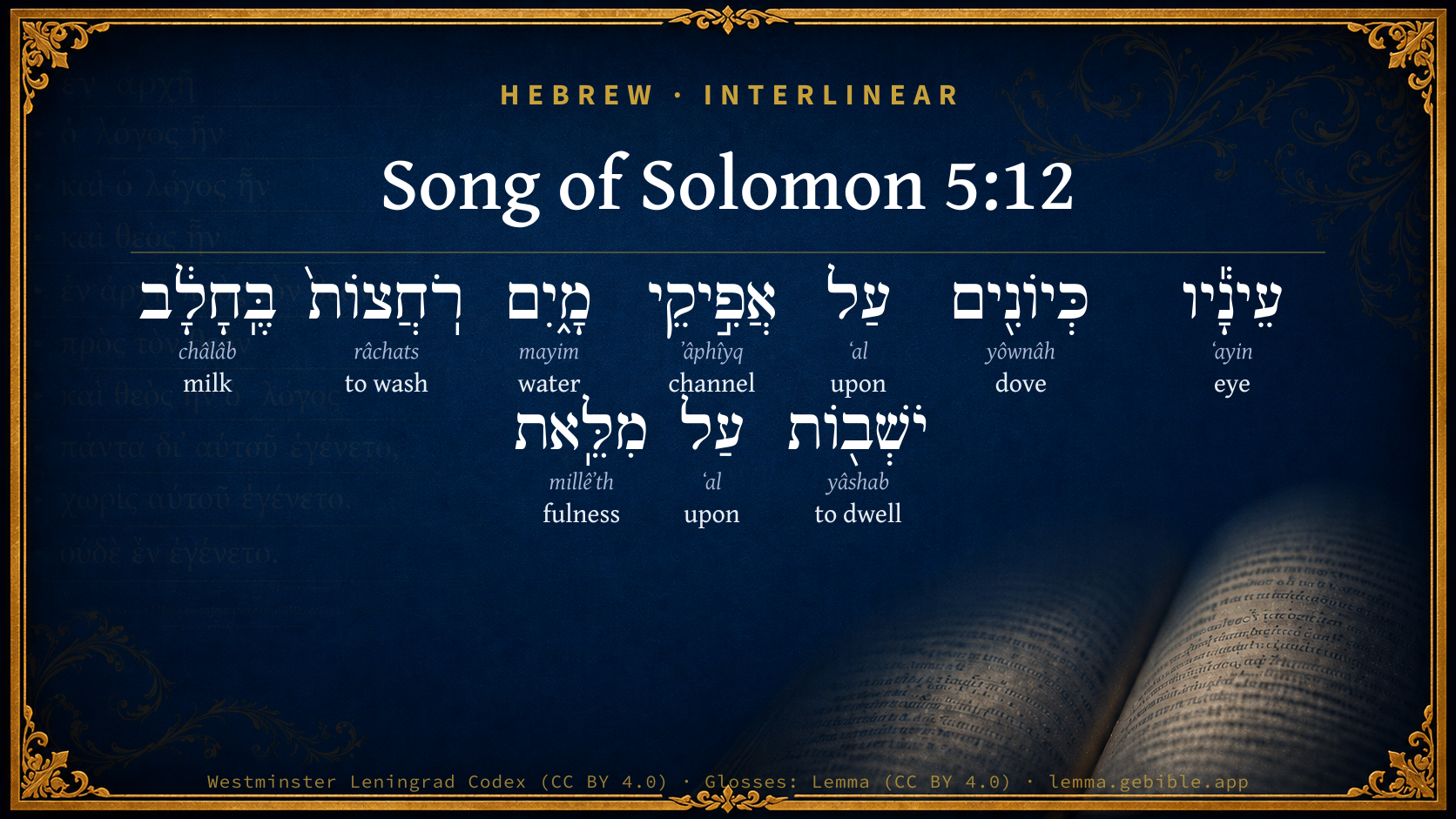
Song of Solomon 5:12

Hebrew (Westminster Leningrad Codex) Song of Solomon 5:12 appears in the Hebrew Old Testament. The text above is from the Westminster Leningrad Codex. Each word links to its Strong’s number, a concise gloss, and parsing drawn from the Open Scriptures Hebrew Bible morphology. Click any word for its full Brown-Driver-Briggs (BDB) entry.
Download image
Cite this verse

Song of Solomon 5:12 (World English Bible). Public Domain. Lemma interlinear Bible study tool, https://lemma.gebible.app/v/song-of-solomon/5/12.

Show BibTeX & RIS
BibTeX
RIS
English Translation
His eyes are like doves beside the water brooks, Washed with milk, mounted like jewels.
World English Bible · Public Domain
Highlights
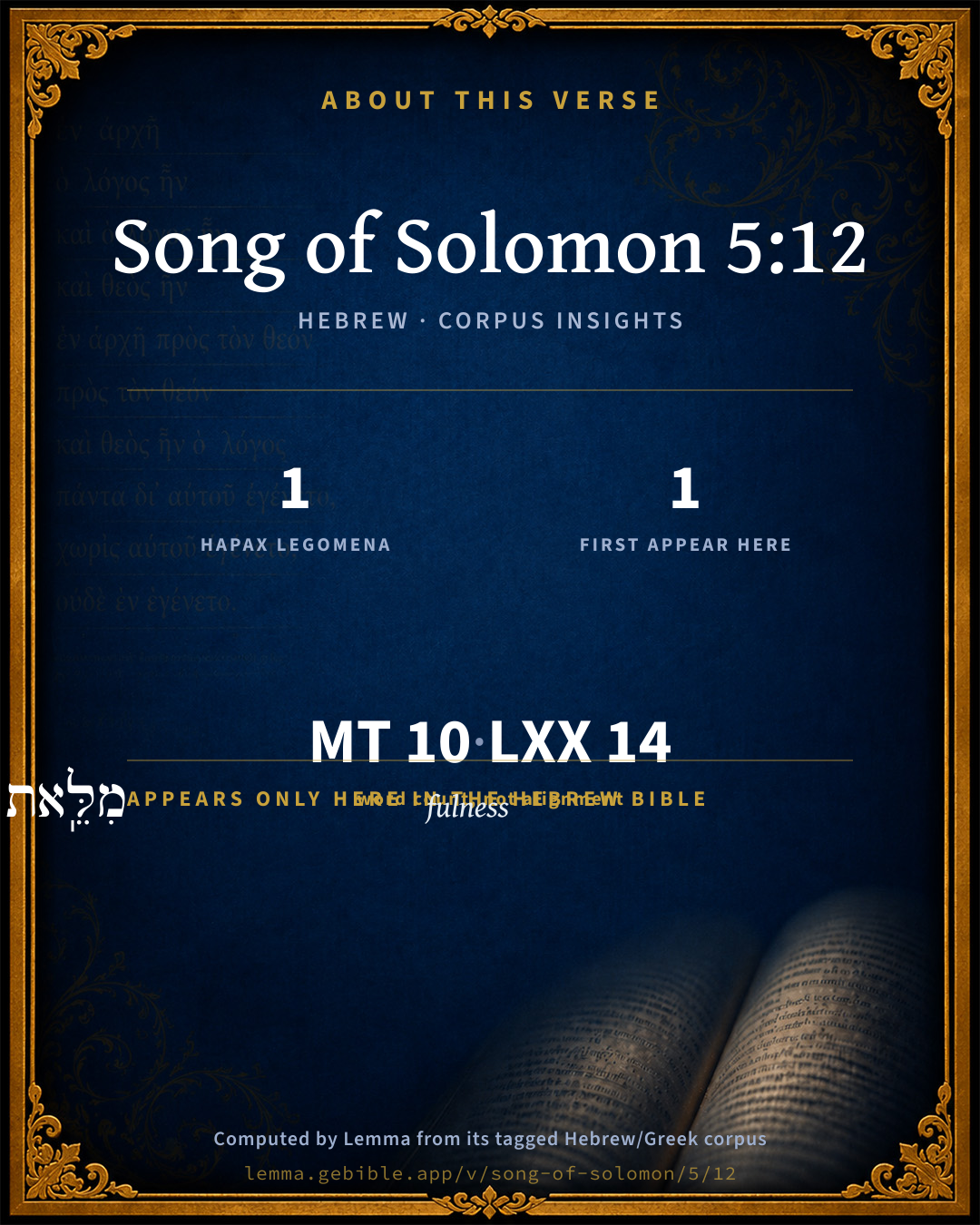
  • 1 hapax legomenon — only here in the Hebrew Bible
  • 1 first appearance in the Hebrew Bible
Full analysis ↓
Download a study sheet

One document with this verse’s original text, its word-by-word gloss line, the meaning frame, cross-references with their text, attributed commentary, and full source and license credits — printable, and it pastes into notes with its structure intact.

This verse Autodidact and up

Study sheet (.html) Plain text (.txt)

A passage Seminary Student

Up to 50 verses in one chapter. A passage sheet keeps up to 6 commentary sources and 12 cross-references per verse, in the order this page ranks them, and says so on the sheet whenever that leaves anything out. Ask for a single verse and you get the Autodidact verse sheet above.

Everything on this page stays free to read, with no account — the sheet is a download of what is already on screen, not access to it.

Want to remove ads? Support Godless Engineer
Compare translations 3

The same verse in 3 English versions, stacked beneath the original-language interlinear above. Click any original word for its lexicon entry.

Each is an independent rendering of the whole verse — the interlinear is not word-aligned to these translations.

Highlighted words mark where these versions differ — a whole-verse word diff, not a word-by-word alignment.

  • World English Bible Public Domain
    His eyes are like doves beside the water brooks, Washed with milk, mounted like jewels.
  • King James Version Public Domain
    His eyes are as the eyes of doves by the rivers of waters, washed with milk, and fitly set.
  • unfoldingWord Literal Text CC BY-SA 4.0
    His eyes like doves beside stream beds of water, bathing in milk, sitting beside the pools.

unfoldingWord Literal Text — © unfoldingWord, licensed CC BY-SA 4.0. Word-aligned USFM3 via Door43 (git.door43.org/unfoldingWord/en_ult).

Versions to compare (up to 4)

3 of 4 selected

Show all 18 translations

Every available English version of this verse, each an independent rendering of the whole verse.

  • World English Bible Public Domain
    His eyes are like doves beside the water brooks, Washed with milk, mounted like jewels.
  • Berean Standard Bible Public Domain
    His eyes are like doves beside the streams of water, bathed in milk and mounted like jewels.
  • Majority Standard Bible Public Domain
    His eyes are like doves beside the streams of water, bathed in milk and mounted like jewels.
  • King James Version Public Domain
    His eyes are as the eyes of doves by the rivers of waters, washed with milk, and fitly set.
  • American Standard Version (1901) Public Domain
    His eyes are like doves beside the water-brooks, Washed with milk, `and' fitly set.
  • Revised Version (1885) Public Domain
    His eyes are like doves beside the water brooks; washed with milk, and fitly set.
  • Geneva Bible (1599) Public Domain
    His eyes are like doues vpon the riuers of waters, which are washt with milke, and remaine by the full vessels.
  • Douay-Rheims (1899) Public Domain
    His eyes as doves upon brooks of waters, which are washed with milk, and sit beside the plentiful streams.
  • Young's Literal Translation Public Domain
    His eyes as doves by streams of water, Washing in milk, sitting in fulness.
  • Literal Standard Version CC BY-SA 4.0
    His eyes as doves by streams of water, || Washing in milk, sitting in fullness.
  • Unlocked Literal Bible CC BY-SA 4.0
    His eyes are like doves beside streams of water, bathed in milk, mounted like jewels.
  • unfoldingWord Literal Text CC BY-SA 4.0
    His eyes like doves beside stream beds of water, bathing in milk, sitting beside the pools.
  • Darby Bible Public Domain
    His eyes are like doves by the water-brooks, Washed with milk, fitly set;
  • World Messianic Bible Public Domain
    His eyes are like doves beside the water brooks, washed with milk, mounted like jewels.
  • Webster's Bible Public Domain
    His eyes are as the eyes of doves by the rivers of waters, washed with milk, and fitly set.
  • Free Bible Version CC BY-SA 4.0
    His eyes are like doves beside springs of water, washed with milk and mounted like sparkling jewels.
  • Bible in Basic English Public Domain
    His eyes are as the eyes of doves by the water streams, washed with milk, and rightly placed.
  • JPS Tanakh (1917) Public Domain
    His eyes are like doves beside the water-brooks; washed with milk, and fitly set.

Literal Standard Version (2020), Covenant Press — licensed CC BY-SA 4.0. Text via the HelloAO Bible API (eBible.org). Unlocked Literal Bible (unfoldingWord) — licensed CC BY-SA 4.0. Text via the HelloAO Bible API (eBible.org). unfoldingWord Literal Text — © unfoldingWord, licensed CC BY-SA 4.0. Word-aligned USFM3 via Door43 (git.door43.org/unfoldingWord/en_ult). Free Bible Version, Dr. Jonathan Gallagher — licensed CC BY-SA 4.0. Text via the HelloAO Bible API (eBible.org).

Word by word

More ways to search: Search by grammar → Find every occurrence → Compare this word →

Practice this passage: Drill this verse → Learn its vocabulary →

About this verse

These counts appear in no published source. They are computed here, from the morphology-tagged text and Lemma’s own curated glosses. What Lemma adds →

10
words
9
distinct lemmas
Wisdom
section

Notable vocabulary

1 hapax legomenon — a word that appears only here in the entire Hebrew Bible:

  • מִלֵּֽאת fulness H4402

First appearance in Scripture

This word makes its first canonical appearance in the Hebrew Bible here:

  • מִלֵּֽאת fulness H4402

Shared distinctive vocabulary

אֲפִ֣יקֵי channel H650 occurs in 19 verses of the Hebrew Bible. Also found in:

Grammatical profile

  • 2 verbs
  • 6 nouns
  • 2 prepositions

Verb forms

  • רֹֽחֲצוֹת֙ Qal · Participle Active
  • יֹשְׁב֖וֹת Qal · Participle Active

Repetition

A word recurs within this verse — often emphatic in Hebrew:

Hebrew & Septuagint length

In English translation the verse runs 15 words from the Hebrew and 17 from the Septuagint (LXX English) — closely comparable.

A rough comparison of the two English renderings, which tokenize alike — not a word-level alignment.

Word counts can differ between the Hebrew and the Greek without any difference in meaning — e.g. the Hebrew direct-object marker אֵת has no separate Greek word, and Greek often adds the article ὁ.

In the original languages it is 10 Hebrew tokens and 14 Greek tokens — but the two are counted differently (Hebrew bundles its prefixes and suffixes into one token; the Greek is in lemma form), so that isn’t a like-for-like length.

Cross-references

3

Topical passages linked to Song of Solomon 5:12 in the Treasury of Scripture Knowledge — connected by theme and wording, ordered by reader-vote popularity; previews shown in the World English Bible.

  • Song of Solomon 1:15 Behold, you are beautiful, my love. Behold, you are beautiful. Your eyes are doves. Beloved
  • Song of Solomon 4:1 Behold, you are beautiful, my love. Behold, you are beautiful. Your eyes are doves behind your veil. Your hair is as a flock of goats, That descend from Mount Gilead.
  • Hebrews 4:13 There is no creature that is hidden from his sight, but all things are naked and laid open before the eyes of him with whom we have to do.

Cross-references courtesy of OpenBible.info (CC BY 4.0).

Hebrew and Greek witnesses Masoretic Hebrew ↔ Greek Septuagint

The same verse in the two great witnesses to the Old Testament, shown verse-for-verse.

These are two independent witnesses, not word-aligned to each other, and the Septuagint is shown in lemma (dictionary) form.

Hebrew Song of Solomon 5:12 Masoretic · Westminster Leningrad Codex

עֵינָ֕יו כְּיוֹנִ֖ים עַל אֲפִ֣יקֵי מָ֑יִם רֹֽחֲצוֹת֙ בֶּֽחָלָ֔ב יֹשְׁב֖וֹת עַל מִלֵּֽאת

His eyes are like doves beside the water brooks, Washed with milk, mounted like jewels.

World English Bible · Public Domain

Greek LXX Song of Solomon 5:12 Septuagint · lemma form

ὀφθαλμός αὐτός ὡς περιστερά ἐπί πλήρωμα ὕδωρ λούω ἐν γάλα καταἧμαι ἐπί πλήρωμα ὕδωρ

His eyes are as doves, by the pools of waters, washed with milk, sitting by the pools.

LXX2012 (modern English Septuagint) · Public Domain

On this verse, The Cambridge Bible for Schools and Colleges discusses the Septuagint’s reading. Read the note in Commentary ↓

Hebrew: Westminster Leningrad Codex (CC BY 4.0). Greek: Septuagint (public domain); English from LXX2012 (modern English Septuagint) (Public Domain). How the Septuagint differs from the Hebrew →

Commentary

Notes on Song of Solomon 5:12 from classic Christian and Jewish commentators (each source and its license shown beneath its notes). The classic Christian expositions comment on the surrounding passage and are grouped to its opening verse, so a note may address several verses; the Jewish commentaries on the Tanakh (Rashi and others) are per-verse, so they appear only where the commentator wrote on this verse.

Lemma curates 59 commentaries, every one of them public domain or Creative Commons licensed, each selected and text-cleaned for this edition rather than reprinted as found. About our sources →

Trapp's Complete Commentary

John Trapp

Son 5:12 His eyes [are] as [the eyes] of doves by the rivers of waters, washed with milk, [and] fitly set.

Ver. 12. His eyes are as the eyes of doves by the rivers of water, &c., ] i.e., they are full of all innocence, singleness, and chastity; {See Trapp on "Son 1:15"} {See Trapp on "Son 4:1"} where Christ had attributed the very same to the Church, who is his image and glory, as the woman is of the man, {1Co 11:7} the very looking glass of his dignity and reflex of his comeliness. His eyes are elsewhere said to be as a "flame of fire," {Rev 1:14 Dan 10:6} sharp and terrible, such as pierce into the inward parts, and need no outward light. Here they are as the "eyes of doves," casting an amiable, gracious, joyful, and comfortable look upon his Church. As his "eyes behold, his eyelids try the children of men" {Psa 11:4} - the one points out his knowledge, the other his critical descant - so he casteth an eye of singular providence and tender affection upon his afflicted people. "I have seen, I have seen," saith he, "the sufferings of my people; I know their sorrows, and am come down to deliver them." {Exo 3:7-8} His "eye affects his heart," and his heart sets his hand to work for their help and safety. In Eze 1:8, we read of faces, eyes, wings, hands, &c., all to express the sufficiency of God’s providence for all means of help; see Psa 33:18-19; Psa 34:16. The Church is like the land of Canaan, which is said to be "a hind which the Lord careth for: the eyes of the Lord are always upon it." {Deu 11:11} He seeth that loveliness in her that he overlooks all, as it were, to look upon her; he beholds that worth in her that the buzzards of the world cannot ken. Therefore the "world knows us not," respects us not, "because it knew not him," {1Jn 3:1} saw "no such beauty that they should desire him." {Isa 53:2} Nicostratus in Aelian, himself being a cunning artisan, finding a curious piece of work, and being wondered at by one, and asked by one what pleasure he could take to stand gazing as he did on the picture, answered, Hadst thou mine eyes, thou wouldst not wonder, but rather be ravished, as I am, at the inimitable art of this piece. Similarily, had men those dove like single eyes that Christ and his people have, "washed in milk," that is, in milk white waters, cleansed from the dust of sinful prejudice, and "fitly set," as a precious stone in the foil of a ring, or as the precious filling stones in the holy ephod, {Exo 25:7} they would "kiss the Son" and admire his spouse; whereas, for want of spiritual eyes, the northern proverb is verified, "unkent, unkist," unknown, unrespected.

John Trapp, A Commentary or Exposition upon All the Books of the Old and New Testament (1647–1656) — public domain. Text from a community e-Sword module.

Adam Clarke's Commentary

Verse 12. His eyes are as the eyes of doves] See on So 4:1.

Washed with milk] The white of the eye, exceedingly white. By the use of stibium, in the East, the eye is rendered very beautiful; and receives such a lustre from the use of this article, that, to borrow the expression of a late traveller, "their eyes appear to be swimming in bliss." I believe this expression to be the meaning of the text.

Fitly set.] Or, as the margin, very properly, sitting in fullness; not sunk, not contracted.

Adam Clarke's Commentary on the Bible (1810–1826) — public domain. Text from a community e-Sword/MySword module.

Ellicott's Commentary for English Readers

(12) Fitly set.—Literally, sitting in fulness, which the Margin explains, according to one received method of interpretation, as beautifully set, like a precious stone in the foil of a ring. If the comparison were to the eyes of the dove, this would be a sufficient interpretation, the image being perfect, owing to the ring of bright red skin round the eye of the turtle-dove. But there is no necessity to have recourse to the figure comparatio compendiana here, since doves delight in bathing; and though there is a certain delicious haze of indistinctness in the image, the soft iridescence of the bird floating and glancing on the face of the stream might not too extravagantly suggest the quick loving glances of the eye. Keats has a somewhat similar figure:—

“To see such lovely eyes in swimming search

After some warm delight, that seems to perch

Dove-like in the dim cell lying beyond

Their upper lids;”

and Dr. Ginsburg aptly quotes from the Gitagovinda: “The glances of her eyes played like a pair of water-birds of azure plumage, that sport near a full-grown lotus in a pool in the season of dew.” The words washed in milk refer to the white of the eye, which swells round the pupil like the fulness of water, i.e., the swelling wave round the dove. The parallelism is like that of Son_1:5.

A Bible Commentary for English Readers, edited by Charles John Ellicott (1878–1897) — public domain. Text from a community e-Sword module.

The Cambridge Bible for Schools and Colleges

gen. ed. J. J. S. Perowne

12. His eyes, &c.] R.V. His eyes are like doves beside the water brooks. Here the idea is different from that in Son_1:15 and Son_4:1. It is not the innocent dove-like look of the eye that is referred to. The eyes themselves, or at least the pupils of the eyes, are compared to doves. Ginsburg’s quotation from the Gitagovinda is almost an exact parallel: “The glances of her eyes played like a pair of water birds of azure plumage, that sport near a full blown lotus in a pool in the season of dew.”

washed with milk] Rather, bathing in milk. This may refer to the eyes; the pupils move in the white of the eye as if bathing in milk. Or it may refer to the doves, in which case it would be an extension or correction of the previous part of the simile; ‘the eyes are like doves by brooks of water or rather streams of milk.’ The choice between these alternatives depends upon the reference of the next clause fitly set. If it refers to the eyes, then this would best be understood of the eyes also. But if that be understood of the doves, as probably it should be, then to avoid the awkwardness of connecting the two participles with different subjects, this clause should be understood of the doves also.

fitly set] The A.V. in margin gives this note, “Heb. sitting in fulness, that is, fitly placed, and set as a precious stone in the foil of a ring.” This is the traditional Jewish interpretation. Others explain full as opposed to sunken (Oettli). Possibly, as LXX suggest, the text is faulty and we should read yôshìbhôth al mìlo’ hammayîm, and translate, sitting upon full streams, when the subject would, of course, be the doves. This latter reading and the rendering it suggests are simpler and more natural than any of the other varied conjectures that have been made.

The Cambridge Bible for Schools and Colleges (gen. ed. J. J. S. Perowne; Cambridge University Press, 1878–1918) — public domain. Text from a community e-Sword module.

Albert Barnes' Notes on the Bible

Or, His eyes are doves. The comparison is to doves seen by streams of water washing in milk (i. e., milk-white), and sitting on fulness (i. e., on the full or abundant water-flood).

Fitly set - This rendering supposes that the eyes within their sockets are compared to precious stones set in the foil of a ring (see the margin); but the other rendering is preferable. The milk-white doves themselves, sitting by full streams of water, or reflected in their flittings athwart the glassy surface, present images of the calm repose and vivid glances of the full pure lustrous eyes of the beloved.

Albert Barnes' Notes on the Bible (1834–1885) — public domain. Text from a community e-Sword/MySword module.

Matthew Poole's English Annotations

His eyes are as the eyes of doves, lovely and pleasant, chaste and innocent.

By the rivers of waters; where they delight to abide, and wherewith they bathe themselves, and wash their eyes; where also their eyes are most lively and beautiful, both by the reflection of the waters, and from that pleasure which they take in such places.

Washed with milk; which may belong either,

1. To the eyes, which are supposed to be washed with water, as white and pure as milk; or,

2. To the doves, which are intimated to be of a milk-white colour, which in those parts was most esteemed, which colour also made the eyes appear more lovely.

Fitly set; neither sinking into the head, nor standing out too much, but in a moderate and comely situation. Heb. sitting in fulness; which may note a full and competently large eye, which is esteemed one beauty of the eye.

Matthew Poole's English Annotations on the Holy Bible (1683–1685) — public domain. Text from a community e-Sword/MySword module.

Whedon's Commentary on the Bible

Daniel D. Whedon

12. His eyes, etc. — Hebrew, His eyes are doves, etc. Doves are fond of bathing and dressing their plumage, and the blue creatures tricking their feathers by a full and sparkling summer stream form a lively and agreeable picture. But the eyes seem to bathe in milk.

Fitly set — Rather, Framed in fulness, that is, with ample development, full-orbed, and gushing copious light.

Daniel D. Whedon (gen. ed.), Commentary on the Old and New Testaments (1874–1909) — public domain. Text from a community e-Sword module.

John Wesley's Explanatory Notes

Of doves - Lovely and pleasant, chaste and innocent. Rivers - Where they delight to abide. Milk - Doves of a milk white colour.

John Wesley, Explanatory Notes Upon the Whole Bible (1754–1765) — public domain. Text via the GEBible commentary corpus.

Scofield Reference Notes

C. I. Scofield

fitly set Heb. "sitting in fulness;" i.e. fitly placed, and set as a precious stone in the foil of a ring.

The Scofield Reference Bible (1917 edition), notes by C. I. Scofield — public domain. Text from a community e-Sword module.

unfoldingWord translationNotes

Door43 World Missions Community

General Information:

The young woman continues to describe the man.

His eyes are like doves

Translate "eyes are like doves" as in Song of Songs 1:15. Possible meanings are 1) the Israelites considered doves to be gentle and soft birds, and the woman considers the man's eyes beautiful because the way the man looks at her makes her think he is gentle. AT: "His eyes are gentle like doves" or 2) the woman is speaking of the man's white eyeballs or the shape of his eyes, the shape of a dove. (See: Metonymy)

doves beside streams of water

Birds that the Israelites considered gentle sitting beside a gently flowing stream are a metaphor for a gentle person. (See: Metaphor)

streams of water

"gently flowing water"

bathed in milk

Milk is a metaphor for the whiteness of the doves. AT: "doves that are white like milk" or 2) milk is a metaphor for the white part of the man's eyes. AT: "his pupils are like doves bathing in white milk" (See: Metaphor)

mounted like jewels

His eyes are beautiful. Jewels that a craftsman has carefully put in place are beautiful. (See: Simile)

translationWords

like

dove

unfoldingWord translationNotes — © Distant Shores Media and the Door43 World Missions Community, licensed CC BY-SA 4.0. Source: git.door43.org/Door43/en_tn.

Rashi

Rabbi Shlomo Yitzchaki (Rashi)

His eyes are like doves beside rivulets of water By rivulets of water his eyes are as beautiful as the eyes of doves. Rivulets of water are beautiful to behold, and the young men go there to swim, so does the poet praise the eyes of “my beloved.” When he gazes upon the rivulets of water, they resemble the beauty of the eyes of doves.

bathing in milk the eyes of my beloved in milk.

fitly set All this is an expression of beauty, neither protruding too much nor sunken, but set on מִלֵאת, their sockets. (Other editions: the eye according to the socket.) The literal meaning parallels the allegorical meaning. And it is a term used to refer to anything made to fit a socket which is made for it as a base, like (Exod. 25:7): “stones to be fit (מְלֻאִים)”; (ibid. 28:17): “And you shall set (וּמִלֵאתָ) into it settings of (מִלֻאַת) stones.”

Rashi on the Tanakh — English translations: “The Judaica Press complete Tanach with Rashi, translated by A. J. Rosenberg” (CC BY 4.0); “Pentateuch with Rashi's commentary by M. Rosenbaum and A.M. Silbermann, 1929-1934” (public domain); “The Metsudah Tanach series, Lakewood, N.J” (CC BY 4.0); and “The Book of Joshua, Metsudah Publications, 1997” (CC BY 4.0). Text via Sefaria.

Lesson kit

Teaching starters — assembled from the data on this page, not authored interpretation. Every prompt links to the verse data it draws on. Edit before teaching.

Song of Solomon, in the Wisdom, opens this verse with 10 words (9 distinct Hebrew lemmas). Its most distinctive word is millêʼth (“fulness”). A historical commentator’s framing appears above. Read the whole chapter for the surrounding context.

Discussion questions

  1. The word millêʼth carries the sense “fulness.” How does it shape the verse?
  2. 1 word here appears nowhere else in the Hebrew Bible. Why might the author reach for such rare wording?
  3. This is the first place “fulness” appears in Scripture (first appears here). What does its debut here establish?
  4. How does 2 Samuel 22:16, which shares the word «channel», read alongside this verse?
  5. What does the repetition of “upon” (2× in this one verse) do in this verse?
  6. These translations render this verse differently; the difference is in the English rendering, not the original. What questions does that raise?
  7. «רֹֽחֲצוֹת֙» is a Qal Participle Active verb. How does that grammatical form shape the action described?
  8. Compare how Trapp's Complete Commentary and Adam Clarke's Commentary read this verse. Where do they agree or differ?

Things to notice

  • 1 word in this verse appears nowhere else in the Hebrew Bible.
  • 1 word makes its first canonical appearance in Scripture here.
  • This verse counts 10 Hebrew ↔ 14 Greek words.
  • These translations choose different wording for 16 words in this verse.
  • “upon” occurs 2× in this single verse.

Reading settings

Reading text

Shown beneath each verse's original-language words.

Old Testament
Old Testament edition

Read the OT as the Masoretic Hebrew (MT) or the Greek Septuagint (LXX).

English shown for the Greek Septuagint (in the Hebrew ↔ Greek comparison).

Comparing translations? Open the Compare panel on any verse page to stack up to four side by side.