
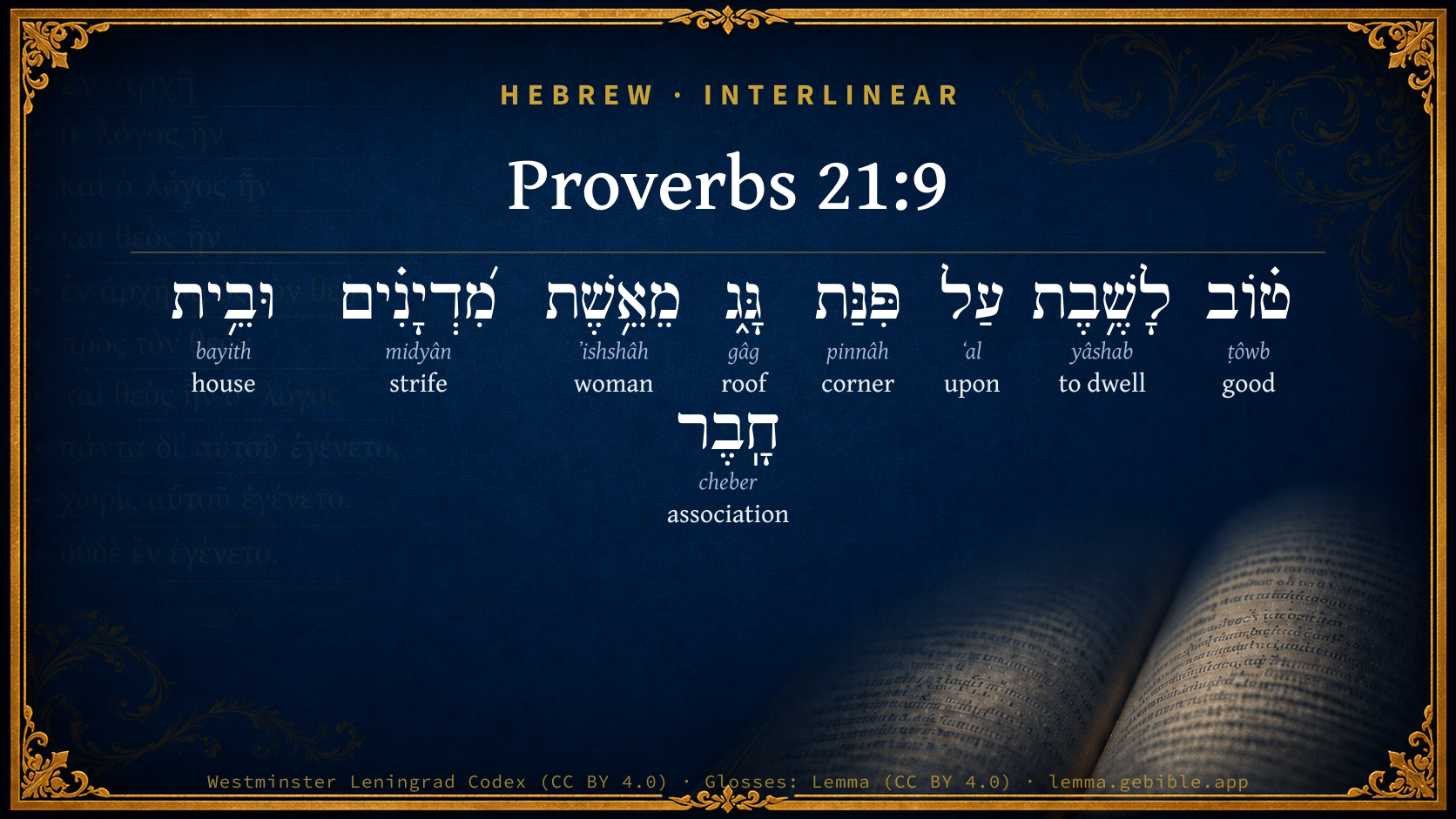
Proverbs 21:9

Hebrew (Westminster Leningrad Codex) Proverbs 21:9 appears in the Hebrew Old Testament. The text above is from the Westminster Leningrad Codex. Each word links to its Strong’s number, a concise gloss, and parsing drawn from the Open Scriptures Hebrew Bible morphology. Click any word for its full Brown-Driver-Briggs (BDB) entry.
Download image
Cite this verse

Proverbs 21:9 (World English Bible). Public Domain. Lemma interlinear Bible study tool, https://lemma.gebible.app/v/proverbs/21/9.

Show BibTeX & RIS
BibTeX
RIS
English Translation
It is better to dwell in the corner of the housetop, Than to share a house with a contentious woman.
World English Bible · Public Domain
Download a study sheet

One document with this verse’s original text, its word-by-word gloss line, the meaning frame, cross-references with their text, attributed commentary, and full source and license credits — printable, and it pastes into notes with its structure intact.

This verse Autodidact and up

Study sheet (.html) Plain text (.txt)

A passage Seminary Student

Up to 50 verses in one chapter. A passage sheet keeps up to 6 commentary sources and 12 cross-references per verse, in the order this page ranks them, and says so on the sheet whenever that leaves anything out. Ask for a single verse and you get the Autodidact verse sheet above.

Everything on this page stays free to read, with no account — the sheet is a download of what is already on screen, not access to it.

Want to remove ads? Support Godless Engineer
Compare translations 3

The same verse in 3 English versions, stacked beneath the original-language interlinear above. Click any original word for its lexicon entry.

Each is an independent rendering of the whole verse — the interlinear is not word-aligned to these translations.

Highlighted words mark where these versions differ — a whole-verse word diff, not a word-by-word alignment.

  • World English Bible Public Domain
    It is better to dwell in the corner of the housetop, Than to share a house with a contentious woman.
  • King James Version Public Domain
    It is better to dwell in a corner of the housetop, than with a brawling woman in a wide house.
  • unfoldingWord Literal Text CC BY-SA 4.0
    Better to dwell on the corner of a roof than a woman of quarrels and a house of companionship.

unfoldingWord Literal Text — © unfoldingWord, licensed CC BY-SA 4.0. Word-aligned USFM3 via Door43 (git.door43.org/unfoldingWord/en_ult).

Versions to compare (up to 4)

3 of 4 selected

Show all 18 translations

Every available English version of this verse, each an independent rendering of the whole verse.

  • World English Bible Public Domain
    It is better to dwell in the corner of the housetop, Than to share a house with a contentious woman.
  • Berean Standard Bible Public Domain
    Better to live on a corner of the roof than to share a house with a quarrelsome wife.
  • Majority Standard Bible Public Domain
    Better to live on a corner of the roof than to share a house with a quarrelsome wife.
  • King James Version Public Domain
    It is better to dwell in a corner of the housetop, than with a brawling woman in a wide house.
  • American Standard Version (1901) Public Domain
    It is better to dwell in the corner of the housetop, Than with a contentious woman in a wide house.
  • Revised Version (1885) Public Domain
    It is better to dwell in the corner of the housetop, than with a contentious woman in a wide house.
  • Geneva Bible (1599) Public Domain
    It is better to dwell in a corner of the house top, then with a contentious woman in a wide house.
  • Douay-Rheims (1899) Public Domain
    It is better to sit in a corner of the housetop, than with a brawling women, and in a common house.
  • Young's Literal Translation Public Domain
    Better to sit on a corner of the roof, Than `with' a woman of contentions and a house of company.
  • Literal Standard Version CC BY-SA 4.0
    Better to sit on a corner of the roof, || Than [with] a woman of contentions and a house of company.
  • Unlocked Literal Bible CC BY-SA 4.0
    It is better to live on a corner of the roof than in a house shared with a quarrelsome wife.
  • unfoldingWord Literal Text CC BY-SA 4.0
    Better to dwell on the corner of a roof than a woman of quarrels and a house of companionship.
  • Darby Bible Public Domain
    It is better to dwell in a corner of the housetop, than with a contentious woman, and a house in common.
  • World Messianic Bible Public Domain
    It is better to dwell in the corner of the housetop than to share a house with a contentious woman.
  • Webster's Bible Public Domain
    It is better to dwell in a corner of the house-top, than with a brawling woman in a wide house.
  • Free Bible Version CC BY-SA 4.0
    It's better to live in a corner of a housetop than to share a whole house with an argumentative wife.
  • Bible in Basic English Public Domain
    It is better to be living in an angle of the house-top, than with a bitter-tongued woman in a wide house.
  • JPS Tanakh (1917) Public Domain
    It is better to dwell in a corner of the housetop, than in a house in common with a contentious woman.

Literal Standard Version (2020), Covenant Press — licensed CC BY-SA 4.0. Text via the HelloAO Bible API (eBible.org). Unlocked Literal Bible (unfoldingWord) — licensed CC BY-SA 4.0. Text via the HelloAO Bible API (eBible.org). unfoldingWord Literal Text — © unfoldingWord, licensed CC BY-SA 4.0. Word-aligned USFM3 via Door43 (git.door43.org/unfoldingWord/en_ult). Free Bible Version, Dr. Jonathan Gallagher — licensed CC BY-SA 4.0. Text via the HelloAO Bible API (eBible.org).

Word by word

More ways to search: Search by grammar → Find every occurrence → Compare this word →

Practice this passage: Drill this verse → Learn its vocabulary →

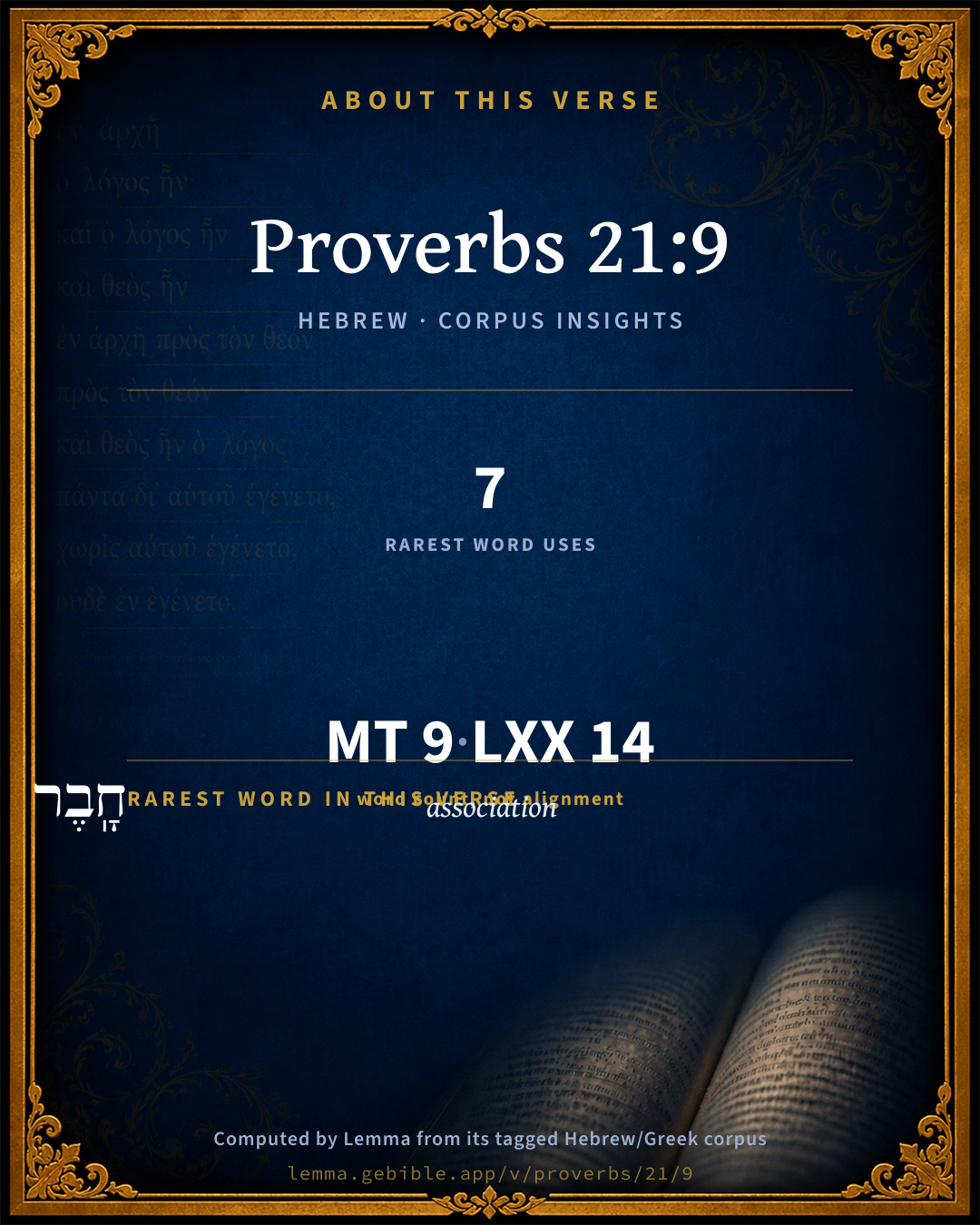
About this verse

These counts appear in no published source. They are computed here, from the morphology-tagged text and Lemma’s own curated glosses. What Lemma adds →

9
words
9
distinct lemmas
Wisdom
section

Notable vocabulary

The rarest word here is חָֽבֶר association H2267 — appearing just 7 times in the whole Hebrew Bible.

Shared distinctive vocabulary

חָֽבֶר association H2267 occurs in 7 verses of the Hebrew Bible. Also found in:

Grammatical profile

  • 1 verb
  • 6 nouns
  • 1 adjective
  • 1 preposition

Verb forms

  • לָשֶׁ֥בֶת Qal · Infinitive Construct

Hebrew & Septuagint length

In English translation the verse runs 20 words from the Hebrew and 22 from the Septuagint (LXX English) — closely comparable.

A rough comparison of the two English renderings, which tokenize alike — not a word-level alignment.

Word counts can differ between the Hebrew and the Greek without any difference in meaning — e.g. the Hebrew direct-object marker אֵת has no separate Greek word, and Greek often adds the article ὁ.

In the original languages it is 9 Hebrew tokens and 14 Greek tokens — but the two are counted differently (Hebrew bundles its prefixes and suffixes into one token; the Greek is in lemma form), so that isn’t a like-for-like length.

Cross-references

7

Topical passages linked to Proverbs 21:9 in the Treasury of Scripture Knowledge — connected by theme and wording, ordered by reader-vote popularity; previews shown in the World English Bible.

  • Proverbs 19:13 A foolish son is the calamity of his father. A wife's quarrels are a continual dripping.
  • Proverbs 21:19 It is better to dwell in a desert land, Than with a contentious and fretful woman.
  • Proverbs 25:24 It is better to dwell in the corner of the housetop, Than to share a house with a contentious woman.
  • Proverbs 27:15–16 A continual dropping on a rainy day And a contentious wife are alike:
  • Proverbs 12:4 A worthy woman is the crown of her husband, But a disgraceful wife is as rottenness in his bones.
  • Proverbs 17:1 Better is a dry morsel with quietness, Than a house full of feasting with strife.
  • Proverbs 15:17 Better is a dinner of herbs, where love is, Than a fattened calf with hatred.

Cross-references courtesy of OpenBible.info (CC BY 4.0).

Hebrew and Greek witnesses Masoretic Hebrew ↔ Greek Septuagint

The same verse in the two great witnesses to the Old Testament, shown verse-for-verse.

These are two independent witnesses, not word-aligned to each other, and the Septuagint is shown in lemma (dictionary) form.

Hebrew Proverbs 21:9 Masoretic · Westminster Leningrad Codex

ט֗וֹב לָשֶׁ֥בֶת עַל פִּנַּת גָּ֑ג מֵאֵ֥שֶׁת מִ֝דְיָנִ֗ים וּבֵ֥ית חָֽבֶר

It is better to dwell in the corner of the housetop, Than to share a house with a contentious woman.

World English Bible · Public Domain

Greek LXX Proverbs 21:9 Septuagint · lemma form

κρείσσων οἰκέω ἐπί γωνία ὕπαιθρος ἤ ἐν κονιάω μετά ἀδικία καί ἐν οἶκος κοινός

It is better to dwell in a corner on the house-top, than in plastered rooms with unrighteousness, and in an open house.

LXX2012 (modern English Septuagint) · Public Domain

On this verse, The Cambridge Bible for Schools and Colleges discusses the Septuagint’s reading. Read the note in Commentary ↓

Hebrew: Westminster Leningrad Codex (CC BY 4.0). Greek: Septuagint (public domain); English from LXX2012 (modern English Septuagint) (Public Domain). How the Septuagint differs from the Hebrew →

Commentary

Notes on Proverbs 21:9 from classic Christian and Jewish commentators (each source and its license shown beneath its notes). The classic Christian expositions comment on the surrounding passage and are grouped to its opening verse, so a note may address several verses; the Jewish commentaries on the Tanakh (Rashi and others) are per-verse, so they appear only where the commentator wrote on this verse.

Lemma curates 59 commentaries, every one of them public domain or Creative Commons licensed, each selected and text-cleaned for this edition rather than reprinted as found. About our sources →

Trapp's Complete Commentary

John Trapp

Pro 21:9 [It is] better to dwell in a corner of the housetop, than with a brawling woman in a wide house.

Ver. 9. It is better to dwell in a corner of the house top.] Their house tops were made flat by order of the law. The sense is, then, A man had better abide abroad, sub dio, under the sun exposed to wind and weather, yea, to crowd into a corner, and to live in a little ease, than to cohabit in a convenient house with a contentious woman, that is ever brawling and brangling, that turns coniugium into coniurgium by inserting the dogs’ letter (r), and leading her husband a dog’s life. Such a one was Zillah, Peninnah, Xantippe, the wife of Phoroneus the lawgiver, who upon his deathbed told his brother he had been a man happy if he had never married. {a} Aristotle {b} affirms, that he that hath miscarried in a wife, hath lost more than half the happiness of his life. Rubius Celer and Albutius Tertius were held happy among the Romans, because the former had lived with a wife three and forty years and eight months, the latter five and twenty years, sine querela, without quarrelling or contending. And this they gave order should be engraven upon their gravestones. {See Trapp on "Pro 19:13"}

{a} Bruson, lib. vii. cap. 22.

{b} Arist. in Rhet.

John Trapp, A Commentary or Exposition upon All the Books of the Old and New Testament (1647–1656) — public domain. Text from a community e-Sword module.

The Preacher's Complete Homiletical Commentary

Joseph S. Exell (gen. ed.)

CRITICAL NOTES.—

Pro_21:9. Wide house. Literally a house of companionship, i.e., to share the house with her.

MAIN HOMILETICS OF Pro_21:9; Pro_21:19

AN ANGRY WOMAN

I. No social discomfort is to be compared to that of an ill-tempered wife. A corner of the housetop would be exposed to the rain and to the storm, both of which, in eastern countries, are generally of a violent character; and although it is not uncommon for orientals sometimes to pass the night there, it would be most undesirable to be obliged at all seasons, and under all circumstances, to have no other place of refuge. He who had to dwell there would at one time be subjected to the intense heat of the mid-day sun, and at another would be chilled by the midnight air. Neither is the wilderness a pleasant place of abode. In addition to all the drawbacks of the housetop arising from exposure to the weather, a wilderness is a place of dreary solitude, and often of danger from wild beasts and lawless men. But it is better to dwell in either of these places than with a brawling or even with an angry woman.

1. Because one might enjoy intervals of repose. The rain would not always descend, neither would the storm-wind be always blowing; the sun would sometimes give forth only an agreeable warmth, and the night-wind bring only a refreshing coolness. Even in the wilderness the solitude would sometimes be enjoyable, and life there would not always be in peril. But the woman pictured here is one whose ill-temper is always ruling her and casting gloom over the home, and when there is no storm of passion actually raging there is one brewing and ready to burst forth. The unhappy partner of her life can never look forward to an hour of ease, for the lulls in the storm are but momentary, and the rifts in the clouds obscured again immediately.

2. Because, whatever may be the discomforts of a housetop or wilderness dwelling, they may leave the soul at rest. They can but reach the body, and the mind may be so absolutely calm or absorbed in thought as to be almost unconscious of what is passing without. To some men solitude has such charms that they are willing to forego many bodily comforts in order to obtain it. There have been and are those whose own thoughts are the only company they desire, and who would gladly brave the drawbacks of the housetop or the wilderness, if by so doing they could be left undisturbed to indulge their own speculations, or pursue their meditations. But the sharp tongue of a contentious woman leaves no corner of the soul undisturbed. It is vain for the subject of it to seek refuge in reflection upon more agreeable topics, to endeavour to banish the actual present by calling up images of the future, or of unseen though distant realities. All the powers of the mind are paralyzed by such an incubus, and the soul cannot wing its flight into pleasanter regions, as it can do sometimes when the suffering only touches the outer man.

II. External good fortune is no proof against this domestic curse. The “wide house” or the “house of companionship,” suggests a goodly mansion—a dwelling which might be the centre of social gatherings, and whose owner is able to indulge in hospitality on a large scale. It calls up before us not the top-story garret of the very poor, or even the narrow dwelling of a struggling man, where the fight for bread, and the effort to make both ends meet, may have something to do with spoiling the temper of the housewife. But the angry and contentious woman is not confined to these abodes—Solomon almost seems to speak here from experience, but even if he did not, we know that even palace walls cannot keep out the curse, and that there is often such a skeleton at the most sumptuous feast.

OUTLINES AND SUGGESTIVE COMMENTS

The family is sometimes a fierce fire. It comprehends the greatest portion of our world. It is to us the most interesting, and therefore is capable of becoming the most trying portion.—Cecil.

Everyone has known some pair chained together by human laws where the heart’s union has either never existed or been rent asunder. Two ships at sea are bound together by strong, short chains. As long as the sea remains perfectly calm all may be well with both; though they do each other no good, they may not inflict much evil. But the sea never rests long, and seldom rests at all. Woe to these two ships when the waves begin to roll. There are two conditions in which they might be safe. If they were either brought more closely together, or more widely separated, it might yet be well with them. If they were from stern to stern riveted into one, or if the chain were broken and the two left to follow independently their several courses, there would be no further cause of anxiety on their account. If they are so united that they shall move as one body, they are safe; if they move far apart, they are safe. The worst possible position is to be chained together, and yet have separate and independent motion in the waves. They will rasp each other’s sides off, and tear open each other’s heart, and go down together.—Arnot.

Better to retire into a corner of the housetop than to quit the house and go into bad company for diversion, as many who, like Adam, make their wife’s sin the excuse of their own.—Henry.

The Preacher's Complete Homiletical Commentary (gen. ed. Joseph S. Exell; Funk & Wagnalls, c. 1892) — public domain (pre-1929). A full-Bible homiletical/sermon-outline anthology covering 65 of 66 books (2 John is absent from the source module). Text from a community e-Sword module.

Tyndale Open Study Notes

Tyndale Open Resources

21:9 // 25:24 A marriage that looks good on the outside (in a lovely home) is unrewarding if it is filled with quarrels (see also 21:19; 25:24; 27:15-17; cp. 11:22; 12:4b).

Tyndale Open Study Notes — © Tyndale Open Resources, licensed CC BY-SA 4.0. Text via the HelloAO Bible API.

Geneva Bible (1599)

Geneva Bible translators

Or, in a great family.

Geneva Bible (1599) marginal notes — public domain. Text via Bolls.life.

Matthew Henry's Commentary

See here, 1. What a great affliction it is to a man to have a brawling scolding woman for his wife, who upon every occasion, and often upon no occasion, breaks out into a passion, and chides either him or those about her, is fretful to herself and furious to her children and servants, and, in both, vexatious to her husband. If a man has a wide house, spacious and pompous, this will embitter the comfort of it to him - a house of society (so the word is), in which a man may be sociable, and entertain his friends; this will make both him and his house unsociable, and unfit for enjoyments of true friendship. It makes a man ashamed of his choice and his management, and disturbs his company. 2. What many a man is forced to do under such an affliction. He cannot keep up his authority. He finds it to no purpose to contradict the most unreasonable passion, for it is unruly and rages so much the more; and his wisdom and grace will not suffer him to render railing for railing, nor his conjugal affection to use any severity, and therefore he finds it his best way to retire into a corner of the house-top, and sit alone there, out of the hearing of her clamour; and if he employ himself well there, as he may do, it is the wisest course he can take. Better do so than quit the house, and go into bad company, for diversion, as many, who, like Adam, make their wife's sin the excuse of their own.

Matthew Henry's Commentary on the Whole Bible (1708–1710) — public domain (CC PDM 1.0). Text via the HelloAO Bible API.

Jamieson, Fausset & Brown

Robert Jamieson, A. R. Fausset & David Brown

corner--a turret or arbor on the roof.

brawling--or contentious.

wide house--literally, "house of fellowship," large enough for several families.

Jamieson, Fausset & Brown — Commentary Critical and Explanatory on the Whole Bible (1871) — public domain (CC PDM 1.0). Text via the HelloAO Bible API.

Adam Clarke's Commentary

Verse 9. In a corner of the housetop] A shed raised on the flat roof: - a wide house; בית חבר beith chaber, "a house of fellowship;" what we should call a lodging-house, or a house occupied by several families. This was usual in the East, as well as in the West. Some think a house of festivity is meant: hence my old MS. Bible has, the hous and feste.

Adam Clarke's Commentary on the Bible (1810–1826) — public domain. Text from a community e-Sword/MySword module.

Ellicott's Commentary for English Readers

(9) It is better to dwell in a corner of the housetop.—Though there exposed to all the storms of heaven. The flat tops of houses were, in the East, used for exercise (2Sa_11:2), sleeping, (1Sa_9:26), devotion (Act_10:9), and various domestic purposes (Jos_2:6).

A Bible Commentary for English Readers, edited by Charles John Ellicott (1878–1897) — public domain. Text from a community e-Sword module.

The Cambridge Bible for Schools and Colleges

gen. ed. J. J. S. Perowne

9. in a corner of the housetop] The LXX. render ἐπὶ γωνίας ὑπαίθρου, with no better hiding-place from the storms of heaven than the narrow corner in which the parapet walls of the flat roof meet (Deu_22:8).

a wide house] Lit. a house of society. This may mean, a house shared in common with her, R.V. marg., but it is better to understand it of a house large enough for the society of many people assembling there. Comp. Act_12:12.

The Cambridge Bible for Schools and Colleges (gen. ed. J. J. S. Perowne; Cambridge University Press, 1878–1918) — public domain. Text from a community e-Sword module.

John Gill's Exposition

It is better to dwell in a corner of the housetop,.... The roofs of houses in Judea were that, encompassed with battlements, whither persons might retire for solitude, and sit in safety: and it is better to be in a corner of such a roof alone, and be exposed to scorching heat, to blustering winds, to thunder storms and showers of rain,

than with a brawling woman in a wide house; large and spacious, full of rooms, fit for a numerous family: or, "an house of society" (u); where many families might dwell and live sociably with each other; or a house where a man, his wife and family, might dwell together, and have communion with each other; it is opposed to the corner of the housetop, and the solitariness of it; as the scolding of the brawling woman, or "a woman of contentions" (w), who is always noisy and quarrelsome, her violent passions, her storming language, and thundering voice, are to the inclemencies of the heavens, to which a man on the housetop is exposed; and yet these are more eligible than the other; see Pro 21:19.

(u) "domo societatis", Montanus, Vatablus, Baynus, Mercerus, Michaelis, "et domus societatis", Schultens. (w) "prae muliere contentionum", Montanus, Schultens.

John Gill's Exposition of the Whole Bible (1746–1763) — public domain (CC PDM 1.0). Text via the HelloAO Bible API.

Albert Barnes' Notes on the Bible

A wide house - literally, “a house of companionship,” i. e., a house shared with her. The flat roof of an Eastern house was often used for retirement by day, or in summer for sleep by night. The corner of such a roof was exposed to all changes of weather, and the point of the proverb lies in the thought that all winds and storms which a man might meet with there are more endurable than the tempest within.

Albert Barnes' Notes on the Bible (1834–1885) — public domain. Text from a community e-Sword/MySword module.

Haydock's Catholic Bible Commentary

Top, (domatis) as the roofs in Palestine were flat. (St. Jerome, ad Sun.) --- Any inconvenience had better be endured, than to live with the quarrelsome. (Menochius)

George Leo Haydock (1774–1849), Haydock's Catholic Family Bible and Commentary, 1859 edition — public domain. Excludes Psalms (Douay-Rheims chapter numbering differs from Protestant) and Deuterocanonical books (Catholic canon only).

Matthew Poole's English Annotations

To dwell, to wit, alone in quietness, as appears from the opposite clause.

Of the house-top; of the roof of the house, which in those countries was flat and plain, and habitable, but was exposed to all the injuries of the weather. In a

wide house; or, in a common house; or, a house of society, where husband and wife live together, or which is capable of many friends or companies.

Matthew Poole's English Annotations on the Holy Bible (1683–1685) — public domain. Text from a community e-Sword/MySword module.

Whedon's Commentary on the Bible

Daniel D. Whedon

9. Corner of the housetop — A slight structure on the roof. See case of prophet’s chamber “on the wall.” 2Ki_4:10. Brawling woman — Hebrew, woman of contentions; a contentious, quarrelsome woman.

A wide house — Margin, “A house of society,” or families. בית חבר, (beth hhabher,) a house in common; that is, in company with such a woman. The point of the proverb is, that a man had better endure all the winds, rains, and storms on the housetop rather than the tempest within. — Speaker’s Commentary. Compare Pro_19:23; Pro_27:15; Pro_21:19, below; Pro_25:24.

Daniel D. Whedon (gen. ed.), Commentary on the Old and New Testaments (1874–1909) — public domain. Text from a community e-Sword module.

The Pulpit Commentary

It is better to dwell in a corner of the housetop. One is to think of the flat roof of an Eastern house, which was used as an apartment for many purposes: e,g. for sleeping and conference, (1Sa_9:25, 1Sa_9:26) for exercise, (2Sa_11:2) for domestic matters, (Jos_2:6) for retirement and prayer. (Psa_102:7 Act_10:9) This, though exposed to the inclemency of the weather, would be not an uncomfortable situation during a great part of the year. But the proverb implies a position abnormally inconvenient as an alternative preferable to a residence inside. Hence, perhaps, it is advisable to render, with Delitzsch, "Better to sit on the pinhole of a house roof." Septuagint, "It is better to dwell in a corner of a place open to the sky (upaiyrou )." Than with a brawling (contentious) woman in a wide house; literally, a house of society; i.e. a house in common. (comp. ver. 19 and Pro_25:24) A solitary corner, replete with inconveniences, is to be preferred to house shared with woman, wife or other female relation, of a quarrelsome and vexatious temper. The LXX puts the matter forcibly, "than in ceiled rooms with unrighteousness and in a common house." So the Latin proverb, "Non quam late, sed quam laete habites, refert." The Scotch have a proverb to the same effect: "A house wi" a reek and a wife wi" a reerd (scold) will sune mak" a man run to the door." "I had rather dwell," says the Son of Sirach (Ecc 25:16), "with a lion and a dragon, than to keep house with a wicked woman."

The Pulpit Commentary (1880–1919), ed. H.D.M. Spence-Jones & Joseph S. Exell — public domain. Text from a community e-Sword module.

Keil & Delitzsch

C. F. Keil & F. Delitzsch

The group now following extends to Pro 21:18, where a new one begins with a variation of its initial verse.

9 Better to sit on the pinnacle of a house-roof,

Than a contentious wife and a house in common.

We have neither to supplement the second line: than with a contentious wife... (Symmachus, Theodotion, Jerome, Luther), nor: than that one have a contentious...; but the meaning is, that sitting on the roof-top better befits one, does better than a quarrelsome wife and a common house (rightly the Targ. and Venet.), i.e., in a common house; for the connecting together of the wife and the house by vav is a Semitic hendiadys, a juxtaposition of two ideas which our language would place in a relation of subordination (Fleischer). This hendiadys would, indeed, be scarcely possible if the idea of the married wife were attached to אושׁת; for that such an one has with her husband a "house of companionship, i.e., a common house," is self-evident. But may it not with equal right be understood of the imperious positive mother-in-law of a widower, a splenetic shrewish aunt, a sickly female neighbour disputing with all the world, and the like? A man must live together with his wife in so far as he does not divorce her; he must then escape from her; but a man may also be constrained by circumstances to live in a house with a quarrelsome mother-in-law, and such an one may, even during the life of his wife, and in spite of her affection, make his life so bitter that he would rather, in order that he might have rest, sit on the pinnacle or ridge of a house-roof. פּנּהּ is the battlement (Zep 1:16) of the roof, the edge of the roof, or its summit; he who sits there does so not without danger, and is exposed to the storm, but that in contrast with the alternative is even to be preferred; he sits alone. Regarding the Chethı̂b מדינים, Kerı̂ מדינים, vid., at Pro 6:14; and cf. the figures of the "continual dropping" for the continual scolding of such a wife, embittering the life of her husband, Pro 19:13.

Keil & Delitzsch — Biblical Commentary on the Old Testament (1861–1891) — public domain (CC PDM 1.0). Text via the HelloAO Bible API. (Old Testament only.)

Bridges on Proverbs

Charles Bridges

In the spacious houses in the East, several families lived together in society. A brawling woman would be a grievous disturbance to the little community; and a peaceable man would prefer the corner of the house-top,†1 exposed to all the inconveniences of wind and weather, to the ample accommodation of a wide house in the atmosphere of contention. (Pro 21:19 ; Pro 25:24 .) A solitary life without would be better than a quarrelsome life within. Some intervals of comfort might be abroad; none at home. Infinitely greater is this trial, when it comes from a man’s own flesh; when she, who ought to be "a crown to her husband," becomes "rottenness to his bones" (Pro 12:4 ); when she that is bound to be his choicest treasure, becomes his piercing scourge. ’It cannot be but a miserable thing to behold, that yet they are of necessity compelled to live together, which yet cannot be in quiet together.’†2 The intent of the Divine ordinance is here contravened. For it would seem "good for the man to be alone," rather than that his "help-meet" (Gen 2:18 ) should turn to be his hindrance, and his curse. But how many bring this bitter trouble upon themselves! They plunge into the important connection on adventure; with no thought of the duties to be done, the temptations to be avoided, the crosses to be borne. They never sought direction in the momentous choice. The wife, not being sought from the LORD, came not from him, and brought no "favor" of him.†3 Illicit pleasure, avarice, or waywardness, brought a calamity, that no external accomplishments, no advantages of riches or rank, could for a moment counterbalance.

The only safe entrance into this ’honourable estate’ is, when each party (as Chrysostom instructs) commit themselves to God — ’Bestow me as thou wilt, and on whom thou wilt.’†4 The only security for happiness is, when, with due regard of mutual fitness, mutual love is grounded reverentially upon the ordinance, which makes of "twain one flesh." (Gen 2:24, with Gen 24:67 .) Contentions will be restrained by the preventive habit of Christian discipline; each considering that passion improves nothing, and patience much, and that it is far better to "give place" to each other, than "to the devil." (Eph 4:27 .) The husband in his claim for submission will remember, that he has found, not a servant, but a wife. She, on her side, will not forget the beauty and order of graceful sacrifice and ready concession; and that her glory is departed from her, should she lose "the ornament of a meek and quiet spirit;" lovely in the sight of man, and "in the sight of God of great price." (1Pe 3:4 .) ’Each severally performs their faithful duties; everything around them acquires firmness and stability.’†5

Footnotes:

†1 Compare Deu 22:8 . Jos 2:6-8 . 2Sa 11:2 . Act 10:9 .

†2 Homily on Matrimony.

†3 Pro 19:14; Pro 18:22 .

†4 Homil. in Coloss.

†5 Chrysost. in Coloss. Hom. x.

Charles Bridges, An Exposition of the Book of Proverbs (1846) — public domain. Text from a community e-Sword module.

Kretzmann's Popular Commentary

Paul E. Kretzmann

v. 9. It is better to dwell in a corner of the housetop, seated alone and forsaken on the parapet of the Oriental flat roof, exposed to every form of weather, than with a brawling woman, one always nagging and quarreling, in a wide house; for though the house be large enough for several families, it is not large enough to afford peace where the one or the other spouse is addicted to such unpleasant behavior.

Paul E. Kretzmann, Popular Commentary of the Bible (1921–1924) — public domain. Text from a community e-Sword module.

unfoldingWord translationNotes

Door43 World Missions Community

a corner of the roof

Houses in those days had flat roofs. Ancient Israelites spent much time on their roofs, where it was often cooler than inside the house, and sometimes people would build a shelter large enough for a person to sleep in on one corner of the roof. (See: Assumed Knowledge and Implicit Information)

quarrelsome wife

"wife who often argues and complains"

The appetite of the wicked craves evil

The writer speaks of a person's appetite, the physical desire for food and drink, as if it were a person who could desire something. The word "wicked" is a nominal adjective that refers to evil people, and the word "evil" is a nominal adjective that refers to evil deeds. AT: "Evil people desire to do evil deeds just as they desire to eat and drink" (See: Personification and Nominal Adjectives)

craves

desires strongly

his neighbor finds no favor in his eyes

The idiom to "find favor" means to have someone approve of and act kindly towards the one who finds favor. Also, the eyes represent seeing, and seeing represents a person's thoughts and attitude towards another person. AT: "his neighbor does not receive favor from him" or "he does not act kindly towards his neighbor" (See: Idiom and Metaphor)

translationWords

evil

neighbor

unfoldingWord translationNotes — © Distant Shores Media and the Door43 World Missions Community, licensed CC BY-SA 4.0. Source: git.door43.org/Door43/en_tn.

Rashi

Rabbi Shlomo Yitzchaki (Rashi)

and the house of a friend That he enters his friend’s house to converse with his wife. And the Midrash Aggadah states: He prophesied that the Shechinah would ultimately leave Israel, who is like a quarrelsome wife.

and the house of a friend A house in which they associate friends with the Holy One, blessed be He; for example, the image that Manasseh erected in the Temple of the Lord.

Rashi on the Tanakh — English translations: “The Judaica Press complete Tanach with Rashi, translated by A. J. Rosenberg” (CC BY 4.0); “Pentateuch with Rashi's commentary by M. Rosenbaum and A.M. Silbermann, 1929-1934” (public domain); “The Metsudah Tanach series, Lakewood, N.J” (CC BY 4.0); and “The Book of Joshua, Metsudah Publications, 1997” (CC BY 4.0). Text via Sefaria.

Lesson kit

Teaching starters — assembled from the data on this page, not authored interpretation. Every prompt links to the verse data it draws on. Edit before teaching.

Proverbs, in the Wisdom, opens this verse with 9 words (9 distinct Hebrew lemmas). Its most distinctive word is cheber (“association”). A historical commentator’s framing appears above. Read the whole chapter for the surrounding context.

Discussion questions

  1. The word cheber carries the sense “association.” How does it shape the verse?
  2. How does Deuteronomy 18:11, which shares the word «association», read alongside this verse?
  3. The translations on this page render this verse differently — a whole-verse word diff, not a word-by-word alignment. What might account for the different wordings?
  4. «לָשֶׁ֥בֶת» is a Qal Infinitive Construct verb. How does that grammatical form shape the action described?
  5. Compare how Trapp's Complete Commentary and The Preacher's Complete Homiletical Commentary read this verse. Where do they agree or differ?

Things to notice

Reading settings

Reading text

Shown beneath each verse's original-language words.

Old Testament
Old Testament edition

Read the OT as the Masoretic Hebrew (MT) or the Greek Septuagint (LXX).

English shown for the Greek Septuagint (in the Hebrew ↔ Greek comparison).

Comparing translations? Open the Compare panel on any verse page to stack up to four side by side.