
1 Chronicles 4:43

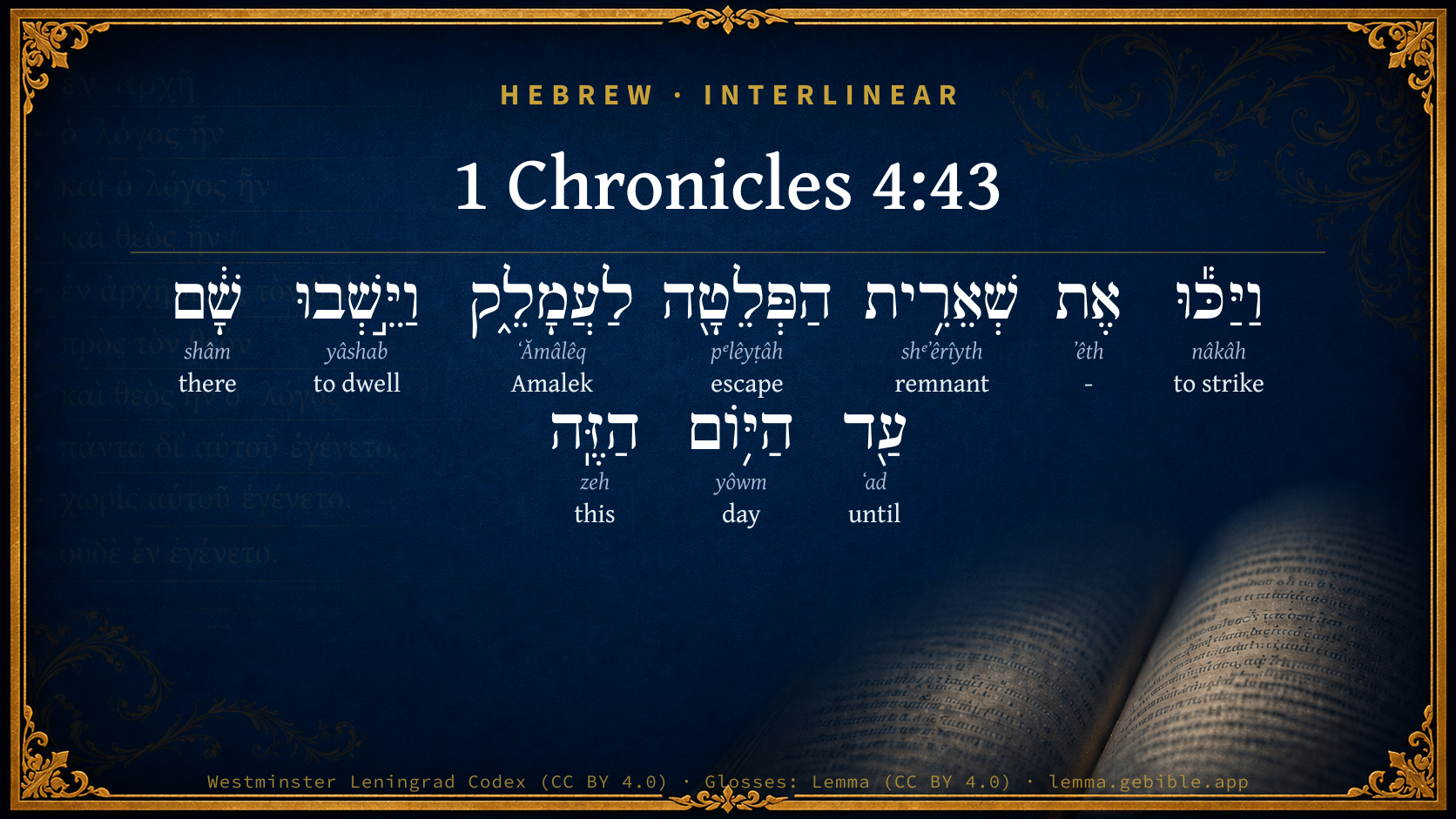
Hebrew (Westminster Leningrad Codex) 1 Chronicles 4:43 appears in the Hebrew Old Testament. The text above is from the Westminster Leningrad Codex. Each word links to its Strong’s number, a concise gloss, and parsing drawn from the Open Scriptures Hebrew Bible morphology. Click any word for its full Brown-Driver-Briggs (BDB) entry.
Download image
Cite this verse

1 Chronicles 4:43 (World English Bible). Public Domain. Lemma interlinear Bible study tool, https://lemma.gebible.app/v/1-chronicles/4/43.

Show BibTeX & RIS
BibTeX
RIS
English Translation
They struck the remnant of the Amalekites who escaped, and have lived there to this day.
World English Bible · Public Domain
Download a study sheet

One document with this verse’s original text, its word-by-word gloss line, the meaning frame, cross-references with their text, attributed commentary, and full source and license credits — printable, and it pastes into notes with its structure intact.

This verse Autodidact and up

Study sheet (.html) Plain text (.txt)

A passage Seminary Student

Up to 50 verses in one chapter. A passage sheet keeps up to 6 commentary sources and 12 cross-references per verse, in the order this page ranks them, and says so on the sheet whenever that leaves anything out. Ask for a single verse and you get the Autodidact verse sheet above.

Everything on this page stays free to read, with no account — the sheet is a download of what is already on screen, not access to it.

Want to remove ads? Support Godless Engineer
Compare translations 3

The same verse in 3 English versions, stacked beneath the original-language interlinear above. Click any original word for its lexicon entry.

Each is an independent rendering of the whole verse — the interlinear is not word-aligned to these translations.

Highlighted words mark where these versions differ — a whole-verse word diff, not a word-by-word alignment.

  • World English Bible Public Domain
    They struck the remnant of the Amalekites who escaped, and have lived there to this day.
  • King James Version Public Domain
    And they smote the rest of the Amalekites that were escaped, and dwelt there unto this day.
  • unfoldingWord Literal Text CC BY-SA 4.0
    and they struck the remnant of the escape of Amalek, and they have dwelled there to this day.

unfoldingWord Literal Text — © unfoldingWord, licensed CC BY-SA 4.0. Word-aligned USFM3 via Door43 (git.door43.org/unfoldingWord/en_ult).

Versions to compare (up to 4)

3 of 4 selected

Show all 18 translations

Every available English version of this verse, each an independent rendering of the whole verse.

  • World English Bible Public Domain
    They struck the remnant of the Amalekites who escaped, and have lived there to this day.
  • Berean Standard Bible Public Domain
    and struck down the remnant of the Amalekites who had escaped. And they have lived there to this day.
  • Majority Standard Bible Public Domain
    and struck down the remnant of the Amalekites who had escaped. And they have lived there to this day.
  • King James Version Public Domain
    And they smote the rest of the Amalekites that were escaped, and dwelt there unto this day.
  • American Standard Version (1901) Public Domain
    And they smote the remnant of the Amalekites that escaped, and have dwelt there unto this day.
  • Revised Version (1885) Public Domain
    And they smote the remnant of the Amalekites that escaped, and dwelt there, unto this day.
  • Geneva Bible (1599) Public Domain
    And they smote the rest of Amalek that had escaped, and they dwelt there vnto this day.
  • Douay-Rheims (1899) Public Domain
    And they slew the remnant of the Amalecites, who had been able to escape, and they dwelt there in their stead unto this day.
  • Young's Literal Translation Public Domain
    and they smite the remnant of those escaped of Amalek, and dwell there unto this day.
  • Literal Standard Version CC BY-SA 4.0
    and they strike the remnant of those escaped of Amalek, and dwell there to this day.
  • Unlocked Literal Bible CC BY-SA 4.0
    They defeated the rest of the Amalekite refugees, and have lived there to this day.
  • unfoldingWord Literal Text CC BY-SA 4.0
    and they struck the remnant of the escape of Amalek, and they have dwelled there to this day.
  • Darby Bible Public Domain
    and they smote the rest of the Amalekites that had escaped; and they dwelt there unto this day.
  • World Messianic Bible Public Domain
    They struck the remnant of the Amalekites who escaped, and have lived there to this day.
  • Webster's Bible Public Domain
    And they smote the rest of the Amalekites that had escaped, and have dwelt there to this day.
  • Free Bible Version CC BY-SA 4.0
    They destroyed the rest of the Amalekites who had escaped. They have lived there to this very day.
  • Bible in Basic English Public Domain
    And they put to death the rest of the Amalekites who had got away safely, and made it their living-place to this day.
  • JPS Tanakh (1917) Public Domain
    And they smote the remnant of the Amalekites that escaped, and dwelt there unto this day.

Literal Standard Version (2020), Covenant Press — licensed CC BY-SA 4.0. Text via the HelloAO Bible API (eBible.org). Unlocked Literal Bible (unfoldingWord) — licensed CC BY-SA 4.0. Text via the HelloAO Bible API (eBible.org). unfoldingWord Literal Text — © unfoldingWord, licensed CC BY-SA 4.0. Word-aligned USFM3 via Door43 (git.door43.org/unfoldingWord/en_ult). Free Bible Version, Dr. Jonathan Gallagher — licensed CC BY-SA 4.0. Text via the HelloAO Bible API (eBible.org).

Word by word

More ways to search: Search by grammar → Find every occurrence → Compare this word →

Practice this passage: Drill this verse → Learn its vocabulary →

הַפְּלֵטָ֖ה
pᵉlêyṭâh
H6413
“the · escape”
Particle, Definite Article + Noun, Common, Feminine, Singular, Absolute
Part of Speech
Particle + Noun
Type
Common
Gender
Feminine
Number
Singular
State
Absolute
Full BDB Definition

Origin: from H6412

TWOT: 1774d

escape, deliverance - escape, deliverance - escaped remnant
  1. וַיַּכּ֕וּ nâkâh H5221 “and · to strike” Conjunction + Verb, Hiphil, Sequential Imperfect, 3rd Person, Masculine, Plural
  2. אֶת ʼêth H853 “-” Particle, Direct Object
  3. שְׁאֵרִ֥ית shᵉʼêrîyth H7611 “remnant of” Noun, Common, Feminine, Singular, Construct
  4. לַעֲמָלֵ֑ק ʻĂmâlêq H6002 “to/for · Amalek” Preposition + Noun, Proper
  5. וַיֵּ֣שְׁבוּ yâshab H3427 “and · to dwell” Conjunction + Verb, Qal, Sequential Imperfect, 3rd Person, Masculine, Plural
  6. שָׁ֔ם shâm H8033 “there” Adverb
  7. עַ֖ד ʻad H5704 “until” Preposition
  8. הַיּ֥וֹם yôwm H3117 “the · day” Particle, Definite Article + Noun, Common, Masculine, Singular, Absolute
  9. הַזֶּֽה zeh H2088 “the · this” Particle, Definite Article + Pronoun, Demonstrative, Masculine, Singular

About this verse

These counts appear in no published source. They are computed here, from the morphology-tagged text and Lemma’s own curated glosses. What Lemma adds →

10
words
10
distinct lemmas
Historical
section

Shared distinctive vocabulary

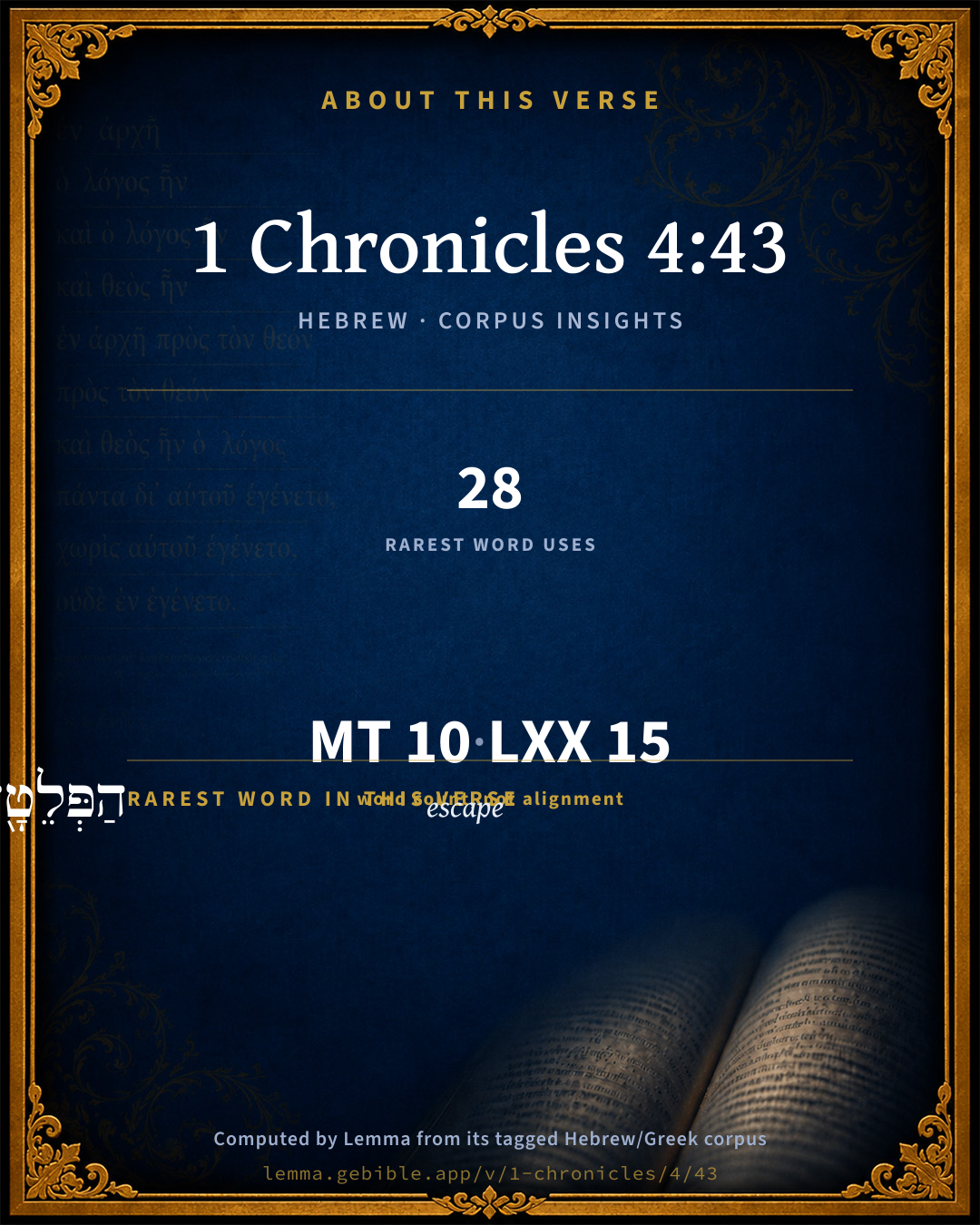
הַפְּלֵטָ֖ה escape H6413 occurs in 28 verses of the Hebrew Bible. Also found in:

Grammatical profile

  • 2 verbs
  • 4 nouns
  • 1 pronoun
  • 1 preposition
  • 1 adverb
  • 1 particle

Verb forms

  • וַיַּכּ֕וּ Hiphil · Sequential Imperfect
  • וַיֵּ֣שְׁבוּ Qal · Sequential Imperfect

Hebrew & Septuagint length

In English translation the verse runs 16 words from the Hebrew and 13 from the Septuagint (LXX English) — closely comparable.

A rough comparison of the two English renderings, which tokenize alike — not a word-level alignment.

Word counts can differ between the Hebrew and the Greek without any difference in meaning — e.g. the Hebrew direct-object marker אֵת has no separate Greek word, and Greek often adds the article ὁ.

In the original languages it is 10 Hebrew tokens and 15 Greek tokens — but the two are counted differently (Hebrew bundles its prefixes and suffixes into one token; the Greek is in lemma form), so that isn’t a like-for-like length.

Cross-references

11

Topical passages linked to 1 Chronicles 4:43 in the Treasury of Scripture Knowledge — connected by theme and wording, ordered by reader-vote popularity; previews shown in the World English Bible.

  • 1 Samuel 30:17 David struck them from the twilight even to the evening of the next day: and there not a man of them escaped, except four hundred young men, who rode on camels and fled.
  • 1 Samuel 15:7–8 Saul struck the Amalekites, from Havilah as you go to Shur, that is before Egypt.
  • 2 Samuel 8:12 of Syria, and of Moab, and of the children of Ammon, and of the Philistines, and of Amalek, and of the spoil of Hadadezer, son of Rehob, king of Zobah.
  • Exodus 17:14–16 Yahweh said to Moses, "Write this for a memorial in a book, and rehearse it in the ears of Joshua: that I will utterly blot out the memory of Amalek from under the sky."
  • Deuteronomy 25:17–19 Remember what Amalek did to you by the way as you came forth out of Egypt;
  • Deuteronomy 34:6 He buried him in the valley in the land of Moab over against Beth Peor: but no man knows of his tomb to this day.
  • Judges 1:26 The man went into the land of the Hittites, and built a city, and called the name of it Luz, which is the name of it to this day.
  • 2 Chronicles 5:9 The poles were so long that the ends of the poles were seen from the ark before the oracle; but they were not seen outside: and there it is to this day.
  • Jeremiah 44:6 Therefore my wrath and my anger was poured forth, and was kindled in the cities of Judah and in the streets of Jerusalem; and they are wasted and desolate, as it is this day.
  • Matthew 27:8 Therefore that field was called "The Field of Blood" to this day.
  • Matthew 28:15 So they took the money and did as they were told. This saying was spread abroad among the Jews, and continues until this day.

Cross-references courtesy of OpenBible.info (CC BY 4.0).

Hebrew and Greek witnesses Masoretic Hebrew ↔ Greek Septuagint

The same verse in the two great witnesses to the Old Testament, shown verse-for-verse.

These are two independent witnesses, not word-aligned to each other, and the Septuagint is shown in lemma (dictionary) form.

Hebrew 1 Chronicles 4:43 Masoretic · Westminster Leningrad Codex

וַיַּכּ֕וּ אֶת שְׁאֵרִ֥ית הַפְּלֵטָ֖ה לַעֲמָלֵ֑ק וַיֵּ֣שְׁבוּ שָׁ֔ם עַ֖ד הַיּ֥וֹם הַזֶּֽה

They struck the remnant of the Amalekites who escaped, and have lived there to this day.

World English Bible · Public Domain

Greek LXX 1 Chronicles 4:43 Septuagint · lemma form

καί πατάσσω ὁ κατάλοιπος ὁ καταλείπω ὁ αμαληκ καί καταοἰκέω ἐκεῖ ἕως ὁ ἡμέρα οὗτος

And they struck the remnant that were left of Amalec, until this day.

LXX2012 (modern English Septuagint) · Public Domain

Hebrew: Westminster Leningrad Codex (CC BY 4.0). Greek: Septuagint (public domain); English from LXX2012 (modern English Septuagint) (Public Domain). How the Septuagint differs from the Hebrew →

Commentary

Notes on 1 Chronicles 4:43 from classic Christian and Jewish commentators (each source and its license shown beneath its notes). The classic Christian expositions comment on the surrounding passage and are grouped to its opening verse, so a note may address several verses; the Jewish commentaries on the Tanakh (Rashi and others) are per-verse, so they appear only where the commentator wrote on this verse.

Lemma curates 59 commentaries, every one of them public domain or Creative Commons licensed, each selected and text-cleaned for this edition rather than reprinted as found. About our sources →

Trapp's Complete Commentary

John Trapp

1Ch 4:43 And they smote the rest of the Amalekites that were escaped, and dwelt there unto this day.

Ver. 43. And they smote the rest of the Amalekites.] Whose preservation from the sword of Joshua, {Exo 17:13} of Saul, {1Sa 15:7} and of David, {2Sa 8:12} was but a reservation to this utter destruction, which God had solemnly sworn, with hand laid upon his own throne. {Exo 17:16}

John Trapp, A Commentary or Exposition upon All the Books of the Old and New Testament (1647–1656) — public domain. Text from a community e-Sword module.

Joseph Benson's Commentary

1Ch 4:43. They smote the rest of the Amalekites — Not destroyed by Saul, or David, or his successors. That dwelt there unto this day — Until the Babylonish captivity, or the time next after it, when these books were written. For, although the main body of the tribe of Simeon, dwelling in Canaan, were carried into captivity, yet this small remnant of them, having removed their dwellings, and being planted In mount Seir, which lay southward from Judah, might possibly be continued and preserved in those parts, when their brethren were gone into captivity.

Joseph Benson's Commentary on the Old and New Testaments (1811–1818) — public domain. Text from a community e-Sword module.

Geneva Bible (1599)

Geneva Bible translators

And were not slain by Saul and David.

Geneva Bible (1599) marginal notes — public domain. Text via Bolls.life.

Adam Clarke's Commentary

Verse 43. They smote the rest of the Amalekites] Those who had escaped in the war which Saul made against them, (see 1Sa 14:48,) and from David, who had attacked them afterwards, 2Sa 8:12.

THE expedition of the Simeonites mentioned here, against Gedor and Seir, was in the days of Hezekiah; and, as Calmet conjectures, near about the time of the captivity of the ten tribes, when the remnant of Simeon would feel themselves obliged to retire more southward, into Arabia Petraea, for fear of the Jews. These may be probable conjectures. - See Calmet.

There are several things in the account of Jabez that are very instructive: -

1. He appears to have been a child brought into the world with great difficulty, at the risk of his own life and that of his mother. So much seems to be implied in, she bare him with sorrow, i.e., with peculiar sorrow and danger.

2. To perpetuate the merciful interposition of God in her own and her son's behalf, she gave him a name that must have recalled to her and his remembrance the danger to which both their lives were exposed, and from which they could not have been extricated but by the especial help of God. She called his name Jabez, c.

3. He was brought up in the fear of God he was no idolater; he worshipped the God of Israel, and he showed the sincerity of his faith by frequent and earnest prayer.

4. His prayer was at once both enlightened and pious. He had piety towards God, and therefore he trusted in him: he knew that he was the fountain of all good, and therefore he sought all necessaries both for body and soul from him. He prayed to the God of Israel.

5. Both the matter and manner of his prayer were excellent. His heart was deeply impressed with its wants, and therefore he was earnest and fervent; O that thou wouldest bless me indeed; אם ברך תברכני im barech tebarecheni; "O that in blessing thou wouldest bless me!" Let me live under thy benediction! Do thou diligently and frequently bless me!

6. He prays for the things necessary for the body as well as for the soul: And enlarge my coasts - grant me as much territory as may support my family. Let the means of living be adequate to the demands of life; let me have the necessaries, conveniences, and, as far as they may be safely intrusted with me, the comforts of life! O that thou wouldest enlarge my coasts!

7. He is conscious that without the continual support of God he must fail; and therefore he prays to be upheld by his power: That thy hand might be with me! May I ever walk with thee, and ever feel the hand of thy power to support and cover me in all the trials, dangers, and difficulties of life; and the hand of thy providence to supply all my wants in reference to both worlds!

8. He dreads both sin and suffering, and therefore prays against both: O that thou wouldest keep me from evil, that it may not grieve me! Sin and misery are in every step of the journey of life; keep me from sin, that I grieve thee not; and keep me from sin, that I render not myself miserable! We can never offend God without injuring ourselves; he that sins must suffer. Thorns and scorpions are everywhere in the way to perdition; and he that walks in it must be torn and stung. He alone is happy who walks in the ways of God. Keep me from evil, that it may not grieve me.

9. Prayers that have a right aim will have a right answer; Jabez did not pray in vain, for God granted him that which he requested. He was continually blessed; his family was increased; the hand of God was upon him for good. He was saved from sin, and saved from the pangs and sufferings of a guilty conscience.

10. If we take up the character and conduct of Jabez in the view given by the Chaldee, we shall not only see him as a pious and careful man, deeply interested in behalf of himself and his family, but we shall see him as a benevolent man, labouring for the welfare of others, and especially for the religious instruction of youth. He founded schools, in which the young and rising generation were taught useful knowledge, and especially the knowledge of God. He had disciples, which were divided into three classes, who distinguished themselves by their fervour in the worship of God, by their docility in obediently hearing and treasuring up the advices and instructions of their teachers, and by their deep piety to God in bringing forth the fruits of the Spirit. The spirit of prophecy, that is, of prayer and supplication, rested upon them.

11. He did not do these things merely as a duty he owed to God and his fellows, but from the abundance of a generous and loving heart: In his counsel he erected a school of disciples. God had blessed him with temporal things, and he secures their continuance by devoting them to his service; he honours God with his substance, and God honours him with his especial blessing and approbation.

12. On these accounts he was more honourable than his brethren. He was of the same stock and the same lineage; he had neither nobility of birth, nor was distinguished by earthly titles; in all these respects he was on a level with his brethren: but God tells us that he was more honourable than them all; and why? because he prayed, because he served his Maker, and because he lived to do good among men; therefore he received the honour that cometh from God. Reader, imitate the conduct of this worthy Israelite, that thou mayest be a partaker of his blessings.

The things added by the Targumist might have been derived from authentic tradition.

Adam Clarke's Commentary on the Bible (1810–1826) — public domain. Text from a community e-Sword/MySword module.

Ellicott's Commentary for English Readers

(43) The rest of the Amalekites that were escaped.—Literally, the remnant of the survivors (pelêtâh, an abstract collective word) belonging to Amalek. These Amalekites are usually supposed to have been some who had taken refuge in Seir from Saul and David’s exterminating wars (1Sa_14:48; 1Sa_15:7; 2Sa_8:12. Comp. 1Ch_1:36, where Amalek appears as a partly Edomite stock.)

A Bible Commentary for English Readers, edited by Charles John Ellicott (1878–1897) — public domain. Text from a community e-Sword module.

The Cambridge Bible for Schools and Colleges

gen. ed. J. J. S. Perowne

43. the rest of the Amalekites] R.V. the remnant of the Amalekites i.e. the descendants of those who had escaped from Saul (1 Samuel 15). They had apparently found refuge in some part of the Edomite territory, for Mount Seir is a synonym for the land of Edom.

The Cambridge Bible for Schools and Colleges (gen. ed. J. J. S. Perowne; Cambridge University Press, 1878–1918) — public domain. Text from a community e-Sword module.

Albert Barnes' Notes on the Bible

Unto this day - These words are probably taken from the record which the writer of Chronicles had before him, and do not imply that the Simeonites remained undisturbed in their conquests until after the return from the captivity. So 1Ch 4:41.

Albert Barnes' Notes on the Bible (1834–1885) — public domain. Text from a community e-Sword/MySword module.

Haydock's Catholic Bible Commentary

Escape the arms of Saul, or of David. (Du Hamel) --- Day. It seems, therefore, that they escaped captivity, having abandoned their own country; or this was taken from a record, which had been made before that event, and is here inserted by Esdras; though, when he wrote, these Simeonites might have experienced the fate of their brethren, who were led captives in the 6th year of Ezechias. (Haydock)

George Leo Haydock (1774–1849), Haydock's Catholic Family Bible and Commentary, 1859 edition — public domain. Excludes Psalms (Douay-Rheims chapter numbering differs from Protestant) and Deuterocanonical books (Catholic canon only).

Matthew Poole's English Annotations

The rest of the Amalekites; not destroyed by Saul, or David, or his successors.

Unto this day; either,

1. Until the captivity of the ten tribes. But that happening so speedily after this time, this expression may seem to be very improper and insignificant here. Or rather,

2. Until the Babylonish captivity, or the time next after it, when these books were written. For although the main body of that tribe dwelling in Canaan were carried into captivity, yet this small remnant of them having removed their dwellings, and being planted in Mount Seir, which lay southward from Judah, might possibly be continued and preserved in those parts, when their brethren were gone into captivity.

Matthew Poole's English Annotations on the Holy Bible (1683–1685) — public domain. Text from a community e-Sword/MySword module.

Whedon's Commentary on the Bible

Daniel D. Whedon

43. The Amalekites that were escaped — Supposed to be those who escaped the sword of Saul and David. 1Sa_14:48; 2Sa_8:12.

Daniel D. Whedon (gen. ed.), Commentary on the Old and New Testaments (1874–1909) — public domain. Text from a community e-Sword module.

The Pulpit Commentary

God"s ways with Amulet.

The reference of the verse is to the remnant that had escaped the great slaughter under King Saul. (1Sa_15:7, 1Sa_15:8) Indications of the existence of scattered portions of this people may be found in 1Sa_27:8; 30:1; 2Sa_8:12. The Amalekites are first mentioned in connection with the aggressive expedition of Chedorlaomer. (Gen_14:7) They occupied the country between Palestine, Idumaea, and Mount Sinai, on the elevated plateau now called Er-Rakhmah. They were a nomad people, and their towns were but collections of tents; they were rich in flocks and herds, and seem to have acquired a vast power by their bold predatory habits. They were consequently most dangerous neighbours for Israel to have so close upon their borders. For the Scripture references to the Amalekites, see Exo_17:8-16; Deu_25:17-19; Num_14:40-45 Num_24:20; Jud_1:3:13 6:3-5 12:15.

I THE SIN OF AMALEK. This is distinctly stated in 1Sa_15:2: "I remember that which Amalek did to Israel, how he laid wait for him in the way, when he came up from Egypt." The expressions used appear to indicate some peculiar treachery in the conduct of this tribe. Probably they regarded themselves as having the sole right to the pasture-grounds in the valleys and plains of the higher ranges of Sinai, and so thought to cut off the advancing hosts of Israel, by taking them in detail as they toiled through the several passes. It may also be urged that the knowledge of the deliverance through the Red Sea had spread among the tribes of the desert; it declared this people to be under Jehovah"s lead, and increased the responsibility of all who attempted to hinder their progress. Amalek added to its sin by incursions in the time of the judges, and by constant annoyance, which in part may explain the severe manner in which it was dealt with. The principle of the treatment of Amalek"s sin may be illustrated by our Lord"s words, "Whoso shall offend one of these little ones that believe in me, it were better for him that a millstone were hanged about his neck, and that he were drowned in the depths of the sea.

II THE DIVINE JUDGMENT ON AMALEK. Remarkable for its severity. Explain that the form and degree of Divine judgments must fit into the customs and sentiments of each age, if they are to exert the proper moral influence upon the age. The extermination of a race was not regarded in Saul"s time as, with our Christian sentiments, we should regard it now. Human life is less valued in the East, and tribal, dynastic, and national changes have always been more sudden, frequent, and violent. Still, this would be, even in those days, so severe a judgment as to prove a solemn warning to the wilful who would try to force their own will against God.

III MAN"S EXECUTION OF THE DIVINE JUDGMENT. It is of the utmost importance, for the due understanding of Old Testament Scripture, that God may use any of his creatures as agents in carrying out his judicial sentences; and man may be his executioner as well as plague, famine, or tempest. In such case what the man has to do for God is right, and the man only comes under the judgments of God for the spirit and the way in which he does it. Saul is not judged for slaying the Amalekites, but for not executing his commission fully and faithfully.

IV MAN"S FAILURE IN EXECUTING THE DIVINE JUDGMENTS. Distinguish between man the agent, and man the individual God looks upon the man, and treats with him in both ways. Man"s trusts from God become tests of man for God. And it may be that the more complicated and difficult the trust is, the more satisfactory it may prove as a moral test. Man is honoured in being permitted to carry out God"s plans and purposes. He may even, from the gospel standpoint, be a "co-worker together with God." But God will not fail to carry out his plans to perfection, even when men may seem to fail him. R.T.

The Pulpit Commentary (1880–1919), ed. H.D.M. Spence-Jones & Joseph S. Exell — public domain. Text from a community e-Sword module.

Rashi

Rabbi Shlomo Yitzchaki (Rashi)

And they smote the remnant... that had escaped from being annihilated by David, for David destroyed every male in Edom.

Rashi on the Tanakh — English translations: “The Judaica Press complete Tanach with Rashi, translated by A. J. Rosenberg” (CC BY 4.0); “Pentateuch with Rashi's commentary by M. Rosenbaum and A.M. Silbermann, 1929-1934” (public domain); “The Metsudah Tanach series, Lakewood, N.J” (CC BY 4.0); and “The Book of Joshua, Metsudah Publications, 1997” (CC BY 4.0). Text via Sefaria.

Lesson kit

Teaching starters — assembled from the data on this page, not authored interpretation. Every prompt links to the verse data it draws on. Edit before teaching.

1 Chronicles, in the Historical, opens this verse with 10 words (10 distinct Hebrew lemmas). Its most distinctive word is pᵉlêyṭâh (“escape”). A historical commentator’s framing appears above. Read the whole chapter for the surrounding context.

Discussion questions

  1. How does “escape” (pᵉlêyṭâh) shape what this verse is saying?
  2. Genesis 32:8 shares the word «escape» with this verse. How do the two illuminate each other?
  3. The translations on this page render this verse differently — a whole-verse word diff, not a word-by-word alignment. What might account for the different wordings?
  4. The verb «וַיַּכּ֕וּ» is Hiphil Sequential Imperfect. How does its form color the action?
  5. Reading how Trapp's Complete Commentary and Joseph Benson's Commentary read this verse, where do the two commentators agree and where do they part?

Things to notice

Reading settings

Reading text

Shown beneath each verse's original-language words.

Old Testament
Old Testament edition

Read the OT as the Masoretic Hebrew (MT) or the Greek Septuagint (LXX).

English shown for the Greek Septuagint (in the Hebrew ↔ Greek comparison).

Comparing translations? Open the Compare panel on any verse page to stack up to four side by side.