
Exodus 33:21

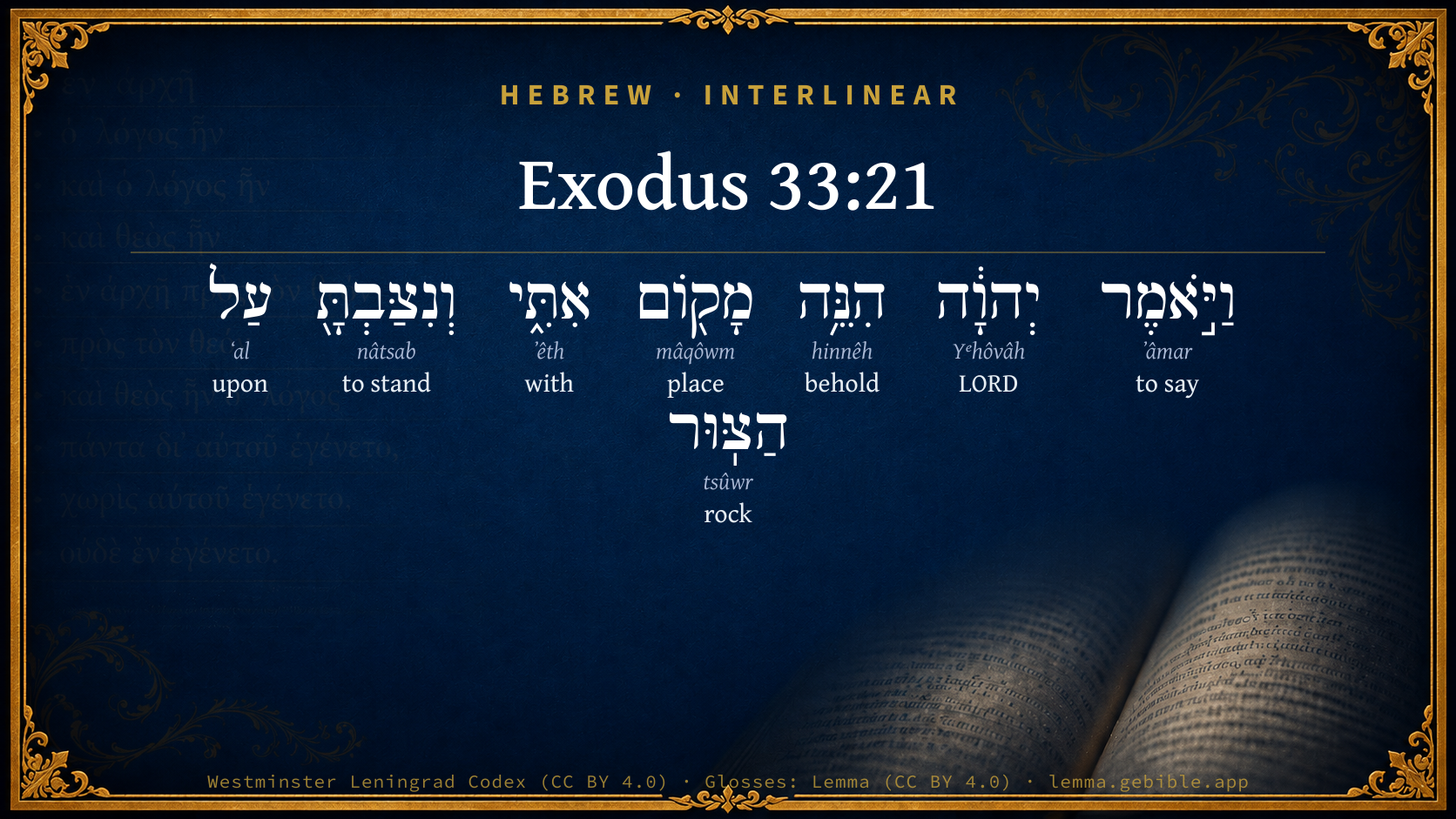
Hebrew (Westminster Leningrad Codex) Exodus 33:21 appears in the Hebrew Old Testament. The text above is from the Westminster Leningrad Codex. Each word links to its Strong’s number, a concise gloss, and parsing drawn from the Open Scriptures Hebrew Bible morphology. Click any word for its full Brown-Driver-Briggs (BDB) entry.
Download image
Cite this verse

Exodus 33:21 (World English Bible). Public Domain. Lemma interlinear Bible study tool, https://lemma.gebible.app/v/exodus/33/21.

Show BibTeX & RIS
BibTeX
RIS
English Translation
Yahweh also said, "Behold, there is a place by me, and you shall stand on the rock.
World English Bible · Public Domain
Download a study sheet

One document with this verse’s original text, its word-by-word gloss line, the meaning frame, cross-references with their text, attributed commentary, and full source and license credits — printable, and it pastes into notes with its structure intact.

This verse Autodidact and up

Study sheet (.html) Plain text (.txt)

A passage Seminary Student

Up to 50 verses in one chapter. A passage sheet keeps up to 6 commentary sources and 12 cross-references per verse, in the order this page ranks them, and says so on the sheet whenever that leaves anything out. Ask for a single verse and you get the Autodidact verse sheet above.

Everything on this page stays free to read, with no account — the sheet is a download of what is already on screen, not access to it.

Want to remove ads? Support Godless Engineer
Compare translations 3

The same verse in 3 English versions, stacked beneath the original-language interlinear above. Click any original word for its lexicon entry.

Each is an independent rendering of the whole verse — the interlinear is not word-aligned to these translations.

Highlighted words mark where these versions differ — a whole-verse word diff, not a word-by-word alignment.

  • World English Bible Public Domain
    Yahweh also said, "Behold, there is a place by me, and you shall stand on the rock.
  • King James Version Public Domain
    And the LORD said, Behold, there is a place by me, and thou shalt stand upon a rock:
  • unfoldingWord Literal Text CC BY-SA 4.0
    And Yahweh said, “Behold, a place with me, and you shall station yourself on the rock.

unfoldingWord Literal Text — © unfoldingWord, licensed CC BY-SA 4.0. Word-aligned USFM3 via Door43 (git.door43.org/unfoldingWord/en_ult).

Versions to compare (up to 4)

3 of 4 selected

Show all 18 translations

Every available English version of this verse, each an independent rendering of the whole verse.

  • World English Bible Public Domain
    Yahweh also said, "Behold, there is a place by me, and you shall stand on the rock.
  • Berean Standard Bible Public Domain
    The LORD continued, “There is a place near Me where you are to stand upon a rock,
  • Majority Standard Bible Public Domain
    The LORD continued, “There is a place near Me where you are to stand upon a rock,
  • King James Version Public Domain
    And the LORD said, Behold, there is a place by me, and thou shalt stand upon a rock:
  • American Standard Version (1901) Public Domain
    and Jehovah said, Behold, there is a place by me, and thou shalt stand upon the rock:
  • Revised Version (1885) Public Domain
    And the LORD said, Behold, there is a place by me, and thou shalt stand upon the rock:
  • Geneva Bible (1599) Public Domain
    Also the Lord sayd, Behold, there is a place by me, and thou shalt stand vpon the rocke:
  • Douay-Rheims (1899) Public Domain
    And again he said: Behold there is a place with me, and thou shalt stand upon the rock.
  • Young's Literal Translation Public Domain
    Jehovah also saith, `Lo, a place `is' by Me, and thou hast stood on the rock,
  • Literal Standard Version CC BY-SA 4.0
    YHWH also says, “Behold, a place [is] by Me, and you have stood on the rock,
  • Unlocked Literal Bible CC BY-SA 4.0
    Yahweh said, “See, here is a place by me; you will stand on this rock.
  • unfoldingWord Literal Text CC BY-SA 4.0
    And Yahweh said, “Behold, a place with me, and you shall station yourself on the rock.
  • Darby Bible Public Domain
    And Jehovah said, Behold, [there is] a place by me: there shalt thou stand on the rock.
  • World Messianic Bible Public Domain
    The LORD also said, “Behold, there is a place by me, and you shall stand on the rock.
  • Webster's Bible Public Domain
    And the LORD said, Behold, there is a place by me, and thou shalt stand upon a rock:
  • Free Bible Version CC BY-SA 4.0
    “Come here and stand by me on this rock,” the Lord went on,
  • Bible in Basic English Public Domain
    And the Lord said, See, there is a place near me, and you may take your place on the rock:
  • JPS Tanakh (1917) Public Domain
    And the LORD said: 'Behold, there is a place by Me, and thou shalt stand upon the rock.

Literal Standard Version (2020), Covenant Press — licensed CC BY-SA 4.0. Text via the HelloAO Bible API (eBible.org). Unlocked Literal Bible (unfoldingWord) — licensed CC BY-SA 4.0. Text via the HelloAO Bible API (eBible.org). unfoldingWord Literal Text — © unfoldingWord, licensed CC BY-SA 4.0. Word-aligned USFM3 via Door43 (git.door43.org/unfoldingWord/en_ult). Free Bible Version, Dr. Jonathan Gallagher — licensed CC BY-SA 4.0. Text via the HelloAO Bible API (eBible.org).

Word by word

More ways to search: Search by grammar → Find every occurrence → Compare this word →

Practice this passage: Drill this verse → Learn its vocabulary →

וְנִצַּבְתָּ֖
nâtsab
H5324
“and · to stand”
Conjunction + Verb, Niphal, Sequential Perfect, 2nd Person, Masculine, Singular
Part of Speech
Conjunction + Verb
Stem
Niphal
Form
Sequential Perfect
Person
2nd Person
Gender
Masculine
Number
Singular
Full BDB Definition

Origin: a primitive root

TWOT: 1398

to stand, take one's stand, stand upright, be set (over), establish - (Niphal) - to station oneself, take one's stand - to stand, be stationed - to stand, take an upright position - to be stationed, be appointed - deputy, prefect, appointed, deputed (substantive) - to stand firm - (Hiphil) - to station, set - to set up, erect - to cause to stand erect - to fix, establish - (Hophal) to be fixed, be determined, be stationary
  1. וַיֹּ֣אמֶר ʼâmar H559 “and · to say” Conjunction + Verb, Qal, Sequential Imperfect, 3rd Person, Masculine, Singular
  2. יְהוָ֔ה Yᵉhôvâh H3068 “LORD” Noun, Proper
  3. הִנֵּ֥ה hinnêh H2009 “behold” Particle, Demonstrative
  4. מָק֖וֹם mâqôwm H4725 “place” Noun, Common, Masculine, Singular, Absolute
  5. אִתִּ֑י ʼêth H854 “with · me” Preposition + Suffix, Personal, 1st Person, Common, Singular
  6. עַל ʻal H5921 “upon” Preposition
  7. הַצּֽוּר tsûwr H6697 “the · rock” Particle, Definite Article + Noun, Common, Masculine, Singular, Absolute

About this verse

These counts appear in no published source. They are computed here, from the morphology-tagged text and Lemma’s own curated glosses. What Lemma adds →

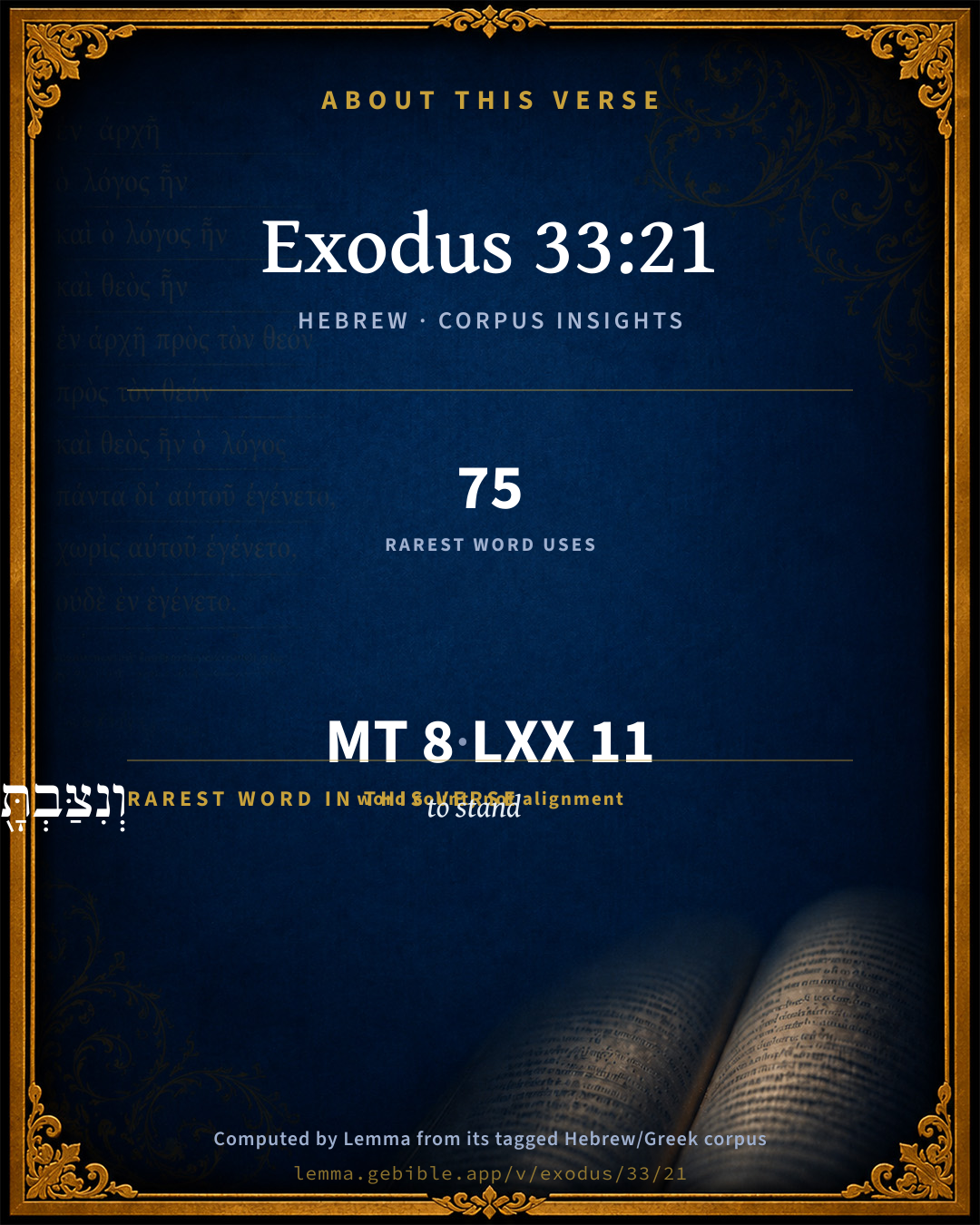
8
words
8
distinct lemmas
Pentateuch
section

Grammatical profile

  • 2 verbs
  • 3 nouns
  • 2 prepositions
  • 1 particle

Verb forms

  • וַיֹּ֣אמֶר Qal · Sequential Imperfect
  • וְנִצַּבְתָּ֖ Niphal · Sequential Perfect

Hebrew & Septuagint length

In English translation the verse runs 17 words from the Hebrew and 17 from the Septuagint (LXX English) — the same length.

A rough comparison of the two English renderings, which tokenize alike — not a word-level alignment.

Word counts can differ between the Hebrew and the Greek without any difference in meaning — e.g. the Hebrew direct-object marker אֵת has no separate Greek word, and Greek often adds the article ὁ.

In the original languages it is 8 Hebrew tokens and 11 Greek tokens — but the two are counted differently (Hebrew bundles its prefixes and suffixes into one token; the Greek is in lemma form), so that isn’t a like-for-like length.

Cross-references

5

Topical passages linked to Exodus 33:21 in the Treasury of Scripture Knowledge — connected by theme and wording, ordered by reader-vote popularity; previews shown in the World English Bible.

  • Deuteronomy 5:31 But as for you, stand you here by me, and I will speak to you all the commandment, and the statutes, and the ordinances, which you shall teach them, that they may do them in the land which I give them to possess it.
  • Zechariah 3:7 "Thus says Yahweh of hosts: 'If you will walk in my ways, and if you will keep my charge, then you also shall judge my house, and shall also keep my courts, and I will give you a place of access among these who stand by.
  • Joshua 20:4 He shall flee to one of those cities, and shall stand at the entrance of the gate of the city, and declare his cause in the ears of the elders of that city; and they shall take him into the city to them, and give him a place, that he may dwell among them.
  • Isaiah 56:5 To them will I give in my house and within my walls a memorial and a name better than of sons and of daughters; I will give them an everlasting name, that shall not be cut off.
  • Luke 15:1 Now all the tax collectors and sinners were coming close to him to hear him.

Cross-references courtesy of OpenBible.info (CC BY 4.0).

Hebrew and Greek witnesses Masoretic Hebrew ↔ Greek Septuagint

The same verse in the two great witnesses to the Old Testament, shown verse-for-verse.

These are two independent witnesses, not word-aligned to each other, and the Septuagint is shown in lemma (dictionary) form.

Hebrew Exodus 33:21 Masoretic · Westminster Leningrad Codex

וַיֹּ֣אמֶר יְהוָ֔ה הִנֵּ֥ה מָק֖וֹם אִתִּ֑י וְנִצַּבְתָּ֖ עַל הַצּֽוּר

Yahweh also said, "Behold, there is a place by me, and you shall stand on the rock.

World English Bible · Public Domain

Greek LXX Exodus 33:21 Septuagint · lemma form

καί εἶπον κύριος ἰδού τόπος παρά ἐγώ ἵστημι ἐπί ὁ πέτρα

And the Lord said, Behold, there is a place by me: you shall stand upon the rock;

LXX2012 (modern English Septuagint) · Public Domain

Hebrew: Westminster Leningrad Codex (CC BY 4.0). Greek: Septuagint (public domain); English from LXX2012 (modern English Septuagint) (Public Domain). How the Septuagint differs from the Hebrew →

Targum (Aramaic paraphrase)

2

The Targum is the ancient Jewish Aramaic paraphrase of the Hebrew Scriptures — an interpretive translation, not the Hebrew text itself. Onkelos (literal) and Pseudo-Jonathan (expansive) render the Torah, and Jonathan the Prophets. Coverage is partial: where no permissively-licensed English translation exists for a verse, only the Aramaic is shown. This is verse-level text, not a word-by-word alignment to the Hebrew.

  1. Targum Onkelos Torah (Genesis–Deuteronomy)
    וַאֲמַר יְיָ הָא אָתַר מַתְקַן קֳדָמָי וְתִתְעַתַּד עַל טִנָרָא:

    (no public-domain English translation for this verse)

    Targum Onkelos — Aramaic: “Onkelos Genesis” (public domain); “Onkelos Exodus” (public domain); “Onkelos Leviticus” (public domain); “Onkelos Numbers” (public domain); “Onkelos Deuteronomy” (public domain). English: “Sefaria Community Translation” (CC0 1.0 (public-domain dedication)); “J.W. Etheridge. The Targums of Onkelos and Jonathan Ben Uzziel on the Pentateuch. London: Longmans, Green, 1862” (public domain). Text via Sefaria.

  2. Targum Pseudo-Jonathan Torah (Genesis–Deuteronomy)
    וַאֲמַר יְיָ הָא אֲתַר מְתַקַּן קֳדָמַי וּתְהֵי מְעַתַּד עַל טִינָרָא

    Behold, a place is prepared before Me, and thou shalt stand upon the rock.

    Targum Pseudo-Jonathan — Aramaic: “Targum Jonathan on Genesis” (public domain); “Targum Jonathan on Exodus” (public domain); “Targum Jonathan on Leviticus” (public domain); “Targum Jonathan on Numbers” (public domain); “Targum Jonathan on Deuteronomy” (public domain). English: “The Targum of Jonathan ben Uzziel, trans. J. W. Etheridge, London, 1862” (public domain). Text via Sefaria.

Commentary

Notes on Exodus 33:21 from classic Christian and Jewish commentators (each source and its license shown beneath its notes). The classic Christian expositions comment on the surrounding passage and are grouped to its opening verse, so a note may address several verses; the Jewish commentaries on the Tanakh (Rashi and others) are per-verse, so they appear only where the commentator wrote on this verse.

Lemma curates 59 commentaries, every one of them public domain or Creative Commons licensed, each selected and text-cleaned for this edition rather than reprinted as found. About our sources →

Joseph Benson's Commentary

Exo 33:21. Behold, there is a place by me — Probably meant of some part of mount Horeb, where Moses had long enjoyed intercourse with God, and from which the tabernacle, where the cloud of glory now appeared, was at no great distance. And thou shalt stand upon a rock — If not that from which the water was miraculously brought, yet certainly one which, like it, was emblematical of Christ, (1Co 10:4,) through whom alone we can have the knowledge of the glory of God. For this glory none can see to their comfort but those that believe, confide, and take shelter in him. While my glory passeth by, I will put thee in a cleft of the rock — As the rock might limit Moses’s view of the divine glory, that he might not be overwhelmed by it; so the refulgent rays of the glory of God are limited and concealed by the humanity of Christ, and by faith we are hid in him, and secured from the effects of the glorious justice and wrath of God, which would otherwise consume us. I will cover thee with my hand while I pass by — My invisible power shall spread a cloud before thee, that thou mayest not be overpowered and struck dead by the excessive glory, and so be undone by thy own desires.

Joseph Benson's Commentary on the Old and New Testaments (1811–1818) — public domain. Text from a community e-Sword module.

Geneva Bible (1599)

Geneva Bible translators

In mount Horeb.

Geneva Bible (1599) marginal notes — public domain. Text via Bolls.life.

Adam Clarke's Commentary

Verse 21. Behold, there is a place by me] There seems to be a reference here to a well-known place on the mount where God was accustomed to meet with Moses. This was a rock; and it appears there was a cleft or cave in it, in which Moses was to stand while the Divine Majesty was pleased to show him all that human nature was capable of bearing: but this appears to have referred more to the counsels of his mercy and goodness, relative to his purpose of redeeming the human race, than to any visible appearance of the Divine Majesty itself. See Clarke on Ex 33:18.

1. THE conclusion of this chapter is very obscure: we can scarcely pretend to say, in any precise manner, what it means; and it is very probable that the whole concerned Moses alone. He was in great perplexity and doubt; he was afraid that God was about to abandon this people; and he well knew that if he did so, their destruction must be the consequence. He had received general directions to decamp, and lead the people towards the promised land; but this was accompanied with a threat that Jehovah would not go with them. The prospect that was before him was exceedingly gloomy and discouraging; and it was rendered the more so because God predicted their persevering stiffneckedness, and gave this as one reason why he would not go up among them, for their provocations would be so great and so frequent that his justice would be so provoked as to break through in a moment and consume them. Moses, well knowing that God must have some great and important designs in delivering them and bringing them thus far, earnestly entreated him to give him some discovery of it, that his own mind might be satisfied. God mercifully condescends to meet his wishes in such a way as no doubt gave him full satisfaction; but as this referred to himself alone the circumstances are not related, as probably they could be of no farther use to us than the mere gratifying of a principle of curiosity.

2. On some occasions to be kept in the dark is as instructive as to be brought into the light. In many cases those words of the prophet are strictly applicable. Verily, thou art a God, who HIDEST THYSELF, O God of Israel, the Saviour! One point we see here very plainly, that while the people continued obstinate and rebellious, that presence of God by which his approbation was signified could not be manifested among them; and yet, without his presence to guide, protect, and provide for them, they could neither go up nor be saved. This presence is promised, and on the fulfilment of the promise the safety of Israel depended. The Church of God is often now in such a state that the approbation of God cannot be manifested in it; and yet if his presence were wholly withdrawn, truth would fall in the streets, equity go backward, and the Church must become extinct. How have the seeds of light and life been preserved during the long, dark, and cold periods when error was triumphant, and the pure worship of God adulterated by the impurities of idolatry and the thick darkness of superstition, by the presence of his endless mercy, preserving his own truth in circumstances in which he could not show his approbation! He was with the Church in the wilderness, and preserved the living oracles, kept alive the heavenly seeds, and is now showing forth the glory of those designs which before he concealed from mankind. He cannot err because he is infinitely wise; he can do nothing that is unkind, because he delighteth in mercy. We, as yet, see only through a glass darkly; by and by we shall see face to face. The Lord's presence is with his people; and those who trust in him have confident rest in his mercy.

Adam Clarke's Commentary on the Bible (1810–1826) — public domain. Text from a community e-Sword/MySword module.

Ellicott's Commentary for English Readers

(21) There is a place by me.—A place on the summit of Sinai, where God had been manifesting Himself, is clearly intended; but it is impossible to fix the place with any certainty. Speculations like those of Dr. Robinson (Biblical Researches, Vol. 1, p. 153) are of little value.

A Bible Commentary for English Readers, edited by Charles John Ellicott (1878–1897) — public domain. Text from a community e-Sword module.

The Cambridge Bible for Schools and Colleges

gen. ed. J. J. S. Perowne

21. stand] better, station thyself: cf. Exo_34:2.

21–23. Jehovah accordingly bids Moses stand where he may see, as He passes by, not His full glory, but only His back, or hinder parts (Exo_26:12 Heb.), i.e., so to say, only the afterglow, which He leaves behind Him, but which may still suggest faintly what the full brilliancy of His presence must be (cf. Job_26:14).

The Cambridge Bible for Schools and Colleges (gen. ed. J. J. S. Perowne; Cambridge University Press, 1878–1918) — public domain. Text from a community e-Sword module.

John Gill's Exposition

And the Lord said, behold, there is a place by me,.... Near him, not in or by the tabernacle, where it may be the pillar of cloud now was, as it had been, Exo 33:9 but upon the rock, where it had been for many days, and near to which there was a fit place for Moses to be in, and have that view of the goodness and glory of God he would favour him with:

and thou shall stand upon a rock; in Horeb, typical of Christ the rock, the rock of Israel, and the rock of ages, the rock of refuge, salvation, and strength; comparable to one for shelter, solidity, firmness, strength, and duration; and happy are they who stand upon this rock; they are safe and secure, they stand on high, and have noble prospects of the perfections of God, and of the riches of his grace and goodness, see Psa 50:2.

John Gill's Exposition of the Whole Bible (1746–1763) — public domain (CC PDM 1.0). Text via the HelloAO Bible API.

Matthew Poole's English Annotations

There is a place by me, in this mountain where my residence and glorious presence now is, and in that part of it whence my voice now cometh to thine ears.

Matthew Poole's English Annotations on the Holy Bible (1683–1685) — public domain. Text from a community e-Sword/MySword module.

The Pulpit Commentary

Behold, there is a place by me. No sufficient indication is given by these words, or by any other words in Scripture, of the exact locality of the manifestation to Moses. The so-called" traditions "are worthless; and we can only say that the scene was probably some portion of the upper part of the Ras Sufsafeh.

The Pulpit Commentary (1880–1919), ed. H.D.M. Spence-Jones & Joseph S. Exell — public domain. Text from a community e-Sword module.

unfoldingWord translationNotes

Door43 World Missions Community

See

"Look" or "Listen" or "Pay attention to what I am about to tell you."

you will see my back

This is because Yahweh will be walking away from Moses.

but my face will not be seen

This can be expressed in active form. AT: "but you will not see my face" (See: Active or Passive)

translationWords

Yahweh

glory

unfoldingWord translationNotes — © Distant Shores Media and the Door43 World Missions Community, licensed CC BY-SA 4.0. Source: git.door43.org/Door43/en_tn.

Rashi

Rabbi Shlomo Yitzchaki (Rashi)

הנה מקום אתי BEHOLD, THERE IS A PLACE BY ME — On the mountain where I am continually speaking with you there is a place prepared by Me for your sake where I will hide you that you may not be hurt by the vision. From there you will see what you will be permitted to see. A Midrashic explanation is that by the word מקום Scripture is speaking of the place where the Shechinah is and that He therefore said, “The place is by Me” and He did not say, “I am in the place”, because the Holy One, blessed be He, is the “place” of the Universe (comprises the Universe) but His Universe is not His place (does not encompass Him) (Genesis Rabbah 68:9).

Rashi on the Tanakh — English translations: “The Judaica Press complete Tanach with Rashi, translated by A. J. Rosenberg” (CC BY 4.0); “Pentateuch with Rashi's commentary by M. Rosenbaum and A.M. Silbermann, 1929-1934” (public domain); “The Metsudah Tanach series, Lakewood, N.J” (CC BY 4.0); and “The Book of Joshua, Metsudah Publications, 1997” (CC BY 4.0). Text via Sefaria.

Ramban (Nachmanides)

Rabbi Moshe ben Nachman (Ramban / Nachmanides)

BEHOLD, THERE IS A PLACE BY ME — on this mountain, where My Glory resides.

AND THOU SHALT STAND UPON THE ROCK — which was upon the mountain, as it is said, Behold, I will stand before thee there upon the rock in Horeb.

Ramban (Nachmanides) on the Tanakh — English translation: “Commentary on the Torah by Ramban (Nachmanides). Translated and annotated by Charles B. Chavel. New York, Shilo Pub. House, 1971-1976” (CC BY 4.0). Text via Sefaria.

Lesson kit

Teaching starters — assembled from the data on this page, not authored interpretation. Every prompt links to the verse data it draws on. Edit before teaching.

Exodus, in the Pentateuch, opens this verse with 8 words (8 distinct Hebrew lemmas). Its most distinctive word is nâtsab (“to stand”). A historical commentator’s framing appears above. Read the whole chapter for the surrounding context.

Discussion questions

  1. The word nâtsab carries the sense “to stand.” How does it shape the verse?
  2. How does Deuteronomy 5:31, which shares this passage’s theme, read alongside this verse?
  3. These translations render this verse differently; the difference is in the English rendering, not the original. What questions does that raise?
  4. «וַיֹּ֣אמֶר» is a Qal Sequential Imperfect verb. How does that grammatical form shape the action described?
  5. Compare how Joseph Benson's Commentary and Geneva Bible (1599) read this verse. Where do they agree or differ?

Things to notice

Reading settings

Reading text

Shown beneath each verse's original-language words.

Old Testament
Old Testament edition

Read the OT as the Masoretic Hebrew (MT) or the Greek Septuagint (LXX).

English shown for the Greek Septuagint (in the Hebrew ↔ Greek comparison).

Comparing translations? Open the Compare panel on any verse page to stack up to four side by side.