
Exodus 32:9

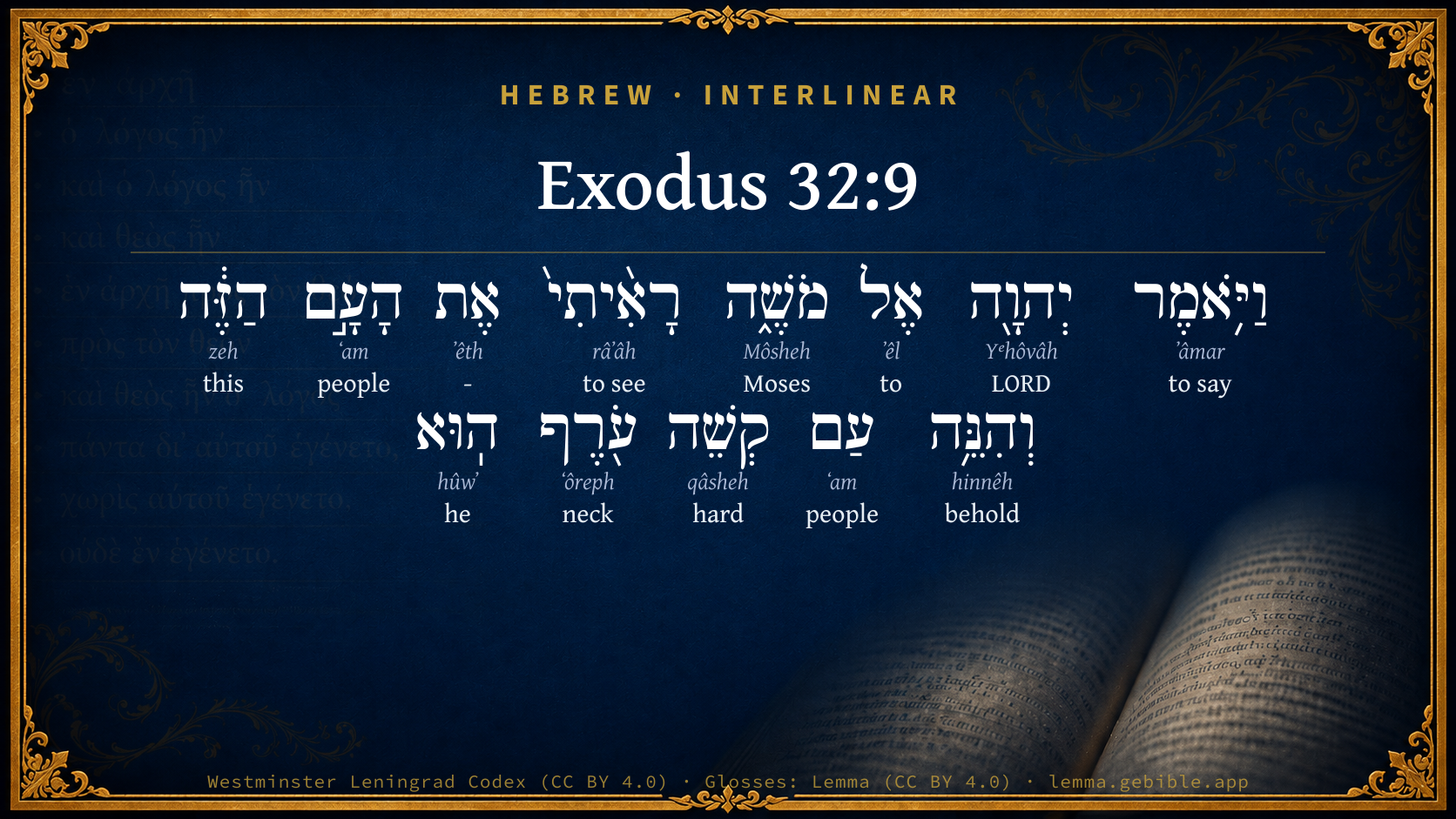
Hebrew (Westminster Leningrad Codex) Exodus 32:9 appears in the Hebrew Old Testament. The text above is from the Westminster Leningrad Codex. Each word links to its Strong’s number, a concise gloss, and parsing drawn from the Open Scriptures Hebrew Bible morphology. Click any word for its full Brown-Driver-Briggs (BDB) entry.
Download image
Cite this verse

Exodus 32:9 (World English Bible). Public Domain. Lemma interlinear Bible study tool, https://lemma.gebible.app/v/exodus/32/9.

Show BibTeX & RIS
BibTeX
RIS
English Translation
Yahweh said to Moses, "I have seen these people, and, behold, they are a stiff-necked people.
World English Bible · Public Domain
Download a study sheet

One document with this verse’s original text, its word-by-word gloss line, the meaning frame, cross-references with their text, attributed commentary, and full source and license credits — printable, and it pastes into notes with its structure intact.

This verse Autodidact and up

Study sheet (.html) Plain text (.txt)

A passage Seminary Student

Up to 50 verses in one chapter. A passage sheet keeps up to 6 commentary sources and 12 cross-references per verse, in the order this page ranks them, and says so on the sheet whenever that leaves anything out. Ask for a single verse and you get the Autodidact verse sheet above.

Everything on this page stays free to read, with no account — the sheet is a download of what is already on screen, not access to it.

Want to remove ads? Support Godless Engineer
Compare translations 3

The same verse in 3 English versions, stacked beneath the original-language interlinear above. Click any original word for its lexicon entry.

Each is an independent rendering of the whole verse — the interlinear is not word-aligned to these translations.

Highlighted words mark where these versions differ — a whole-verse word diff, not a word-by-word alignment.

  • World English Bible Public Domain
    Yahweh said to Moses, "I have seen these people, and, behold, they are a stiff-necked people.
  • King James Version Public Domain
    And the LORD said unto Moses, I have seen this people, and, behold, it is a stiffnecked people:
  • unfoldingWord Literal Text CC BY-SA 4.0
    And Yahweh said to Moses, “I have seen this people, and behold, it is a people hard of neck.

unfoldingWord Literal Text — © unfoldingWord, licensed CC BY-SA 4.0. Word-aligned USFM3 via Door43 (git.door43.org/unfoldingWord/en_ult).

Versions to compare (up to 4)

3 of 4 selected

Show all 18 translations

Every available English version of this verse, each an independent rendering of the whole verse.

  • World English Bible Public Domain
    Yahweh said to Moses, "I have seen these people, and, behold, they are a stiff-necked people.
  • Berean Standard Bible Public Domain
    The LORD also said to Moses, “I have seen this people, and they are indeed a stiff-necked people.
  • Majority Standard Bible Public Domain
    The LORD also said to Moses, “I have seen this people, and they are indeed a stiff-necked people.
  • King James Version Public Domain
    And the LORD said unto Moses, I have seen this people, and, behold, it is a stiffnecked people:
  • American Standard Version (1901) Public Domain
    And Jehovah said unto Moses, I have seen this people, and, behold, it is a stiffnecked people:
  • Revised Version (1885) Public Domain
    And the LORD said unto Moses, I have seen this people, and, behold, it is a stiffnecked people:
  • Geneva Bible (1599) Public Domain
    Againe the Lord said vnto Moses, I haue seene this people, and beholde, it is a stiffe necked people.
  • Douay-Rheims (1899) Public Domain
    And again the Lord said to Moses: See that this people is stiffnecked:
  • Young's Literal Translation Public Domain
    And Jehovah saith unto Moses, `I have seen this people, and lo, it `is' a stiff-necked people;
  • Literal Standard Version CC BY-SA 4.0
    And YHWH says to Moses, “I have seen this people, and behold, it [is] a stiff-necked people;
  • Unlocked Literal Bible CC BY-SA 4.0
    Then Yahweh said to Moses, “I have seen this people. Look, they are a stiff-necked people.
  • unfoldingWord Literal Text CC BY-SA 4.0
    And Yahweh said to Moses, “I have seen this people, and behold, it is a people hard of neck.
  • Darby Bible Public Domain
    And Jehovah said to Moses, I see this people, and behold, it is a stiff-necked people.
  • World Messianic Bible Public Domain
    The LORD said to Moses, “I have seen these people, and behold, they are a stiff-necked people.
  • Webster's Bible Public Domain
    And the LORD said to Moses, I have seen this people, and behold it is a stiff-necked people:
  • Free Bible Version CC BY-SA 4.0
    “I know what these people are like,” the Lord continued saying to Moses. “They are so rebellious!
  • Bible in Basic English Public Domain
    And the Lord said to Moses, I have been watching this people, and I see that they are a stiff-necked people.
  • JPS Tanakh (1917) Public Domain
    And the LORD said unto Moses: 'I have seen this people, and, behold, it is a stiffnecked people.

Literal Standard Version (2020), Covenant Press — licensed CC BY-SA 4.0. Text via the HelloAO Bible API (eBible.org). Unlocked Literal Bible (unfoldingWord) — licensed CC BY-SA 4.0. Text via the HelloAO Bible API (eBible.org). unfoldingWord Literal Text — © unfoldingWord, licensed CC BY-SA 4.0. Word-aligned USFM3 via Door43 (git.door43.org/unfoldingWord/en_ult). Free Bible Version, Dr. Jonathan Gallagher — licensed CC BY-SA 4.0. Text via the HelloAO Bible API (eBible.org).

Word by word

More ways to search: Search by grammar → Find every occurrence → Compare this word →

Practice this passage: Drill this verse → Learn its vocabulary →

עֹ֖רֶף
ʻôreph
H6203
“neck”
Noun, Common, Masculine, Singular, Absolute
Part of Speech
Noun
Type
Common
Gender
Masculine
Number
Singular
State
Absolute
Full BDB Definition

Origin: from H6202

TWOT: 1700a

neck, back of the neck, back - back of the neck - of fleeing foe - of apostasy (figuratively) - stiff of neck, obstinate (figuratively)
  1. וַיֹּ֥אמֶר ʼâmar H559 “and · to say” Conjunction + Verb, Qal, Sequential Imperfect, 3rd Person, Masculine, Singular
  2. יְהוָ֖ה Yᵉhôvâh H3068 “LORD” Noun, Proper
  3. אֶל ʼêl H413 “to” Preposition
  4. מֹשֶׁ֑ה Môsheh H4872 “Moses” Noun, Proper
  5. רָאִ֨יתִי֙ râʼâh H7200 “to see” Verb, Qal, Perfect, 1st Person, Common, Singular
  6. אֶת ʼêth H853 “-” Particle, Direct Object
  7. הָעָ֣ם ʻam H5971 “the · people” Particle, Definite Article + Noun, Common, Masculine, Singular, Absolute
  8. הַזֶּ֔ה zeh H2088 “the · this” Particle, Definite Article + Pronoun, Demonstrative, Masculine, Singular
  9. וְהִנֵּ֥ה hinnêh H2009 “and · behold” Conjunction + Particle, Demonstrative
  10. עַם ʻam H5971 “people” Noun, Common, Masculine, Singular, Absolute
  11. קְשֵׁה qâsheh H7186 “hard of” Adjective, Adjective, Masculine, Singular, Construct
  12. הֽוּא hûwʼ H1931 “he” Pronoun, Personal, 3rd Person, Masculine, Singular

About this verse

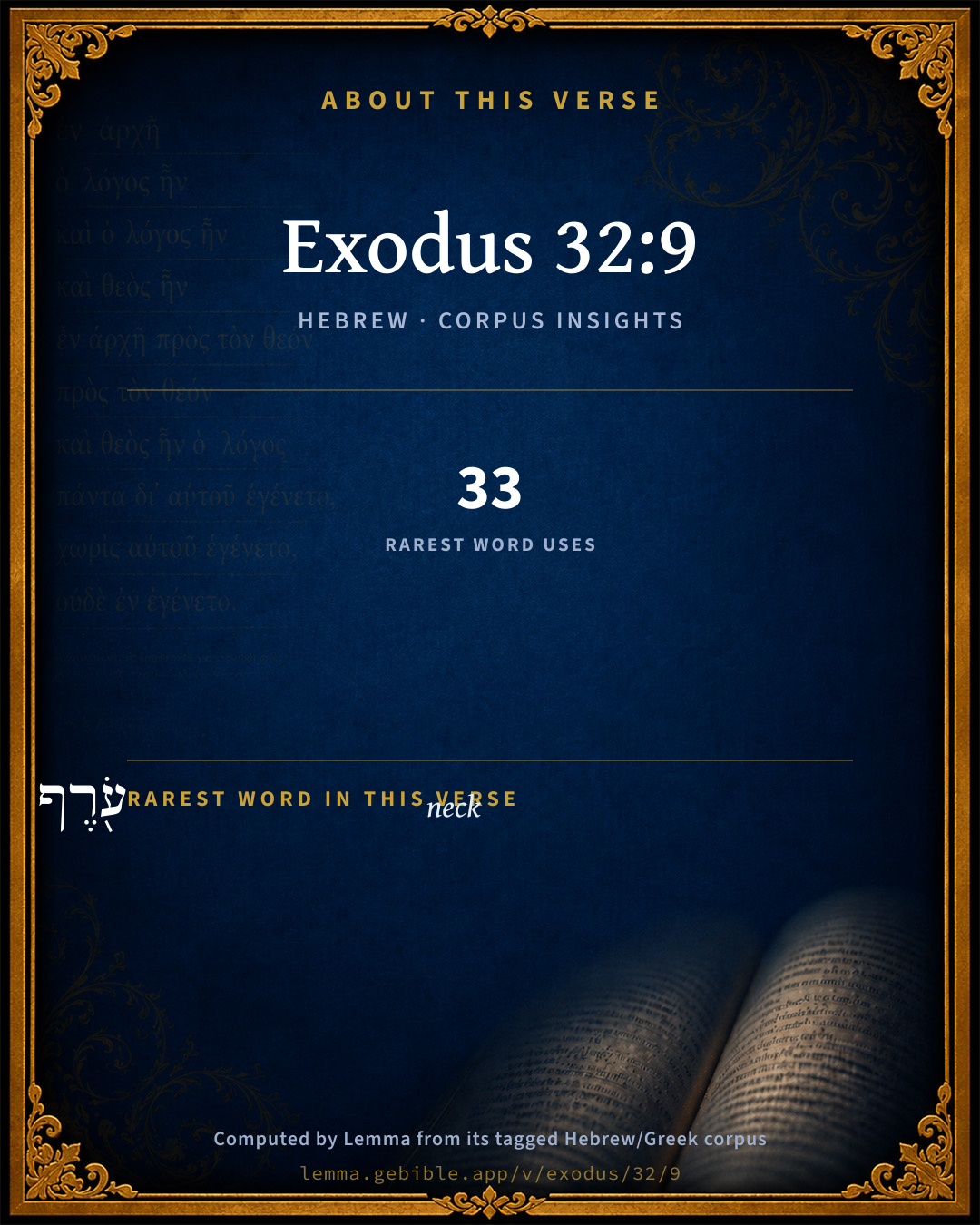
These counts appear in no published source. They are computed here, from the morphology-tagged text and Lemma’s own curated glosses. What Lemma adds →

13
words
12
distinct lemmas
Pentateuch
section

Shared distinctive vocabulary

עֹ֖רֶף neck H6203 occurs in 32 verses of the Hebrew Bible. Also found in:

Grammatical profile

  • 2 verbs
  • 5 nouns
  • 1 adjective
  • 2 pronouns
  • 1 preposition
  • 2 particles

Verb forms

  • וַיֹּ֥אמֶר Qal · Sequential Imperfect
  • רָאִ֨יתִי֙ Qal · Perfect

Repetition

A word recurs within this verse — often emphatic in Hebrew:

  • הָעָ֣ם people H5971 ×2

Hebrew & Septuagint length

In English translation the verse runs 16 words from the Hebrew and 16 from the Septuagint (LXX English) — the same length.

A rough comparison of the two English renderings, which tokenize alike — not a word-level alignment.

Word counts can differ between the Hebrew and the Greek without any difference in meaning — e.g. the Hebrew direct-object marker אֵת has no separate Greek word, and Greek often adds the article ὁ.

Cross-references

16

Topical passages linked to Exodus 32:9 in the Treasury of Scripture Knowledge — connected by theme and wording, ordered by reader-vote popularity; previews shown in the World English Bible.

  • Acts 7:51 "You stiff-necked and uncircumcised in heart and ears, you always resist the Holy Spirit! As your fathers did, so you do.
  • Isaiah 48:4 Because I knew that you are obstinate, and your neck is an iron sinew, and your brow brass;
  • Deuteronomy 9:13 Furthermore Yahweh spoke to me, saying, I have seen this people, and, behold, it is a stiff-necked people:
  • Exodus 33:3 to a land flowing with milk and honey: for I will not go up in the midst of you, for you are a stiff-necked people, lest I consume you in the way."
  • Exodus 33:5 Yahweh said to Moses, "Tell the children of Israel, 'You are a stiff-necked people. If I were to go up into your midst for one moment, I would consume you. Therefore now take off your jewelry from you, that I may know what to do to you."
  • Exodus 34:9 He said, "If now I have found favor in your sight, Lord, please let the Lord go in the midst of us; although this is a stiff-necked people; pardon our iniquity and our sin, and take us for your inheritance."
  • Deuteronomy 31:27 For I know your rebellion, and your stiff neck: behold, while I am yet alive with you this day, you have been rebellious against Yahweh; and how much more after my death?
  • 2 Chronicles 30:8 Now don't you be stiff-necked, as your fathers were; but yield yourselves to Yahweh, and enter into his sanctuary, which he has sanctified forever, and serve Yahweh your God, that his fierce anger may turn away from you.
  • Deuteronomy 9:6 Know therefore, that Yahweh your God doesn't give you this good land to possess it for your righteousness; for you are a stiff-necked people.
  • Deuteronomy 10:16 Circumcise therefore the foreskin of your heart, and be no more stiff-necked.
  • Nehemiah 9:17 and refused to obey, neither were mindful of your wonders that you did among them, but hardened their neck, and in their rebellion appointed a captain to return to their bondage. But you are a God ready to pardon, gracious and merciful, slow to anger, and abundant in loving kindness, and didn't forsake them.
  • Psalms 78:8 And might not be as their fathers, A stubborn and rebellious generation, A generation that didn't make their hearts loyal, Whose spirit was not steadfast with God.
  • Proverbs 29:1 He who is often rebuked and stiffens his neck Will be destroyed suddenly, with no remedy.
  • Zechariah 7:11–12 But they refused to listen, and turned their backs, and stopped their ears, that they might not hear.
  • Jeremiah 13:27 I have seen your abominations, even your adulteries, and your neighing, the lewdness of your prostitution, on the hills in the field. Woe to you, Jerusalem! you will not be made clean; how long shall it yet be?
  • Hosea 6:10 In the house of Israel I have seen a horrible thing. There is prostitution in Ephraim. Israel is defiled.

Cross-references courtesy of OpenBible.info (CC BY 4.0).

Hebrew and Greek witnesses Masoretic Hebrew ↔ Greek Septuagint

The same verse in the two great witnesses to the Old Testament, shown verse-for-verse.

These are two independent witnesses, not word-aligned to each other, and the Septuagint is shown in lemma (dictionary) form.

Hebrew Exodus 32:9 Masoretic · Westminster Leningrad Codex

וַיֹּ֥אמֶר יְהוָ֖ה אֶל מֹשֶׁ֑ה רָאִ֨יתִי֙ אֶת הָעָ֣ם הַזֶּ֔ה וְהִנֵּ֥ה עַם קְשֵׁה עֹ֖רֶף הֽוּא

Yahweh said to Moses, "I have seen these people, and, behold, they are a stiff-necked people.

World English Bible · Public Domain

Greek LXX Exodus 32:9 Septuagint · lemma form
These are your gods, O Israel, who brought you up out of the land of Egypt.

LXX2012 (modern English Septuagint) · Public Domain

On this verse, Ellicott's Commentary for English Readers discusses the Septuagint’s reading. Read the note in Commentary ↓

Hebrew: Westminster Leningrad Codex (CC BY 4.0). Greek: Septuagint (public domain); English from LXX2012 (modern English Septuagint) (Public Domain). How the Septuagint differs from the Hebrew →

Targum (Aramaic paraphrase)

2

The Targum is the ancient Jewish Aramaic paraphrase of the Hebrew Scriptures — an interpretive translation, not the Hebrew text itself. Onkelos (literal) and Pseudo-Jonathan (expansive) render the Torah, and Jonathan the Prophets. Coverage is partial: where no permissively-licensed English translation exists for a verse, only the Aramaic is shown. This is verse-level text, not a word-by-word alignment to the Hebrew.

  1. Targum Onkelos Torah (Genesis–Deuteronomy)
    וַאֲמַר יְיָ לְמשֶׁה גְלִי קֳדָמַי עַמָא הָדֵין וְהָא עַמָא קְשֵׁי קְדַל הוּא:

    (no public-domain English translation for this verse)

    Targum Onkelos — Aramaic: “Onkelos Genesis” (public domain); “Onkelos Exodus” (public domain); “Onkelos Leviticus” (public domain); “Onkelos Numbers” (public domain); “Onkelos Deuteronomy” (public domain). English: “Sefaria Community Translation” (CC0 1.0 (public-domain dedication)); “J.W. Etheridge. The Targums of Onkelos and Jonathan Ben Uzziel on the Pentateuch. London: Longmans, Green, 1862” (public domain). Text via Sefaria.

  2. Targum Pseudo-Jonathan Torah (Genesis–Deuteronomy)
    וַאֲמַר יְיָ לְמשֶׁה גְּלֵי קֳדָמָי זְדוֹנְהוֹן דְּעַמָּא הָדֵין וְהָא עַם קְשֵׁי קְדַל הוּא

    And the Lord said to Mosheh, The pride of this people is manifest before Me, and, behold, it is a people of hard neck.

    Targum Pseudo-Jonathan — Aramaic: “Targum Jonathan on Genesis” (public domain); “Targum Jonathan on Exodus” (public domain); “Targum Jonathan on Leviticus” (public domain); “Targum Jonathan on Numbers” (public domain); “Targum Jonathan on Deuteronomy” (public domain). English: “The Targum of Jonathan ben Uzziel, trans. J. W. Etheridge, London, 1862” (public domain). Text via Sefaria.

Commentary

Notes on Exodus 32:9 from classic Christian and Jewish commentators (each source and its license shown beneath its notes). The classic Christian expositions comment on the surrounding passage and are grouped to its opening verse, so a note may address several verses; the Jewish commentaries on the Tanakh (Rashi and others) are per-verse, so they appear only where the commentator wrote on this verse.

Lemma curates 59 commentaries, every one of them public domain or Creative Commons licensed, each selected and text-cleaned for this edition rather than reprinted as found. About our sources →

Trapp's Complete Commentary

John Trapp

Exo 32:9 And the LORD said unto Moses, I have seen this people, and, behold, it [is] a stiffnecked people:

Ver. 9. A stiffnecked people.] And so they are still to this very day. Jerome {a} complains that in his time they thrice a day curse {a} Christ in their synagogue, and closed up their prayers with Maledic, Domine, Nazaraeis. They are thought to advise most of that mischief which the Turk puts in execution against Christians. They counterfeit Christianity in Portugal even to the degree of priesthood, and think they may do it, either for the avoiding of danger, or increasing their substance. There are very few of them that turn Christians in good earnest: Adeo in cordibus eorum radices fixit pertinacitas. {b} So stubborn they are to this day, and stiffnecked, their necks are wholly possessed with an iron sinew.

{a} Jerome, in Isa., lib. xii. cap. 49, tom. 5, et lib. xiv. cap. 42.

{b} Rivet., Jesuita Vapul., 322.

John Trapp, A Commentary or Exposition upon All the Books of the Old and New Testament (1647–1656) — public domain. Text from a community e-Sword module.

Joseph Benson's Commentary

Exo 32:9. A stiff-necked people — Untractable, wilful, and stubborn; unapt to come under the yoke of the divine law, averse from all good, and prone to all evil, incorrigible by judgments, and obstinate to all the methods of cure.

Joseph Benson's Commentary on the Old and New Testaments (1811–1818) — public domain. Text from a community e-Sword module.

Tyndale Open Study Notes

Tyndale Open Resources

32:9-10 God was apparently prepared to disown his people, since they had broken their covenant with him.

Tyndale Open Study Notes — © Tyndale Open Resources, licensed CC BY-SA 4.0. Text via the HelloAO Bible API.

Adam Clarke's Commentary

Verse 9. A stiff-necked people] Probably an allusion to the stiff-necked ox, the object of their worship.

Adam Clarke's Commentary on the Bible (1810–1826) — public domain. Text from a community e-Sword/MySword module.

Ellicott's Commentary for English Readers

(9) It is a stiff-necked people.—This phrase, afterwards so common (Exo_33:3; Exo_33:5; Exo_34:5; Deu_9:6; Deu_9:13; Deu_10:16; 2Ch_30:8; 2Ch_36:13; Psa_75:5; Jer_17:23; Act_7:51), occurs here for the first time. It is generally explained as “obstinate,” but rather means “perverse,” the metaphor being taken from the horse that stiffens his neck against the pull of the rein, and will not be guided by the rider. The LXX. omit the verse, for no intelligible reason.

A Bible Commentary for English Readers, edited by Charles John Ellicott (1878–1897) — public domain. Text from a community e-Sword module.

The Cambridge Bible for Schools and Colleges

gen. ed. J. J. S. Perowne

9. stiffnecked] so Exo_33:3; Exo_33:5; Exo_34:9; Deu_9:6; Deu_9:13 (repeated from here)†.

9–14. Jehovah declares that He will exterminate the people: but allows Himself to be diverted from His purpose by Moses’ intercession.

The Cambridge Bible for Schools and Colleges (gen. ed. J. J. S. Perowne; Cambridge University Press, 1878–1918) — public domain. Text from a community e-Sword module.

John Gill's Exposition

And the Lord said unto Moses, I have seen this people,.... He had observed their ways and works, their carriage and behaviour; he had seen them before this time; he knew from all eternity what they would be, that their neck would be as an iron sinew, and their brow brass; but now he saw that in fact which he before saw as future, and they proved to be the people he knew they would be; besides, this is said to give Moses the true character of them, which might be depended upon, since it was founded upon divine knowledge and observation:

and, behold, it is a stiffnecked people; obstinate and self-willed, resolute in their own ways, and will not be reclaimed, inflexible and not subjected to the yoke of the divine law; a metaphor taken from such creatures as will not submit their necks or suffer the yoke or bridle to be put upon them, but draw back and slip away; or, as Aben Ezra thinks, to a man that goes on his way upon a run, and will not turn his neck to him that calls him, so disobedient and irreclaimable were these people.

John Gill's Exposition of the Whole Bible (1746–1763) — public domain (CC PDM 1.0). Text via the HelloAO Bible API.

Haydock's Catholic Bible Commentary

And again. The Septuagint omit this verse. Moses, at the first intimation of the people’s sin, fell prostrate before the Lord, to sue for pardon, and pleaded the natural weakness of an ungovernable multitude, in order to extenuate their fault. This God admits. --- I see, &c. But while he seems bent on punishing them, to try his servant, he encourages him inwardly to pray with fervour. (Salien.)

George Leo Haydock (1774–1849), Haydock's Catholic Family Bible and Commentary, 1859 edition — public domain. Excludes Psalms (Douay-Rheims chapter numbering differs from Protestant) and Deuterocanonical books (Catholic canon only).

Matthew Poole's English Annotations

Untractable, wilful, and stubborn, incorrigible by my judgments, ungovernable by mine or by any laws. A metaphor from those beasts that will not bend their necks to receive the yoke or bridle.

Matthew Poole's English Annotations on the Holy Bible (1683–1685) — public domain. Text from a community e-Sword/MySword module.

Whedon's Commentary on the Bible

Daniel D. Whedon

9. A stiffnecked people — Unmanageable and perverse, like the ox that stoutly resists all efforts to guide or drive him. Comp. the same expression in Exo_33:3; Exo_33:5; Exo_34:9; Deu_9:6; Deu_9:13.

Daniel D. Whedon (gen. ed.), Commentary on the Old and New Testaments (1874–1909) — public domain. Text from a community e-Sword module.

The Pulpit Commentary

A stiffnecked people. This epithet, which becomes epitheton usitatum, is here used for the first time. It does not so much mean "obstinate" as "perverse" like a horse that stiffens the neck when the driver pulls the right or left rein, and will not go the way he is wanted to go. (Compare Exo_33:3, 5 34:9; Deu_9:6, 13 31:27; etc.)

The Pulpit Commentary (1880–1919), ed. H.D.M. Spence-Jones & Joseph S. Exell — public domain. Text from a community e-Sword module.

John Wesley's Explanatory Notes

It is a stiff-necked people - Unapt to come under the yoke of the divine law, averse to all good, and prone to evil, obstinate to the methods of cure.

John Wesley, Explanatory Notes Upon the Whole Bible (1754–1765) — public domain. Text via the GEBible commentary corpus.

unfoldingWord translationNotes

Door43 World Missions Community

I have seen this people

Here Yahweh compares knowing the people to seeing them. AT: "I know this people" (See: Metaphor)

a stiff-necked people

Yahweh speaks of the people being stubborn as if they had stiff necks. AT: "a stubborn people" (See: Metaphor)

Now then

The word "now" is used here to mark a break in what Yahweh was telling Moses. Here Yahweh tells what he will do to the people.

My anger will burn hot against them

Yahweh speaks of his anger as if it were a fire that could burn hot. AT: "My anger towards them will be terrible" or "I am extremely angry with them" (See: Metaphor)

from you

The word "you" refers to Moses. (See: Forms of You)

why does your anger burn against your people ... a mighty hand?

Moses used this question to to try to persuade Yahweh not to be so angry with his people. This rhetorical question can be translated as a statement. AT: "Do not let your anger burn against your people ... a mighty hand." or "Do not be so angry with your people ... a mighty hand." (See: Metaphor and Rhetorical Question)

great power ... mighty hand

These two phrases share similar meanings and are combined for emphasis. (See: Doublet)

a mighty hand

Here the word "hand" refers to the things Yahweh did. AT: "and the powerful things you did" (See: Metonymy)

translationWords

Yahweh

stiff-necked

anger

nation

power

might

unfoldingWord translationNotes — © Distant Shores Media and the Door43 World Missions Community, licensed CC BY-SA 4.0. Source: git.door43.org/Door43/en_tn.

Rashi

Rabbi Shlomo Yitzchaki (Rashi)

קשה ערף STIFF-NECKED — They turn their stiffened necks towards those who reprove them (i e. they turn their back upon them) and refuse to listen.

Rashi on the Tanakh — English translations: “The Judaica Press complete Tanach with Rashi, translated by A. J. Rosenberg” (CC BY 4.0); “Pentateuch with Rashi's commentary by M. Rosenbaum and A.M. Silbermann, 1929-1934” (public domain); “The Metsudah Tanach series, Lakewood, N.J” (CC BY 4.0); and “The Book of Joshua, Metsudah Publications, 1997” (CC BY 4.0). Text via Sefaria.

Lesson kit

Teaching starters — assembled from the data on this page, not authored interpretation. Every prompt links to the verse data it draws on. Edit before teaching.

Exodus, in the Pentateuch, opens this verse with 13 words (12 distinct Hebrew lemmas). Its most distinctive word is ʻôreph (“neck”). A historical commentator’s framing appears above. Read the whole chapter for the surrounding context.

Discussion questions

  1. The word ʻôreph carries the sense “neck.” How does it shape the verse?
  2. Genesis 49:8 shares the word «neck» with this verse. How do the two illuminate each other?
  3. “people” occurs 2× in this one verse. What is the effect of the repetition?
  4. These translations render this verse differently; the difference is in the English rendering, not the original. What questions does that raise?
  5. The verb «וַיֹּ֥אמֶר» is Qal Sequential Imperfect. How does its form color the action?
  6. Reading how Trapp's Complete Commentary and Joseph Benson's Commentary read this verse, where do the two commentators agree and where do they part?

Things to notice

Reading settings

Reading text

Shown beneath each verse's original-language words.

Old Testament
Old Testament edition

Read the OT as the Masoretic Hebrew (MT) or the Greek Septuagint (LXX).

English shown for the Greek Septuagint (in the Hebrew ↔ Greek comparison).

Comparing translations? Open the Compare panel on any verse page to stack up to four side by side.