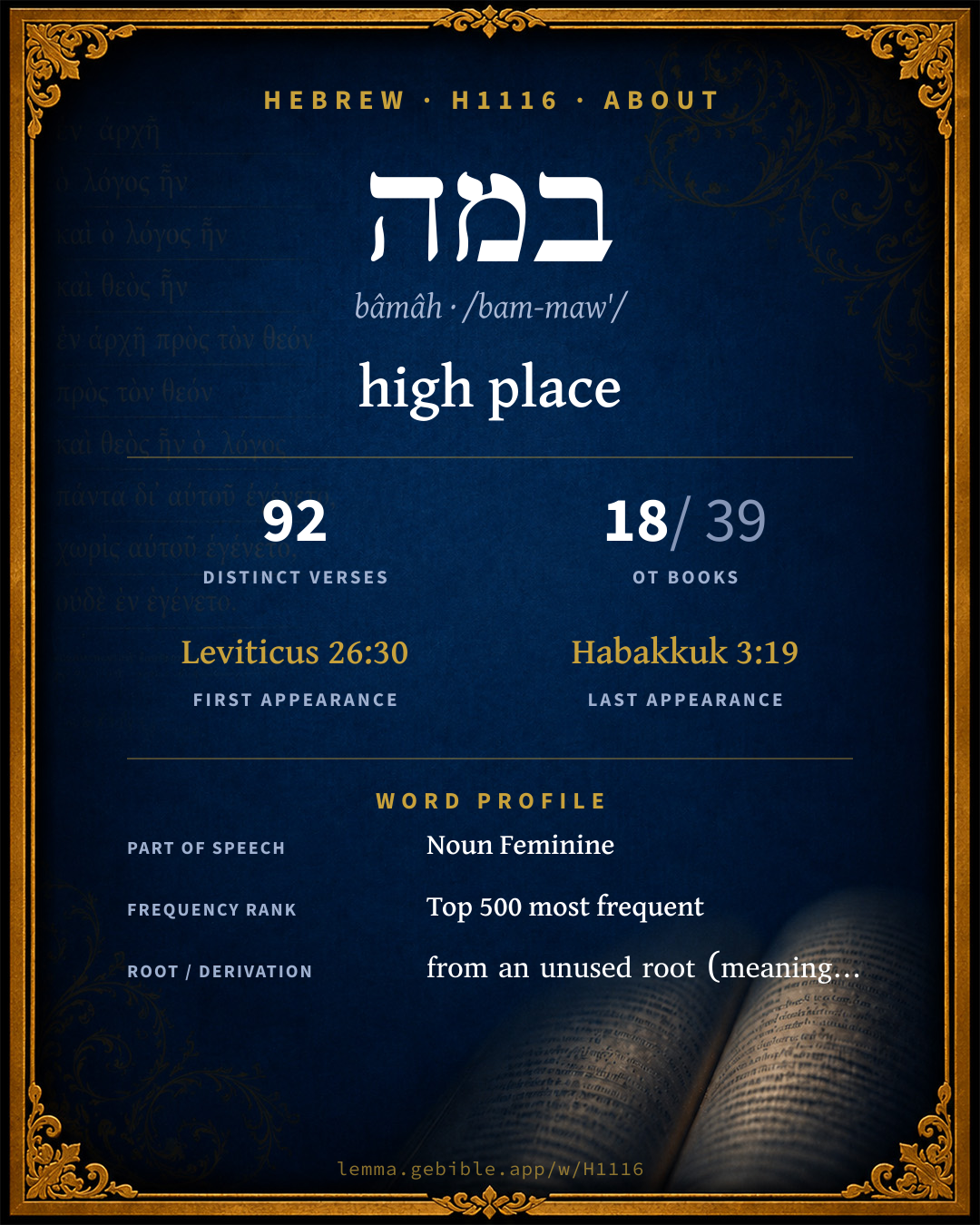
בָּמָה
high place
also: ridge, height, bamah fuller range ↓
Full lexicon entry — Brown-Driver-Briggs (BDB)
From Brown-Driver-Briggs (BDB)
Where this word appears
See every Absolute-state word in the Hebrew Bible →
Grammar key — what these labels mean
Part of speech
- Noun
- A naming word — a person, place, thing, or idea.
Noun type
- Common
- A common noun — a general class of person, place, or thing (“king,” “city,” “water”), not a specific name.
State
- Absolute
- The independent form of a noun, not bound to a following word.
- Construct
- A noun bound to a following noun in a possessive / “of” relationship (the construct chain).
Gender
- Feminine
- Grammatically feminine.
Number
- Plural
- More than one (in Hebrew, generally three or more).
- Singular
- One.
Grammatical forms
- Noun, Common, Feminine, Plural, Absolute 51 times (49%)
- Noun, Common, Feminine, Plural, Construct 34 times (33%)
- Noun, Common, Feminine, Singular, Absolute 19 times (18%)
Parsed forms decoded from the imported morphology (morphhb / Westminster Leningrad Codex — WLC text public domain, morphhb tagging CC BY 4.0), counted across 104 parsed occurrences — not distinct verses.
Every verse where H1116 appears — 92 distinct verses across 18 books. Click any verse to open its interlinear word-by-word view. Verse text shown in the World English Bible for context — . Each verse’s Hebrew form is shown with its reference; the English is not keyword-highlighted, since the data carries no word-level English alignment. Use “Compare translations” on any verse to read it across multiple English versions. This concordance covers the Hebrew Bible; Septuagint (Greek Old Testament) occurrences are not indexed here.
Leviticus 1 verse
Numbers 2 verses
- Numbers 21:28 בָּמ֥וֹת n c fp cs For a fire is gone out of Heshbon, A flame from the city of Sihon: It has devoured Ar of Moab, The lords of the high places of the Arnon.
- Numbers 33:52 בָּמֹתָ֖/ם n c fp cs + sfx pers 3mp then you shall drive out all the inhabitants of the land from before you, and destroy all their figured [stones], and destroy all their molten images, and demolish all their high places:
Deuteronomy 2 verses
- Deuteronomy 32:13 במותי בָּ֣מֳתֵי n c fp cs n c fp cs He made him ride on the high places of the earth, He ate the increase of the field; He made him to suck honey out of the rock, Oil out of the flinty rock;
- Deuteronomy 33:29 בָּמוֹתֵ֥י/מוֹ n c fp cs + sfx pers 3mp Happy are you, Israel: Who is like you, a people saved by Yahweh, The shield of your help, The sword of your excellency! Your enemies shall submit themselves to you; You shall tread on their high places.
1 Samuel 7 verses
- 1 Samuel 9:12 בַּ/בָּמָֽה prep det + n c fs They answered them, and said, He is; behold, [he is] before you: make haste now, for he is come today into the city; for the people have a sacrifice today in the high place:
- 1 Samuel 9:13 הַ/בָּמָ֜תָ/ה ptcl def.art + n c fs + sfx dem as soon as you are come into the city, you shall immediately find him, before he goes up to the high place to eat; for the people will not eat until he come, because he does bless the sacrifice; [and] afterwards they eat who are invited. Now therefore get you up; for at this time you shall find him.
- 1 Samuel 9:14 הַ/בָּמָֽה ptcl def.art + n c fs They went up to the city; [and] as they came within the city, behold, Samuel came out toward them, to go up to the high place.
- 1 Samuel 9:19 הַ/בָּמָ֔ה ptcl def.art + n c fs Samuel answered Saul, and said, I am the seer; go up before me to the high place, for you shall eat with me today: and in the morning I will let you go, and will tell you all that is in your heart.
- 1 Samuel 9:25 מֵ/הַ/בָּמָ֖ה prep + ptcl def.art + n c fs When they were come down from the high place into the city, he talked with Saul on the housetop.
- 1 Samuel 10:5 מֵֽ/הַ/בָּמָ֔ה prep + ptcl def.art + n c fs After that you shall come to the hill of God, where is the garrison of the Philistines: and it shall happen, when you are come there to the city, that you shall meet a band of prophets coming down from the high place with a psaltery, and a tambourine, and a pipe, and a harp, before them; and they will be prophesying:
- 1 Samuel 10:13 הַ/בָּמָֽה ptcl def.art + n c fs When he had made an end of prophesying, he came to the high place.
2 Samuel 3 verses
- 2 Samuel 1:19 בָּמוֹתֶ֖י/ךָ n c fp cs + sfx pers 2ms Your glory, Israel, is slain on your high places! How are the mighty fallen!
- 2 Samuel 1:25 בָּמוֹתֶ֖י/ךָ n c fp cs + sfx pers 2ms How are the mighty fallen in the midst of the battle! Jonathan is slain on your high places.
- 2 Samuel 22:34 בָּמוֹתַ֖/י n c fp cs + sfx pers 1cs He makes his feet like hinds' [feet], Sets me on my high places.
1 Kings 12 verses
- 1 Kings 3:2 בַּ/בָּמ֑וֹת prep det + n c fp Only the people sacrificed in the high places, because there was no house built for the name of Yahweh until those days.
- 1 Kings 3:3 בַּ/בָּמ֔וֹת prep det + n c fp Solomon loved Yahweh, walking in the statutes of David his father: only he sacrificed and burnt incense in the high places.
- 1 Kings 3:4 הַ/בָּמָ֣ה ptcl def.art + n c fs The king went to Gibeon to sacrifice there; for that was the great high place: a thousand burnt offerings did Solomon offer on that altar.
- 1 Kings 11:7 בָּמָ֗ה n c fs Then did Solomon build a high place for Chemosh the abomination of Moab, on the mountain that is before Jerusalem, and for Molech the abomination of the children of Ammon.
- 1 Kings 12:31 בָּמ֑וֹת n c fp He made houses of high places, and made priests from among all the people, who were not of the sons of Levi.
- 1 Kings 12:32 הַ/בָּמ֖וֹת ptcl def.art + n c fp Jeroboam ordained a feast in the eighth month, on the fifteenth day of the month, like the feast that is in Judah, and he went up to the altar; so did he in Bethel, sacrificing to the calves that he had made: and he placed in Bethel the priests of the high places that he had made.
- 1 Kings 13:2 הַ/בָּמוֹת֙ ptcl def.art + n c fp He cried against the altar by the word of Yahweh, and said, altar, altar, thus says Yahweh: Behold, a son shall be born to the house of David, Josiah by name; and on you shall he sacrifice the priests of the high places who burn incense on you, and men's bones shall they burn on you.
- 1 Kings 13:32 הַ/בָּמ֔וֹת ptcl def.art + n c fp For the saying which he cried by the word of Yahweh against the altar in Bethel, and against all the houses of the high places which are in the cities of Samaria, shall surely happen.
- 1 Kings 13:33 בָמ֔וֹת בָמֽוֹת n c fp n c fp After this thing Jeroboam didn't return from his evil way, but made again from among all the people priests of the high places: whoever would, he consecrated him, that there might be priests of the high places.
- 1 Kings 14:23 בָּמ֥וֹת n c fp For they also built them high places, and pillars, and Asherim, on every high hill, and under every green tree;
- 1 Kings 15:14 וְ/הַ/בָּמ֖וֹת conj + ptcl def.art + n c fp But the high places were not taken away: nevertheless the heart of Asa was perfect with Yahweh all his days.
- 1 Kings 22:43 הַ/בָּמ֖וֹת בַּ/בָּמֽוֹת ptcl def.art + n c fp prep det + n c fp He walked in all the way of Asa his father; He didn't turn aside from it, doing that which was right in the eyes of Yahweh: however the high places were not taken away; the people still sacrificed and burnt incense in the high places.
2 Kings 19 verses
- 2 Kings 12:3 הַ/בָּמ֖וֹת בַּ/בָּמֽוֹת ptcl def.art + n c fp prep det + n c fp However the high places were not taken away; the people still sacrificed and burnt incense in the high places.
- 2 Kings 14:4 הַ/בָּמ֖וֹת בַּ/בָּמֽוֹת ptcl def.art + n c fp prep det + n c fp However the high places were not taken away: the people still sacrificed and burnt incense in the high places.
- 2 Kings 15:4 הַ/בָּמ֖וֹת בַּ/בָּמֽוֹת ptcl def.art + n c fp prep det + n c fp However the high places were not taken away: the people still sacrificed and burnt incense in the high places.
- 2 Kings 15:35 הַ/בָּמוֹת֙ בַּ/בָּמ֑וֹת ptcl def.art + n c fp prep det + n c fp However the high places were not taken away: the people still sacrificed and burned incense in the high places. He built the upper gate of the house of Yahweh.
- 2 Kings 16:4 בַּ/בָּמ֖וֹת prep det + n c fp He sacrificed and burnt incense in the high places, and on the hills, and under every green tree.
- 2 Kings 17:9 בָּמוֹת֙ n c fp The children of Israel did secretly things that were not right against Yahweh their God: and they built them high places in all their cities, from the tower of the watchmen to the fortified city;
- 2 Kings 17:11 בָּמ֔וֹת n c fp and there they burnt incense in all the high places, as did the nations whom Yahweh carried away before them; and they worked wicked things to provoke Yahweh to anger;
- 2 Kings 17:29 הַ/בָּמ֗וֹת ptcl def.art + n c fp However every nation made gods of their own, and put them in the houses of the high places which the Samaritans had made, every nation in their cities in which they lived.
- 2 Kings 17:32 בָמ֔וֹת הַ/בָּמֽוֹת n c fp ptcl def.art + n c fp So they feared Yahweh, and made to them from among themselves priests of the high places, who sacrificed for them in the houses of the high places.
- 2 Kings 18:4 הַ/בָּמ֗וֹת ptcl def.art + n c fp He removed the high places, and broke the pillars, and cut down the Asherah: and he broke in pieces the brazen serpent that Moses had made; for to those days the children of Israel did burn incense to it; and he called it Nehushtan.
- 2 Kings 18:22 בָּמֹתָ֣י/ו n c fp cs + sfx pers 3ms But if you tell me, We trust in Yahweh our God; isn't that he whose high places and whose altars Hezekiah has taken away, and has said to Judah and to Jerusalem, You shall worship before this altar in Jerusalem?
- 2 Kings 21:3 הַ/בָּמ֔וֹת ptcl def.art + n c fp For he built again the high places which Hezekiah his father had destroyed; and he reared up altars for Baal, and made an Asherah, as did Ahab king of Israel, and worshiped all the host of the sky, and served them.
- 2 Kings 23:5 בַּ/בָּמוֹת֙ prep det + n c fp He put down the idolatrous priests, whom the kings of Judah had ordained to burn incense in the high places in the cities of Judah, and in the places round about Jerusalem; those also who burned incense to Baal, to the sun, and to the moon, and to the planets, and to all the host of the sky.
- 2 Kings 23:8 הַ/בָּמ֗וֹת בָּמ֣וֹת ptcl def.art + n c fp n c fp cs He brought all the priests out of the cities of Judah, and defiled the high places where the priests had burned incense, from Geba to Beersheba; and he broke down the high places of the gates that were at the entrance of the gate of Joshua the governor of the city, which were on a man's left hand at the gate of the city.
- 2 Kings 23:9 הַ/בָּמ֔וֹת ptcl def.art + n c fp Nevertheless the priests of the high places didn't come up to the altar of Yahweh in Jerusalem, but they ate unleavened bread among their brothers.
- 2 Kings 23:13 הַ/בָּמ֞וֹת ptcl def.art + n c fp The high places that were before Jerusalem, which were on the right hand of the mountain of corruption, which Solomon the king of Israel had built for Ashtoreth the abomination of the Sidonians, and for Chemosh the abomination of Moab, and for Milcom the abomination of the children of Ammon, did the king defile.
- 2 Kings 23:15 הַ/בָּמָה֙ הַ/בָּמָ֖ה הַ/בָּמָ֛ה ptcl def.art + n c fs ptcl def.art + n c fs ptcl def.art + n c fs Moreover the altar that was at Bethel, and the high place which Jeroboam the son of Nebat, who made Israel to sin, had made, even that altar and the high place he broke down; and he burned the high place and beat it to dust, and burned the Asherah.
- 2 Kings 23:19 הַ/בָּמ֜וֹת ptcl def.art + n c fp All the houses also of the high places that were in the cities of Samaria, which the kings of Israel had made to provoke [Yahweh] to anger, Josiah took away, and did to them according to all the acts that he had done in Bethel.
- 2 Kings 23:20 הַ/בָּמ֤וֹת ptcl def.art + n c fp He killed all the priests of the high places that were there, on the altars, and burned men's bones on them; and he returned to Jerusalem.
1 Chronicles 2 verses
- 1 Chronicles 16:39 בַּ/בָּמָ֖ה prep det + n c fs and Zadok the priest, and his brothers the priests, before the tent of Yahweh in the high place that was at Gibeon,
- 1 Chronicles 21:29 בַּ/בָּמָ֖ה prep det + n c fs For the tent of Yahweh, which Moses made in the wilderness, and the altar of burnt offering, were at that time in the high place at Gibeon.
2 Chronicles 17 verses
- 2 Chronicles 1:3 לַ/בָּמָ֖ה prep det + n c fs So Solomon, and all the assembly with him, went to the high place that was at Gibeon; for there was the tent of meeting of God, which Moses the servant of Yahweh had made in the wilderness.
- 2 Chronicles 1:13 לַ/בָּמָ֤ה prep det + n c fs So Solomon came from the high place that was at Gibeon, from before the tent of meeting, to Jerusalem; and he reigned over Israel.
- 2 Chronicles 11:15 לַ/בָּמ֖וֹת prep det + n c fp and he appointed him priests for the high places, and for the male goats, and for the calves which he had made.
- 2 Chronicles 14:3 וְ/הַ/בָּמ֑וֹת conj + ptcl def.art + n c fp for he took away the foreign altars, and the high places, and broke down the pillars, and hewed down the Asherim,
- 2 Chronicles 14:5 הַ/בָּמ֖וֹת ptcl def.art + n c fp Also he took away out of all the cities of Judah the high places and the sun-images: and the kingdom was quiet before him.
- 2 Chronicles 15:17 וְ/הַ֨/בָּמ֔וֹת conj + ptcl def.art + n c fp But the high places were not taken away out of Israel: nevertheless the heart of Asa was perfect all his days.
- 2 Chronicles 17:6 הַ/בָּמ֥וֹת ptcl def.art + n c fp His heart was lifted up in the ways of Yahweh: and furthermore he took away the high places and the Asherim out of Judah.
- 2 Chronicles 20:33 הַ/בָּמ֖וֹת ptcl def.art + n c fp However the high places were not taken away; neither as yet had the people set their hearts to the God of their fathers.
- 2 Chronicles 21:11 בָמ֖וֹת n c fp Moreover he made high places in the mountains of Judah, and made the inhabitants of Jerusalem to play the prostitute, and led Judah astray.
- 2 Chronicles 28:4 בַּ/בָּמ֖וֹת prep det + n c fp He sacrificed and burnt incense in the high places, and on the hills, and under every green tree.
- 2 Chronicles 28:25 בָמ֔וֹת n c fp In every city of Judah he made high places to burn incense to other gods, and provoked to anger Yahweh, the God of his fathers.
- 2 Chronicles 31:1 הַ֠/בָּמוֹת ptcl def.art + n c fp Now when all this was finished, all Israel who were present went out to the cities of Judah, and broke in pieces the pillars, and hewed down the Asherim, and broke down the high places and the altars out of all Judah and Benjamin, in Ephraim also and Manasseh, until they had destroyed them all. Then all the children of Israel returned, every man to his possession, into their own cities.
- 2 Chronicles 32:12 בָּמֹתָ֖י/ו n c fp cs + sfx pers 3ms Has not the same Hezekiah taken away his high places and his altars, and commanded Judah and Jerusalem, saying, You shall worship before one altar, and on it shall you burn incense?
- 2 Chronicles 33:3 הַ/בָּמ֔וֹת ptcl def.art + n c fp For he built again the high places which Hezekiah his father had broken down; and he reared up altars for the Baals, and made Asheroth, and worshiped all the host of the sky, and served them.
- 2 Chronicles 33:17 בַּ/בָּמ֑וֹת prep det + n c fp Nevertheless the people sacrificed still in the high places, but only to Yahweh their God.
- 2 Chronicles 33:19 בָּמוֹת֙ n c fp His prayer also, and how [God] was entreated of him, and all his sin and his trespass, and the places in which he built high places, and set up the Asherim and the engraved images, before he humbled himself: behold, they are written in the history of Hozai.
- 2 Chronicles 34:3 הַ/בָּמוֹת֙ ptcl def.art + n c fp For in the eighth year of his reign, while he was yet young, he began to seek after the God of David his father; and in the twelfth year he began to purge Judah and Jerusalem from the high places, and the Asherim, and the engraved images, and the molten images.
Job 1 verse
Psalms 2 verses
Isaiah 5 verses
- Isaiah 14:14 בָּ֣מֳתֵי n c fp cs I will ascend above the heights of the clouds; I will make myself like the Most High.
- Isaiah 15:2 הַ/בָּמ֖וֹת ptcl def.art + n c fp They are gone up to Bayith, and to Dibon, to the high places, to weep: Moab wails over Nebo, and over Medeba; on all their heads is baldness, every beard is cut off.
- Isaiah 16:12 הַ/בָּמָ֑ה ptcl def.art + n c fs It shall happen, when Moab presents himself, when he wearies himself on the high place, and shall come to his sanctuary to pray, that he shall not prevail.
- Isaiah 36:7 בָּמֹתָ֣י/ו n c fp cs + sfx pers 3ms But if you tell me, We trust in Yahweh our God: isn't that he, whose high places and whose altars Hezekiah has taken away, and has said to Judah and to Jerusalem, You shall worship before this altar?
- Isaiah 58:14 בָּ֣מֳותֵי n c fp cs then shall you delight yourself in Yahweh; and I will make you to ride on the high places of the earth; and I will feed you with the heritage of Jacob your father: for the mouth of Yahweh has spoken it.
Jeremiah 6 verses
- Jeremiah 7:31 בָּמ֣וֹת n c fp cs They have built the high places of Topheth, which is in the valley of the son of Hinnom, to burn their sons and their daughters in the fire; which I didn't command, neither came it into my mind.
- Jeremiah 17:3 בָּמֹתֶ֕י/ךָ n c fp cs + sfx pers 2ms My mountain in the field, I will give your substance and all your treasures for a spoil, [and] your high places, because of sin, throughout all your borders.
- Jeremiah 19:5 בָּמ֣וֹת n c fp cs and have built the high places of Baal, to burn their sons in the fire for burnt offerings to Baal; which I didn't command, nor spoke it, neither came it into my mind:
- Jeremiah 26:18 לְ/בָמ֥וֹת prep + n c fp cs Micah the Morashtite prophesied in the days of Hezekiah king of Judah; and he spoke to all the people of Judah, saying, Thus says Yahweh of Hosts: Zion shall be plowed as a field, and Jerusalem shall become heaps, and the mountain of the house as the high places of a forest.
- Jeremiah 32:35 בָּמ֨וֹת n c fp cs They built the high places of Baal, which are in the valley of the son of Hinnom, to cause their sons and their daughters to pass through [the fire] to Molech; which I didn't command them, neither did it come into my mind, that they should do this abomination, to cause Judah to sin.
- Jeremiah 48:35 בָמָ֔ה n c fs Moreover I will cause to cease in Moab, says Yahweh, him who offers in the high place, and him who burns incense to his gods.
Ezekiel 6 verses
- Ezekiel 6:3 בָּמֽוֹתֵי/כֶֽם n c fp cs + sfx pers 2mp and say, You mountains of Israel, hear the word of the Lord Yahweh: Thus says the Lord Yahweh to the mountains and to the hills, to the watercourses and to the valleys: Behold, I, even I, will bring a sword on you, and I will destroy your high places.
- Ezekiel 6:6 וְ/הַ/בָּמ֖וֹת conj + ptcl def.art + n c fp In all your dwelling-places the cities shall be laid waste, and the high places shall be desolate; that your altars may be laid waste and made desolate, and your idols may be broken and cease, and your sun-images may be hewn down, and your works may be abolished.
- Ezekiel 16:16 בָּמ֣וֹת n c fp You took of your garments, and made for yourselves high places decked with various colors, and played the prostitute on them: [the like things] shall not come, neither shall it be [so].
- Ezekiel 20:29 הַ/בָּמָ֔ה ptcl def.art + n c fs Then I said to them, What means the high place whereunto you go? So the name of it is called Bamah to this day.
- Ezekiel 36:2 וּ/בָמ֣וֹת conj + n c fp cs Thus says the Lord Yahweh: Because the enemy has said against you, Aha! and, The ancient high places are ours in possession;
- Ezekiel 43:7 בָּמוֹתָֽ/ם n c fp cs + sfx pers 3mp He said to me, Son of man, [this is] the place of my throne, and the place of the soles of my feet, where I will dwell in the midst of the children of Israel forever. The house of Israel shall no more defile my holy name, neither they, nor their kings, by their prostitution, and by the dead bodies of their kings [in] their high places;
Hosea 1 verse
Amos 2 verses
- Amos 4:13 בָּ֣מֳתֵי n c fp cs For, behold, he who forms the mountains, And creates the wind, And declares to man what is his thought; Who makes the morning darkness, And treads on the high places of the Earth: Yahweh, the God of hosts, is his name."
- Amos 7:9 בָּמ֣וֹת n c fp cs The high places of Isaac will be desolate, the sanctuaries of Israel will be laid waste; and I will rise against the house of Jeroboam with the sword."
Micah 3 verses
- Micah 1:3 במותי בָּ֥מֳתֵי n c fp cs n c fp cs For, behold, Yahweh comes forth out of his place, And will come down and tread on the high places of the earth.
- Micah 1:5 בָּמ֣וֹת n c fp cs "All this is for the disobedience of Jacob, And for the sins of the house of Israel. What is the disobedience of Jacob? Isn't it Samaria? And what are the high places of Judah? Aren't they Jerusalem?
- Micah 3:12 לְ/בָמ֥וֹת prep + n c fp cs Therefore Zion for your sake will be plowed like a field, And Jerusalem will become heaps of rubble, And the mountain of the temple like the high places of a forest.
Habakkuk 1 verse
About this entry
At a glance — auto-summarized from this page’s data, not written by a person. Every figure links to its source below. This summary describes the numbers; it doesn’t interpret them.
The Hebrew noun במה centers on the idea of “high place.” Alongside “high place” the lexicon also lists “ridge”, “height”, and “bamah” — part of its full sense range. It appears 92 verses across 18 books of the Hebrew Bible, among its moderately common vocabulary. Debuting at Leviticus 26:30, it then recurs through the corpus. It shares a root with במה and במות. For the data behind this summary, explore the sense tree and the renderings breakdown below.
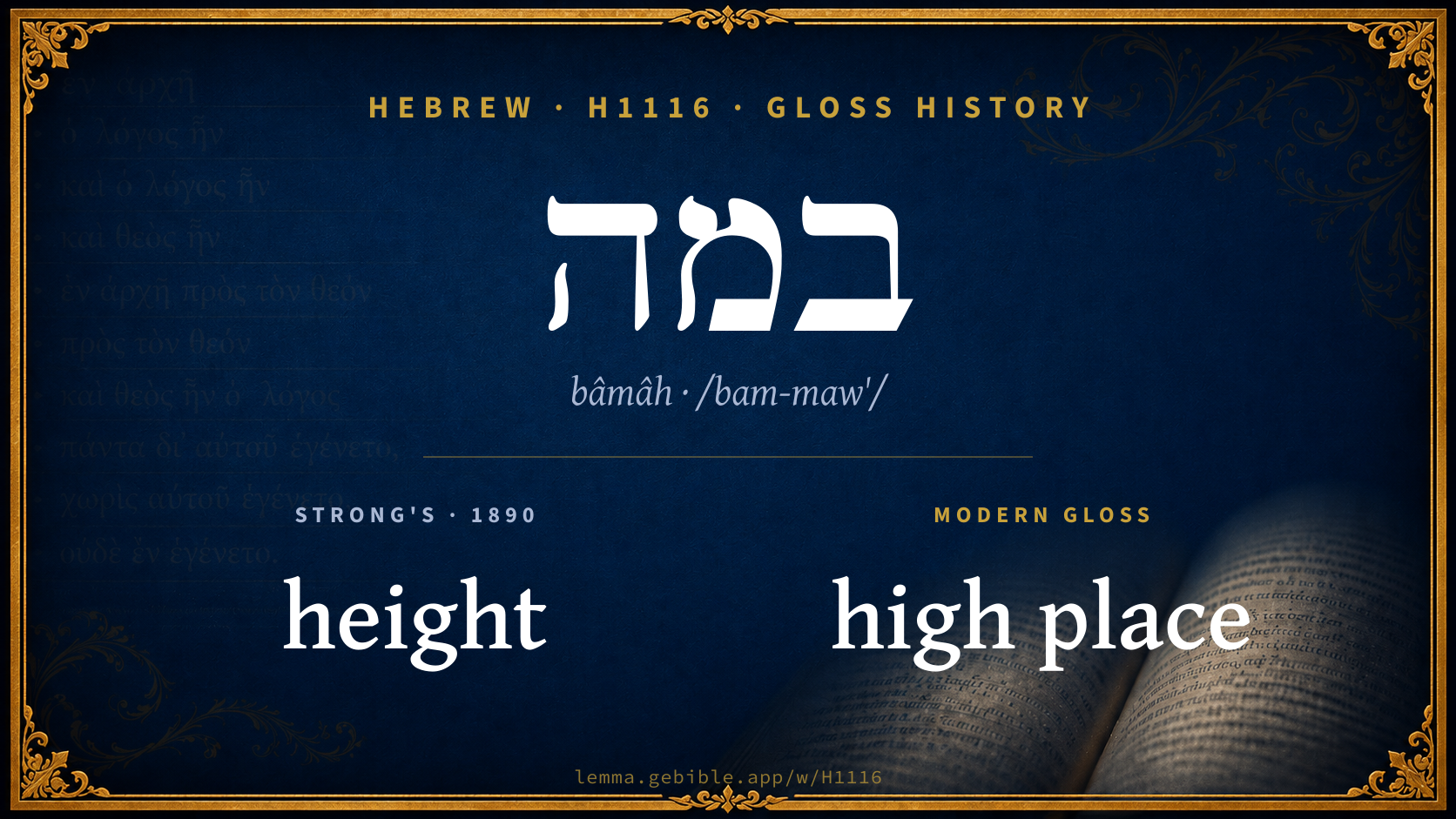
Gloss history
Strong's 1890 vs modern scholarship
About this word
Strong's H1116 catalogs a Hebrew word from the Hebrew Old Testament.
These counts are not copied from any lexicon or concordance. They are computed here, from the morphology-tagged Hebrew Old Testament. What Lemma adds →
- 92
- distinct verses
- The word appears in 92 distinct verses.
- 18 / 39
- OT books
- The word appears in 18 of 39 Old Testament books.
- #410
- by frequency
- Top 500 most frequent Hebrew words (rank 410 of 8,640 Hebrew words by occurrence).
View all 92 occurrences in the concordance →
Most concentrated in
- 2 Kings 19 verses 21%
- 2 Chronicles 17 verses 18%
- 1 Kings 12 verses 13%
By section of the Old Testament
By traditional corpus
Conventional, traditional groupings — biblical authorship is debated, so this is a traditional corpus grouping, not an authorship claim. Each share is this word’s portion of its verses in that division of the Hebrew canon. Each figure is a share of the word’s 92 distinct verses.
- Prophets (Nevi'im) 65 verses · 71%
- Writings (Ketuvim) 22 verses · 24%
- Torah (Pentateuch) 5 verses · 5%
How translations render this word
Counts come from each version’s own published word-to-Strong’s tagging or interlinear alignment — an approximate guide to how each version renders this word, not a word-level alignment the data otherwise carries. Because each total is that version’s own tagged count, the per-version totals vary from one another and need not match the appearance or distinct-verse counts above. These counts may also differ from a printed concordance because Lemma counts each distinctly tagged rendering and does not collapse phrase taggings into a single head-word total. This is a fixed set of word-tagged versions (KJV, ASV, BSB, ULT) and does not change with the reading translation you choose elsewhere. Each version’s license is shown beside its name below (and on Sources).
- King James Version: High places 68×, High place 16×, Howbeit the high places 3×
- American Standard Version: High places 61×, High place 14×, Howbeit the high places 6×
- Berean Standard Bible: High places 64×, High place 16×, Heights 10×
- unfoldingWord Literal Text: High places 61×, High place 18×, High places of 11×
King James Version Public Domain
Renders H1116 across 102 tagged occurrences — most commonly:
Plus 13 renderings that appear only once — usually multi-word phrases or single function words the recovered tagging swept in, not distinct renderings.
American Standard Version Public Domain
Renders H1116 across 102 tagged occurrences — most commonly:
Plus 17 renderings that appear only once — usually multi-word phrases or single function words the recovered tagging swept in, not distinct renderings.
Berean Standard Bible Public Domain
Renders H1116 across 97 tagged occurrences — most commonly:
Plus 5 renderings that appear only once — usually multi-word phrases or single function words the recovered tagging swept in, not distinct renderings. Not rendered by a distinct English word in 5 further occurrences.
unfoldingWord Literal Text CC BY-SA 4.0
Renders H1116 across 111 tagged occurrences — most commonly:
Plus 10 renderings that appear only once — usually multi-word phrases or single function words the recovered tagging swept in, not distinct renderings.
11 senses and sub-senses in the full BDB
What do BDB’s symbols mean?
BDB uses these scholarly abbreviations:
| Symbol | Meaning |
|---|---|
| 𝔊 | the Septuagint (the ancient Greek translation, LXX) |
| 𝔙 | the Vulgate (the Latin translation) |
| 𝔖 | the Syriac version (the Peshitta) |
| 𝔗 | the Targum (the Aramaic translation) |
| ψ | the Psalms |
| √ | root (the underlying root or stem) |
| ‖ | parallel passage (a synonymous or contrasted parallel) |
| † | the dagger: every passage where the word occurs is cited |
The 11 senses and sub-senses the full Brown-Driver-Briggs lexicon distinguishes for this word, in lexicon order (not ranked by frequency), with BDB’s own verbatim wording and sub-sense lettering. Shown in Hebrew script with BDB’s own scholarly abbreviations. The condensed entry is in the Lexicon Entry tab. See also the Forms in the corpus table below.
- 1. high place, mountain: בָּמוֹת יָעַר forest mountains Mi 3:12 = Je 26:18; במות עולם ancient mountains Ez 36:2; במות ארנן Nu 21:28 (E poet.) e.g. Micah 3:12
- 2. high places, battle-fields, the chief places of the land giving possession, victory, dominion: על במותיך on thy high places (Gilboa, the battle-field) 2 S 1:19, 25 (in v 19 𝔊 has a doublet מֵתֶיךָ thy dead, v. We Dr). e.g. 2 Samuel 1:19
- a. of Israel: רכב על במתי ארץ ride upon the high places of the land Dt 32:13 & Is 58:14 cf. Dt 33:29 ψ 18:34 = 2 S 22:34, Hb 3:19. e.g. Deuteronomy 32:13
- b. of God: דרך על במתי ארץ tread upon the high places of the earth Am 4:13 cf. Mi 1:3; במתי ים Jb 9:8; עלה על במתי עב (aspiration of the king of Babylon) Is 14:14. e.g. Amos 4:13
- 3. high places, as places of worship, at first on hills and mountains, later on artificial mounds or platforms, under green trees, and in cities; still later for the chapels erected thereon, and once apparently for a portable sanctuary (decked with diverse colours) Ez 16:16. The ancient worship of Israel was conducted on these high places. In the times of Samuel and David they ascended to them, descended from them, and offered sacrifices on them, 1 S 9:12–25; 10:5, 13 (הבמה for הביתה We Dr). The custom continued in the reign of Solomon, but Gibeon was הבמה הגדולה 1 K 3:2–4 cf. 1 Ch 16:39 21:29; 2 Ch 1:3, 13. High places of Baal were also used Nu 22:41 (E) Je 19:5 32:35; of Moab Is 15:2; 16:12; Je 48:35 (cf. MI27); these must be demolished Nu 33:52 (J). Solomon built במות (platforms or chaples) to Chemosh and Milkom on the Mt. of Evil Counsel opposite Jerusalem 1 K 11:7: Jeroboam made temples on the ancient high places of Dan and Bethel 1 K 12:31, 32; 2 Ch 11:15; they are called במות און Ho 10:8, במות ישׂחק Am 7:9: the kings of Israel built במות and בתי הבמות in all their cities 2 K 17:9, and the people worshipped there 2 K 17:11; these were also used by the mixed population after the exile of Israel 2 K 17:29, 32(×2): these various idolatrous high places were first destroyed by Josiah 1 K 13:2, 32, 33 2 K 23:5–20 2 Ch 34:3. The worship of Yahweh on high places continued in Judah until the exile 1 K 22:44 2 K 15:35; the sanctity code predicts that Yahweh will destroy them Lv 26:30; they were regarded as the reason for the rejection of Shiloh ψ 78:58. The complier of Kings, writing from the point of view of the Deut. code, complains רַק הַבָּמוֹת לֹא סָרוּ 2 K 12:4; 14:4; 15:4, 35 cf. 2 Ch 15:17; 20:33, and praises the few pious kings who destroyed them. e.g. Ezekiel 16:16
- a. Rehoboam built במות with מצבות & אשׁרים on every high hill and under every green tree 1 K 14:23. e.g. 1 Kings 14:23
- b. Asa did not remove the high places 1 K 15:14 (2 Ch 14:2, 4 is incorrect unless במות בעל). e.g. 1 Kings 15:14
- c. Jehoshaphat in his reform on the basis of the covenant code did not remove them 1 K 22:44 (עוֹד הֵסִיר אֶת־הַבָּמוֹת 2 Ch 17:16 is doubtless incorrect, possibly read מצבות); Jehoram, his son, made high places in the cities of Judah 2 Ch 21:11 𝔊 𝔙; not mountains ℌ); and Ahaz sacrificed on high places on the hills and under every green tree and in every city of Judah 2 K 16:4; 2 Ch 28:4, 25; cf. Mi 1:5 (read חטאת? so 𝔊 𝔖 𝔗 Che al.; yet cf. JBL1890, 73 f.) e.g. 1 Kings 22:44
- d. Hezekiah removed them 2 K 18:4, 22 2 Ch 31:1 32:12; Is 36:7; but Manasseh rebuilt them 2 K 21:3; 2 Ch 33:3, 19, and the people continued to sacrifice thereon to Yahweh 2 Ch 33:17. e.g. 2 Kings 18:4
- e. Josiah, in his reform, based on the Deut. code, defiled them and brake them down from Geba to Beersheba 2 K 23:5, 8, 9; but subsequently there were במות התפת in the valley of Ben Hinnom Je 7:31, and במות throughout Judah Je 17:3 cf. Ez 6:3, 6; 20:29 (questioned by Ew & Co). e.g. 2 Kings 23:5
- 4. funereal mound (?) Ez 43:7 (Thes, but in their high places AV RV; in their death 𝔗 Theod Ew Hi RVm), Is 53:9 (Lowth Ew Bö; Rodwell Orelli; but in his death AV RV, or martyr death De Che Br). e.g. Ezekiel 43:7
Senses from the full Brown-Driver-Briggs lexicon (Brown, Driver, Briggs; Oxford 1906 — public domain), digitized via Sefaria, supplemented by the OpenScriptures HebrewLexicon (CC BY 4.0). Full attribution on Sources.
Word origin
n.f. high place (√ appar. בום on account of firm—ָ; cf. Assyrian bâmâte ZimBP 48, Moab. במת MI 3, 27)—Je 48:35 + 18 times; הַבָּמָ֫תָה 1 S 9:13 pl. בָּמוֹת Nu 21:19 + 62 times; cstr. בָּֽמֳתֵי Jb 9:8; Is 14:14; Am 4:13; בָּֽמֳו֯תֵי Dt 32:13; Is 58:14; Mi 1:3 (Ew§ 211 d Ges§ 87, 5 archaic fem. cstr. with retracted accent before monosyl. in poetry, bâmŏ-thê not bŏm); sf. בָּמֹתַי 2 S 22:34 + 3 times; בָּמוֹתַי ψ 18:34 + 10 times;—
— Brown-Driver-Briggs (Oxford 1906, public domain), digitized via Sefaria, supplemented by the OpenScriptures HebrewLexicon (CC BY 4.0). See Sources.
Origin: from an unused root (meaning to be high)
Jastrow Dictionary
A second Hebrew/Aramaic lexicon for comparison, covering Aramaic and post-biblical (Talmudic, Targumic, Midrashic) usage that the biblical-Hebrew BDB does not. Matched by lemma rather than by Strong’s number, so a lemma may carry more than one Jastrow headword (shown separately below), and the entries cover usage well beyond the Bible.
בָּמָה
- entrance, gathering place, ascent (cmp. b. h. מָבוֹא a. מַעֲלֶה); esp. Bamah, name of the legitimate altars prior to, and of the illegitimate after, the establishment of a central sanctuary (at Shiloh) and of the Temple at Jerusalem; temporary or improvised altar; v. Zeb. XIV, 4—8.—Meg. I, 10 ב׳ גדולה national altar; ב׳ קטנה local altar (during their period of legitimacy); Tosef. Zeb. XIII, 17 sq.; a. fr.—Pl. בָּמוֹת Zeb. l. c. Ib. 114ᵇ בשעת היתר הב׳ at the period when bamoth were permitted. v. supra; a. fr. [Meg. 32ᵃ הלוחות והב׳, v. בִּימָה.] Cmp. בִּימָה.
מָה
- (b. h.)
- 1. something; anything. Num. R. s. 14; Tanḥ. Ḥayé 3, v. בְּלִימָה.
- 2. what? which? Ḥull. 89ᵃ (play on הא̇מ̇נ̇ם א̇ל̇ם̇, Ps. LVIII, 2) מה א̇ומ̇נ̇תו … כא̇ל̇ם̇ which is the best policy for man in this world? Let him act as if he were mute (keep silence). B. Mets. 63ᵃ, a. e. מה לו הן מה לי דמיהן what are they to me and what their equivalent, i.e. what difference does it make whether the purchased objects or their equivalent be delivered?; Y. Yoma V, 43ᵃ bot. מה ביניהן ומה בין דמיהן. B. Bath. 32ᵇ; 31ᵃ מה (לי) לו לשקר what motive could he have to tell a lie? Ib., a. e. מה לי לשקר במקום עדים וכ׳ we do not apply the principle that we believe a defendant because he has no motive to lie, where witnesses are on hand; a. v. fr.—מה … אף what …?, even so, i.e. as … so. Gitt. 23ᵇ מה אתם … אף וכ׳ as you (Num. XVIII, 28) refers to Israelites, so must your delegate be an Israelite. Sabb. 133ᵇ מה הוא … אף וכ׳ as He is gracious and merciful, so be thou &c.; a. fr.—מה … לא כל שכן, v. כָּל.—מה … אינו דין, v. דִּין II.—מה ל־ … שכן … תאמר what has this to do with …? In this case …, whereas &c., i.e. it is different with … because &c. Kidd. 4ᵇ מה ליבמה שכן … תאמר וכ׳ the case of a Y’bamah is different, because she can neither be acquired by means of a document, whereas this (an ordinary woman) &c.; a. fr.—מָה נַפְשְׁךָ (in Babli mostly: מִמָּה נפשך; abbr. ממ"נ) whatever be thy opinion (from whatever opinion thou start), i.e. whichever side you take, at all events. Y. Ber. I, 2ᵇ מ׳ נ׳ אם וכ׳ at all events (he has offended); if it was day-time when the first stars (on Friday evening) were visible, it was day-time when the first stars (on Sabbath evening) were visible &c.; Sabb. 35ᵇ חייכ חטאת ממ"נ must bring a sin-offering at all events (whether you consider twilight a part of the day or a part of the night). Ib. 34ᵃ (in Chald. dict.) מה נפשך אי וכ׳ whichever side you take, if twilight is day &c. Erub. 10ᵃ גדולה … למה לי ממ"נ אי וכ׳ what reason was there for saying ‘large …’? In either case (it is incorrect), if it be to permit the use of the larger court &c. Ḥull. 29ᵃ ממ"נ אי מחצה וכ׳ in either case (the slaughtering is ritually correct); if you adopt the opinion that an exact half is to be considered as if it were the larger portion &c.; a. v. fr.—Ib. 78ᵇ מה אם נפשך, v. נֶפֶשׁ.—בַּמֶּה a) wherewith? B. Bath. 10ᵇ במה תרום וכ׳ whereby can the horn of Israel be lifted up? Sabb. II, 1; a. fr.—b) in what case? במה דברים אמורים (abbr. בד"א), v. אָמַר I.—לָמָּה wherefore? Ber. 3ᵃ תחלת … סימנא למה לי what need is there for a sign for the beginning of the first watch? M. Kat. 28ᵃ ל׳ נסמכה וכ׳ why is the account of the death of Miriam attached to &c.?; a. fr.—לַמֶּה to what?, whereto? Kidd. 40ᵇ ל׳ צדיקים נמשלים what are the righteous to be compared to?—ל׳ הדבר דומה, v. דָּמָה; a. fr.—V. לָמָה. e.g. Psalms 58:2
- 3. (relat.) which, what. Pes. 88ᵇ מה שקנה עבד וכ׳ whatever the slave acquires belongs to the master. Ber. I, 1 כל מה שאמרו וכ׳ for whatever act the scholars designated the time ‘up to midnight’ &c.; a. v. fr.
מָה ²
- ch. same (v. מָא). Targ. II Sam. XVIII, 23. Targ. Ex. XXXIII, 21; a. v. fr.—Snh. 65ᵇ; Gen. R. s. 11, v. גּוּבְרָא. Y. Ned. VI, end, 40ᵃ מה שבקית תמן what (prominent men) I left there (in Palestine); Y. Snh. I, 19ᵃ top (corr. acc.) [Ib. מה מודע לי, read מאן.]—Y. Gitt. I, 43ᵈ מה אנן קיימין what do we stand at, i.e. what is the case before us? Y. Dem. I, 21ᵈ bot. מה אפשר דר׳ וכ׳ what? is it possible that &c.? i.e. it is impossible that &c.; ib. מה ר׳ ז׳ מיכול וכ׳ it is impossible that R. Z. should eat &c. Y. Sabb. XIV, 14ᶜ מה ביניהון wherein do they differ?, v. בֵּין. Ḥull. 34ᵃ, a. e. מה נפשך, v. preced.; a. v. fr.—מָהִיא = מה היא, how is it? Y. Sabb. l. c.
A Dictionary of the Targumim, the Talmud Babli and Yerushalmi, and the Midrashic Literature (Marcus Jastrow; London, Luzac, 1903) — Public Domain. Digitized via Sefaria. Digitized via Sefaria. Full attribution on Sources.
Forms in the corpus
The 62 distinct written forms H1116 takes in the Hebrew Bible, most frequent first — each parse links to that state’s occurrences in the concordance. Hebrew forms include their vowel points and cantillation, so a single lemma takes many written forms.
The 60 most common forms are shown; 2 rarer forms follow in the full concordance.
Same root — word family
Other BDB entries built from the same root as H1116, grouped by Strong’s listed origin. These share a root / origin per the lexicon — not necessarily a shared meaning. Each links to that word’s own entry.
Proper names from this root
People and places named from this root — a name, not an additional meaning of the word.
Compare all same-root words → 2 of the same-root words are proper names (people or places). They share a root, not necessarily a meaning.
Septuagint verse parallels
This word appears in 86 verses that also exist in the Greek Old Testament (Septuagint), out of the 92 Hebrew verses it occurs in. You can read those verses in Greek by switching the Old Testament edition to the Septuagint.
Read these verses in the Septuagint
- Leviticus 26:30
- Numbers 21:28
- Deuteronomy 32:13
- 1 Samuel 9:12
- 2 Samuel 1:19
- 1 Kings 3:2
- 2 Kings 12:3
- 1 Chronicles 16:39
- 2 Chronicles 1:3
- Job 9:8
- Isaiah 14:14
- Jeremiah 7:31
This is a verse-level parallel only — the same verses exist in both the Hebrew and Greek Old Testaments. No word-level Hebrew↔Greek correspondence is claimed: the data carries no such alignment, so no Greek word is shown as this Hebrew word’s translation. Coverage is not total — the Septuagint omits the deuterocanon and renumbers the Psalms, so some Hebrew verses have no direct Greek parallel.