2 Chronicles 1:13

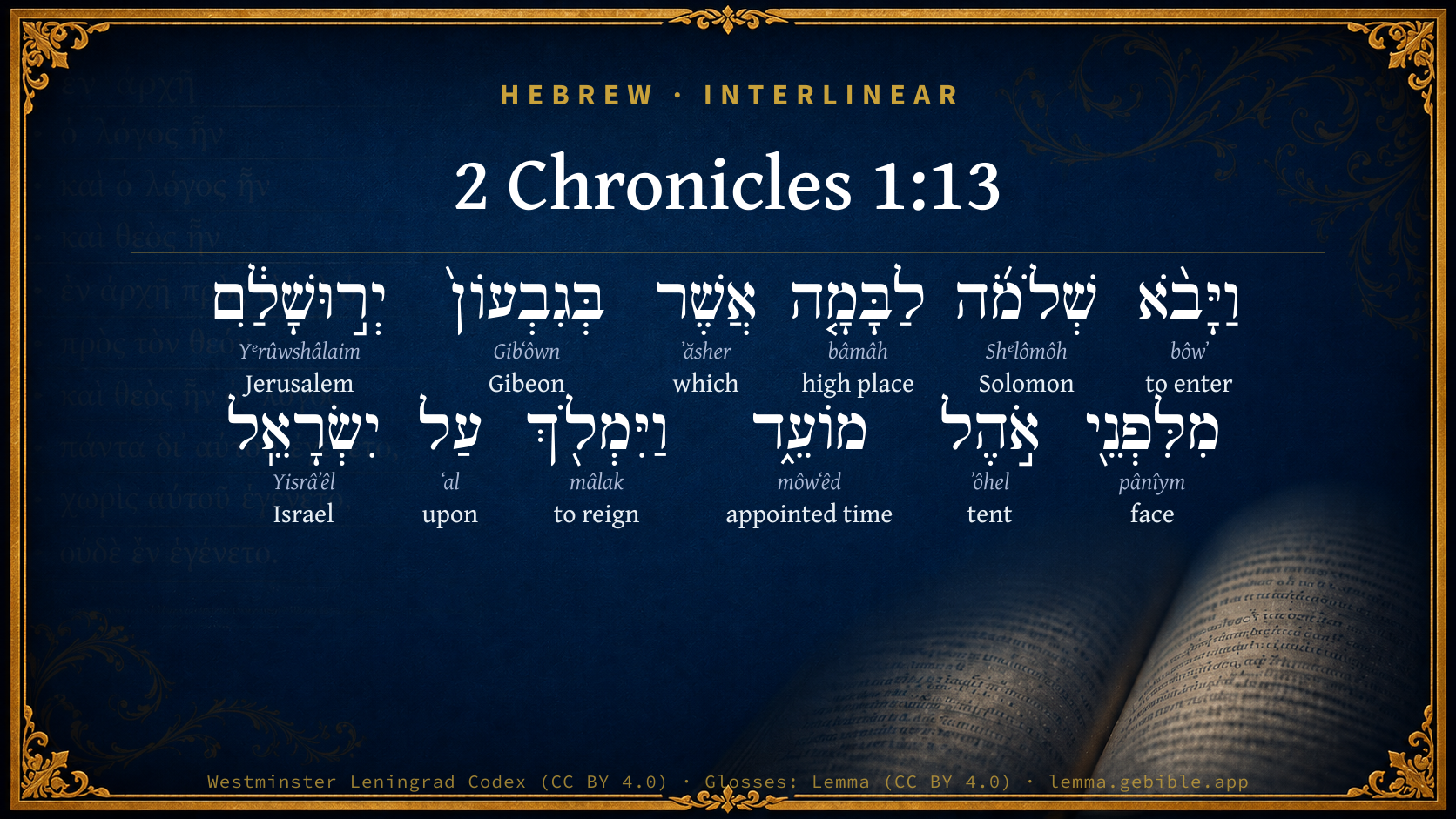
Hebrew (Westminster Leningrad Codex) 2 Chronicles 1:13 appears in the Hebrew Old Testament. The text above is from the Westminster Leningrad Codex. Each word links to its Strong’s number, a concise gloss, and parsing drawn from the Open Scriptures Hebrew Bible morphology. Click any word for its full Brown-Driver-Briggs (BDB) entry.
Download image
Cite this verse

2 Chronicles 1:13 (World English Bible). Public Domain. Lemma interlinear Bible study tool, https://lemma.gebible.app/v/2-chronicles/1/13.

Show BibTeX & RIS
BibTeX
RIS
English Translation
So Solomon came from the high place that was at Gibeon, from before the tent of meeting, to Jerusalem; and he reigned over Israel.
World English Bible · Public Domain
Download a study sheet

One document with this verse’s original text, its word-by-word gloss line, the meaning frame, cross-references with their text, attributed commentary, and full source and license credits — printable, and it pastes into notes with its structure intact.

This verse Autodidact and up

Study sheet (.html) Plain text (.txt)

A passage Seminary Student

Up to 50 verses in one chapter. A passage sheet keeps up to 6 commentary sources and 12 cross-references per verse, in the order this page ranks them, and says so on the sheet whenever that leaves anything out. Ask for a single verse and you get the Autodidact verse sheet above.

Everything on this page stays free to read, with no account — the sheet is a download of what is already on screen, not access to it.

Want to remove ads? Support Godless Engineer
Compare translations 3

The same verse in 3 English versions, stacked beneath the original-language interlinear above. Click any original word for its lexicon entry.

Each is an independent rendering of the whole verse — the interlinear is not word-aligned to these translations.

Highlighted words mark where these versions differ — a whole-verse word diff, not a word-by-word alignment.

  • World English Bible Public Domain
    So Solomon came from the high place that was at Gibeon, from before the tent of meeting, to Jerusalem; and he reigned over Israel.
  • King James Version Public Domain
    Then Solomon came from his journey to the high place that was at Gibeon to Jerusalem, from before the tabernacle of the congregation, and reigned over Israel.
  • unfoldingWord Literal Text CC BY-SA 4.0
    And Solomon came from the high place that was at Gibeon to Jerusalem, from before the tent of meeting; and he was king over Israel.

unfoldingWord Literal Text — © unfoldingWord, licensed CC BY-SA 4.0. Word-aligned USFM3 via Door43 (git.door43.org/unfoldingWord/en_ult).

Versions to compare (up to 4)

3 of 4 selected

Show all 18 translations

Every available English version of this verse, each an independent rendering of the whole verse.

  • World English Bible Public Domain
    So Solomon came from the high place that was at Gibeon, from before the tent of meeting, to Jerusalem; and he reigned over Israel.
  • Berean Standard Bible Public Domain
    So Solomon went to Jerusalem from the high place in Gibeon before the Tent of Meeting, and he reigned over Israel.
  • Majority Standard Bible Public Domain
    So Solomon went to Jerusalem from the high place in Gibeon, from before the Tent of Meeting, and he reigned over Israel.
  • King James Version Public Domain
    Then Solomon came from his journey to the high place that was at Gibeon to Jerusalem, from before the tabernacle of the congregation, and reigned over Israel.
  • American Standard Version (1901) Public Domain
    So Solomon came from the high place that was at Gibeon, from before the tent of meeting, unto Jerusalem; and he reigned over Israel.
  • Revised Version (1885) Public Domain
    So Solomon came from his journey to the high place that was at Gibeon, from before the tent of meeting, unto Jerusalem; and he reigned over Israel.
  • Geneva Bible (1599) Public Domain
    Then Salomon came from the hie place, that was at Gibeon, to Ierusalem from before the Tabernacle of the Congregation, and reigned ouer Israel.
  • Douay-Rheims (1899) Public Domain
    Then Solomon came from the high place of Gabaon to Jerusalem before the tabernacle of the covenant, and reigned over Israel.
  • Young's Literal Translation Public Domain
    And Solomon cometh in `from' the high place that `is' in Gibeon to Jerusalem, from before the tent of meeting, and reigneth over Israel,
  • Literal Standard Version CC BY-SA 4.0
    And Solomon comes in to Jerusalem [from] the high place that [is] in Gibeon, from before the Tent of Meeting, and reigns over Israel,
  • Unlocked Literal Bible CC BY-SA 4.0
    So Solomon came to Jerusalem from the high place that was at Gibeon, from before the tent of meeting; he reigned over Israel.
  • unfoldingWord Literal Text CC BY-SA 4.0
    And Solomon came from the high place that was at Gibeon to Jerusalem, from before the tent of meeting; and he was king over Israel.
  • Darby Bible Public Domain
    Then Solomon came back [from] the high place at Gibeon to Jerusalem, from before the tent of meeting, and reigned over Israel.
  • World Messianic Bible Public Domain
    So Solomon came from the high place that was at Gibeon, from before the Tent of Meeting, to Jerusalem; and he reigned over Israel.
  • Webster's Bible Public Domain
    Then Solomon came from his journey to the high place that was at Gibeon to Jerusalem, from before the tabernacle of the congregation, and reigned over Israel.
  • Free Bible Version CC BY-SA 4.0
    Then Solomon returned to Jerusalem from the Tent of Meeting in Gibeon, and he ruled over Israel.
  • Bible in Basic English Public Domain
    So Solomon went back from the high place at Gibeon, from before the Tent of meeting, to Jerusalem; and he was king over Israel.
  • JPS Tanakh (1917) Public Domain
    So Solomon came from his journey to the high place that was at Gibeon, from before the tent of meeting, unto Jerusalem; and he reigned over Israel.

Literal Standard Version (2020), Covenant Press — licensed CC BY-SA 4.0. Text via the HelloAO Bible API (eBible.org). Unlocked Literal Bible (unfoldingWord) — licensed CC BY-SA 4.0. Text via the HelloAO Bible API (eBible.org). unfoldingWord Literal Text — © unfoldingWord, licensed CC BY-SA 4.0. Word-aligned USFM3 via Door43 (git.door43.org/unfoldingWord/en_ult). Free Bible Version, Dr. Jonathan Gallagher — licensed CC BY-SA 4.0. Text via the HelloAO Bible API (eBible.org).

Word by word

More ways to search: Search by grammar → Find every occurrence → Compare this word →

Practice this passage: Drill this verse → Learn its vocabulary →

בְּגִבְעוֹן֙
Gibʻôwn
H1391
“in/at · Gibeon”
Preposition + Noun, Proper
Part of Speech
Preposition + Noun
Type
Proper
Full BDB Definition

Origin: from the same as H1387

TWOT: None

Gibeon = "hill city" - a Levitical city of Benjamin, modern 'el-Jib', which lies 5 miles or 8 kilometers from Jerusalem
  1. וַיָּבֹ֨א bôwʼ H935 “and · to enter” Conjunction + Verb, Qal, Sequential Imperfect, 3rd Person, Masculine, Singular
  2. שְׁלֹמֹ֜ה Shᵉlômôh H8010 “Solomon” Noun, Proper
  3. לַבָּמָ֤ה bâmâh H1116 “to/for the · high place” Preposition, Determined + Noun, Common, Feminine, Singular, Absolute
  4. אֲשֶׁר ʼăsher H834 “which” Particle, Relative
  5. יְר֣וּשָׁלִַ֔ם Yᵉrûwshâlaim H3389 “Jerusalem” Noun, Proper
  6. מִלִּפְנֵ֖י pânîym H6440 “from · to/for · face(s) of” Preposition + Preposition + Noun, Common, Both, Plural, Construct
  7. אֹ֣הֶל ʼôhel H168 “tent of” Noun, Common, Masculine, Singular, Construct
  8. מוֹעֵ֑ד môwʻêd H4150 “appointed time” Noun, Common, Masculine, Singular, Absolute
  9. וַיִּמְלֹ֖ךְ mâlak H4427 “and · to reign” Conjunction + Verb, Qal, Sequential Imperfect, 3rd Person, Masculine, Singular
  10. עַל ʻal H5921 “upon” Preposition
  11. יִשְׂרָאֵֽל Yisrâʼêl H3478 “Israel” Noun, Proper

About this verse

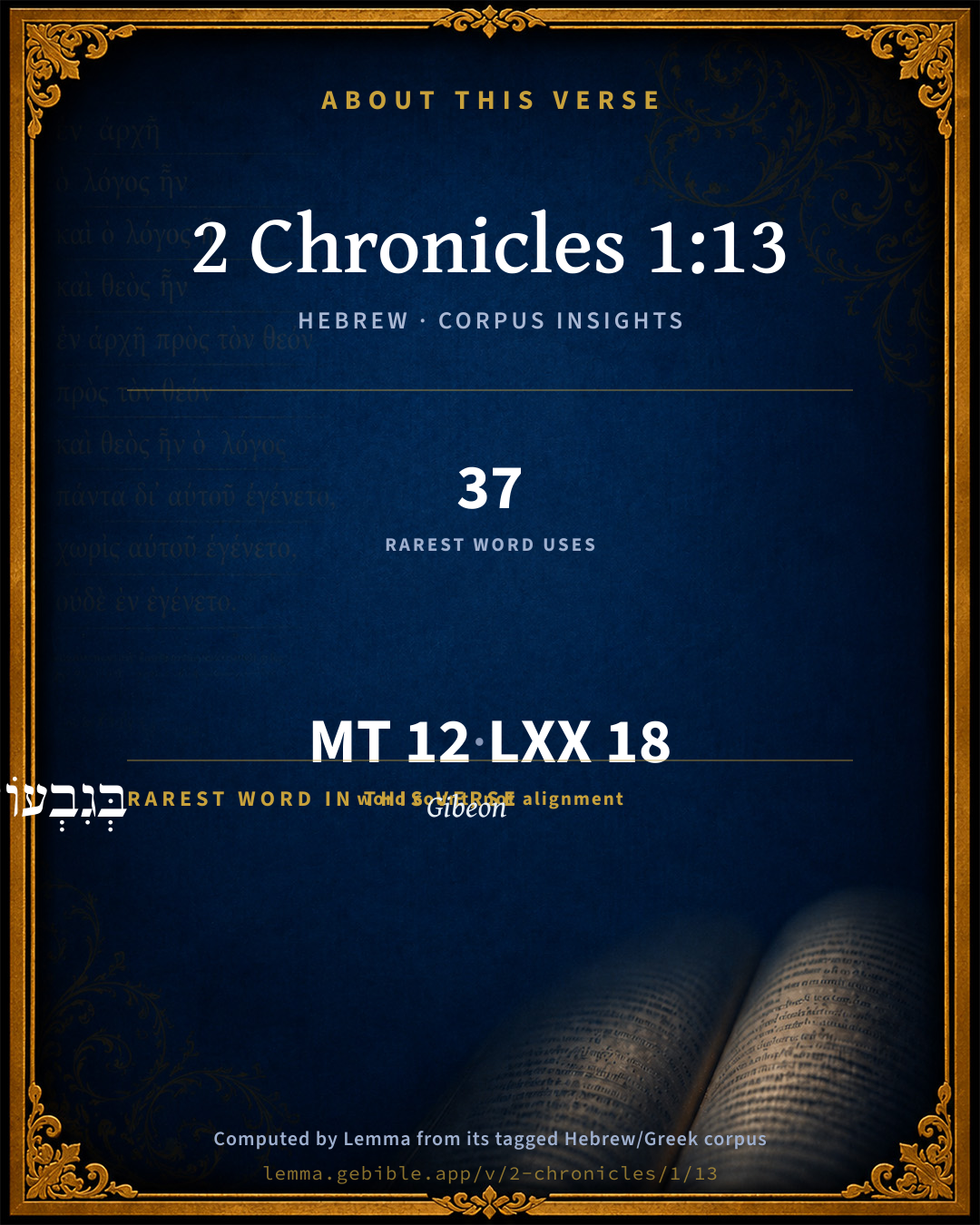
These counts appear in no published source. They are computed here, from the morphology-tagged text and Lemma’s own curated glosses. What Lemma adds →

12
words
12
distinct lemmas
Historical
section

Shared distinctive vocabulary

בְּגִבְעוֹן֙ Gibeon H1391 occurs in 35 verses of the Hebrew Bible. Also found in:

Grammatical profile

  • 2 verbs
  • 8 nouns
  • 1 preposition
  • 1 particle

Verb forms

  • וַיָּבֹ֨א Qal · Sequential Imperfect
  • וַיִּמְלֹ֖ךְ Qal · Sequential Imperfect

Hebrew & Septuagint length

In English translation the verse runs 24 words from the Hebrew and 23 from the Septuagint (LXX English) — closely comparable.

A rough comparison of the two English renderings, which tokenize alike — not a word-level alignment.

Word counts can differ between the Hebrew and the Greek without any difference in meaning — e.g. the Hebrew direct-object marker אֵת has no separate Greek word, and Greek often adds the article ὁ.

In the original languages it is 12 Hebrew tokens and 18 Greek tokens — but the two are counted differently (Hebrew bundles its prefixes and suffixes into one token; the Greek is in lemma form), so that isn’t a like-for-like length.

Cross-references

2

Topical passages linked to 2 Chronicles 1:13 in the Treasury of Scripture Knowledge — connected by theme and wording, ordered by reader-vote popularity; previews shown in the World English Bible.

  • 1 Kings 4:24–25 For he had dominion over all [the region] on this side the River, from Tiphsah even to Gaza, over all the kings on this side the River: and he had peace on all sides round about him.
  • 2 Chronicles 1:3 So Solomon, and all the assembly with him, went to the high place that was at Gibeon; for there was the tent of meeting of God, which Moses the servant of Yahweh had made in the wilderness.

Cross-references courtesy of OpenBible.info (CC BY 4.0).

Hebrew and Greek witnesses Masoretic Hebrew ↔ Greek Septuagint

The same verse in the two great witnesses to the Old Testament, shown verse-for-verse.

These are two independent witnesses, not word-aligned to each other, and the Septuagint is shown in lemma (dictionary) form.

Hebrew 2 Chronicles 1:13 Masoretic · Westminster Leningrad Codex

וַיָּבֹ֨א שְׁלֹמֹ֜ה לַבָּמָ֤ה אֲשֶׁר בְּגִבְעוֹן֙ יְר֣וּשָׁלִַ֔ם מִלִּפְנֵ֖י אֹ֣הֶל מוֹעֵ֑ד וַיִּמְלֹ֖ךְ עַל יִשְׂרָאֵֽל

So Solomon came from the high place that was at Gibeon, from before the tent of meeting, to Jerusalem; and he reigned over Israel.

World English Bible · Public Domain

Greek LXX 2 Chronicles 1:13 Septuagint · lemma form

καί ἔρχομαι σαλωμών ἐκ βαμα ὁ ἐν γαβαων εἰς ἰερουσαλήμ ἀπό πρόσωπον σκηνή μαρτύριον καί βασιλεύω ἐπί ἰσραήλ

And Solomon came from the high place that was in Gabaon to Jerusalem, from before the tabernacle of witness, and reigned over Israel.

LXX2012 (modern English Septuagint) · Public Domain

On this verse, Ellicott's Commentary for English Readers discusses the Septuagint’s reading. Read the note in Commentary ↓

Hebrew: Westminster Leningrad Codex (CC BY 4.0). Greek: Septuagint (public domain); English from LXX2012 (modern English Septuagint) (Public Domain). How the Septuagint differs from the Hebrew →

Commentary

Notes on 2 Chronicles 1:13 from classic Christian and Jewish commentators (each source and its license shown beneath its notes). The classic Christian expositions comment on the surrounding passage and are grouped to its opening verse, so a note may address several verses; the Jewish commentaries on the Tanakh (Rashi and others) are per-verse, so they appear only where the commentator wrote on this verse.

Lemma curates 59 commentaries, every one of them public domain or Creative Commons licensed, each selected and text-cleaned for this edition rather than reprinted as found. About our sources →

Matthew Henry's Commentary

Here is, 1. Solomon's entrance upon the government (Ch2 1:13): He came from before the tabernacle, and reigned over Israel. He would not do any acts of government till he had done his acts of devotion, would not take honour to himself till he had given honour to God - first the tabernacle, and then the throne. But, when he had obtained wisdom from God, he did not bury his talent, but as he received the gift ministered the same, did not give up himself to ease and pleasure, but minded business: he reigned over Israel. 2. The magnificence of his court (Ch2 1:14): He gathered chariots and horsemen. Shall we praise him for this? We praise him not; for the king was forbidden to multiply horses, Deu 17:16. I do not remember that ever we find his good father in a chariot or on horseback; a mule was the highest he mounted. We should endeavor to excel those that went before us in goodness rather than in grandeur. 3. The wealth and trade of his kingdom. He made silver and gold very cheap and common, Ch2 1:15. The increase of gold lowers the value of it; but the increase of grace advances its price; the more men have of that the more they value it. How much better therefore is it to get wisdom than gold! He opened also a trade with Egypt, whence he imported horses and linen-yarn, which he exported again to the kings of Syria, with great advantage no doubt, Ch2 1:16, Ch2 1:17. This we had before, Kg1 10:28, Kg1 10:29. It is the wisdom of princes to promote industry and encourage trade in their dominions. Perhaps Solomon took the hint of setting up the linen-manufacture, bringing linen-yarn out of Egypt, working it into cloth, and then sending that to other nations, from what his mother taught when she specified this as one of the characteristics of the virtuous woman, She maketh fine linen, and selleth it, and delivereth girdles of it to the merchant, Pro 31:24. In all labour there is profit.

Matthew Henry's Commentary on the Whole Bible (1708–1710) — public domain (CC PDM 1.0). Text via the HelloAO Bible API.

Trapp's Complete Commentary

John Trapp

2Ch 1:13 Then Solomon came [from his journey] to the high place that [was] at Gibeon to Jerusalem, from before the tabernacle of the congregation, and reigned over Israel.

Ver. 13. And reigned over Israel.] Sic regnabat, he so reigned, sc., with that wisdom and knowledge which God had promised him.

John Trapp, A Commentary or Exposition upon All the Books of the Old and New Testament (1647–1656) — public domain. Text from a community e-Sword module.

The Biblical Illustrator

Joseph S. Exell

2Ch_1:13-14

And Solomon gathered chariots.

Solomons wealth

I. Wealth derived from trading speculations.

II. Wealth acquired in opposition to Gods commands (Deu_17:16-17). He must trust in the Lord God, not in chariots and horses (Psa_20:7).

III. Wealth therefore risky in its possesion. Prosperity of Solomon his great misfortune. The smallest departure from rectitude may lead to grievous errors and fearful miseries. (J. Wolfendale.)

The Biblical Illustrator, edited by Joseph S. Exell (c. 1880s–1900s) — public domain. Text from a community e-Sword module.

Ellicott's Commentary for English Readers

(13) Then Solomon came from his journey to the high place that was at Gibeon to Jerusalem.—Heb., And Solomon came to the high place that was in Gibeon to Jerusalem. Clearly we should read, “from the high place,” with the LXX. and Vulgate. The difficulty is as old as the Syriac version, which reads, “And Solomon came to the great high place [reading bûmsâ—i.e., βῶμος—with Dr. Payne Smith] that is in Gibeon the city, which is on the east of Jerusalem, from before the tabernacle.”

From before the tabernacle of the congregation.—See 2Ch_1:3; 2Ch_1:6. Perhaps “to (or at) the high place that was at G-ibeon,” was originally a marginal gloss upon this expression. (Comp. 2Ch_1:3.) The reading, “And Solomon came to Jerusalem from before the tent of tryst,” would be quite intelligible without this addition.

And reigned over Israel.—Syr., over all Israel. (Comp. 1Ki_4:1.) But the remark, “and he reigned over Israel,” is by no means “superfluous” (Bertheau), inasmuch as it naturally introduces the following sketch of the reign, which carries us on from God’s promise to its fulfilment.

The chronicler does not notice the sacrifices which, on his return, Solomon offered before the ark at Jerusalem (1Ki_3:15), nor the story of the king’s wise judgment which there follows (1Ki_3:16-28). It is unreasonable to seek any other ground of such omissions than the free and legitimate exercise of the compiler’s discretion in the choice of his own materials. That he did not depreciate the sanctuary on Mount Zion as a place of sacrifice, is evident from 1Ch_21:18 to 1Ch_22:1.

A Bible Commentary for English Readers, edited by Charles John Ellicott (1878–1897) — public domain. Text from a community e-Sword module.

The Cambridge Bible for Schools and Colleges

gen. ed. J. J. S. Perowne

13. from his journey to the high place that was at Gibeon] This clause yields no sense in the Hebrew and is probably a misplaced gloss. Read simply, Then Solomon came to Jerusalem (cp. 1Ki_3:15).

The Cambridge Bible for Schools and Colleges (gen. ed. J. J. S. Perowne; Cambridge University Press, 1878–1918) — public domain. Text from a community e-Sword module.

Albert Barnes' Notes on the Bible

From his journey - These words are not in the original text, which is thought to be corrupt. It is best to correct the text, and then simply to translate: “And Solomon came from the high place that was at Gibeon to Jerusalem.”

Albert Barnes' Notes on the Bible (1834–1885) — public domain. Text from a community e-Sword/MySword module.

Haydock's Catholic Bible Commentary

Before. Hebrew and Septuagint, "from before the tabernacle," which was at Gabaon. there was another at Jerusalem, where (Haydock) Solomon rendered homage to the Lord. (Calmet)

George Leo Haydock (1774–1849), Haydock's Catholic Family Bible and Commentary, 1859 edition — public domain. Excludes Psalms (Douay-Rheims chapter numbering differs from Protestant) and Deuterocanonical books (Catholic canon only).

Matthew Poole's English Annotations

To the high place, or, from the high place; for the Hebrew prefix lamed, which commonly signifies to, is sometimes put for the Latin de, which signifies from.

Matthew Poole's English Annotations on the Holy Bible (1683–1685) — public domain. Text from a community e-Sword/MySword module.

The Pulpit Commentary

Solomon"s return after sacrifice from Gibeon to Jerusalem, and from before the tabernacle of the congregation" to before the ark of the covenant of the Lord" in Mount Zion. 1Ki 3:1-50 This verse not merely bears the trace of a slightly corrupt text in the presence of the Hebrew preposition: before hmB where there can be no doubt the preposition should stand, but also suggests (keeping in view our ver. 3, and comparing (1Ki_3:15) the condensed and cut-down method of Chronicles, and its strong preferences for selecting out of the various material at its command. The tabernacle of the congregation. This styling of the "tabernacle" is of very frequent occurrence. It is found above thirty times in Exodus, and fully as often in Leviticus and Numbers. Afterwards it is sprinkled more rarely in the historical books. The reason of its being styled "the tabernacle of the congregation" (rewOm) is doubtful perhaps because of the gatherings of the people in front of it, or possibly because of its being the place where God would meet with Moses. The other name, the tabernacle of "witness" or "testimony" or covenant" (tWde Num_9:15, etc.) is not unfrequent. Hence the LXX skhnhou the Vulgate, tabernaculum testimonii; and Luther"s Stifisuitten. This verse very much stints the information contained in the parallel, to the effect that Solomon forthwith took his place before the ark of the covenant in Mount Zion, and offered burnt offerings and peace offerings, and gave a feast to all his servants (2Sa_6:17-19; 1Ch_16:1-3; Deu_14:26-29) And he reigned over Israel. These words seem nugatory both in themselves and as placed here. They probably stand for 1Ki_4:1.

Vers. 13-17.

From the altar to the throne.

A great step was now taken. Solomon, the young man, mounted the throne of his father David; in so doing he assumed the function of one who had behind him a large and varied experience, and who had above and around him the assured and proved loving-kindness of God. Solomon began his reign most promisingly. We gather

I THAT HE DID WELL TO STEP TO THE THRONE FROM THE ALTAR. He came from before the tabernacle and reigned" (ver. 13). There could have been no place so suitable as that where Jehovah was worshipped from which to ascend to kingly power. There is no resort so good as the throne of grace, from which we can ascend any throne of authority or power to-day. It is well, indeed, to pass from intercourse with God to association with men and to the conduct of human affairs. The visit to the house of the Lord, fellowship with Christ at his table or in our own chamber, will give a calmness of spirit, an unselfishness of aim, and a steadfastness of principle which will go far to qualify us for the difficult duties and heavy burdens and (it may be) the serious battles of daily life.

II THAT ONE MAN MAY HOLD IN HIS HAND THE WELL-BEING OF MANY. Solomon "reigned over Israel." In those days reigning meant governing. And though the Hebrew monarchy was not actually absolute, it was invested with great power. A good sovereign wrought great blessings, and a bad one caused terrible evils to his country. Great power, in the shape of royal authority, has passed or is passing away. But still men "reign over others lead, direct, rule, influence, mightily affect them for good or evil. Very great power has the statesman, the preacher, the poet, the principal, the teacher. The possession of power is usually esteemed a thing to be greatly coveted. But it is as full of solemn responsibility as it is of noble opportunity; it calls for a deep sense of obligation and accountability; also for peculiar prayerfulness of spirit and of habit. Humble and not proud, conscious of dependence on God and not self-sufficient, should be the man of high position and commanding influence.

III THAT AFFLUENCE MAY BE A GOOD SIGN, BUT IT IS A PERILOUS CONDITION. All those instances of national prosperity related in the text the abundance of horses and chariots, and of gold and silver, the cultivation of choice trees, etc. were signs that Jehovah was favouring the land, and that Solomon was fulfilling his early promise. But affluence, whether individual or national, is a dangerous condition. It tends to luxury; and luxury leads only too often to sloth and self-indulgence; and these lead straight to wrong-doing and impiety. It is "a slippery place," where a few can walk without stumbling, but where the many slip. and fall.

1. Envy not the greatly prosperous; plenteousness of gold and silver may impoverish the soul while it enriches the treasury.

2. Care much, care most, for the abundance of Christian truth, of sterlingprinciple, of generous helpfulness. C.

Vers. 13-17.

The glory of Solomon.

I HIS SPLENDID EQUIPAGE. "Solomon gathered chariots and horsemen.

1. A sign of great prosperity. Mentioned on this account rather than as a proof of the expensiveness and burdensomeness of Solomon"s reign (Ewald).

(1) A discrepancy. Solomon had 40, 000 stalls; (1Ki_4:26; Josephus, "Ant. Jud:," 8:2:4) 12, 000 horsemen and 1400 chariots (ver. 14; 2Ch 10:25) 4000 stalls and 12, 000 horsemen. (2Ch_9:25)

(2) An explanation. The stalls probably were 4000, the horsemen 12, 000, and the chariots 1400. The Israelitish war-chariot, like the Egyptian and Assyrian, may have been two-horsed, in which case 1400 chariots would represent 2800 horses. A reserve force of 1200 would bring the total number of horses to 4000, which would require 4000 stalls: That the horsemen should be 12, 000 may be explained by supposing that, as Solomon"s equestrian equipage was more for show than action, each horse may have had a rider as well as each chariot a charioteer; or the term "horsemen" may have embraced all persons connected with the equestrian service.

2. An act of great wickedness. If the Divine prohibition (Deu_17:16) forbade not the actual possession of horses by Israelitish kings, it certainly condemned their indefinite multiplication. David respected this prohibition (2Sa_8:4; 1Ch_18:4) Solomon overstepped its limits, consequently what Moses had predicted ensued first Solomon sought a matrimonial alliance with, (1Ki_3:1) and then the people put their trust in, Egypt (2Ki_18:24; Hos_7:11) The glory of princes does not always harmonize with the commands of the King of kings. Solomon"s horsemen and chariots were partly kept in Jerusalem to augment his magnificence, and partly distributed through chariot-cities, not so much to overawe the people as for convenience in providing fodder for the beasts, and meeting the state necessities of the king.

II HIS ENORMOUS WEALTH. The revenues of Solomon were:

1. Varied. Gold and silver and cedar wood; the precious metals obtained from Ophir, in South Arabia (Ewald, Keil, Bahr, etc.), by means of Tarshish ships (cf. the modern expressions, "India-men," "Greenlanders"), which sailed from Ezion-geber, on the Red Sea (2Ch_9:21; 1Ki_9:26-28) and also from the numerous Eastern potentates the kings of the earth", (2Ch_9:23) who came to hear his

2. wisdom, and brought every man his present, vessels of silver and vessels of; (2Ch_9:24) the timber purchased from Hiram of Tyre, and procured from Mount Lebanon. (1Ki_5:10)

3. Abundant. Making large allowance for rhetorical exaggeration, the crown wealth in Solomon"s days was immense. Even if the gold and silver were barely as plentiful as stones (ver. 15), one may judge of its quantity by the statements that "the weight of gold that came to Solomon in one year was six hundred and sixty-six talents" (equivalent to estimating the gold talent at besides that brought by chapmen, merchants, foreign kings, and provincial governors. (2Ch_9:13, 14 1Ki_10:14, 1Ki_10:15) This accumulation of wealth in the hands of the crown, more accordant with ancient than with modem practice, was likewise then more excusable than now for obvious religious as well as political reasons.

III HIS COMMERCIAL ENTERPRISE.

1. How far it extended. To Egypt, The first mention of commercial intercourse between Israel and Egypt, this is also one of the earliest indications of contact between these two peoples since the Exodus; and the silence of Scripture as to Egypt during the long interval between the Exodus and the age of Solomon receives a striking confirmation from the monuments, which show "no really great or conquering monarch between Rameses III and Sheshonk I" (Rawlinson, "Egypt and Babylon," p. 328).

2. In what it consisted. Horses and chariots. A native of Armenia and Media, whence it was fetched by the Jews to Palestine, (Ezr_2:66) the horse had been used in Egypt from the earliest times, (Gen_41:43 Gen_47:17) and in Solomon"s time had been brought by the Egyptians to a high degree of cultivation in respect both of swiftness and courage two qualities highly serviceable for war. Hence Solomon naturally turned to the Nile valley when he thought of setting up an equestrian establishment. The manufacturing of war-chariots had also engaged the attention of the Pharaohs and their people; and these likewise were imported by the Israelitish monarch. Taking the shekel at 3s. 4d., the price of a horse was and of a war-chariot (perhaps with two horses and harness) sterling.

3. By whom it was conducted. By the king"s merchants, who were so called, not because, as foreign horse-dealers settled in the country, they were required to contribute to the king"s treasury a portion of their gains in the shape of an income-tax (Bertheau), but because they traded for the king (Keil), acting as his agents, going down to Egypt, purchasing the animals in droves, and fetching them up for his use. So skilful did these merchants show themselves both in judging of the animals and in driving bargains with Egyptian dealers, and so far had their fame travelled, that their services were sought for by the Hittite and Syrian kings of the day.

LESSONS.

1. The criminality of disobedience.

2. The danger of wealth.

3. The advantages of trade and commerce. W.

The Pulpit Commentary (1880–1919), ed. H.D.M. Spence-Jones & Joseph S. Exell — public domain. Text from a community e-Sword module.

Kretzmann's Popular Commentary

Paul E. Kretzmann

Solomon’s Immense Wealth

v. 13. Then Solomon came from his journey to the high place that was at Gibeon to Jerusalem, from before the Tabernacle of the Congregation, where he had served the Lord by his special act of worship, and reigned over Israel, after having publicly offered praise and thanks to the Lord before the Ark of the Covenant.

v. 14. And Solomon gathered chariots and horsemen; and he had a thousand and four hundred chariots and twelve thousand horsemen, who were trained to fight in chariots as well as on horseback, which he placed in the chariot cities, such as were especially designated for that purpose, and with the king at Jerusalem.

v. 15. And the king made silver and gold at Jerusalem as plenteous as stones, on account of the great masses of the precious metals which he acquired in the course of time, and cedar-trees made he as the sycomore trees that are in the vale for abundance, the sycamore-fig tree being one of the most common in the valleys toward the southeast.

v. 16. And Solomon had horses brought out of Egypt, for the horses of that country were very highly valued, being as fine as Arabian steeds, but larger and more powerful, and linen yarn, the fine, silklike byssus of Egypt; the king’s merchants received the linen yarn at a price, or, "they fetched a troop for a certain price," delivered to certain established markets.

v. 17. And they fetched up and brought forth out of Egypt a chariot for six hundred shekels of silver (almost four hundred dollars) and an horse for an hundred and fifty (not quite one hundred dollars); and so brought they out horses for all the kings of the Hittites and for the kings of Syria, thereby establishing a lucrative business, by their means. Thus the gracious promises of God to Solomon were literally fulfilled, even as they invariably are to this day. It is but for us to trust in Him with childlike confidence, and we shall not be ashamed.

Paul E. Kretzmann, Popular Commentary of the Bible (1921–1924) — public domain. Text from a community e-Sword module.

Lesson kit

Teaching starters — assembled from the data on this page, not authored interpretation. Every prompt links to the verse data it draws on. Edit before teaching.

2 Chronicles, in the Historical, opens this verse with 12 words (12 distinct Hebrew lemmas). Its most distinctive word is Gibʻôwn (“Gibeon”). A historical commentator’s framing appears above. Read the whole chapter for the surrounding context.

Discussion questions

  1. How does “Gibeon” (Gibʻôwn) shape what this verse is saying?
  2. How does Joshua 9:3, which shares the word «Gibeon», read alongside this verse?
  3. These translations render this verse differently. What is at stake in choosing one wording over another?
  4. «וַיָּבֹ֨א» is a Qal Sequential Imperfect verb. How does that grammatical form shape the action described?
  5. Compare how Matthew Henry's Commentary and Trapp's Complete Commentary read this verse. Where do they agree or differ?

Things to notice

Reading settings

Reading text

Shown beneath each verse's original-language words.

Old Testament
Old Testament edition

Read the OT as the Masoretic Hebrew (MT) or the Greek Septuagint (LXX).

English shown for the Greek Septuagint (in the Hebrew ↔ Greek comparison).

Comparing translations? Open the Compare panel on any verse page to stack up to four side by side.