2 Chronicles 11:15

Hebrew (Westminster Leningrad Codex) 2 Chronicles 11:15 appears in the Hebrew Old Testament. The text above is from the Westminster Leningrad Codex. Each word links to its Strong’s number, a concise gloss, and parsing drawn from the Open Scriptures Hebrew Bible morphology. Click any word for its full Brown-Driver-Briggs (BDB) entry.
Download image
Cite this verse

2 Chronicles 11:15 (World English Bible). Public Domain. Lemma interlinear Bible study tool, https://lemma.gebible.app/v/2-chronicles/11/15.

Show BibTeX & RIS
BibTeX
RIS
English Translation
and he appointed him priests for the high places, and for the male goats, and for the calves which he had made.
World English Bible · Public Domain
Download a study sheet

One document with this verse’s original text, its word-by-word gloss line, the meaning frame, cross-references with their text, attributed commentary, and full source and license credits — printable, and it pastes into notes with its structure intact.

This verse Autodidact and up

Study sheet (.html) Plain text (.txt)

A passage Seminary Student

Up to 50 verses in one chapter. A passage sheet keeps up to 6 commentary sources and 12 cross-references per verse, in the order this page ranks them, and says so on the sheet whenever that leaves anything out. Ask for a single verse and you get the Autodidact verse sheet above.

Everything on this page stays free to read, with no account — the sheet is a download of what is already on screen, not access to it.

Want to remove ads? Support Godless Engineer
Compare translations 3

The same verse in 3 English versions, stacked beneath the original-language interlinear above. Click any original word for its lexicon entry.

Each is an independent rendering of the whole verse — the interlinear is not word-aligned to these translations.

Highlighted words mark where these versions differ — a whole-verse word diff, not a word-by-word alignment.

  • World English Bible Public Domain
    and he appointed him priests for the high places, and for the male goats, and for the calves which he had made.
  • King James Version Public Domain
    And he ordained him priests for the high places, and for the devils, and for the calves which he had made.
  • unfoldingWord Literal Text CC BY-SA 4.0
    And he established for himself priests for the high places and for the goats and for the calves which he had made.

unfoldingWord Literal Text — © unfoldingWord, licensed CC BY-SA 4.0. Word-aligned USFM3 via Door43 (git.door43.org/unfoldingWord/en_ult).

Versions to compare (up to 4)

3 of 4 selected

Show all 18 translations

Every available English version of this verse, each an independent rendering of the whole verse.

  • World English Bible Public Domain
    and he appointed him priests for the high places, and for the male goats, and for the calves which he had made.
  • Berean Standard Bible Public Domain
    And Jeroboam appointed his own priests for the high places and for the goat demons and calf idols he had made.
  • Majority Standard Bible Public Domain
    And Jeroboam appointed his own priests for the high places and for the goat demons and calf idols he had made.
  • King James Version Public Domain
    And he ordained him priests for the high places, and for the devils, and for the calves which he had made.
  • American Standard Version (1901) Public Domain
    and he appointed him priests for the high places, and for the he-goats, and for the calves which he had made.
  • Revised Version (1885) Public Domain
    and he appointed him priests for the high places, and for the he-goats, and for the calves which he had made.
  • Geneva Bible (1599) Public Domain
    And he ordeyned him Priests for the hie places, and for the deuils and for the calues which he had made.
  • Douay-Rheims (1899) Public Domain
    And he made to himself priests for the high places, and for the devils, and for the calves which he had made.
  • Young's Literal Translation Public Domain
    and he establisheth to him priests for high places, and for goats, and for calves, that he made --
  • Literal Standard Version CC BY-SA 4.0
    and he establishes for himself priests for high places, and for goat [idols] and for calf [idols] that he made.
  • Unlocked Literal Bible CC BY-SA 4.0
    Jeroboam appointed for himself priests for the high places and the goat and calf idols he had made.
  • unfoldingWord Literal Text CC BY-SA 4.0
    And he established for himself priests for the high places and for the goats and for the calves which he had made.
  • Darby Bible Public Domain
    and he ordained for himself priests for the high places, and for the he-goats and for the calves that he had made.
  • World Messianic Bible Public Domain
    He himself appointed priests for the high places, for the male goat and calf idols which he had made.
  • Webster's Bible Public Domain
    And he ordained him priests for the high places, and for the devils, and for the calves which he had made.
  • Free Bible Version CC BY-SA 4.0
    Jeroboam chose his own priests for the high places and for the goat and calf idols he had made.
  • Bible in Basic English Public Domain
    And he himself made priests for the high places, and for the images of he-goats and oxen which he had made.
  • JPS Tanakh (1917) Public Domain
    and he appointed him priests for the high places, and for the satyrs, and for the calves which he had made.

Literal Standard Version (2020), Covenant Press — licensed CC BY-SA 4.0. Text via the HelloAO Bible API (eBible.org). Unlocked Literal Bible (unfoldingWord) — licensed CC BY-SA 4.0. Text via the HelloAO Bible API (eBible.org). unfoldingWord Literal Text — © unfoldingWord, licensed CC BY-SA 4.0. Word-aligned USFM3 via Door43 (git.door43.org/unfoldingWord/en_ult). Free Bible Version, Dr. Jonathan Gallagher — licensed CC BY-SA 4.0. Text via the HelloAO Bible API (eBible.org).

Word by word

More ways to search: Search by grammar → Find every occurrence → Compare this word →

Practice this passage: Drill this verse → Learn its vocabulary →

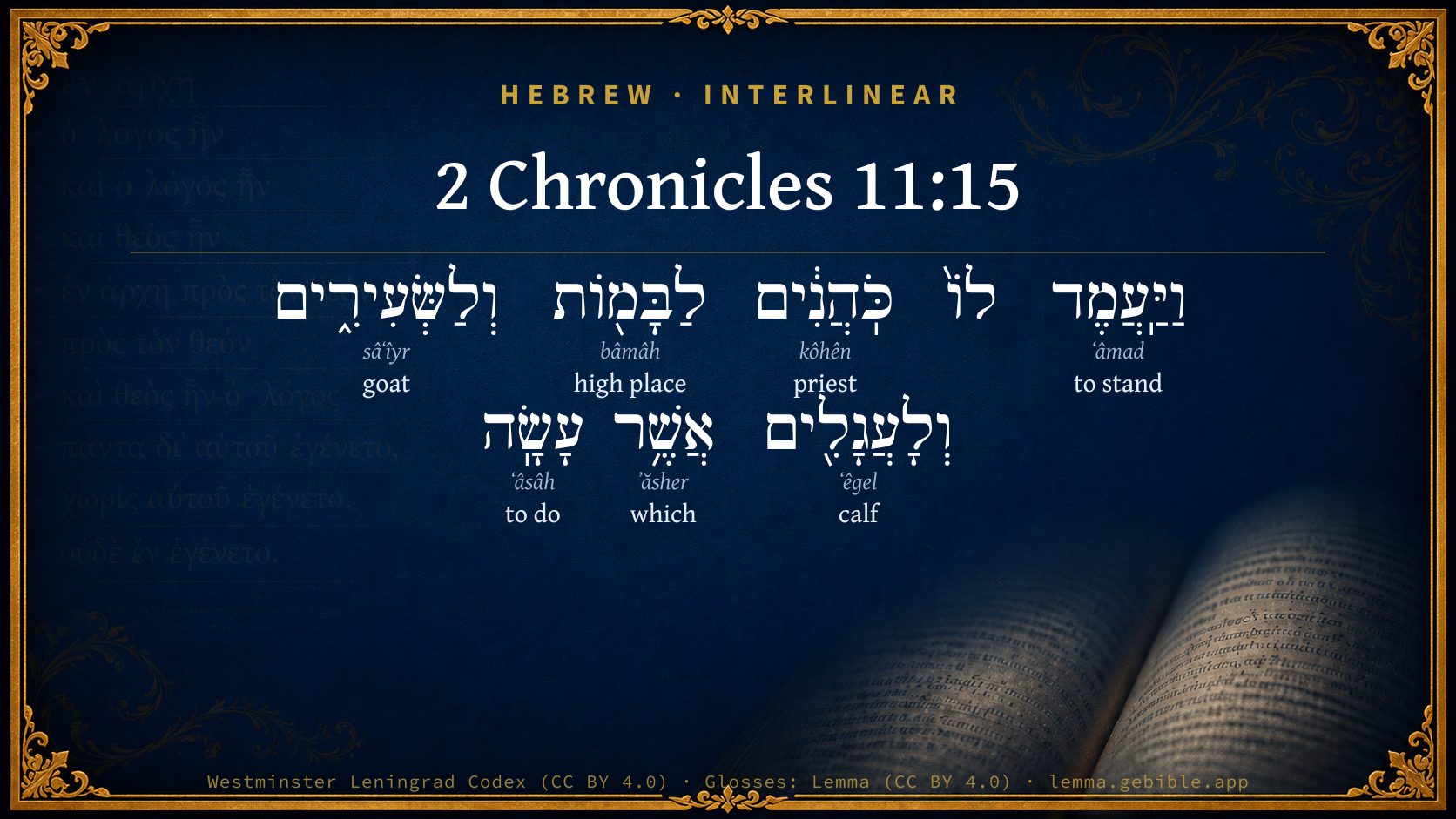
וְלָעֲגָלִ֖ים
ʻêgel
H5695
“and · to/for the · calves”
Conjunction + Preposition, Determined + Noun, Common, Masculine, Plural, Absolute
Part of Speech
Conjunction + Preposition + Noun
Type
Common
Gender
Masculine
Number
Plural
State
Absolute
Full BDB Definition

Origin: from the same as H5696

TWOT: 1560a

calf, bull-calf
  1. וַיַּֽעֲמֶד ʻâmad H5975 “and · to stand” Conjunction + Verb, Hiphil, Sequential Imperfect, 3rd Person, Masculine, Singular
  2. כֹּֽהֲנִ֔ים kôhên H3548 “priests” Noun, Common, Masculine, Plural, Absolute
  3. לַבָּמ֖וֹת bâmâh H1116 “to/for the · high places” Preposition, Determined + Noun, Common, Feminine, Plural, Absolute
  4. וְלַשְּׂעִירִ֑ים sâʻîyr H8163 “and · to/for the · goats” Conjunction + Preposition, Determined + Noun, Common, Masculine, Plural, Absolute
  5. אֲשֶׁ֥ר ʼăsher H834 “which” Particle, Relative
  6. עָשָֽׂה ʻâsâh H6213 “to do” Verb, Qal, Perfect, 3rd Person, Masculine, Singular

About this verse

These counts appear in no published source. They are computed here, from the morphology-tagged text and Lemma’s own curated glosses. What Lemma adds →

8
words
7
distinct lemmas
Historical
section

Shared distinctive vocabulary

וְלָעֲגָלִ֖ים calf H5695 occurs in 35 verses of the Hebrew Bible. Also found in:

Grammatical profile

  • 2 verbs
  • 4 nouns
  • 1 preposition
  • 1 particle

Verb forms

  • וַיַּֽעֲמֶד Hiphil · Sequential Imperfect
  • עָשָֽׂה Qal · Perfect

Hebrew & Septuagint length

In English translation the verse runs 22 words from the Hebrew and 25 from the Septuagint (LXX English) — closely comparable.

A rough comparison of the two English renderings, which tokenize alike — not a word-level alignment.

Word counts can differ between the Hebrew and the Greek without any difference in meaning — e.g. the Hebrew direct-object marker אֵת has no separate Greek word, and Greek often adds the article ὁ.

Cross-references

13

Topical passages linked to 2 Chronicles 11:15 in the Treasury of Scripture Knowledge — connected by theme and wording, ordered by reader-vote popularity; previews shown in the World English Bible.

  • 1 Kings 12:28 Whereupon the king took counsel, and made two calves of gold; and he said to them, It is too much for you to go up to Jerusalem: see your gods, Israel, which brought you up out of the land of Egypt.
  • Deuteronomy 32:17 They sacrificed to demons, [which were] no God, To gods that they didn't know, To new [gods] that came up of late, Which your fathers didn't dread.
  • 1 Kings 12:31 He made houses of high places, and made priests from among all the people, who were not of the sons of Levi.
  • 1 Kings 13:33 After this thing Jeroboam didn't return from his evil way, but made again from among all the people priests of the high places: whoever would, he consecrated him, that there might be priests of the high places.
  • Exodus 32:4–8 He received what they handed him, and fashioned it with an engraving tool, and made it a molten calf; and they said, "These are your gods, Israel, which brought you up out of the land of Egypt."
  • Exodus 32:31 Moses returned to Yahweh, and said, "Oh, this people have sinned a great sin, and have made themselves gods of gold.
  • 1 Kings 14:9 but have done evil above all who were before you, and have gone and made you other gods, and molten images, to provoke me to anger, and have cast me behind your back:
  • Psalms 106:19–20 They made a calf in Horeb, And worshiped a molten image.
  • Hosea 8:5–6 Let Samaria throw out his calf-idol! My anger burns against them! How long will it be before the are capable of purity?
  • Hosea 13:2 Now they sin more and more, And have made themselves molten images of their silver, Even idols according to their own understanding, All of them the work of the craftsmen. They say of them, "They offer human sacrifice and kiss the calves."
  • 1 Timothy 4:1 But the Spirit says expressly that in later times some will fall away from the faith, paying attention to seducing spirits and doctrines of demons,
  • Revelation 16:14 for they are spirits of demons, performing signs; which go forth to the kings of the whole inhabited earth, to gather them together for the war of that great day of God, the Almighty.
  • 1 Corinthians 10:20–21 But I say that the things which the Gentiles sacrifice, they sacrifice to demons, and not to God, and I don't desire that you would have communion with demons.

Cross-references courtesy of OpenBible.info (CC BY 4.0).

Hebrew and Greek witnesses Masoretic Hebrew ↔ Greek Septuagint

The same verse in the two great witnesses to the Old Testament, shown verse-for-verse.

These are two independent witnesses, not word-aligned to each other, and the Septuagint is shown in lemma (dictionary) form.

Hebrew 2 Chronicles 11:15 Masoretic · Westminster Leningrad Codex

וַיַּֽעֲמֶד לוֹ֙ כֹּֽהֲנִ֔ים לַבָּמ֖וֹת וְלַשְּׂעִירִ֑ים וְלָעֲגָלִ֖ים אֲשֶׁ֥ר עָשָֽׂה

and he appointed him priests for the high places, and for the male goats, and for the calves which he had made.

World English Bible · Public Domain

Greek LXX 2 Chronicles 11:15 Septuagint · lemma form

καί καταἵστημι ἑαυτοῦ ἱερεύς ὁ ὑψηλός καί ὁ εἴδωλον καί ὁ μάταιος καί ὁ μόσχος ὅς ποιέω ιεροβοαμ

And he made for himself priests of the high places, and for the idols, and for the vanities, and for the calves which Jeroboam made.

LXX2012 (modern English Septuagint) · Public Domain

On this verse, Haydock's Catholic Bible Commentary discusses the Septuagint’s reading. Read the note in Commentary ↓

Hebrew: Westminster Leningrad Codex (CC BY 4.0). Greek: Septuagint (public domain); English from LXX2012 (modern English Septuagint) (Public Domain). How the Septuagint differs from the Hebrew →

Commentary

Notes on 2 Chronicles 11:15 from classic Christian and Jewish commentators (each source and its license shown beneath its notes). The classic Christian expositions comment on the surrounding passage and are grouped to its opening verse, so a note may address several verses; the Jewish commentaries on the Tanakh (Rashi and others) are per-verse, so they appear only where the commentator wrote on this verse.

Lemma curates 59 commentaries, every one of them public domain or Creative Commons licensed, each selected and text-cleaned for this edition rather than reprinted as found. About our sources →

Trapp's Complete Commentary

John Trapp

2Ch 11:15 And he ordained him priests for the high places, and for the devils, and for the calves which he had made.

Ver. 15. And he ordained him priests.] See 1Ki 12:31.

And for the devils.] Heb., Hairy horrid things, boegy men. See Rev 9:11; Rev 9:20. The devil is ειδωλοχαρης, saith Synesius; and hereby it appeareth that Jeroboam set up more idols than the two golden calves.

John Trapp, A Commentary or Exposition upon All the Books of the Old and New Testament (1647–1656) — public domain. Text from a community e-Sword module.

Joseph Benson's Commentary

2Ch 11:15. For the high places, and for devils — Or, for the high places, both for devils, (the Baals, or false gods, which divers of his people worshipped, whom he encouraged to do so, giving them liberty to do any thing but to serve God at Jerusalem,) and for the calves — So he erected two sorts of high places, some for Baal, and some for the true God, whom he pretended to worship in and by the calves.

Joseph Benson's Commentary on the Old and New Testaments (1811–1818) — public domain. Text from a community e-Sword module.

Tyndale Open Study Notes

Tyndale Open Resources

11:15 Some scholars believe that Jeroboam set up the goat and calf idols as pedestals for the Lord, noting that the Canaanites believed that their gods stood on the backs of animals (cp. Exod 32:5, where the gold calf was used in “a festival to the Lord”). However, Jeroboam never specifically credited the Lord with rescuing Israel (1 Kgs 12:28), so others think he might have meant that other gods stood on the animals. Still others think Jeroboam might have adopted the practice of the Egyptians, portraying actual pagan deities in animal form (cp. Exod 32:4).

Tyndale Open Study Notes — © Tyndale Open Resources, licensed CC BY-SA 4.0. Text via the HelloAO Bible API.

Geneva Bible (1599)

Geneva Bible translators

Meaning, idols, read Isa. 44:15.

Geneva Bible (1599) marginal notes — public domain. Text via Bolls.life.

Jamieson, Fausset & Brown

Robert Jamieson, A. R. Fausset & David Brown

he ordained him priests--The persons he appointed to the priesthood were low and worthless creatures (Kg1 12:31; Kg1 13:33); any were consecrated who brought a bullock and seven rams (Ch2 13:9; Exo 29:37).

for the high places--Those favorite places of religious worship were encouraged throughout the country.

for the devils--a term sometimes used for idols in general (Lev 17:7). But here it is applied distinctively to the goat deities, which were probably worshipped chiefly in the northern parts of his kingdom, where the heathen Canaanites still abounded.

for the calves which he had made--figures of the ox gods Apis and Mnevis, with which Jeroboam's residence in Egypt had familiarized him. (See on Kg1 12:26).

Jamieson, Fausset & Brown — Commentary Critical and Explanatory on the Whole Bible (1871) — public domain (CC PDM 1.0). Text via the HelloAO Bible API.

Adam Clarke's Commentary

Verse 15. And he ordained him priests - for the devils] שעירים seirim, the hairy ones; probably goats: for as the golden calves, or oxen, were in imitation of the Egyptian ox-god, Apis; so they no doubt paid Divine honours to the goat, which we know was an object of religious veneration in Egypt.

Adam Clarke's Commentary on the Bible (1810–1826) — public domain. Text from a community e-Sword/MySword module.

Ellicott's Commentary for English Readers

(15) And he ordained.—And had appointed (1Ch_15:16-17; 1Ch_22:2).

For the high places.—Bâmôth. (See Note on 1Ki_12:31 seqq.) Such local sanctuaries existed not only at Dan and Bethel, but also in other cities of the northern kingdom. (Comp. 2Ki_17:9.)

And for the devils.—Sĕ‘îrîm, “satyrs” (Isa_13:21). Literally, goats. (See Note on Lev_17:7.) The phrase indicates a prevalence of debasing idolatry in the time of Jeroboam.

And for the calves.—See Note on 1Ki_12:28. The “calves” represented the God of Israel. It appears therefore that Jeroboam encouraged a system of syncretism, or mixture of worships.

A Bible Commentary for English Readers, edited by Charles John Ellicott (1878–1897) — public domain. Text from a community e-Sword module.

The Cambridge Bible for Schools and Colleges

gen. ed. J. J. S. Perowne

15. the devils] R.V. the he-goats (Lev_17:7 R.V.). The heathen Arabs believed in the existence of demons (called jinn) having various animal forms and inhabiting deserted places, and this belief was probably shared by the Hebrews. In this verse and in Lev_17:7, the writers seem to identify the gods worshipped by the heathen with these jinn. (Cp. W. R. Smith, Religion of the Semites, pp. 120 ff.).

the calves] Not previously mentioned in Chron.; 1Ki_12:28.

The Cambridge Bible for Schools and Colleges (gen. ed. J. J. S. Perowne; Cambridge University Press, 1878–1918) — public domain. Text from a community e-Sword module.

John Gill's Exposition

So they strengthened the kingdom of Judah,.... Made it more numerous, and in a better condition to defend itself:

and made Rehoboam son of Solomon strong three years; established him on the throne, strengthened the government in his hands, and were the means of preserving him in the pure worship of God for the space of time mentioned, the reason of which follows:

for three years they walked in the way of David and Solomon; in their good ways, which were according to the rule of the divine word; and which, as they refer to the whole of David's life and reign, some particular actions excepted, so to the former part of Solomon's reign, before he fell into idolatry, and to the latter part of it after his repentance; for that he did repent is by some concluded from hence, and may be more strongly from the book of Ecclesiastes, written by him in his old age. This is to be understood both of Rehoboam and his people, who after three years forsook the law of the Lord, Ch2 12:1.

John Gill's Exposition of the Whole Bible (1746–1763) — public domain (CC PDM 1.0). Text via the HelloAO Bible API.

Albert Barnes' Notes on the Bible

The high places - i. e., the two sanctuaries at Dan and Bethel.

For the devils - literally, “for the goats:” probably the word is used (as in Lev 17:7) for objects of idolatrous worship generally.

Albert Barnes' Notes on the Bible (1834–1885) — public domain. Text from a community e-Sword/MySword module.

Haydock's Catholic Bible Commentary

Devils. Hebrew, "goats." (Calmet) --- Septuagint express this by two names, "for the idols, and for the fools." (Haydock) --- The Mendesians of Egypt, solemnly worshipped the goat; and Pan was represented nearly in the same form. Yet it is probable that the Hebrews style the idols by this name out of derision, 3 Kings xv. 2. (Calmet)

George Leo Haydock (1774–1849), Haydock's Catholic Family Bible and Commentary, 1859 edition — public domain. Excludes Psalms (Douay-Rheims chapter numbering differs from Protestant) and Deuterocanonical books (Catholic canon only).

Matthew Poole's English Annotations

Or,

for the high places, both for the devils (i.e. the Baals, or false gods, which divers of his people worshipped, whom he permitted and encouraged to do so, giving them liberty to do any thing but to serve God at Jerusalem)

and for the calves. So he erected two sorts of high places, some for Baal, and some for the true God, whom he pretended and would be thought to worship in and by the calves.

Matthew Poole's English Annotations on the Holy Bible (1683–1685) — public domain. Text from a community e-Sword/MySword module.

Whedon's Commentary on the Bible

Daniel D. Whedon

15. Ordained him priests — See on 1Ki_12:31.

For the devils —לשׂעירים, for the goats. The word is translated satyrs in Isa_13:21; Isa_34:14, and is supposed to have been a goat-shaped deity, a wood-demon, that dwelt in desert places, and was to be appeased by Divine worship. “This superstition,” says Furst, “was probably derived from Egypt, where a goat, (Josephus, Apion, 2:7,) or Pan, who was depicted with a goat’s head and feet, (Herod., 2:46, 145,) was worshipped.” The word is used in Lev_4:24; Lev_16:9; Num_7:16; Num_15:24, for the he goat that was sacrificed as a sin offering; but Jeroboam probably meant to recognize and introduce the superstitions of Egypt, and set up images of Pan as well as the calves, though probably not until after his people had become familiar with the calf worship. Comp. note on 1Ki_12:28.

Daniel D. Whedon (gen. ed.), Commentary on the Old and New Testaments (1874–1909) — public domain. Text from a community e-Sword module.

The Pulpit Commentary

The high places; i.e. Dan and Bethel. (1Ki_12:28-33) For the devils; i.e. for the "hairy ones" ( Reference is intended to the idolatrous wore ship of the "he-goats" by the Hebrews, after the example of Egypt, and the reference here is either literal or derived. (Lev_17:7) For the calves. (see 1Ki_12:28)

The Pulpit Commentary (1880–1919), ed. H.D.M. Spence-Jones & Joseph S. Exell — public domain. Text from a community e-Sword module.

John Wesley's Explanatory Notes

High places - Or, for the high places, both for the devils (the Baals, or false gods, which divers of his people worshipped, whom he encouraged to do so, giving them liberty to do anything but to serve God at Jerusalem) and for the calves. So he erected two sorts of high places, some for Baal, and some for the true God, whom be pretended to worship, in and by the calves.

John Wesley, Explanatory Notes Upon the Whole Bible (1754–1765) — public domain. Text via the GEBible commentary corpus.

Scofield Reference Notes

C. I. Scofield

devils

Lit. "hairy ones," i.e. satyrs, Isa 13:21.

The Scofield Reference Bible (1917 edition), notes by C. I. Scofield — public domain. Text from a community e-Sword module.

Rashi

Rabbi Shlomo Yitzchaki (Rashi)

priests for the high places i.e., Why did Jeroboam coerce them to abandon [their positions]? Because he stationed pagan priests for the satyrs.

Rashi on the Tanakh — English translations: “The Judaica Press complete Tanach with Rashi, translated by A. J. Rosenberg” (CC BY 4.0); “Pentateuch with Rashi's commentary by M. Rosenbaum and A.M. Silbermann, 1929-1934” (public domain); “The Metsudah Tanach series, Lakewood, N.J” (CC BY 4.0); and “The Book of Joshua, Metsudah Publications, 1997” (CC BY 4.0). Text via Sefaria.

Lesson kit

Teaching starters — assembled from the data on this page, not authored interpretation. Every prompt links to the verse data it draws on. Edit before teaching.

2 Chronicles, in the Historical, opens this verse with 8 words (7 distinct Hebrew lemmas). Its most distinctive word is ʻêgel (“calf”). A historical commentator’s framing appears above. Read the whole chapter for the surrounding context.

Discussion questions

  1. The word ʻêgel carries the sense “calf.” How does it shape the verse?
  2. Exodus 32:4 shares the word «calf» with this verse. How do the two illuminate each other?
  3. These translations render this verse differently; the difference is in the English rendering, not the original. What questions does that raise?
  4. The verb «וַיַּֽעֲמֶד» is Hiphil Sequential Imperfect. How does its form color the action?
  5. Reading how Trapp's Complete Commentary and Joseph Benson's Commentary read this verse, where do the two commentators agree and where do they part?

Things to notice

Reading settings

Reading text

Shown beneath each verse's original-language words.

Old Testament
Old Testament edition

Read the OT as the Masoretic Hebrew (MT) or the Greek Septuagint (LXX).

English shown for the Greek Septuagint (in the Hebrew ↔ Greek comparison).

Comparing translations? Open the Compare panel on any verse page to stack up to four side by side.