2 Chronicles 21:11

Hebrew (Westminster Leningrad Codex) 2 Chronicles 21:11 appears in the Hebrew Old Testament. The text above is from the Westminster Leningrad Codex. Each word links to its Strong’s number, a concise gloss, and parsing drawn from the Open Scriptures Hebrew Bible morphology. Click any word for its full Brown-Driver-Briggs (BDB) entry.
Download image
Cite this verse

2 Chronicles 21:11 (World English Bible). Public Domain. Lemma interlinear Bible study tool, https://lemma.gebible.app/v/2-chronicles/21/11.

Show BibTeX & RIS
BibTeX
RIS
English Translation
Moreover he made high places in the mountains of Judah, and made the inhabitants of Jerusalem to play the prostitute, and led Judah astray.
World English Bible · Public Domain
Download a study sheet

One document with this verse’s original text, its word-by-word gloss line, the meaning frame, cross-references with their text, attributed commentary, and full source and license credits — printable, and it pastes into notes with its structure intact.

This verse Autodidact and up

Study sheet (.html) Plain text (.txt)

A passage Seminary Student

Up to 50 verses in one chapter. A passage sheet keeps up to 6 commentary sources and 12 cross-references per verse, in the order this page ranks them, and says so on the sheet whenever that leaves anything out. Ask for a single verse and you get the Autodidact verse sheet above.

Everything on this page stays free to read, with no account — the sheet is a download of what is already on screen, not access to it.

Want to remove ads? Support Godless Engineer
Compare translations 3

The same verse in 3 English versions, stacked beneath the original-language interlinear above. Click any original word for its lexicon entry.

Each is an independent rendering of the whole verse — the interlinear is not word-aligned to these translations.

Highlighted words mark where these versions differ — a whole-verse word diff, not a word-by-word alignment.

  • World English Bible Public Domain
    Moreover he made high places in the mountains of Judah, and made the inhabitants of Jerusalem to play the prostitute, and led Judah astray.
  • King James Version Public Domain
    Moreover he made high places in the mountains of Judah and caused the inhabitants of Jerusalem to commit fornication, and compelled Judah thereto.
  • unfoldingWord Literal Text CC BY-SA 4.0
    Also, he himself made the high places in the hills of Judah, and he caused the inhabitants of Jerusalem to commit adultery, and he drove Judah away.

unfoldingWord Literal Text — © unfoldingWord, licensed CC BY-SA 4.0. Word-aligned USFM3 via Door43 (git.door43.org/unfoldingWord/en_ult).

Versions to compare (up to 4)

3 of 4 selected

Show all 18 translations

Every available English version of this verse, each an independent rendering of the whole verse.

  • World English Bible Public Domain
    Moreover he made high places in the mountains of Judah, and made the inhabitants of Jerusalem to play the prostitute, and led Judah astray.
  • Berean Standard Bible Public Domain
    Jehoram had also built high places on the hills of Judah; he had caused the people of Jerusalem to prostitute themselves and had led Judah astray.
  • Majority Standard Bible Public Domain
    Jehoram had also built high places on the hills of Judah; he had caused the people of Jerusalem to prostitute themselves and had led Judah astray.
  • King James Version Public Domain
    Moreover he made high places in the mountains of Judah and caused the inhabitants of Jerusalem to commit fornication, and compelled Judah thereto.
  • American Standard Version (1901) Public Domain
    Moreover he made high places in the mountains of Judah, and made the inhabitants of Jerusalem to play the harlot, and led Judah astray.
  • Revised Version (1885) Public Domain
    Moreover he made high places in the mountains of Judah, and made the inhabitants of Jerusalem to go a whoring, and led Judah astray.
  • Geneva Bible (1599) Public Domain
    Moreouer hee made hie places in the mountaines of Iudah, and caused the inhabitants of Ierusalem to commit fornication, and compelled Iudah thereto.
  • Douay-Rheims (1899) Public Domain
    Moreover he built also high places in the cities of Juda, and he made the inhabitants of Jerusalem to commit fornication, and Juda to transgress.
  • Young's Literal Translation Public Domain
    also, he hath made high places in the mountains of Judah, and causeth the inhabitants of Jerusalem to commit whoredom, and compelleth Judah.
  • Literal Standard Version CC BY-SA 4.0
    also, he has made high places on the mountains of Judah, and causes the inhabitants of Jerusalem to commit whoredom, and compels Judah.
  • Unlocked Literal Bible CC BY-SA 4.0
    In addition, Jehoram had also built high places in the mountains of Judah and he made the inhabitants of Jerusalem to live like prostitutes, and he led Judah astray.
  • unfoldingWord Literal Text CC BY-SA 4.0
    Also, he himself made the high places in the hills of Judah, and he caused the inhabitants of Jerusalem to commit adultery, and he drove Judah away.
  • Darby Bible Public Domain
    Moreover he made high places on the mountains of Judah, and caused the inhabitants of Jerusalem to commit fornication, and compelled Judah [thereto].
  • World Messianic Bible Public Domain
    Moreover he made high places in the mountains of Judah, and made the inhabitants of Jerusalem play the prostitute, and led Judah astray.
  • Webster's Bible Public Domain
    Moreover, he made high places in the mountains of Judah, and caused the inhabitants of Jerusalem to commit fornication, and compelled Judah to do the same.
  • Free Bible Version CC BY-SA 4.0
    He also built high places on the mountains of Judah; he made the people of Jerusalem unfaithful to God and led Judah away from him.
  • Bible in Basic English Public Domain
    And more than this, he made high places in the mountains of Judah, teaching the people of Jerusalem to go after false gods, and guiding Judah away from the true way.
  • JPS Tanakh (1917) Public Domain
    Moreover he made high places in the mountains of Judah, and made the inhabitants of Jerusalem to go astray, and drew Judah away.

Literal Standard Version (2020), Covenant Press — licensed CC BY-SA 4.0. Text via the HelloAO Bible API (eBible.org). Unlocked Literal Bible (unfoldingWord) — licensed CC BY-SA 4.0. Text via the HelloAO Bible API (eBible.org). unfoldingWord Literal Text — © unfoldingWord, licensed CC BY-SA 4.0. Word-aligned USFM3 via Door43 (git.door43.org/unfoldingWord/en_ult). Free Bible Version, Dr. Jonathan Gallagher — licensed CC BY-SA 4.0. Text via the HelloAO Bible API (eBible.org).

Word by word

More ways to search: Search by grammar → Find every occurrence → Compare this word →

Practice this passage: Drill this verse → Learn its vocabulary →

וַיַּדַּ֖ח
nâdach
H5080
“and · to thrust”
Conjunction + Verb, Hiphil, Sequential Imperfect, 3rd Person, Masculine, Singular
Part of Speech
Conjunction + Verb
Stem
Hiphil
Form
Sequential Imperfect
Person
3rd Person
Gender
Masculine
Number
Singular
Full BDB Definition

Origin: a primitive root

TWOT: 1304

to impel, thrust, drive away, banish - (Qal) - to impel - to thrust away, banish - (Niphal) - to be impelled - to be thrust out, be banished - banished, outcast (participle) - to be driven away - to be thrust away, thrust aside - (Pual) to be thrust into - thrust (participle) - (Hiphil) - to thrust, move, impel - to thrust out, banish - to thrust away, thrust aside - (Hophal) to be chased, be hunted - chased, hunted (participle)
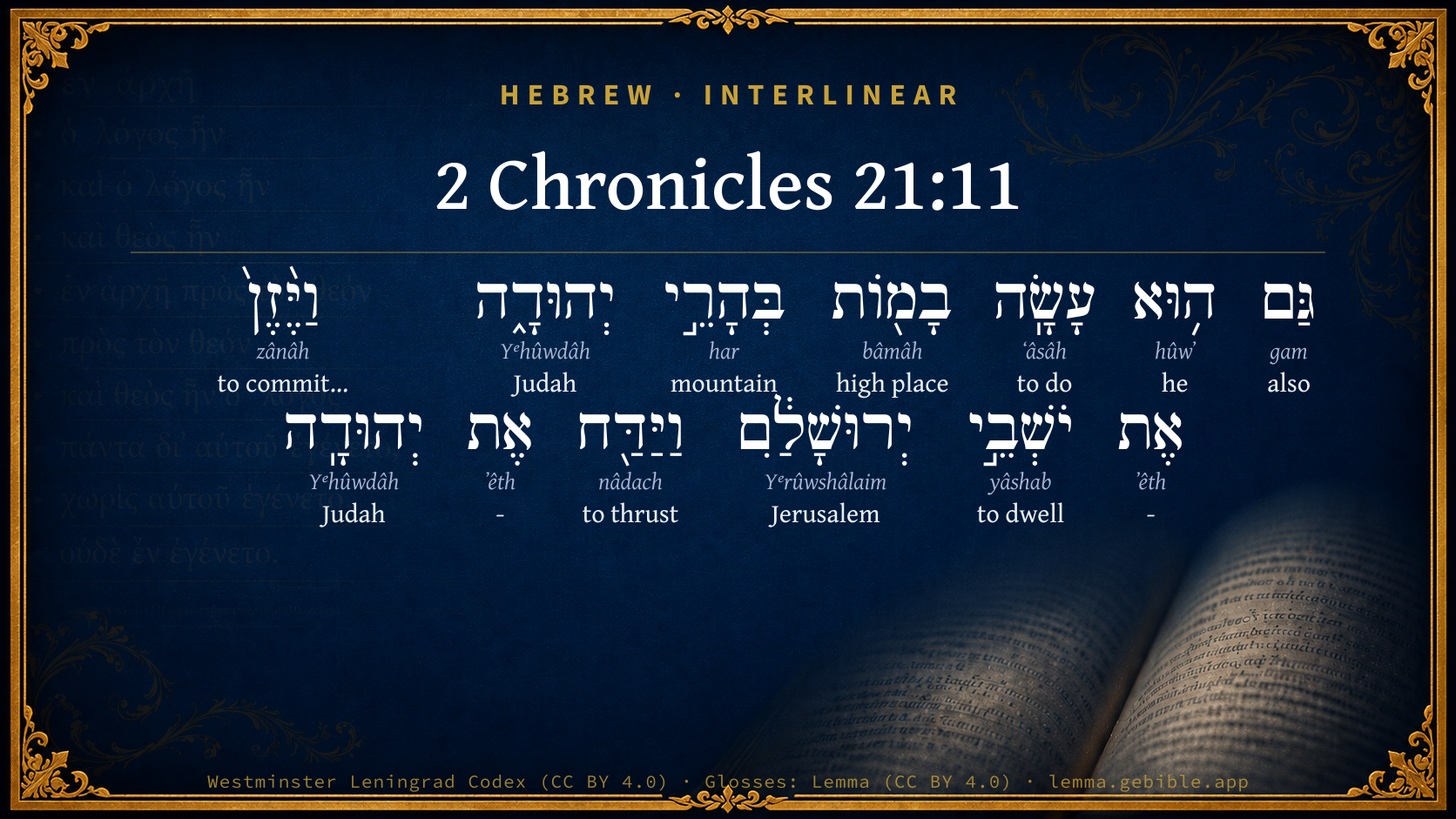
  1. גַּם gam H1571 “also” Particle, Accusative
  2. ה֥וּא hûwʼ H1931 “he” Pronoun, Personal, 3rd Person, Masculine, Singular
  3. עָשָֽׂה ʻâsâh H6213 “to do” Verb, Qal, Perfect, 3rd Person, Masculine, Singular
  4. בָמ֖וֹת bâmâh H1116 “high places” Noun, Common, Feminine, Plural, Absolute
  5. בְּהָרֵ֣י har H2022 “in/at · mountains of” Preposition + Noun, Common, Masculine, Plural, Construct
  6. יְהוּדָ֑ה Yᵉhûwdâh H3063 “Judah” Noun, Proper
  7. וַיֶּ֨זֶן֙ zânâh H2181 “and · to commit fornication” Conjunction + Verb, Hiphil, Sequential Imperfect, 3rd Person, Masculine, Singular
  8. אֶת ʼêth H853 “-” Particle, Direct Object
  9. יֹשְׁבֵ֣י yâshab H3427 “dwelling” Verb, Qal, Participle Active, Masculine, Plural, Construct
  10. יְרוּשָׁלִַ֔ם Yᵉrûwshâlaim H3389 “Jerusalem” Noun, Proper
  11. אֶת ʼêth H853 “-” Particle, Direct Object
  12. יְהוּדָֽה Yᵉhûwdâh H3063 “Judah” Noun, Proper

About this verse

These counts appear in no published source. They are computed here, from the morphology-tagged text and Lemma’s own curated glosses. What Lemma adds →

13
words
11
distinct lemmas
Historical
section

Shared distinctive vocabulary

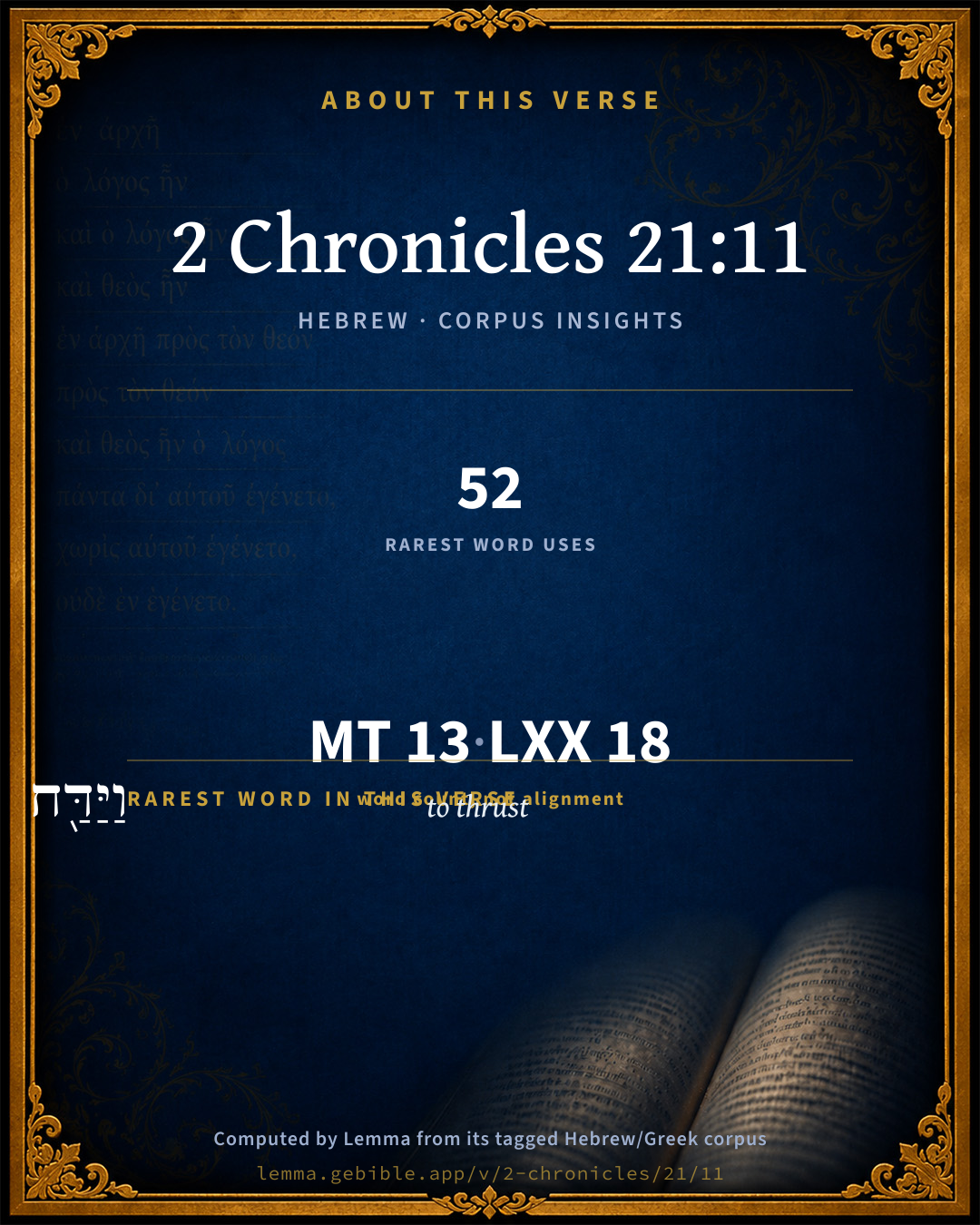
וַיַּדַּ֖ח to thrust H5080 occurs in 51 verses of the Hebrew Bible. Also found in:

Grammatical profile

  • 4 verbs
  • 5 nouns
  • 1 pronoun
  • 3 particles

Verb forms

  • עָשָֽׂה Qal · Perfect
  • וַיֶּ֨זֶן֙ Hiphil · Sequential Imperfect
  • יֹשְׁבֵ֣י Qal · Participle Active
  • וַיַּדַּ֖ח Hiphil · Sequential Imperfect

Repetition

A word recurs within this verse — often emphatic in Hebrew:

  • יְהוּדָ֑ה Judah H3063 ×2

Hebrew & Septuagint length

In English translation the verse runs 24 words from the Hebrew and 23 from the Septuagint (LXX English) — closely comparable.

A rough comparison of the two English renderings, which tokenize alike — not a word-level alignment.

Word counts can differ between the Hebrew and the Greek without any difference in meaning — e.g. the Hebrew direct-object marker אֵת has no separate Greek word, and Greek often adds the article ὁ.

In the original languages it is 13 Hebrew tokens and 18 Greek tokens — but the two are counted differently (Hebrew bundles its prefixes and suffixes into one token; the Greek is in lemma form), so that isn’t a like-for-like length.

Cross-references

20

Topical passages linked to 2 Chronicles 21:11 in the Treasury of Scripture Knowledge — connected by theme and wording, ordered by reader-vote popularity; previews shown in the World English Bible.

  • Leviticus 20:5 then I will set my face against that man, and against his family, and will cut him off, and all who play the prostitute after him, to play the prostitute with Molech, from among their people.
  • Leviticus 17:7 They shall no more sacrifice their sacrifices to the goat idols, after which they play the prostitute. This shall be a statute forever to them throughout their generations.'
  • 1 Kings 11:7 Then did Solomon build a high place for Chemosh the abomination of Moab, on the mountain that is before Jerusalem, and for Molech the abomination of the children of Ammon.
  • Deuteronomy 12:2–4 You shall surely destroy all the places in which the nations that you shall dispossess served their gods, on the high mountains, and on the hills, and under every green tree:
  • 1 Kings 14:9 but have done evil above all who were before you, and have gone and made you other gods, and molten images, to provoke me to anger, and have cast me behind your back:
  • 1 Kings 14:16 He will give Israel up because of the sins of Jeroboam, which he has sinned, and with which he has made Israel to sin.
  • 2 Kings 9:22 It happened, when Joram saw Jehu, that he said, Is it peace, Jehu? He answered, What peace, so long as the prostitution of your mother Jezebel and her witchcraft abound?
  • 2 Kings 21:11 Because Manasseh king of Judah has done these abominations, and has done wickedly above all that the Amorites did, who were before him, and has made Judah also to sin with his idols;
  • 2 Chronicles 21:13 but have walked in the way of the kings of Israel, and have made Judah and the inhabitants of Jerusalem to play the prostitute, like as the house of Ahab did, and also have slain your brothers of your father's house, who were better than yourself:
  • 2 Chronicles 33:9 Manasseh seduced Judah and the inhabitants of Jerusalem, so that they did evil more than did the nations whom Yahweh destroyed before the children of Israel.
  • Psalms 78:58 For they provoked him to anger with their high places, And moved him to jealousy with their engraved images.
  • Psalms 106:39 Thus were they defiled with their works, And prostituted themselves in their deeds.
  • Ezekiel 16:15–63 But you did trust in your beauty, and played the prostitute because of your renown, and poured out your prostitution on everyone who passed by; his it was.
  • Ezekiel 20:28 For when I had brought them into the land, which I swore to give to them, then they saw every high hill, and every thick tree, and they offered there their sacrifices, and there they presented the provocation of their offering; there also they made their sweet savor, and they poured out there their drink-offerings.
  • Daniel 3:5–6 that whenever you hear the sound of the horn, flute, zither, lyre, harp, pipe, and all kinds of music, you fall down and worship the golden image that Nebuchadnezzar the king has set up;
  • Daniel 3:15 Now if you are ready whenever you hear the sound of the horn, flute, zither, lyre, harp, pipe, and all kinds of music to you fall down and worship the image which I have made, [well]: but if you don't worship, you shall be cast the same hour into the midst of a burning fiery furnace; and who is that god that shall deliver you out of my hands?
  • Habakkuk 2:15 "Woe to him who gives his neighbor drink, pouring your inflaming wine until they are drunk, so that you may gaze at their naked bodies!
  • Revelation 2:20–22 But I have this against you, that you tolerate your woman, Jezebel, who calls herself a prophetess. She teaches and seduces my servants to commit sexual immorality, and to eat things sacrificed to idols.
  • Revelation 13:15–17 It was given to him to give breath to it, to the image of the beast, that the image of the beast should both speak, and cause as many as wouldn't worship the image of the beast to be killed.
  • Revelation 17:1–6 One of the seven angels who had the seven bowls came and spoke with me, saying, "Come here. I will show you the judgment of the great prostitute who sits on many waters,

Cross-references courtesy of OpenBible.info (CC BY 4.0).

Hebrew and Greek witnesses Masoretic Hebrew ↔ Greek Septuagint

The same verse in the two great witnesses to the Old Testament, shown verse-for-verse.

These are two independent witnesses, not word-aligned to each other, and the Septuagint is shown in lemma (dictionary) form.

Hebrew 2 Chronicles 21:11 Masoretic · Westminster Leningrad Codex

גַּם ה֥וּא עָשָֽׂה בָמ֖וֹת בְּהָרֵ֣י יְהוּדָ֑ה וַיֶּ֨זֶן֙ אֶת יֹשְׁבֵ֣י יְרוּשָׁלִַ֔ם וַיַּדַּ֖ח אֶת יְהוּדָֽה

Moreover he made high places in the mountains of Judah, and made the inhabitants of Jerusalem to play the prostitute, and led Judah astray.

World English Bible · Public Domain

Greek LXX 2 Chronicles 21:11 Septuagint · lemma form

καί γάρ αὐτός ποιέω ὑψηλός ἐν πόλις ἰουδά καί ἐκπορνεύω ὁ καταοἰκέω ἐν ἰερουσαλήμ καί ἀποπλανάω ὁ ἰούδας

For he built high places in the cities of Juda, and caused the dwellers in Jerusalem to go a-whoring, and led Juda astray.

LXX2012 (modern English Septuagint) · Public Domain

On this verse, Ellicott's Commentary for English Readers discusses the Septuagint’s reading. Read the note in Commentary ↓

Hebrew: Westminster Leningrad Codex (CC BY 4.0). Greek: Septuagint (public domain); English from LXX2012 (modern English Septuagint) (Public Domain). How the Septuagint differs from the Hebrew →

Commentary

Notes on 2 Chronicles 21:11 from classic Christian and Jewish commentators (each source and its license shown beneath its notes). The classic Christian expositions comment on the surrounding passage and are grouped to its opening verse, so a note may address several verses; the Jewish commentaries on the Tanakh (Rashi and others) are per-verse, so they appear only where the commentator wrote on this verse.

Lemma curates 59 commentaries, every one of them public domain or Creative Commons licensed, each selected and text-cleaned for this edition rather than reprinted as found. About our sources →

Trapp's Complete Commentary

John Trapp

2Ch 21:11 Moreover he made high places in the mountains of Judah, and caused the inhabitants of Jerusalem to commit fornication, and compelled Judah [thereto].

Ver. 11. Moreover he made high places.] {a} He restored what his father and grandfather had destroyed, Heroum filii noxae. The reason whereof some give is this, that God may show that good children are his gift alone. And again, good men are oft so intent upon the public affairs in state and church, that they neglect their private, and give not their children so good education as they should.

To commit fornication.] To worship Baal. See 2Ki 9:22. This was the worse, because in Jerusalem, the holy city; and because he caused them to do it, partly by his allurements, and partly by affrightments; as did Julian also the apostate, qui persuadendo persecutus est.

{a} Quasi bellum Deo indicens. - Lavat.

John Trapp, A Commentary or Exposition upon All the Books of the Old and New Testament (1647–1656) — public domain. Text from a community e-Sword module.

Albert Barnes' Notes on the Bible

See 2Ki 8:18. The writer of Kings only tells us in general terms that Jehoram “did evil in the sight of the Lord,” and “walked in the way of the house of Ahab.” Here, in 2Ch 21:11, 2Ch 21:13, we have particulars of his idolatry. Jehoram, it seems, seduced by the evil influence of his wife - Athaliah, the daughter of Ahab - permitted the introduction of Baal-worship, idolatrous altars in various high places, groves (Asherahs), images, and pillars; the people were not only allowed, but compelled to take part in the new rites. “To commit fornication” is a common metaphor, signifying idolatry or spiritual unfaithfulness (compare the 2Ki 9:22 note).

Albert Barnes' Notes on the Bible (1834–1885) — public domain. Text from a community e-Sword/MySword module.

Joseph Benson's Commentary

2Ch 21:11. He made high places — Not to the Lord, whose sworn enemy he was, but to Baals, or false gods. Caused the inhabitants of Jerusalem to commit fornication — Spiritual whoredom, or idolatry, seducing them to eat things sacrificed to idols, (Rev 2:20,) not only by his counsel and example, but, as it follows, by force, by threats, and penalties.

Joseph Benson's Commentary on the Old and New Testaments (1811–1818) — public domain. Text from a community e-Sword module.

Geneva Bible (1599)

Geneva Bible translators

Meaning, idolatry because that the idolater breaketh promise with God, as doth the adulteress to her husband.

Geneva Bible (1599) marginal notes — public domain. Text via Bolls.life.

Adam Clarke's Commentary

Verse 11. To commit fornication] That is, to serve idols. The Israelites were considered as joined to Jehovah as a woman is joined to her husband: when she associates with other men, this is adultery; when they served other gods, this was called by the same name, it was adultery against Jehovah. This is frequently the only meaning of the terms adultery and fornication in the Scriptures.

Adam Clarke's Commentary on the Bible (1810–1826) — public domain. Text from a community e-Sword/MySword module.

Ellicott's Commentary for English Readers

(11) Moreover he made.—There is a stress on the pronoun, “he made,” in contrast with Asa and Jehoshaphat, his worthier predecessors (2Ch_17:6). Or he himself, and not the people. LXX., καὶ γὰρ αὐτὸς ἐποίησεν. From this point to the end of the reign the narrative is peculiar to the chronicler.

High places.—For the worship of the foreign gods, as well as of the God of Israel.

Mountains.—Many Heb. MSS., LXX., and Vulg., “cities” (a similar word); Syriac, “Moreover he made high places in the mountain of Judah, and caused the Nazarites of Jerusalem to drink wine, and scattered those who were of the house of Judah.”

And caused the inhabitants of Jerusalem to commit fornication—i.e., the spiritual fornication of unfaithfulness to Jehovah, the only lawful spouse of Israel. (Comp. Hos_2:5; Hos_2:8; Hos_2:13; Hos_2:16-17; Hos_2:19 :1Ch_5:25.)

And compelled.—Or, seduced (Deu_13:6; Deu_13:11). LXX., ἀπεπλάνησε.

A Bible Commentary for English Readers, edited by Charles John Ellicott (1878–1897) — public domain. Text from a community e-Sword module.

The Cambridge Bible for Schools and Colleges

gen. ed. J. J. S. Perowne

11–15 (not in Kings). Jehoram’s Sins and Elijah’s written Denunciation

11. in the mountains] So Pesh., but ἐν πόλεσιν LXX. The difference between the two readings in Heb. is very small.

caused … to commit fornication] R.V. made … to go a whoring, i.e. led … into idolatry according to a much used metaphor of Scripture.

compelled Judah thereto] Lit., banished Judah, i.e. from the presence of Jehovah (a second metaphor meaning the same as the last, but on the negative side; “lead into idolatry” = “lead away from Jehovah”).

The Cambridge Bible for Schools and Colleges (gen. ed. J. J. S. Perowne; Cambridge University Press, 1878–1918) — public domain. Text from a community e-Sword module.

John Gill's Exposition

And hast walked in the way of the kings of Israel,.... Worshipping the calves, and even Baal, with other idols, as they did:

and hast made Judah and the inhabitants of Jerusalem to go a whoring, like to the whoredoms of the house of Ahab; meaning spiritual whoredoms or idolatries:

and hast also slain thy brethren of thy father's house, which were better than thyself; more religious, more humane, more prudent, and fitter for government.

John Gill's Exposition of the Whole Bible (1746–1763) — public domain (CC PDM 1.0). Text via the HelloAO Bible API.

Haydock's Catholic Bible Commentary

Fornication; idolatry. M. --- Heb. "and compelled Juda." Sept. "seduced." Syriac, "dissipated Juda." C. --- He used every art of seduction and violence to introduce idolatry, to the ruin of his kingdom. H.

George Leo Haydock (1774–1849), Haydock's Catholic Family Bible and Commentary, 1859 edition — public domain. Excludes Psalms (Douay-Rheims chapter numbering differs from Protestant) and Deuterocanonical books (Catholic canon only).

Matthew Poole's English Annotations

He made high places; not to the Lord, whose sworn enemy he was, but to Baals, or false gods.

Caused the inhabitants of Jerusalem to commit fornication; not only by his counsel and example, but, as it follows, by force, by threats and penalties.

Matthew Poole's English Annotations on the Holy Bible (1683–1685) — public domain. Text from a community e-Sword/MySword module.

Whedon's Commentary on the Bible

Daniel D. Whedon

11. He made high places in the mountains — Thus undoing, or setting at naught, the labours of his pious father, who had exerted himself with marked though not complete success, (compare 2Ch_17:6; 2Ch_20:33,) to take away this stone of stumbling from Israel.

Caused… Jerusalem to commit fornication — A common scriptural metaphor for idolatry.

Compelled Judah — In thus using violence to seduce the people to idolatry, Jehoram was probably influenced by his wife, Athaliah, who would fain have introduced a foreign idolatry into the kingdom of Judah as her mother Jezebel had done into the kingdom of Israel.

Daniel D. Whedon (gen. ed.), Commentary on the Old and New Testaments (1874–1909) — public domain. Text from a community e-Sword module.

The Pulpit Commentary

Caused to commit fornication. Perhaps the meaning is exclusively here the infidelity of idolatry, but at any rate it includes this.

The Pulpit Commentary (1880–1919), ed. H.D.M. Spence-Jones & Joseph S. Exell — public domain. Text from a community e-Sword module.

John Wesley's Explanatory Notes

High places - Not to the Lord, but to Baals or false gods. And caused - Not only by his counsel and example, but by force, by threats, and penalties.

John Wesley, Explanatory Notes Upon the Whole Bible (1754–1765) — public domain. Text via the GEBible commentary corpus.

unfoldingWord translationNotes

Door43 World Missions Community

Jehoram had also built high places

Other people helped Jehoram build these high places all over the mountains of Judah. AT: "Jehoram and the people had also built high places" (See: Synecdoche)

he made the inhabitants of Jerusalem to live like prostitutes

Jehoram caused the people to serve idols instead of Yahweh. People who serve other gods in order to receive something from them are spoken of as spiritual prostitutes. AT: "he caused the people of Jerusalem to leave Yahweh and serve other gods, as prostitutes serve men who are not their husbands" (See: Metaphor)

he led Judah astray

Not following Yahweh is spoken of as not following the correct path. AT: "he caused Judah to no longer follow Yahweh" (See: Metaphor)

translationWords

high place

prostitute

unfoldingWord translationNotes — © Distant Shores Media and the Door43 World Missions Community, licensed CC BY-SA 4.0. Source: git.door43.org/Door43/en_tn.

Rashi

Rabbi Shlomo Yitzchaki (Rashi)

and led the inhabitants of Jerusalem astray - Heb. זְנוּת. It is appropriate to use the term harlotry in connection with anyone who forsakes and exchanges the fear of the Holy One, blessed be He, for the idolatry of star and planet worship - for such a person behaves in the manner of a promiscuous woman who commits adultery with others, and similar to this are (Deut. 31:16): “and this people will rise and go astray (וְזָנָה) after the foreign gods of the land”; (Hos. 1:2): “for the land will go astray (זָנה תִזְנֶה), etc.”

Rashi on the Tanakh — English translations: “The Judaica Press complete Tanach with Rashi, translated by A. J. Rosenberg” (CC BY 4.0); “Pentateuch with Rashi's commentary by M. Rosenbaum and A.M. Silbermann, 1929-1934” (public domain); “The Metsudah Tanach series, Lakewood, N.J” (CC BY 4.0); and “The Book of Joshua, Metsudah Publications, 1997” (CC BY 4.0). Text via Sefaria.

Lesson kit

Teaching starters — assembled from the data on this page, not authored interpretation. Every prompt links to the verse data it draws on. Edit before teaching.

2 Chronicles, in the Historical, opens this verse with 13 words (11 distinct Hebrew lemmas). Its most distinctive word is nâdach (“to thrust”). A historical commentator’s framing appears above. Read the whole chapter for the surrounding context.

Discussion questions

  1. How does “to thrust” (nâdach) shape what this verse is saying?
  2. How does Deuteronomy 4:19, which shares the word «to thrust», read alongside this verse?
  3. What does the repetition of “Judah” (2× in this one verse) do in this verse?
  4. The translations on this page render this verse differently — a whole-verse word diff, not a word-by-word alignment. What might account for the different wordings?
  5. «עָשָֽׂה» is a Qal Perfect verb. How does that grammatical form shape the action described?
  6. Compare how Trapp's Complete Commentary and Albert Barnes' Notes on the Bible read this verse. Where do they agree or differ?

Things to notice

Reading settings

Reading text

Shown beneath each verse's original-language words.

Old Testament
Old Testament edition

Read the OT as the Masoretic Hebrew (MT) or the Greek Septuagint (LXX).

English shown for the Greek Septuagint (in the Hebrew ↔ Greek comparison).

Comparing translations? Open the Compare panel on any verse page to stack up to four side by side.