Ezekiel 36:2

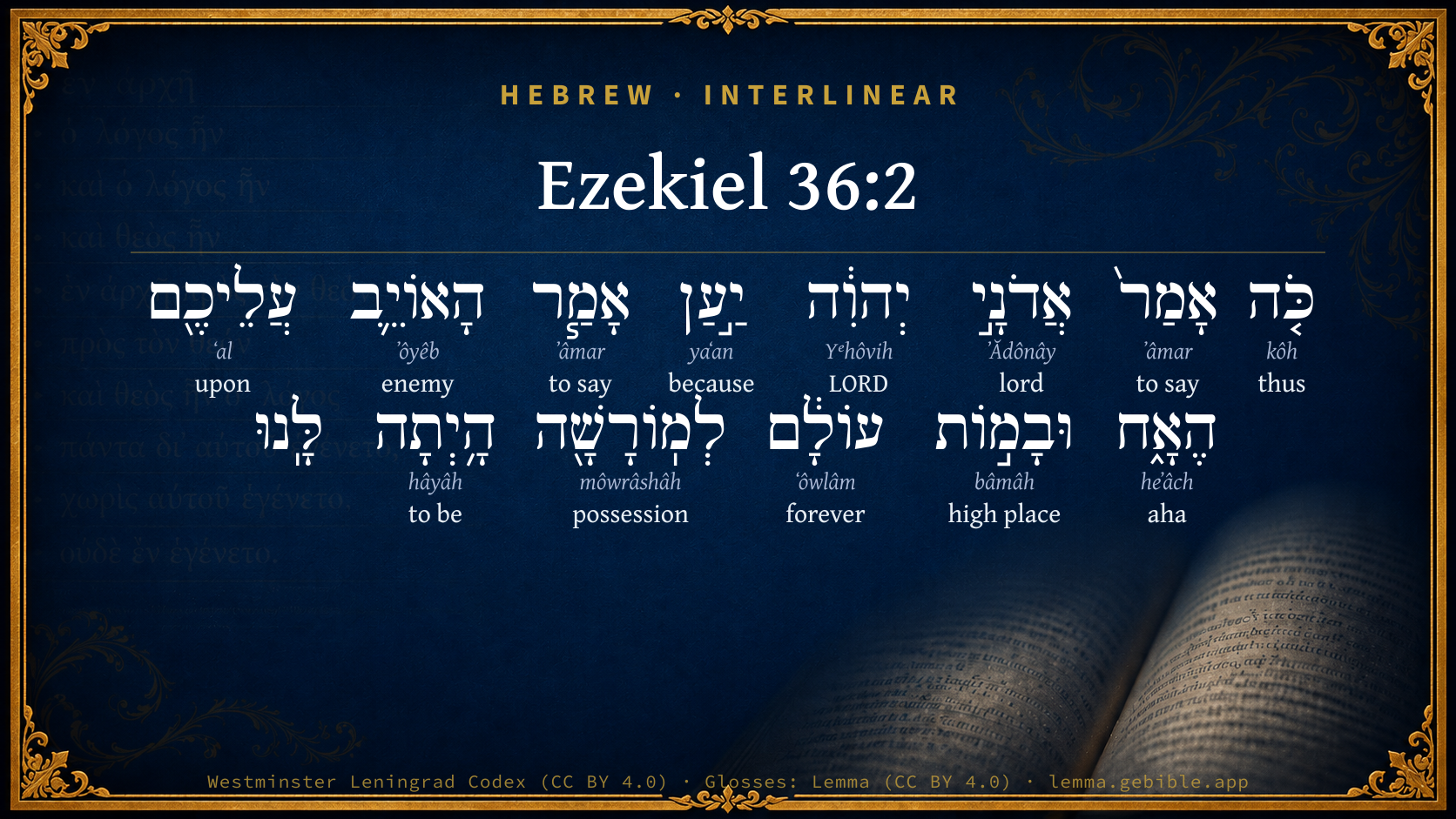
Hebrew (Westminster Leningrad Codex) Ezekiel 36:2 appears in the Hebrew Old Testament. The text above is from the Westminster Leningrad Codex. Each word links to its Strong’s number, a concise gloss, and parsing drawn from the Open Scriptures Hebrew Bible morphology. Click any word for its full Brown-Driver-Briggs (BDB) entry.
Download image
Cite this verse

Ezekiel 36:2 (World English Bible). Public Domain. Lemma interlinear Bible study tool, https://lemma.gebible.app/v/ezekiel/36/2.

Show BibTeX & RIS
BibTeX
RIS
English Translation
Thus says the Lord Yahweh: Because the enemy has said against you, Aha! and, The ancient high places are ours in possession;
World English Bible · Public Domain
Download a study sheet

One document with this verse’s original text, its word-by-word gloss line, the meaning frame, cross-references with their text, attributed commentary, and full source and license credits — printable, and it pastes into notes with its structure intact.

This verse Autodidact and up

Study sheet (.html) Plain text (.txt)

A passage Seminary Student

Up to 50 verses in one chapter. A passage sheet keeps up to 6 commentary sources and 12 cross-references per verse, in the order this page ranks them, and says so on the sheet whenever that leaves anything out. Ask for a single verse and you get the Autodidact verse sheet above.

Everything on this page stays free to read, with no account — the sheet is a download of what is already on screen, not access to it.

Want to remove ads? Support Godless Engineer
Compare translations 3

The same verse in 3 English versions, stacked beneath the original-language interlinear above. Click any original word for its lexicon entry.

Each is an independent rendering of the whole verse — the interlinear is not word-aligned to these translations.

Highlighted words mark where these versions differ — a whole-verse word diff, not a word-by-word alignment.

  • World English Bible Public Domain
    Thus says the Lord Yahweh: Because the enemy has said against you, Aha! and, The ancient high places are ours in possession;
  • King James Version Public Domain
    Thus saith the Lord GOD; Because the enemy hath said against you, Aha, even the ancient high places are ours in possession:
  • unfoldingWord Literal Text CC BY-SA 4.0
    The Lord Yahweh says this: The enemy has said about you, “Aha!” and “The ancient high places have become our possession.”’

unfoldingWord Literal Text — © unfoldingWord, licensed CC BY-SA 4.0. Word-aligned USFM3 via Door43 (git.door43.org/unfoldingWord/en_ult).

Versions to compare (up to 4)

3 of 4 selected

Show all 18 translations

Every available English version of this verse, each an independent rendering of the whole verse.

  • World English Bible Public Domain
    Thus says the Lord Yahweh: Because the enemy has said against you, Aha! and, The ancient high places are ours in possession;
  • Berean Standard Bible Public Domain
    This is what the Lord GOD says: Because the enemy has said of you, ‘Aha! The ancient heights have become our possession,’
  • Majority Standard Bible Public Domain
    This is what the Lord GOD says: Because the enemy has said of you, ‘Aha! The ancient heights have become our possession,’
  • King James Version Public Domain
    Thus saith the Lord GOD; Because the enemy hath said against you, Aha, even the ancient high places are ours in possession:
  • American Standard Version (1901) Public Domain
    Thus saith the Lord Jehovah: Because the enemy hath said against you, Aha! and, The ancient high places are ours in possession;
  • Revised Version (1885) Public Domain
    Thus saith the Lord GOD: Because the enemy hath said against you, Aha! and, The ancient high places are ours in possession:
  • Geneva Bible (1599) Public Domain
    Thus saith the Lord God, because the enemie hath sayde against you, Aha, euen the hye places of the world are ours in possession,
  • Douay-Rheims (1899) Public Domain
    Thus saith the Lord God: Because the enemy hath said of you: Aha, the everlasting heights are given to us for an inheritance.
  • Young's Literal Translation Public Domain
    Thus said the Lord Jehovah: Because the enemy said against you, Aha, and the high places of old for a possession have been to us,
  • Literal Standard Version CC BY-SA 4.0
    Thus said Lord YHWH: Because the enemy said against you, Aha! The high places of old have also become our possession,
  • Unlocked Literal Bible CC BY-SA 4.0
    The Lord Yahweh says this: The enemy has said about you, “Aha!” and “The ancient high places have become our possession.”'
  • unfoldingWord Literal Text CC BY-SA 4.0
    The Lord Yahweh says this: The enemy has said about you, “Aha!” and “The ancient high places have become our possession.”’
  • Darby Bible Public Domain
    Thus saith the Lord Jehovah: Because the enemy hath said against you, Aha! and, The ancient high places are become ours in possession;
  • World Messianic Bible Public Domain
    The Lord GOD says: ‘Because the enemy has said against you, “Aha!” and, “The ancient high places are ours in possession!”’
  • Webster's Bible Public Domain
    Thus saith the Lord GOD; Because the enemy had said against you, Aha, even the ancient high places are ours in possession:
  • Free Bible Version CC BY-SA 4.0
    This is what the Lord God says: The enemy said about you, ‘Aha! These old high places now belong to us,’
  • Bible in Basic English Public Domain
    This is what the Lord has said: Because your hater has said against you, Aha! and, The old waste places are our heritage, we have taken them:
  • JPS Tanakh (1917) Public Domain
    Thus saith the Lord GOD: Because the enemy hath said against you: Aha! even the ancient high places are ours in possession;

Literal Standard Version (2020), Covenant Press — licensed CC BY-SA 4.0. Text via the HelloAO Bible API (eBible.org). Unlocked Literal Bible (unfoldingWord) — licensed CC BY-SA 4.0. Text via the HelloAO Bible API (eBible.org). unfoldingWord Literal Text — © unfoldingWord, licensed CC BY-SA 4.0. Word-aligned USFM3 via Door43 (git.door43.org/unfoldingWord/en_ult). Free Bible Version, Dr. Jonathan Gallagher — licensed CC BY-SA 4.0. Text via the HelloAO Bible API (eBible.org).

Word by word

More ways to search: Search by grammar → Find every occurrence → Compare this word →

Practice this passage: Drill this verse → Learn its vocabulary →

לְמֽוֹרָשָׁ֖ה
môwrâshâh
H4181
“to/for · possession”
Preposition + Noun, Common, Feminine, Singular, Absolute
Part of Speech
Preposition + Noun
Type
Common
Gender
Feminine
Number
Singular
State
Absolute
Full BDB Definition

Origin: from H4180

TWOT: 920e

a possession
  1. כֹּ֤ה kôh H3541 “thus” Adverb
  2. אָמַר֙ ʼâmar H559 “to say” Verb, Qal, Perfect, 3rd Person, Masculine, Singular
  3. אֲדֹנָ֣י ʼĂdônây H136 “Lord · my” Noun, Common, Masculine, Plural, Construct + Suffix, Personal, 1st Person, Common, Singular
  4. יְהוִ֔ה Yᵉhôvih H3069 “LORD” Noun, Proper
  5. יַ֣עַן yaʻan H3282 “because” Conjunction
  6. אָמַ֧ר ʼâmar H559 “to say” Verb, Qal, Perfect, 3rd Person, Masculine, Singular
  7. הָאוֹיֵ֛ב ʼôyêb H341 “the · enemy” Particle, Definite Article + Verb, Qal, Participle Active, Masculine, Singular, Absolute
  8. עֲלֵיכֶ֖ם ʻal H5921 “upon · you” Preposition + Suffix, Personal, 2nd Person, Masculine, Plural
  9. הֶאָ֑ח heʼâch H1889 “aha” Particle, Interjection
  10. וּבָמ֣וֹת bâmâh H1116 “and · high places of” Conjunction + Noun, Common, Feminine, Plural, Construct
  11. עוֹלָ֔ם ʻôwlâm H5769 “forever” Noun, Common, Masculine, Singular, Absolute
  12. הָ֥יְתָה hâyâh H1961 “to be” Verb, Qal, Perfect, 3rd Person, Feminine, Singular

About this verse

These counts appear in no published source. They are computed here, from the morphology-tagged text and Lemma’s own curated glosses. What Lemma adds →

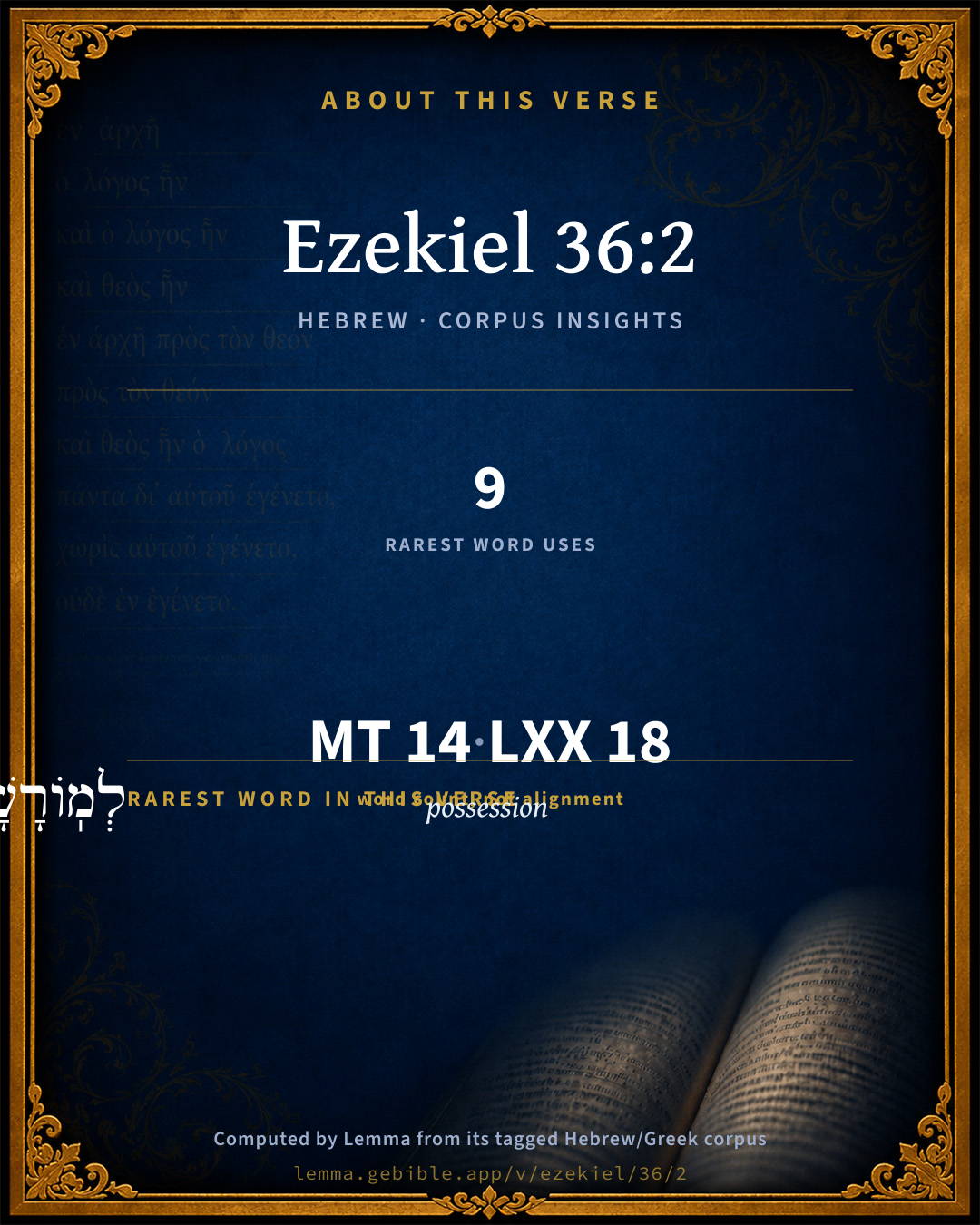
14
words
12
distinct lemmas
Prophets
section

Notable vocabulary

The rarest word here is לְמֽוֹרָשָׁ֖ה possession H4181 — appearing just 9 times in the whole Hebrew Bible.

Shared distinctive vocabulary

לְמֽוֹרָשָׁ֖ה possession H4181 occurs in 9 verses of the Hebrew Bible. Also found in:

Grammatical profile

  • 4 verbs
  • 5 nouns
  • 2 prepositions
  • 1 conjunction
  • 1 adverb
  • 1 particle

Verb forms

  • אָמַר֙ Qal · Perfect
  • אָמַ֧ר Qal · Perfect
  • הָאוֹיֵ֛ב Qal · Participle Active
  • הָ֥יְתָה Qal · Perfect

Repetition

A word recurs within this verse — often emphatic in Hebrew:

  • אָמַר֙ to say H559 ×2

Hebrew & Septuagint length

In English translation the verse runs 22 words from the Hebrew and 23 from the Septuagint (LXX English) — closely comparable.

A rough comparison of the two English renderings, which tokenize alike — not a word-level alignment.

Word counts can differ between the Hebrew and the Greek without any difference in meaning — e.g. the Hebrew direct-object marker אֵת has no separate Greek word, and Greek often adds the article ὁ.

In the original languages it is 14 Hebrew tokens and 18 Greek tokens — but the two are counted differently (Hebrew bundles its prefixes and suffixes into one token; the Greek is in lemma form), so that isn’t a like-for-like length.

Cross-references

9

Topical passages linked to Ezekiel 36:2 in the Treasury of Scripture Knowledge — connected by theme and wording, ordered by reader-vote popularity; previews shown in the World English Bible.

  • Deuteronomy 32:13 He made him ride on the high places of the earth, He ate the increase of the field; He made him to suck honey out of the rock, Oil out of the flinty rock;
  • Ezekiel 25:3 and tell the children of Ammon, Hear the word of the Lord Yahweh: Thus says the Lord Yahweh, Because you said, Aha, against my sanctuary, when it was profaned; and against the land of Israel, when it was made desolate; and against the house of Judah, when they went into captivity:
  • Ezekiel 35:10 Because you have said, These two nations and these two countries shall be mine, and we will possess it; whereas Yahweh was there:
  • Psalms 78:69 He built his sanctuary like the heights, Like the earth which he has established forever.
  • Isaiah 58:14 then shall you delight yourself in Yahweh; and I will make you to ride on the high places of the earth; and I will feed you with the heritage of Jacob your father: for the mouth of Yahweh has spoken it.
  • Jeremiah 49:1 Of the children of Ammon. Thus says Yahweh: Has Israel no sons? has he no heir? why then does Malcam possess Gad, and his people well in the cities of it?
  • Ezekiel 26:2 Son of man, because Tyre has said against Jerusalem, Aha, she is broken: the gate of the peoples; she is turned to me; I shall be replenished, now that she is laid waste:
  • Habakkuk 3:19 Yahweh, the Lord, is my strength. He makes my feet like deer's feet, And enables me to go in high places. For the music director, on my stringed instruments.
  • Ezekiel 36:5 therefore thus says the Lord Yahweh: Surely in the fire of my jealousy have I spoken against the residue of the nations, and against all Edom, that have appointed my land to themselves for a possession with the joy of all their heart, with despite of soul, to cast it out for a prey.

Cross-references courtesy of OpenBible.info (CC BY 4.0).

Hebrew and Greek witnesses Masoretic Hebrew ↔ Greek Septuagint

The same verse in the two great witnesses to the Old Testament, shown verse-for-verse.

These are two independent witnesses, not word-aligned to each other, and the Septuagint is shown in lemma (dictionary) form.

Hebrew Ezekiel 36:2 Masoretic · Westminster Leningrad Codex

כֹּ֤ה אָמַר֙ אֲדֹנָ֣י יְהוִ֔ה יַ֣עַן אָמַ֧ר הָאוֹיֵ֛ב עֲלֵיכֶ֖ם הֶאָ֑ח וּבָמ֣וֹת עוֹלָ֔ם לְמֽוֹרָשָׁ֖ה הָ֥יְתָה לָּֽנוּ

Thus says the Lord Yahweh: Because the enemy has said against you, Aha! and, The ancient high places are ours in possession;

World English Bible · Public Domain

Greek LXX Ezekiel 36:2 Septuagint · lemma form

ὅδε λέγω κύριος κύριος ἀντί ὅς εἶπον ὁ ἐχθρός ἐπί σύ εὖγε ἔρημος αἰώνιος εἰς κατάσχεσις ἐγώ γίγνομαι

Thus says the Lord God; Because the enemy has said against you, Aha, the old waste places are become a possession for us:

LXX2012 (modern English Septuagint) · Public Domain

On this verse, The Cambridge Bible for Schools and Colleges discusses the Septuagint’s reading. Read the note in Commentary ↓

Hebrew: Westminster Leningrad Codex (CC BY 4.0). Greek: Septuagint (public domain); English from LXX2012 (modern English Septuagint) (Public Domain). How the Septuagint differs from the Hebrew →

Targum (Aramaic paraphrase)

1

The Targum is the ancient Jewish Aramaic paraphrase of the Hebrew Scriptures — an interpretive translation, not the Hebrew text itself. Onkelos (literal) and Pseudo-Jonathan (expansive) render the Torah, and Jonathan the Prophets. Coverage is partial: where no permissively-licensed English translation exists for a verse, only the Aramaic is shown. This is verse-level text, not a word-by-word alignment to the Hebrew.

  1. Targum Jonathan Prophets (Joshua–Malachi)
    כִּדְנַן אֲמַר יְיָ אֱלֹהִים חֲלַף דִי אֲמַר סַנְאָה אֲלֵיכוֹן חֶדְוָא וּבָמַת עֲלָם לִירוּתָא הֲוַת לָנָא:

    (no public-domain English translation for this verse)

    Targum Jonathan — Aramaic: “Mikraot Gedolot” (public domain). English: “Sefaria Community Translation” (CC0 1.0 (public-domain dedication)); “London "Chaldee Paraphrase," 1871” (public domain). Text via Sefaria.

Commentary

Notes on Ezekiel 36:2 from classic Christian and Jewish commentators (each source and its license shown beneath its notes). The classic Christian expositions comment on the surrounding passage and are grouped to its opening verse, so a note may address several verses; the Jewish commentaries on the Tanakh (Rashi and others) are per-verse, so they appear only where the commentator wrote on this verse.

Lemma curates 59 commentaries, every one of them public domain or Creative Commons licensed, each selected and text-cleaned for this edition rather than reprinted as found. About our sources →

Trapp's Complete Commentary

John Trapp

Eze 36:2 Thus saith the Lord GOD; Because the enemy hath said against you, Aha, even the ancient high places are ours in possession:

Ver. 2. Because the enemy hath said.] The Church fareth the better for her enemies petulancies and insolencies against her.

Even the ancient high places.] Or, The everlasting altitudes. Judea lay high; the Church is much higher.

Are ours in possession.] Thus the Edomites triumphed before the victory. So did the Spaniards in 1588, and God heard them, {as Eze 35:13} for he is all-ear, all-eye, &c. He is jealous for his people, {Zec 1:14} and jealousy is quick sighted, quick conceited.

John Trapp, A Commentary or Exposition upon All the Books of the Old and New Testament (1647–1656) — public domain. Text from a community e-Sword module.

Joseph Benson's Commentary

Eze 36:2-7. Because the enemy hath said, &c. — This prophecy appears to be a continuation of the preceding. “The Idumeans have made their boasts (see Eze 36:5, and Eze 35:10) that they should become masters of the mountainous parts of Judea, where the ancient fortresses were placed which commanded all the rest of the country.” — Lowth. And ye are taken up in the lips of talkers, &c. — Your calamities have made you become a proverb, a by-word, and a reproach among the heathen round about you, according to the threatenings of the prophets denounced against you: see the margin. Thus saith the Lord to the mountains, &c., which became a prey to the residue of the heathen — To those heathen that were left after the general desolations threatened to the neighbouring countries, Moab, Edom, Ammon, &c. Surely in the fire of my jealousy — In that fervent zeal and concern that I have for my own honour, which is blasphemed among the heathen; have I spoken against the residue of the heathen — Against all the nations that are and have been enemies to Israel; against all Idumea, which have appointed my land into their possession — Who have fully expected to get the dominion of my land, and be the sole possessors of it. Because ye have borne the shame of the heathen — Because the heathen nations have made a scoff of you; therefore I have lifted up my hand — I have sworn, or absolutely determined: see Gen 14:22. Surely the heathen that are about you shall bear their shame — The heathen nations around, that have made a mock of you, shall be mocked themselves, and be as much held in contempt as they have held you.

Joseph Benson's Commentary on the Old and New Testaments (1811–1818) — public domain. Text from a community e-Sword module.

Tyndale Open Study Notes

Tyndale Open Resources

36:2 The ancient heights of Israel could not be stolen by their enemies because the Lord had given them to his people.

Tyndale Open Study Notes — © Tyndale Open Resources, licensed CC BY-SA 4.0. Text via the HelloAO Bible API.

Geneva Bible (1599)

Geneva Bible translators

That is, the Edomite.

That is, Jerusalem, which for God’s promises was the chiefest of all the world.

Geneva Bible (1599) marginal notes — public domain. Text via Bolls.life.

Adam Clarke's Commentary

Verse 2. Because the enemy hath said] The Idumeans thought they would shortly be put in possession of all the strong places of Israel; the ancient high places shall be ours.

Adam Clarke's Commentary on the Bible (1810–1826) — public domain. Text from a community e-Sword/MySword module.

Ellicott's Commentary for English Readers

(2) The ancient high places.—This is very nearly the same expression as in Gen_49:26; Deu_33:15, where it is translated “everlasting (or lasting) hills,” and is probably an allusion to those passages. “The enemy” is a general term, which may refer to Edom; but from the following verses it is more likely that it is used for the heathen at large. When Israel’s land had been left desolate, the surrounding nations claimed that God’s promise to His people had failed, and that they themselves might now enter upon its secure possession.

A Bible Commentary for English Readers, edited by Charles John Ellicott (1878–1897) — public domain. Text from a community e-Sword module.

The Cambridge Bible for Schools and Colleges

gen. ed. J. J. S. Perowne

2. Cf. Eze_25:3, Eze_26:2.

ancient high places] “High places” is not used here in the usual religious sense of rural sanctuaries, but said of the mountain—land of Israel, cf. Deu_32:13; Mic_3:12. On ancient or “eternal” as an epithet of mountains cf. Gen_49:26; Deu_33:15; Psa_24:7. For “high places” LXX. reads “wastes,” cf. perpetual desolations, Eze_35:9.

The Cambridge Bible for Schools and Colleges (gen. ed. J. J. S. Perowne; Cambridge University Press, 1878–1918) — public domain. Text from a community e-Sword module.

John Gill's Exposition

Thus saith the Lord God,.... By the mouth of the prophet, who was bid to prophesy:

because the enemy had said against you, aha: rejoicing at the calamity of God's people, particularly the Edomites or Idumeans, as in the preceding chapter; and who are chiefly meant; and also the Ammonites and Tyrians, Eze 25:3,

even the ancient high places are ours in possession; or, "the high places of the world shall be unto us for a possession" (f); the land of Israel, according to Kimchi and others, was the highest part of the world, Jerusalem the highest part of that land, and the temple was built on the highest part of the city; and all these the Edomites claimed as their own, the land, city, and temple, and thought themselves sure of the same, as if they had them in actual possession; even the hilly part of the country, which had been so from the creation, and where stood many of the fortified and frontier towns and cities; which as strong as they were, or had been, they fancied would easily fall into their hands, now such desolations were made in the land.

(f) "excelsa seculi haereditario jure futura sunt nobis", Junius & Tremellius, Polanus; "celsa seculi haereditas evenit nobis", Cocceius, Starckius.

John Gill's Exposition of the Whole Bible (1746–1763) — public domain (CC PDM 1.0). Text via the HelloAO Bible API.

Haydock's Catholic Bible Commentary

Heights. Septuagint, "deserts." The mountains are often styled eternal, as being the best symbols of durability, Deuteronomy xxxiii. 15.

George Leo Haydock (1774–1849), Haydock's Catholic Family Bible and Commentary, 1859 edition — public domain. Excludes Psalms (Douay-Rheims chapter numbering differs from Protestant) and Deuterocanonical books (Catholic canon only).

Matthew Poole's English Annotations

Many were the enemies of God’s people, but they so conspired in one design, with one consent, and were so one in their humours, and enmity, and carriage, that the prophet speaks of them as one, and particularly of Edom.

Aha; rejoicingly and with insulting pride, as Ammon did, Eze 25:3, and Tyre did, Eze 26:2, which see.

The ancient high places; the everlasting hills; but this is common with other hills, whose foundations, as these of Israel, are from the beginning, and shall be to the end. What they aim at is a deriding of Israel, who by promise from God claimed these mountains as a perpetual inheritance, but were now cast out of it, and they hereby tax the God of Israel as not keeping his promise. So they blaspheme God and insult over his people.

Ours; our right, as of the elder house, now conquerors and feudatories to him that hath subdued them; thus they pretend right to justify their injustice.

In possession; we are now where we should have been these one thousand one hundred and sixty years or more, where we thought we would be one time or other, in spite of them and all their boasts of their God; we are where we will keep, and none shall put us out. Such impious brags were their ruin, and are implied in the words.

Matthew Poole's English Annotations on the Holy Bible (1683–1685) — public domain. Text from a community e-Sword/MySword module.

Whedon's Commentary on the Bible

Daniel D. Whedon

2. Aha, even the ancient high places — “Aha! and, The” (R.V.). Compare Eze_25:3; Eze_26:2; Eze_35:10. The “high places” and “lasting hills” (Deu_32:13; Deu_33:15) stood for the most sacred and best protected parts of the land.

Daniel D. Whedon (gen. ed.), Commentary on the Old and New Testaments (1874–1909) — public domain. Text from a community e-Sword module.

The Pulpit Commentary

Because the enemy hath said against you. The ground of Jehovah"s purposed proceeding against Edom and the surrounding heathen peoples (vers. 3, 5) is expressly declared to be the jubilation over the downfall of Israel, and the eagerness with which they sought to appropriate to themselves her forsaken land. Aha! Exulting over Israel"s misfortune. (Eze_25:3; Psa_40:16) The ancient high places, which Israel"s enemies fancied had become theirs in possession, were probably "the everlasting hills" of Gen_49:26 and Deu_33:15, the principal mountains of Palestine, which, as Havernick finely observes, were "the honorable witnesses and indestructible monuments of that ancient blessing spoken by Israel"s ancestor, and still resting on the people;" and to assail which was, in consequence, not only to sin against Jehovah, but to attempt an enterprise foredoomed to failure and shame. At the same time, Plumptre"s suggestion ("Ezekiel: an Ideal Biography," Expositor, vol. 8:284; and Unpublished Notes) is not without plausibility, that, considering the special significance of the term bamoth in Ezekiel, the phrase should be held as referring to the sanctuaries which stood upon those heights including, of course, the chief sanctuary, or temple (Schroder); in support of which the dean cites the frequency with which the enemies of Israel, as, for instance, the Assyrians and the Moabites, in their inscriptions, boasted that they had captured these sanctuaries (see "Records of the Past," 2nd series, tel. 1. p. 107; 2:203).

HOMILETICS.

Premature triumph.

The enemies of Israel were triumphing over the fallen nation, but prematurely; for they did not reckon on a possibility of a restoration. This is like the triumph of evil over the ruined world.

I THERE IS A TRIUMPH OF EVIL.

1. In the fall of man. When Adam fell it seemed as though the greatest work of God had been hopelessly ruined almost as soon as it appeared. No sooner was man made in the image of God than he groveled in the dust, and marred the heavenly likeness with ugly stains of sins.

2. In the history of primitive man. So evil is man that the whole race, with the exception of a single family, is swept off the face of the earth. Once more the world is reduced to a desolate condition, once more evil seems to have conquered.

3. In the troubles of the Hebrews. The people of God become oppressed slaves in Egypt. "Where is the promise delivered to the fathers?

4. In the failure to enter Palestine. The Israelites reach the borders of the land, and are then driven back defeated, and compelled to wander in the wilderness for forty years.

5. In the miserable days of the judges. When the land was at length possessed, it was not found to be all milk and honey. War and wickedness, sorrow and shame, make the first ages of the possession of Canaan almost the darkest period in Jewish history.

6. The wickedness of later days. The story of Israel is a story of repeated rebellions against God, and repeated Divine chastisements.

7. In the Captivity. When the two nations were driven into captivity, and their territory devastated by the heathen, the triumph of the enemies of the people of God seemed to be complete.

8. In the cruelty of later days. Eastern empires, the Seleucidae, and the Romans successively triumphed over and oppressed the once favored people.

9. In the cross of Christ. Here, indeed, the enemies of righteousness reach their crowning triumph. Satan now exults over the sorrow and death of the Son of man.

10. In the history of Christendom. This has not been a history of continuous growth and victory over evil. First there were the great persecutions. Then followed the great apostasy. The dark ages marked the triumph of ignorance and cruelty. Today the powers of evil are mighty and exultant.

II THIS TRIUMPH WILL BE REVERSED. It is premature. We have not yet reached the end of the story. The battle is still raging; it is too early for the foe to sing his paeans of victory. All along the dark recital of victories of evil there has been the alternative picture of Divine deliverance. We make a mistake when we dwell only on the gloomy side of history. God has been revealing himself in history. Not only did he save the eight in the ark. He delivered all Israel from Egypt. He gave Canaan, and he gave restoration from the Captivity. He sent his Son to save the world. In the darkest hour when Christ hung dying on the cross while evil seemed to be most triumphant, victory was really being won by that very death of the world"s Savior. We have not seen the end yet. Perhaps we are on the fringe of a great contest between the servants of Christ and his foes. But never was the work of Christ more manifest than it is today in Christian activity at home and in the harvest of the mission-field abroad. While the unbeliever exults in what he thinks is the demonstration of the falsehood of Christianity and the sure prospect of its speedy downfall, there are more earnest active Christians at work than ever there were. By the grace of God we may trust that, though the battle is still fierce, we are moving on to victory under the Captain of our salvation.

The Pulpit Commentary (1880–1919), ed. H.D.M. Spence-Jones & Joseph S. Exell — public domain. Text from a community e-Sword module.

John Wesley's Explanatory Notes

Because the enemy - Many were the enemies of God's people; but they so conspired in one design, that the prophet speaks of them as one, and particularly of Edom.

John Wesley, Explanatory Notes Upon the Whole Bible (1754–1765) — public domain. Text via the GEBible commentary corpus.

Rashi

Rabbi Shlomo Yitzchaki (Rashi)

“Aha!” [An expression of] joy.

and “the high places of the world” the land of Israel, which is the height and the beauty of the world.

Rashi on the Tanakh — English translations: “The Judaica Press complete Tanach with Rashi, translated by A. J. Rosenberg” (CC BY 4.0); “Pentateuch with Rashi's commentary by M. Rosenbaum and A.M. Silbermann, 1929-1934” (public domain); “The Metsudah Tanach series, Lakewood, N.J” (CC BY 4.0); and “The Book of Joshua, Metsudah Publications, 1997” (CC BY 4.0). Text via Sefaria.

Lesson kit

Teaching starters — assembled from the data on this page, not authored interpretation. Every prompt links to the verse data it draws on. Edit before teaching.

Ezekiel, in the Prophets, opens this verse with 14 words (12 distinct Hebrew lemmas). Its most distinctive word is môwrâshâh (“possession”). A historical commentator’s framing appears above. Read the whole chapter for the surrounding context.

Discussion questions

  1. How does “possession” (môwrâshâh) shape what this verse is saying?
  2. Exodus 6:8 shares the word «possession» with this verse. How do the two illuminate each other?
  3. “to say” occurs 2× in this one verse. What is the effect of the repetition?
  4. These translations render this verse differently; the difference is in the English rendering, not the original. What questions does that raise?
  5. The verb «אָמַר֙» is Qal Perfect. How does its form color the action?
  6. Reading how Trapp's Complete Commentary and Joseph Benson's Commentary read this verse, where do the two commentators agree and where do they part?

Things to notice

Reading settings

Reading text

Shown beneath each verse's original-language words.

Old Testament
Old Testament edition

Read the OT as the Masoretic Hebrew (MT) or the Greek Septuagint (LXX).

English shown for the Greek Septuagint (in the Hebrew ↔ Greek comparison).

Comparing translations? Open the Compare panel on any verse page to stack up to four side by side.