
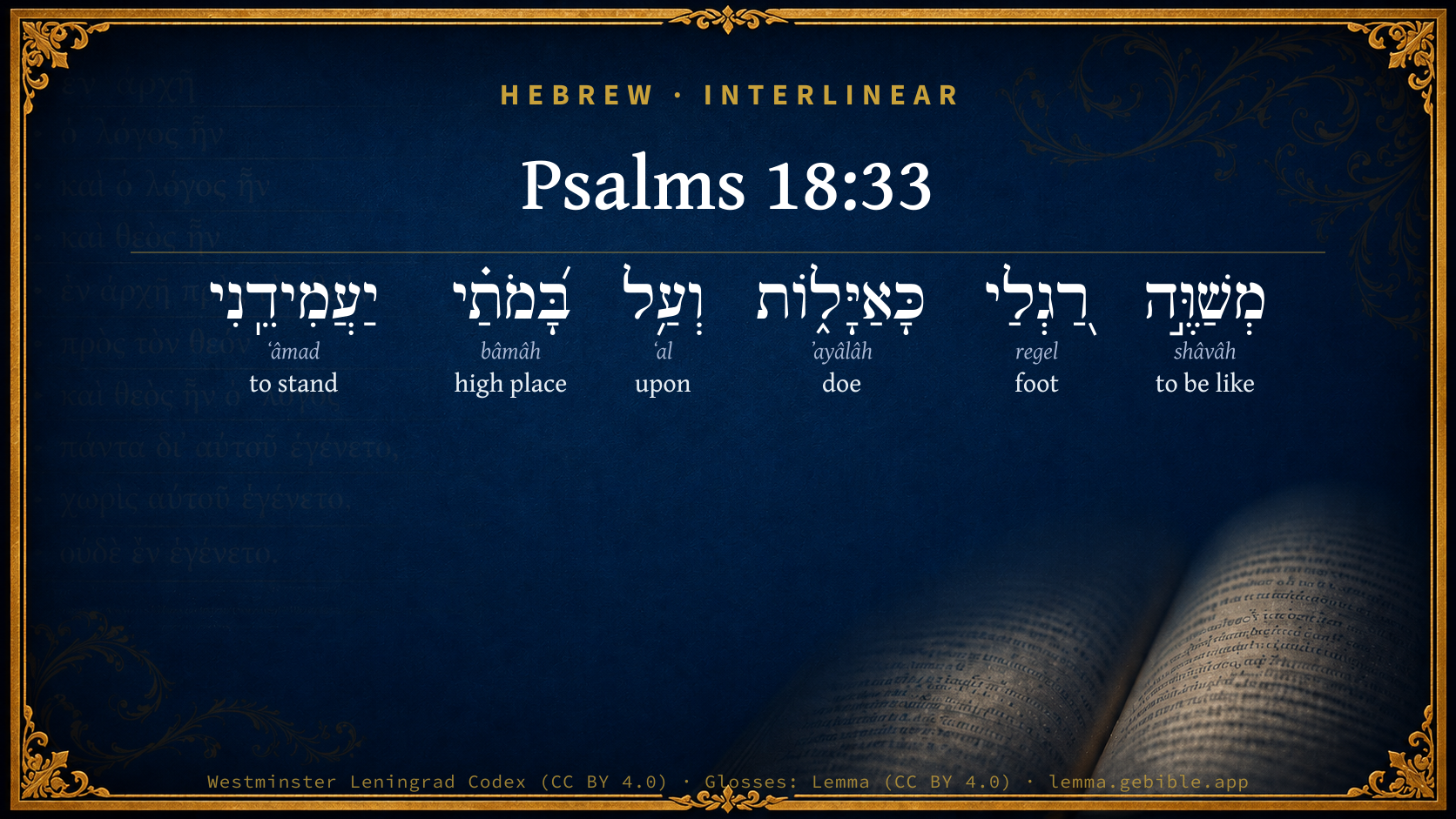
Psalms 18:33

Hebrew (Westminster Leningrad Codex) Psalms 18:33 appears in the Hebrew Old Testament. The text above is from the Westminster Leningrad Codex. Each word links to its Strong’s number, a concise gloss, and parsing drawn from the Open Scriptures Hebrew Bible morphology. Click any word for its full Brown-Driver-Briggs (BDB) entry.
Download image
Cite this verse

Psalms 18:33 (World English Bible). Public Domain. Lemma interlinear Bible study tool, https://lemma.gebible.app/v/psalms/18/33.

Show BibTeX & RIS
BibTeX
RIS
English Translation
He makes my feet like deer's feet, And sets me on my high places.
World English Bible · Public Domain
Download a study sheet

One document with this verse’s original text, its word-by-word gloss line, the meaning frame, cross-references with their text, attributed commentary, and full source and license credits — printable, and it pastes into notes with its structure intact.

This verse Autodidact and up

Study sheet (.html) Plain text (.txt)

A passage Seminary Student

Up to 50 verses in one chapter. A passage sheet keeps up to 6 commentary sources and 12 cross-references per verse, in the order this page ranks them, and says so on the sheet whenever that leaves anything out. Ask for a single verse and you get the Autodidact verse sheet above.

Everything on this page stays free to read, with no account — the sheet is a download of what is already on screen, not access to it.

Want to remove ads? Support Godless Engineer
Compare translations 3

The same verse in 3 English versions, stacked beneath the original-language interlinear above. Click any original word for its lexicon entry.

Each is an independent rendering of the whole verse — the interlinear is not word-aligned to these translations.

Highlighted words mark where these versions differ — a whole-verse word diff, not a word-by-word alignment.

  • World English Bible Public Domain
    He makes my feet like deer's feet, And sets me on my high places.
  • King James Version Public Domain
    He maketh my feet like hinds' feet, and setteth me upon my high places.
  • unfoldingWord Literal Text CC BY-SA 4.0
    making my feet like a deer, and he makes me stand on my high places,

unfoldingWord Literal Text — © unfoldingWord, licensed CC BY-SA 4.0. Word-aligned USFM3 via Door43 (git.door43.org/unfoldingWord/en_ult).

Versions to compare (up to 4)

3 of 4 selected

Show all 18 translations

Every available English version of this verse, each an independent rendering of the whole verse.

  • World English Bible Public Domain
    He makes my feet like deer's feet, And sets me on my high places.
  • Berean Standard Bible Public Domain
    He makes my feet like those of a deer and stations me upon the heights.
  • Majority Standard Bible Public Domain
    He makes my feet like those of a deer and stations me upon the heights.
  • King James Version Public Domain
    He maketh my feet like hinds' feet, and setteth me upon my high places.
  • American Standard Version (1901) Public Domain
    He maketh my feet like hinds' `feet': And setteth me upon my high places.
  • Revised Version (1885) Public Domain
    He maketh my feet like hinds’ feet: and setteth me upon my high places,
  • Geneva Bible (1599) Public Domain
    He maketh my feete like hindes feete, and setteth me vpon mine high places.
  • Douay-Rheims (1899) Public Domain
    God who hath girt me with strength; and made my way blameless.
  • Young's Literal Translation Public Domain
    Making my feet like hinds, And on my high places causeth me to stand.
  • Literal Standard Version CC BY-SA 4.0
    Making my feet like does, || And on my high places causes me to stand.
  • Unlocked Literal Bible CC BY-SA 4.0
    He makes my feet swift like a deer and places me on the heights!
  • unfoldingWord Literal Text CC BY-SA 4.0
    making my feet like a deer, and he makes me stand on my high places,
  • Darby Bible Public Domain
    Who maketh my feet like hinds' [feet], and setteth me upon my high places;
  • World Messianic Bible Public Domain
    He makes my feet like deer’s feet, and sets me on my high places.
  • Webster's Bible Public Domain
    \\18:32\\It is God that girdeth me with strength, and maketh my way perfect.
  • Free Bible Version CC BY-SA 4.0
    He makes me surefooted like the deer, able to walk the heights in safety.
  • Bible in Basic English Public Domain
    He makes my feet like roes' feet, and puts me on high places.
  • JPS Tanakh (1917) Public Domain
    (18-34) Who maketh my feet like hinds', and setteth me upon my high places;

Literal Standard Version (2020), Covenant Press — licensed CC BY-SA 4.0. Text via the HelloAO Bible API (eBible.org). Unlocked Literal Bible (unfoldingWord) — licensed CC BY-SA 4.0. Text via the HelloAO Bible API (eBible.org). unfoldingWord Literal Text — © unfoldingWord, licensed CC BY-SA 4.0. Word-aligned USFM3 via Door43 (git.door43.org/unfoldingWord/en_ult). Free Bible Version, Dr. Jonathan Gallagher — licensed CC BY-SA 4.0. Text via the HelloAO Bible API (eBible.org).

Word by word

More ways to search: Search by grammar → Find every occurrence → Compare this word →

Practice this passage: Drill this verse → Learn its vocabulary →

About this verse

These counts appear in no published source. They are computed here, from the morphology-tagged text and Lemma’s own curated glosses. What Lemma adds →

6
words
6
distinct lemmas
Wisdom
section

Notable vocabulary

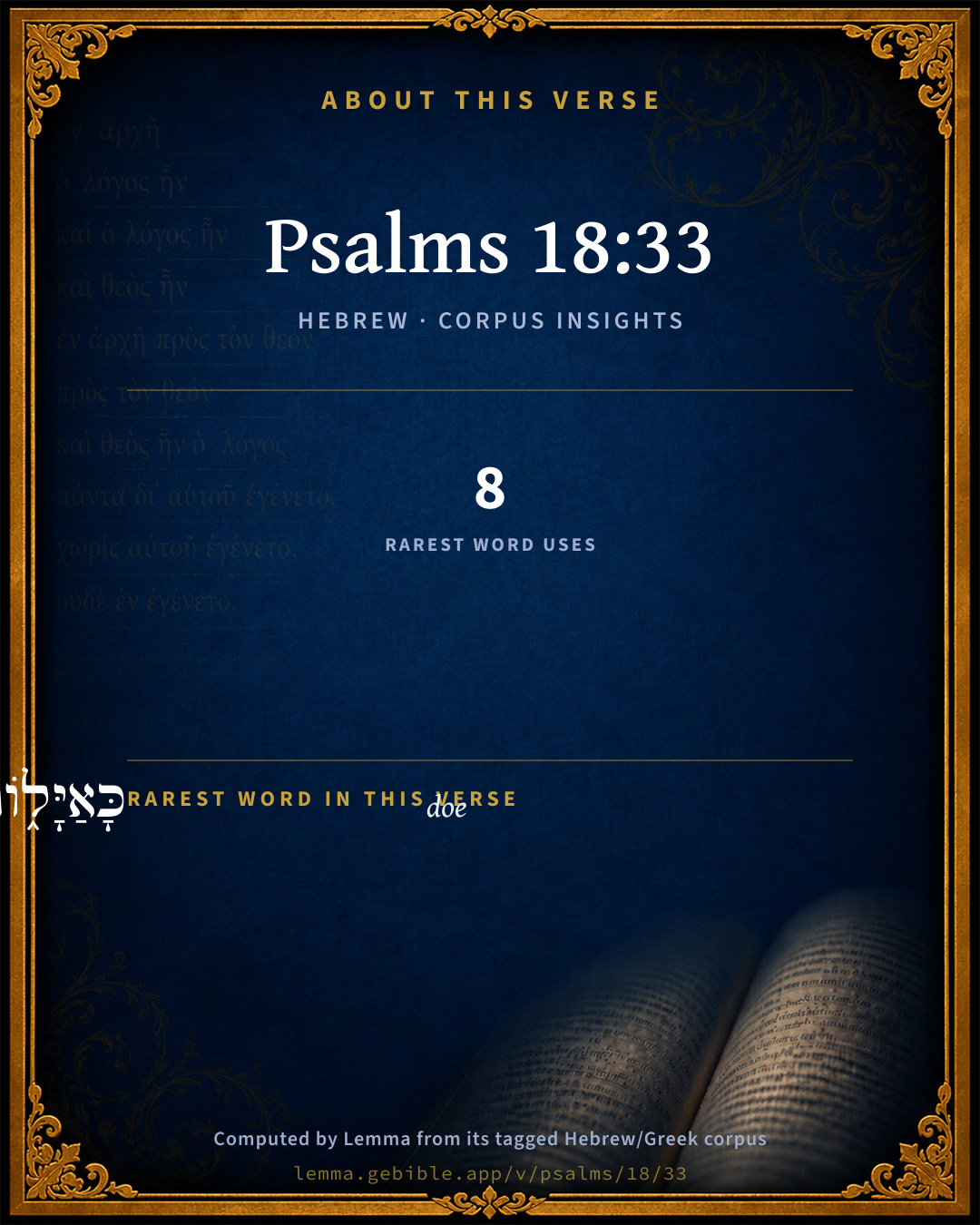
The rarest word here is כָּאַיָּל֑וֹת doe H355 — appearing just 8 times in the whole Hebrew Bible.

Shared distinctive vocabulary

כָּאַיָּל֑וֹת doe H355 occurs in 8 verses of the Hebrew Bible. Also found in:

Grammatical profile

  • 2 verbs
  • 3 nouns
  • 1 preposition

Verb forms

  • מְשַׁוֶּ֣ה Piel · Participle Active
  • יַעֲמִידֵֽנִי Hiphil · Imperfect

Hebrew & Septuagint length

In English translation the verse runs 14 words from the Hebrew and 13 from the Septuagint (LXX English) — closely comparable.

A rough comparison of the two English renderings, which tokenize alike — not a word-level alignment.

Word counts can differ between the Hebrew and the Greek without any difference in meaning — e.g. the Hebrew direct-object marker אֵת has no separate Greek word, and Greek often adds the article ὁ.

Cross-references

5

Topical passages linked to Psalms 18:33 in the Treasury of Scripture Knowledge — connected by theme and wording, ordered by reader-vote popularity; previews shown in the World English Bible.

  • Habakkuk 3:19 Yahweh, the Lord, is my strength. He makes my feet like deer's feet, And enables me to go in high places. For the music director, on my stringed instruments.
  • Deuteronomy 32:13 He made him ride on the high places of the earth, He ate the increase of the field; He made him to suck honey out of the rock, Oil out of the flinty rock;
  • Deuteronomy 33:29 Happy are you, Israel: Who is like you, a people saved by Yahweh, The shield of your help, The sword of your excellency! Your enemies shall submit themselves to you; You shall tread on their high places.
  • 2 Samuel 2:18 The three sons of Zeruiah were there, Joab, and Abishai, and Asahel: and Asahel was as light of foot as a wild gazelle.
  • 2 Samuel 22:14 Yahweh thundered from heaven, The Most High uttered his voice.

Cross-references courtesy of OpenBible.info (CC BY 4.0).

Hebrew and Greek witnesses Masoretic Hebrew ↔ Greek Septuagint

The same verse in the two great witnesses to the Old Testament, shown verse-for-verse.

You’re reading Greek Psalm 17 (Hebrew Psalm 18). The Septuagint counts the superscription, so verse numbers can differ from the Hebrew — chapter-level alignment, not verse-by-verse. Numbering follows Rahlfs.

These are two independent witnesses, not word-aligned to each other, and the Septuagint is shown in lemma (dictionary) form.

Hebrew Psalms 18:33 Masoretic · Westminster Leningrad Codex

מְשַׁוֶּ֣ה רַ֭גְלַי כָּאַיָּל֑וֹת וְעַ֥ל בָּ֝מֹתַ֗י יַעֲמִידֵֽנִי

He makes my feet like deer's feet, And sets me on my high places.

World English Bible · Public Domain

Greek LXX Greek Psalm 17:33 Septuagint · lemma form

ὁ θεός ὁ περιζωννύω ἐγώ δύναμις καί τίθημι ἄμωμος ὁ ὁδός ἐγώ

who strengthens my feet as hart's feet, and sets me upon high places.

LXX2012 (modern English Septuagint) · Public Domain

On this verse, John Gill's Exposition discusses the Septuagint’s reading. Read the note in Commentary ↓

Hebrew: Westminster Leningrad Codex (CC BY 4.0). Greek: Septuagint (public domain); English from LXX2012 (modern English Septuagint) (Public Domain). How the Septuagint differs from the Hebrew →

Commentary

Notes on Psalms 18:33 from classic Christian and Jewish commentators (each source and its license shown beneath its notes). The classic Christian expositions comment on the surrounding passage and are grouped to its opening verse, so a note may address several verses; the Jewish commentaries on the Tanakh (Rashi and others) are per-verse, so they appear only where the commentator wrote on this verse.

Lemma curates 59 commentaries, every one of them public domain or Creative Commons licensed, each selected and text-cleaned for this edition rather than reprinted as found. About our sources →

Trapp's Complete Commentary

John Trapp

Psa 18:33 He maketh my feet like hinds’ [feet], and setteth me upon my high places.

Ver. 33. He maketh my feet like hinds’ feet] Heb. He matcheth my feet, like hinds’ feet; that is, not only swift, if I have occasion by flight to provide for myself, or to pursue mine enemies flying before me; but also steady, if I come into any dangerous places. Asahel was swift of foot as a wild roe, 2Sa 2:18. Josephus saith of him, that he contended with horses in running. Saul and Jonathan are said to be swifter than eagles, 2Sa 1:23. Achilles was ποδας ωκυς, saith Homer. The hind, when pursued by the wolf, runs most swiftly; witness the poet (Horat. lib. 1, Od. 15, 23):

Quem tu, cervus uti vallis in altera

Visum parte lupum, graminis immemor,

Sublimi fugies mollis anhelitu.

And again,

Vitas hinnuleo me similis, Chloe, &c.

But they that wait upon the Lord have a promise that they shall not only run as hinds, but mount up as eagles; they shall run and not be weary, and they shall walk and not faint, Isa 40:31.

He setteth me upon my high places] Where, having by flight or fight escaped, I am secured; yea, he hath advanced me, and brought me to this high honour, Securus postquam evasi ab illis (R. David).

John Trapp, A Commentary or Exposition upon All the Books of the Old and New Testament (1647–1656) — public domain. Text from a community e-Sword module.

The Biblical Illustrator

Joseph S. Exell

Psa_18:29; Psa_18:33-34

By Thee have I run through a troop.

Surmounting impossible difficulties

This is a poetical way of representing the fact that impossibilities have often been made possible in our own experience. Looking back upon certain combinations of circumstances, we cannot but feel that we were surrounded by great and high walls, and that troops of dangers thickened around us in deadly array, Now that we see ourselves in a large place, we are tempted to believe that we are still in a dream, and that our liberty is a thing which we hold only in the uncertain light of a momentary vision. When our imagination is vexed by the cross colours which make up the panorama of life, it is easy to persuade us that tomorrow we shall be back again in chains, for we have enjoyed but an imaginary liberty. Then, under happier circumstances, we see how the miracle is a simple reality,--that we have in very deed escaped perils which at one time seemed to be insurmountable, and that our escape is due entirely to the exercise of the almightiness of God. It is remarkable how, under such circumstances, we unconsciously magnify our own importance in the universe. We do not mean to be ostentatious and proud when we declare that God has exerted Himself specially on our behalf, and has indeed Himself been disquieted until our comfort was restored and established. The Psalmist speaks here as if he were the sole object of the Lords care, and as if the Infinite took delight only in his well-being and prosperity. (Joseph Parker, D. D.)

Energy put into a man

Sir Alexander Ball was one of those great men who adorned our navy at the end of the eighteenth century. The following anecdote is told of him by his friend the poet Coleridge. In a large party at Malta I had observed a naval officer listening to Sir A. Ball with a mixed expression of awe and affection that gave a more than common interest to so manly a countenance. This officer afterwards told me that he considered himself indebted to Sir Alexander for that which was dearer to him than his life. When he was Lieutenant Ball, said he, he was the officer I accompanied in my first boat expedition, being then a midshipman, and only in my fourteenth year. As we were rowing up to the vessel which we were to attack, amid a discharge of musketry, I was overpowered by fear, and seemed on the point of fainting away. Lieutenant Ball, who saw the condition I was in, placed himself close beside me, and still keeping his countenance directed towards the enemy, pressed my hand in the most friendly manner, and said in a low voice, Courage, my dear boy. You will recover in a minute or so. I was just the same when I first went out in this way. Sir, added the officer to me, it was just as if an angel had put a new soul into me. With the feeling I was not yet dishonoured, the whole burden of agony was removed; and from that moment I was as fearless and forward as the oldest of the boats crew.

One trophy for two exploits

What is true of David is true of Davids Lord. The Holy Ghost has presented to us the experience of Jesus in that model of experience through which David passed. So the text tells both of Christ and the believer also. Let us speak of it.

I. In relation to Christ. And

1. For the first sentence, By Thee have I run through a troop. Christs enemies were as a troop for number. Who can count them? But also for their discipline. They were marshalled under that skilful and crafty leader Satan, the arch fiend and Prince of Darkness. And his servants are well trained. He came against Jesus with his army, in settled order. It was no wild rush of Some Tartar host, but a well arranged and well regulated attack. Never let us undervalue the strength of Christs enemies. Now, this sentence has been read in varied ways, and each is very suggestive. One reads it, By Thee have I run to a troop; so that Jesus did not wait for the attack, but made it Himself, See how He went forth to meet Judas and the armed band on the night of the betrayal. But our version reads, through a troop, and this is also accurate. For His victory was complete. They stood firm as if they would not flinch, they thought they had defeated Him; but His Cross was the very symbol of His omnipotence, for in weakness was He strong. See Him running through this troop. And how speedily. His sufferings were but short. What a stride was that which Jesus took when He marched right through His enemies, and laid them right and left slain before Him. There is yet another version, By Thee have I run after a troop. As if he would say, I met them, fought them, vanquished them, pursued them, and captured them. He led captivity captive. Note the words, By Thee. He acted as the servant of God. But it is blessed to think that the Father as well as the Son, yea, the whole Trinity of sacred Persons, is engaged for our redemption.

2. The second sentence, By my God have I leaped over a wall. David seems to be describing the capture of some fortress, such as Jebus, afterwards called Jerusalem. Now Satan had shut us all up in a mighty fortress. It had as one bulwark the strength of sin and the law; as another the suggestions of Satan to mens hearts; and then there was the deep ditch of mens sins, and the mound outside of Human Depravity. Now Christ comes, and He leaps over these walls. And He not only Himself surmounted these walls, but brought all His people on His shoulders, as AEneas carried off his old father Anchises. And all this also was by my God. He acted as Mediator. Let our souls meditate much upon Christs victories.

II. To the believer. He has his troops of enemies and his imprisoning wall. But sometimes he makes the mistake of trying to climb over the troop when he should break through them, and of trying to break through the wall which he should climb over. Let him have courage for the troop to run through them, and discretion for the wall to climb over it. And by means of faith he can do this. Luther often used to defy Satan to battle. I care not to do that, but he used in his queer quaint way to say, I often laugh at Satan, and there is nothing makes him so angry as when I attack him to his face, and tell him that through God I am more than a match for him, tell him to do his worst, and yet I will beat him; and tell him to put forth his fury, and yet I will overcome him. He that has made God his refuge need fear no storm. Look, said a poor woman to a lady who called to see her, Look, maam, Ill show you all Im worth. And she showed her her cupboard with nothing in it but a dry crust; and a chest, but it was empty. That is all I am worth, maam, but I have not a doubt or fear but that God will supply my need. Now that woman bad learnt how to run through a troop and by her God to leap over a wall. What have you for your soul like that? (C. H. Spurgeon.)

The Biblical Illustrator, edited by Joseph S. Exell (c. 1880s–1900s) — public domain. Text from a community e-Sword module.

Joseph Benson's Commentary

Psa 18:33. He maketh my feet like hinds’ feet — That is, most swift and nimble. As he makes me wise in counsel and contrivance, Psa 18:32; so he makes me speedy and expeditious in execution; which are the two great excellences of a captain. He gives me great agility, either to flee and escape from my enemies when prudence requires it, or to pursue them when I see occasion. Swiftness of foot was reckoned a very honourable qualification among the ancient warriors, who, as they generally fought on foot, were enabled, by their agility and swiftness, speedily to run from place to place, give orders, attack their enemies, defend their friends, and perform divers other offices the service might require of them: of which we have many instances in the battles of Homer and Virgil. One of the highest commendations Homer gives his principal hero is taken from his swiftness, terming him continually ποδας οκυς Αχιλλευς, swift-footed Achilles. This qualification was peculiarly useful to David, as the country of Judea, and some of those where he was obliged to make war, were very mountainous and steep. And setteth me upon my high places — Hebrew,

יעמידני, jagnamideeni, he maketh me to stand — That is, either he places me in safe and strong places, out of the reach of mine enemies; or he confirms and establishes me in that high and honourable estate, into which he hath advanced me, and gives me wisdom to improve my victories.

Joseph Benson's Commentary on the Old and New Testaments (1811–1818) — public domain. Text from a community e-Sword module.

J. A. Alexander on Psalms

Joseph Addison Alexander

34. (Psa 18:33). Making my feet like hinds, and on my heights he makes me stand. The first word properly means equalling, assimilating, the idea of resemblance being expressed in Hebrew both by the verb and by the particle of comparison. The female animal is supposed by some to be mentioned because it was regarded as more fleet, and accordingly we find it used in the Egyptian hieroglyphics as a symbol of swiftness. The name, however, may be used generally, as in English we apply either the masculine or feminine pronoun to some whole species. My heights, those which are to be mine by right of conquest and by divine gift. The heights may be either the natural highlands of the country or the artificial heights of its fortified places. It has been disputed whether the swiftness mentioned in the first clause has reference to attack or flight. Most probably both were meant to be included, as in Psa 18:30 (29) above. For both reasons swiftness of foot was prized in the heroic age, as appears from Homer's standing description of Achilles. See 2Sa 2:18, 1Ch 12:8.

Joseph Addison Alexander, The Psalms Translated and Explained (1850) — public domain. Text from a community e-Sword module.

Geneva Bible (1599)

Geneva Bible translators

As towers and forts, which he took out of the hands of God’s enemies.

Geneva Bible (1599) marginal notes — public domain. Text via Bolls.life.

Jamieson, Fausset & Brown

Robert Jamieson, A. R. Fausset & David Brown

God's help farther described. He gives swiftness to pursue or elude his enemies (Hab 3:19), strength, protection, and a firm footing.

Jamieson, Fausset & Brown — Commentary Critical and Explanatory on the Whole Bible (1871) — public domain (CC PDM 1.0). Text via the HelloAO Bible API.

Adam Clarke's Commentary

Verse 33. My feet like hinds' feet] Swiftness, or speed of foot, was a necessary qualification of an ancient hero. This was of great advantage in pursuing, combating, or escaping from a fallen foe. Ποδας ωκυς Αχιλλευς, "the swiftfooted Achilles," is frequently given by Homer as a most honourable qualification of his hero.

Upon my high places.] In allusion to the hinds, antelopes, mountain goats, &c., which frequented such places, and in which they found both food and safety. God frequently preserved the life of David by means of these.

Adam Clarke's Commentary on the Bible (1810–1826) — public domain. Text from a community e-Sword/MySword module.

John Calvin's Commentaries

David, having taken many strongholds which, on account of their steep and difficult access, were believed to be impregnable, extols the grace of God in this particular. When he says that God had given him feet like hinds’ feet, he means that he had given him unusual swiftness, and such as does not naturally belong to men. The sense, therefore, is, that he had been aided by God in an extraordinary manner, so that like a roe he climbed with amazing speed over inaccessible rocks. He calls the strongholds, which, as conqueror, he had obtained by right of war, his high places; for he could justly boast that he took possession of nothing which belonged to another man, inasmuch as he knew that he had been called to occupy these fortresses by God. When he says that his hands had been taught and framed to war, he confesses that he had not acquired his dexterity in fighting by his own skill, nor by exercise and experience, but had obtained it as a gift through the singular goodness of God. It is true in general, that strength and skill in war proceed only from a secret virtue communicated by God; but David immediately after shows that he had been furnished with greater strength for carrying on his wars than what men commonly possess, inasmuch as his arms were sufficiently strong to break even bows of brass in pieces True, he had by nature a vigorous and powerful bodily frame; but the Scripture describes him as a man of low stature, and the similitude itself which he here uses implies something surpassing the natural strength of man. In the following verse, he declares that it was by the grace of God alone that he had escaped, and been kept in perfect safety: Thou hast also given me the shield of thy salvation. By the phrase, the shield of God’s salvation, he intimates, that if God had not wonderfully preserved him, he would have been exposed unprotected to many deadly wounds; and thus God’s shield of salvation is tacitly opposed to all the coverings and armor with which he had been provided. He again ascribes his safety to the free goodness of God as its cause, which he says had increased him, or more and more carried him forward in the path of honor and success; for, by the word increase, he means a continuation and an unintermitted and ever growing augmentation of the tokens of the divine favor towards him.

John Calvin's Commentaries (1540-1563) — public domain. Text from the Calvin Translation Society English edition (1840s-50s) via the Christian Classics Ethereal Library (ccel.org). Calvin's coverage is partial (roughly two-thirds of the Bible); uncommented books and verses are honest gaps, never fabricated. The 19th-century editor's footnotes and remarks are omitted so the notes are faithfully Calvin's own voice.

Ellicott's Commentary for English Readers

(33) This verse is borrowed in Hab_3:19. For swiftness as an essential of a warrior in Oriental esteem comp. 2Sa_1:23, and the invariable epithet in Homer’s Iliad, “swift-footed Achilles.” For “hind” comp. Gen_49:21. Observe “his feet” in Samuel.

My high places.—With allusion to the mountain fortresses the poet had scaled and won.

A Bible Commentary for English Readers, edited by Charles John Ellicott (1878–1897) — public domain. Text from a community e-Sword module.

The Cambridge Bible for Schools and Colleges

gen. ed. J. J. S. Perowne

33. like hinds’ feet] The hind, like the gazelle, was a type of the agility, swiftness, and sure-footedness which were indispensable qualifications in ancient warfare. Cp. 2Sa_2:18; 1Ch_12:8.

setteth me upon my high places] The metaphor of the hind, bounding freely over the hills, is continued. David’s high places are the mountain strongholds, the occupation of which secured him in the possession of the country. Cp. Deu_32:13; and Hab_3:19, which is a reminiscence of this passage and Deu_33:29.

The Cambridge Bible for Schools and Colleges (gen. ed. J. J. S. Perowne; Cambridge University Press, 1878–1918) — public domain. Text from a community e-Sword module.

John Gill's Exposition

He teacheth my hands to war,.... From whence it appears, that war, in some cases, is lawful; and that all the skilfulness and art in training men for war, in the use of armour, in marshalling of armies, in forming sieges, &c. is all from God; see Psa 144:1; and so is all that spiritual skill, in making use of the whole armour of God against every enemy, sin, Satan, and the world; and even the wisdom and skill, counsel and instruction, which Christ as man and Mediator had, when it was the hour and power of darkness; when he was engaged with principalities and powers, and got the victory over them, were from the Lord: see Psa 16:7;

so that a bow of steel is broken by mine arms; that is, the bow of an enemy falling into his hands, which might be literally true of David. It is in the Hebrew text, "a bow of brass"; and so Apollinarius renders it; which Kimchi and Ben Melech interpret strong iron, that is, steel; and so the Targum; see Job 20:24; Satan is an archer; his temptations are darts, and fiery ones; and his strong bow may be said to be broken by the arms of faith, when his temptations, under the influence of divine grace, are repelled and rendered ineffectual; and especially his bow was broken by Christ, not only in the wilderness, when he was vanquished by him; but in the garden, and on the cross, when Satan could find nothing in him, and get no other advantage over him, but to bruise his heel; when he himself had his head broke, his works ruined, and he himself destroyed. Some render the words, "mine arms have bent a bow of steel": that is, such skill and strength were given him that he was able to bend, draw, and shoot a bow or steel: the Targum is, "and hath strengthened mine arm as a bow of brass", or "steel"; and so the Syriac and Arabic versions; and to the same purpose the Septuagint, Vulgate Latin, and Ethiopic versions; or it may be rendered, "my arms have bent", or "made to descend (o), a bow of brass"; for when a bow is bent, the horns or corners of it are made to descend towards a man.

(o) "ut current", Cocceius; so Michaelis; "ut descendat vel deprimatur", Gejerus; vid. Gussetii Comment. Ebr. p. 507. so Jarchi.

John Gill's Exposition of the Whole Bible (1746–1763) — public domain (CC PDM 1.0). Text via the HelloAO Bible API.

Albert Barnes' Notes on the Bible

He maketh my feet like hinds’ feet - So Hab 3:19, “He will make my feet like hinds’ feet, and he will make me to walk upon mine high places.” The hind is the female deer, remarkable for fleetness or swiftness. The meaning here is, that God had made him alert or active, enabling him to pursue a flying enemy, or to escape from a swift-running foe.

And setteth me upon my high places - places of safety or refuge. The idea is, that God had given him security, or had rendered him safe from danger. Compare Deu 32:13. Swiftness of foot, or ability to escape from, or to pursue an enemy, was regarded as of great value in ancient warfare. Achilles, according to the descriptions of Homer, was remarkable for it. Compare 2Sa 2:18; 1Ch 12:8.

Albert Barnes' Notes on the Bible (1834–1885) — public domain. Text from a community e-Sword/MySword module.

Matthew Poole's English Annotations

Like hinds’ feet, i.e. most swift and nimble. As he made me wise in counsel and contrivance, (which he elsewhere saith,) so he made me speedy and expeditious in the execution; which are the two great excellencies of a captain. He gave me great agility, either to flee and escape from mine enemies, when prudence required it; or to pursue them, when I saw occasion.

Setteth me, Heb. maketh me to stand, i.e. either he placeth me in safe and strong places, out of the reach of mine enemies; or he confirms and establisheth me in that high and honourable estate into which he hath advanced me, and gives me wisdom to improve my victories.

Matthew Poole's English Annotations on the Holy Bible (1683–1685) — public domain. Text from a community e-Sword/MySword module.

The Treasury of David

Charles H. Spurgeon

Ver. 33. The conqueror's feet had been shod by a divine hand, and the next note must, therefore, refer to them.

He maketh my feet like hinds' feet, and setteth me upon my high places. Pursuing his foes the warrior had been swift of foot as a young roe, but, instead of taking pleasure in the legs of a man, he ascribes the boon of swiftness to the Lord alone. When our thoughts are nimble, and our spirits rapid, like the chariots of Amminadib, let us not forget that our best Beloved's hand has given us the choice favour. Climbing into impregnable fortresses, David had been preserved from slipping, and made to stand where scarce the wild goat can find a footing; herein was preserving mercy manifested. We, too, have had our high places of honour, service, temptation, and danger, but hitherto we have been kept from falling. Bring hither the harp, and let us emulate the psalmist's joyful thanksgiving; had we fallen, our wailings must have been terrible; since we have stood, let our gratitude be fervent.

Ver. 33. He maketh my feet like hinds' feet, and setteth me upon my high places: that is, he doth give swiftness and speed to his church; as Augustine interprets it, transcendendo spinosa, et umbrosa implacamenta hujus saeculi, passing lightly through the thorny and shady incumbrances of this world. "He will make me walk upon my high places." David saith, "He setteth me upon high places." For, consider David, as he then was, when he composed this Psalm, it was at the time when God had delivered him from the hand of all his enemies, and from the hand of Saul. For then God set his feet on high places, setting his kingdom, and establishing him in the place of Saul. Edward Marbury.

Ver. 33. He maketh my feet like hinds' feet: twlyak ylgr hwvm. Celerity of motion was considered as one of the qualities of an ancient hero. Achilles is celebrated for being podas wkus. Virgil's Nisus is hyperbolically described, Et ventis et fulminis ocior alis; and the men of God, who came to David, "Men of might, and men of war fit for the battle, that could handle shield and buckler, "are said to have had "faces like the faces of lions, "and to have been "as swift as the roes upon the mountains." 1Ch 12:8. Asahel is described as "light of foot as a wild roe" (2Sa 2:18); and Saul seems called the roe (in the English translation, "the beauty) of Israel." 2Sa 1:19. It has been said that the legs of the hind are straighter than those of the buck, and that she is swifter than he is; but there is no sufficient proof of this. Gataker gives the true account of it when he says, "The female formula is often used for the species." This is not uncommon in Hebrew. The female ass obviously stands for the ass species. Ge 12:16 Job 1:3 42:12. Some (at the head of whom is Bochart, Hierozoicon, P.I.L. 2 c 17), have supposed the reference to be to the peculiar hardness of the hoof of the roe, which enables it to walk firmly, without danger of falling, on the roughest and rockiest places. Virgil calls the hind aeri-pedem, brass footed. Others suppose the reference to be to its agility and celerity. There is nothing to prevent our supposing that there is reference to both these distinguishing qualities of the hind's feet. John Brown.

Ver. 33. He maketh my feet like hinds feet, etc. He maketh me able to stand on the sides of mountains and rocks, which were anciently used as fastnesses in time of war. The feet of the sheep, the goat, and the hart are particularly adapted to standing in such places. Mr. Merrick has here very appositely cited the following passage from Xenophon; Lib. de Venatione:Episkupein dei econta tus kunas tas men en oredi edtwdas lafouz See also Ps 104:18, where the same property of standing on the rocks and steep cliffs, is attributed to the wild goat. Stephen Street, M.A., in loc., 1790.

Charles H. Spurgeon's The Treasury of David (1869–1885) — public domain. Psalms only. Text from a community e-Sword/MySword module.

Whedon's Commentary on the Bible

Daniel D. Whedon

33. Like hinds’ feet—Not only swift but sure footed, so as to walk in difficult places safely. In the Egyptian paintings the hind is the symbol of fleetness. See on Psa_42:1.

Setteth me upon my high places— Perhaps, causeth my feet to stand sure on elevated, and hence insecure, paths, like the hind: but it is probably better to take high places for strongholds. “He establishes me in fastnesses,” which were commonly on tops of hills or mountains. The passage is parallel to Hab_3:19, where to “walk upon high places,” or fortresses, means to have the military control of the land. So, also, Deu_33:29, et al.

Daniel D. Whedon (gen. ed.), Commentary on the Old and New Testaments (1874–1909) — public domain. Text from a community e-Sword module.

The Pulpit Commentary

He maketh my feet like hinds" feet. (comp. 2Sa_2:18 1Ch_12:8 Hab_3:19) The Israelites reckoned swiftness of foot, agility, and endurance among the highest of warlike qualities. These qualities were needed especially in the pursuit of defeated enemies; and the rapidity of David"s conquests (2Sa_5:6-10 2Sa_8:1-14 2Sa 10:15-20) must be ascribed to them mainly. And setteth me upon my high places; i.e. establishes me in the strongholds that command my extensive territory, and give me secure possession of it, as Zion, Rabbath-Ammon, Damascus, Petra, perhaps Zobah, Rehob, and others.

The Pulpit Commentary (1880–1919), ed. H.D.M. Spence-Jones & Joseph S. Exell — public domain. Text from a community e-Sword module.

John Wesley's Explanatory Notes

High-places - Confirms me in that high estate into which he hath advanced me.

John Wesley, Explanatory Notes Upon the Whole Bible (1754–1765) — public domain. Text via the GEBible commentary corpus.

unfoldingWord translationNotes

Door43 World Missions Community

makes my feet swift

This refers to enabling a person to run fast. AT: "makes me run very fast" (See: Synecdoche)

like a deer and places me on the heights

The deer is especially quick and stable in the mountains. (See: Simile)

He trains my hands

Here "my hands" refers to the person. AT: "He trains me" (See: Synecdoche)

my arms

This refers to the person. AT: "me" (See: Synecdoche)

translationWords

deer

bow and arrow

bronze

unfoldingWord translationNotes — © Distant Shores Media and the Door43 World Missions Community, licensed CC BY-SA 4.0. Source: git.door43.org/Door43/en_tn.

Rashi

Rabbi Shlomo Yitzchaki (Rashi)

and He makes my way perfect He removed all obstacles from my way until it became perfect and paved.

Rashi on the Tanakh — English translations: “The Judaica Press complete Tanach with Rashi, translated by A. J. Rosenberg” (CC BY 4.0); “Pentateuch with Rashi's commentary by M. Rosenbaum and A.M. Silbermann, 1929-1934” (public domain); “The Metsudah Tanach series, Lakewood, N.J” (CC BY 4.0); and “The Book of Joshua, Metsudah Publications, 1997” (CC BY 4.0). Text via Sefaria.

Lesson kit

Teaching starters — assembled from the data on this page, not authored interpretation. Every prompt links to the verse data it draws on. Edit before teaching.

Psalms, in the Wisdom, opens this verse with 6 words (6 distinct Hebrew lemmas). Its most distinctive word is ʼayâlâh (“doe”). A historical commentator’s framing appears above. Read the whole chapter for the surrounding context.

Discussion questions

  1. How does “doe” (ʼayâlâh) shape what this verse is saying?
  2. How does Genesis 49:21, which shares the word «doe», read alongside this verse?
  3. These translations render this verse differently; the difference is in the English rendering, not the original. What questions does that raise?
  4. «מְשַׁוֶּ֣ה» is a Piel Participle Active verb. How does that grammatical form shape the action described?
  5. Compare how Trapp's Complete Commentary and The Biblical Illustrator read this verse. Where do they agree or differ?

Things to notice

Reading settings

Reading text

Shown beneath each verse's original-language words.

Old Testament
Old Testament edition

Read the OT as the Masoretic Hebrew (MT) or the Greek Septuagint (LXX).

English shown for the Greek Septuagint (in the Hebrew ↔ Greek comparison).

Comparing translations? Open the Compare panel on any verse page to stack up to four side by side.