
1 Kings 22:44

Hebrew (Westminster Leningrad Codex) 1 Kings 22:44 appears in the Hebrew Old Testament. The text above is from the Westminster Leningrad Codex. Each word links to its Strong’s number, a concise gloss, and parsing drawn from the Open Scriptures Hebrew Bible morphology. Click any word for its full Brown-Driver-Briggs (BDB) entry.
Download image
Cite this verse

1 Kings 22:44 (World English Bible). Public Domain. Lemma interlinear Bible study tool, https://lemma.gebible.app/v/1-kings/22/44.

Show BibTeX & RIS
BibTeX
RIS
English Translation
Jehoshaphat made peace with the king of Israel.
World English Bible · Public Domain
Download a study sheet

One document with this verse’s original text, its word-by-word gloss line, the meaning frame, cross-references with their text, attributed commentary, and full source and license credits — printable, and it pastes into notes with its structure intact.

This verse Autodidact and up

Study sheet (.html) Plain text (.txt)

A passage Seminary Student

Up to 50 verses in one chapter. A passage sheet keeps up to 6 commentary sources and 12 cross-references per verse, in the order this page ranks them, and says so on the sheet whenever that leaves anything out. Ask for a single verse and you get the Autodidact verse sheet above.

Everything on this page stays free to read, with no account — the sheet is a download of what is already on screen, not access to it.

Want to remove ads? Support Godless Engineer
Compare translations 3

The same verse in 3 English versions, stacked beneath the original-language interlinear above. Click any original word for its lexicon entry.

Each is an independent rendering of the whole verse — the interlinear is not word-aligned to these translations.

Highlighted words mark where these versions differ — a whole-verse word diff, not a word-by-word alignment.

  • World English Bible Public Domain
    Jehoshaphat made peace with the king of Israel.
  • King James Version Public Domain
    And Jehoshaphat made peace with the king of Israel.
  • unfoldingWord Literal Text CC BY-SA 4.0
    And Jehoshaphat made peace with the king of Israel.

unfoldingWord Literal Text — © unfoldingWord, licensed CC BY-SA 4.0. Word-aligned USFM3 via Door43 (git.door43.org/unfoldingWord/en_ult).

Versions to compare (up to 4)

3 of 4 selected

Show all 18 translations

Every available English version of this verse, each an independent rendering of the whole verse.

  • World English Bible Public Domain
    Jehoshaphat made peace with the king of Israel.
  • Berean Standard Bible Public Domain
    Jehoshaphat also made peace with the king of Israel.
  • Majority Standard Bible Public Domain
    Jehoshaphat also made peace with the king of Israel.
  • King James Version Public Domain
    And Jehoshaphat made peace with the king of Israel.
  • American Standard Version (1901) Public Domain
    And Jehoshaphat made peace with the king of Israel.
  • Revised Version (1885) Public Domain
    And Jehoshaphat made peace with the king of Israel.
  • Geneva Bible (1599) Public Domain
    And Iehoshaphat made peace with the King of Israel.
  • Douay-Rheims (1899) Public Domain
    Nevertheless he took not away the high places: for as Set the people offered sacrifices and burnt incense in the high places.
  • Young's Literal Translation Public Domain
    And Jehoshaphat maketh peace with the king of Israel;
  • Literal Standard Version CC BY-SA 4.0
    And Jehoshaphat makes peace with the king of Israel;
  • Unlocked Literal Bible CC BY-SA 4.0
    Jehoshaphat made peace with the king of Israel.
  • unfoldingWord Literal Text CC BY-SA 4.0
    And Jehoshaphat made peace with the king of Israel.
  • Darby Bible Public Domain
    And Jehoshaphat was at peace with the king of Israel.
  • World Messianic Bible Public Domain
    Jehoshaphat made peace with the king of Israel.
  • Webster's Bible Public Domain
    \\22:43\\nevertheless the high places were not taken away; for the people offered and burnt incense yet in the high places.
  • Free Bible Version CC BY-SA 4.0
    Jehoshaphat also made peace with the king of Israel.
  • Bible in Basic English Public Domain
    And Jehoshaphat made peace with the king of Israel.
  • JPS Tanakh (1917) Public Domain
    (22-45) And Jehoshaphat made peace with the king of Israel.

Literal Standard Version (2020), Covenant Press — licensed CC BY-SA 4.0. Text via the HelloAO Bible API (eBible.org). Unlocked Literal Bible (unfoldingWord) — licensed CC BY-SA 4.0. Text via the HelloAO Bible API (eBible.org). unfoldingWord Literal Text — © unfoldingWord, licensed CC BY-SA 4.0. Word-aligned USFM3 via Door43 (git.door43.org/unfoldingWord/en_ult). Free Bible Version, Dr. Jonathan Gallagher — licensed CC BY-SA 4.0. Text via the HelloAO Bible API (eBible.org).

Word by word

More ways to search: Search by grammar → Find every occurrence → Compare this word →

Practice this passage: Drill this verse → Learn its vocabulary →

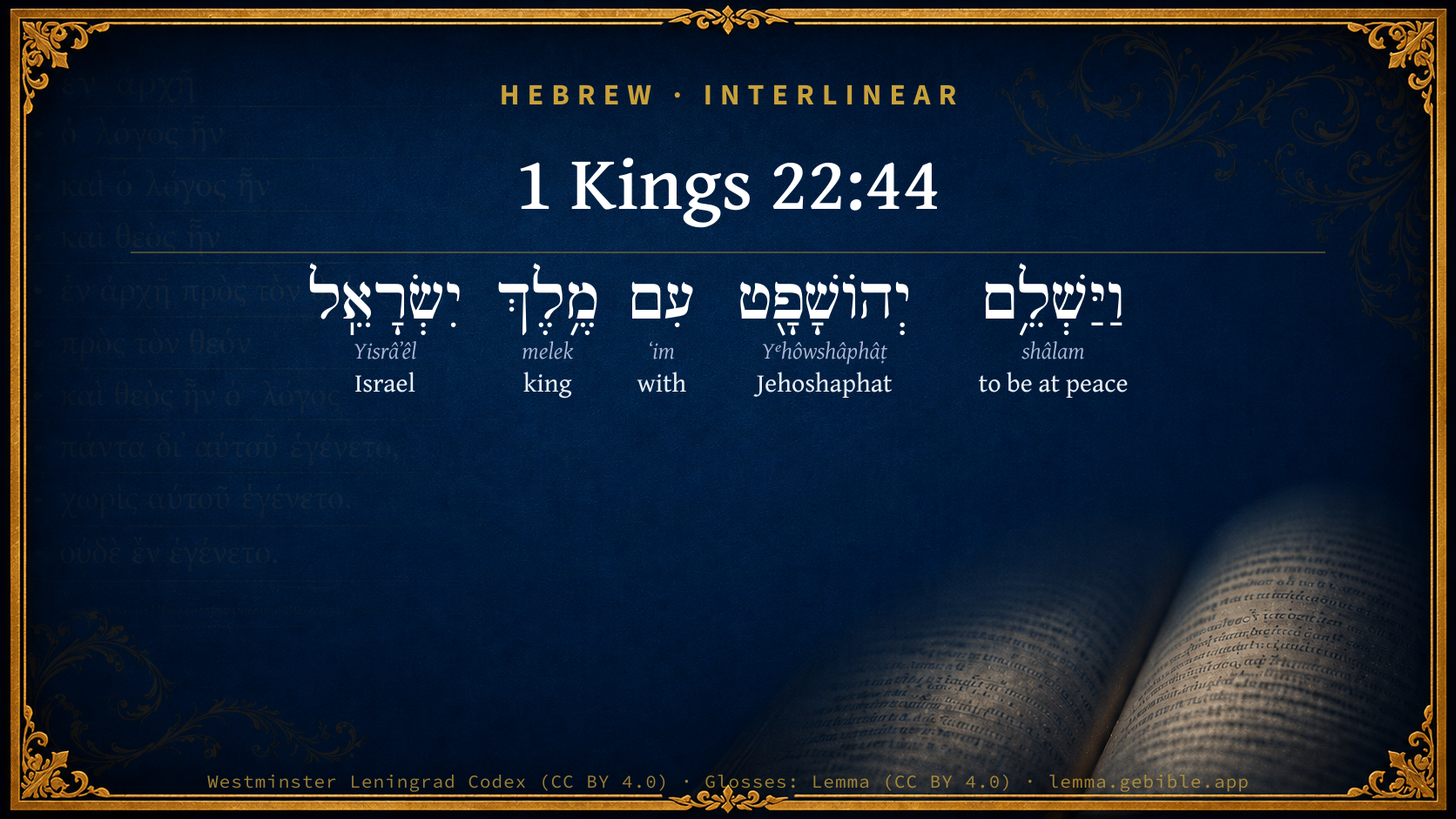
יְהוֹשָׁפָ֖ט
Yᵉhôwshâphâṭ
H3092
“Jehoshaphat”
Noun, Proper
Part of Speech
Noun
Type
Proper
Full BDB Definition

Origin: from H3068 and H8199

TWOT: None

Jehoshaphat = "Jehovah has judged" - son of king Asa and himself king of Judah for 25 years; one of the best, most pious, and prosperous kings of Judah (noun proper masculine) - son of Nimshi and father of king Jehu of the northern kingdom of Israel (noun proper masculine) - son of Ahilud and chronicler under David and Solomon (noun proper masculine) - son of Paruah and one of the 12 commissary officers under Solomon (noun proper masculine) - a priest and trumpeter in the time of David (noun proper masculine) - symbolical name of a valley near Jerusalem which is the place of ultimate judgment; maybe the deep ravine which separates Jerusalem from the Mount of Olives through which the Kidron flowed (noun proper locative)
  1. וַיַּשְׁלֵ֥ם shâlam H7999 “and · to be at peace” Conjunction + Verb, Hiphil, Sequential Imperfect, 3rd Person, Masculine, Singular
  2. עִם ʻim H5973 “with” Preposition
  3. מֶ֥לֶךְ melek H4428 “king of” Noun, Common, Masculine, Singular, Construct
  4. יִשְׂרָאֵֽל Yisrâʼêl H3478 “Israel” Noun, Proper

About this verse

These counts appear in no published source. They are computed here, from the morphology-tagged text and Lemma’s own curated glosses. What Lemma adds →

5
words
5
distinct lemmas
Historical
section

Grammatical profile

  • 1 verb
  • 3 nouns
  • 1 preposition

Verb forms

  • וַיַּשְׁלֵ֥ם Hiphil · Sequential Imperfect

Hebrew & Septuagint length

In English translation the verse runs 8 words from the Hebrew and 21 from the Septuagint (LXX English) — the Septuagint runs noticeably longer here. See the side-by-side →

A rough comparison of the two English renderings, which tokenize alike — not a word-level alignment.

Word counts can differ between the Hebrew and the Greek without any difference in meaning — e.g. the Hebrew direct-object marker אֵת has no separate Greek word, and Greek often adds the article ὁ.

Cross-references

5

Topical passages linked to 1 Kings 22:44 in the Treasury of Scripture Knowledge — connected by theme and wording, ordered by reader-vote popularity; previews shown in the World English Bible.

  • 1 Kings 22:2 It happened in the third year, that Jehoshaphat the king of Judah came down to the king of Israel.
  • 2 Kings 8:18 He walked in the way of the kings of Israel, as did the house of Ahab: for he had the daughter of Ahab as wife; and he did that which was evil in the sight of Yahweh.
  • 2 Chronicles 19:2 Jehu the son of Hanani the seer went out to meet him, and said to king Jehoshaphat, Should you help the wicked, and love those who hate Yahweh? for this thing wrath is on you from before Yahweh.
  • 2 Chronicles 21:6 He walked in the way of the kings of Israel, as did the house of Ahab; for he had the daughter of Ahab as wife: and he did that which was evil in the sight of Yahweh.
  • 2 Corinthians 6:14 Don't be unequally yoked with unbelievers, for what fellowship have righteousness and iniquity? Or what communion has light with darkness?

Cross-references courtesy of OpenBible.info (CC BY 4.0).

Hebrew and Greek witnesses Masoretic Hebrew ↔ Greek Septuagint

The same verse in the two great witnesses to the Old Testament, shown verse-for-verse.

Here the Septuagint runs noticeably longer than the Hebrew — LXX2012 (modern English Septuagint) 21 words vs World English Bible 8. A rough length comparison of the two English translations, not a word-level alignment — read both below.

These are two independent witnesses, not word-aligned to each other, and the Septuagint is shown in lemma (dictionary) form.

Hebrew 1 Kings 22:44 Masoretic · Westminster Leningrad Codex

וַיַּשְׁלֵ֥ם יְהוֹשָׁפָ֖ט עִם מֶ֥לֶךְ יִשְׂרָאֵֽל

Jehoshaphat made peace with the king of Israel.

World English Bible · Public Domain

Greek LXX 1 Kings 22:44 Septuagint · lemma form

πλήν ὁ ὑψηλός οὐ ἐκαἴρω ἔτι ὁ λαός θυσιάζω καί θυμιάζω ἐν ὁ ὑψηλός

Only he took not away any of the high places: the people still sacrificed and burnt incense on the high places.

LXX2012 (modern English Septuagint) · Public Domain

Hebrew: Westminster Leningrad Codex (CC BY 4.0). Greek: Septuagint (public domain); English from LXX2012 (modern English Septuagint) (Public Domain). How the Septuagint differs from the Hebrew →

Targum (Aramaic paraphrase)

1

The Targum is the ancient Jewish Aramaic paraphrase of the Hebrew Scriptures — an interpretive translation, not the Hebrew text itself. Onkelos (literal) and Pseudo-Jonathan (expansive) render the Torah, and Jonathan the Prophets. Coverage is partial: where no permissively-licensed English translation exists for a verse, only the Aramaic is shown. This is verse-level text, not a word-by-word alignment to the Hebrew.

  1. Targum Jonathan Prophets (Joshua–Malachi)
    בְּרַם בְּמָתָא לָא עֲטָרָא עַד כְּעַן עַמָא מְדַבְּחִין וּמַסְקִין בּוּסְמִין עַל בָּמָתָא:

    (no public-domain English translation for this verse)

    Targum Jonathan — Aramaic: “Mikraot Gedolot” (public domain). English: “Sefaria Community Translation” (CC0 1.0 (public-domain dedication)); “London "Chaldee Paraphrase," 1871” (public domain). Text via Sefaria.

Commentary

Notes on 1 Kings 22:44 from classic Christian and Jewish commentators (each source and its license shown beneath its notes). The classic Christian expositions comment on the surrounding passage and are grouped to its opening verse, so a note may address several verses; the Jewish commentaries on the Tanakh (Rashi and others) are per-verse, so they appear only where the commentator wrote on this verse.

Lemma curates 59 commentaries, every one of them public domain or Creative Commons licensed, each selected and text-cleaned for this edition rather than reprinted as found. About our sources →

Trapp's Complete Commentary

John Trapp

1Ki 22:44 And Jehoshaphat made peace with the king of Israel.

Ver. 44. And Jehoshaphat made peace with the king of Israel.] But better he had not, for God was deeply displeased with it. {2Ch 19:2} Now a man had better be at odds with all the world, than with God and his own conscience. He purchaseth his outward peace at too dear a rate, that parteth with his inward for it. Numa’s temple of old is said to have had this inscription, πιστεως και ειρηνης ιερος, The temple of faith and peace; but first of faith.

John Trapp, A Commentary or Exposition upon All the Books of the Old and New Testament (1647–1656) — public domain. Text from a community e-Sword module.

Joseph Benson's Commentary

1Ki 22:44-46. Jehoshaphat made peace, &c. — With Ahab first, and then with his son. This is noted as a blemish in his government, 2Ch 19:2; and proved of most mischievous consequence to his posterity. The remnant of the sodomites — he took out of the land — He made a more narrow search after them than his father had done, who is said to have removed them; but, it appears, some still remained, though without his knowledge.

Joseph Benson's Commentary on the Old and New Testaments (1811–1818) — public domain. Text from a community e-Sword module.

Ellicott's Commentary for English Readers

(44) And Jehoshaphat.—This verse is chronologically out of place. It refers to the policy of Jehoshaphat, pursued apparently from the beginning, of exchanging the chronic condition of war with Israel in the preceding reigns, for peace and alliance.

A Bible Commentary for English Readers, edited by Charles John Ellicott (1878–1897) — public domain. Text from a community e-Sword module.

The Cambridge Bible for Schools and Colleges

gen. ed. J. J. S. Perowne

44. Jehoshaphat made peace with the king of Israel] This is mentioned because up to his time the two kingdoms had been always at war.

The Cambridge Bible for Schools and Colleges (gen. ed. J. J. S. Perowne; Cambridge University Press, 1878–1918) — public domain. Text from a community e-Sword module.

Albert Barnes' Notes on the Bible

This refers probably to an early period in Jehoshaphat’s reign - about his eighth or his ninth year - when he closed the long series of wars between the two kingdoms by a formal peace, perhaps at once cemented by a marriage between Jehoram and Athaliah (1Ki 22:2 note).

Albert Barnes' Notes on the Bible (1834–1885) — public domain. Text from a community e-Sword/MySword module.

Haydock's Catholic Bible Commentary

He took not away, &c. He left some of the high places, viz., those in which they worshipped the true God: but took away all others, 2 Paralipomenon xvii. 6; (Challoner) and even those also, before the end of his reign; (Calmet) as they were contrary to the law. (Menochius) --- Others think that the passage in Paralipomenon is incorrect; ula being substituted for vaud. He took away the high places, (chap. xix. 3.) and the groves. (Grotius) (Capell.) --- We know that such remained in the days of Joas; and Josaphat in not ranked among the irreproachable kings, Ecclesiasticus xlix. 5. (Calmet) --- He attempted perhaps to remove those places, but was prevented by the people. (Menochius) See chap. xv. 14.

George Leo Haydock (1774–1849), Haydock's Catholic Family Bible and Commentary, 1859 edition — public domain. Excludes Psalms (Douay-Rheims chapter numbering differs from Protestant) and Deuterocanonical books (Catholic canon only).

Matthew Poole's English Annotations

With Ahab first, and then with his son. This is noted as a blemish in his government, 2Ch 19:2, and proved of most mischievous consequence to Jehoshaphat’s posterity; as we shall see, 2Ki 9; 2Ki 10.

Matthew Poole's English Annotations on the Holy Bible (1683–1685) — public domain. Text from a community e-Sword/MySword module.

Whedon's Commentary on the Bible

Daniel D. Whedon

44. Made peace with the king of Israel — His son Jehoram married Ahab’s daughter. 2Ki_8:18. As we have just seen, Jehoshaphat went up with Ahab to battle against Ramoth-gilead. Blunt finds some undesigned coincidences in this history which serve to confirm its veracity. “Thus, Ahab is succeeded by a son Ahaziah (1Ki_22:40) on the throne of Israel, and Jehoram is also succeeded by a son Ahaziah (the nephew of the other) on the throne of Judah. 2Ch_22:1. Again, Ahaziah, king of Israel, dies, and he is succeeded by a Jehoram; (2Ki_1:17; 2Ki_3:1;) but a Jehoram, the brother-in-law of the former, is at the same moment on the throne of Judah, as his father’s colleague. 2Ki_1:17. However our patience may be put to the proof in disengaging the thread of Israel and Judah at this point of their annals, we have the satisfaction of feeling that the intricacy of the history at such a moment is a very strong argument for the truth of the history. For though no remark is made upon this identity of names, we at once perceive that it may very naturally be referred to the union which is said to have taken place between the houses.”

Daniel D. Whedon (gen. ed.), Commentary on the Old and New Testaments (1874–1909) — public domain. Text from a community e-Sword module.

The Pulpit Commentary

And Jehoshaphat made peace with the king of Israel. One great feature of his reign was this: that the hostility which had lasted, even if it sometimes slumbered, between the two kingdoms for seventy years, from the date of their separation to the time of Asa"s death, gave way to peace and even alliance. Judah now recognized the division of the kingdom as an accomplished fact, and no longer treated Israel, even theoretically, as in rebellion. It is probable that the marriage of Jehoram and Athaliah was at once the fruit of, and was intended to cement, this good understanding. (2Ch_18:1) It is hardly likely (Bahr) that the peace was the result of the union of the two families. From the analogy of 2Ch_19:2 2Ch_20:37; cf. 1Ki_16:31; 2Ki_3:14, we should conclude that the marriage at any rate was ill advised and displeasing to God. Bahr sees in it a step on the part of Jehoshaphat towards realizing the union of the two kingdoms under the supremacy of Judah. He thinks that we cannot otherwise account for this complete change of front.

The Pulpit Commentary (1880–1919), ed. H.D.M. Spence-Jones & Joseph S. Exell — public domain. Text from a community e-Sword module.

John Wesley's Explanatory Notes

Made peace - With Ahab first, and then with his son. This is noted as a blemish in his government, 2 Chron. xix, 2, and proved of most mischievous consequence to his posterity.

John Wesley, Explanatory Notes Upon the Whole Bible (1754–1765) — public domain. Text via the GEBible commentary corpus.

Lesson kit

Teaching starters — assembled from the data on this page, not authored interpretation. Every prompt links to the verse data it draws on. Edit before teaching.

1 Kings, in the Historical, opens this verse with 5 words (5 distinct Hebrew lemmas). Its most distinctive word is Yᵉhôwshâphâṭ (“Jehoshaphat”). The Greek Septuagint runs longer here. A historical commentator’s framing appears above. Read the whole chapter for the surrounding context.

Discussion questions

  1. How does “Jehoshaphat” (Yᵉhôwshâphâṭ) shape what this verse is saying?
  2. How does 1 Kings 22:2, which shares this passage’s theme, read alongside this verse?
  3. The Septuagint runs longer here than the Hebrew. What might account for the difference?
  4. «וַיַּשְׁלֵ֥ם» is a Hiphil Sequential Imperfect verb. How does that grammatical form shape the action described?
  5. Compare how Trapp's Complete Commentary and Joseph Benson's Commentary read this verse. Where do they agree or differ?

Reading settings

Reading text

Shown beneath each verse's original-language words.

Old Testament
Old Testament edition

Read the OT as the Masoretic Hebrew (MT) or the Greek Septuagint (LXX).

English shown for the Greek Septuagint (in the Hebrew ↔ Greek comparison).

Comparing translations? Open the Compare panel on any verse page to stack up to four side by side.