
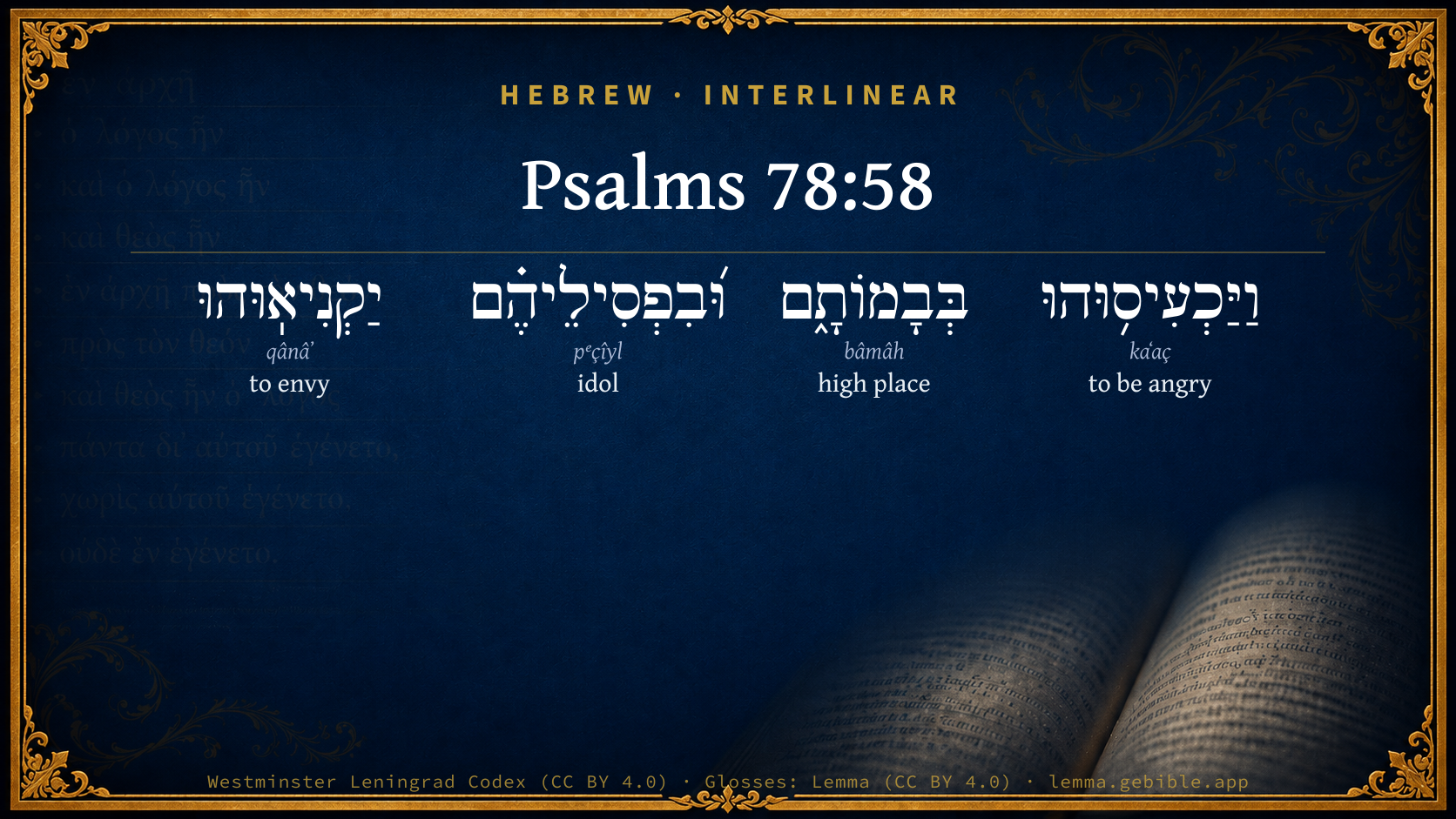
Psalms 78:58

Hebrew (Westminster Leningrad Codex) Psalms 78:58 appears in the Hebrew Old Testament. The text above is from the Westminster Leningrad Codex. Each word links to its Strong’s number, a concise gloss, and parsing drawn from the Open Scriptures Hebrew Bible morphology. Click any word for its full Brown-Driver-Briggs (BDB) entry.
Download image
Cite this verse

Psalms 78:58 (World English Bible). Public Domain. Lemma interlinear Bible study tool, https://lemma.gebible.app/v/psalms/78/58.

Show BibTeX & RIS
BibTeX
RIS
English Translation
For they provoked him to anger with their high places, And moved him to jealousy with their engraved images.
World English Bible · Public Domain
Download a study sheet

One document with this verse’s original text, its word-by-word gloss line, the meaning frame, cross-references with their text, attributed commentary, and full source and license credits — printable, and it pastes into notes with its structure intact.

This verse Autodidact and up

Study sheet (.html) Plain text (.txt)

A passage Seminary Student

Up to 50 verses in one chapter. A passage sheet keeps up to 6 commentary sources and 12 cross-references per verse, in the order this page ranks them, and says so on the sheet whenever that leaves anything out. Ask for a single verse and you get the Autodidact verse sheet above.

Everything on this page stays free to read, with no account — the sheet is a download of what is already on screen, not access to it.

Want to remove ads? Support Godless Engineer
Compare translations 3

The same verse in 3 English versions, stacked beneath the original-language interlinear above. Click any original word for its lexicon entry.

Each is an independent rendering of the whole verse — the interlinear is not word-aligned to these translations.

Highlighted words mark where these versions differ — a whole-verse word diff, not a word-by-word alignment.

  • World English Bible Public Domain
    For they provoked him to anger with their high places, And moved him to jealousy with their engraved images.
  • King James Version Public Domain
    For they provoked him to anger with their high places, and moved him to jealousy with their graven images.
  • unfoldingWord Literal Text CC BY-SA 4.0
    And they provoked him to anger with their high places, and with their carved images they moved him to jealousy.

unfoldingWord Literal Text — © unfoldingWord, licensed CC BY-SA 4.0. Word-aligned USFM3 via Door43 (git.door43.org/unfoldingWord/en_ult).

Versions to compare (up to 4)

3 of 4 selected

Show all 18 translations

Every available English version of this verse, each an independent rendering of the whole verse.

  • World English Bible Public Domain
    For they provoked him to anger with their high places, And moved him to jealousy with their engraved images.
  • Berean Standard Bible Public Domain
    They enraged Him with their high places and provoked His jealousy with their idols.
  • Majority Standard Bible Public Domain
    They enraged Him with their high places and provoked His jealousy with their idols.
  • King James Version Public Domain
    For they provoked him to anger with their high places, and moved him to jealousy with their graven images.
  • American Standard Version (1901) Public Domain
    For they provoked him to anger with their high places, And moved him to jealousy with their graven images.
  • Revised Version (1885) Public Domain
    For they provoked him to anger with their high places, and moved him to jealousy with their graven images.
  • Geneva Bible (1599) Public Domain
    And they prouoked him to anger with their high places, and mooued him to wrath with their grauen images.
  • Douay-Rheims (1899) Public Domain
    They provoked him to anger on their hills: and moved him to jealousy with their graven things.
  • Young's Literal Translation Public Domain
    And make Him angry with their high places, And with their graven images make Him zealous,
  • Literal Standard Version CC BY-SA 4.0
    And make Him angry with their high places, || And make Him zealous with their carved images,
  • Unlocked Literal Bible CC BY-SA 4.0
    For they made him angry with their high places and provoked him to jealous anger with their idols.
  • unfoldingWord Literal Text CC BY-SA 4.0
    And they provoked him to anger with their high places, and with their carved images they moved him to jealousy.
  • Darby Bible Public Domain
    And they provoked him to anger with their high places, and moved him to jealousy with their graven images.
  • World Messianic Bible Public Domain
    For they provoked him to anger with their high places, and moved him to jealousy with their engraved images.
  • Webster's Bible Public Domain
    For they provoked him to anger with their high places, and moved him to jealousy with their graven images.
  • Free Bible Version CC BY-SA 4.0
    They made him angry with their pagan high places of worship; they made him jealous with their idols.
  • Bible in Basic English Public Domain
    They made him angry with their high places; moving him to wrath with their images.
  • JPS Tanakh (1917) Public Domain
    For they provoked Him with their high places, and moved Him to jealousy with their graven images.

Literal Standard Version (2020), Covenant Press — licensed CC BY-SA 4.0. Text via the HelloAO Bible API (eBible.org). Unlocked Literal Bible (unfoldingWord) — licensed CC BY-SA 4.0. Text via the HelloAO Bible API (eBible.org). unfoldingWord Literal Text — © unfoldingWord, licensed CC BY-SA 4.0. Word-aligned USFM3 via Door43 (git.door43.org/unfoldingWord/en_ult). Free Bible Version, Dr. Jonathan Gallagher — licensed CC BY-SA 4.0. Text via the HelloAO Bible API (eBible.org).

Word by word

More ways to search: Search by grammar → Find every occurrence → Compare this word →

Practice this passage: Drill this verse → Learn its vocabulary →

About this verse

These counts appear in no published source. They are computed here, from the morphology-tagged text and Lemma’s own curated glosses. What Lemma adds →

4
words
4
distinct lemmas
Wisdom
section

Notable vocabulary

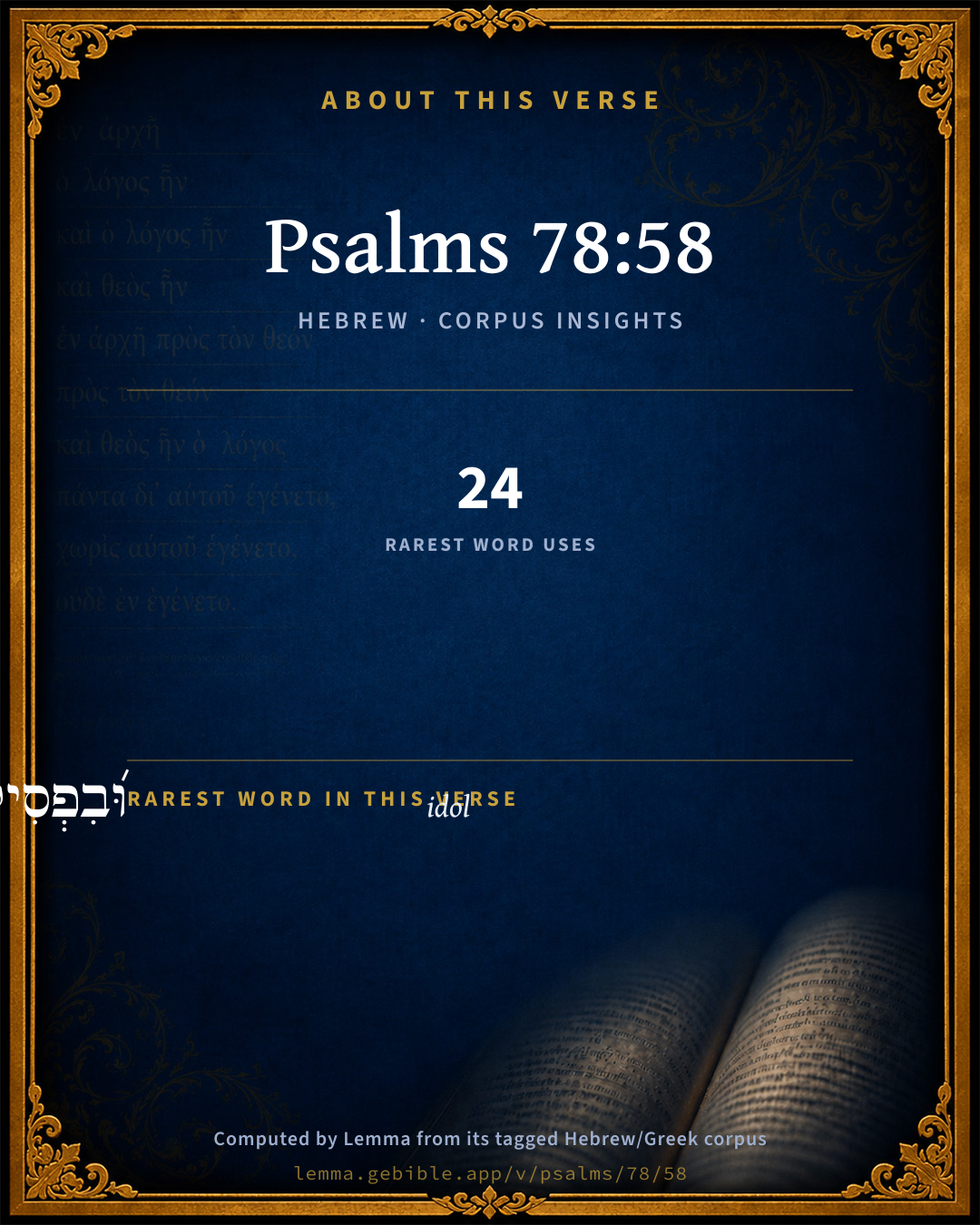
The rarest word here is וּ֝בִפְסִילֵיהֶ֗ם idol H6456 — appearing just 24 times in the whole Hebrew Bible.

Shared distinctive vocabulary

וּ֝בִפְסִילֵיהֶ֗ם idol H6456 occurs in 24 verses of the Hebrew Bible. Also found in:

Grammatical profile

  • 2 verbs
  • 2 nouns

Verb forms

  • וַיַּכְעִיס֥וּהוּ Hiphil · Sequential Imperfect
  • יַקְנִיאֽוּהוּ Hiphil · Imperfect

Hebrew & Septuagint length

In English translation the verse runs 19 words from the Hebrew and 17 from the Septuagint (LXX English) — closely comparable.

A rough comparison of the two English renderings, which tokenize alike — not a word-level alignment.

Word counts can differ between the Hebrew and the Greek without any difference in meaning — e.g. the Hebrew direct-object marker אֵת has no separate Greek word, and Greek often adds the article ὁ.

Cross-references

24

Topical passages linked to Psalms 78:58 in the Treasury of Scripture Knowledge — connected by theme and wording, ordered by reader-vote popularity; previews shown in the World English Bible.

  • Deuteronomy 32:21 They have moved me to jealousy with that which is not God; They have provoked me to anger with their vanities: I will move them to jealousy with those who are not a people; I will provoke them to anger with a foolish nation.
  • Leviticus 26:30 I will destroy your high places, and cut down your incense altars, and cast your dead bodies upon the bodies of your idols; and my soul will abhor you.
  • 1 Kings 12:31 He made houses of high places, and made priests from among all the people, who were not of the sons of Levi.
  • 1 Corinthians 10:22 Or do we provoke the Lord to jealousy? Are we stronger than he?
  • Deuteronomy 12:2 You shall surely destroy all the places in which the nations that you shall dispossess served their gods, on the high mountains, and on the hills, and under every green tree:
  • 1 Kings 11:7 Then did Solomon build a high place for Chemosh the abomination of Moab, on the mountain that is before Jerusalem, and for Molech the abomination of the children of Ammon.
  • Exodus 20:4–5 "You shall not make for yourselves an idol, nor any image of anything that is in the heavens above, or that is in the earth beneath, or that is in the water under the earth:
  • Exodus 34:14 for you shall worship no other god: for Yahweh, whose name is Jealous, is a jealous God.
  • Numbers 33:52 then you shall drive out all the inhabitants of the land from before you, and destroy all their figured [stones], and destroy all their molten images, and demolish all their high places:
  • Deuteronomy 4:16–25 Lest you corrupt yourselves, and make yourself an engraved image in the form of any figure, the likeness of male or female,
  • Deuteronomy 12:4 You shall not do so to Yahweh your God.
  • Deuteronomy 27:15 Cursed be the man who makes an engraved or molten image, an abomination to Yahweh, the work of the hands of the craftsman, and sets it up in secret. All the people shall answer and say, Amen.
  • Deuteronomy 32:16–17 They moved him to jealousy with strange [gods]; With abominations provoked they him to anger.
  • Judges 2:11–12 The children of Israel did that which was evil in the sight of Yahweh, and served the Baals;
  • Judges 2:17 Yet they didn't listen to their judges; for they played the prostitute after other gods, and bowed themselves down to them: they turned aside quickly out of the way in which their fathers walked, obeying the commandments of Yahweh; [but] they didn't do so.
  • Judges 2:20 The anger of Yahweh was kindled against Israel; and he said, Because this nation have transgressed my covenant which I commanded their fathers, and have not listened to my voice;
  • Judges 10:6 The children of Israel again did that which was evil in the sight of Yahweh, and served the Baals, and the Ashtaroth, and the gods of Syria, and the gods of Sidon, and the gods of Moab, and the gods of the children of Ammon, and the gods of the Philistines; and they forsook Yahweh, and didn't serve him.
  • 1 Kings 11:10 and had commanded him concerning this thing, that he should not go after other gods: but he didn't keep that which Yahweh commanded.
  • Psalms 79:5 How long, Yahweh? Will you be angry forever? Will your jealousy burn like fire?
  • Psalms 97:7 Let all them be shamed who serve engraved images, Who boast in their idols. Worship him, all you gods!
  • Jeremiah 8:19 Behold, the voice of the cry of the daughter of my people from a land that is very far off: isn't Yahweh in Zion? Isn't her King in her? Why have they provoked me to anger with their engraved images, and with foreign vanities?
  • Ezekiel 8:3–5 He put forth the form of a hand, and took me by a lock of my head; and the Spirit lifted me up between earth and the sky, and brought me in the visions of God to Jerusalem, to the door of the gate of the inner [court] that looks toward the north; where was the seat of the image of jealousy, which provokes to jealousy.
  • Ezekiel 20:28–29 For when I had brought them into the land, which I swore to give to them, then they saw every high hill, and every thick tree, and they offered there their sacrifices, and there they presented the provocation of their offering; there also they made their sweet savor, and they poured out there their drink-offerings.
  • Hosea 13:2 Now they sin more and more, And have made themselves molten images of their silver, Even idols according to their own understanding, All of them the work of the craftsmen. They say of them, "They offer human sacrifice and kiss the calves."

Cross-references courtesy of OpenBible.info (CC BY 4.0).

Hebrew and Greek witnesses Masoretic Hebrew ↔ Greek Septuagint

The same verse in the two great witnesses to the Old Testament, shown verse-for-verse.

You’re reading Greek Psalm 77 (Hebrew Psalm 78). The Septuagint counts the superscription, so verse numbers can differ from the Hebrew — chapter-level alignment, not verse-by-verse. Numbering follows Rahlfs.

These are two independent witnesses, not word-aligned to each other, and the Septuagint is shown in lemma (dictionary) form.

Hebrew Psalms 78:58 Masoretic · Westminster Leningrad Codex

וַיַּכְעִיס֥וּהוּ בְּבָמוֹתָ֑ם וּ֝בִפְסִילֵיהֶ֗ם יַקְנִיאֽוּהוּ

For they provoked him to anger with their high places, And moved him to jealousy with their engraved images.

World English Bible · Public Domain

Greek LXX Greek Psalm 77:58 Septuagint · lemma form

καί παραὀργίζω αὐτός ἐν ὁ βουνός αὐτός καί ἐν ὁ γλυπτός αὐτός παραζηλόω αὐτός

And they provoked him with their high places, and moved him to jealousy with their graven images.

LXX2012 (modern English Septuagint) · Public Domain

Hebrew: Westminster Leningrad Codex (CC BY 4.0). Greek: Septuagint (public domain); English from LXX2012 (modern English Septuagint) (Public Domain). How the Septuagint differs from the Hebrew →

Commentary

Notes on Psalms 78:58 from classic Christian and Jewish commentators (each source and its license shown beneath its notes). The classic Christian expositions comment on the surrounding passage and are grouped to its opening verse, so a note may address several verses; the Jewish commentaries on the Tanakh (Rashi and others) are per-verse, so they appear only where the commentator wrote on this verse.

Lemma curates 59 commentaries, every one of them public domain or Creative Commons licensed, each selected and text-cleaned for this edition rather than reprinted as found. About our sources →

Trapp's Complete Commentary

John Trapp

Psa 78:58 For they provoked him to anger with their high places, and moved him to jealousy with their graven images.

Ver. 58. For they provoked him to anger with their high places] After the manner of the heathens; yet with a good intention, as they called it; because God is to be everywhere worshipped. But this was against an express law, Deu 12:2 Exo 20:3-4.

John Trapp, A Commentary or Exposition upon All the Books of the Old and New Testament (1647–1656) — public domain. Text from a community e-Sword module.

J. A. Alexander on Psalms

Joseph Addison Alexander

58. (Psa 78:58) And made him angry with their heights, and with their idols made him jealous. Here, for the first time, idolatry is mentioned as the great national sin of Israel after the death of Joshua and the contemporary elders. This sin is intimately connected with the one described in Psa 78:9, since the failure to exterminate the Canaanites and gain complete possession of the country, with its necessary consequence, the continued residence of gross idolaters in the midst of Israel, could not fail to expose the chosen people to perpetual temptation, and afford occasion to their worst defections. In the last clause, graven images are put for the whole class of idols or created gods, of whom the true God must be jealous as his rivals, as well as indignant at the heights or high places, the hill-tops where these false gods were most usually worshipped. The whole form of expression is Mosaic. See Deu 32:16; Deu 32:21, and compare Exo 20:5.

Joseph Addison Alexander, The Psalms Translated and Explained (1850) — public domain. Text from a community e-Sword module.

Geneva Bible (1599)

Geneva Bible translators

By serving God otherwise than he had appointed.

Geneva Bible (1599) marginal notes — public domain. Text via Bolls.life.

John Calvin's Commentaries

58. And they provoked him to anger with their high places. We have here adduced the species of defection by which the Israelites afforded incontestable evidence that they refused to be faithful to God, and to yield allegiance to him. They had been sufficiently, and more than sufficiently warned, that the service of God would be perverted and contaminated, unless they were regulated in every part of it by the Divine Word; and now, disregarding his whole law, they recklessly follow their own inventions. And the fruits which uniformly proceed from the contempt of the law are, that men who choose rather to follow their own understanding than to submit to the authority of God, become wedded to gross superstitions. The Psalmist complains that the service of God was corrupted by them in two ways; in the first place, by their defacing the glory of God, in setting up for themselves idols and graven images; and, secondly, by their inventing strange and forbidden ceremonies to appease the anger of God.

John Calvin's Commentaries (1540-1563) — public domain. Text from the Calvin Translation Society English edition (1840s-50s) via the Christian Classics Ethereal Library (ccel.org). Calvin's coverage is partial (roughly two-thirds of the Bible); uncommented books and verses are honest gaps, never fabricated. The 19th-century editor's footnotes and remarks are omitted so the notes are faithfully Calvin's own voice.

The Cambridge Bible for Schools and Colleges

gen. ed. J. J. S. Perowne

58. They provoked Jehovah, the “jealous God” Who can tolerate no rival (Exo_20:5), by their adoption of Canaanite idolatries. Cp. Deu_32:16; Deu_32:21.

The Cambridge Bible for Schools and Colleges (gen. ed. J. J. S. Perowne; Cambridge University Press, 1878–1918) — public domain. Text from a community e-Sword module.

John Gill's Exposition

When God heard this,.... Their building high places, and sacrificing on them, their making and worshipping graven images, and the language which such actions spoke; who also heard what they said to their idols, when they paid their devotion to them, acknowledging them to be their gods; he took notice of and observed all this, for nothing could pass his all seeing eye and hearing ear; and who acted as a righteous Judge, first heard, and then proceeded to give and execute the sentence; by which he let them know that he did hear and observe what they said and did:

he was wroth, and greatly abhorred Israel; not his remnant among them, according to the election of grace, which he in all ages had; for this would be contrary to his everlasting love, which always continues; to the immutability of his nature, who changes not; to his Word, who says, fury is not in me; and to his oath, who hath sworn that he will not be wroth with his people: he may indeed, and does, abhor their sins, but not their persons; he may seem to them and others, in the dispensations of his providence, to be wroth with them and abhor them; but does not in reality. This is to be understood of the bulk of the people in general, and is to be explained and illustrated by those several instances of his displeasure with them in the times of the judges; when his anger waxed hot against them for their idolatries and other sins, and he delivered them up into the hands of their enemies, Jdg 3:7.

John Gill's Exposition of the Whole Bible (1746–1763) — public domain (CC PDM 1.0). Text via the HelloAO Bible API.

Albert Barnes' Notes on the Bible

For they provoked him to anger with their high places - places where idols were worshipped; usually on mountains or elevated places. Lev 26:30; compare 1Ki 3:2; 1Ki 12:31-32; 2Ki 17:32; 2Ch 33:17.

And moved him to jealousy - As one is when affections due to himself are bestowed upon another - as in the married life. “With their graven images.” Their idols. Graven images are here put for idols in general.

Albert Barnes' Notes on the Bible (1834–1885) — public domain. Text from a community e-Sword/MySword module.

The Treasury of David

Charles H. Spurgeon

Ver. 58. For they provoked him to anger with their high places. This was their first errorwill worship, or the worship of God, otherwise than according to his command. Many think lightly of this, but it was no mean sin; and its tendencies to further offence are very powerful. The Lord would have his holy place remain as the only spot for sacrifice; and Israel, in wilful rebellion, (no doubt glossed over by the plea of great devotion,)determined to have many altars upon many hills. If they might have but one God, they insisted upon it that they would not be restricted to one sacred place of sacrifice. How much of the worship of the present day is neither more nor less than sheer will worship! Nobody dare plead a divine appointment for a tithe of the offices, festivals, ceremonies, and observances of certain churches. Doubtless God, so far from being honoured by worship which he has not commanded, is greatly angered at it.

And moved him to jealousy with their graven images. This was but one more step; they manufactured symbols of the invisible God, for they lusted after something tangible and visible to which they could shew reverence. This also is the crying sin of modern times. Do we not hear and see superstition abounding? Images, pictures, crucifixes, and a host of visible things are had in religious honour, and worst of all men now a days worship what they eat, and call that a God which passes into their belly, and thence into baser places still. Surely the Lord is very patient, or he would visit the earth for this worst and basest of idolatry. He is a jealous God, and abhors to see himself dishonoured by any form of representation which can come from man's hands.

Ver. 58. High places. Or, altars, chapels, and such like places, to celebrate divine service in, out of the only place which was by him consecrated, and was alone acceptable unto him; or peradventure also dedicated to idols; and were so called, because that they chose out the choicest hills and hillocks for those purposes. John Diodati.

None.

Charles H. Spurgeon's The Treasury of David (1869–1885) — public domain. Psalms only. Text from a community e-Sword/MySword module.

The Pulpit Commentary

For they provoked him to anger with their high places. The "high place" worship was always displeasing to God. It was, no doubt, deeply tinged with idolatry. And moved him to jealousy with their graven images. In the time of the Judges, both graven and molten images were employed by the Israelites in a worship which they nevertheless regarded as the worship of Jehovah. (see the history of Micah in Jud_1:17 and Jud_1:18, especially Jud_1:17:4, 13, and Jud_1:18:14, 17, 18, 31)

The Pulpit Commentary (1880–1919), ed. H.D.M. Spence-Jones & Joseph S. Exell — public domain. Text from a community e-Sword module.

unfoldingWord translationNotes

Door43 World Missions Community

General Information:

The writer continues to describe what God did for the people of Israel.

made him angry with their high places and provoked him to jealous anger with their idols

These two phrases are in parallel and have similar meanings. (See: Parallelism)

translationWords

anger

high place

jealous

false god

reject

unfoldingWord translationNotes — © Distant Shores Media and the Door43 World Missions Community, licensed CC BY-SA 4.0. Source: git.door43.org/Door43/en_tn.

Lesson kit

Teaching starters — assembled from the data on this page, not authored interpretation. Every prompt links to the verse data it draws on. Edit before teaching.

Psalms, in the Wisdom, opens this verse with 4 words (4 distinct Hebrew lemmas). Its most distinctive word is pᵉçîyl (“idol”). A historical commentator’s framing appears above. Read the whole chapter for the surrounding context.

Discussion questions

  1. The word pᵉçîyl carries the sense “idol.” How does it shape the verse?
  2. Deuteronomy 7:5 shares the word «idol» with this verse. How do the two illuminate each other?
  3. These translations render this verse differently. What is at stake in choosing one wording over another?
  4. The verb «וַיַּכְעִיס֥וּהוּ» is Hiphil Sequential Imperfect. How does its form color the action?
  5. Reading how Trapp's Complete Commentary and J. A. Alexander on Psalms read this verse, where do the two commentators agree and where do they part?

Things to notice

Reading settings

Reading text

Shown beneath each verse's original-language words.

Old Testament
Old Testament edition

Read the OT as the Masoretic Hebrew (MT) or the Greek Septuagint (LXX).

English shown for the Greek Septuagint (in the Hebrew ↔ Greek comparison).

Comparing translations? Open the Compare panel on any verse page to stack up to four side by side.