Habakkuk 3:19

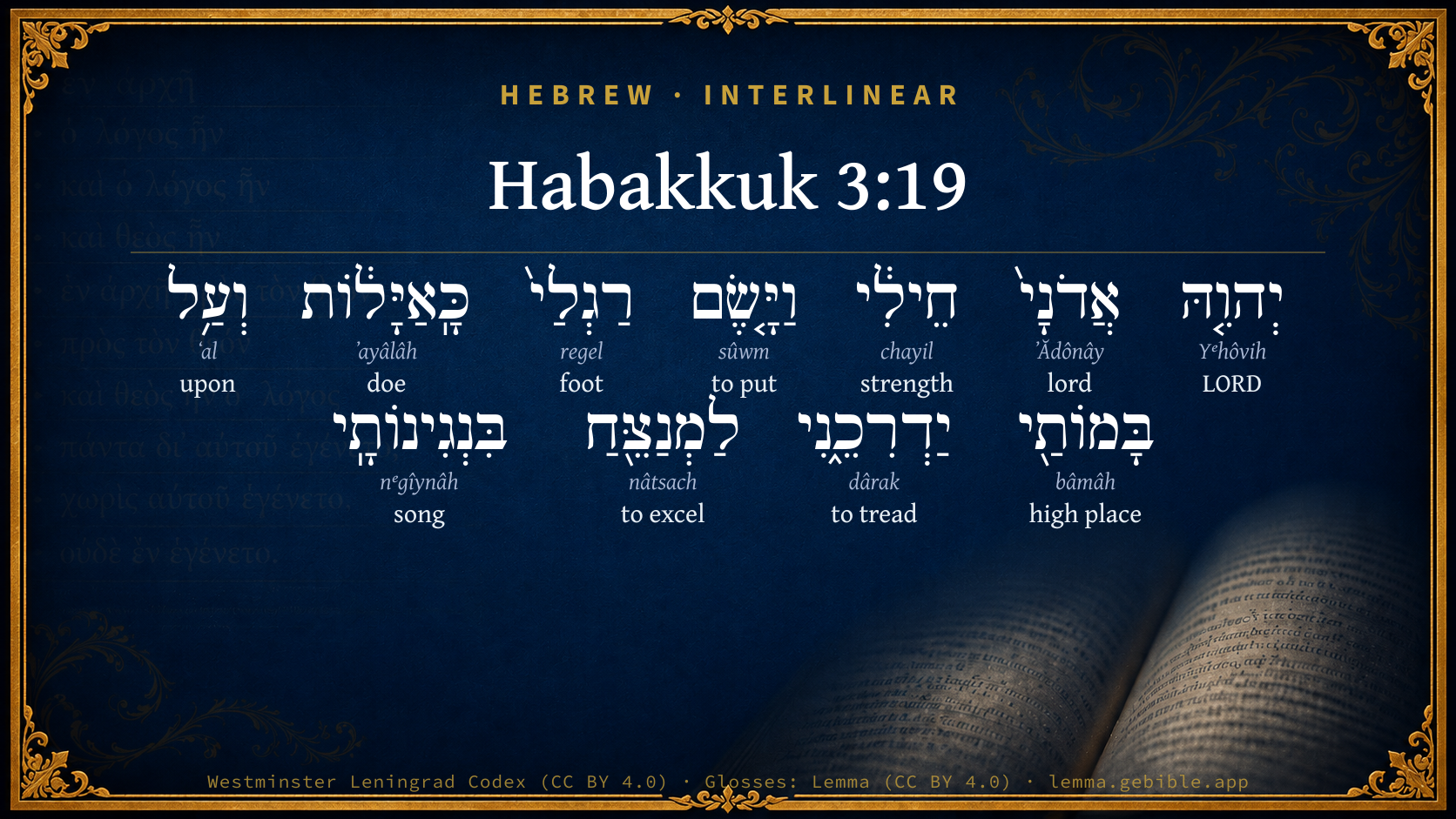
Hebrew (Westminster Leningrad Codex) Habakkuk 3:19 appears in the Hebrew Old Testament. The text above is from the Westminster Leningrad Codex. Each word links to its Strong’s number, a concise gloss, and parsing drawn from the Open Scriptures Hebrew Bible morphology. Click any word for its full Brown-Driver-Briggs (BDB) entry.
Download image
Cite this verse

Habakkuk 3:19 (World English Bible). Public Domain. Lemma interlinear Bible study tool, https://lemma.gebible.app/v/habakkuk/3/19.

Show BibTeX & RIS
BibTeX
RIS
English Translation
Yahweh, the Lord, is my strength. He makes my feet like deer's feet, And enables me to go in high places. For the music director, on my stringed instruments.
World English Bible · Public Domain
Download a study sheet

One document with this verse’s original text, its word-by-word gloss line, the meaning frame, cross-references with their text, attributed commentary, and full source and license credits — printable, and it pastes into notes with its structure intact.

This verse Autodidact and up

Study sheet (.html) Plain text (.txt)

A passage Seminary Student

Up to 50 verses in one chapter. A passage sheet keeps up to 6 commentary sources and 12 cross-references per verse, in the order this page ranks them, and says so on the sheet whenever that leaves anything out. Ask for a single verse and you get the Autodidact verse sheet above.

Everything on this page stays free to read, with no account — the sheet is a download of what is already on screen, not access to it.

Want to remove ads? Support Godless Engineer
Compare translations 3

The same verse in 3 English versions, stacked beneath the original-language interlinear above. Click any original word for its lexicon entry.

Each is an independent rendering of the whole verse — the interlinear is not word-aligned to these translations.

Highlighted words mark where these versions differ — a whole-verse word diff, not a word-by-word alignment.

  • World English Bible Public Domain
    Yahweh, the Lord, is my strength. He makes my feet like deer's feet, And enables me to go in high places. For the music director, on my stringed instruments.
  • King James Version Public Domain
    The LORD God is my strength, and he will make my feet like hinds' feet, and he will make me to walk upon mine high places. To the chief singer on my stringed instruments.
  • unfoldingWord Literal Text CC BY-SA 4.0
    Yahweh the Lord my strength, and he made my feet like deer, and on my high places he makes me tread. q1 To the chief musician, on my stringed instruments.

unfoldingWord Literal Text — © unfoldingWord, licensed CC BY-SA 4.0. Word-aligned USFM3 via Door43 (git.door43.org/unfoldingWord/en_ult).

Versions to compare (up to 4)

3 of 4 selected

Show all 18 translations

Every available English version of this verse, each an independent rendering of the whole verse.

  • World English Bible Public Domain
    Yahweh, the Lord, is my strength. He makes my feet like deer's feet, And enables me to go in high places. For the music director, on my stringed instruments.
  • Berean Standard Bible Public Domain
    GOD the Lord is my strength; He makes my feet like those of a deer; He makes me walk upon the heights! For the choirmaster. With stringed instruments.
  • Majority Standard Bible Public Domain
    GOD the Lord is my strength; He makes my feet like those of a deer; He makes me walk upon the heights! For the choirmaster. With stringed instruments.
  • King James Version Public Domain
    The LORD God is my strength, and he will make my feet like hinds' feet, and he will make me to walk upon mine high places. To the chief singer on my stringed instruments.
  • American Standard Version (1901) Public Domain
    Jehovah, the Lord, is my strength; And he maketh my feet like hinds' `feet', And will make me to walk upon my high places.
  • Revised Version (1885) Public Domain
    Jehovah, the Lord, is my strength, and he maketh my feet like hinds’ feet, and will make me to walk upon mine high places. For the Chief Musician, on my stringed instruments.
  • Geneva Bible (1599) Public Domain
    The Lord God is my strength: hee will make my feete like hindes feete, and he will make me to walke vpon mine hie places. To the chiefe singer on Neginothai.
  • Douay-Rheims (1899) Public Domain
    The Lord God is my strength: and he will make my feet like the feet of harts: and he the conqueror will lead me upon my high places singing psalms.
  • Young's Literal Translation Public Domain
    Jehovah the Lord `is' my strength, And He doth make my feet like hinds, And on my high-places causeth me to tread. To the overseer with my stringed instruments!
  • Literal Standard Version CC BY-SA 4.0
    YHWH the Lord [is] my strength, || And He makes my feet like does, || And causes me to tread on my high-places. To the overseer with my stringed instruments!
  • Unlocked Literal Bible CC BY-SA 4.0
    The Lord Yahweh is my strength and he makes my feet like the deer's. He makes me go forward on my high places. —To the music director, on my stringed instruments.
  • unfoldingWord Literal Text CC BY-SA 4.0
    Yahweh the Lord my strength, and he made my feet like deer, and on my high places he makes me tread. q1 To the chief musician, on my stringed instruments.
  • Darby Bible Public Domain
    Jehovah, the Lord, is my strength, And he maketh my feet like hinds' [feet], And he will make me to walk upon my high places. To the chief Musician. On my stringed instruments.
  • World Messianic Bible Public Domain
    GOD, the Lord, is my strength. He makes my feet like deer’s feet, and enables me to go in high places. For the music director, on my stringed instruments.
  • Webster's Bible Public Domain
    The LORD God is my strength, and he will make my feet like hinds' feet, and he will make me to walk upon my high places. To the chief singer on my stringed instruments.
  • Free Bible Version CC BY-SA 4.0
    The Lord God is my strength. He makes me able to walk in the highest mountains, as sure-footed as a deer. (To the music director: with my stringed instruments.)
  • Bible in Basic English Public Domain
    The Lord God is my strength, and he makes my feet like roes' feet, guiding me on my high places. For the chief music-maker on corded instruments.
  • JPS Tanakh (1917) Public Domain
    God, the Lord, is my strength, and He maketh my feet like hinds' feet, and He maketh me to walk upon my high places. For the Leader. With my string-music.

Literal Standard Version (2020), Covenant Press — licensed CC BY-SA 4.0. Text via the HelloAO Bible API (eBible.org). Unlocked Literal Bible (unfoldingWord) — licensed CC BY-SA 4.0. Text via the HelloAO Bible API (eBible.org). unfoldingWord Literal Text — © unfoldingWord, licensed CC BY-SA 4.0. Word-aligned USFM3 via Door43 (git.door43.org/unfoldingWord/en_ult). Free Bible Version, Dr. Jonathan Gallagher — licensed CC BY-SA 4.0. Text via the HelloAO Bible API (eBible.org).

Word by word

More ways to search: Search by grammar → Find every occurrence → Compare this word →

Practice this passage: Drill this verse → Learn its vocabulary →

כָּֽאַיָּל֔וֹת
ʼayâlâh
H355
“like/as the · does”
Preposition, Determined + Noun, Common, Feminine, Plural, Absolute
Part of Speech
Preposition + Noun
Type
Common
Gender
Feminine
Number
Plural
State
Absolute
Full BDB Definition

Origin: feminine of H354

TWOT: 45l

doe, deer, hind
  1. יְהוִ֤הּ Yᵉhôvih H3069 “LORD” Noun, Proper
  2. אֲדֹנָי֙ ʼĂdônây H136 “Lord · my” Noun, Common, Masculine, Plural, Construct + Suffix, Personal, 1st Person, Common, Singular
  3. חֵילִ֔י chayil H2428 “strength · my” Noun, Common, Masculine, Singular, Construct + Suffix, Personal, 1st Person, Common, Singular
  4. וַיָּ֤שֶׂם sûwm H7760 “and · to put” Conjunction + Verb, Qal, Sequential Imperfect, 3rd Person, Masculine, Singular
  5. רַגְלַי֙ regel H7272 “feet · my” Noun, Common, Feminine, Dual, Construct + Suffix, Personal, 1st Person, Common, Singular
  6. וְעַ֥ל ʻal H5921 “and · upon” Conjunction + Preposition
  7. בָּמוֹתַ֖י bâmâh H1116 “high places · my” Noun, Common, Feminine, Plural, Construct + Suffix, Personal, 1st Person, Common, Singular
  8. יַדְרִכֵ֑נִי dârak H1869 “to tread · me” Verb, Hiphil, Imperfect, 3rd Person, Masculine, Singular + Suffix, Personal, 1st Person, Common, Singular
  9. לַמְנַצֵּ֖חַ nâtsach H5329 “to/for the · excelling” Preposition, Determined + Verb, Piel, Participle Active, Masculine, Singular, Absolute
  10. בִּנְגִינוֹתָֽי nᵉgîynâh H5058 “in/at · songs” Preposition + Noun, Common, Feminine, Plural, Absolute

About this verse

These counts appear in no published source. They are computed here, from the morphology-tagged text and Lemma’s own curated glosses. What Lemma adds →

11
words
11
distinct lemmas
Prophets
section

Notable vocabulary

The rarest word here is כָּֽאַיָּל֔וֹת doe H355 — appearing just 8 times in the whole Hebrew Bible.

Shared distinctive vocabulary

כָּֽאַיָּל֔וֹת doe H355 occurs in 8 verses of the Hebrew Bible. Also found in:

Grammatical profile

  • 3 verbs
  • 7 nouns
  • 1 preposition

Verb forms

  • וַיָּ֤שֶׂם Qal · Sequential Imperfect
  • יַדְרִכֵ֑נִי Hiphil · Imperfect
  • לַמְנַצֵּ֖חַ Piel · Participle Active

Hebrew & Septuagint length

In English translation the verse runs 29 words from the Hebrew and 26 from the Septuagint (LXX English) — closely comparable.

A rough comparison of the two English renderings, which tokenize alike — not a word-level alignment.

Word counts can differ between the Hebrew and the Greek without any difference in meaning — e.g. the Hebrew direct-object marker אֵת has no separate Greek word, and Greek often adds the article ὁ.

Cross-references

20

Topical passages linked to Habakkuk 3:19 in the Treasury of Scripture Knowledge — connected by theme and wording, ordered by reader-vote popularity; previews shown in the World English Bible.

  • 2 Samuel 22:34 He makes his feet like hinds' [feet], Sets me on my high places.
  • Psalms 18:33 He makes my feet like deer's feet, And sets me on my high places.
  • Philippians 4:13 I can do all things through Christ, who strengthens me.
  • Psalms 46:1 God is our refuge and strength, A very present help in trouble.
  • Deuteronomy 32:13 He made him ride on the high places of the earth, He ate the increase of the field; He made him to suck honey out of the rock, Oil out of the flinty rock;
  • Psalms 27:1 Yahweh is my light and my salvation. Whom shall I fear? Yahweh is the strength of my life. Of whom shall I be afraid?
  • Isaiah 58:14 then shall you delight yourself in Yahweh; and I will make you to ride on the high places of the earth; and I will feed you with the heritage of Jacob your father: for the mouth of Yahweh has spoken it.
  • 2 Corinthians 12:9–10 He has said to me, "My grace is sufficient for you, for my power is made perfect in weakness." Most gladly therefore I will rather glory in my weaknesses, that the power of Christ may rest on me.
  • Isaiah 12:2 Behold, God is my salvation. I will trust, and will not be afraid; for Yah, Yahweh, is my strength and song; and he has become my salvation."
  • Ephesians 3:16 that he would grant you, according to the riches of his glory, that you may be strengthened with power through his Spirit in the inward man;
  • Colossians 1:11 strengthened with all power, according to the might of his glory, for all endurance and perseverance with joy;
  • Deuteronomy 33:29 Happy are you, Israel: Who is like you, a people saved by Yahweh, The shield of your help, The sword of your excellency! Your enemies shall submit themselves to you; You shall tread on their high places.
  • Psalms 4:1–8 Answer me when I call, God of my righteousness. Give me relief from my distress. Have mercy on me, and hear my prayer.
  • Zechariah 10:12 I will strengthen them in Yahweh; And they will walk up and down in his name," says Yahweh.
  • Psalms 18:1 I love you, Yahweh, my strength.
  • Psalms 76:1–12 In Judah, God is known. His name is great in Israel.
  • Psalms 6:1–10 Yahweh, don't rebuke me in your anger, Neither discipline me in your wrath.
  • Psalms 54:1–55:23 Save me, God, by your name. Vindicate me in your might.
  • Isaiah 45:24 Only in Yahweh, it is said of me, is righteousness and strength; even to him shall men come; and all those who were incensed against him shall be disappointed.
  • Psalms 67:1–7 May God be merciful to us, bless us, And cause his face to shine on us. Selah.

Cross-references courtesy of OpenBible.info (CC BY 4.0).

Hebrew and Greek witnesses Masoretic Hebrew ↔ Greek Septuagint

The same verse in the two great witnesses to the Old Testament, shown verse-for-verse.

These are two independent witnesses, not word-aligned to each other, and the Septuagint is shown in lemma (dictionary) form.

Hebrew Habakkuk 3:19 Masoretic · Westminster Leningrad Codex

יְהוִ֤הּ אֲדֹנָי֙ חֵילִ֔י וַיָּ֤שֶׂם רַגְלַי֙ כָּֽאַיָּל֔וֹת וְעַ֥ל בָּמוֹתַ֖י יַדְרִכֵ֑נִי לַמְנַצֵּ֖חַ בִּנְגִינוֹתָֽי

Yahweh, the Lord, is my strength. He makes my feet like deer's feet, And enables me to go in high places. For the music director, on my stringed instruments.

World English Bible · Public Domain

Greek LXX Habakkuk 3:19 Septuagint · lemma form

κύριος ὁ θεός δύναμις ἐγώ καί τάσσω ὁ πούς ἐγώ εἰς συντέλεια ἐπί ὁ ὑψηλός ἐπιβιβάζω ἐγώ ὁ νικάω ἐν ὁ ᾠδή αὐτός

The Lord God is my strength, and he will perfectly strengthen my feet; he mounts me upon high places, that I may conquer by his song.

LXX2012 (modern English Septuagint) · Public Domain

On this verse, Haydock's Catholic Bible Commentary discusses the Septuagint’s reading. Read the note in Commentary ↓

Hebrew: Westminster Leningrad Codex (CC BY 4.0). Greek: Septuagint (public domain); English from LXX2012 (modern English Septuagint) (Public Domain). How the Septuagint differs from the Hebrew →

Targum (Aramaic paraphrase)

1

The Targum is the ancient Jewish Aramaic paraphrase of the Hebrew Scriptures — an interpretive translation, not the Hebrew text itself. Onkelos (literal) and Pseudo-Jonathan (expansive) render the Torah, and Jonathan the Prophets. Coverage is partial: where no permissively-licensed English translation exists for a verse, only the Aramaic is shown. This is verse-level text, not a word-by-word alignment to the Hebrew.

  1. Targum Jonathan Prophets (Joshua–Malachi)
    אֱלֹהִים יְיָ דְסָעֵיד לִי בְּחֵילָא מְשַׁוֵי רַגְלַי קַלִילִין כְּאַיָלָתָא וְעַל בֵּית תּוּקְפִי יְקִימְינָנִי לְדִילֵיהּ נִצְחָנִין וּגְבוּרָן וְקֳדָמוֹהִי אֲנָא מְנַגֵן בְּתוּשְׁבַּחְתִּי:

    (no public-domain English translation for this verse)

    Targum Jonathan — Aramaic: “Mikraot Gedolot” (public domain). English: “Sefaria Community Translation” (CC0 1.0 (public-domain dedication)); “London "Chaldee Paraphrase," 1871” (public domain). Text via Sefaria.

Commentary

Notes on Habakkuk 3:19 from classic Christian and Jewish commentators (each source and its license shown beneath its notes). The classic Christian expositions comment on the surrounding passage and are grouped to its opening verse, so a note may address several verses; the Jewish commentaries on the Tanakh (Rashi and others) are per-verse, so they appear only where the commentator wrote on this verse.

Lemma curates 59 commentaries, every one of them public domain or Creative Commons licensed, each selected and text-cleaned for this edition rather than reprinted as found. About our sources →

Trapp's Complete Commentary

John Trapp

Hab 3:19 The LORD God [is] my strength, and he will make my feet like hinds’ [feet], and he will make me to walk upon mine high places. To the chief singer on my stringed instruments.

Ver. 19. The Lord God is my strength] And hence his joy of faith, and ability to bear up under pressures of afflictions, as a man that is well lined within, and hath abundance of good blood and fresh spirits, can endure to go with less clothes than another.

And he will make my feet like hinds’ feet] As these do swiftly and suddenly run up to the top of inaccessible rocks, so shall I quickly escape out of trouble and walk upon mine high places again in the holy land; yea, as Jacob, after he had conversed with God at Bethel, lifted up his feet and went lustily on his way to Padanaram, Gen 29:1, so shall I go lightly on my long journey to heaven; and, having my soul supplied with the oil of spiritual joy, I shall find it made more lithe, nimble, and ready to every good work.

To the chief musician on my stringed instruments] This is David-like indeed, as in the whole prayer or song he resembleth that sweet singer of Israel; and the verse hath caused a cloud. Euthymius saith of David, that he was Primi regis et lingua et cor et calamus, the tongue, heart, and pen of Almighty God. In the primitive times happy was he held that could repeat aliquid Davidicmn, anything of David’s doings. Our King Alfred translated the Psalter himself into his own Saxon tongue. Andronicus, the Greek emperor, made it his manual, his Vade mecum. It appeareth by the context of this whole chapter that the prophet Habakkuk was well versed in the Psalms, which is a sweet field and rosary of promises, a summary of the Old Testament, saith Luther; the good soul’s soliloquy, saith another, wherein are amulets of comfort more pleasant than the pools of Heshbon, more glorious than the tower of Lebanon, more redolent than the oil of Aaron, more fructifying than the dew of Hermon. Most worthy to be laid up in that Persian casket embroidered with gold and pearl, which Alexander reserved for Homer’s Iliad. Our prophet, as he partly imitated, and partly transcribed them in this Canticle, yea, in this verse, {confer Psa 18:33-34} so he concludeth as David many times beginneth, To the chief chanter or music master, or, To him that excelleth in the art of singing and playing on instruments, those holy Levites, whose charge it was, 1Ch 9:33, and for whom he doubted not but God would afford and provide new matter of psalmody, by compassing his people about with songs of deliverance. Selah. Psa 32:7.

John Trapp, A Commentary or Exposition upon All the Books of the Old and New Testament (1647–1656) — public domain. Text from a community e-Sword module.

The Biblical Illustrator

Joseph S. Exell

Hab_3:19

The Lord God is my strength, and He will make my feet like hinds feet.

Strength, buoyancy, devotion

The expressions are of a highly metaphorical and imaginative character, but they admit of being brought down to very plain facts, and they tell us the results in heart and mind of true faith and communion with God. It is to be noticed that a parallel saying, almost verbatim, the same is that of my text, occurs in the 18th Psalm. I note that the three clauses of our text present three aspects of what our lives and ourselves may steadfastly be if we, too, will rejoice in the God of our salvation. First, such communion with God brings--

I. God to a man for his strength. The 18th Psalm gives a somewhat different and inferior version of that thought when it says, It is the Lord that girdeth me with strength. But Habakkuk, though perhaps he could not have put into dogmatic shape all that he meant, had come further than that, The Lord is my strength. He not only gives, as one might put a coin into the hand of a beggar, while standing separate from him all the while, but the Lord is my strength. And what does that mean? It is an anticipation of that most wonderful and highest of all the New Testament truths which the Apostle declared when he said: I can do all things in Christ which strengtheneth me within. My grace is sufficient for thee, and My strength is made perfect in weakness. Ah! do not let us deprive ourselves of the lofty consolations and the mysterious influx of power which may be ours. That is the first blessing that this ancient believer, out of the twilight of early revelation, felt as certain to come through communion with God. The second is like unto it. Such rejoicing communion with God will give--

II. Light-footedness in the path of life. He makes my feet like hinds feet. The stag, in all languages spoken by people that have ever seen it, is the very emblem of elastic, springing ease, of light and bounding gracefulness, that clears every obstacle, and sweeps swiftly over the moor. And when this singer, or his brother psalmist in the other psalm that we have referred to, says Thou makest my feet like hinds feet, what he is thinking about is that fight and easy, springing, elastic gait, that swiftness of advance. What a contrast that is to the way in which most of us get through our days work! The monotony of trivial, constantly recurring doings, the fluctuations in the thermometer of our own spirits; the stiff bits of road that we have all to encounter sooner or later; and, as days go on, the diminishing buoyancy of nature, and the love of walking a little slower than we used to do; we all know these things, and our gait is affected by them. It is the same thought, under a somewhat different garb, which the apostle has when he tells us that the Christian soldier ought to have his feet shod with the alacrity that comes from the Gospel of peace. We are to be always ready to run, and to run with light hearts when we do. That is a possible result of Christian communion, and ought, far more than it is, to be an achieved reality with each of us. Of course, physical conditions vary. Of course, our spirits go up and down. Of course, the work that we have to do one day seems easier than the same work does another. Unless that is true, that Christianity gives to a man the Divine gladness which makes him ready for work, I do not know what is the good of his Christianity to him. But not only is that so, but this same communion with God, which is the opening of the heart for the influx of the Divine power, brings to bear upon all our work new motives which redeem it from being oppressive, tedious, monotonous, trivial, too much for our endurance, or too little for our effort. All work that is not done in fellowship with Jesus Christ tends to become either too heavy to be tackled successfully, or too trivial to demand our best energies; and in either case will be done perfunctorily, and, as the days go on, mechanically and wearisomely, as a grind and a plod. If we live in daily communion with God, another thought, too, will come in, which will, in like manner, make us ready to run with cheerfulness the race that is set before us. We shall connect everything that befalls us, and everything that we have to do, with the final issue, and life will become solemn, grave, and blessed, because it is the outer court and vestibule of the eternal life with God in Christ. The last of the thoughts here is, communion with God brings--

III. Elevation. He will make me to walk upon my high places. One sees the herd on the skyline of the mountain ridge, and at home up there, far above dangers and attack; able to keep their footing on cliff and precipice, and tossing their antlers in the pure air. One wave of the hand, and they are miles away. He sets me upon my high places. Communion with God does not, only help us to plod and to travel, but it helps us to soar. If we keep ourselves in touch with Him we shall be like a weight that is hung on to a balloon. The buoyancy of the one will lift the leadenness of the other. Are you and I familiar with these upper ranges of thought and experience and life? Do we feel at home there more than down in the bottom, amongst the swamps and the miasma and the mists? It is safe up there. The air is pure; the poison mists are down lower; the hunters do not come there; their arrows or their rifles will not carry so far. It is only when the herd ventures a little down the hill that it is in danger from shots. But the elevation will not be such aa to make us despise the low paths on which duty--the sufficient and loftiest thing of all--lies for us. Our souls may be like stars, and dwell apart, and yet may lay the humblest duties upon themselves, and whilst we live in the high places, we may travel on lifes common way in cheerful godliness. So we may go on until at last we shall hear the Voice that says, Come up higher, and shall be lifted to the mountain of God, where the living waters are, and shall fear no snares or hunters any more for ever. (A. Maclaren, D. D.)

And will make me to walk upon mine high places.

High places

High places are the best things in life and experience. They lift a man up to God.

I. High places of vision. On a mountain we see more clearly. There are seasons when we get clear views of Divine truth, when they appear in a new glory. True, the revelation is made,--it is all in the book. But so the landscape exists. Yet unless your feet ascend the high places it is as though it were not there. So the revelation is in the book, but you must get up the mount of vision to see it.

II. The high places of faith. On high places we see things farthest, and so the mount of faith. Not only is there nothing between you and the distant object, but through a rarefied atmosphere there is the least possible obstruction. Moses on the heights of Pisgah saw the goodly land of promise spread out before him. It is a beautiful type of faith, Gazing upon the land which lies across the narrow stream, a man may take out his title-deeds and contemplate his possessions.

III. The high places of enjoyment. In high places men breathe more freely, so pure and exhilarating is the rarefied air. So it is with the soul. Drink in the quickening, inspiring influence of the Spirit. Yield yourselves to God. If you live in the Spirit, walk in the Spirit. Be spiritually minded.

IV. The high places of exertion. On the heights a man can do more than on the low places of ordinary life. This is an image of spiritual life. God makes a mans feet like hinds feet; that is, He makes the heavy, sluggish mortal into a light active being. To reach these heights we must climb. God will lead, but we must walk. If we would be great or high we must bear in mind they must depend on our own labour. (Homilist.)

The Biblical Illustrator, edited by Joseph S. Exell (c. 1880s–1900s) — public domain. Text from a community e-Sword module.

Joseph Benson's Commentary

Hab 3:19. The Lord God is my strength — He that is the God of our salvation in another world, will be our strength in this world, to carry us on in our journey thither, and help us over the difficulties and oppositions we meet with in our way, even then when provisions are cut off, to make it appear that man does not live by bread alone, but may have the want of bread supplied by the graces and comforts of God’s Spirit. Observe, reader: 1st, We may be strong for our spiritual warfare and work, The Lord God is my strength, the strength of my heart, Psa 73:26. 2d, We may be swift for our spiritual race, He will make my feet like hinds’ feet, that with enlargement of heart I may run the way of his commandments. 3d, We may be successful in our spiritual enterprises, He will make me to walk upon my high places: that is, I shall gain my point, shall be restored unto my land, and tread upon the high places of the enemy: see the notes on Psa 18:33; Deu 32:13; Deu 33:29. Thus the prophet, who began his prayer with fear and trembling, concludes it with joy and triumph; for prayer is the support and consolation of a pious soul. And as he seems to have had the beginning of Moses’s blessing in his eye, at Hab 3:3, so in this he alludes to the conclusion of it. Some think it appears from the last words, To the chief singers, &c., that this prayer was sung in the temple service. Houbigant, however, gives the last words another turn, rendering them thus: And shall bring me to the tops of the mountains to victory in my song; or, that I may overcome, when those things which I here sing shall have their completion.

Joseph Benson's Commentary on the Old and New Testaments (1811–1818) — public domain. Text from a community e-Sword module.

MacLaren's Expositions of Holy Scripture

Alexander MacLaren

Habakkuk

THE IDEAL DEVOUT LIFE

Hab 3:19.

So ends one of the most magnificent pieces of imaginative poetry in Scripture or anywhere else. The singer has been describing a great delivering manifestation of the Most High God, which, though he knew it was for the deliverance of God’s people, shed awe and terror over his soul. Then he gathers himself together to vow that in this God, thus manifested as the God of his salvation, he ‘will rejoice,’ whatever penury or privation may attach to his outward life. Lastly, he rises, in these final words, to the apprehension of what this God, thus rejoiced in, will become to those who so put their trust and their gladness upon Himself.

The expressions are of a highly metaphorical and imaginative character, but they admit of being brought down to very plain facts, and they tell us the results in heart and mind of true faith and communion with God.

It is to be noticed that a parallel saying, almost verbatim the same as that of my text, occurs in the 18th psalm, and that there, too, it is the last and joyous result of a tremendous manifestation of the delivering energy of God.

Without any attempt to do more than bring out the deep meaning of the words, I note that the three clauses of our text present three aspects of what our lives and ourselves may steadfastly be if we, too, will rejoice in the God of our salvation.

I. First, such communion with God brings God to a man for his strength.

The 18th psalm, which is closely parallel, as I have remarked, with this one, gives a somewhat different and inferior version of that thought when it says, ‘It is the Lord that girdeth me with strength.’ But Habakkuk, though perhaps he could not have put into dogmatic shape all that he meant, had come farther than that with this: ‘The Lord is my strength.’ He not only gives, as one might put a coin into the hand of a beggar, while standing separate from him all the while, but ‘He is my strength.’

And what does that mean? It is an anticipation of that most wonderful and highest of all the New Testament truths which the Apostle declared when he said: ‘I can do all things in Christ which strengtheneth me within.’ It is the anticipation in experience-which always comes before dogmatic formulas that reduce experiences into articulate utterances, of what the Apostle recorded when he said that he had heard the voice that declared, ‘My grace is sufficient for thee, and My strength is made perfect in weakness.’

Ah, brother! do not let us deprive ourselves of the lofty consolations and the mysterious influx of power which may be ours, if we will open our eyes to see, and our hearts to receive, what is really the central blessing of the Gospel, the communication through the same faith as Habakkuk exercised when he said, ‘I will rejoice in the God of my salvation,’ of an actual divine strength to dwell in and manifest itself majestically and triumphantly through, our weakness. ‘The Lord is my strength,’ and if we will rejoice in the Lord we shall find that Habakkuk’s experience was lower than ours, inasmuch as he knew less of God than we do; and we shall be able to surpass his saying with the other one of the Prophet: ‘The Lord is my strength and song; He also is become my salvation.’ That is the first blessing that this ancient believer, out of the twilight of early revelation, felt as certain to come through communion with God.

II. The second is like unto it. Such rejoicing communion with God will give light-footedness in the path of life.

‘He makes my feet like hinds’ feet.’ The stag is, in all languages spoken by people that have ever seen it, the very type and emblem of elastic, springing ease, of light and bounding gracefulness, that clears every obstacle, and sweeps swiftly over the moor. And when this singer, or his brother psalmist in the other psalm that we have referred to, says, ‘Thou makest my feet like hinds’ feet,’ what he is thinking about is that light and easy, springing, elastic gait, that swiftness of advance. What a contrast that is to the way in which most of us get through our day’s work! Plod, plod, plod, in a heavy-footed, spiritless grind, like that with which the ploughman toils down the sticky furrows of a field, with a pound of clay at each heel; or like that with which a man goes wearied home from his work at night. The monotony of trivial, constantly recurring doings, the fluctuations in the thermometer of our own spirits; the stiff bits of road that we have all to encounter sooner or later; and as days go on, our diminishing buoyancy of nature, and the love of walking a little slower than we used to do; we all know these things, and our gait is affected by them. But then my text brings a bright assurance, that swift and easy and springing as the course of a stag on a free hill-side may be the gait with which we run the race set before us.

It is the same thought, under a somewhat different garb, which the Apostle has when he tells us that the Christian soldier ought to have his ‘feet shod with the alacrity that comes from the gospel of peace.’ We are to be always ready to run, and to run with light hearts when we do. That is a possible result of Christian communion, and ought, far more than it is, to be an achieved reality with each of us. Of course physical conditions vary. Of course our spirits go up and down. Of course the work that we have to do one day seems easier than the same work does another. All these fluctuations and variations, and causes of heavy-footedness-and sometimes more sinful ones, causes of sluggishness-will survive; but in spite of them all, and beneath them all, it is possible that we may have ourselves thus equipped for the road, and may rejoice in our work ‘as a strong man to run a race,’ and may cheerily welcome every duty, and cast ourselves into all our tasks. It is possible, because communion with God manifest in Christ does, as we have been seeing, actually breathe into men a vigour, and consequently a freshness and a buoyancy that do not belong to themselves, and do not come from nature or from surrounding things. Unless that is true, that Christianity gives to a man the divine gladness which makes him ready for work, I do not know what is the good of his Christianity to him.

But not only is that so, but this same communion with God, which is the opening of the heart for the influx of the divine power, brings to bear upon all our work new motives which redeem it from being oppressive, tedious, monotonous, trivial, too great for our endurance, or too little for our effort. All work that is not done in fellowship with Jesus Christ tends to become either too heavy to be tackled successfully, or too trivial to demand our best energies, and in either case will be done perfunctorily, and as the days go on, mechanically and wearisomely, as a grind and a pled. ‘Thou makest my feet like hinds’ feet’-if I get the new motive of love to God in Christ well into my heart so that it comes out and influences all my actions, there will be no more tasks too formidable to undertake, or too small to be worth an effort. There will be nothing unwelcome. The rough places will be made plain, and the crooked things straight, and our feet will be shod with the preparedness of the gospel of peace.

If we live in daily communion with God, another thought, too, will come in, which will, in like manner, make us ready ‘to run with’ cheerfulness ‘the race that is set before us.’ We shall connect everything that befalls us, and everything that we have to do, with the final issue, and life will become solemn, grave, and blessed, because it is the outer court and vestibule of the eternal life with God in Christ. They that hold communion with Him, and only they, will, as another prophet says, ‘run and not be weary,’ when there come the moments that require a special effort; and ‘will walk and not faint’ through the else tediously long hours of commonplace duty and dusty road.

III. The last of the thoughts here is-Communion with God brings elevation.

‘He will make me to walk upon my high places.’ One sees the herd on the skyline of the mountain ridge, and at home up there, far above dangers and attack; able to keep their footing on cliff and precipice, and tossing their antlers in the pure air. One wave of the hand, and they are miles away. ‘He sets me upon my high places’; if we will keep ourselves in simple, loving fellowship with God in Christ; and day by day, even when ‘the fig-tree does not blossom, and there is no fruit in the vine,’ will still ‘rejoice in the God of our salvation,’ He will lift us up, and Isaiah’s other clause in the verse which I have quoted will be fulfilled: ‘They shall mount up with wings as eagles.’ Communion with God does not only help us to plod and to travel, but it helps us to soar. If we keep ourselves in touch with Him, we shall be like a weight that is hung on to a balloon. The buoyancy of the one will lift the leadenness of the other. If we hold fast by Christ’s hand that will lift us up to the high places, the heights of God, in so far as we may reach them in this world; and we shall be at home up there. They will be ‘my high places,’ that I never could have got at by my own scrambling, but to which Thou hast lifted me up, and which, by Thy grace, have become my natural abode. I am at home there, and walk at liberty in the loftiness, and fear no fall amongst the cliffs.

Are you and I familiar with these upper ranges of thought and experience and life? Do we feel at home there more than down in the bottoms, amongst the swamps, and the miasma, and the mists? Where is your home, brother? The Mass begins with Sursum corda: ‘Up with your hearts,’ and that is the word for us. But the way to get up is to keep ourselves in touch with Jesus Christ, and then He will, even whilst our feet are travelling along this road of earth, set us at His own right hand in the heavenly places, and make them ‘our high places.’ It is safe up there. The air is pure; the poison mists are down lower; the hunters do not come there; their arrows or their rifles will not carry so far. It is only when the herd ventures a little down the hill that it is in danger from shots.

But the elevation will not be such as to make us despise the low paths on which duty-the sufficient and loftiest thing of all-lies for us. Our souls may be like stars, and dwell apart, and yet may lay the humblest duties upon themselves, and whilst we live in the high places, we ‘may travel on life’s common way in cheerful godliness.’ Communion with Him will make us light-footed, and lift us high, and yet it will keep us at desk, and mill, and study, and kitchen, and nursery, and shop, and we shall find that the high places are reachable in every life, and in every task. So we may go on until at last we shall hear the Voice that says, ‘Come up higher,’ and shall he lifted to the mountain of God, where the living waters are, and shall fear no snares or hunters any more for ever.

Alexander MacLaren, Expositions of Holy Scripture (1904–1910) — public domain. Text from a community e-Sword module.

Tyndale Open Study Notes

Tyndale Open Resources

3:19 Habakkuk owed whatever strength he had to the Sovereign Lord, his Savior (3:18). Habakkuk compared his spiritual climb to a deer swiftly ascending to the mountaintops and gracefully gliding over them (cp. Ps 18:32-33).

Tyndale Open Study Notes — © Tyndale Open Resources, licensed CC BY-SA 4.0. Text via the HelloAO Bible API.

Geneva Bible (1599)

Geneva Bible translators

The chief singer upon the instruments of music, shall have occasion to praise God for this great deliverance of his Church.

Geneva Bible (1599) marginal notes — public domain. Text via Bolls.life.

Jamieson, Fausset & Brown

Robert Jamieson, A. R. Fausset & David Brown

hinds' feet . . . walk upon . . . high places--Habakkuk has here before his mind Psa 18:33-34; Deu 32:13. "Hinds' (gazelles') feet" imply the swiftness with which God enables him (the prophet and his people) to escape from his enemies, and return to his native land. The "high places" are called "mine," to imply that Israel shall be restored to his own land, a land of hills which are places of safety and of eminence (compare Gen 19:17; Mat 24:16). Probably not only the safety, but the moral elevation, of Israel above all the lands of the earth is implied (Deu 33:29).

on my stringed instruments--neginoth. This is the prophet's direction to the precentor ("chief singer") as to how the preceding ode (Hab. 3:1-19) is to be performed (compare Psa 4:1; Psa 6:1, titles). The prophet had in mind a certain form of stringed instrument adapted to certain numbers and measures. This formula at the end of the ode, directing the kind of instrument to be used, agrees with that in the beginning of it, which directs the kind of melody (compare Isa 38:20).

Next: Zephaniah Introduction

Jamieson, Fausset & Brown — Commentary Critical and Explanatory on the Whole Bible (1871) — public domain (CC PDM 1.0). Text via the HelloAO Bible API.

Adam Clarke's Commentary

Verse 19. The Lord God is my strength] This is an imitation, if not a quotation, from Ps 18:32-33, where see the notes.

Will make me to walk upon mine high places] This last verse is spoken in the person of the people, who seem to anticipate their restoration; and that they shall once more rejoice in the hills and mountains of Judea.

To the chief singer on my stringed instruments.] This line, which is evidently a superscription, leads me to suppose that when the prophet had completed his short ode, he folded it up, with the above direction to the master singer, or leader of the choir, to be sung in the temple service. Many of the Psalms are directed in the same way. "To the master singer;" or, "chief musician;" to be sung, according to their nature, on different kinds of instruments, or with particular airs or tunes.

Neginoth, נגינות which we translate stringed instruments, means such as were struck with a plectrum, or excited by some kind of friction or pulsation; as violins and cymbals or tambarines are. I do not think that the line makes any part of the prophecy, but merely the superscription or direction of the work when it was finished. The ending will appear much more dignified, this line being separated from it.

Adam Clarke's Commentary on the Bible (1810–1826) — public domain. Text from a community e-Sword/MySword module.

John Calvin's Commentaries

He confirms the same truth,—that he sought no strength but in God alone. But there is an implied contrast between God and those supports on which men usually lean. There is indeed no one, who is not of a cheerful mind, when he possesses all necessary things, when no danger, no fear is impending: we are then courageous when all things smile on us. But the Prophet, by calling God his strength, sets him in opposition to all other supports; for he wishes to encourage the faithful to persevere in their hope, however grievously God might afflict them. His meaning then is,—that even when evils impetuously rage against us, when we vacillate and are ready to fall every moment, God ought then to be our strength; for the aid which he has promised for our support is all-sufficient. We hence see that the Prophet entertained firm hope, and by his example animated the faithful, provided they had God propitious, however might all other things fail them.

He will make, he says, my feet like those of hinds. I am inclined to refer this to their return to their own country, though some give this explanation,—“God will give the swiftest feet to his servants, so that they may pass over all obstacles to destroy their enemies;” but as they might think in their exile that their return was closed up against them, the Prophet introduces this most apt similitude, that God would give his people feet like those of hinds, so that they could climb the precipices of mountains, and dread no difficulties: He will then, he says, give me the feet of hinds, and make me to tread on my high places. Some think that this was said with regard to Judea, which is, as it is well known, mountainous; but I take the expression more simply in this way,—that God would make his faithful people to advance boldly and without fear along high places: for they who fear hide themselves and dare not to raise up the head, nor proceed openly along public roads; but the Prophet says, God will make me to tread on any high places

He at last adds, To the leader on my beatings. The first word some are wont to render conqueror. This inscription, To the leader, למנצח, lamenatsech, frequently occurs in the Psalms. To the conqueror, is the version of some; but it means, I have no doubt, the leader of the singers. Interpreters think that God is signified here by this title, for he presides over all the songs of the godly: and it may not inaptly be applied to him as the leader of the singers, as though the Prophet had said,—“God will be a strength to me; though I am weak in myself, I shall yet be strong in him; and he will enable me to surmount all obstacles, and I shall proceed boldly, who am now like one half-dead; and he will thus become the occasion of my song, and be the leader of the singers engaged in celebrating his praises, when he shall deliver from death his people in so wonderful a manner.” We hence see that the connection is not unsuitable, when he says, that there would be strength for him in God; and particularly as giving of thanks belonged to the leader or the chief singer, in order that God’s aid might be celebrated, not only privately but at the accustomed sacrifices, as was usually the case under the law. Those who explain it as denoting the beginning of a song, are extremely frigid and jejune in what they advance; I shall therefore pass it by.

He adds, on my beatings. This word, נגינות, neginoth, I have already explained in my work on the Psalms. Some think that it signifies a melody, others render it beatings (pulsationes) or notes (modos;) and others consider that musical instruments are meant. I affirm nothing in a doubtful matter: and it is enough to bear in mind what we have said,—that the Prophet promises here to God a continual thanksgiving, when the faithful were redeemed, for not only each one would acknowledge that they had been saved by God’s hand, but all would assemble together in the Temple, and there testify their gratitude, and not only with their voices confess God as their Deliverer, but also with instruments of music, as we know it to have been the usual custom under the Law.

John Calvin's Commentaries (1540-1563) — public domain. Text from the Calvin Translation Society English edition (1840s-50s) via the Christian Classics Ethereal Library (ccel.org). Calvin's coverage is partial (roughly two-thirds of the Bible); uncommented books and verses are honest gaps, never fabricated. The 19th-century editor's footnotes and remarks are omitted so the notes are faithfully Calvin's own voice.

Ellicott's Commentary for English Readers

(19) The Lord God.—This is an adaptation from Psa_18:33. The “hinds’ feet” indicate the strength and elasticity of the prophet’s confidence; the “high places” are, as Kleinert observes, “the heights of salvation which stand at the end of the way of tribulation, and which only the righteous man can climb by the confidence of faith.”

To the chief singer—i.e., to the precentor, or presiding singer. The rubric may be interpreted either “To the precentor. (To be performed) on my stringed instruments,” or, “To him who presides over my stringed instruments.” The fact that the same direction occurs with the words in the same order in six Psalms perhaps favours the latter rendering in all cases. The preposition al would, however, in this case be appropriate rather than b’ On the terms used, see Psa_4:1. It has been inferred from the use of the possessive pronoun, “my stringed instruments,” that Habakkuk was a Levite, and therefore himself entitled to accompany the Temple music. But see Introduction, § 1.

A Bible Commentary for English Readers, edited by Charles John Ellicott (1878–1897) — public domain. Text from a community e-Sword module.

The Cambridge Bible for Schools and Colleges

gen. ed. J. J. S. Perowne

19. The Lord God is my strength] lit. Jehovah, the Lord is, &c. Psa_73:26, “God is the strength of my heart”; Psa_18:32, “The God that girdeth me with strength.” The strength is an inward one, confidence and assurance and courageousness in the face of all external afflictions.

And he will make my feet] Or, and he maketh. The points in the comparison are perhaps swiftness and security. What is suggested is the freshness of life, the power and confidence in action, which is felt to be drawn from God.

And he will make me to walk] Or, and he maketh me.

upon mine high places] The words seem still to carry on the figure of the “hinds’ feet.” The pronoun mine does not refer to any particular high places; my high places are just those on which I walk or tread. Sept., Syr., Vulg. omit my, with no difference of meaning. The phrase “tread on my high places” expresses the freedom, the superiority to hindrance or restraint, and the power, which the community is conscious of in the strength of God. Cf. Psa_18:33.

To the chief singer] In the titles to Psalms 4, 6 the word is rendered chief musician. It means director, or, superintendent.

on my stringed instruments] Or, with my. In the titles to Psalms 4, 6 &c. in A.V. the original word neginoth is retained. In the sing this word may mean playing on strings, in the plur it appears to mean stringed instruments. The whole expression has the meaning: To the director in the (Temple) music; or, To the director; with (Temple) music. The pronoun my occasions difficulty. On the assumption that this musical direction came from the author of the hymn it has been inferred that he was a Levite and a musician. Such an assumption would exclude the authorship of Habakkuk. But even supposing the author were some other Levite, how could a single member of the orchestra say “my stringed instruments”? The Sept. reads his, which might refer to the director, but no reliance can ever be placed on the pronouns of the Sept. All evidence, however, is against ascribing any of these musical directions to the authors of the hymns themselves. The similar passage Isa_38:20 should perhaps be rendered: “Therefore will we strike (play) my stringed instruments all the days of our life in the house of the Lord.” In both passages the pronoun my must either be deleted according to the usage in the titles to Psalms 4, 6 &c., or the speaker who says “my” must be supposed to be the worshipping congregation. Only a collective body could say “my stringed instruments” and “our life” (Isa_38:20) in the same breath.

The Cambridge Bible for Schools and Colleges (gen. ed. J. J. S. Perowne; Cambridge University Press, 1878–1918) — public domain. Text from a community e-Sword module.

John Gill's Exposition

The Lord God is my strength,.... The author and giver of natural and spiritual strength, as he is to all his people; he is the strength of their hearts when ready to faint and sink, and of their graces, faith, hope, love, patience, &c. and continues and increases them, and draws them forth into lively acts and exercise; and of their lives, natural and spiritual, which he supports and maintains, secures and defends; from him they have their strength to perform the duties of religion; to oppose their spiritual enemies, sin, Satan, and the world; and to bear them up under all trials and afflictions, and carry them through them, and deliver out of them, and which is principally intended here: the church, though in distress, and pressed with sorrows, yet believed the strength of Christ would be made perfect in her weakness, and she should be upheld by him under all, and brought out of it:

and he will make my feet like hinds' feet; swift as they, as the Targum, which are very swift; and on account of the swiftness of them is the comparison used: and which is to be understood, not barely of the Jews being swift of foot to return to their own country, when the time of their conversion is come; or to pursue their enemies, as Kimchi; that is, Gog or the Turks, having got the victory over them: but of all Christians, whose feet will be swift to run, in a lively cheerful manner, the way of Christ's commandments; their souls being strengthened, and their hearts enlarged with the love and grace of God; and to surmount with ease all difficulties and obstructions that lie in their way: and chiefly this regards the ministers of the Gospel, and the swift progress they will make in spreading it in the world; as the apostles and first ministers of the word, having their feet shod with the preparation of the Gospel of peace, went swiftly through all parts of the world, even to the ends of the earth, with it; so in the latter day many will run to and fro, everywhere preaching the everlasting Gospel to all nations; the knowledge of it shall greatly increase; see Dan 12:4 this passage seems to be taken out of Psa 18:33 and there may be not only an allusion to the swiftness of those creatures, but to the strength and firmness of their feet; so that they can go upon rocks and mountains securely, and tread and walk, and even run upon them with safety; and this sense is directed to, not only by what follows, concerning "walking" on "high places"; but by the word here used, which signifies to "make", or "set", fix, place, order, and settle (b); and this agrees with the nature of those creatures, whose feet are not only swift, but firm; they tread sure and stable; hence hinds and harts are by the poets (c) called the "brasen footed hinds", or "harts"; because of the firmness and stability of their going; and it is an observation of Jarchi's (d), that the feet of the females stand firmer and more upright than the feet of the males; wherefore, both here, and in Psa 18:33, not harts, but hinds, are made mention of; and so this may also denote the stability of the saints in those times, both ministers and common Christians, in the exercise of grace, and in the performance of duty; their hearts will be established in the faith of Christ, and in love to him, and in the hope of eternal life by him; all which they will be settled in, and will hold fast, and not let go; and will be steadfast and immovable, always abounding in the work of the Lord their God; and so in the Gospel of Christ, and in the ordinances of it, their souls will be established in and with the doctrines of grace, and will continue steadfastly in them, and abide by and keep the ordinances as they have been delivered to them; nor will any difficulties, which may seem like hills and mountains, and cragged rocks, deter or discourage them, or move them from the hope of the Gospel, or from their duty; but they shall walk on securely and firmly:

and he will make me to walk upon mine high places: meaning not so much the high places of the land of Judea, some part of it being mountainous, though there may be some reference to them; but it signifies the exalted state of the church after the troublesome times, when it shall be exalted above the hills, and established on the top of the mountains; when Christ the Lamb, with his 144,000 sealed ones, shall stand upon Mount Zion with harps in their hands, having gotten the victory over the antichristian beast and his image; and when the saints shall have the dominion of the world; and the kingdom and the greatness of it, under the whole heaven, shall be given to them, Isa 2:2 as well as they shall be in lively, spiritual, and heavenly frames of soul; mount up with wings, as eagles; soar aloft in the exercise of faith; dwell on high in the contemplation of divine things; have their affections set on things above; and their conversation in heaven while they are on earth: especially this may be said of them when they shall have the glory of God upon them in the New Jerusalem state, and shall dwell in the new heavens and the new earth, with Christ at the head of them; and when they shall possess the ultimate glory in the highest heavens to all eternity; see Deu 33:29 and thus ends this prayer of Habakkuk; which serves to draw out the desires of good men after the flourishing estate of the kingdom and interest of Christ; to assist their faith in the belief, hope, and expectation of it; and to lead their views to its summit and perfection, notwithstanding all the difficulties and discouragements that may lie in its way: and being of so much moment and importance, that it might remain and continue, and be of use to the church in succeeding ages, the prophet delivered or directed it

to the chief singer, to be set to tune, and sung by him, as David's prayers, and others, sometimes were, and to be preserved for future usefulness; and this he would have sung (he says)

on my stringed instruments; which were either invented by him, or used by him in the temple, or were his own property: or he sent this prayer or ode to him who was over these instruments, had the care and use of them; and which were such as were to be stricken with the hand, bone, or quill; and are the same that are called "Neginoth" in the title of the fourth Psalm Psa 4:1, and others.

(b) , Sept.; "et ponet", V. L. Pagninus, Montanus, Burkius; "qui disponit", Junius & Tremellius; "et possuit", (c) "Fixerit aeripedem cervam licet----" Virgil. Aeneid. 6. prope finem. "Vincunt aeripedes ter terno Nestore cervi." Ausonii Idyll. 11. (d) Comment. in Psal. xviii. 34.

Next: Zephaniah Introduction

John Gill's Exposition of the Whole Bible (1746–1763) — public domain (CC PDM 1.0). Text via the HelloAO Bible API.

Albert Barnes' Notes on the Bible

The Lord God is my strength - The prophet does not inwardly only exult and triumph in God, but he confesses also in words of praise, that in Him he hath all things, that He is All things in him. And as he had confessed the Father, under the Name whereby He revealed Himself to Moses, and the Son, “the Lord God of my salvation,” so he confesses God the Holy Ghost, who, in us, is our strength. “He is our strength,” so that through Him, we can do all things; “He is our strength,” so that without Him, we can do nothing; “He is our strength,” so that when we put forth strength, we put forth nothing of our own, we add nothing of our own, we use not our own strength, of which we have none, but we do use His; and we have It ever ready to use, as if it were our own. For it is not our own and it is our own; not our own, i. e., not from or of ourselves; but our own, since It is in us, yea “He the Lord our God is our strength,” not without us, for He is our strength, but in us.

And so he says further, how we can use it as our own. “He will make my feet like hinds,” which bound upward through His imparted strength, trod, when scared by alarms here below, flee tearless to their native reeks, spring from height to height, and at last shew themselves on some high peak, and standing on the Rock, look down on the whole world below their feet and upward on high. Even so when at the end of the world all shall fail, and the love of many shall wax cold, and the Church, which is likened to the fig tree the vine and the (Luk 13:6; Isa 5:1; 21:33; etc. Rom 11:17.) olive, shall yield no fruits, and sweetness shall be corrupted by vanities, and the oil of mercy shall be dried up, and lamps go out, and its promises shall fail and it shall lie, having “a show of goodness, but denying the power of it; in words confessing God, and in works denying Him;” and through their own negligences, or the carelessness of pastors, the sheep of Christ shall perish from His very fold, and they who should be strong to labor 1Co 9:9-10. shall cease, God’s elect shall joy in Him, “beholding His goodness, and loving Him in all things, and He will give them free affections, and fervid longings of holy love, whereby they shall not walk only, but run the way of His commandments and prevail over the enemies of their salvation.”

Yet though this strength is inward, and used by man, still God who gives it, Himself guides it. Not man shall “direct his own ways,” but “He will make me to walk (as on a plain way) upon my high place.” Steep and slippery places and crags of the reeks are but ways to the safe height above, to those whom God makes to walk on them; and since he has passed all things earthly, what are his high places, but the heavenly places, even his home, even while a pilgrim here, but now at the end, much more his home, when not in hope only, but in truth, he is “raised up together, and made to sit together in heavenly places in Christ Jesus?” Eph 2:6)

And now what remains then, but that this song of praise should be forever? And so it is not without meaning, nor was of old thought to be so that there stand here, at the end, words which elsewhere in the Psalms always stand at the beginning. Nor is it anywhere else, “upon my stringed instruments.”

To the chief singer on my stringed instruments - To Him to whom all praise is due, through whom we praise Himself, His Spirit pleading in us, for us, “upon my stringed instruments.” He Himself, providing, as it were, and teaching the prelude of the endless song, and by His spirit, breathing upon the instrument which He has attuned, and it giving back faithfully, in union with the heavenly choir with whom it is now blended, the angelic hymn, “Glory to God in the Highest.”

Albert Barnes' Notes on the Bible (1834–1885) — public domain. Text from a community e-Sword/MySword module.

Haydock's Catholic Bible Commentary

Places. I shall escape the fury of the Chaldeans, and sing a hymn of thanksgiving. (Calmet) --- "The conqueror singing psalms" may be unconnected with the rest, (Haydock) and designed to shew that the hymn was intended for religious meetings. It may signify, "To the chief over the female musicians." (Calmet) --- Lamnatseach binginothai. Protestants, "to the chief singer on my stringed instruments:" marg.[marginal note,] "Neginoth." Septuagint, "He will order my feet unto perfection. He will establish me upon the heights, to gain the victory in his canticle." (Haydock) --- I shall exchange my former complaints for songs of praise, and be crowned by Jesus. (St. Jerome)

George Leo Haydock (1774–1849), Haydock's Catholic Family Bible and Commentary, 1859 edition — public domain. Excludes Psalms (Douay-Rheims chapter numbering differs from Protestant) and Deuterocanonical books (Catholic canon only).

Matthew Poole's English Annotations

The prophet had in his own, and in the name of all the godly, made a full profession of his faith, and resolution to behave himself with joy in midst of troubles, Hab 3:17,18; now he gives us account on what ground he speaks so, it is not in his own strength he can do it, but it is because the Lord God is his strength.

He will make my feet like hinds’ feet; that I may escape to God my refuge to that safe mountain of salvation, that I may at last flee from Babylon to Judea, to Jerusalem.

He will make me to walk upon mine high places; to my native country, to my beloved city, and thy more beloved temple, which were built like high places to that munition of rocks, &c., Deu 32:13; Isa 33:16. My God will return my captivity, and when I am set at liberty, as I shall be, by Cyrus, my God will be my strength, that, as a hind let loose, I may hasten to the mountains of Israel.

To the chief singer; let this be kept on record for public use, this be a pattern for others as well as it is a declaration of my faith, hope, desire, and prayer.

Matthew Poole's English Annotations on the Holy Bible (1683–1685) — public domain. Text from a community e-Sword/MySword module.

The Pulpit Commentary

The Lord God is my strength; more accurately, Jehovah, the Lord, is my strength, from Psa_18:32; comp. Psa_27:1. He will make my feet like hinds" feet. (Psa_18:33) He makes me active and swift-footed as the gazelle, as a lusty warrior (2Sa_1:23 2Sa_2:18) should be. So by the help of God I shall be superior to my enemies. He will make me to walk upon mine high places. The expression is used properly of God, (Mic_1:3) and elsewhere, says Keil, to denote the victorious possession and government of a country. (see Deu_32:13 Deu_33:29) Here it signifies that believing Israel shall overcome all opposition and dwell in safety in its own land. To the chief singer (musician) on my stringed instruments (neginoth). This is a musical direction, answering to the heading in ver. 1, and implies that the ode is committed to the conductor of the temple music, to be by him adapted for the public service to the accompaniment of stringed instruments. Such directions are elsewhere always found at the beginning, not the end, of psalms. (see Ps 4 Ps 6 Ps 54 Ps 55 Ps 67 Ps 76) It has been thought that the suffix of the first person, "my stringed instruments," denotes that Habakkuk had a right to take part in the temple service, and was therefore a Levite; but it is very doubtful whether this suffix is not a clerical error, as Kuenen and Ewald suppose, or merely paragogic. Certainly neither the Greek, Latin, nor Syriac Versions afford it any confirmation. These versions make the subscription part of the ode. Thus LXX, jEpi ta uJyhla ejpibiba me, tou nikhsai ejn th wjdh aujtou, He maketh me to mount upon the high places, that I may conquer by his song;" Vulgate, Super excelsa mea deducet me victor (victori, Cod. Amiat.) in psalmis canentem.

Ver. 19 (first clause)God our Strength.

"The Lord God is my Strength.

I THE LORD GOD IS OUR STRENGTH IN THE CONFLICT WITH SIN. Men are drawn into sin in the hope of securing some personal gratification; they yearn after some unattained good, some unrealized satisfaction, and they yield to the enticements of evil in the hope of securing that for which they are thus craving. But the man whose hope is in God, and to whom he is his "exceeding joy," has parted with these earthly yearnings; in proportion as the higher and the eternal has gained an influence over him, this attachment to the lower and the fleeting has been rooted out. With hearts uncentred from the true God, the Chaldeans craved worldly dominion, and in seeking this "rejoiced to devour the poor secretly" (ver. 14), whereas Habakkuk with God as his Portion was as unaffected by the vanities of earth as dwellers inland are by the noise of the distant sea. So the good, rejoicing in God, are unallured by the baits of temptation, and are rendered strong to war against evil.

II THE LORD GOD IS OUR STRENGTH IN THE MIDST OF THE ADVERSE SCENES OF LIFE. Man, seeking his satisfaction in earthly things, must be feeble indeed when these fail him, since, with thoughts and affections centred in these, as they depart they leave him without comfort and in a state of orphanage. But he who has sought and found his satisfaction in God has remaining with him, when things seen and temporal have taken their flight, the unseen and the eternal to cheer and gladden his soul. Hence he is strong, and in the light of the Divine teaching and the Divine love can calmly look at his sorrows until, interpreted thus, they become to him light afflictions which are but for a moment, and which work for him a far more exceeding and eternal weight of glory.

III THE LORD GOD IS OUR STRENGTH IN HOLY SERVICE. Such service is ever attended with difficulties and discouragements, and it is only as we lift up our eyes to the everlasting hills, rejoicing in God and becoming strengthened by him, that we can grapple with these and overcome them. It was this prophet"s strong faith and delight in his God that enabled him to prove himself so true a witness in the corrupt age in which his lot was cast. It has ever been the case that the men who have been the most effective workers for God have been the men to whom his living Presence has been an intense reality.

IV THE LORD GOD WILL CONTINUE TO BE THE STRENGTH OF HIS PEOPLE WHEN THEIR TIME OF SERVICE SHALL CLOSE. Whether this prophet lived to see the devastation of his country which he predicted, we cannot tell, the accounts of his life being so meagre and for the most part apocryphal. We know, however, that, from the state of mental doubt and distress in which he was when he commenced his prophecy, (Hab_1:2) he fought his way to unswerving trust in God; for his brief prophecy, opening with the expression of his ardent yearning for more light in reference to the mystery of God"s ways, closes with notes of triumphant confidence and hope. Often, doubtless, as his faith became strengthened, did he feel himself in life to be so raised and elevated through his hope and joy in God, as to be like the hind bounding joyously to the high places: and raised above the tumults of earth, though not in heaven, yet in "heavenly places" he communed with his God. Even so we should believe that, as his life terminated, he calmly departed in peace, having seen God"s salvation. And all faithful servants of Heaven shall find that when heart and flesh fail, God will be the Strength of their hearts and their Portion forever. Happy, then, in life and in death such as can say from their inmost souls, "The Lord is my Strength S.D.H.

The Pulpit Commentary (1880–1919), ed. H.D.M. Spence-Jones & Joseph S. Exell — public domain. Text from a community e-Sword module.

John Wesley's Explanatory Notes

Like hinds feet - That I may escape to God my refuge. He will make me - To conquer and triumph.

John Wesley, Explanatory Notes Upon the Whole Bible (1754–1765) — public domain. Text via the GEBible commentary corpus.

Rashi

Rabbi Shlomo Yitzchaki (Rashi)

To the conductor [to play] with my melodies To the Levite who conducts the music in the Temple. I will compose for him [the Levites’ conductor] with my melodies, and the Levite[s] will accompany him with musical instruments.

To the conductor As it is stated (Ezra 3:8) “... appointed the Levites from twenty years old and upward to superintend the work of the house of the Lord.”

with my melodies This is an expression of a vocal melody to raise and lower, orgenedors in O.F.

Rashi on the Tanakh — English translations: “The Judaica Press complete Tanach with Rashi, translated by A. J. Rosenberg” (CC BY 4.0); “Pentateuch with Rashi's commentary by M. Rosenbaum and A.M. Silbermann, 1929-1934” (public domain); “The Metsudah Tanach series, Lakewood, N.J” (CC BY 4.0); and “The Book of Joshua, Metsudah Publications, 1997” (CC BY 4.0). Text via Sefaria.

Lesson kit

Teaching starters — assembled from the data on this page, not authored interpretation. Every prompt links to the verse data it draws on. Edit before teaching.

Habakkuk, in the Prophets, opens this verse with 11 words (11 distinct Hebrew lemmas). Its most distinctive word is ʼayâlâh (“doe”). A historical commentator’s framing appears above. Read the whole chapter for the surrounding context.

Discussion questions

  1. The word ʼayâlâh carries the sense “doe.” How does it shape the verse?
  2. How does Genesis 49:21, which shares the word «doe», read alongside this verse?
  3. These translations render this verse differently. What is at stake in choosing one wording over another?
  4. «וַיָּ֤שֶׂם» is a Qal Sequential Imperfect verb. How does that grammatical form shape the action described?
  5. Compare how Trapp's Complete Commentary and The Biblical Illustrator read this verse. Where do they agree or differ?

Things to notice

Reading settings

Reading text

Shown beneath each verse's original-language words.

Old Testament
Old Testament edition

Read the OT as the Masoretic Hebrew (MT) or the Greek Septuagint (LXX).

English shown for the Greek Septuagint (in the Hebrew ↔ Greek comparison).

Comparing translations? Open the Compare panel on any verse page to stack up to four side by side.