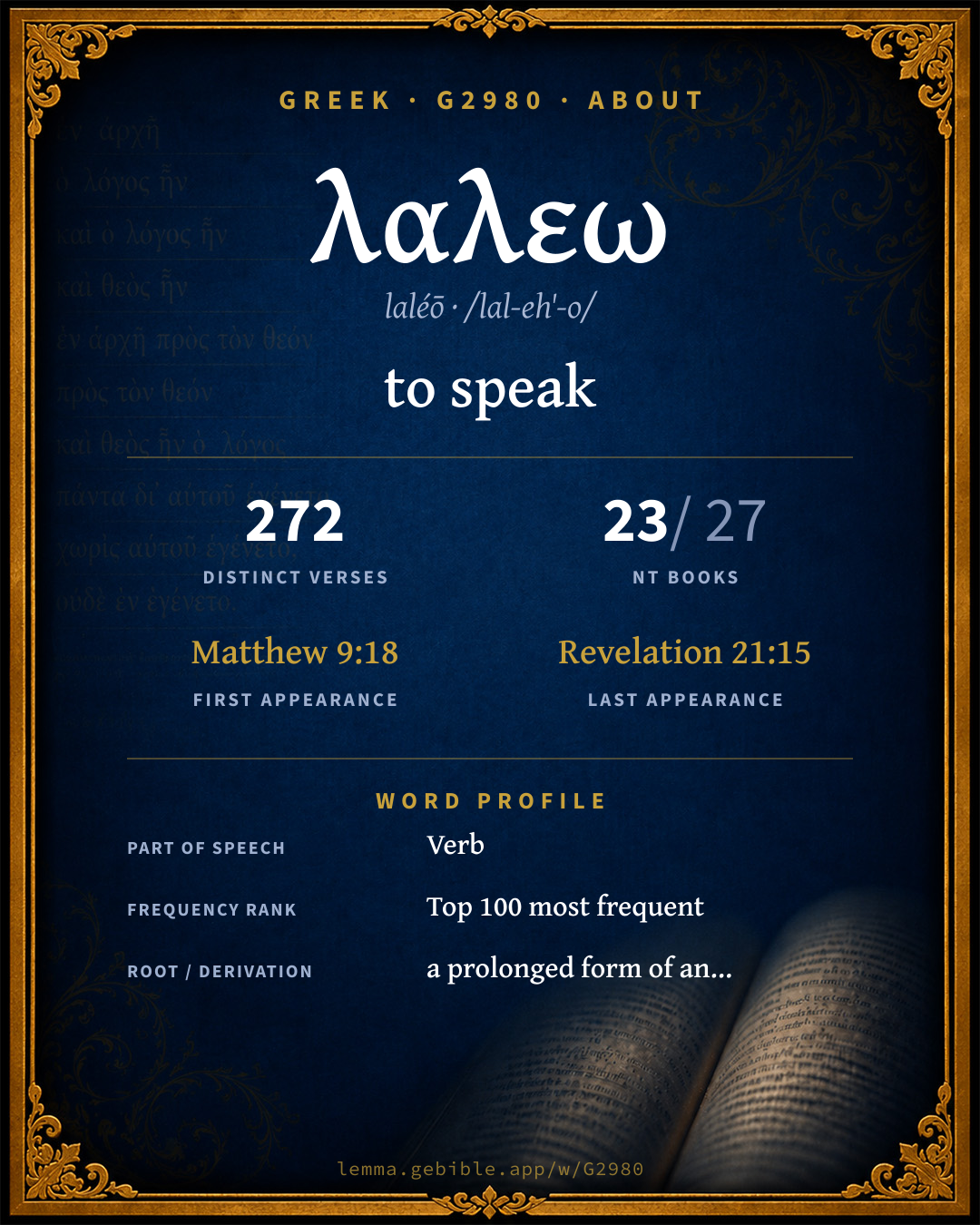
λαλέω
to speak
‘to speak’ is one of 6 main senses fuller range ↓
Full lexicon entry — Thayer's Greek Lexicon
From Thayer's Greek Lexicon
Where this word appears
See every Aorist-tense verb in the Greek New Testament →
Grammar key — what these labels mean
Part of speech
- Verb
- An action or state-of-being word.
Tense
- Aorist
- Action viewed as a simple whole, without regard to duration — often past (perfective aspect).
- Present
- Ongoing or general action in present time (imperfective aspect).
- Imperfect
- Continuous or repeated action in past time (“was writing”).
- Perfect
- A completed past action with continuing present results.
- Future
- Action expected in future time.
Voice
- Active
- The subject performs the action.
- Passive
- The subject receives the action.
Mood
- Indicative
- States a fact or asks a factual question (the mood of reality).
- Infinitive
- A verbal noun (“to write”), unmarked for person or number.
- Participle
- A verbal adjective (“writing,” “having written”).
- Imperative
- Expresses a command or request.
- Subjunctive
- Expresses probability, purpose, or possibility (the mood of contingency).
Case
- Genitive
- The case of source, possession, or “of” — answers “whose / from what.”
- Nominative
- The case of the subject (and the predicate nominative).
- Dative
- The case of the indirect object, means, or location — “to / for / with / in.”
- Accusative
- The case of the direct object and of extent.
Person
- 3rd person
- The one spoken about (“he / she / it / they”).
- 1st person
- The speaker (“I / we”).
- 2nd person
- The one addressed (“you”).
Gender
- Masculine
- Grammatically masculine.
- Neuter
- Grammatically neuter.
- Feminine
- Grammatically feminine.
Number
- Singular
- One.
- Plural
- More than one.
5 verses where G2980 appears in the Aorist tense in the Book of Revelation. Filtered view — show all forms. Click any verse to open its interlinear word-by-word view. Verse text shown in the World English Bible for context — . Each verse’s Greek form is shown with its reference; the English is not keyword-highlighted, since the data carries no word-level English alignment. Use “Compare translations” on any verse to read it across multiple English versions. This concordance covers the Greek New Testament; Septuagint (Greek Old Testament) occurrences of this word are not indexed here.
Revelation
- Revelation 10:3 ἐλάλησαν aor act ind 3pl He cried with a loud voice, as a lion roars. When he cried, the seven thunders uttered their voices.
- Revelation 10:4 ἐλάλησαν ἐλάλησαν aor act ind 3pl aor act ind 3pl When the seven thunders sounded, I was about to write; but I heard a voice from the sky saying, "Seal up the things which the seven thunders said, and don't write them."
- Revelation 13:15 λαλήσῃ aor act subj 3sg It was given to him to give breath to it, to the image of the beast, that the image of the beast should both speak, and cause as many as wouldn't worship the image of the beast to be killed.
- Revelation 17:1 ἐλάλησεν aor act ind 3sg One of the seven angels who had the seven bowls came and spoke with me, saying, "Come here. I will show you the judgment of the great prostitute who sits on many waters,
- Revelation 21:9 ἐλάλησεν aor act ind 3sg One of the seven angels who had the seven bowls, who were loaded with the seven last plagues came, and he spoke with me, saying, "Come here. I will show you the wife, the Lamb's bride."
About this entry
At a glance — auto-summarized from this page’s data, not written by a person. Every figure links to its source below. This summary describes the numbers; it doesn’t interpret them.
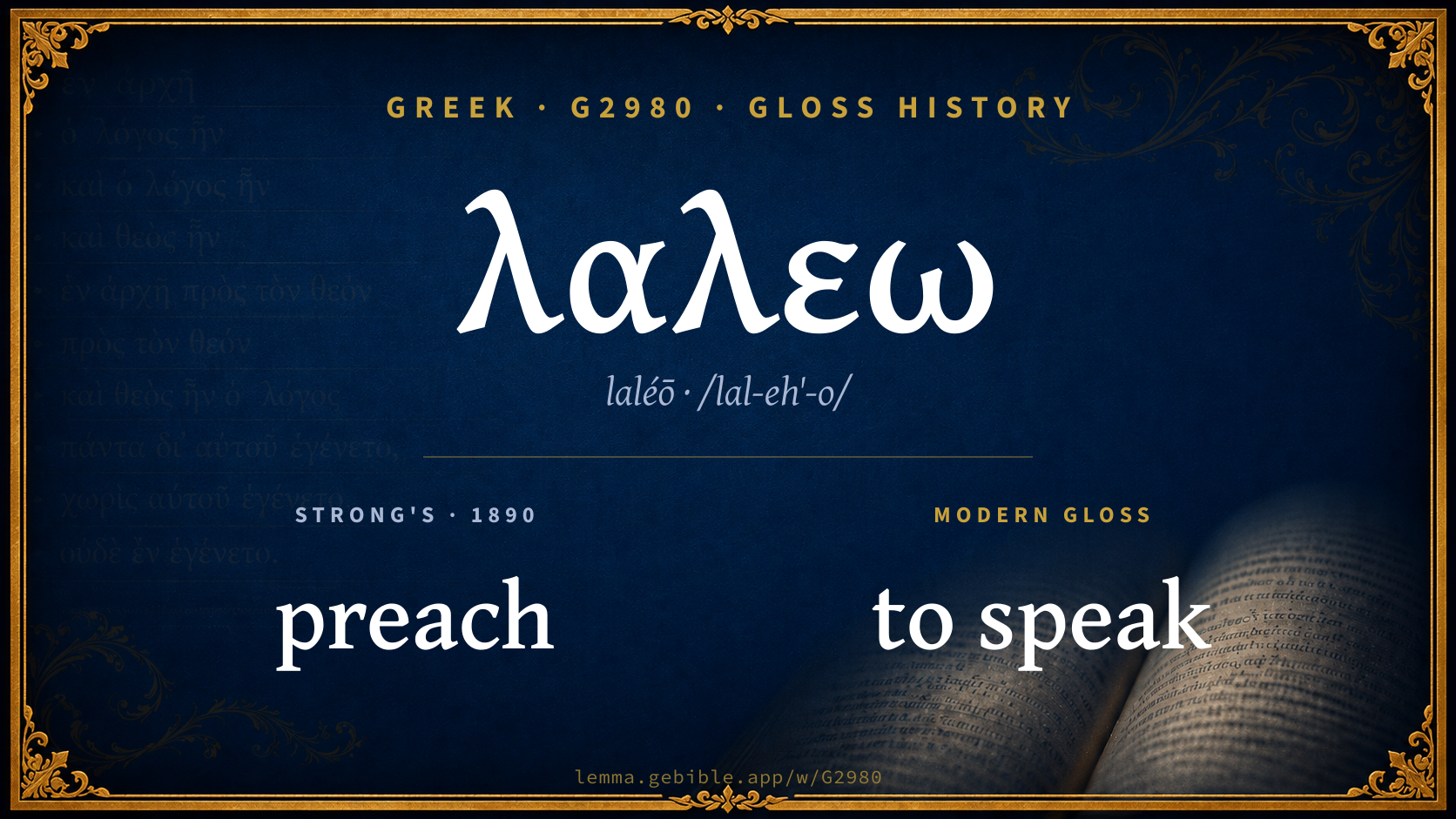
At its core, λαλεω (laléō) means “to speak.” The King James Version’s older “spake” has given way to “speak” in modern versions, as the renderings breakdown shows. It turns up in 272 verses across 23 books, a common footprint. It first appears in Matthew 9:18. Ranging over 6 senses, it is not a single-sense word. Each statement above links to its evidence; the full detail follows below.
Gloss history
Strong's 1890 vs modern scholarship
About this word
Strong's G2980 catalogs a Greek word from the Greek New Testament.
These counts are not copied from any lexicon or concordance. They are computed here, from the morphology-tagged Greek New Testament. What Lemma adds →
- 272
- distinct verses
- The word appears in 272 distinct verses.
- 23 / 27
- NT books
- The word appears in 23 of 27 New Testament books.
- #59
- by frequency
- Top 100 most frequent Greek words (rank 59 of 5,347 Greek words by occurrence).
View all 272 occurrences in the concordance →
By section of the New Testament
By traditional corpus
Conventional, traditional groupings — biblical authorship is debated, so this is a traditional corpus grouping, not an authorship claim. Some books belong to more than one corpus (Luke is in both the Gospels and the Lukan corpus, and so on), so these shares overlap and need not total 100%. Each figure is a share of the word’s 272 distinct verses.
- Gospels 122 verses · 45%
- Lukan (Luke–Acts) 91 verses · 33%
- Johannine 65 verses · 24%
- Pauline corpus 52 verses · 19%
- Hebrews 15 verses · 6%
- General (Catholic) Epistles 12 verses · 4%
- Revelation 11 verses · 4%
How translations render this word
Counts come from each version’s own published word-to-Strong’s tagging or interlinear alignment — an approximate guide to how each version renders this word, not a word-level alignment the data otherwise carries. Because each total is that version’s own tagged count, the per-version totals vary from one another and need not match the appearance or distinct-verse counts above. These counts may also differ from a printed concordance because Lemma counts each distinctly tagged rendering and does not collapse phrase taggings into a single head-word total. This is a fixed set of word-tagged versions (KJV, ASV, BSB, ULT) and does not change with the reading translation you choose elsewhere. Each version’s license is shown beside its name below (and on Sources).
- King James Version: Speak 62×, Spake 48×, He spake 14×
- American Standard Version: Speak 60×, Spake 43×, Speaketh 21×
- Berean Standard Bible: Speak 44×, Spoke 23×, Speaking 17×
- unfoldingWord Literal Text: Speak 56×, Speaking 47×, Spoke 25×
King James Version Public Domain
Renders G2980 across 305 tagged occurrences — most commonly:
Plus other, less common renderings. Plus 62 renderings that appear only once — usually multi-word phrases or single function words the recovered tagging swept in, not distinct renderings. Not rendered by a distinct English word in 3 further occurrences.
American Standard Version Public Domain
Renders G2980 across 308 tagged occurrences — most commonly:
Plus other, less common renderings. Plus 52 renderings that appear only once — usually multi-word phrases or single function words the recovered tagging swept in, not distinct renderings.
Berean Standard Bible Public Domain
Renders G2980 across 290 tagged occurrences — most commonly:
Plus other, less common renderings. Plus 90 renderings that appear only once — usually multi-word phrases or single function words the recovered tagging swept in, not distinct renderings. Not rendered by a distinct English word in 8 further occurrences.
unfoldingWord Literal Text CC BY-SA 4.0
Renders G2980 across 332 tagged occurrences — most commonly:
Plus other, less common renderings. Plus 53 renderings that appear only once — usually multi-word phrases or single function words the recovered tagging swept in, not distinct renderings.
Senses in Thayer's
The 6 senses Thayer's distinguishes for this word, in lexicon order (not ranked by frequency or importance). The full entry — with sub-senses — is in the Lexicon Entry tab.
- to utter a voice or emit a sound
- to use the tongue or the faculty of speech
- to utter articulate sounds
- to talk
- to utter, tell
- to use words in order to declare one's mind and disclose one's thoughts
Word origin
Origin: a prolonged form of an otherwise obsolete verb
A prolonged form of an otherwise obsolete verb; to talk that is utter words : - preach say speak (after) talk tell utter. Compare G3004 .
— Strong’s Exhaustive Concordance (1890), public domain.
Forms in the corpus
The 63 distinct written forms G2980 takes in the Greek New Testament, most frequent first — each parse links to that tense’s occurrences in the concordance.
The 60 most common forms are shown; 3 rarer forms follow in the full concordance.
Same root — word family
Other Thayer's entries built from the same root as G2980, grouped by Strong’s listed origin. These share a root / origin per the lexicon — not necessarily a shared meaning. Each links to that word’s own entry.
Derived from this word
Compare all same-root words → They share a root, not necessarily a meaning.
Septuagint usage
The same Greek word λαλεω appears 1,049 times in the Greek Old Testament (Septuagint), across 957 verses in 35 books.
- 1,049
- LXX occurrences
- Tagged occurrences of this Greek word in the Septuagint.
- 957
- verses
- Distinct Septuagint verses containing this word.
- 35 / 39
- OT books
- The word appears in 35 of the 39 Old Testament books.
Sample Septuagint occurrences
- Genesis 12:4 λαλέω
- Exodus 4:10 λαλέω
- Leviticus 1:1 λαλέω
- Numbers 1:1 λαλέω
- Deuteronomy 1:1 λαλέω
- Joshua 10:12 λαλέω
- Judges 1:20 λαλέω
- Ruth 1:18 λαλέω
- 1 Samuel 1:13 λαλέω
- 2 Samuel 2:27 λαλέω
- 1 Kings 1:14 λαλέω
- 2 Kings 1:3 λαλέω
Septuagint occurrences (same lexeme)
Every verse where the same Strong’s number (G2980) appears in the Greek Septuagint — showing the first 50 of 957. Verse text shown in the World English Bible for context; the Greek form is the matched word — the English is not keyword-highlighted.
- Genesis 12:4 λαλέω So Abram went, as Yahweh had spoken to him. Lot went with him. Abram was seventy-five years old when he departed out of Haran.
- Genesis 16:13 λαλέω She called the name of Yahweh who spoke to her, "You are a God who sees," for she said, "Have I even stayed alive after seeing him?"
- Genesis 17:3 λαλέω Abram fell on his face. God talked with him, saying,
- Genesis 17:22 λαλέω When he finished talking with him, God went up from Abraham.
- Genesis 17:23 λαλέω Abraham took Ishmael his son, all who were born in his house, and all who were bought with his money; every male among the men of Abraham's house, and circumcised the flesh of their foreskin in the same day, as God had said to him.
- Genesis 18:19 λαλέω For I have known him, to the end that he may command his children and his household after him, that they may keep the way of Yahweh, to do righteousness and justice; to the end that Yahweh may bring on Abraham that which he has spoken of him."
- Genesis 18:27 λαλέω Abraham answered, "See now, I have taken it on myself to speak to the Lord, who am but dust and ashes.
- Genesis 18:29 λαλέω He spoke to him yet again, and said, "What if there are forty found there?" He said, "I will not do it for the forty's sake."
- Genesis 18:30 λαλέω He said, "Oh don't let the Lord be angry, and I will speak. What if there are thirty found there?" He said, "I will not do it, if I find thirty there."
- Genesis 18:31 λαλέω He said, "See now, I have taken it on myself to speak to the Lord. What if there are twenty found there?" He said, "I will not destroy it for the twenty's sake."
- Genesis 18:32 λαλέω He said, "Oh don't let the Lord be angry, and I will speak yet but this once. What if ten are found there?" He said, "I will not destroy it for the ten's sake."
- Genesis 18:33 λαλέω Yahweh went his way, as soon as he had finished communing with Abraham, and Abraham returned to his place.
- Genesis 19:14 λαλέω Lot went out, and spoke to his sons-in-law, who were pledged to marry his daughters, and said, "Get up! Get out of this place, for Yahweh will destroy the city." But he seemed to his sons-in-law to be joking.
- Genesis 19:21 λαλέω He said to him, "Behold, I have granted your request concerning this thing also, that I will not overthrow the city of which you have spoken.
- Genesis 20:8 λαλέω Abimelech rose early in the morning, and called all his servants, and told all these things in their ear. The men were very scared.
- Genesis 21:1 λαλέω Yahweh visited Sarah as he had said, and Yahweh did to Sarah as he had spoken.
- Genesis 21:2 λαλέω Sarah conceived, and bore Abraham a son in his old age, at the set time of which God had spoken to him.
- Genesis 23:8 λαλέω He talked with them, saying, "If it be your mind that I should bury my dead out of my sight, hear me, and entreat for me to Ephron the son of Zohar,
- Genesis 23:16 λαλέω Abraham listened to Ephron. Abraham weighed to Ephron the silver which he had named in the audience of the children of Heth, four hundred shekels of silver, according to the current merchants' standard.
- Genesis 24:7 λαλέω Yahweh, the God of heaven, who took me from my father's house, and from the land of my birth, who spoke to me, and who swore to me, saying, 'I will give this land to your seed.' He will send his angel before you, and you shall take a wife for my son from there.
- Genesis 24:15 λαλέω It happened, before he had done speaking, that behold, Rebekah came out, who was born to Bethuel the son of Milcah, the wife of Nahor, Abraham's brother, with her pitcher on her shoulder.
- Genesis 24:30 λαλέω It happened, when he saw the ring, and the bracelets on his sister's hands, and when he heard the words of Rebekah his sister, saying, "This is what the man said to me," that he came to the man. Behold, he was standing by the camels at the spring.
- Genesis 24:33 λαλέω Food was set before him to eat. But he said, "I will not eat until I have told my message." He said, "Speak on."
- Genesis 24:45 λαλέω Before I had done speaking in my heart, behold, Rebekah came forth with her pitcher on her shoulder. She went down to the spring, and drew. I said to her, 'Please let me drink.'
- Genesis 24:51 λαλέω Behold, Rebekah is before you, take her, and go, and let her be your master's son's wife, as Yahweh has spoken."
- Genesis 27:5 λαλέω Rebekah heard when Isaac spoke to Esau his son. Esau went to the field to hunt for venison, and to bring it.
- Genesis 27:6 λαλέω Rebekah spoke to Jacob her son, saying, "Behold, I heard your father speak to Esau your brother, saying,
- Genesis 27:19 λαλέω Jacob said to his father, "I am Esau your firstborn. I have done what you asked me to do. Please arise, sit and eat of my venison, that your soul may bless me."
- Genesis 28:15 λαλέω Behold, I am with you, and will keep you, wherever you go, and will bring you again into this land. For I will not leave you, until I have done that which I have spoken of to you."
- Genesis 29:9 λαλέω While he was yet speaking with them, Rachel came with her father's sheep, for she kept them.
- Genesis 31:24 λαλέω God came to Laban, the Syrian, in a dream of the night, and said to him, "Take heed to yourself that you don't speak to Jacob either good or bad."
- Genesis 31:29 λαλέω It is in the power of my hand to hurt you, but the God of your father spoke to me last night, saying, 'Take heed to yourself that you don't speak to Jacob either good or bad.'
- Genesis 32:20 λαλέω You shall say, 'Not only that, but behold, your servant, Jacob, is behind us.'" For, he said, "I will appease him with the present that goes before me, and afterward I will see his face. Perhaps he will accept me."
- Genesis 34:3 λαλέω His soul joined to Dinah, the daughter of Jacob, and he loved the young lady, and spoke kindly to the young lady.
- Genesis 34:6 λαλέω Hamor the father of Shechem went out to Jacob to talk with him.
- Genesis 34:8 λαλέω Hamor talked with them, saying, "The soul of my son, Shechem, longs for your daughter. Please give her to him as a wife.
- Genesis 34:13 λαλέω The sons of Jacob answered Shechem and Hamor his father with deceit, and spoke, because he had defiled Dinah their sister,
- Genesis 34:20 λαλέω Hamor and Shechem, his son, came to the gate of their city, and talked with the men of their city, saying,
- Genesis 35:13 λαλέω God went up from him in the place where he spoke with him.
- Genesis 35:14 λαλέω Jacob set up a pillar in the place where he spoke with him, a pillar of stone. He poured out a drink-offering on it, and poured oil on it.
- Genesis 35:15 λαλέω Jacob called the name of the place where God spoke with him "Bethel."
- Genesis 37:4 λαλέω His brothers saw that their father loved him more than all his brothers, and they hated him, and couldn't speak peaceably to him.
- Genesis 39:10 λαλέω It happened that as she spoke to Joseph day by day, that he didn't listen to her, to lie by her, or to be with her.
- Genesis 39:17 λαλέω She spoke to him according to these words, saying, "The Hebrew servant, whom you have brought to us, came in to me to mock me,
- Genesis 39:19 λαλέω It happened, when his master heard the words of his wife, which she spoke to him, saying, "This is what your servant did to me," that his wrath was kindled.
- Genesis 41:9 λαλέω Then the chief cupbearer spoke to Pharaoh, saying, "I remember my faults today.
- Genesis 41:17 λαλέω Pharaoh spoke to Joseph, "In my dream, behold, I stood on the brink of the river:
- Genesis 42:7 λαλέω Joseph saw his brothers, and he recognized them, but acted like a stranger to them, and spoke roughly with them. He said to them, "Where did you come from?" They said, "From the land of Canaan to buy food."
- Genesis 42:22 λαλέω Reuben answered them, saying, "Didn't I tell you, saying, 'Don't sin against the child,' and you wouldn't listen? Therefore also, behold, his blood is required."
- Genesis 42:30 λαλέω "The man, the lord of the land, spoke roughly with us, and took us for spies of the country.
These are occurrences of the same Greek lexeme (G2980) in the Septuagint — not a translation of any one Hebrew word. The store carries no word-level Hebrew↔Greek alignment, so no Hebrew original is asserted here. Counts come from the recovered LXX Strong's tagging — high-frequency vocabulary is well covered, while rare or late forms may be untagged — so they reflect tagged occurrences and may slightly undercount.