
1 Timothy 5:13

Greek (Tischendorf 8th ed.) 1 Timothy 5:13 appears in the Greek New Testament. The text above is from the Tischendorf 8th edition. Each word links to its Strong’s number and a concise gloss. Click any word for its full Thayer’s Greek Lexicon entry.
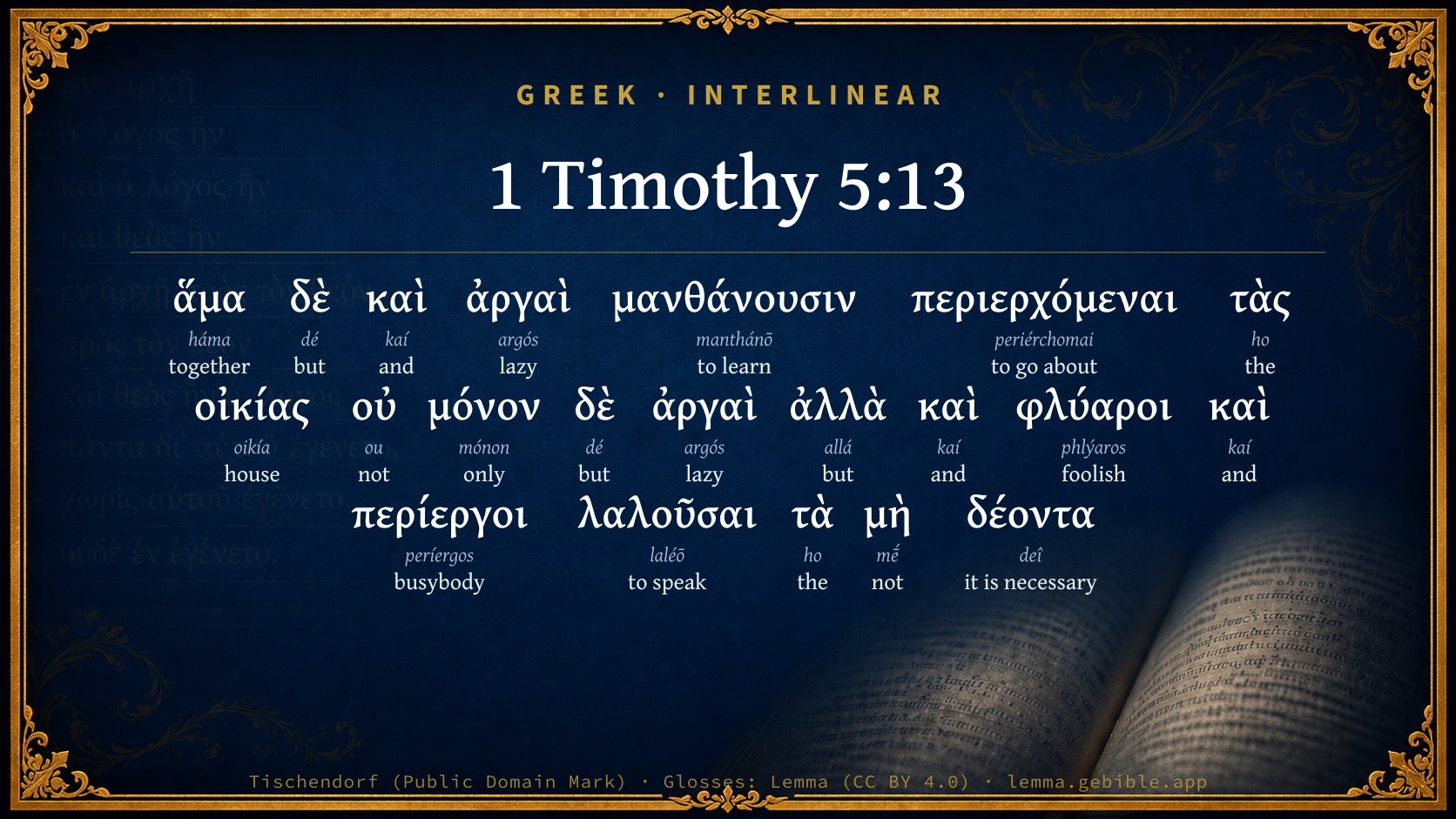
Download image
Cite this verse

1 Timothy 5:13 (World English Bible). Public Domain. Lemma interlinear Bible study tool, https://lemma.gebible.app/v/1-timothy/5/13.

Show BibTeX & RIS
BibTeX
RIS
English Translation
Besides, they also learn to be idle, going about from house to house. Not only idle, but also gossips and busybodies, saying things which they ought not.
World English Bible · Public Domain
Highlights
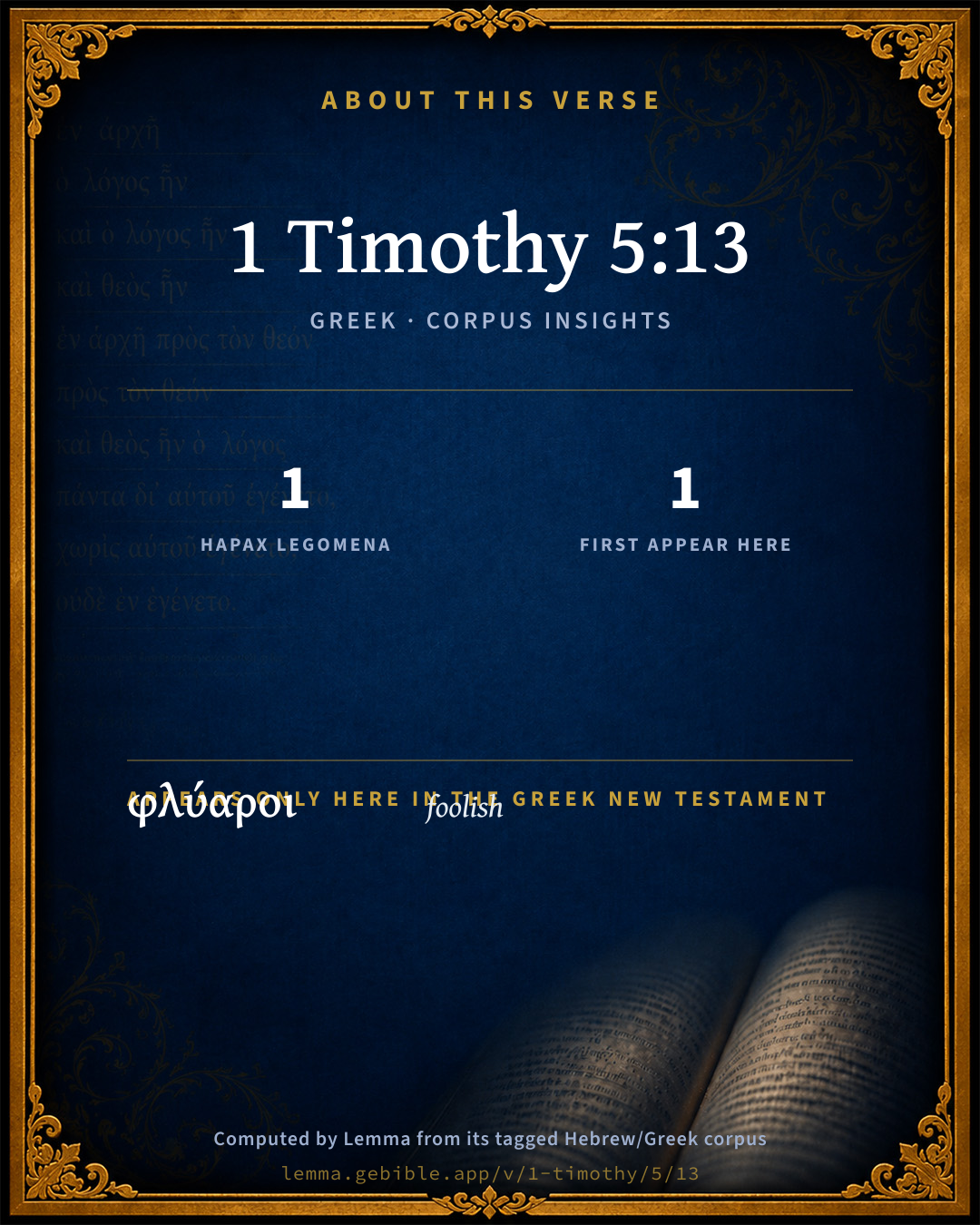
  • 1 hapax legomenon — only here in the Greek New Testament
  • 1 first appearance in the Greek New Testament
Full analysis ↓
Download a study sheet

One document with this verse’s original text, its word-by-word gloss line, the meaning frame, cross-references with their text, attributed commentary, and full source and license credits — printable, and it pastes into notes with its structure intact.

This verse Autodidact and up

Study sheet (.html) Plain text (.txt)

A passage Seminary Student

Up to 50 verses in one chapter. A passage sheet keeps up to 6 commentary sources and 12 cross-references per verse, in the order this page ranks them, and says so on the sheet whenever that leaves anything out. Ask for a single verse and you get the Autodidact verse sheet above.

Everything on this page stays free to read, with no account — the sheet is a download of what is already on screen, not access to it.

Want to remove ads? Support Godless Engineer
Compare translations 3

The same verse in 3 English versions, stacked beneath the original-language interlinear above. Click any original word for its lexicon entry.

Each is an independent rendering of the whole verse — the interlinear is not word-aligned to these translations.

Highlighted words mark where these versions differ — a whole-verse word diff, not a word-by-word alignment.

  • World English Bible Public Domain
    Besides, they also learn to be idle, going about from house to house. Not only idle, but also gossips and busybodies, saying things which they ought not.
  • King James Version Public Domain
    And withal they learn to be idle, wandering about from house to house; and not only idle, but tattlers also and busybodies, speaking things which they ought not.
  • unfoldingWord Literal Text CC BY-SA 4.0
    But at the same time, they also learn to be idle, wandering about the houses, and not only idle, but also babblers and meddlers, saying what they should not.

unfoldingWord Literal Text — © unfoldingWord, licensed CC BY-SA 4.0. Word-aligned USFM3 via Door43 (git.door43.org/unfoldingWord/en_ult).

Versions to compare (up to 4)

3 of 4 selected

Show all 19 translations

Every available English version of this verse, each an independent rendering of the whole verse.

  • World English Bible Public Domain
    Besides, they also learn to be idle, going about from house to house. Not only idle, but also gossips and busybodies, saying things which they ought not.
  • Berean Standard Bible Public Domain
    At the same time they will also learn to be idle, going from house to house and being not only idle, but also gossips and busybodies, discussing things they should not mention.
  • Majority Standard Bible Public Domain
    At the same time they will also learn to be idle, going from house to house and being not only idle, but also gossips and busybodies, discussing things they should not mention.
  • King James Version Public Domain
    And withal they learn to be idle, wandering about from house to house; and not only idle, but tattlers also and busybodies, speaking things which they ought not.
  • American Standard Version (1901) Public Domain
    And withal they learn also `to be' idle, going about from house to house; and not only idle, but tattlers also and busybodies, speaking things which they ought not.
  • Revised Version (1885) Public Domain
    And withal they learn also to be idle, going about from house to house; and not only idle, but tattlers also and busybodies, speaking things which they ought not.
  • Geneva Bible (1599) Public Domain
    And likewise also being idle they learne to goe about from house to house: yea, they are not onely ydle, but also pratlers and busibodies, speaking things which are not comely.
  • Douay-Rheims (1899) Public Domain
    And withal being idle they learn to go about from house to house: and are not only idle, but tattlers also, and busybodies, speaking things which they ought not.
  • Young's Literal Translation Public Domain
    and at the same time also, they learn `to be' idle, going about the houses; and not only idle, but also tattlers and busybodies, speaking the things they ought not;
  • Literal Standard Version CC BY-SA 4.0
    and also at the same time, they learn [to be] idle, going around the houses; and not only idle, but also tattlers and busybodies, speaking things they should not;
  • Unlocked Literal Bible CC BY-SA 4.0
    At the same time, they also learn to be lazy and they go around from house to house. They not only become lazy, but they also talk nonsense and are busybodies, saying things they should not say.
  • unfoldingWord Literal Text CC BY-SA 4.0
    But at the same time, they also learn to be idle, wandering about the houses, and not only idle, but also babblers and meddlers, saying what they should not.
  • Darby Bible Public Domain
    And, at the same time, they learn also [to be] idle, going about to people's houses; and not only idle, but also gossipers and meddlers, speaking things not becoming.
  • World Messianic Bible Public Domain
    Besides, they also learn to be idle, going about from house to house. Not only idle, but also gossips and busybodies, saying things which they ought not.
  • Webster's Bible Public Domain
    And at the same time they learn to be idle, wandering about from house to house, and not only idle, but tattlers also, and busy-bodies, speaking things which they ought not.
  • Free Bible Version CC BY-SA 4.0
    They also get used to a lazy life, just visiting each other in their homes. Not only lazy, but they gossip and meddle, talking about things they shouldn't.
  • Bible in Basic English Public Domain
    And they get into the way of doing no work, going about from house to house; and not only doing no work, but talking foolishly, being over-interested in the business of others, saying things which they have no right to say.
  • Text-Critical English NT CC BY 4.0
    At the same time, they learn to be idle, wandering about from house to house. And they are not only idle, but also gossips and busybodies, saying things they should not say.
  • Tyndale New Testament (1534) Public Domain
    And also they learne to goo from housse to housse ydle ye not ydle only but also tryflynge and busybodyes speakynge thynges which are not comly.

Literal Standard Version (2020), Covenant Press — licensed CC BY-SA 4.0. Text via the HelloAO Bible API (eBible.org). Unlocked Literal Bible (unfoldingWord) — licensed CC BY-SA 4.0. Text via the HelloAO Bible API (eBible.org). unfoldingWord Literal Text — © unfoldingWord, licensed CC BY-SA 4.0. Word-aligned USFM3 via Door43 (git.door43.org/unfoldingWord/en_ult). Free Bible Version, Dr. Jonathan Gallagher — licensed CC BY-SA 4.0. Text via the HelloAO Bible API (eBible.org).

Word by word

More ways to search: Search by grammar → Find every occurrence → Compare this word →

Practice this passage: Drill this verse → Learn its vocabulary →

φλύαροι
phlýaros
G5397
“foolish”
Adjective, Nominative, Plural, Feminine
Part of Speech
Adjective
Case
Nominative
Number
Plural
Gender
Feminine
Full Thayer's Definition

Origin: from phluo (to bubble)

TDNT: None

1. of persons uttering or doing silly things, garrulous, babbling 2. of things, foolish, trifling, vain
  1. ἅμα háma G260 “together” Adverb
  2. δὲ dé G1161 “but” Conjunction
  3. καὶ kaí G2532 “and” Conjunction
  4. ἀργαὶ argós G692 “lazy” Adjective, Nominative, Plural, Feminine
  5. μανθάνουσιν manthánō G3129 “to learn” Verb, Present, Active, Indicative, 3rd person, Plural
  6. περιερχόμεναι periérchomai G4022 “to go about” Verb, Present, Middle or Passive deponent, Participle, Nominative, Plural, Feminine
  7. τὰς ho G3588 “the” Article, Accusative, Plural, Feminine
  8. οἰκίας oikía G3614 “house” Noun, Accusative, Plural, Feminine
  9. οὐ ou G3756 “not” Particle, Negative
  10. μόνον mónon G3440 “only” Adverb
  11. δὲ dé G1161 “but” Conjunction
  12. ἀργαὶ argós G692 “lazy” Adjective, Nominative, Plural, Feminine
  13. ἀλλὰ allá G235 “but” Conjunction
  14. καὶ kaí G2532 “and” Conjunction
  15. καὶ kaí G2532 “and” Conjunction
  16. περίεργοι períergos G4021 “busybody” Adjective, Nominative, Plural, Feminine
  17. λαλοῦσαι laléō G2980 “to speak” Verb, Present, Active, Participle, Nominative, Plural, Feminine
  18. τὰ ho G3588 “the” Article, Accusative, Plural, Neuter
  19. μὴ mḗ G3361 “not” Particle, Negative
  20. δέοντα deî G1163 “it is necessary” Verb, Present, Active, Participle, Accusative, Plural, Neuter

About this verse

These counts appear in no published source. They are computed here, from the morphology-tagged text and Lemma’s own curated glosses. What Lemma adds →

21
words
16
distinct lemmas
Pauline Epistles
section

Notable vocabulary

1 hapax legomenon — a word that appears only here in the entire Greek New Testament:

  • φλύαροι foolish G5397

First appearance in Scripture

This word makes its first canonical appearance in the Greek New Testament here:

  • φλύαροι foolish G5397

Shared distinctive vocabulary

περίεργοι busybody G4021 occurs in 2 verses of the Greek New Testament. Also found in:
Repetition

Words recur within this verse:

Cross-references

11

Topical passages linked to 1 Timothy 5:13 in the Treasury of Scripture Knowledge — connected by theme and wording, ordered by reader-vote popularity; previews shown in the World English Bible.

  • Proverbs 20:19 He who goes about as a tale-bearer reveals secrets; Therefore don't keep company with him who opens wide his lips.
  • 2 Thessalonians 3:6–11 Now we command you, brothers, in the name of our Lord Jesus Christ, that you withdraw yourselves from every brother who walks in rebellion, and not after the tradition which they received from us.
  • Proverbs 31:27 She looks well to the ways of her household, And doesn't eat the bread of idleness.
  • Acts 20:30 Men will arise from among your own selves, speaking perverse things, to draw away the disciples after them.
  • Leviticus 19:16 "'You shall not go up and down as a slanderer among your people; neither shall you stand against the life of your neighbor. I am Yahweh.
  • Luke 10:7 Remain in that same house, eating and drinking the things they give, for the laborer is worthy of his wages. Don't go from house to house.
  • Acts 20:20 how I didn't shrink from declaring to you anything that was profitable, teaching you publicly and from house to house,
  • Titus 1:11 whose mouths must be stopped; men who overthrow whole houses, teaching things which they ought not, for dishonest gain's sake.
  • James 3:10 Out of the same mouth comes forth blessing and cursing. My brothers, these things ought not to be so.
  • 1 Peter 4:15 For let none of you suffer as a murderer, or a thief, or an evil doer, or as a meddler in other men's matters.
  • 3 John 1:10 Therefore, if I come, I will call attention to his deeds which he does, unjustly accusing us with wicked words. Not content with this, neither does he himself receive the brothers, and those who would, he forbids and throws out of the assembly.

Cross-references courtesy of OpenBible.info (CC BY 4.0).

Commentary

Notes on 1 Timothy 5:13 from classic Christian and Jewish commentators (each source and its license shown beneath its notes). The classic Christian expositions comment on the surrounding passage and are grouped to its opening verse, so a note may address several verses; the Jewish commentaries on the Tanakh (Rashi and others) are per-verse, so they appear only where the commentator wrote on this verse.

Lemma curates 59 commentaries, every one of them public domain or Creative Commons licensed, each selected and text-cleaned for this edition rather than reprinted as found. About our sources →

Tyndale Open Study Notes

Tyndale Open Resources

5:13 Too seldom do those who are fully supported by the church invest their lives in remarkable piety (cp. 2:9-10; 5:10). Abusing the church’s support does not help them or the Good News (cp. 5:14). • talking about things they shouldn’t: The wording suggests involvement in the false teaching (5:15; cp. 2 Thes 3:11-13; Titus 1:11).

Tyndale Open Study Notes — © Tyndale Open Resources, licensed CC BY-SA 4.0. Text via the HelloAO Bible API.

Bengel's Gnomon

Johann Albrecht Bengel

1Ti 5:13. Μανθάνουσι περιερχόμεναι, they learn going about) This participle is not put for the infinitive, but the genus, ‘learning,’ is reprehended: the species follows, they learn the things which are learned by going about from house to house, i.e. they curiously pry into the state of families. The Mimesis[42] lies in this, that the expression used is, they learn. For elsewhere those things are only said to be learned which are good. But these women learn by going about, they search out all things; and thence their progress is progress in the wrong direction.—τὰς οἰκίας, houses) 2Ti 3:6.—φλύαροι, [tattlers] triflers) in respect to words.—περίεργοι busybodies) in respect to deeds.—λαλοῦσαι, speaking) This word is construed with they leanr. They speak out all that they have learned.—τὰ μὴ δέοντα) ἃ μὴ δεῖ, Tit 1:11.

[42] A figure, whereby the word which the party reprehended would use is alluded to; as here these young widows would call their inquiries by the favourable term, learning. They learn (the genus), says Paul; but the speeies of learning they learn is what is to be learnt by going about visiting houses.—ED.

Bengel's Gnomon of the New Testament — English translation (T&T Clark, Edinburgh, 1860) — public domain. Text from a community e-Sword module.

Meyer's Critical & Exegetical Commentary

Heinrich August Wilhelm Meyer

1Ti_5:13. Ἅμα δὲ καὶ ἀργαὶ μανθάνουσι περιερχόμεναι τὰς οἰκίας] By far the greater number of expositors connect μανθάνουσι immediately with περιερχόμεναι, they learn to run about in houses (Luther; so, too, de Wette, Wiesinger, van Oosterzee). But μανθάνειν with the partic. does not mean learn; it is observe, perceive, remark; μανθάνειν, in the sense of learn (accustom oneself), has always the infinitive (comp. 1Ti_5:4). Leo therefore takes it here as be wont to; but this sense only occurs in the preterite. Winer (pp. 325 f. [E. T. p. 436]) thinks it probable that ἀργαὶ μανθάνουσι are to be taken together, they learn idleness (or they learn to be lazy; so in the second edition of this commentary; so, too, Hofmann). It is in favour of this construction that the chief emphasis is laid on ἀργαί; but no passage can be found confirming it.[184] Besides, the position of ἈΡΓΑΊ shows that it belongs to the subject. Bengel had taken refuge in supplying something explaining it: discunt quae domos obeundo discuntur, i. e statum familiarum curiose explorant. Buttmann (pp. 260 f.) agrees with this explanation, only that he regards the supplied words: statum, etc., as too arbitrary and sweeping; he observes: what they learn ΠΕΡΙΕΡΧΌΜΕΝΑΙ Τ. ΟἸΚ. is sufficiently indicated, not indeed grammatically, but in sense, by ἈΡΓΑΊ, ΦΛΥΑΡΟΊ, ΠΕΡΙΈΡΓΟΙ, ΛΑΛΟῦΣΑΙ ΤᾺ ΜῊ ΔΈΟΝΤΑ. But if, as Buttmann thinks, we are to assume here an anacolouthon, it would be more natural to find the hint of what is to be supplied in the ΠΕΡΙΕΡΧΌΜΕΝΑΙ Τ. ΟἸΚ., so that the meaning would be: they learn ΠΕΡΙΕΡΧΌΜΕΝΑΙ this very ΠΕΡΙΈΡΧΕΣΘΑΙ.

On the construction ΠΕΡΙΕΡΧΌΜΕΝΑΙ ΤᾺς ΟἸΚΊΑς, comp. Mat_4:23 : ΠΕΡΙῆΓΕΝ ὍΛΗΝ ΤῊΝ ΓΑΛΙΛΑΊΑΝ.

Οὐ ΜΌΝΟΝ ΔῈ ἈΡΓΑῚ, ἈΛΛᾺ ΚΑῚ ΦΛΎΑΡΟΙ Κ.Τ.Λ.] ΦΛΎΑΡΟΙ, talkative (Luther), only occurs here; the verb ΦΛΥΑΡΈΩ in 3Jn_1:10. Theophylact: ΠΕΡΙΟΔΕΎΟΥΣΑΙ ΤᾺς ΟἸΚΊΑς, ΟὐΔῈΝ ἈΛΛʼ Ἢ ΤᾺ ΤΑΎΤΗς ΕἸς ἘΚΕΊΝΗΝ ΦΈΡΟΥΣΙ, ΚΑῚ ΤᾺ ἘΚΕΊΝΗς ΕἸς ΤΑΎΤΗΝ. Calvin: ex otio nascebatur curiositas, quae ipsa garrulitatis est mater.

ΚΑῚ ΠΕΡΊΕΡΓΟΙ, inquisitive, Luther (likewise ἍΠ. ΛΕΓ.; but in 2Th_3:11 : ΜΗΔῈΝ ἘΡΓΑΖΟΜΈΝΟΥς, ἈΛΛᾺ ΠΕΡΙΕΡΓΑΖΟΜΈΝΟΥς), forms a peculiar contrast to the preceding ἈΡΓΑΊ; Chrysostom: Ὁ ΓᾺΡ ΤᾺ ἙΑΥΤΟῦ ΜῊ ΜΕΡΙΜΝῶΝ ΤᾺ ἙΤΈΡΟΥ ΜΕΡΙΜΝΉΣΕΙ ΠΆΝΤΩς.

ΛΑΛΟῦΣΑΙ ΤᾺ ΜῊ ΔΈΟΝΤΑ] added to define further what precedes.

In these two verses Paul sets forth the danger of receiving young widows into the class of church-widows. It is not improbable that there were definite instances, and these caused the apostle to speak in this general way.

[184] Winer, indeed, quotes two passages, one from Plato, Euthyd. 276b: οἱ ἀμαθεῖς ἄρα σοφοὶ μανθάνουσι, and the other from Dio Chr. 55. 558: ὁ Σωκράτης ὅτι μὲν παῖς ὢν ἐμάνθανε λιθοξόος τὴν τοῦ πατρὸς τέχνην, ἀκηκόαμεν. Buttmann remarks on the first, that the addition σοφοί (which is quite meaningless) is rejected on MS. authority, and on the other that it is of quite a different nature. In both, cases he is clearly right.

Meyer — Critical and Exegetical Commentary on the New Testament — English translation by Peter Christie, edited by Frederick Crombie (T&T Clark, 1880) — public domain. Text from a community e-Sword module.

Expositor's Greek Testament

ed. W. Robertson Nicoll

1Ti 5:13 . ἅμα δὲ καί is Pauline. See reff.

It is best to assume an omission of εἶναι , not necessarily through corruption of the text, as Blass supposes ( Gram . p. 247). On the example cited by Winer-Moulton, Gram . p. 437 from Plato, Euthyd . p. 276 b , οἱ ἀμαθεῖς ἄρα σοφοὶ μανθάνουσιν , and Dio. Chrys. lv. 558, Field notes, “Although the reading in Plato may be doubtful, there is no doubt of the agreement of St. Paul’s construction with later usage”. Field adds two from St. Chrysostom T. vii. p. 699 a : τί οὖν ; ἂν παλαιστὴς μανθάνῃς ; T. ix. p. 259 b : εἰ ἰατρὸς μέλλοις μανθάνειν . He notes that the correlative phraseology, διδάξαι (or διδάξασθαι ) τινὰ τεκτόνα , χαλκέα , ἱππέα , ῥήτορα , is to be found in the best writers.

It is impossible to connect μανθ . περιερχ . as Vulg., discunt circuire domos ; for, as Alf. says, “ μανθάνω with a participle always means to be aware of, take notice of , the act implied in the verb”. Here, e.g. , the meaning would be “they learn that they are going about,” which is absurd. Bengel’s view, that μανθάνουσι is to be taken absolutely, is equally impossible: “being idle, they are learners,” the nature of the things they learn to be inferred from the way they spend their time. Von Soden connects μανθ . with τὰ μὴ δέοντα ; suggesting that they learnt in the houses referred to in 2Ti 3:6 what was taught there ( ἂ μὴ δεῖ , Tit 1:11 ).

περιερχόμεναι τὰς οἰκίας : These last words may possibly refer to the house to house visitation, going about (R.V.), which might be part of the necessary duty of the Church widows; but which would be a source of temptation to young women, and would degenerate into wandering (A.V.).

οὐ μόνον δὲ … ἀλλὰ καί is a Pauline use of constant occurrence. See Rom 5:3 ; Rom 5:11 ; Rom 8:23 ; Rom 9:10 ; 2Co 7:7 ; 2Co 8:19 ; Phi 2:27 [ οὐ … δὲ μόνον ]; 2Ti 4:8 . Also in Act 19:27 , 3Ma 3:23 .

ἀργαί , φλύαροι , περίεργοι : A series of natural causes and consequences. The social intercourse of idle people is naturally characterised by silly chatter which does not merely affect the understanding of those who indulge in it, but leads them on to mischievous interference in other people’s affairs.

φλύαροι : φλυαρεῖν is found in 3Jn 1:10 , prating . φλύαρος is an epithet of φιλοσοφία in 4Ma 5:10 ; and in Pro 23:29 ( [283] [284] ) φλυαρίαι ὁμιλίαι ἐνφιλόνικοι are among the consequences of excessive wine-drinking.

[283] Codex Sinaiticus (sæc. iv.), now at St. Petersburg, published in facsimile type by its discoverer, Tischendorf, in 1862.

[284] Codex Sinaiticus (sæc. iv.), now at St. Petersburg, published in facsimile type by its discoverer, Tischendorf, in 1862.

περίεργοι : See 2Th 3:11 , μηδὲν ἐργαζομένους ἀλλὰ περιεργαζομένους . In Act 19:19 τὰ περίεργα , curious arts , means the arts of those who are curious about, and pry into, matters concealed from human knowledge, impertinent to man’s lawful needs.

λαλοῦσαι τὰ μὴ δέοντα expresses the positively mischievous activity of the φλύαροι , as περίεργοι . Compare Tit 1:11 , διδάσκοντες ἃ μὴ δεῖ . In both passages μή is expressive of the impropriety, in the writer’s opinion, of whatever might conceivably be spoken and taught; whereas τὰ οὐ δέοντα would express the notion that certain specific improper things had, as a matter of fact, been spoken. See Winer-Moulton, Gram . p. 603.

The Expositor's Greek Testament, edited by W. Robertson Nicoll (1897–1910) — public domain. Text from a community e-Sword module.

Geneva Bible (1599)

Geneva Bible translators

Another reason: because they are for the most part prattlers and busybodies, and gadders up and down, neglecting their charge and duty.

Geneva Bible (1599) marginal notes — public domain. Text via Bolls.life.

Jamieson, Fausset & Brown

Robert Jamieson, A. R. Fausset & David Brown

withal--"at the same time, moreover."

learn--usually in a good sense. But these women's "learning" is idleness, trifling, and busybodies' tattle.

wandering--Greek, "going about."

from house to house--of the members of the Church (Ti2 3:6). "They carry the affairs of this house to that, and of that to this; they tell the affairs of all to all" [THEOPHYLACT].

tattlers--literally "trifling talkers." In Jo3 1:10, translated "prating."

busybodies--mischievously busy; inconsiderately curious (Th2 3:11). Act 19:19, "curious," the same Greek. Curiosity usually springs from idleness, which is itself the mother of garrulity [CALVIN].

speaking--not merely "saying." The subject-matter, as well as the form, is involved in the Greek word [ALFORD].

which they ought not-- (Tit 1:11).

Jamieson, Fausset & Brown — Commentary Critical and Explanatory on the Whole Bible (1871) — public domain (CC PDM 1.0). Text via the HelloAO Bible API.

Adam Clarke's Commentary

Verse 13. And withal they learn to be idle] They do not love work, and they will not work.

Wandering about from house to house] Gadding, gossiping; never contented with home; always visiting.

And not only idle] If it went no farther, this would be intolerable; but they are tattlers-tale-bearers; whisperers; light, trifling persons; all noise and no work.

Busybodies] Persons who meddle with the concerns of others; who mind every one's business but their own.

Speaking things which they ought not.] Lies, slanders, calumnies; backbiting their neighbours, and everywhere sowing the seed of dissension.

Adam Clarke's Commentary on the Bible (1810–1826) — public domain. Text from a community e-Sword/MySword module.

John Calvin's Commentaries

13 And not only so, but they grow idle Nothing is more becoming in women than keeping the house; and hence, among the ancients, a tortoise was the image of a good and respectable mother of a family. But there are many who are diseased with the opposite vice. Nothing delights them more than the liberty of running from one place to another, and especially when, being freed from the burden of a family, they have nothing to do at home.

Tattlers and busybodies Besides, those widows, under the pretense of the respect due to the public character which they sustained, had more easy access to many persons. This opportunity, obtained through the kindness of the Church, they abused for purposes of “idleness;” and next, as usually happens, from slothfulness sprung curiosity, which is also the mother of talkativeness. Most true is the saying of Horace: “Shun an inquisitive person, for he is always a tattler.” “No trust should be placed,” as Plutarch says, “in inquisitive persons, for, as soon as they have heard anything, they are never at rest till they have blabbed it out.” This is especially the case with women, who, by nature, are prone to talkativeness, and cannot keep a secret. With good reason, therefore, has Paul joined together these three things, sloth, inquisitiveness, and tattling.

John Calvin's Commentaries (1540-1563) — public domain. Text from the Calvin Translation Society English edition (1840s-50s) via the Christian Classics Ethereal Library (ccel.org). Calvin's coverage is partial (roughly two-thirds of the Bible); uncommented books and verses are honest gaps, never fabricated. The 19th-century editor's footnotes and remarks are omitted so the notes are faithfully Calvin's own voice.

Ellicott's Commentary for English Readers

(13) And withal they learn to be idle, wandering about from house to house.—The first fervour of their devotion and renunciation of self will have cooled, their very occupation will become a snare to them—the going about to the various dwellings for the object of consoling, instructing, assisting, would give them, now that their minds were no longer exclusively turned to religious thoughts, and their hearts were no more alone filled by Jesus, many an opportunity of wasting precious hours, of indulging in frivolous, if not in harmful, conversation; and this the Apostle seems to have feared would be the result of these visits, and the fruit of their work, if the younger sisters were enrolled in the official list, for he speaks of such becoming “not only idle, but tattlers also and busy bodies, speaking things which they ought not.”

A Bible Commentary for English Readers, edited by Charles John Ellicott (1878–1897) — public domain. Text from a community e-Sword module.

The Cambridge Bible for Schools and Colleges

gen. ed. J. J. S. Perowne

13. they learn to be idle] Insert ‘also’; R.V. they learn also to be idle. The position of ‘idle’ and the stress in the next clause ‘not only idlers but’ point to this construction, making ‘idle’ predicate, though no infinitive ‘to be,’ ‘to become,’ is inserted. The rendering of Bp Wordsworth, Grimm and others, ‘Being idle they are learners running about from house to house,’ gives indeed ‘an oxymoron—a common figure of speech with St Paul.’ But the authority for ‘learn’ in so absolute a sense is very doubtful, since everywhere, e.g. in 1Ti_2:11. ‘let a woman learn in silence,’ and 2Ti_3:7, ‘always learning and never able to come to the full knowledge,’ there is much more in the context of connected phrase and subject.

wandering about from house to house] Lit. ‘the houses’ that made up the Christian settlement: so 2Ti_3:6, ‘they that creep into our houses.’ Compare 3Jn_1:14, ‘our friends salute thee.’

tattlers also and busybodies] The first word occurs again only as participle in 3Jn_1:10, ‘tattling of us with evil words.’ ‘Its derivation (connected with fluere) points to a babbling profluent way of talking.’ Bp Ellicott. ‘Busybodies,’ prying round into other people’s business; so 2Th_3:11, ‘not busy, but busybodies.’ Hence its use for ‘magical arts,’ Act_19:19. Contrast the epithet of the younger women, Tit_2:5 (best mss.) ‘busy at home,’ which is not found elsewhere.

The Cambridge Bible for Schools and Colleges (gen. ed. J. J. S. Perowne; Cambridge University Press, 1878–1918) — public domain. Text from a community e-Sword module.

Trapp's Complete Commentary

John Trapp

13 And withal they learn to be idle, wandering about from house to house; and not only idle, but tattlers also and busybodies, speaking things which they ought not.

Ver. 13. They learn to be idle] It is an art soon learned, by doing nothing to do naughtily. Nihil agendo male agere discunt, Idleness is the hour of temptation, and an idle person is the devil’s tennis ball, tossed by him at his pleasure.

Wandering about from house to house] As vagrants, or as pedlars opening their packs, and dropping here a tale and there a tale. A practice flatly forbidden by God, Lev 19:16; "Thou shalt not go up and down as a tale bearer." The Hebrew word signifieth a pedlar, רגל whence רגל for a foot. And another Hebrew word used for defaming or slandering, Psa 15:3, properly noteth a footing or trotting it up and down, prying and spying and carrying tales and rumours, 2Sa 19:27. The Greek word also αργεω, and the Latin word arguo, first signifies to be idle, and next to reprehend others. (Beckman de Origin. ling. Lat.) Because they that have little to do at home, will be overly busy abroad, in censuring and slandering others.

And not only idle] The firstborn of idleness is, to do nothing; the next issue that she hath is, to do evil. Otium negotium, Idleness is a kind of business.

But tattlers also] Gr. φλυαροι, triflers; Magno conatu magnas nugas agunt. The Rabbis have a proverb, "That ten kabs of speech descended into the world, and the women took away nine of them."

And busybodies] For "every fool will be meddling," Pro 20:3.

Speaking things, &c.] It is a very hard thing well to manage many words: εν πολυλογια πολυμωρια, In multiloquio stultiloquium.

John Trapp, A Commentary or Exposition upon All the Books of the Old and New Testament (1647–1656) — public domain. Text from a community e-Sword module.

Albert Barnes' Notes on the Bible

And withal - In addition to the prospect that they may marry again, there are other disadvantages which might follow from such an arrangement, and other evils to be feared which it is desirable to avoid.

They learn to be idle - That is, if supported by the church, and if without the settled principles which might be expected in those more aged and experienced, it may be feared that they will give themselves up to an indolent life. There would be a security in the age and established habits of these more advanced in life, which there could not be in their case. The apostle does not mean that widows are naturally disposed to be idle, but that in the situation referred to there would be danger of it.

Wandering about from house to house - A natural consequence of supposing that they had nothing to do, and a practice not only profitless, but always attended with mischief.

Tattlers also - Literally, “overflowing;” then overflowing with talk; praters, triflers. They would learn all the news; become acquainted with the secrets of families, and of course indulge in much idle and improper conversation. Our word “gossipers” would accurately express the meaning here. The noun does not occur elsewhere in the New Testament. The verb occurs in Joh 3:10; rendered, “prating against.”

And busy-bodies - see the notes on 2Th 3:11. The word means, probably, “working all round, overdoing,” and then “an intermeddler.” Persons who have nothing to do of their own, commonly find employment by interesting themselves in the affairs of their neighbors. No one likes to be wholly idle, and if anyone is not found doing what he ought to do, he will commonly be found engaged in doing what he ought not.

Speaking things which they ought not - Revealing the concerns of their neighbors; disclosing secrets; magnifying trifles, so as to exalt themselves into importance, as if they were entrusted with the secrets of others; inventing stories and tales of gossip, that they may magnify and maintain their own consequence in the community. No persons are commonly more dangerous to the peace of a neighborhood than those who have nothing to do.

Albert Barnes' Notes on the Bible (1834–1885) — public domain. Text from a community e-Sword/MySword module.

Haydock's Catholic Bible Commentary

Idle, &c. He shews by what steps they fall. Neglecting their prayers, they give themselves to idleness; they go about visiting from house to house; they are carried away with curiosity to hear what passes, and speak what they ought not of their neighbour’s faults. (Witham) --- The young widow that bears a resemblance with this portrait, is not less to be lamented on her own account than feared and shunned on account of others.

George Leo Haydock (1774–1849), Haydock's Catholic Family Bible and Commentary, 1859 edition — public domain. Excludes Psalms (Douay-Rheims chapter numbering differs from Protestant) and Deuterocanonical books (Catholic canon only).

Matthew Poole's English Annotations

The apostle here gives some other reasons, why he would not have widows too young taken into the ministry of the church.

And withal they learn to be idle, wandering about from house to house; they being young, and having no business at home, nor any husbands to conduct and govern them, are subject to be gadding up and down;

and not only idle, but tattlers also; and to be tattling idly and impertinently, and that not only of their own, but others’ concerns;

and busybodies, interesting themselves in the matters of other persons and families;

speaking things which they ought not, and in the multitude of words, folly being never wanting, they are prone to speak things which they ought not: from whence we may deserve, that nothing more becometh Christians than a gravity and composedness of behaviour and speech, a government of their tongues, and considering aforehand well what they speak.

Matthew Poole's English Annotations on the Holy Bible (1683–1685) — public domain. Text from a community e-Sword/MySword module.

Whedon's Commentary on the Bible

Daniel D. Whedon

13. Withal—That is, additionally, or, at the same time. Wandering like gossips from house to house in order, as tattlers and meddlesome busy-bodies, to retail scandal.

Daniel D. Whedon (gen. ed.), Commentary on the Old and New Testaments (1874–1909) — public domain. Text from a community e-Sword module.

The Pulpit Commentary

Also to be for to be, A.V; going for wandering, A.V Also seems unnecessary, as "withal" seems to represent ama kai. Learn to be idle (ajrgainousin). This is a construction which has no similar passage in Greek to support it, except one very doubtful one in Plato, "Euthudemus" (vol. 4. p. 105, Bekker"s edit.). But the other constructions proposed, viz. to construe manqanousi, "they are inquisitive, or, curious," as Grotius and substantially Bengel; or to take periercomenai after manqanousi, "they learn to go about" (Vulgate, De Wette, etc.), cannot be justified by examples either, as manqanein has always either an accusative ease or an infinitive mood after it, unless it is used in quite a different sense, as in the passage from Herod., 3:1, quoted by Alford: Diabeblhmenov... ouj manqaneiv, "You are slandered without being aware of it." In this difficulty it is best to take the sense given in the A.V and the R.V, following Chrysostom, etc., and of moderns Winer, Ellicott, Alford, etc., which the general turn and balance of the sentence favors. Going about (periercomenai); comp. Act_23:1-3, where there is the same idea of reproach in the term. It is used in a good sense inaroi); Heb_11:37. Tattlers (flu) only here in the New Testament, and once only in the LXX, RAPC 4Ma 5:10) but common in classical Greek. It means "a trifling silly talker." The verb fluarew occurs in 3Jn_1:10. Busybodies (periergoi); only here and zesqai Act_19:19 in the New Testament or LXX, but not uncommon in classical Greek, in the sense in which it is used here. The verb perierga occurs in 2Th_3:11 in the same sense, "meddling with what does not concern you.

The busybody life.

withal they learn to be idle, wandering about from house to house; and not only idle, but tattlers also and busybodies, speaking things which they ought not." Indolence is the parent of all sins, because, with evil so active in the world, some of its emissaries are sure to be wanting houseroom in our hearts.

I WE MAY LEARN TO BE IDLE. There is no life so undignified as that which is busy in trifles, which has learned to enjoy listless hours. For the wandering thought produces the wandering life. "Wandering about from house to house;" and, having nothing else to build with, too often build aerial structures of untruths and half-truths.

II NOT ONLY IDLE, BUT TATTLERS. The harm that has been worked in this world by busybodies cannot be over-estimated. It is easy to send an arrow into the air, but not to gather it up again. It is easy to poison the river of good reputation, but we cannot re-purify the stream. It is easy to pluck the flower of a good man"s fame, but we cannot restore its beauty. "Speaking things which they ought not." Holy few really make "I ought" govern their lives! Custom and convenience and pleasantness too often constrain our speech. People like to startle others, to give the shock of a new sensation, to amuse them, to please them. And, alas! it is too true that tattlers and busybodies know how to gratify those they visit. St. Paul thinks in this next verse (14) that marriage and care of children and housewifery are good things (which the ascetic Roman Church seems not to think), and that women so occupied give none occasion to the adversary to speak reproachfully. W.M.S.

The Pulpit Commentary (1880–1919), ed. H.D.M. Spence-Jones & Joseph S. Exell — public domain. Text from a community e-Sword module.

Fairbairn on Ezekiel, Jonah & the Pastoral Epistles

Patrick Fairbairn

Ver. 13. Other proofs are here given of their tendency in that direction, and such as would naturally grow by the comparative ease in which they might be enabled to live in consequence of the pecuniary support ministered to them by the church. Moreover, they learn also to be idle, going about from house to house. The connection seems plainly to require that the expression in the first clause, ἀργαὶ μανθάνουσιν, should be taken in the sense here ascribed to it; for it immediately follows, and not only to be idle, but tattlers also, etc., clearly implying that idleness had been predicated of them in what went before. The construction is certainly peculiar, but is merely, after all, as well stated by Winer (Gr. § 45), “an abbreviated mode of expression, such as we sometimes find elsewhere with an adjective (Plato, Euthyd. 276, b, οἱ ἀμαθεῖς ἄρα σοφοὶ μανθάνουσιν, and frequently διδάσκειν τινὰ σοφόν), which does not, like the participle, include the notion of time and mood. This exposition,” he adds, “which is adopted by Beza, Piscator, and others, and has recently been approved by Huther, is supported by the fact that ἀργαὶ is taken up again in the following clause as the principal word.” He therefore justly discards the interpretation which had been given by some previous expositors, coupling the verb μανθάνουσιν with the participle following, περιερχόμενοι, and rendering, they learn to go about idle. But this is not really the sense that would be gained by so construing the passage, as μανθάνειν when followed by a participle having reference to the subject, signifies, not to learn, but to perceive, understand, or remark (see also Jelf, Gr. § 683). The apostle justly regarded it as a great evil, and the proof of a frivolous, unsanctified, worldly spirit, that young widows should fall into idle, gossiping habits, and unwise in the church to place them in circumstances which would tempt them into such ways. The later expressions in the verse merely point to the different forms which the evil in the case supposed naturally assumes: (φλύαροι, loose talkers, babbling out whatever might come into their minds; περίεργοι, busybodies, intermeddling with affairs which did not properly concern them; λαλοῦσαι τὰ μὴ δέοντα, speaking things which they ought not, which were not befitting, or, as it may be explained, carrying about reports and sayings from one family to another, and so giving rise to serious misunderstandings, jealousies, and strife. The plain remedy for all this, the most effective check against it, would manifestly be to throw those younger widows as much as possible on their own resources, and encourage them to take any fitting opportunity that might present itself of obtaining a settlement in life, and having households of their own to occupy them. And this is precisely what the apostle advises in the next verse.

Patrick Fairbairn — An Exposition of Ezekiel (1851), Jonah (1849), and The Pastoral Epistles (1874) — public domain. Text from a community e-Sword module.

The People's New Testament

B. W. Johnson

13. Withal, they learn to be idle. They have not that gravity which is required for this work of visitation and ministration laid upon the “widows indeed,” but wander from house to house to gossip.

B. W. Johnson's The People's New Testament with Notes (1889–1891) — public domain. Electronic text from the Christian Classics Ethereal Library (CCEL) ThML edition.

Cambridge Greek Testament for Schools and Colleges

13. ἅμα δὲ καί, introducing the second reason for the exclusion of young women from the order of ‘widows.’

ἀργαὶ μανθάνουσιν κ.τ.λ. The translation is doubtful. We may construe (a) being idle, they pick up information, as they go about from house to house &c.; or, ‘in idleness, they are always learning,’ but nothing comes of it. This would be comparable to the γυναικάρια … πάντοτε μανθάνοντα of 2Ti 3:6-7. But (i.) this is to take μανθάνειν in a somewhat forced way, and (ii.) the antithesis in the next clause is spoilt, οὐ μόνον δὲ ἀργαὶ ἀλλὰ καὶ κ.τ.λ. It is better to render with the A.V. and R.V., (b) they learn to be idle, going about from house to house, sc. in the discharge of their allotted ministrations. Their want of sobriety and steadiness may lead them to use their opportunities of usefulness as an excuse for idleness and gossip. This construction of μανθάνειν is not without parallel, although unusual; e.g. Field cites Chrys. IX. 259 B εἰ ἰατρὸς μέλλοις μανθάνειν.

ἀργός is not found in St Paul save here and at Tit 1:12 (in a quotation), but it is a LXX. word.

οὐ μόνον δὲ … ἀλλὰ καί.… This is a regular Pauline construction; cf. 2Co 7:7.

φλύαροι, garrulous, tattlers. We have φλυαρεῖν in 3Jn 1:10, but φλύαρος (once in LXX. at 4Ma 5:10) does not occur elsewhere in the N.T.

περίεργοι, busybodies. Cf. 2Th 3:11 μηδὲν ἑργαζομένους ἀλλὰ περιεργαζομένους. For περίεργος (which is not a LXX. word, and is not used elsewhere in St Paul) cp. Act 19:19.

λαλοῦσαι τὰ μὴ δέοντα, speaking things which they ought not. That is, they are likely to make mischief, carrying from house to house private matters which have come to their knowledge in the course of their official visits.

Cambridge Greek Testament for Schools and Colleges (Cambridge University Press, 1896; 21 vols, various authors incl. Carr, Maclear, Plummer, Farrar, Lumby, Moule, M. R. James, Simcox) — public domain. Text from a community e-Sword module.

Alford’s Greek Testament

Henry Alford

13.] Moreover they also learn to be idle (so Syr., Chr., Thl., Beza, Huther, Winer, Ellic. (“It is needless to say that Winer does not conceive ‘an ellipsis of οὖσαι for εἶναι.’ Bloomf.,—a mistake of which such a scholar could not be capable.” Ellic. edn. 1), al.;—a harsh construction, but, it is said, not without example: however, the only one cited is from Plato, Euthyd. p. 276 b: οἱ ἀμαθεῖς ἄρα σοφοὶ μανθάνουσι, where the word σοφοί does not occur in Bekker’s text, and seems on critical grounds very suspicious. Still, I conceive that the present sentence will admit of no other construction, on account of the emphatic position of ἀργαί, which is further heightened by οὐ μόνον δὲ ἀργαί below. De W. objects to it, that idleness is the cause, not the effect, of going about, &c.: but it may well be answered, that not only does a spirit of idleness give rise to such going about, but such going about confirms the habit of idleness.

Bengel would lay the stress on μανθάνουσιν—‘reprehenditur discendi genus: sequiturque species,—discunt, quæ domos obeundo discuntur, i.e. statum familiarum curiose explorant.’ But μανθ. does not seem to bear this meaning. The usual interpretation has been to take περιερχ. as an infin., ‘learn to go about:’ so vulg., Luth., &c.: but the objection to this is, that μανθάνω with a participle always means to be aware of, take notice of, the act implied in the verb: e.g. διαβεβλημένος ὑπὸ Ἀμάσιος οὐ μανθάνεις, Herod. iii. 1) going about from house to house (lit. “the houses,” viz. of the faithful. For the construction compare Mat 9:35, περιῆγεν ὁ Ἰησοῦς τὰς πόλεις: but not only (to be) idle, but also gossips (περιοδεύουσαι τὰς οἰκίας, οὐδὲν ἀλλʼ ἢ τὰ ταύτης εἰς ἐκείνην φέρουσι, καὶ τὰ ἐκείνης εἰς ταύτην. Thl. ‘Ex otio nascebatur curiositas, quæ ipsa garrulitatis est mater.’ Calv.) and busybodies (reff.), speaking (not merely ‘saying:’ the subject-matter, as well as the form, is involved in λαλοῦσαι) things which are not fitting (his fear is, that these younger widows will not only do the Church’s work idly, but make mischief by bearing about tales and scandal).

I will (consult Ellic.’s note on βούλομαι. We may generally state that θέλω is the resting inclination of the will, βούλομαι its active exertion) then (“οὖν has here its proper collective force, ‘in consequence of these things being so, I desire.’ ” Ellic.) that younger widows (such, and not the younger women, is evidently the Apostle’s meaning. (χήρας is supplied in several cursives, Chr., Thdrt., Jer.) The whole passage has concerned widows—and to them he returns again, ver. 16) marry (not as Chrys., ἐπειδὴ αὐταὶ βούλονται βούλομαι κἀγώ … ἔδει μὲν οὖν τὰ τοῦ θεοῦ μεριμνᾷν, ἔδει τὴν π στιν φυλάττειν. ἐπειδὴ δὲ ἐκεῖνα οὐ γίνεται, βέλτιον ταῦτα γενέσθαι (so also, characteristically, the R.-Cath. Mack): for it is not younger widows who have been taken into the catalogue of πρεσβύτιδες of whom he is speaking, but younger widows in general: Chrys.’s interpretation would make the Apostle contradict himself. The οὖν on which Mack lays stress as favouring this meaning, simply infers from the temptations of young widows just described. There is no inconsistency here with the view expressed in 1Co 7:39, 1Co 7:40: the time and circumstances were different), bear children, govern households (i.e. in their place, and with their share of the duties: οἰκουρεῖν, as Chrys. Both these verbs belong to later Greek: cf. Lobeck on Phryn., p. 373), give no occasion (starting-point, in their behaviour or language) to the adversary (who is meant? Chrys. and the ancients for the most part understand, the devil (μὴ βουλόμενος τὸν διάβολον ἀφορυὴν λαμβάνειν): and so, lately, Huther, defending it by his interpretation of λοιδορίας χάριν (see below). But St. Paul’s own usage of ἀντικείμενος (reff., see also Tit 2:8) is our best guide. Ordinarily using it of human adversaries, he surely would here have mentioned ὁ διάβολος, had he intended him. And the understanding him to be here meant brings in the next verse very awkwardly, as he there has an entirely new part assigned him. Understand therefore, any adversary, Jew or Gentile, who may be on the watch to get occasion, by the lax conduct of the believers, to slander the Church) for the sake of reproach (to be joined with ἀφορμήν: the ἀφορμή, when taken advantage of by the adversary, would be used λοιδορίας χάριν, for the sake and purpose of reproaching the people of God. Mack would join λ. χ. with βούλομαι,—most unnaturally: ‘I will, on account of the reproach which might otherwise come on the Church, νεωτέρας γαμεῖν &c.:’—Leo,—with τῷ ἀντικειμένῳ,—which would more naturally be τῷ λοιδορίας χάριν ἀντικειμένῳ.

λοιδορία must be kept to its true sense, reproach brought on the Gospel; not forced, as Huther, for the sake of his view of ὁ ἀντικείμενος, to that of disgrace brought on the church by the fall of the widows);—for already (‘particula provocat ad experientiam,’ Beng.) some (widows) have been (we are obliged here to give a perfect rendering in English. Our language will not, as the habit of mixed constructions in the Greek permits, bear the placing an indefinite past event in a definite portion of time such as ἤδη expresses) turned away (out of the right path, ref.) after (so as to follow) Satan (‘eoque occasionem dedere calumniæ,’ Beng. When De W. doubts whether St. Paul’s experience could have been long enough to bear out such an assertion—and thus impugns the genuineness of the Epistle,—this is very much a matter of dates: and even taking the earliest commonly assigned, the assertion might be strictly true, applying as it does not only to Ephesus, but to the far wider range of his apostolic ministry).

Henry Alford, The Greek Testament (1849–1861) — public domain. Text from a community e-Sword module.

International Critical Commentary

13. ἀργαὶ μανθάνουσι] “they learn to be idle,” an unusual construction, but found in the technical phrase of learning a profession; cf. παλαιστὴς μανθάνειν, ἱατρός μανθάνειν, Chrys. vii. p. 699 A, ix. p. 259 B (Field, Otium Norvic. ad loc.). Hence it is unnecessary to suppose that εἶναι has dropped out of the text (Blass, N.T. Gr. § 73), or to conjecture λανθάνουσι (Hitzig).

μανθάνουσι] cf. 2Ti 3:7 πάντοτε μανθάνοντα, and contrast sup. 2:11 ἐν ἡσυχίᾳ μανθανέτω.

International Critical Commentary — older volumes (1896–1929), various authors — public domain. Text from a community e-Sword module.

Vincent's Word Studies in the New Testament

Marvin R. Vincent

They learn [μανθανουσιν] . To be taken absolutely, as 1Co 14:31; 2Ti 3:7. They go about under the influence of an insatiable curiosity, and meet those who "creep into houses and take captive silly women" (2Ti 3:7), and learn all manner of nonsense and error.

Going about [περιερχομεναι] . o P. Comp. Act 19:13.

Tattlers [φλυαροι] . N. T. o. Comp. 4 Macc. 5 10. The verb fluarein to prate, 3Jo 1:10.

Busybodies [περιεργοι] . In this sense only here. Comp. ta perierga curious arts, Act 19:19. The participle periergazomenoi busybodies, 2Th 3:11. See note. Rend. the whole passage : "And withal, being also idle, they learn, gadding about from house to house; and not only (are they) idle, but tattlers also, and busybodies, speaking things which they ought not." 123

Marvin R. Vincent, Word Studies in the New Testament (1887–1900) — public domain. Text from a community e-Sword/MySword module.

Lesson kit

Teaching starters — assembled from the data on this page, not authored interpretation. Every prompt links to the verse data it draws on. Edit before teaching.

1 Timothy, in the Pauline Epistles, opens this verse with 21 words (16 distinct Greek lemmas). Its most distinctive word is phlýaros (“foolish”). A historical commentator’s framing appears above. Read the whole chapter for the surrounding context.

Discussion questions

  1. The word phlýaros carries the sense “foolish.” How does it shape the verse?
  2. This verse holds 1 word here found nowhere else in the Greek New Testament. What might the rare word draw attention to?
  3. The word “foolish” first appears here in Scripture. What is being introduced at this debut?
  4. Acts 19:19 shares the word «busybody» with this verse. How do the two illuminate each other?
  5. “lazy” occurs 2× in this one verse. What is the effect of the repetition?
  6. These translations render this verse differently; the difference is in the English rendering, not the original. What questions does that raise?
  7. Reading how Tyndale Open Study Notes and Bengel's Gnomon read this verse, where do the two commentators agree and where do they part?

Things to notice

  • 1 word in this verse appears nowhere else in the Greek New Testament.
  • 1 word makes its first canonical appearance in Scripture here.
  • These translations choose different wording for 20 words in this verse.
  • “lazy” occurs 2× in this single verse.
  • 16 distinct Greek lemmas span 21 words in this verse.

Reading settings

Reading text

Shown beneath each verse's original-language words.

Old Testament
Old Testament edition

Read the OT as the Masoretic Hebrew (MT) or the Greek Septuagint (LXX).

English shown for the Greek Septuagint (in the Hebrew ↔ Greek comparison).

Comparing translations? Open the Compare panel on any verse page to stack up to four side by side.