Revelation 13:15

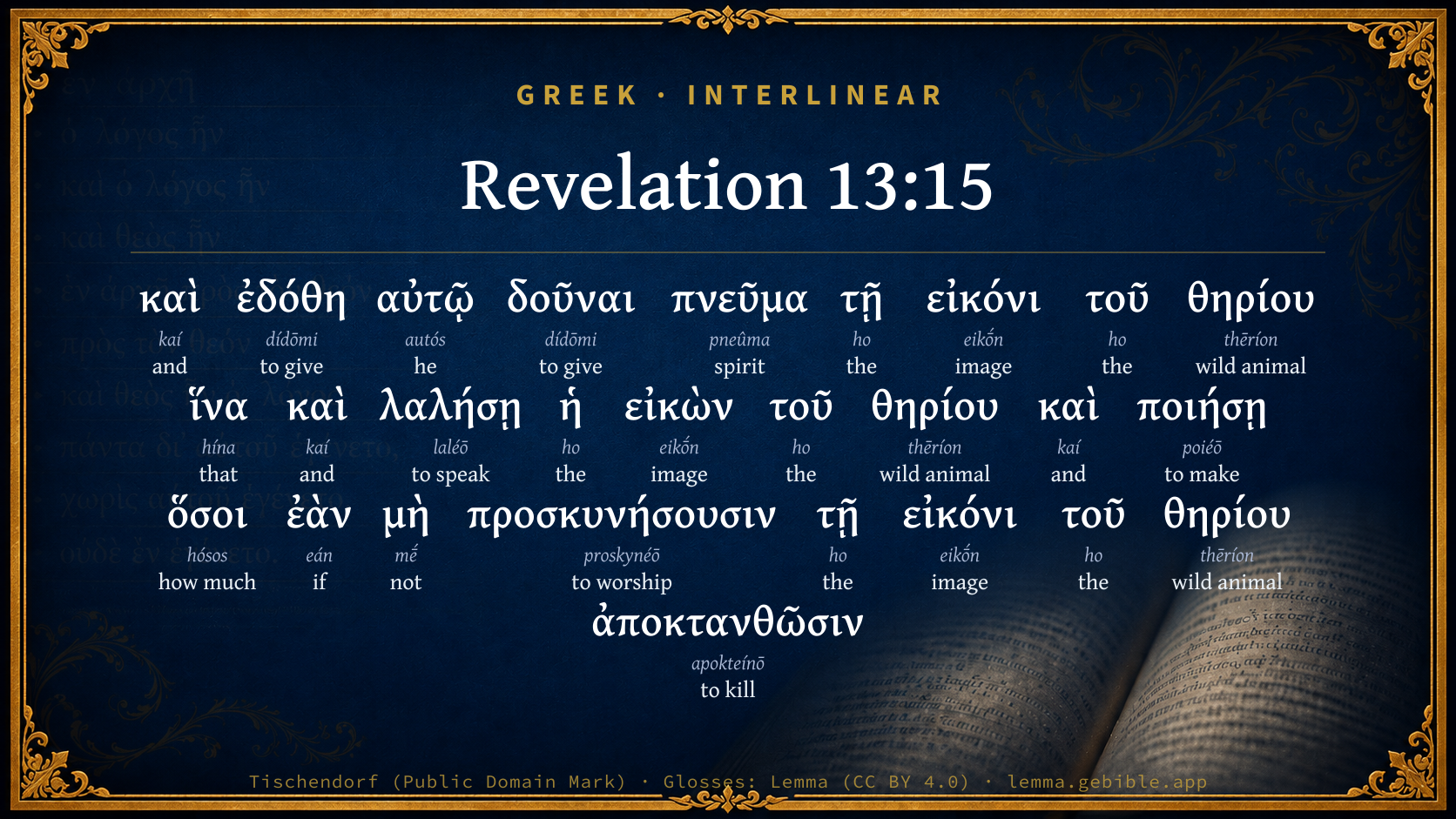
Greek (Tischendorf 8th ed.) Revelation 13:15 appears in the Greek New Testament. The text above is from the Tischendorf 8th edition. Each word links to its Strong’s number and a concise gloss. Click any word for its full Thayer’s Greek Lexicon entry.
Download image
Cite this verse

Revelation 13:15 (World English Bible). Public Domain. Lemma interlinear Bible study tool, https://lemma.gebible.app/v/revelation/13/15.

Show BibTeX & RIS
BibTeX
RIS
English Translation
It was given to him to give breath to it, to the image of the beast, that the image of the beast should both speak, and cause as many as wouldn't worship the image of the beast to be killed.
World English Bible · Public Domain
Download a study sheet

One document with this verse’s original text, its word-by-word gloss line, the meaning frame, cross-references with their text, attributed commentary, and full source and license credits — printable, and it pastes into notes with its structure intact.

This verse Autodidact and up

Study sheet (.html) Plain text (.txt)

A passage Seminary Student

Up to 50 verses in one chapter. A passage sheet keeps up to 6 commentary sources and 12 cross-references per verse, in the order this page ranks them, and says so on the sheet whenever that leaves anything out. Ask for a single verse and you get the Autodidact verse sheet above.

Everything on this page stays free to read, with no account — the sheet is a download of what is already on screen, not access to it.

Want to remove ads? Support Godless Engineer
Compare translations 3

The same verse in 3 English versions, stacked beneath the original-language interlinear above. Click any original word for its lexicon entry.

Each is an independent rendering of the whole verse — the interlinear is not word-aligned to these translations.

Highlighted words mark where these versions differ — a whole-verse word diff, not a word-by-word alignment.

  • World English Bible Public Domain
    It was given to him to give breath to it, to the image of the beast, that the image of the beast should both speak, and cause as many as wouldn't worship the image of the beast to be killed.
  • King James Version Public Domain
    And he had power to give life unto the image of the beast, that the image of the beast should both speak, and cause that as many as would not worship the image of the beast should be killed.
  • unfoldingWord Literal Text CC BY-SA 4.0
    And it was granted to it to give breath to the image of the beast so that the image of the beast might even speak and might cause whoever does not worship the image of the beast to be killed.

unfoldingWord Literal Text — © unfoldingWord, licensed CC BY-SA 4.0. Word-aligned USFM3 via Door43 (git.door43.org/unfoldingWord/en_ult).

Versions to compare (up to 4)

3 of 4 selected

Show all 19 translations

Every available English version of this verse, each an independent rendering of the whole verse.

  • World English Bible Public Domain
    It was given to him to give breath to it, to the image of the beast, that the image of the beast should both speak, and cause as many as wouldn't worship the image of the beast to be killed.
  • Berean Standard Bible Public Domain
    The second beast was permitted to give breath to the image of the first beast, so that the image could speak and cause all who refused to worship it to be killed.
  • Majority Standard Bible Public Domain
    The second beast was permitted to give breath to the image of the first beast, so that the image could speak and cause all who refused to worship it to be killed.
  • King James Version Public Domain
    And he had power to give life unto the image of the beast, that the image of the beast should both speak, and cause that as many as would not worship the image of the beast should be killed.
  • American Standard Version (1901) Public Domain
    And it was given `unto him' to give breath to it, `even' to the image to the breast, that the image of the beast should both speak, and cause that as many as should not worship the image of the beast should be killed.
  • Revised Version (1885) Public Domain
    And it was given unto him to give breath to it, even to the image of the beast, that the image of the beast should both speak, and cause that as many as should not worship the image of the beast should be killed.
  • Geneva Bible (1599) Public Domain
    And it was permitted to him to giue a spirit vnto the image of the beast, so that the image of the beast should speake, and should cause that as many as would not worship the image of the beast, should be killed.
  • Douay-Rheims (1899) Public Domain
    And it was given him to give life to the image of the beast, and that the image of the beast should speak; and should cause, that whosoever will not adore the image of the beast, should be slain.
  • Young's Literal Translation Public Domain
    and there was given to it to give a spirit to the image of the beast, that also the image of the beast may speak, and `that' it may cause as many as shall not bow before the image of the beast, that they may be killed.
  • Literal Standard Version CC BY-SA 4.0
    and there was given to it to give a spirit to the image of the beast, that also the image of the beast may speak, and it may cause as many as will not worship the image of the beast, that they may be killed.
  • Unlocked Literal Bible CC BY-SA 4.0
    It was permitted to give breath to the beast's image so that the image would even speak and cause all who refused to worship the beast to be killed.
  • unfoldingWord Literal Text CC BY-SA 4.0
    And it was granted to it to give breath to the image of the beast so that the image of the beast might even speak and might cause whoever does not worship the image of the beast to be killed.
  • Darby Bible Public Domain
    And it was given to it to give breath to the image of the beast, that the image of the beast should also speak, and should cause that as many as should not do homage to the image of the beast should be killed.
  • World Messianic Bible Public Domain
    It was given to him to give breath to the image of the beast, that the image of the beast should both speak, and cause as many as wouldn’t worship the image of the beast to be killed.
  • Webster's Bible Public Domain
    And he had power to give life to the image of the beast, that the image of the beast should both speak, and cause that as many as would not worship the image of the beast should be killed.
  • Free Bible Version CC BY-SA 4.0
    He was permitted to breathe life into the image of the beast so that it could speak, ordering anyone who did not worship it put to death.
  • Bible in Basic English Public Domain
    And he had power to give breath to the image of the beast, so that words might come from the image of the beast, and that he might have all those who did not give worship to the image of the beast put to death.
  • Text-Critical English NT CC BY 4.0
    The second beast was permitted to give breath to the image of the first beast, so that the image could speak and cause whoever refused to worship the image to be killed.
  • Tyndale New Testament (1534) Public Domain
    And he had power to geve a sprete vnto the ymage of the beest and that the ymage of the beest shuld speake and shuld cause that as many as wolde not worshyppe the ymage of the beest shuld be kylled.

Literal Standard Version (2020), Covenant Press — licensed CC BY-SA 4.0. Text via the HelloAO Bible API (eBible.org). Unlocked Literal Bible (unfoldingWord) — licensed CC BY-SA 4.0. Text via the HelloAO Bible API (eBible.org). unfoldingWord Literal Text — © unfoldingWord, licensed CC BY-SA 4.0. Word-aligned USFM3 via Door43 (git.door43.org/unfoldingWord/en_ult). Free Bible Version, Dr. Jonathan Gallagher — licensed CC BY-SA 4.0. Text via the HelloAO Bible API (eBible.org).

Word by word

More ways to search: Search by grammar → Find every occurrence → Compare this word →

Practice this passage: Drill this verse → Learn its vocabulary →

εἰκόνι
eikṓn
G1504
“image”
Noun, Dative, Singular, Feminine
Part of Speech
Noun
Case
Dative
Number
Singular
Gender
Feminine
Full Thayer's Definition

Origin: from G1503

TDNT: 08:21,2

1. an image, figure, likeness a. an image of the things (the heavenly things) 1. used of the moral likeness of renewed men to God 2. the image of the Son of God, into which true Christians are transformed, is likeness not only to the heavenly body, but also to the most holy and blessed state of mind, which Christ possesses b. the image of one 1. one in whom the likeness of any one is seen 2. applied to man on account of his power of command 3. to Christ on account of his divine nature and absolute moral excellence
  1. καὶ kaí G2532 “and” Conjunction
  2. ἐδόθη dídōmi G1325 “to give” Verb, Aorist, Passive, Indicative, 3rd person, Singular
  3. αὐτῷ autós G846 “he” Personal pronoun, Dative, Singular, Neuter
  4. δοῦναι dídōmi G1325 “to give” Verb, Aorist, Active, Infinitive
  5. πνεῦμα pneûma G4151 “spirit” Noun, Accusative, Singular, Neuter
  6. τῇ ho G3588 “the” Article, Dative, Singular, Feminine
  7. τοῦ ho G3588 “the” Article, Genitive, Singular, Neuter
  8. θηρίου thēríon G2342 “wild animal” Noun, Genitive, Singular, Neuter
  9. ἵνα hína G2443 “that” Conjunction
  10. καὶ kaí G2532 “and” Conjunction
  11. λαλήσῃ laléō G2980 “to speak” Verb, Aorist, Active, Subjunctive, 3rd person, Singular
  12. ἡ ho G3588 “the” Article, Nominative, Singular, Feminine
  13. εἰκὼν eikṓn G1504 “image” Noun, Nominative, Singular, Feminine
  14. τοῦ ho G3588 “the” Article, Genitive, Singular, Neuter
  15. θηρίου thēríon G2342 “wild animal” Noun, Genitive, Singular, Neuter
  16. καὶ kaí G2532 “and” Conjunction
  17. ποιήσῃ poiéō G4160 “to make” Verb, Aorist, Active, Subjunctive, 3rd person, Singular
  18. ὅσοι hósos G3745 “how much” Correlative pronoun, Nominative, Plural, Masculine
  19. ἐὰν eán G1437 “if” Conditional
  20. μὴ mḗ G3361 “not” Particle, Negative
  21. προσκυνήσουσιν proskynéō G4352 “to worship” Verb, Future, Active, Indicative, 3rd person, Plural
  22. τῇ ho G3588 “the” Article, Dative, Singular, Feminine
  23. εἰκόνι eikṓn G1504 “image” Noun, Dative, Singular, Feminine
  24. τοῦ ho G3588 “the” Article, Genitive, Singular, Neuter
  25. θηρίου thēríon G2342 “wild animal” Noun, Genitive, Singular, Neuter
  26. ἀποκτανθῶσιν apokteínō G615 “to kill” Verb, Aorist, Passive, Subjunctive, 3rd person, Plural

About this verse

These counts appear in no published source. They are computed here, from the morphology-tagged text and Lemma’s own curated glosses. What Lemma adds →

27
words
15
distinct lemmas
Revelation
section

Notable vocabulary

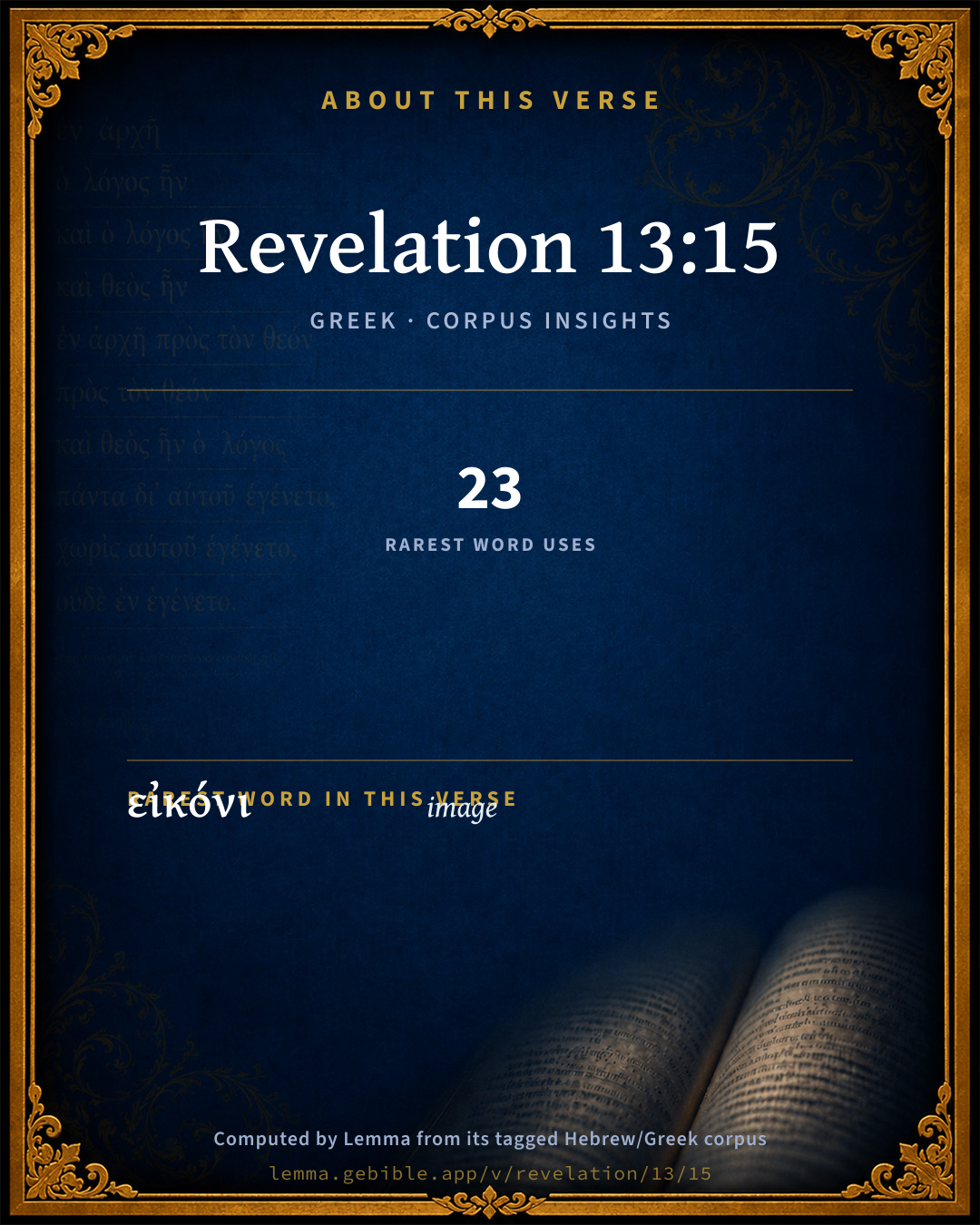
The rarest word here is εἰκόνι image G1504 — appearing just 23 times in the whole Greek New Testament.

Shared distinctive vocabulary

εἰκόνι image G1504 occurs in 20 verses of the Greek New Testament. Also found in:

Repetition

Words recur within this verse:

  • εἰκόνι image G1504 ×3
  • θηρίου wild animal G2342 ×3
  • ἐδόθη to give G1325 ×2
  • τῇ the G3588 ×6
  • καὶ and G2532 ×3

Cross-references

22

Topical passages linked to Revelation 13:15 in the Treasury of Scripture Knowledge — connected by theme and wording, ordered by reader-vote popularity; previews shown in the World English Bible.

  • Daniel 3:3–6 Then the satraps, the deputies, and the governors, the judges, the treasurers, the counselors, the sheriffs, and all the rulers of the provinces, were gathered together to the dedication of the image that Nebuchadnezzar the king had set up; and they stood before the image that Nebuchadnezzar had set up.
  • Revelation 16:2 The first went, and poured out his bowl into the earth, and it became a harmful and evil sore on the people who had the mark of the beast, and who worshiped his image.
  • Revelation 19:20 The beast was taken, and with him the false prophet who worked the signs in his sight, with which he deceived those who had received the mark of the beast and those who worshiped his image. These two were thrown alive into the lake of fire that burns with sulfur.
  • Revelation 20:4 I saw thrones, and they sat on them, and judgment was given to them. I saw the souls of those who had been beheaded for the testimony of Jesus, and for the word of God, and such as didn't worship the beast nor his image, and didn't receive the mark on their forehead and on their hand. They lived, and reigned with Christ for the thousand years.
  • Revelation 17:6 I saw the woman drunken with the blood of the saints, and with the blood of the martyrs of Jesus. When I saw her, I wondered with great amazement.
  • Daniel 7:25 He shall speak words against the Most High, and shall wear out the saints of the Most High; and he shall think to change the times and the law; and they shall be given into his hand until a time and times and half a time.
  • Revelation 13:14 He deceives my own people who dwell on the earth because of the signs he was granted to do in front of the beast; saying to those who dwell on the earth, that they should make an image to the beast who had the sword wound and lived.
  • Revelation 14:9 Another angel, a third, followed them, saying with a great voice, "If anyone worships the beast and his image, and receives a mark on his forehead, or on his hand,
  • Revelation 14:11 The smoke of their torment goes up forever and ever. They have no rest day and night, those who worship the beast and his image, and whoever receives the mark of his name.
  • Revelation 18:20 Rejoice over her, O heaven, you saints, apostles, and prophets; for God has judged your judgment on her."
  • Revelation 18:24 In her was found the blood of prophets and of saints, and of all who have been slain on the earth."
  • Genesis 2:7 Yahweh God formed man from the dust of the ground, and breathed into his nostrils the breath of life; and man became a living soul.
  • Psalms 115:5 They have mouths, but they don't speak; They have eyes, but they don't see;
  • Psalms 135:16–17 They have mouths, but they can't speak; They have eyes, but they can't see;
  • Jeremiah 10:5 They are like a palm tree, of turned work, and don't speak: they must be carried, because they can't go. Don't be afraid of them; for they can't do evil, neither is it in them to do good."
  • Jeremiah 10:14 Every man is become brutish [and is] without knowledge; every goldsmith is disappointed by his engraved image; for his molten image is falsehood, and there is no breath in them.
  • Jeremiah 51:17 Every man is become brutish [and is] without knowledge; every goldsmith is disappointed by his image; for his molten image is falsehood, and there is no breath in them.
  • Revelation 17:17 For God has put in their hearts to do what he has in mind, and to be of one mind, and to give their kingdom to the beast, until the words of God should be accomplished.
  • Habakkuk 2:19 Woe to him who says to the wood, 'Awake!' or to the mute stone, 'Arise!' Shall this teach? Behold, it is overlaid with gold and silver, and there is no breath at all in the midst of it.
  • James 2:26 For as the body apart from the spirit is dead, even so faith apart from works is dead.
  • Revelation 16:5 I heard the angel of the waters saying, "You are righteous, who are and who were, you Holy One, because you have judged these things.
  • Revelation 17:14 These will war against the Lamb, and the Lamb will overcome them, for he is Lord of lords, and King of kings. They also will overcome who are with him, called and chosen and faithful."

Cross-references courtesy of OpenBible.info (CC BY 4.0).

Commentary

Notes on Revelation 13:15 from classic Christian and Jewish commentators (each source and its license shown beneath its notes). The classic Christian expositions comment on the surrounding passage and are grouped to its opening verse, so a note may address several verses; the Jewish commentaries on the Tanakh (Rashi and others) are per-verse, so they appear only where the commentator wrote on this verse.

Lemma curates 59 commentaries, every one of them public domain or Creative Commons licensed, each selected and text-cleaned for this edition rather than reprinted as found. About our sources →

Burkitt's Expository Notes on the New Testament

William Burkitt

St. John proceeds here to give a farther character and description of the beast, which he had begun to describe, Rev 13:11.

And, 1. His bloody cruelty is set forth, Rev 13:15. He causeth them to be killed that would not worship the image of the beast.

Where mark, It is not said that he killed them himself, nor challenging directly the power of life and death to himself; but he causeth them to be killed, namely, by the secular power, by the kings and princes, who are the horns of the beast, and who give their power and strength to the beast, and war against the Lamb.

Again, 2. After his cruelty follows his compulsion; he causes all sorts of men, high and low, bond and free, to receive a mark in their right hand, and in their forehead, in allusion to an ancient custom, which was to mark servants and soldiers on the arm by which it was known what master or captain they belonged to; in like manner the beast here is said to have a mark for those that are his, which mark seems probably to have been an open owning of him, an active engagement for him, a professed subjection to him.

3. The beast here is said to interdict and forbid all trade and commerce with those that had not his mark, Rev 13:17. He causeth that no man might buy or sell, save he that had the mark of the beast. Several bulls and decrees have been sent forth from Rome, commanding that no traffic or commerce be had with any heretic in buying or selling, but only with those that profess themselves members of the Romish church.

4. It is added, that the Number of the beast is six hundred sixty-six, that is, that the numeral letters of a certain word or name, being computed, should amount to that number. I shall close this chapter with the words of a great man, Archbishop Tillotson, on Rev 14:13. "Unto whom all the fore-mentioned characters of the beast do agree, and especially the number of his name, I shall not presume to conjecture, much less positively to determine, because it is said to require a particular wisdom and understanding to find it out: Here is wisdom, let him that hath understanding count the number of the beast. However, the event will discover it."

And again, on Luk 9:55 he thus speaks; "It is believed by many and not without cause, that the Pope and his faction are the antichristian beast; I will say no more than I know in this matter: I am not certain that is is he that is particularly designed in scripture by the name; but however that be, I challenge antichrist himself, whoever he is, and whenever he comes, to do worse and wickeder things than he has done: verily it almost looks uncharitably barely to relate what these men have not blushed to act."

William Burkitt's Expository Notes on the New Testament (1700–1703) — public domain. Text from a community e-Sword module.

Bengel's Gnomon

Johann Albrecht Bengel

Rev 13:15. Ἵνα λαλήσῃ ἡ εἰκὼν τοῦ θηρίου) that the image of the beast should speak. “That images should speak, is a wonderful thing, and yet not incredible. You find it mentioned in Roman stories, and in Valerius Maximus, respecting the images of Juno Moneta, of Fortuna Mulielnis, and of Silvanus. And Moses Maimonides, in Part iii. ch. 24 of the Guide of those in doubt, says, that two books have been read by himself respecting Images which spake.”—Grotius on this passage. Add the things which Peter Crugotius and Nic. Mulerius cite on this passage also. The things which Freinshemius has collected on Florus, who treats, Book ii. c. 8, respecting the sweat of Apollo of Cumæ, are not dissimilar. “All these things were so customary two or three centuries ago, in the case of images belonging to our country, that they wept, laughed, and even SPOKE and walked, almost oftener than men; and performed other actions, which the men of our time can scarcely believe.”—ἵνα ἀποκτανθῶσι, that they should be killed) Rupertus says with weight on this passage: “Christ did not do this; nor have His prophets nor apostles taught, nor have kings now become Christian understood this, that they should kill, and think that the service of Christ is to be advanced by bloodshed. For the true God does not wish compulsory, but willing service. Therefore also in this, nay, even especially in this, he will show to those who have understanding, and who are strong in reason, that he is in truth Antichrist, that he is in truth not Christ; but that, in accordance with his name, he is opposed to Christ. It is Christ who shed His own blood. It is Antichrist who shed the blood of others.” After the Reformation, illustrious interpreters from time to time laid it down that a most violent persecution was even then impending from the beast: as Phil. Nicolai, Book ii. concerning the kingdom of Christ, p. 305; Hoe on Ap. XI., num. 78; Doelingius de Antichr. p. 298, and everywhere. Add Matthew Hofmann’s Chronology Apoc. p. 116.

Bengel's Gnomon of the New Testament — English translation (T&T Clark, Edinburgh, 1860) — public domain. Text from a community e-Sword module.

Meyer's Critical & Exegetical Commentary

Heinrich August Wilhelm Meyer

Rev_13:15. To the second beast, it was further given (ἐδοθη, cf. Rev_13:7): δοῦναι πνεῦμα τῇ εἰκόνι τοῦ θηρίου, i.e., to give that image of the beast a demoniacal πνεῦμα ζωῆς,[3374] and that, too, with the intention (ἽΝΑ ΚΑῚ ΛΑΛ.) that this might thereby speak, and also by this sign of life manifest his usurped divine glorywhich must be adored (Rev_13:15 b). Rev_13:15 a must not be understood of a speaking of the spirit of heathen idols;[3375] but this feature of the description contains a suggestion of what has been reported concerning divine images actually speaking;[3376] and John appears[3377] to presuppose the reality of such demoniacal miracles.

Significant, besides, is the statement that the idol of the first beast had not the power to speak of itself, nor with the rough force with which the beast ruled the world, but that the intellectual power of the lying wisdom of the world must give that beast living speech. The false prophet with his ΠΛΑΝᾶΝ belongs thereto, if that beast is to find worship.

Incorrect is the special reference in Victorin.: He will cause a golden image to antichrist to be placed in the temple at Jerusalem, and the vanishing angel to enter, and to give thence voices and decisions.

κ. ποιήσῃ ἱνα

ἀποκτανθῶσι. On the construction, cf. Rev_13:12. On the historical illustration of this testimony, as in the letter of Pliny to Trajan.[3378]

[3374] Cf. Rev_11:11.

[3375] Against Hengstenb., who remarks how the heathen in his idol objectified his own views, and that, too, with a vividness which was attested by the assertions of actual speech on the part of those images.

[3376] Cf. Grot., Ew. ii., who also recalls the popular deception of speaking statues of Mary.

[3377] Cf. also Rev_13:13.

[3378] L. X., ep. 97: When they invoked the gods, and with wine and frankincense made supplication to your image, which, for that purpose, I had commanded to be brought together with the statues of the deities, none of which things, as is said, those who are really Christians can be forced to do. Those who remain faithful must die: Threatening also to punish them with death. Such as persisted, I ordered them to be led away. Cf., concerning the Neronian persecution, Tacit., Ann., xv. 44.

Meyer — Critical and Exegetical Commentary on the New Testament — English translation by Peter Christie, edited by Frederick Crombie (T&T Clark, 1880) — public domain. Text from a community e-Sword module.

Expositor's Greek Testament

ed. W. Robertson Nicoll

Rev 13:15 . The statue is made to speak, in order to work on the credulity and awe of the worshippers. The trick was well within the reach of contemporary magic ( cf. Valer. Maxim, i. 8. 3 5), and later tradition attributed it to Simon Magus (Clem. Recogn. iii. 47, cf. Clem. Hom. ii. 32), while similar ventriloquism was practised by Apollonius of Tyana and Egyptian sorcerers at Caligula’s court. cf. Lucian’s αὐτόφωνοι χρησμοὶ ( Alex . 26). ἀποκτανθῶσιν , cf. the scutcheon of Captain Pope in Bunyan’s Holy War “the stake, the flame, and the good man in it”.

The Expositor's Greek Testament, edited by W. Robertson Nicoll (1897–1910) — public domain. Text from a community e-Sword module.

Geneva Bible (1599)

Geneva Bible translators

To give life as Jannes and Jambres imitated the wonders that Moses wrought.

And of this miracle of the images of the beast (that is, which the beast hath ordained to establish idolatry) which miraculously speak and give judgment, or rather marvelously, by the fraud of the false prophets, the Papists books are full fraughted.

Geneva Bible (1599) marginal notes — public domain. Text via Bolls.life.

Jamieson, Fausset & Brown

Robert Jamieson, A. R. Fausset & David Brown

he had power--Greek, "it was given to him."

to give life--Greek, "breath," or "spirit."

image--Nebuchadnezzar set up in Dura a golden image to be worshipped, probably of himself; for his dream had been interpreted, "Thou art this head of gold"; the three Hebrews who refused to worship the image were east into a burning furnace. All this typifies the last apostasy. PLINY, in his letter to Trajan, states that he consigned to punishment those Christians who would not worship the emperor's image with incense and wine. So JULIAN, the apostate, set up his own image with the idols of the heathen gods in the Forum, that the Christians in doing reverence to it, might seem to worship the idols. So Charlemagne's image was set up for homage; and the Pope adored the new emperor [DUPIN, vol. 6, p. 126]. Napoleon, the successor of Charlemagne, designed after he had first lowered the Pope by removing him to Fontainebleau, then to "make an idol of him" [Memorial de Sainte Helene]; keeping the Pope near him, he would, through the Pope's influence, have directed the religious, as well as the political world. The revived Napoleonic dynasty may, in some one representative, realize the project, becoming the beast supported by the false prophet (perhaps some openly infidel supplanter of the papacy, under a spiritual guise, after the harlot, or apostate Church, who is distinct from the second beast, has been stripped and judged by the beast, Rev 17:16); he then might have an image set up in his honor as a test of secular and spiritual allegiance.

speak--"False doctrine will give a spiritual, philosophical appearance to the foolish apotheosis of the creaturely personified by Antichrist" [AUBERLEN]. JEROME, on Daniel 7, says, Antichrist shall be "one of the human race in whom the whole of Satan shall dwell bodily." Rome's speaking images and winking pictures of the Virgin Mary and the saints are an earnest of the future demoniacal miracles of the false prophet in making the beast's or Antichrist's image to speak.

Jamieson, Fausset & Brown — Commentary Critical and Explanatory on the Whole Bible (1871) — public domain (CC PDM 1.0). Text via the HelloAO Bible API.

Adam Clarke's Commentary

Verse 15. And he had power to give life unto the image of the beast, that the image of the beast should both speak, and cause that as many as would not worship the image of the beast should be killed.] I would just observe that the Brahmins, by repeating incantations, profess to give eyes and a soul to an image recently made, before it is worshipped; afterwards, being supposed to be the residence of the god or goddess it represents, it has a legal right to worship. On this verse the learned bishop observes: "The influence of the two-horned beast, or corrupted clergy, is farther seen in persuading and inducing mankind to make an image to the beast which had the wound by a sword, and did live. This image and representative of the beast is the pope. He is properly the idol of the Church. He represents in himself the whole power of the beast, and is the head of all authority, temporal as well as spiritual. He is nothing more than a private person, without power and without authority, till the two-horned beast or corrupted clergy, by choosing him pope, give life unto him, and enable him to speak and utter his decrees, and to persecute even to death as many as refuse to submit to him and to worship him. As soon as he is chosen pope he is clothed with the pontifical robes, and crowned and placed upon the altar, and the cardinals come and kiss his feet, which ceremony is called adoration. They first elect and then they worship him, as in the medals of Martin V., where two are represented crowning the pope, and two kneeling before him, with this inscription, Quem creant adorant; 'Whom they create they adore.' He is THE PRINCIPLE OF UNITY TO THE TEN KINGDOMS OF THE BEAST, and causeth, as far as he is able, all who will not acknowledge his supremacy to be put to death." The great ascendency which the popes have obtained over the kings of the Latin world by means of the Romish hierarchy is sufficiently marked in the history of Europe. As long as the great body of the people were devoted to the Roman Catholic idolatry, it was in vain for the kings of the different Roman Catholic countries to oppose the increasing usurpations of the popes. They ascended, in spite of all opposition, to the highest pinnacle of human greatness; for even the authority of the emperors themselves was established or annulled at their pleasure. The high sounding tone of the popes commenced in Gregory VII., A.D. 1073, commonly known by the name of Hildebrand, who aimed at nothing less than universal empire. He published an anathema against all who received the investiture of a bishopric or abbacy from the hands of a layman, as also against those by whom the investiture should be performed. This measure being opposed by Henry IV., emperor of Germany, the pope deposed him from all power and dignity, regal or imperial. See Corps Dlplomatique, tom. i. p. 53. Great numbers of German princes siding with the pope, the emperor found himself under the necessity of going, (in January, 1077,) to the bishop of Rome to implore his forgiveness, which was not granted him till he had fasted three days, standing from morning to evening barefooted, and exposed to the inclemency of the weather! In the following century the power of the pope was still farther increased; for on the 23d of September, 1122, the Emperor Henry V. gave up all right of conferring the regalia by the ceremony of the ring and crosier, so that the chapters and communities should be at liberty to fill up their own vacancies. In this century the election of the Roman pontiffs was confined by Alexander III. to the college of cardinals. In the thirteenth century the popes (Dr. Mosheim observes) "inculcated that pernicious maxim, that the bishop of Rome is the supreme lord of the universe, and that neither princes nor bishops, civil governors nor ecclesiastical rulers, have any lawful power in Church or state but what they derive from him. To establish their authority both in civil and ecclesiastical matters upon the firmest foundation, they assumed to themselves the power of disposing of the various offices of the Church, whether of a higher or more subordinate nature, and of creating bishops, abbots, and canons, according to their fancy. The first of the pontiffs who usurped such an extravagant extent of authority was Innocent III., (A.D. 1198-1216,) whose example was followed by Honorius III., (A.D. 1216,) Gregory IX., (A.D. 1227,) and several of their successors." Thus the plenitude of the papal power (as it is termed) was not confined to what was spiritual; the Romish bishops "dethroned monarchs, disposed of crowns, absolved subjects from the obedience due to their sovereigns, and laid kingdoms under interdicts. There was not a state in Europe which had not been disquieted by their ambition. There was not a throne which they had not shaken, nor a prince who did not tremble at their presence." The point of time in which the Romish bishops attained their highest elevation of authority was about the commencement of the fourteenth century. Boniface VIII., who was pope at this time, outstripped all his predecessors in the high sounding tone of his public decrees. According to his famous bull Unam Sanctam, published Nov. 16, 1302, "the secular power is but a simple emanation from the ecclesiastical; and the double power of the pope, founded upon Holy Scripture, is even an article of faith. God," said he, "has confided to Saint Peter, and to his successors, two swords, the one spiritual, the other temporal. The first ought to be exercised by the Church itself; and the other, by secular powers for the service of the Church, and according to the will of the pope. The latter, that is to say, the temporal sword, is in subjection to the former, and the temporal authority depends indispensably on the spiritual power which judges it, white God alone can judge the spiritual power. Finally," he adds, "it is necessary to salvation for every human creature to be in subjection to the Roman pontiff." The false prophet SAID "to them that dwell upon the earth, that they should make an image to the beast that had the wound by a sword, and did live;" that is, the Romish priesthood PREACHED UP the pope's supremacy over temporal princes; and, through their astonishing influence on the minds of the people, the bishop of Rome at last became the supreme sovereign of the secular Latin empire, and thus was at the head of all authority, temporal and spiritual.

The papists have in their various superstitions professed to worship God. But they are said, in the unerring words of prophecy, to worship the dragon, beast, and image of the beast, and to blaspheme God; for they received as holy those commandments of men that stand in direct opposition to the sacred Scriptures, and which have been imposed on them by the Romish bishops, aided by the secular powers. "God is a Spirit, and they who worship him must worship him in SPIRIT and in TRUTH."

Adam Clarke's Commentary on the Bible (1810–1826) — public domain. Text from a community e-Sword/MySword module.

Ellicott's Commentary for English Readers

(15) And he had power . . .—Better, And it was given to him to give breath to the image of the wild beast, that the image of the wild beast should both speak, and cause that as many as do not worship the image of the wild beast shall be slain. The image to the wild beast is an image also of the wild beast: and the image of the monster is endued with apparent vitality. Wisdom can give a semblance of life to the most doomed cause; and the bulk of mankind read only with their eyes, and not at all with their thoughts. The image of the Roman emperor was, in ancient days, made an object of worship. Christians suffered rather than by such an act of worship prove disloyal to Christ: like their spiritual ancestors, they refused to worship the image which the world-power had set up; they were willing to render to Cæsar the things that were Cæsar’s, but the homage which belonged to God they refused to any but their God. These are but types of those who have refused, though tempted by specious eloquence and sagacious subtlety, to offer homage to any mere world-power; for the golden image is ever set up upon the plains of this world: its glitter and its vitality survive the storm and the conflict of the ages: it speaks, and men hear and adore, for they walk by sight, not by faith; and it needs no imperial or papal edict to doom to social death and failure those who refuse to shape their conduct by considerations of self-interest, and who are sure to be treated as fanatics because they follow right and conscience and Christ.

A Bible Commentary for English Readers, edited by Charles John Ellicott (1878–1897) — public domain. Text from a community e-Sword module.

The Cambridge Bible for Schools and Colleges

gen. ed. J. J. S. Perowne

15. he had power] Lit. it was given to him.

life] Lit. breath or spirit.

The Cambridge Bible for Schools and Colleges (gen. ed. J. J. S. Perowne; Cambridge University Press, 1878–1918) — public domain. Text from a community e-Sword module.

John Gill's Exposition

And he causeth all, both small and great, rich and poor,

free and bond,.... Men of all ranks and degrees, states and conditions, within his jurisdiction; this refers to the beast, and not to the image:

to receive a mark in their right hand, or in their foreheads; or "that they might give themselves marks", as the Complutensian edition reads; which is an allusion either to the custom among the Romans of imprinting marks upon their servants and soldiers, by which they might be known to whom they belonged; servants had them in their foreheads (i), and soldiers in their hands (k); or to the usages of the Jews in binding their phylacteries upon their arms and foreheads, to put them in mind of the law of God, and their obedience to it; or to the practices of the Heathens, in putting the mark of the god they worshipped upon their bodies; Maimonides (l) says, it was a custom with the Gentiles to mark themselves with their idols, showing that they were their bought servants, and were marked for their service: the sense is, that some received the mark in one place, and some in another: those who were obliged to receive the mark in the right hand seem to be the clergy, such who entered into holy orders; who lifted up their right hand, and swore and vowed allegiance to the pope, and testified they were ready to defend and support his religion and interest; and who in their ordination are said to have an indelible character impressed on them: and those who received the mark in their foreheads are the common people in general, who one and all have the same impress upon them; which may intend either the sign of the cross in baptism, or rather their open confession of the Popish religion, which they as publicly avow and declare as if it had been written on their foreheads.

(i) Apulei Metamorph. l. 9. Ausonii Epigram. l. 15. Seneca de Ira, l. 3. c. 3. (k) Aetius apud Turnebi Advers. l. 23. c. 12. (l) Hilchot Obede Cochab. c. 12. sect. 11.

John Gill's Exposition of the Whole Bible (1746–1763) — public domain (CC PDM 1.0). Text via the HelloAO Bible API.

Trapp's Complete Commentary

John Trapp

15 And he had power to give life unto the image of the beast, that the image of the beast should both speak, and cause that as many as would not worship the image of the beast should be killed.

Ver. 15. Should be killed] What slaughters Charles V made at Magdeburg and elsewhere by the pope’s appointment, and what bloody work hath been done in Germany now for this twenty-eight years, or thereabouts, by the now emperor and his father, against the Protestant party, I need not here to relate.

John Trapp, A Commentary or Exposition upon All the Books of the Old and New Testament (1647–1656) — public domain. Text from a community e-Sword module.

Albert Barnes' Notes on the Bible

And he had power to give life unto the image of the beast - That is, that image of the beast would be naturally powerless, or would have no life in itself. The second beast, however, had power to impart life to it, so that it would be invested with authority, and would exercise that authority in the manner specified. If this refers, as is supposed, to the Roman civil power - the power of the empire restored - it would find a fulfillment in some act of the papacy by which the empire that resembled in the extent of its jurisdiction, and in its general character, the former Roman empire, received some vivifying impulse, or was invested with new power. That is, it would have power conferred on it through the papacy which it would not have in itself, and which would confirm its jurisdiction. How far events actually occurred corresponding with this, will be considered in the notes at the close of this verse.

That the image of the beast should both speak - Should give signs of life; should issue authoritative commands. The speaking here referred to pertains to what is immediately specified, in issuing a command that they who “would not worship the image of the beast should be killed.”

And cause that as many as would not worship the image of the beast - Would not honor it, or acknowledge its authority. The “worship” here referred to is civil, not religious homage. See the notes on Rev 13:4. The meaning is, that what is here called the “image of the beast” had power given it, by its connection with the second “beast,” to set up its jurisdiction over people, and to secure their allegiance on pain of death. The power by which this was done was derived from the second beast; the obedience and homage demanded was of the most entire and submissive character; the nature of the government was in a high degree arbitrary; and the penalty enforced for refusing this homage was death. The facts that we are to look for in the fulfillment of this are:

(1)That the Roman imperial power was about to expire - as if wounded to death by the sword;

(2)That this was revived in the form of what is here called the “image of the beast” - that is, in a form closely resembling the former power;

(3)That this was done by the agency of the papal power, represented by the second beast;

(4)That the effect of this was to set up over people a wide-extended secular jurisdiction, of a most arbitrary and absolute kind, where the penalty of disobedience to its laws was death, and where the infliction of this was, in fact, to be traced to the influence of the second beast - that is, the papal spiritual power.

The question now is, whether facts occurred that corresponded with this emblematic representation. Now, as to the leading fact, the decline of the Roman imperial power - the fatal wound inflicted on that by the “sword” - there can be no doubt. In the time of “Augustulus,” as above stated, it had become practically extinct - “wounded as it were to death,” and so wounded that it would never have been revived again had it not been for some foreign influence. It is true also, that, when the papacy arose, the necessity was felt of allying itself with some wide extended civil or secular dominion, that might be under its own control, and that would maintain its spiritual authority. It is true, also, that the empire was revived - the very “image” or copy, so far as it could be, of the former Roman power, in the time of Charlemagne, and that the power which was wielded in what was called the “empire,” was what was, in a great measure, derived from the papacy, and was designed to sustain the papacy, and was actually employed for that purpose. These are the main facts, I suppose, which are here referred to, and a few extracts from Mr. Gibbon will show with what propriety and accuracy the symbols here employed were used, on the supposition that this was the designed reference:

(a) The rise, or restoration of this imperial power in the time and the person of Charlemagne. Mr. Gibbon says (3:342), “It was after the Nicene synod, and under the reign of the pious Irene, that the popes consummated the separation of Rome and Italy (from the Eastern empire) by the translation of the empire to the less orthodox Charlemagne. They were compelled to choose between the rival nations; religion was not the sole motive of their choice; and while they dissembled the failings of their friends, they beheld with reluctance and suspicion the Catholic virtues of their foes. The difference of language and manners had perpetuated the enmity of the two capitals (Rome and Constantinople); and they were alienated from each other by the hostile opposition of seventy years. In that schism the Romans had tasted of freedom, and the popes of sovereignty; their submission would have exposed them to the revenge of a jealous tyrant, and the revolution of Italy had betrayed the impotence as well as the tyranny of the Byzantine court.”

Mr. Gibbon then proceeds to state reasons why Charlemagne was selected as the one who was to be placed at the head of the revived imperial power, and then adds (p. 343), “The title of patrician was below the merit and greatness of Charlemagne; and it was only by reviving the “Western empire” that they could pay their obligations, or secure their establishment. By this decisive measure they would finally eradicate the claims of the Greeks; from the debasement of a provincial town the majesty of Rome would be restored; the Latin Christians would be united, under a supreme head, in their ancient metropolis; “and the conquerors of the West would receive their crown from the successors of Peter. The Roman church would acquire a zealous and respectable advocate”; and under the shadow of the Carlovingian power, the bishop might exercise, with honor and safety, the government of the city.” All this seems as if it were a designed commentary on such expressions as these: “And he exerciseth all the power of the first beast, and causeth the earth and them which dwell therein to worship the first beast, whose deadly wound was healed,” “saying to them that dwell on the earth that they should make an image to the beast which had the wound by a sword, and did live; and he had power to give life unto the image of the beast,” etc.

(b) Its extent. It is said Rev 13:12, “And he exerciseth all the power of the first beast, and causeth the earth and them which dwell therein to worship the first beast, whose deadly wound was healed.” Compare Rev 13:14-15. That is, the extent of the jurisdiction of the revived power, or the restored empire, would be as great as it was before the wound was inflicted. Of the extent of the restored empire under Charlemagne, Mr. Gibbon has given a full account, iii. pp. 546-549. The passage is too long to be copied here in full, and a summary of it only can be given. He says, “The empire was not unworthy of its title; and some of the fairest kingdoms of Europe were the patrimony or conquest of a prince who reigned at the same time in France, Spain, Italy, Germany, and Hungary.

I. The Roman province of Gaul had been transformed into the name and monarchy of France, etc.

II. The Saracens had been expelled from France by the grandfather and father of Charlemagne, but they still possessed the greatest part of Spain, from the rock of Gibraltar to the Pyrenees. Amidst their civil divisions, an Arabian emir of Saragossa implored his protection in the diet of Paderborn. Charlemagne undertook the expedition, restored the emir, and, without distinction of faith, impartially crushed the resistance of the Christians, and rewarded the obedience and service of the Muslims. In his absence he instituted the Spanish March, which extended from the Pyrenees to the river Ebro: Barcelona was the residence of the French governor; he possessed the counties of Rousillon and Catalonia; and the infant kingdoms of Navarre and Aragon were subject to his jurisdiction.

III. As king of the Lombards, and patrician of Rome, he reigned over the greatest part of Italy, a tract of a thousand miles from the Alps to the borders of Calabria, etc.

IV. Charlemagne was the first who united Germany under the same scepter, etc.

V. He retaliated on the Avars, or Huns of Pannonia, the same calamities which they had inflicted on the nations: the royal residence of the Chagan was left desolate and unknown; and the treasures, the rapine of two hundred and fifty years, enriched the victorious troops, or decorated the churches of Italy and Gaul.” “If we retrace the outlines of the geographical picture,” continues Mr. Gibbon, “it will be seen that the empire of the Franks extended, between east and west, from the Ebro to the Elbe or Vistula; between the north and south, from the duchy of Beneventum to the river Eyder, the perpetual boundary of Germany and Denmark. Two-thirds of the Western empire of Rome were subject to Charlemagne, and the deficiency was amply supplied by his command of the inaccessible or invincible nations of Germany.”

(c) The dependence of this civil or revived secular power on the papacy. “His deadly wound was healed.” “And caused the earth to worship the first beast.” “Saying to them that dwell on the earth, that they should make an image to the beast.” “He had power to give life unto the image of the beast.” Thus Mr. Gibbon (3:343) says, “From the debasement of a provincial town, the majesty of Rome would be restored; the Latin Christians would be united, under a supreme head, in their ancient metropolis; and the conquerors of the West would receive their crown from the successors of Peter.” And again (3:344) he says, “On the festival of Christmas, the last year of the eighth century, Charlemagne appeared in the church of Peter; and, to gratify the vanity of Rome, he had exchanged the simple dress of his country for the habit of a patrician. After the celebration of the holy mysteries, Leo suddenly placed a precious crown on his head, and the dome resounded with the acclamations of the people, ‘Long life and victory to Charles, the most pious Augustus, crowned by God the great and pacific emperor of the Romans!’ The head and body of Charlemagne were consecrated by the royal unction; his coronation oath represents a promise to maintain the faith and privileges of the church; and the first-fruits are paid in rich offerings to the shrine of the apostle. In his familiar conversation the emperor protested his ignorance of the intentions of Leo, which he would have disappointed by his absence on that memorable day.

But the preparations of the ceremony must have disclosed the secret; and the journey of Charlemagne reveals his knowledge and expectation; he had acknowledged that the imperial title was the object of his ambition, and a Roman senate had pronounced that it was the only adequate reward of his merit and services.” So again (3:350), Mr. Gibbon, speaking of the conquests of Otho (962 a.d.), and of his victorious march over the Alps, and his subjugation of Italy, says, “From that memorable era, two maxims of public jurisprudence were introduced by force and ratified by time:

I. That the prince who was elected in the German diet, acquired from that instant the subject kingdoms of Italy and Rome.

II. But that he might not legally assume the titles of emperor and Augustus, until he had received the crown from the hands of the Roman Pontiff.” In connection with these quotations from Mr. Gibbon, we may add, from Sigonius, the oath which the emperor took on the occasion of his coronation: “I, the Emperor, do engage and promise, in the name of Christ, before God and the blessed apostle Peter, that I will be a protector and defender of this holy church of Rome, in all things wherein I can be useful to it, so far as divine assistance shall enable me, and so far as my knowledge and power can reach” (quoted by Prof. Bush, Hieroph. Nov. 1842, p. 141). We learn, also, from the biographers of Charlemagne that a commemorative coin was struck at Rome under his reign, bearing this inscription: “Renovatio Imperil Romani” - “Revival of the Roman Empire” (Ibid.). These quotations, whose authority will not be questioned, and whose authors will not be suspected of having had any design to illustrate these passages in the Apocalypse, will serve to confirm what is said in the notes of the decline and restoration of the Roman secular power; of its dependence on the papacy to give it life and vigor; and of the fact that it was designed to sustain the papacy, and to perpetuate the power of Rome. It needs only to be added, that down to the time of Charles the Fifth - the period of the Reformation-nothing was more remarkable in history than the readiness of this restored secular power to sustain the papacy and to carry out its designs; or than the readiness of the papacy to sustain an absolute civil despotism, and to make the world subject to it by suppressing all attempts in favor of civil liberty.

Albert Barnes' Notes on the Bible (1834–1885) — public domain. Text from a community e-Sword/MySword module.

Matthew Poole's English Annotations

The beast, mentioned Rev 13:11, had power to give life unto this new formed idolatry, conformable to that of the pagans, in which the old beast again lived: he gave life to it by his decrees and bulls, and canon laws, and by his excommunications and censures of those that would not comply with his idolatry as heretics; after which the persons so adjudged were delivered up to the secular power to be put to death.

Matthew Poole's English Annotations on the Holy Bible (1683–1685) — public domain. Text from a community e-Sword/MySword module.

Whedon's Commentary on the Bible

Daniel D. Whedon

15. Life unto the image—He was not to be a dead statue, like an image of an emperor; he should speak; and he, the image, should cause the refusers of worship to be killed.

Worship the image—To the pope the attributes of the Deity are ascribed, the name God is given, and the worship, due to God, is offered the papal theocracy. See note on 2Th_2:7. The Canon also declared, “It is certain that the pope was styled God by Constantine, and it is manifest that God cannot be judged by men.” And so Pope Urban II. maintained that he was judge of all men, but that he could be judged by no man, and he was acquitted of an accusation on that ground. And, under Pope Symmachus, at the beginning of the sixth century, it was declared that the pope was judge in the place of God, and could himself be judged by none. He was above all human jurisdiction. And, at the fifth Lateran Council, the orator announced, with all acceptance, “Thou art finally a second God on earth.” See our notes on 2Th_2:4-10.

Killed—No domination ever existed on earth so bloody and so cruel, in every form of infliction, as the popedom, from its first establishment to the present hour. Religious wars waged by its instigation, massacres and exterminations, inquisitions and dragonades, tortures by rack and by burning, form the staple of the history. The Spanish inquisition, the massacre of St. Bartholomew, the Smithfield fagots, are exploits of this infernal image. Every country in western Europe is stained by this antichrist with blood. It has ruined South America. In our Protestant North America its devotees are numerous and menacing, but impotent as yet.

Daniel D. Whedon (gen. ed.), Commentary on the Old and New Testaments (1874–1909) — public domain. Text from a community e-Sword module.

The Pulpit Commentary

And he had power to give life unto the image of the beast, that the image of the beast should both speak, and cause that as many as would not worship the image of the beast should be killed; and it was given to him to give breath, etc. a and a number of cursives lead the indicative future, poihsei , that is," he the beast shall cause," etc. The symbolism is most probably derived from the heathen oracles. This beast is permitted to give life, to impart spirit to the image; that is, he gives it an appearance of reality which a mere image could not possess. This is the dangerous power of self deceit. If men would face the naked truth, stripped of plausible arguments and specious resemblances, they would see that there was no reality in the ideal which they place before their minds, and their worship of which is prompted by love of the world, and the denial of God"s power. Together with the attempt to deceive men into worshipping the image, is offered the alternative of death, or, should we not say, apparent death? It is only self deceit which makes men imagine that the alternative to an acceptance of the sovereignty of Satan and the world; is death. No doubt many Christians in St. John"s time were thus beguiled. They deceived themselves by imagining that they must either conform to the heathen practices required of them, or suffer death; those with clearer mental vision saw that the threatened death was in reality life.

The Pulpit Commentary (1880–1919), ed. H.D.M. Spence-Jones & Joseph S. Exell — public domain. Text from a community e-Sword module.

John Wesley's Explanatory Notes

So that the image of the wild beast should speak - Many instances of this kind have been already among the Papists, as well as the heathens. And as many as will not worship - When it is required of them; as it will be of all that buy or sell. Shall be killed - By this the Pope manifests that he is antichrist, directly contrary to Christ. It is Christ who shed his own blood; it is antichrist who sheds the blood of others. And yet, it seems, his last and most cruel persecution is to come. This persecution, the reverse of all that preceded, will, as we may gather from many scriptures, fall chiefly on the outward court worshippers, the formal Christians. It is probable that few real, inward Christians shall perish by it: on the contrary, those who "watch and pray always" shall be "accounted worthy to escape all these things, and to stand before the Son of man," Luke xxi, 36.

John Wesley, Explanatory Notes Upon the Whole Bible (1754–1765) — public domain. Text via the GEBible commentary corpus.

Kretzmann's Popular Commentary

Paul E. Kretzmann

The mark of the second beast:

v. 15. and he had power to give life unto the image of the beast, that the image of the beast should both speak and cause that as many as would not worship the image of the beast should be killed.

v. 16. And he causeth all, both small and great, rich and poor, free and bond, to receive a mark in their right hand or in their foreheads,

v. 17. and that no man might buy or sell save he that had the mark or the name of the beast or the number of his name.

v. 18. Here is wisdom. Let him that hath understanding count the number of the beast; for it is the number of a man; and his number is six hundred threescore and six.

There is a remarkable show of authority which is here described: And there was granted him to give spirit to the image of the beast, that the image of the beast should both speak and cause that as many as would not worship the image of the beast should die; and he obliges all, the small and the great, and the rich and the poor, and the free and the slaves, that they impress upon them a mark upon their right hand or upon their foreheads, that no one can buy or sell unless he has the mark, the name of the beast or the number of his name. So far the power of the beast goes by God’s permission, to this extent he is God’s scourge upon those that will not accept the salvation through Christ. Even the image, the copy of the first beast, this second beast caused to have the ability to speak and to exert great might in the world. He does not confine himself to any special class of people: powerful or without influence, rich or poor, free or in slavery, the beast will try to get them all into his power and to control them according to both body and soul. To do this, he sees to it that his mark is impressed, either upon their right hands or upon their foreheads. The word here used by John originally designated the imperial stamp on documents and merchandise, a red seal with the emperor’s name or effigy. The mark on the hand was to indicate that the wearer would faithfully conform all his acts to the will of his master; and that on the forehead indicated that the wearer openly proclaimed himself a servant of the beast. So far did the power of the beast go at certain times that the very commerce of states and nations was controlled by it, and men could buy and sell commodities only with his permission.

So far as the explanation of this picture is concerned, the seer writes: Here is wisdom: he that has understanding, let him compute the number of the beast, for it is the number of a man, and his name is six hundred sixty-six. Here indeed the gift of interpretation is needed if one would make absolute assertions. A great many commentators have tried to make the characteristics here given fit some individual historical person, Nero, who probably served as a type, Napoleon, and others. But if we take the features of the picture as a whole, the most probable conclusion is the following. As the first beast pictured the Roman Empire, continued in the kingdom of Anti-Christ as he showed himself mainly before the Reformation, so the second beast represents him as he has appeared since that time. Before the Reformation he exerted his power in an open and unrestricted manner; since that time he has assumed a lamb-like aspect, which has deceived thousands of people. The image of the first beast is still there, the detailed hierarchical organization modeled after that of the Roman Empire, as it has been strengthened by the Jesuits. There is a Pope, there are cardinals, there are archbishops and bishops and priests and deacons and subdeacons and a great many other officials, all fitting in with the system. There is the matter of the Inquisition, which developed its greatest power since the Reformation. There are the signs and wonders, which make such a great impression upon men. There are the two swords, the temporal and the spiritual, which the Pope still claims for himself. There are the many cases of interdict, or spiritual boycott, when congregations, cities, and states were suspended from the means of grace. There are the cases of indulgences, when the forgiveness of sins was made a matter of traffic and bargaining. There are the cases of special commercial privileges granted to individuals and to communities by papal dispensation or permission. There are many other features which apply with peculiar force to Anti-Christ and his kingdom.

Luther writes about this chapter and the preceding one: "What abominations, woe, and damage this imperial papacy has committed cannot be related now. For in the first place, the world through his book has been filled with idolatry, with monasteries, institutions, saints, pilgrimages, purgatory, indulgences, lack of marriage, and innumerable other specimens of human doctrine and works. In the second place, who is able to tell how much bloodshed, murder, war, and misery the Popes have been the cause of, both with their own wars and by provoking emperors, kings, and princes?"

Summary

In the pictures of two beasts the prophet pictures the kingdom of Anti-Christ in its two phases, before and after the Reformation, showing its great power both in gaining worshipers and in bringing misery and death upon those that refused to accept Anti-Christ’s doctrines.

Paul E. Kretzmann, Popular Commentary of the Bible (1921–1924) — public domain. Text from a community e-Sword module.

The People's New Testament

B. W. Johnson

15–17. And he had power to give life unto the image of the beast. The image of the beast, of the old Pagan power, this eighth head, which is the beast and of the seven, is not a lifeless image. The arts of the dragon lamb gave it life. The spiritual power built up the temporal and gave it imperial and despotic dominion. It had power to slay all who would not worship it. The awful dragonnades in Southern France, the frightful work of the Inquisition, the merciless persecution in Holland, the scenes of blood and death caused by Rome in many lands, are the fulfillment.

B. W. Johnson's The People's New Testament with Notes (1889–1891) — public domain. Electronic text from the Christian Classics Ethereal Library (CCEL) ThML edition.

unfoldingWord translationNotes

Door43 World Missions Community

It was permitted

This can be stated in active form. AT: "God permitted the beast from the earth" (See: Active or Passive)

to give breath to the beast's image

Here the word "breath" represents life. AT: "to give life to the beast's image" (See: Metonymy)

the beast's image

This is the image of the first beast that had been mentioned.

cause all who refused to worship the beast to be killed

"put to death anyone who refused to worship the first beast"

It also forced everyone

"The beast from the earth also forced everyone"

It was impossible for anyone to buy or sell unless he had the mark of the beast

"People could buy or sell things only if they had the mark of the beast." The implicit information that the beast from the earth commanded it can be stated clearly. AT: "He commanded that people could buy or sell things only if they had the mark of the beast" (See: Assumed Knowledge and Implicit Information)

the mark of the beast

This was an identifying mark that indicated that the person who received it worshiped the beast.

translationWords

breath

beast

image

worship

might

free

servant

unfoldingWord translationNotes — © Distant Shores Media and the Door43 World Missions Community, licensed CC BY-SA 4.0. Source: git.door43.org/Door43/en_tn.

Cambridge Greek Testament for Schools and Colleges

15. αὐτῷ δοῦναι. ACP* read αὐτῇ for αὐτῷ. C omits δοῦναι as if τῇ εἰκόνι τοῦ θηρίου were a gloss on αὐτῇ.

ὅσοι. AP read ἵνα ὅσοι. Text. Rec[455] with 1 Areth[456] inserts ἵνα before ἀποκτανθῶσιν.

[455] Rec. Textus Receptus as printed by Scrivener.

[456] Arethas, Archbishop of Caesarea.

15. ἐδόθη αὐτῷ δοῦναι. A. V[466] to avoid the repetition of give translates here and above “he had power.”

[466] Authorised Version.

πνεῦμα. Not πνεῦμα ζωῆς as in Rev 11:11, though the sense is practically the same, except that there the life is true and blessed, as always in St John.

Cambridge Greek Testament for Schools and Colleges (Cambridge University Press, 1896; 21 vols, various authors incl. Carr, Maclear, Plummer, Farrar, Lumby, Moule, M. R. James, Simcox) — public domain. Text from a community e-Sword module.

Vincent's Word Studies in the New Testament

Marvin R. Vincent

Speak. This is supposed by some to refer to the tricks of pagan priests in making pictures and statues appear to speak

Marvin R. Vincent, Word Studies in the New Testament (1887–1900) — public domain. Text from a community e-Sword/MySword module.

Lesson kit

Teaching starters — assembled from the data on this page, not authored interpretation. Every prompt links to the verse data it draws on. Edit before teaching.

Revelation, in the Revelation, opens this verse with 27 words (15 distinct Greek lemmas). Its most distinctive word is eikṓn (“image”). A historical commentator’s framing appears above. Read the whole chapter for the surrounding context.

Discussion questions

  1. The word eikṓn carries the sense “image.” How does it shape the verse?
  2. How does Matthew 22:20, which shares the word «image», read alongside this verse?
  3. What does the repetition of “image” (3× in this one verse) do in this verse?
  4. The translations on this page render this verse differently — a whole-verse word diff, not a word-by-word alignment. What might account for the different wordings?
  5. Compare how Burkitt's Expository Notes on the New Testament and Bengel's Gnomon read this verse. Where do they agree or differ?

Things to notice

Reading settings

Reading text

Shown beneath each verse's original-language words.

Old Testament
Old Testament edition

Read the OT as the Masoretic Hebrew (MT) or the Greek Septuagint (LXX).

English shown for the Greek Septuagint (in the Hebrew ↔ Greek comparison).

Comparing translations? Open the Compare panel on any verse page to stack up to four side by side.