Revelation 21:15

Greek (Tischendorf 8th ed.) Revelation 21:15 appears in the Greek New Testament. The text above is from the Tischendorf 8th edition. Each word links to its Strong’s number and a concise gloss. Click any word for its full Thayer’s Greek Lexicon entry.
Download image
Cite this verse

Revelation 21:15 (World English Bible). Public Domain. Lemma interlinear Bible study tool, https://lemma.gebible.app/v/revelation/21/15.

Show BibTeX & RIS
BibTeX
RIS
English Translation
He who spoke with me had for a measure, a golden reed, to measure the city, its gates, and its walls.
World English Bible · Public Domain
Download a study sheet

One document with this verse’s original text, its word-by-word gloss line, the meaning frame, cross-references with their text, attributed commentary, and full source and license credits — printable, and it pastes into notes with its structure intact.

This verse Autodidact and up

Study sheet (.html) Plain text (.txt)

A passage Seminary Student

Up to 50 verses in one chapter. A passage sheet keeps up to 6 commentary sources and 12 cross-references per verse, in the order this page ranks them, and says so on the sheet whenever that leaves anything out. Ask for a single verse and you get the Autodidact verse sheet above.

Everything on this page stays free to read, with no account — the sheet is a download of what is already on screen, not access to it.

Want to remove ads? Support Godless Engineer
Compare translations 3

The same verse in 3 English versions, stacked beneath the original-language interlinear above. Click any original word for its lexicon entry.

Each is an independent rendering of the whole verse — the interlinear is not word-aligned to these translations.

Highlighted words mark where these versions differ — a whole-verse word diff, not a word-by-word alignment.

  • World English Bible Public Domain
    He who spoke with me had for a measure, a golden reed, to measure the city, its gates, and its walls.
  • King James Version Public Domain
    And he that talked with me had a golden reed to measure the city, and the gates thereof, and the wall thereof.
  • unfoldingWord Literal Text CC BY-SA 4.0
    And the one speaking with me had a golden measuring rod so that he might measure the city and her gates and her wall.

unfoldingWord Literal Text — © unfoldingWord, licensed CC BY-SA 4.0. Word-aligned USFM3 via Door43 (git.door43.org/unfoldingWord/en_ult).

Versions to compare (up to 4)

3 of 4 selected

Show all 19 translations

Every available English version of this verse, each an independent rendering of the whole verse.

  • World English Bible Public Domain
    He who spoke with me had for a measure, a golden reed, to measure the city, its gates, and its walls.
  • Berean Standard Bible Public Domain
    The angel who spoke with me had a golden measuring rod to measure the city and its gates and walls.
  • Majority Standard Bible Public Domain
    The angel who spoke with me had a golden measuring rod to measure the city and its gates and walls.
  • King James Version Public Domain
    And he that talked with me had a golden reed to measure the city, and the gates thereof, and the wall thereof.
  • American Standard Version (1901) Public Domain
    And he that spake with me had for a measure a golden reed to measure the city, and the gates thereof, and the wall thereof.
  • Revised Version (1885) Public Domain
    And he that spake with me had for a measure a golden reed to measure the city, and the gates thereof, and the wall thereof.
  • Geneva Bible (1599) Public Domain
    And hee that talked with mee, had a golden reede, to measure the citie withall, and the gates thereof, and the wall thereof.
  • Douay-Rheims (1899) Public Domain
    And he that spoke with me, had a measure of a reed of gold, to measure the city and the gates thereof, and the wall.
  • Young's Literal Translation Public Domain
    And he who is speaking with me had a golden reed, that he may measure the city, and its gates, and its wall;
  • Literal Standard Version CC BY-SA 4.0
    And he who is speaking with me had a golden reed, that he may measure the city, and its gates, and its wall;
  • Unlocked Literal Bible CC BY-SA 4.0
    The one who spoke with me had a measuring rod made of gold to measure the city, its gates, and its wall.
  • unfoldingWord Literal Text CC BY-SA 4.0
    And the one speaking with me had a golden measuring rod so that he might measure the city and her gates and her wall.
  • Darby Bible Public Domain
    And he that spoke with me had a golden reed [as] a measure, that he might measure the city, and its gates, and its wall.
  • World Messianic Bible Public Domain
    He who spoke with me had for a measure a golden reed to measure the city, its gates, and its walls.
  • Webster's Bible Public Domain
    And he that talked with me, had a golden reed to measure the city, and its gates, and its wall.
  • Free Bible Version CC BY-SA 4.0
    The angel who spoke to me had a golden measuring rod to measure the city, its gates, and its wall.
  • Bible in Basic English Public Domain
    And he who was talking with me had a gold measuring-rod to take the measure of the town, and of its doors, and its wall.
  • Text-Critical English NT CC BY 4.0
    The angel who spoke to me had a golden measuring rod to measure the city, its gates, and its wall.
  • Tyndale New Testament (1534) Public Domain
    And he that talked with me had a golden read to measure the cite with all and the gates therof and the wall therof.

Literal Standard Version (2020), Covenant Press — licensed CC BY-SA 4.0. Text via the HelloAO Bible API (eBible.org). Unlocked Literal Bible (unfoldingWord) — licensed CC BY-SA 4.0. Text via the HelloAO Bible API (eBible.org). unfoldingWord Literal Text — © unfoldingWord, licensed CC BY-SA 4.0. Word-aligned USFM3 via Door43 (git.door43.org/unfoldingWord/en_ult). Free Bible Version, Dr. Jonathan Gallagher — licensed CC BY-SA 4.0. Text via the HelloAO Bible API (eBible.org).

Word by word

More ways to search: Search by grammar → Find every occurrence → Compare this word →

Practice this passage: Drill this verse → Learn its vocabulary →

τεῖχος
teîchos
G5038
“city wall”
Noun, Accusative, Singular, Neuter
Part of Speech
Noun
Case
Accusative
Number
Singular
Gender
Neuter
Full Thayer's Definition

Origin: akin to the base of G5088

TDNT: None

1. the wall around a city, town wall
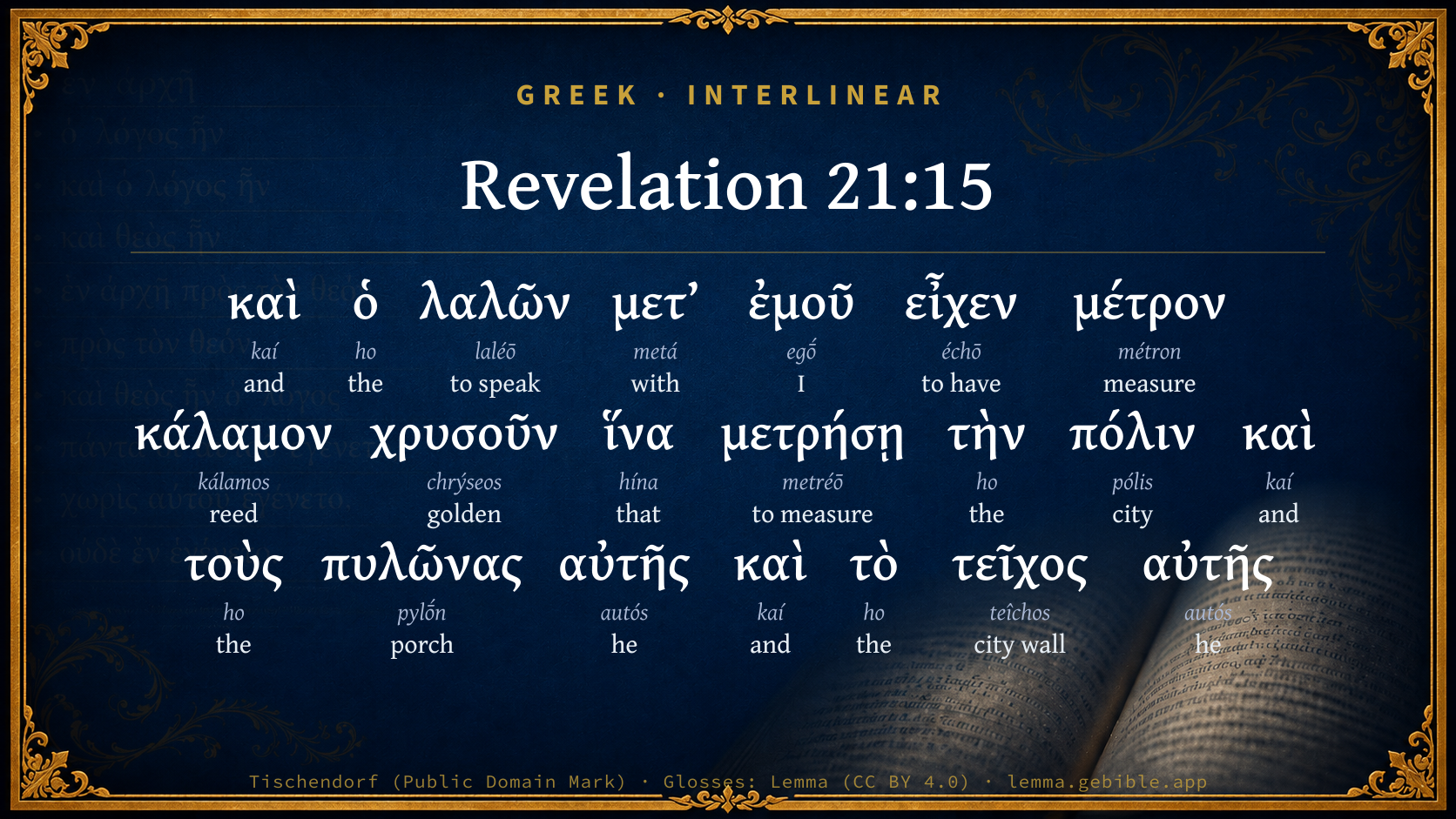
  1. καὶ kaí G2532 “and” Conjunction
  2. ὁ ho G3588 “the” Article, Nominative, Singular, Masculine
  3. λαλῶν laléō G2980 “to speak” Verb, Present, Active, Participle, Nominative, Singular, Masculine
  4. μετ’ metá G3326 “with” Preposition
  5. ἐμοῦ egṓ G1473 “I” Personal pronoun, 1st person, Genitive, Singular
  6. εἶχεν échō G2192 “to have” Verb, Imperfect, Active, Indicative, 3rd person, Singular
  7. μέτρον métron G3358 “measure” Noun, Accusative, Singular, Neuter
  8. κάλαμον kálamos G2563 “reed” Noun, Accusative, Singular, Masculine
  9. χρυσοῦν chrýseos G5552 “golden” Adjective, Accusative, Singular, Masculine
  10. ἵνα hína G2443 “that” Conjunction
  11. μετρήσῃ metréō G3354 “to measure” Verb, Aorist, Active, Subjunctive, 3rd person, Singular
  12. τὴν ho G3588 “the” Article, Accusative, Singular, Feminine
  13. πόλιν pólis G4172 “city” Noun, Accusative, Singular, Feminine
  14. καὶ kaí G2532 “and” Conjunction
  15. τοὺς ho G3588 “the” Article, Accusative, Plural, Masculine
  16. πυλῶνας pylṓn G4440 “porch” Noun, Accusative, Plural, Masculine
  17. αὐτῆς autós G846 “he” Personal pronoun, Genitive, Singular, Feminine
  18. καὶ kaí G2532 “and” Conjunction
  19. τὸ ho G3588 “the” Article, Accusative, Singular, Neuter
  20. αὐτῆς autós G846 “he” Personal pronoun, Genitive, Singular, Feminine

About this verse

These counts appear in no published source. They are computed here, from the morphology-tagged text and Lemma’s own curated glosses. What Lemma adds →

21
words
15
distinct lemmas
Revelation
section

Notable vocabulary

The rarest word here is τεῖχος city wall G5038 — appearing just 9 times in the whole Greek New Testament.

Shared distinctive vocabulary

τεῖχος city wall G5038 occurs in 9 verses of the Greek New Testament. Also found in:

Repetition

Words recur within this verse:

Cross-references

4

Topical passages linked to Revelation 21:15 in the Treasury of Scripture Knowledge — connected by theme and wording, ordered by reader-vote popularity; previews shown in the World English Bible.

  • Zechariah 2:1 I lifted up my eyes, and saw, and, behold, a man with a measuring line in his hand.
  • Revelation 11:1–2 A reed like a rod was given to me. Someone said, "Rise, and measure God's temple, and the altar, and those who worship in it.
  • Ezekiel 41:1–5 He brought me to the temple, and measured the posts, six cubits broad on the one side, and six cubits broad on the other side, which was the breadth of the tent.
  • Exodus 40:3–5 You shall put the ark of the testimony in it, and you shall screen the ark with the veil.

Cross-references courtesy of OpenBible.info (CC BY 4.0).

Where the printed editions differ

1 variant

Places in this verse where the major printed Greek editions disagree on the wording in a way that affects the translation — a comparison of editions, not a manuscript-by-manuscript collation. The editions are the modern critical texts (Nestlé-Aland 28/27, SBL, Westcott-Hort, Tregelles, Tyndale House) and the traditional texts behind the KJV (the Textus Receptus and the Byzantine/Majority text). It is not a claim about which reading is original.

  1. Extra text
    μέτρον

    “a measuring”

    In NA28NA27TynSBLWHTregByz Not in TR

    μέτρον (metron) 'a measuring' is only in older manuscripts (NA28+NA27+Tyn+SBL+WH+Treg+Byz)

Textual data: Translators Amalgamated Greek New Testament (STEPBible TAGNT) · CC BY 4.0.

Commentary

Notes on Revelation 21:15 from classic Christian and Jewish commentators (each source and its license shown beneath its notes). The classic Christian expositions comment on the surrounding passage and are grouped to its opening verse, so a note may address several verses; the Jewish commentaries on the Tanakh (Rashi and others) are per-verse, so they appear only where the commentator wrote on this verse.

Lemma curates 59 commentaries, every one of them public domain or Creative Commons licensed, each selected and text-cleaned for this edition rather than reprinted as found. About our sources →

The Biblical Illustrator

Joseph S. Exell

Rev_21:15-17

A golden reed to measure the city.

A talk with children--measures

What should we do in life without measures? This beautiful building could not have been erected as well as it has been if there had not been a good deal of very precise measuring, so that everything should fit into its proper place, without a chink or crack to be seen anywhere. So, every house that is built, every road that is laid out, and especially every railroad, requires a great deal of measuring. When, too, you have to draw a map, or plan, you must be very precise about your measurements to do it properly. Then, again, the singers measure. They have so many beats to the bar. Even poetry is governed by different measures. John says the heavenly city had been measured carefully--And the city lieth four-square,… and he measured the city with the reed. The first measure that people used was just a reed out of the hedge: a very rough and ready sort of thing; but it answered the purpose if it was exactly the right length. But as we get more and more respectable, we adopt more costly measures. They are not necessarily a bit more correct; but they are more imposing. We have our wooden measures; then comes the ivory measure; and in this instance we have the costliest of all materials, namely, gold--a measure to measure the city which is a golden reed. Everything was measured with great precision--the gates thereof, and the walls thereof, etc. Now I want to show that it is Gods will that you should do everything in this way systematically and punctually--not by rule of thumb, as we call it. Some of the old people used to measure with their thumbs. You know there are some who do that to-day. They reckon as inch between the point of the thumb and the first joint. That is the rule of thumb, and is not very exact. Now what God would have us do in life is not to measure anything in that haphazard way, but everything by a certain and infallible standard. Now, this Book is Gods law from heaven for life on earth; and there is one great standard of whom this Book speaks, namely, Jesus Christ. The Apostle Paul teaches us that it is possible for us by the grace of God to come up to the stature of the perfect man in Christ Jesus. He is our infallible standard; and nobody else is infallible. There are some very good people whose example it is well for us to imitate, in so far as they follow Christ, but no further. Whenever even they fall short, we must not imitate them. We are to go back to the original standard, even Jesus Christ our Saviour. This Book further teaches us what we ought to do. Ah, you say, we so often fail. Yes you do; and there forgiveness comes in. There are many sins. Some fall through ignorance: they do not know any better, and the Lord forgives them freely. Others sin through sheer wickedness; and if even they repent, the Lord will forgive. But our aim should be to come up to the standard; and the Saviour will give us every needful grace to do so. We could not do much without Him; but we can do a great deal through Him. (D. Davies.)

Two cities

The book of the Revelation is full of contrasts:--e.g., Michael and the dragon; the woman clothed with the sun, and the woman clothed in scarlet; the beast and his mark, and the Lamb and His mark. One might almost re-arrange the contents in a series of contrasts or antitheses, culminating in the great antithesis of Babylon and the New Jerusalem.

I. The appearance of the two cities. Both lie foursquare, but--In Babylon there are no natural heights; such heights as there are, are artificial, and barely rise to the level of the walls. In the New Jerusalem, on the other hand, the height and the length and the breadth are equal. Surely this well represents the difference which exists between the world and the Church. Worldly ambition can, at most, rear for itself some mound of fame; the saints progress by an upward pathway which winds towards the summit of the holy mountain. Ye are come unto Mount Zion.

II. The rivers which water the two cities. Babylon was watered by the Euphrates, of which the source lay without the walls. The city was taken through this radical defect; the invaders, altering the course of the river, entered secretly along the river-bed. In the New Jerusalem the river of the water of life has its source in the midst of the city, flowing out from beneath the throne, which occupies its midmost summit. In either case the river is a type of health and happiness. The pleasures of the world, however, are never safe from pollution at the source. Disease and death may taint them at any time, or draw the stream into other channels. But there is a river, the streams whereof make glad the city of God, and that river has its source protected; it confers pleasure for evermore, because it is sheltered by His right hand.

III. The comparative size of the two cities. Babylon was a great city--about three times the size of London. Yet, comparing the measurements which Herodotus gives of Babylon with those which St. John gives of the New Jerusalem, we find that the latter would contain just 10,000 of the former. The world has great influence, and the cause is adequate to the effect; yet how comparatively insignificant it is when we contrast its pretensions with the greatness of Gods Church!

IV. The gates and streets of the two cities. Babylon here seems to have the advantage--one hundred gates instead of twelve. The advantage, however, is only apparent, and serves to illustrate its real deficiencies. For observe--Babylon is built on a plain, with twenty-five gates on each side, and streets running from gate to gate; its ground-plan forms a series of squares held together by the limiting square of the walls. The New Jerusalem is built on a hill. The city is pyramidal in form; all the streets run up towards the summit, and meet in the vicinity of the throne. The world is held together by restraint; its elements have all a pseudo independence; its motto is, Each for himself. It has no true principle of unity. In the Church, on the other hand, there is a centre of attraction. The throne of God and of the Lamb gives to the whole an organic unity. Its members may approach from different sides, but all of necessity approach the centre. Their motto is, Thy will be done; in dependence on that will they are united. (C. A. Goodhart, M. A.)

The length and the breadth and the height of it are equal.--

The symmetry of life

So much of the noblest life which the world has seen dissatisfies us with its partialness; so many of the greatest men we see are great only on certain sides, and have their other sides all shrunken, flat, and small, that it may be well for us to dwell upon the picture which these words suggest, of a humanity rich, and full, and strong all round, complete on every side, the perfect cube of human life which comes down out of heaven from God.

I. The length of life. All men have their special powers and dispositions. Each man finds that he has his. That nature which he has discovered in himself decides for him his career. What he is, even before he knows it, has decided what he does. His life has run out in a line which had the promise and potency of its direction in the nature which his birth and education gave him. All his self-culture strove that way. Through the confusion and whirl of human lives, his life ran in one sharp, narrow line, from what he knew he was, to what he meant to be and do. That clear, straight line of unswerving intention, that struggle and push right onward to the end--that is the end of his life. To have an end and seek it eagerly--no man does anything in the world without that. Therefore, we may freely say to any young man, Find your purpose and fling your life out to it; and the loftier your purpose is, the more sure you will be to make the world richer with every enrichment of yourself. This, you see, comes to the same thing as saying that this first dimension of life, which we call length, the more loftily it is sought, has always a tendency to promote self-development.

II. The second dimension of life is breadth. Breadth in a mans life is its outreach laterally. It is the tendency of a mans career to bring him into sympathy and relationship with other men. First, the mans own career becomes to him the interpretation of the careers of other men; and secondly, by his sympathy with other men, his own life displays to him its best capacity. His task is always glorified and kept from narrowness by his perpetual demand upon it, that it should give him such a broad understanding of human life in general as should make him fit to read, and touch, and help all other kinds of life.

III. The height of life is its reach upward toward something distinctly greater than humanity. The reaching of mankind towards God! Evidently, in order that that may become a true dimension of a mans life, it must not be a special action. It must be something which pervades all that he is and does. It must not be a solitary column set on one holy spot of the nature. It must be a movement of the whole nature upward. To any man in whom that uplifting of life has genuinely begun, all life without it must seem very flat and poor. (Bp. Phillips Brooks.)

The proportionateness of the spiritual kingdom of God

The proportionateness of the Holy City as an illustration of what ought to be the proportionateness of another structure.

I. Some are disproportionate through isolated height. Such a one was, at first, the Apostle John. He saw a city in the air, and gazed into heaven. There are many such who dreamily meditate upon the glories of heaven. Such are often the very ones who would pass the beggar-child on the street. They do not notice the tear-dimmed- eyes and the anguish of the suffering face; for they are hurrying home to read, perchance to weep over thoughts that are beautiful. The height and the length and the breadth are not equal.

II. Others are disproportionate through isolated length These are the exclusively practical people. They see the plain matter-of-fact way of duty before them, and they walk bravely along it, yet they have never caught a glimpse of the lights in the streets of the city of God. The length and the height and the breadth are not equal.

III. Others still are disproportionate through isolated breadth. Some are broad for the sake of being broad, and there is no beauty in such. They delight in making a parade of their breadth; they enjoy the look of surprise and pain on the face of some saint of God. They imagine themselves to be liberal, but their knowledge is scant. In them is no height of contemplation; they have never dreamed a dream of the Holy City, nor have seen the Lamb in the midst of the throne. In them is no length of practical usefulness; they have not visited the widow and fatherless in their affliction. Even the breadth which they have is the laxity of ignorance and waywardness, and that is all they have. The breadth and the height and the length are not equal. Some naturally incline towards the heights of spiritual meditation, to gaze on the glories of the Holy City; others towards the plain pathway of the practical; others still towards the breadth by which they hear other voices expressing other thoughts of Gods universe. Others, again, pass through the various stages in succession; while still others possess these three qualities in different degrees. It is the purpose of God, by His grace, to make these qualities in the youthful soul proportionate and harmonious--to make the height, the length, and the breadth equal. Some day a scholar will write a book in which he will tell how God sought to accomplish this in one and another of the disciples. The book will be one of rare suggestiveness. John, the beloved, had the height and the breadth--to him came the command to cast out devils. Paul scaled the heights of contemplation when he meditated upon the exceeding riches of His grace, and he passed far along the way of duty when he answered the call, Come over and help us. But he needed the breadth, and this he must gain by the sympathy of a common suffering. Therefore came the thorn in the flesh; and thus he saw in the breadth of sympathy at once the sorrows of others and the sorrow of the Son of Man. In the souls of young Christians, the height and length and breadth will meet together in the clear and harmonious colours of a rainbow of our God. The Christian religion, and it only, extirpates or represses no noble instinct; it welcomes height and length and breadth, and all that is included in them, and gives to each its proper place. But we need an ideal to be before us. We look on the noblest sons of men one by one, and find them marred by reason of irregularity. Where shall we find this ideal? Within the magic circle of the Person of the Man Christ Jesus all these three are presented in absolute fulness and exquisite harmony! We stand in awe of the heights of heavenly contemplation of which glimpses are given to us. When He departed into a solitary place, when He lifted up His eyes to heaven in communion with His Father, He drew aside the veil and showed to us the glories of heavenly contemplation. Then, to think of the practical aspect of His active life. How He toiled to realise the Messianic plan by training the twelve, by announcing the laws of the kingdom, by healing every sickness and every disease among the people! Then in Him was breadth bounded only by the universe, broad as the love of God. It was a breadth which led Him to hear voices of sheep not of this fold who would yet enter to find pasture, that there might be one fold and one Shepherd. It is the priceless privilege of every young Christian who has yielded himself to God through Christ, to seek to attain by His grace towards the measure of the stature of the fulness of Christ; for in Him and in Him alone the height and the length and the breadth are equal. (G. Matheson, D. D.)

The Biblical Illustrator, edited by Joseph S. Exell (c. 1880s–1900s) — public domain. Text from a community e-Sword module.

Joseph Benson's Commentary

Rev 21:15-16. And he that talked with me had — Like the angel who appeared in vision to Ezekiel; a golden reed, &c. — A measuring-rod, with this circumstance of illustrious distinction, that it was golden; to measure the city, &c. — In the several parts thereof; by which measure was signified the greatness and extent of the city, with the exact order and just proportion of every part: to show figuratively that this city was prepared for a great number of inhabitants, how small soever the number of real Christians may sometimes appear to be; and that every thing relating to the happiness of this heavenly state was prepared with the greatest care and exactness. And the city lieth four-square — Upon measuring it appeared that the city was an exact square, of equal length and breadth, and of a very large extent. For it appeared on measure to be twelve thousand furlongs — Or one thousand five hundred miles, not, it seems, in circumference, but on each of the four sides. Jerusalem was thirty-three furlongs in circumference; Alexandria thirty in length, ten in breadth; Nineveh is reported to have been four hundred furlongs round, Babylon four hundred and eighty. The length, and the breadth, and the height of it — That is, says Bishop Newton, of its walls and buildings; are equal — Are everywhere of the same beauty, strength, and proportion. For this equality, as Grotius observes, seems to belong to the walls and buildings compared with each other, not with the length and breadth of the city. For to understand the height of the city, whether of its walls or buildings, to be equal to the length or breadth of it, would make its houses and walls to be out of all proportion. For how large soever men may conceive the extent of the city, and of the contiguous buildings, houses twelve thousand furlongs high are beyond all propriety in the boldest figures. Or, if the twelve thousand furlongs be understood of the whole circumference of the city, the length of each of its four sides (it being an exact square) would be three hundred and seventy-five miles; and houses even of such a height would be out of all due proportion. Some interpreters, to avoid this difficulty, have included the height of the mountain on which the city is supposed to stand; but it is not said that the city itself was situated on a mountain, but only that John was called up to a mountain to view the model of it. Nor is it easy to say what end could be answered by making the height of the buildings so enormous, unless to render the city a perfect cube, for which no reason can be assigned; a perfect square rendering the emblem full as perfect. The truth is, the numbers themselves are evidently typical, taken from twelve, the number of the apostles, multiplied by one thousand. For as before, the number of the members of the Christian Church was represented by one hundred and forty-four thousand, the square number of twelve multiplied by one thousand; so this manner of numbering will very properly signify a city, of which true Christians are to be the happy citizens and settled inhabitants; a city which shall have incomparably greater extent, and more strength and beauty, than ancient Babylon, Rome, or any other seat of empire ever known in this world.

Joseph Benson's Commentary on the Old and New Testaments (1811–1818) — public domain. Text from a community e-Sword module.

Tyndale Open Study Notes

Tyndale Open Resources

21:15-17 measure the city: Measuring defines accepted boundaries (contrast the unmeasured section of the Temple, 11:2; see also Ezek 40:3–42:20).

Tyndale Open Study Notes — © Tyndale Open Resources, licensed CC BY-SA 4.0. Text via the HelloAO Bible API.

Meyer's Critical & Exegetical Commentary

Heinrich August Wilhelm Meyer

Rev_21:15-17. The angel who shows John the city[4300] gives him a clear view of its dimensions by[4301] actually measuring them before the eyes of the seer.[4302]

ΜΈΤΡΟΝ ΚΆΛΑΜΟΝ ΧΡΥΣΟῦΝ. Cf. Rev_11:1, where, however, the ΚΆΛΑΜΟς is not expressly designated as ΜΈΤΡΟΝ.[4303] The measuring-reed is golden because of the glory, not indeed of the measuring angel,[4304] but of the objects to be measured (Rev_21:18). These are presented in the series designated in Rev_21:15; viz., the city (Rev_21:16), the walls (Rev_21:17-20), the gates (Rev_21:21). That the city lies (ΚΕῖΤΑΙ, cf. Rev_4:2) four-cornered, and, indeed, with right angles and equal length and breadth, and, therefore, that its outline forms a perfect square,[4305] John recognizes already (Rev_21:16 a) even before the angel begins to measure. But the angel also establishes the length of the particular sides: καὶ ἐμέτρησεν τὴν πόλιν, κ.τ.λ. (Rev_21:16 b). The words by themselves might signify that the entire circuit of the city[4306] amounted to twelve thousand stadia (ἘΠῚ ΣΤΑΔΊΟΥς),[4307] so that each of the four equal sides would measure three thousand stadia; but as the equality of the length and the breadth has been designated from the very beginning, it is more probable that the twelve thousand stadia which were actually measured are meant as the mass lying at the foundation of the entire building, which, according to Rev_21:16 c, applies also to the height of the city; for that by the closing words (καὶ τὸ μῆκος

ἰσα ἐστίν), dimensions actually identical are given for the length, breadth, and height of the city, is to be denied neither on account of Rev_21:17, nor on account of Rev_22:2,[4308] for the reason that the idea of the city thus resulting is a monstrosity.[4309] The city appears, therefore, as an enormous cube, which measures in length, breadth, and height, each, twelve thousand stadia.[4310] [See Note XCVI., p. 000.] The height of the city (Rev_21:16 c) is not the height of the walls (Rev_21:17), as Bengel also admits, who affirms, on this account, that the one hundred and forty-four cubits (Rev_21:17) are equal to the twelve hundred stadia (Rev_21:16); but the idea of the height of the city as a whole, i.e., of the mass of houses contained in it, is given, Rev_21:16 c.[4311]

In Rev_21:17 there follows the measuring of the walls, viz., of their height, since the length of the walls is identical with the length and breadth of the city[4312] (Rev_21:16). The specification of one hundred and forty-four cubits[4313] is to be understood according to the common measure of a man (μέτρον ἀνθρώπου),[4314] which is the measure of the angel. The words ὅ ἔστιν ἀγγέλου cannot say that, in the present case, the angel has made use of the ordinary human measure,[4315] but the measurements of the angel and of man are made equal,[4316] without venturing, against the expression μέτρον ἀνθρώπου, to declare[4317] that the measure of glorified men is here regarded.[4318]

In comparison with the height of the city (Rev_21:16), the wall appears very low, even though this is extraordinarily high when compared with earthly relations.[4319] The reason is not that the walls are to form only a bulwark put about the city like a temple,[4320] and, besides, that the light proceeding from the city is not to be obstructed by a high wall;[4321] but it may be indicated that for keeping off every thing relatively unclean (cf. Rev_21:27) the relatively low walls are sufficient, because, indeed, a violent attack is perfectly inconceivable.

[4300] Cf. Rev_21:9.

[4301] Cf. Eze_40:5 sqq.

[4302] Bengel, Ewald, De Wette.

[4303] Eze_42:16 sqq.

[4304] Hengstenb.

[4305] Cf. Eze_48:16.

[4306] Vitr., Eichh., Ew. i., Volkm.

[4307] Cf. Winer, p. 381.

[4308] Where the streets are spoken of.

[4309] Against De Wette, who explains the ἰσα in reference to the height, viz., of the walls, according to his misconception of Rev_21:16 c, as uniform, because the walls are everywhere 144, i.e., 12 × 12 cubits high.

[4310] i.e., 300 German miles [a German mile being equal to 4.611 English and American statute miles, the measure would be, according to our computation, nearly 1,400 miles]. Andr., Beng., Züll., Hengstenb., Rinck; also Ew. ii., who at the same time alludes to the fact that this uniformity was found in the ancient Mosaic sanctuary only in the holy of holies. Cf. also Luthardt.

[4311] Hengstenb.

[4312] If the thickness of the walls were meant (Luther, gloss), it would necessarily be expressed.

[4313] Not 144,000, Ew. ii., p. 349.

[4314] Cf. Rev_13:18.

[4315] De Wette.

[4316] Hengstenb.

[4317] Ebrard.

[4318] Mat_22:30.

[4319] Cf. Rev_21:12.

[4320] Cf. Eze_11:5.

[4321] Züll.

The splendor of the wall of the city itself (Rev_21:18), of the twelve foundation stones (Rev_21:19), and of the twelve gates (Rev_21:21), is described with the greatest glory whereof human fantasy is capable.

ἡ ἐνδόμησις τ. τειχ. αὐτ. In Josephus,[4322] a stone mole built in the sea, which is intended to break the force of the waves, is thus named.[4323] Here the proper wall is designated, so far as it stands upon the foundation stones;[4324] but the technical expression compounded with ἘΝ[4325] has its justification here, because the higher masonry is rooted, as it were, in the ground.

Beside the wall, in Rev_21:18 b, the city as a whole, i.e., the mass of houses,[4326] whose height was given, Rev_21:16 c, is mentioned, because this enormous mass, projecting above the walls, must now first be described before the individual parts (Rev_21:19-21) can come more accurately into consideration. The city consists of pure gold, like unto clear glass. Already Andreas has correctly remarked that the addition, ὅμοιον ὑάλῳ καθαρῷ.,[4327] represents the gold as transparent, which had been already sufficiently designated by καθαρόν as free from every mixture, so that in this respect it did not require any special comparison with the purity of glass,[4328] although Andreas makes a mistake in referring this to the διαυγὲς καὶ λαμπρὸν of the inhabitants of the city.[4329] But it is inconceivable that John, in order to illustrate the inexpressible glory of the city descending from heaven, transgresses the natural limits of the earthly, and therefore here, e.g., represents a transparent gold as the material whereof the houses of the new Jerusalem consist, as it is unjustifiable to pervert the beautiful pictures which spring from the sanctified fantasy of the seer into theological propositions, and, accordingly, to expect that gold now opaque shall actually, in the world to come, receive the nature of a precious stone, transparency.[4330]

The description, Rev_21:19, turns to particular details, and that, too, to the foundations of the walls. With all precious stones are they adorned,[4331] but not in such a way as possibly only to be set with precious stones, but[4332] every individual ΘΕΜΈΛΙΟς consists of an enormous precious stone.[4333]

As the twelve ΘΕΜΈΛΙΟΙ have nothing to do with the number of the Israelitish tribes,[4334] so that artificial expedient whereby the stones mentioned in Rev_21:19 sq. are brought into an assumed relation[4335] to those which the high priest wore in his breastplate, is to be discarded as decidedly as the vain attempt to assign individual jewels to the individual apostles.[4336] De Wette and Hengstenb. also, with propriety, deny that an intentional order is to be sought in the precious stones here mentioned, which, according to Ebrard, will not become clear until in eternity.

ἼΑΣΠΙς. Like the entire ἘΝΔΌΜΗΣΙς of the walls. Cf. Rev_4:3

ΣΆΠΦΕΙΡΟς, סַפִיר, Exo_24:10; Exo_28:18. The descriptions of the ancients,[4337] especially of Pliny,[4338] apply not so much to our azure, transparent sapphire, as rather to our dark-blue opaque lazuli, lapis lazuli.[4339]

χαλκηδών. Possibly corresponding to the שְׁבו̇, Exo_28:19, where, however, the LXX., with whom the name ΧΑΛΚΗΔΏΝ does not occur, have ἈΧΆΤΗς. Even Pliny is not acquainted with the name chalcedony. On the agate occurring in various forms and compositions, cf. Pliny, H. N., xxxvii. 54.

σμάραγδος. Cf. Rev_4:3. In the LXX.,[4340] σμάρ. stands for the Hebr. בָרֶקֶת. Cf. Plin., l. c., c. xvi.: The third rank is ascribed to emeralds for reason. The appearance of no color is more pleasing, since there is nothing whatever greener than they.[4341]

σαρδόνυξ. יהֲלס, Exo_39:11; Eze_28:13. Plin., l. c., c. 23: Formerly by sardonyx, as appears from the name, was understood the brilliancy in the sard, i.e., that in the flesh beneath mans finger-nail, and translucent on both sides.

σάρδιον. Cf. Rev_4:3.

χρυσόλιθος. Exo_28:20, LXX., for תַרְשִׁישׁ. The chrys. of the ancients, which Plin., l. c., c. 42, describes as golden-yellow,[4342] is probably identical with our topaz.

βήρυλλος. LXX., Exo_28:20; Eze_28:13 (βηρύλλιον) for שֹׁהַס, which Gen_2:12 renders by ὁ λίθος ὁ πράσινος. The stone is in color γλαυκίζων,[4343] or, as Pliny, l. c., c. 20, says, most appropriately: They imitate the greenness of the pure sea.

τοπάζιον. Exo_28:17; Eze_28:13; Job_28:19, LXX., for כִּטְדָה. Our topaz is yellow and transparent, so as to correspond with the description of Strabo;[4344] while the declarations of Pliny, l. c., c. 32, refer to our chrysolite.

ΧΡΥΣΌΠΡΑΣΟς. This does not occur in the LXX. Pliny, l. c., c. 20, presents the chrysoprasus with the chrysoberyl, but ascribes to it a paler golden color than to the latter.

ὙΆΚΙΝΘΟς. In the LXX. the Cod. Alex. has this name, where Cod. Vat. gives ΛΙΓΎΡΙΟΝ[4345] for לֶשֶס. Pliny, l. c., c. 41, compares it with the amethyst, and remarks: This is the difference, viz., that the violet shining in the amethyst is diluted in the jacinth.

ἈΜΈΘΥΣΤΟς. Exo_28:19, LXX., for אַחְלָמָה. Pliny, l. c., c. 40, reckons the amethyst as a purple gem; he says especially of the Indian amethysts, the most distinguished: They have the absolute color purpurae felicis; but, even to the inferior kinds, he ascribes a similar color and transparency.[4346]

The twelve gates consist each (ἀνὰ εἰς ἕκαστος)[4347] of one pearl. Cf. Bava Bathra, p. 75, Revelation 1 : God will give gems and pearls thirty cubits long and just as broad, and will hollow them to the depth of twenty cubits and the breadth of ten, and place them in the gates of Jerusalem, etc.[4348]

The streets of the city

ἡ πλατεῖα τ. πόλ. designates in general all the streets of the city,[4349] not the market-place,[4350] also not the chief street leading into the city,[4351] because, in the entire description of the city, nothing is said of what lies outside the wallsconsist, like the houses which rise from the streets (Rev_21:18), of pure gold, which is as transparent as transparent glass.

[4322] Ant., xv. 9.

[4323] ἠ δὲ ἐνδόμησις, ὄσην ἐνεβάλετο κατὰ τῆς θαλάσσης, κ.τ.λ. [The building, as much as he cast into the sea].

[4324] Wetst., De Wette, Hengstenb., Bleek.

[4325] Instead of this, another, possibly ἐπιδόμησις, is not afforded.

[4326] Hengstenb., Ebrard, Ew. ii.

[4327] Cf. also Rev_21:21.

[4328] Against Beng., Hengstenb.

[4329] Cf. also Vitr., etc.

[4330] Ebrard.

[4331] παντὶ. Cf. Rev_18:12.

[4332] Cf. Isa_54:11 sq.

[4333] Andr., Beng., De Wette, Hengstenb., Ebrard.

[4334] Cf. Rev_21:14.

[4335] Cf. especially Züll., Excurs. II., p. 456 sqq.; also Ew. ii., Luthardt, Volkm.

[4336] Andr., Beng., etc.

[4337] Cf. Wetst.

[4338] H. N., xxxvii. 39: For in sapphires the gold shines with azure points. Of sapphires, white with purple, yet among the Medes the best are nowhere transparent.

[4339] Cf., in general, Winer, Rwb., ii. 350 sqq.

[4340] Exo_28:17; Eze_28:13.

[4341] See also Wetst.

[4342] Shining with golden brilliancy.

[4343] Bluish-green, Epiphan. in Wetst.

[4344] διαφανὴς, χρυσοειδὲς ἁπολάμπων φέγγσς [diaphanous, emitting a radiance like gold].

[4345] Exo_28:19; Eze_28:13.

[4346] A violet color shines through all.

[4347] Cf. Winer, p. 234.

[4348] See Wetst.

[4349] De Wette, Hengstenb., Ebrard.

[4350] Beng.

[4351] Züll.

NOTES BY THE AMERICAN EDITOR

XCVI. Rev_21:16. ἴσα ἐστίν

Alford: Düsterdiecks idea that the houses were three thousand stadii in height, while the wall was only one hundred and forty-four cubits, is too absurd to come at all into question. The words are open, this last consideration being taken into account, to two interpretations: (1), That the city, including the hill or rock on which it was placed, and which may be imagined as descending with it, formed such a cube as seems here described; or (2), That there is some looseness of use in the word ἴσα, and that we must understand that the length and breadth were equal to each other, and the height equal all round. Of these two, I prefer the former, as doing no violence to the words, and, at the same time, recalling somewhat the form of the earthly Jerusalem on its escarpment above the valley of the Kedron. On the other hand, Gebhardt: According to Düsterdieck, the relative lowness of the wall is indicative of the security of the city (comp. Isa_62:6); and very justly do we see in the size of the city, and the height of the walls, so prominently expressed, a symbol of its safety from every danger. Hengstenberg: Manifestly the height, and the length, and the breadth are equal; and nothing is said concerning the relation of the houses to one another. For, according to this conception, the height of the city would be altogether undetermined.

Meyer — Critical and Exegetical Commentary on the New Testament — English translation by Peter Christie, edited by Frederick Crombie (T&T Clark, 1880) — public domain. Text from a community e-Sword module.

Geneva Bible (1599)

Geneva Bible translators

A transition unto a more exquisite description of the parts of the Church, by finding out the measure of the same by the Angel that measured them.

Geneva Bible (1599) marginal notes — public domain. Text via Bolls.life.

Jamieson, Fausset & Brown

Robert Jamieson, A. R. Fausset & David Brown

had a golden reed--so Coptic. But A, B, Vulgate, and Syriac read, "had (as) a measure, a golden reed." In Rev 11:2 the non-measuring of the outer courts of the temple implied its being given up to secular and heathen desecration. So here, on the contrary, the city being measured implies the entire consecration of every part, all things being brought up to the most exact standard of God's holy requirements, and also God's accurate guardianship henceforth of even the most minute parts of His holy city from all evil.

Jamieson, Fausset & Brown — Commentary Critical and Explanatory on the Whole Bible (1871) — public domain (CC PDM 1.0). Text via the HelloAO Bible API.

Adam Clarke's Commentary

Verse 15. Had a golden reed] Several excellent MSS. add μετρον, a measure; he had a measuring rod made of gold. This account of measuring the city seems to be copied, with variations, from Eze 40:3, &c.

Adam Clarke's Commentary on the Bible (1810–1826) — public domain. Text from a community e-Sword/MySword module.

Ellicott's Commentary for English Readers

THE MEASUREMENT OF THE CITY.

(15) And he that talked with me . . .—Or, better, And he who was talking with me had a golden reed . . . The allusion here is to the angel mentioned in Ezekiel (Eze_15:3); the reed, or measuring rod, is of gold, that used in Rev_11:1 was not said to be of gold; the measurement there was the symbol of preservation amid impending danger; the measuring here is more glorious—it is measuring which exhibits the beauty and proportion of the city which is now dwelling at peace. Gold is one of the features of the city; the street is gold (Rev_21:18; Rev_21:21); it may stand, as a token of the wealth (Psa_72:15; 1Ki_10:14-21) of the royal city; but the wealth of that city is love. (Comp. Note on Rev_3:18.)

A Bible Commentary for English Readers, edited by Charles John Ellicott (1878–1897) — public domain. Text from a community e-Sword module.

The Cambridge Bible for Schools and Colleges

gen. ed. J. J. S. Perowne

15. a golden reed] So Rev_11:1; this is more closely parallel to Eze_40:3; Eze_40:5. See also Zec_2:1.

the gates] As it happens, we are not actually told of their measurement.

The Cambridge Bible for Schools and Colleges (gen. ed. J. J. S. Perowne; Cambridge University Press, 1878–1918) — public domain. Text from a community e-Sword module.

John Gill's Exposition

And he that talked with me,.... One of the seven angels, Rev 21:9 for not a man is the measurer of this city, as in Eze 40:3 nor John, as of the temple, Rev 11:1 but an angel, the same that showed to John this great sight:

had a golden reed; not a common measuring reed, or rod, as in Eze 40:4 but one covered with gold, denoting the present glorious state of the church, being without spot or wrinkle, or any such thing:

to measure the city; the new Jerusalem, its length and breadth; see Zac 2:1 to show how exactly conformable this church state will be to the rule of God's word, even to perfection: and the gates thereof; to signify who had a right to enter into it, and who not:

and the wall thereof; its height, it being exceeding high.

John Gill's Exposition of the Whole Bible (1746–1763) — public domain (CC PDM 1.0). Text via the HelloAO Bible API.

Trapp's Complete Commentary

John Trapp

15 And he that talked with me had a golden reed to measure the city, and the gates thereof, and the wall thereof.

Ver. 15. Had a golden reed] Not those twelve Trent articles, or any human invention, but the word, as Rev 11:1, wherewith is measured not the temple only, as there, but the city, gates, and wall, as Eze 40:1-49.

John Trapp, A Commentary or Exposition upon All the Books of the Old and New Testament (1647–1656) — public domain. Text from a community e-Sword module.

Albert Barnes' Notes on the Bible

And he that talked with me - The angel, Rev 21:9.

Had a golden reed to measure the city - See the notes on Rev 11:1. The reed, or measuring rod, here, is of gold, because all about the city is of the most rich and costly materials. The rod is thus suited to the personage who uses it, and to the occasion. Compare a similar description in Eze 40:3-5; Eze 43:16. The object of this measuring is to show that the city has proper architectural proportions.

And the gates thereof, ... - To measure every part of the city, and to ascertain its exact dimensions.

Albert Barnes' Notes on the Bible (1834–1885) — public domain. Text from a community e-Sword/MySword module.

Matthew Poole's English Annotations

This seemeth to signify the transcendency of the state of the church now, to what it was before; it was then measured by a man, Rev 11:1-19, now by an angel; then by an ordinary reed, now by a golden reed.

Matthew Poole's English Annotations on the Holy Bible (1683–1685) — public domain. Text from a community e-Sword/MySword module.

Whedon's Commentary on the Bible

Daniel D. Whedon

15. The measurement.

He that talked with me—The one of the seven angels of Rev_21:9.

A golden reed—Compare Rev_11:1.

Daniel D. Whedon (gen. ed.), Commentary on the Old and New Testaments (1874–1909) — public domain. Text from a community e-Sword module.

The Pulpit Commentary

And he that talked with me had a golden reed to measure the city, and the gates thereof, and the wall thereof; had for a measure a golden reed to measure, etc. "He that spake" is the angel of ver. 9. (cf. the action of Rev_11:1; and on Eze_40:3, 5 42:15, et seq. ) Here the measuring is evidently to indicate the large extent of the city. (see Rev_11:1) The reed is golden, as being the typical heavenly material.

The Pulpit Commentary (1880–1919), ed. H.D.M. Spence-Jones & Joseph S. Exell — public domain. Text from a community e-Sword module.

John Wesley's Explanatory Notes

And he measured the city, twelve thousand furlongs - Not in circumference, but on each of the four sides. Jerusalem was thirtythree furlongs in circumference; Alexandria thirty in length, ten in breadth. Nineveh is reported to have been four hundred furlongs round; Babylon four hundred and eighty. But what inconsiderable villages were all these compared to the new Jerusalem! By this measure is understood the greatness of the city, with the exact order and just proportion of every part of it; to show, figuratively, that this city was prepared for a great number of inhabitants, how small soever the number of real Christians may sometimes appear to be; and that everything relating to the happiness of that state was prepared with the greatest order and exactness. The city is twelve thousand furlongs high; the wall, an hundred and forty-four reeds. This is exactly the same height, only expressed in a different manner. The twelve thousand furlongs, being spoken absolutely, without any explanation, are common, human furlongs: the hundred forty-four reeds are not of common human length, but of angelic, abundantly larger than human. It is said, the measure of a man that is, of an angel because St. John saw the measuring angel in an human shape. The reed therefore was as great as was the stature of that human form in which the angel appeared. In treating of all these things a deep reverence is necessary; and so is a measure of spiritual wisdom; that we may neither understand them too literally and grossly, nor go too far from the natural force of the words. The gold, the pearls, the precious stones, the walls, foundations, gates, are undoubtedly figurative expressions; seeing the city itself is in glory, and the inhabitants of it have spiritual bodies: yet these spiritual bodies are also real bodies, and the city is an abode distinct from its inhabitants, and proportioned to them who take up a finite and a determinate space. The measures, therefore, above mentioned are real and determinate.

John Wesley, Explanatory Notes Upon the Whole Bible (1754–1765) — public domain. Text via the GEBible commentary corpus.

Kretzmann's Popular Commentary

Paul E. Kretzmann

The measurements and the ornaments of the city:

v. 15. And he that talked with me had a golden reed to measure the city and the gates thereof and the wall thereof.

v. 16. And the city lieth four-square and the length is as large as the breadth. And he measured the city with the reed, twelve thousand furlongs. The length and the breadth and the height of it are equal.

v. 17. And he measured the wall thereof, an hundred and forty and four cubits, according to the measure of a man, that is, of the angel.

v. 18. And the building of the wall of it was of jasper; and the city was pure gold, like unto clear glass.

v. 19. And the foundations of the wall of the city were garnished with all manner of precious stones. The first foundation was jasper; the second, sapphire; the third, a chalcedony; the fourth, an emerald;

v. 20. the fifth, sardonyx; the sixth, sardius; the seventh, chrysolite; the eighth, beryl; the ninth, a topaz; the tenth, a chrysoprasus; the eleventh, a jacinth; the twelfth, an amethyst.

v. 21. And the twelve gates were twelve pearls; every several gate was of one pearl; and the street of the city was pure gold, as it were transparent glass.

This is a picture which, both as a whole, by the impression which it makes in its entirety and in all its various traits and parts, transcends all imagination. It all stands out so absolutely beyond all human conception: And he that was speaking with me had as a measuring-rod a golden wand, in order to measure the city and its gates and its wall. And the city lies four-square, and its length is the same as its width. And he measured the city with the wand, twelve thousand stadia [at six hundred to six hundred and twenty-five feet], its length and its width and its height are the same; and he measured its wall, one hundred and forty-four cubits, the measure of a man, that is, of an angel. All of this is intended to show that the Church of the perfected saints, the Church Triumphant in eternal life, will have that perfection which God has planned for her in every respect, 1Co 13:10. There will no longer be any inequality or unevenness, but all believers without exception will know God perfectly, will bear the perfect image of God in their own bodies, will be perfectly happy and blessed, will enjoy all the gifts and blessings of eternity in the fullness of perfection.

But the description has only begun: And the material of its wall was jasper, and the city is pure gold resembling transparent glass; the foundations of the wall of the city are decorated with every kind of precious stone: the first foundation, jasper; the second, sapphire; the third, chalcedony; the fourth, emerald; the fifth, onyx; the sixth, sardius; the seventh, chrysolite; the eighth, beryl; the ninth, topaz; the tenth, chrysoprase; he eleventh, jacinth; the twelfth, amethyst. And the twelve gates were twelve pearls, each individual gate made of a single pearl. And the streets of the city are of pure gold, transparent as crystal. To the idea of perfection and immensity conveyed in the first part of the description there is added here that of a splendor past all human understanding. One thing stands out beyond the slightest doubt: there will be such glory, such beauty, such splendor as cannot be reached even by the fondest and most daring imagination of man. Everything will be light, clear, full of ineffable glory. All the ways of God will be manifest before our eyes, and one miracle after the other will be revealed to us.

Paul E. Kretzmann, Popular Commentary of the Bible (1921–1924) — public domain. Text from a community e-Sword module.

Burkitt's Expository Notes on the New Testament

William Burkitt

Still St. John proceeds in the description of the heavenly state, and the church triumphant in it; this is called a city, in respect of its magnificent building, comely order, and invincible strength; a great city, in regard of its largeness and capaciousness, being full of glorified saints and angels; and Jerusalem, because of that everlasting peace which is there enjoyed, as the Hebrew word signifies; and here an account is given of the measuring of this great city: we read of its measuring before, chap 9, but differently from its measuring now; then it was measured by a man, now by an angel; then by an ordinary reed, now by a golden reed; intimating the transcendency of the state of the church now to what it was before, and representing the firmness, perfection, and greatness, of the new Jerusalem.

Here note, An observable difference in the measuring of the church militant and of the church triumphant: the church militant, upon a just measure by the reed of the word is found unequal in its parts, some parts of it are purer and better than others, but in the New Jerusalem all parts are equal in perfection and purity; the length is as large as the breadth, and the height equal to either: the church of Christ in heaven shall be exceeding large and great, perfect and complete, nothing shall be found irregular in it, all things can there endure the measuring reed, and abide the exactest trial.

William Burkitt's Expository Notes on the New Testament (1700–1703) — public domain. Text from a community e-Sword module.

The People's New Testament

B. W. Johnson

15–21. And he … had a golden reed to measure the city. The reed is a divine measure and the city is to correspond to the measure. In chapter 11 the church is measured with a reed. Both the earthly and the heavenly church must agree with the divine plan.

B. W. Johnson's The People's New Testament with Notes (1889–1891) — public domain. Electronic text from the Christian Classics Ethereal Library (CCEL) ThML edition.

Expositor's Greek Testament

ed. W. Robertson Nicoll

The measures of the city are now taken, as in Eze 40:3 ; Eze 40:48 ; Eze 42:16 f., to elucidate the vision (otherwise in Rev 11:1-2 ). It turns out to be an enormous quadrilateral cube, like Ezekiel’s ideal sanctuary, a cube being symbolical of perfection to a Jew, as a circle is to ourselves. Whether 1500 miles represent the total circumference or the length of each side, the hyperbole is obvious, but John is following the patriotic rabbinic traditions which asserted that Jerusalem would extend as far as Damascus in the latter days (Zec 9:1 ) if not to the high throne of God. In Sib. Or. 5:250 f. the heaven-born Jews who inhabit Jerusalem are to run a wall as far as Joppa. Further measurements in Baba-Bathra f. 75, 2 ( cf. Gfrôrer, ii. 245 f.; Bacher, Agada d. Tann. i. 194 f., 392). As in the case of the tabernacle in Jerusalem of the Hexateuch, so here: the symmetry and harmony of the divine life are naïvely represented by Oriental fantasy in terms of mathematics and architecture. A wall of about 72 yards high seems oddly unsymmetrical in view of the gigantic proportions of the city, though it might refer to the breadth (Simcox) or to the height of the city above the plain. But the whole description is built on multiples of twelve, a sacred number of completeness. The wall is a purely poetical detail, required to fill out the picture of the ancient city; like the similar touches in 24, 26, Rev 22:2 , it has no allegorical significance whatever. cf. Slav. En. lxv. 10: “and there shall be to them” ( i.e. , to the just in eternity) “a great wall which cannot be broken down”. μέτρον κ . τ . λ ., another naive reminder ( cf. Rev 19:9-10 , Rev 22:8-9 ) that angels were not above men.

The Expositor's Greek Testament, edited by W. Robertson Nicoll (1897–1910) — public domain. Text from a community e-Sword module.

Cambridge Greek Testament for Schools and Colleges

15. μέτρον, κάλαμον χρ. Text. Rec[828] omits μέτρον with 1 cop[829] arm[830], Primas[831] harundinem auream ad mensuram, אc μέτρον καλάμου.

[828] Rec. Textus Receptus as printed by Scrivener.

[829] Coptic.

[830] Armenian.

[831] Primasius, edited by Haussleiter.

15. μέτρον, κὰλαμον χρυσοῦν. So Rev 11:1. This is more closely parallel to Eze 11:3; Eze 11:5. See also Zec 2:1.

τοὺς πυλῶνας. As it happens we are not actually told of these measurements.

Cambridge Greek Testament for Schools and Colleges (Cambridge University Press, 1896; 21 vols, various authors incl. Carr, Maclear, Plummer, Farrar, Lumby, Moule, M. R. James, Simcox) — public domain. Text from a community e-Sword module.

Alford’s Greek Testament

Henry Alford

15-17.] Its measurement: cf. Eze 40:3-5. And he that spoke with me had as a measure a golden reed (reff.) that he might measure the city, and her gates and her wall. And the city lieth four-square (so E. V. well; is in shape tetragonal), and her length is as great as [also] her breadth (see below). And he measured the city with the reed to the length of stadii of the amount of twelve thousands (such appears to be the construction. On the ἐπί, ‘over,’ of extent, see Winer, edn. 6, § 49, l. 3, a. We have it in the adverbial phrase ἐφʼ ὅσον, Rom 11:13. The 12,000 stadii are in all probability the whole circumference, 1000 to each space between the gates); the length and the breadth and the height of it are equal (the supposition of many expositors, that the city thus formed a monstrous cube, 3000 stadii in length, in breadth, and in height, really does not appear to be necessarily included in these words. Nay, it seems to be precluded by what next follows, where the angel measures the height of the wall. For Düsterdieck’s idea that the houses were 3000 stadii in height, while the wall was only 144 cubits, is too absurd to come at all into question. The words are open, this last consideration being taken into account, to two interpretations: 1) that the city, including the hill or rock on which it was placed, and which may be imagined as descending with it, formed such a cube as seems here described: or 2) that there is some looseness of use in the word ἴσα, and that we must understand that the length and breadth were equal to each other and the height equal all round: nearly so De Wette, al. Of these two I prefer the former, as doing no violence to the words, and as recalling somewhat the form of the earthly Jerusalem on its escarpment above the valley of the Kedron. Some such idea seems also to be pointed at in the rabbinical books, e. g. Bava Bathra, f. 75. 2, “Dixit Rabba, R. Jochananem dixisse, Deum S. B. tempore futuro Hierosolyma evecturum in altitudinem xii. milliarium S. D. Zach. xiv. 10. Quid est ‘in loco suo?’ talem esse futuram superne, qualis est infra. Rabba dixit, senex mihi narravit, se vidisse Hierosolymam priorem, quæ xii. milliarium erat. Dices, difficilem fore adscensum? sed scriptum est, Isa 60:8.” And in Schir R. vii. 5, “Jerusalem tempore futuro dilatabitur ita ut pertingat usque ad portas Damasci, Zach. 9:1 … et exaltabitur ut pertingat usque ad thronum gloriæ, donec dicatur, locus mihi angustus est.” See more citations in Wetst,). And he measured the wall of it (i. e. the height of the wall of it), of an hundred and forty-four cubits, the measure of a man, which is that of an angel (meaning that in this matter of measure, men and angels use the same. The interpretation, that in this particular case, the angel used the measure current among men (De Wette, al.), is ungrammatical.

As to the height thus given, it may be observed that the height of Solomon’s porch, the highest part of his temple, was 120 cubits, 2Ch 3:4, and the general height of his temple, 30 cubits, 1Ki 6:2).

Henry Alford, The Greek Testament (1849–1861) — public domain. Text from a community e-Sword module.

Vincent's Word Studies in the New Testament

Marvin R. Vincent

A golden reed. Add metron as a measure. See ch. Rev 11:1. Compare Eze 40:5.

Marvin R. Vincent, Word Studies in the New Testament (1887–1900) — public domain. Text from a community e-Sword/MySword module.

Lesson kit

Teaching starters — assembled from the data on this page, not authored interpretation. Every prompt links to the verse data it draws on. Edit before teaching.

Revelation, in the Revelation, opens this verse with 21 words (15 distinct Greek lemmas). Its most distinctive word is teîchos (“city wall”). A historical commentator’s framing appears above. Read the whole chapter for the surrounding context.

Discussion questions

  1. How does “city wall” (teîchos) shape what this verse is saying?
  2. Acts 9:25 shares the word «city wall» with this verse. How do the two illuminate each other?
  3. “the” occurs 4× in this one verse. What is the effect of the repetition?
  4. These translations render this verse differently; the difference is in the English rendering, not the original. What questions does that raise?
  5. Reading how The Biblical Illustrator and Joseph Benson's Commentary read this verse, where do the two commentators agree and where do they part?

Things to notice

Reading settings

Reading text

Shown beneath each verse's original-language words.

Old Testament
Old Testament edition

Read the OT as the Masoretic Hebrew (MT) or the Greek Septuagint (LXX).

English shown for the Greek Septuagint (in the Hebrew ↔ Greek comparison).

Comparing translations? Open the Compare panel on any verse page to stack up to four side by side.