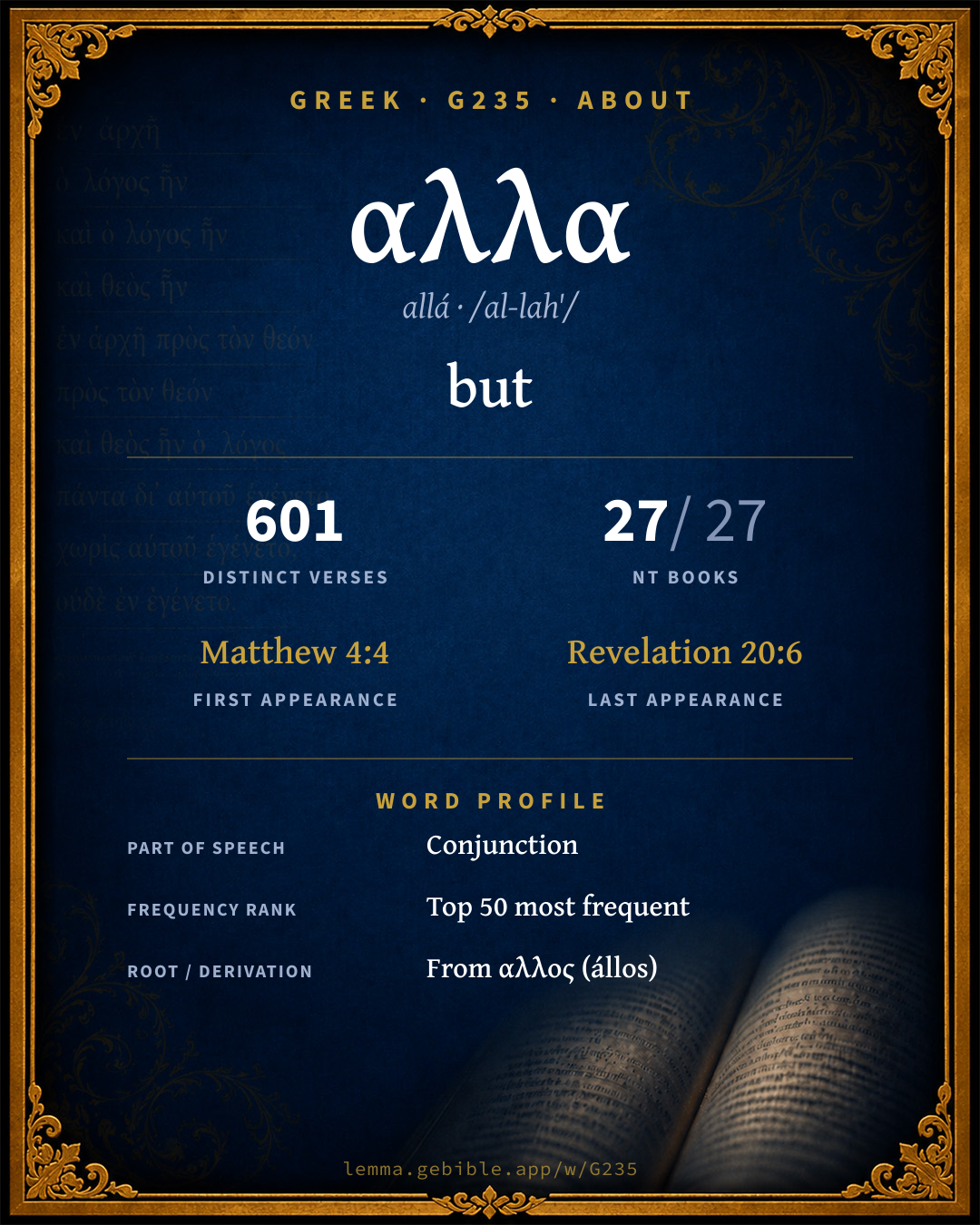
ἀλλά
but
Full lexicon entry — Thayer's Greek Lexicon
From Thayer's Greek Lexicon
Where this word appears
Grammar key — what these labels mean
Part of speech
- Conjunction
- A joining word linking words or clauses.
- Adjective
- A word that describes or qualifies a noun.
Case
- Nominative
- The case of the subject (and the predicate nominative).
Gender
- Neuter
- Grammatically neuter.
Number
- Plural
- More than one.
Every verse where G235 appears in the Book of 2 Corinthians — 53 distinct verses. Click any verse to open its interlinear word-by-word view. Verse text shown in the World English Bible for context — . Each verse’s Greek form is shown with its reference; the English is not keyword-highlighted, since the data carries no word-level English alignment. Use “Compare translations” on any verse to read it across multiple English versions. This concordance covers the Greek New Testament; Septuagint (Greek Old Testament) occurrences of this word are not indexed here.
2 Corinthians
- 2 Corinthians 1:9 ἀλλὰ ἀλλ’ conj conj Yes, we ourselves have had the sentence of death within ourselves, that we should not trust in ourselves, but in God who raises the dead,
- 2 Corinthians 1:12 ἀλλ’ conj For our boasting is this: the testimony of our conscience, that in holiness and sincerity of God, not in fleshly wisdom but in the grace of God we behaved ourselves in the world, and more abundantly toward you.
- 2 Corinthians 1:13 ἀλλ’ conj For we write no other things to you, than what you read or even acknowledge, and I hope you will acknowledge to the end;
- 2 Corinthians 1:19 ἀλλὰ conj For the Son of God, Jesus Christ, who was preached among you by us, by me, Silvanus, and Timothy, was not "Yes and no," but in him is "Yes."
- 2 Corinthians 1:24 ἀλλὰ conj Not that we have lordship over your faith, but are fellow workers with you for your joy. For you stand firm in faith.
- 2 Corinthians 2:4 ἀλλὰ conj For out of much affliction and anguish of heart I wrote to you with many tears, not that you should be made sorry, but that you might know the love that I have so abundantly for you.
- 2 Corinthians 2:5 ἀλλὰ conj But if any has caused sorrow, he has caused sorrow, not to me, but in part (that I not press too heavily) to you all.
- 2 Corinthians 2:13 ἀλλὰ conj I had no relief for my spirit, because I didn't find Titus, my brother, but taking my leave of them, I went out into Macedonia.
- 2 Corinthians 2:17 ἀλλ’ ἀλλ’ conj conj For we are not as so many, peddling the word of God. But as of sincerity, but as of God, in the sight of God, we speak in Christ.
- 2 Corinthians 3:3 ἀλλὰ ἀλλ’ conj conj being revealed that you are a letter of Christ, ministered by us, written not with ink, but with the Spirit of the living God; not in tablets of stone, but in tablets that are hearts of flesh.
- 2 Corinthians 3:5 ἀλλ’ conj not that we are sufficient of ourselves, to account anything as from ourselves; but our sufficiency is from God;
- 2 Corinthians 3:6 ἀλλὰ conj who also made us sufficient as servants of a new covenant; not of the letter, but of the Spirit. For the letter kills, but the Spirit gives life.
- 2 Corinthians 3:14 ἀλλὰ conj But their minds were hardened, for until this very day at the reading of the old covenant the same veil remains, because in Christ it passes away.
- 2 Corinthians 3:15 ἀλλ’ conj But to this day, when Moses is read, a veil lies on their heart.
- 2 Corinthians 4:2 ἀλλὰ ἀλλὰ conj conj But we have renounced the hidden things of shame, not walking in craftiness, nor handling the word of God deceitfully; but by the manifestation of the truth commending ourselves to every man's conscience in the sight of God.
- 2 Corinthians 4:5 ἀλλὰ conj For we don't preach ourselves, but Christ Jesus as Lord, and ourselves as your servants for Jesus' sake;
- 2 Corinthians 4:8 ἀλλ’ ἀλλ’ conj conj We are pressed on every side, yet not crushed; perplexed, yet not to despair;
- 2 Corinthians 4:9 ἀλλ’ ἀλλ’ conj conj pursued, yet not forsaken; struck down, yet not destroyed;
- 2 Corinthians 4:16 ἀλλ’ ἀλλ’ conj conj Therefore we don't faint, but though our outward man is decaying, yet our inward man is renewed day by day.
- 2 Corinthians 4:18 ἀλλὰ conj while we don't look at the things which are seen, but at the things which are not seen. For the things which are seen are temporal, but the things which are not seen are eternal.
- 2 Corinthians 5:4 ἀλλ’ conj For indeed we who are in this tent do groan, being burdened; not that we desire to be unclothed, but that we desire to be clothed, that what is mortal may be swallowed up by life.
- 2 Corinthians 5:12 ἀλλὰ conj For we are not commending ourselves to you again, but speak as giving you occasion of boasting on our behalf, that you may have something to answer those who boast in appearance, and not in heart.
- 2 Corinthians 5:15 ἀλλὰ conj He died for all, that those who live should no longer live to themselves, but to him who for their sakes died and rose again.
- 2 Corinthians 5:16 ἀλλὰ conj Therefore we know no one after the flesh from now on. Even though we have known Christ after the flesh, yet now we know him so no more.
- 2 Corinthians 6:4 ἀλλ’ conj but in everything commending ourselves, as servants of God, in great endurance, in afflictions, in hardships, in distresses,
- 2 Corinthians 7:5 ἀλλ’ conj For even when we had come into Macedonia, our flesh had no relief, but we were afflicted on every side. Fightings were outside. Fear was inside.
- 2 Corinthians 7:6 ἀλλ’ conj Nevertheless, he who comforts the lowly, God, comforted us by the coming of Titus;
- 2 Corinthians 7:7 ἀλλὰ conj and not by his coming only, but also by the comfort with which he was comforted in you, while he told us of your longing, your mourning, and your zeal for me; so that I rejoiced still more.
- 2 Corinthians 7:9 ἀλλ’ conj I now rejoice, not that you were made sorry, but that you were made sorry to repentance. For you were made sorry in a godly way, that you might suffer loss by us in nothing.
- 2 Corinthians 7:11 ἀλλὰ ἀλλὰ ἀλλὰ ἀλλὰ ἀλλὰ ἀλλὰ conj conj conj conj conj conj For behold, this same thing, that you were made sorry in a godly way, what earnest care it worked in you. Yes, what defense, indignation, fear, longing, zeal, and vengeance! In everything you demonstrated yourselves to be pure in the matter.
- 2 Corinthians 7:12 ἀλλ’ conj So although I wrote to you, I wrote not for his cause that did the wrong, nor for his cause that suffered the wrong, but that your earnest care for us might be revealed in you in the sight of God.
- 2 Corinthians 7:14 ἀλλ’ conj For if in anything I have boasted to him on your behalf, I was not disappointed. But as we spoke all things to you in truth, so our glorying also which I made before Titus was found to be truth.
- 2 Corinthians 8:5 ἀλλὰ conj This was not as we had hoped, but first they gave their own selves to the Lord, and to us through the will of God.
- 2 Corinthians 8:7 ἀλλ’ conj But as you abound in everything, in faith, utterance, knowledge, all earnestness, and in your love to us, see that you also abound in this grace.
- 2 Corinthians 8:8 ἀλλὰ conj I speak not by way of commandment, but as proving through the earnestness of others the sincerity also of your love.
- 2 Corinthians 8:10 ἀλλὰ conj I give a judgment in this: for this is expedient for you, who were the first to start a year ago, not only to do, but also to be willing.
- 2 Corinthians 8:13 ἀλλ’ conj For this is not that others may be eased and you distressed,
- 2 Corinthians 8:19 ἀλλὰ conj Not only so, but who was also appointed by the assemblies to travel with us in this grace, which is served by us to the glory of the Lord himself, and to show our readiness.
- 2 Corinthians 8:21 ἀλλὰ conj Having regard for honorable things, not only in the sight of the Lord, but also in the sight of men.
- 2 Corinthians 9:12 ἀλλὰ conj For this service of giving that you perform not only makes up for lack among the saints, but abounds also through many givings of thanks to God;
- 2 Corinthians 10:4 ἀλλὰ conj for the weapons of our warfare are not of the flesh, but mighty before God to the throwing down of strongholds,
- 2 Corinthians 10:12 ἀλλὰ conj For we are not bold to number or compare ourselves with some of those who commend themselves. But they themselves, measuring themselves by themselves, and comparing themselves with themselves, are without understanding.
- 2 Corinthians 10:13 ἀλλὰ conj But we will not boast beyond proper limits, but within the boundaries with which God appointed to us, which reach even to you.
- 2 Corinthians 10:18 ἀλλ’ conj For it isn't he who commends himself who is approved, but whom the Lord commends.
- 2 Corinthians 11:1 ἀλλὰ conj I wish that you would bear with me in a little foolishness, but indeed you do bear with me.
- 2 Corinthians 11:6 ἀλλ’ ἀλλ’ conj conj But though I am unskilled in speech, yet I am not unskilled in knowledge. No, in every way we have been revealed to you in all things.
- 2 Corinthians 11:17 ἀλλ’ conj That which I speak, I don't speak according to the Lord, but as in foolishness, in this confidence of boasting.
- 2 Corinthians 12:14 ἀλλὰ ἀλλὰ conj conj Behold, this is the third time I am ready to come to you, and I will not be a burden to you; for I seek not your possessions, but you. For the children ought not to save up for the parents, but the parents for the children.
- 2 Corinthians 12:16 ἀλλὰ conj But be it so, I did not myself burden you. But, being crafty, I caught you with deception.
- 2 Corinthians 13:3 ἀλλὰ conj seeing that you seek a proof of Christ who speaks in me; who toward you is not weak, but is powerful in you.
- 2 Corinthians 13:4 ἀλλὰ ἀλλὰ conj conj For he was crucified through weakness, yet he lives through the power of God. For we also are weak in him, but we will live with him through the power of God toward you.
- 2 Corinthians 13:7 ἀλλ’ conj Now I pray to God that you do no evil; not that we may appear approved, but that you may do that which is honorable, though we are as reprobate.
- 2 Corinthians 13:8 ἀλλὰ conj For we can do nothing against the truth, but for the truth.
About this entry
At a glance — auto-summarized from this page’s data, not written by a person. Every figure links to its source below. This summary describes the numbers; it doesn’t interpret them.
The Greek conjunction αλλα centers on the idea of “but.” Its earliest occurrence is Matthew 4:4. Spanning 601 verses in 27 books, it ranks among the most common words of the Greek New Testament. Related forms include αλλος, αλλασσω and αλλαχοθεν. For the data behind this summary, explore the sense tree and the renderings breakdown below.
Gloss history
Strong's 1890 vs modern scholarship

About this word
Strong's G235 catalogs a Greek word from the Greek New Testament.
These counts are not copied from any lexicon or concordance. They are computed here, from the morphology-tagged Greek New Testament. What Lemma adds →
- 601
- distinct verses
- The word appears in 601 distinct verses.
- 27 / 27
- NT books
- The word appears in 27 of 27 New Testament books.
- #31
- by frequency
- Top 50 most frequent Greek words (rank 31 of 5,347 Greek words by occurrence).
View all 601 occurrences in the concordance →
Most concentrated in
- John 101 verses 17%
- Romans 68 verses 11%
- 1 Corinthians 63 verses 10%
By section of the New Testament
By traditional corpus
Conventional, traditional groupings — biblical authorship is debated, so this is a traditional corpus grouping, not an authorship claim. Some books belong to more than one corpus (Luke is in both the Gospels and the Lukan corpus, and so on), so these shares overlap and need not total 100%. Each figure is a share of the word’s 601 distinct verses.
- Pauline corpus 283 verses · 47%
- Gospels 214 verses · 36%
- Johannine 132 verses · 22%
- Lukan (Luke–Acts) 65 verses · 11%
- General (Catholic) Epistles 46 verses · 8%
- Hebrews 16 verses · 3%
- Revelation 12 verses · 2%
How translations render this word
Counts come from each version’s own published word-to-Strong’s tagging or interlinear alignment — an approximate guide to how each version renders this word, not a word-level alignment the data otherwise carries. Because each total is that version’s own tagged count, the per-version totals vary from one another and need not match the appearance or distinct-verse counts above. These counts may also differ from a printed concordance because Lemma counts each distinctly tagged rendering and does not collapse phrase taggings into a single head-word total. This is a fixed set of word-tagged versions (KJV, ASV, BSB, ULT) and does not change with the reading translation you choose elsewhere. Each version’s license is shown beside its name below (and on Sources).
- King James Version: But 566×, Yea 15×, Yet 11×
- American Standard Version: But 521×, Howbeit 18×, Yet 16×
- Berean Standard Bible: But 433×, Instead 49×, No 10×
- unfoldingWord Literal Text: But 556×, Instead 32×, Rather 10×
King James Version Public Domain
Renders G235 across 636 tagged occurrences — most commonly:
Plus 11 renderings that appear only once — usually multi-word phrases or single function words the recovered tagging swept in, not distinct renderings. Not rendered by a distinct English word in 1 further occurrence.
American Standard Version Public Domain
Renders G235 across 616 tagged occurrences — most commonly:
Plus 24 renderings that appear only once — usually multi-word phrases or single function words the recovered tagging swept in, not distinct renderings.
Berean Standard Bible Public Domain
Renders G235 across 565 tagged occurrences — most commonly:
Plus other, less common renderings. Plus 10 renderings that appear only once — usually multi-word phrases or single function words the recovered tagging swept in, not distinct renderings. Not rendered by a distinct English word in 66 further occurrences.
unfoldingWord Literal Text CC BY-SA 4.0
Renders G235 across 642 tagged occurrences — most commonly:
Plus 12 renderings that appear only once — usually multi-word phrases or single function words the recovered tagging swept in, not distinct renderings.
Senses in Thayer's
The 1 sense Thayer's distinguishes for this word, in lexicon order (not ranked by frequency or importance). The full entry — with sub-senses — is in the Lexicon Entry tab.
- but
Word origin
Derived from αλλος (állos) (G243) — another.
Neuter plural of G243 ; properly other things that is (adverbially) contrariwise (in many relations): - and but (even) howbeit indeed nay nevertheless no notwithstanding save therefore yea yet.
— Strong’s Exhaustive Concordance (1890), public domain.
Forms in the corpus
The 6 distinct written forms G235 takes in the Greek New Testament, most frequent first — each parse links to that case’s occurrences in the concordance.
| Form | Parsing | Example | Uses |
|---|---|---|---|
| ἀλλὰ allà | Conjunction | Matthew 5:17 | 408 |
| ἀλλ’ all | Conjunction | Matthew 4:4 | 220 |
| Ἀλλὰ Allà | Conjunction | Mark 13:24 | 4 |
| ἀλλά allá | Conjunction | Luke 24:21 | 2 |
| ἄλλα álla | Adjective, Nominative, Plural, Neuter | John 6:23 | 1 |
| Ἀλλ’ All | Conjunction | Romans 10:16 | 1 |
Same root — word family
Other Thayer's entries built from the same root as G235, grouped by Strong’s listed origin. These share a root / origin per the lexicon — not necessarily a shared meaning. Each links to that word’s own entry.
Derives from
Shares the same root
- αλλασσω allássō G236 to change
- αλλαχοθεν allachóthen G237 from another place
- αλληγορεω allēgoréō G238 to speak allegorically
- αλληλων allḗlōn G240 one another
- αλλογενης allogenḗs G241 foreigner
- αλλοτριος allótrios G245 foreign
- αλλοφυλος allóphylos G246 foreign
- αλλως állōs G247 otherwise
Compare all same-root words → Showing 4 of 10 — not the complete family. They share a root, not necessarily a meaning.
Septuagint usage
The same Greek word αλλα appears 364 times in the Greek Old Testament (Septuagint), across 360 verses in 28 books.
- 364
- LXX occurrences
- Tagged occurrences of this Greek word in the Septuagint.
- 360
- verses
- Distinct Septuagint verses containing this word.
- 28 / 39
- OT books
- The word appears in 28 of the 39 Old Testament books.
Sample Septuagint occurrences
- Genesis 15:4 ἀλλά
- Exodus 8:24 ἀλλά
- Leviticus 11:21 ἀλλά
- Numbers 10:30 ἀλλά
- Deuteronomy 1:28 ἀλλά
- Joshua 1:18 ἀλλά
- Judges 2:2 ἀλλά
- 1 Samuel 1:23 ἀλλά
- 2 Samuel 10:3 ἀλλά
- 1 Kings 3:11 ἀλλά
- 2 Kings 4:2 ἀλλά
- 1 Chronicles 2:34 ἀλλά
Septuagint occurrences (same lexeme)
Every verse where the same Strong’s number (G235) appears in the Greek Septuagint — showing the first 50 of 360. Verse text shown in the World English Bible for context; the Greek form is the matched word — the English is not keyword-highlighted.
- Genesis 15:4 ἀλλά Behold, the word of Yahweh came to him, saying, "This man will not be your heir, but he who will come forth out of your own body will be your heir."
- Genesis 17:5 ἀλλά Neither will your name any more be called Abram, but your name will be Abraham; for the father of a multitude of nations have I made you.
- Genesis 17:15 ἀλλά God said to Abraham, "As for Sarai your wife, you shall not call her name Sarai, but her name will be Sarah.
- Genesis 18:15 ἀλλά Then Sarah denied, saying, "I didn't laugh," for she was afraid." He said, "No, but you did laugh."
- Genesis 19:2 ἀλλά and he said, "See now, my lords, please turn aside into your servant's house, stay all night, wash your feet, and you will rise up early, and go on your way." They said, "No, but we will stay in the street all night."
- Genesis 20:12 ἀλλά Moreover she is indeed my sister, the daughter of my father, but not the daughter of my mother; and she became my wife.
- Genesis 21:23 ἀλλά Now therefore swear to me here by God that you will not deal falsely with me, nor with my son, nor with my son's son. But according to the kindness that I have done to you, you shall do to me, and to the land in which you have lived as a foreigner."
- Genesis 21:26 ἀλλά Abimelech said, "I don't know who has done this thing. Neither did you tell me, neither did I hear of it, until today."
- Genesis 24:4 ἀλλά But you shall go to my country, and to my relatives, and take a wife for my son Isaac."
- Genesis 24:38 ἀλλά but you shall go to my father's house, and to my relatives, and take a wife for my son.'
- Genesis 28:17 ἀλλά He was afraid, and said, "How dreadful is this place! This is none other than God's house, and this is the gate of heaven."
- Genesis 32:29 ἀλλά Jacob asked him, "Please tell me your name." He said, "Why is it that you ask what my name is?" He blessed him there.
- Genesis 34:31 ἀλλά They said, "Should he deal with our sister as with a prostitute?"
- Genesis 35:10 ἀλλά God said to him, "Your name is Jacob. Your name shall not be Jacob any more, but your name will be Israel." He named him Israel.
- Genesis 38:23 ἀλλά Judah said, "Let her keep it, lest we be shamed. Behold, I sent this kid, and you haven't found her."
- Genesis 40:14 ἀλλά But remember me when it will be well with you, and show kindness, please, to me, and make mention of me to Pharaoh, and bring me out of this house.
- Genesis 40:15 ἀλλά For indeed, I was stolen away out of the land of the Hebrews, and here also have I done nothing that they should put me into the dungeon."
- Genesis 40:23 ἀλλά Yet the chief cupbearer didn't remember Joseph, but forgot him.
- Genesis 42:12 ἀλλά He said to them, "No, but you have come to see the nakedness of the land."
- Genesis 42:34 ἀλλά Bring your youngest brother to me. Then I will know that you are not spies, but that you are honest men. So I will deliver your brother to you, and you shall trade in the land.'"
- Genesis 44:26 ἀλλά We said, 'We can't go down. If our youngest brother is with us, then will we go down: for we may not see the man's face, unless our youngest brother is with us.'
- Genesis 45:1 ἀλλά Then Joseph couldn't control himself before all those who stood before him, and he cried, "Cause every man to go out from me!" There stood no man with him, while Joseph made himself known to his brothers.
- Genesis 45:8 ἀλλά So now it wasn't you who sent me here, but God, and he has made me a father to Pharaoh, lord of all his house, and ruler over all the land of Egypt.
- Genesis 47:18 ἀλλά When that year was ended, they came to him the second year, and said to him, "We will not hide from my lord how our money is all spent, and the herds of cattle are my lord's. There is nothing left in the sight of my lord, but our bodies, and our lands.
- Genesis 47:30 ἀλλά but when I sleep with my fathers, you shall carry me out of Egypt, and bury me in their burying place." He said, "I will do as you have said."
- Genesis 48:19 ἀλλά His father refused, and said, "I know, my son, I know. He also will become a people, and he also will be great. However, his younger brother will be greater than he, and his seed will become a multitude of nations."
- Exodus 8:24 ἀλλά Yahweh did so; and there came grievous swarms of flies into the house of Pharaoh, and into his servants' houses: and in all the land of Egypt the land was corrupted by reason of the swarms of flies.
- Exodus 9:2 ἀλλά For if you refuse to let them go, and hold them still,
- Exodus 10:25 ἀλλά Moses said, "You must also give into our hand sacrifices and burnt-offerings, that we may sacrifice to Yahweh our God.
- Exodus 12:9 ἀλλά Don't eat it raw, nor boiled at all with water, but roasted with fire; with its head, its legs and its inner parts.
- Exodus 16:8 ἀλλά Moses said, "Now Yahweh shall give you meat to eat in the evening, and in the morning bread to satisfy you; because Yahweh hears your murmurings which you murmur against him. And who are we? Your murmurings are not against us, but against Yahweh."
- Exodus 16:20 ἀλλά Notwithstanding they didn't listen to Moses, but some of them left of it until the morning, and it bred worms, and became foul: and Moses was angry with them.
- Exodus 21:13 ἀλλά but not if it is unintentional, but God allows it to happen: then I will appoint you a place where he shall flee.
- Exodus 23:5 ἀλλά If you see the donkey of him who hates you fallen down under his burden, don't leave him, you shall surely help him with it.
- Exodus 23:24 ἀλλά You shall not bow down to their gods, nor serve them, nor follow their practices, but you shall utterly overthrow them and demolish their pillars.
- Exodus 32:18 ἀλλά He said, "It isn't the voice of those who shout for victory, neither is it the voice of those who cry for being overcome; but the noise of those who sing that I hear."
- Exodus 33:16 ἀλλά For how would people know that I have found favor in your sight, I and your people? Isn't it in that you go with us, so that we are separated, I and your people, from all the people who are on the surface of the earth?"
- Leviticus 11:21 ἀλλά Yet you may eat these: of all winged creeping things that go on all fours, which have legs above their feet, with which to hop on the earth.
- Leviticus 21:2 ἀλλά except for his relatives that are near to him: for his mother, for his father, for his son, for his daughter, for his brother,
- Leviticus 21:14 ἀλλά A widow, or one divorced, or a woman who has been defiled, or a prostitute, these he shall not marry: but a virgin of his own people shall he take as a wife.
- Leviticus 26:15 ἀλλά and if you shall reject my statutes, and if your soul abhors my ordinances, so that you will not do all my commandments, but break my covenant;
- Leviticus 26:23 ἀλλά "'If by these things you won't be reformed to me, but will walk contrary to me;
- Leviticus 27:21 ἀλλά but the field, when it goes out in the Jubilee, shall be holy to Yahweh, as a field devoted; it shall be owned by the priests.
- Leviticus 27:29 ἀλλά "'No one devoted, who shall be devoted from among men, shall be ransomed; he shall surely be put to death.
- Numbers 10:30 ἀλλά He said to him, I will not go; but I will depart to my own land, and to my relatives.
- Numbers 13:28 ἀλλά However the people who dwell in the land are strong, and the cities are fortified, [and] very great: and moreover we saw the children of Anak there.
- Numbers 13:30 ἀλλά Caleb stilled the people before Moses, and said, Let us go up at once, and possess it; for we are well able to overcome it.
- Numbers 13:33 ἀλλά There we saw the Nephilim, the sons of Anak, who come of the Nephilim: and we were in our own sight as grasshoppers, and so we were in their sight.
- Numbers 14:9 ἀλλά Only don't rebel against Yahweh, neither fear the people of the land; for they are bread for us: their defense is removed from over them, and Yahweh is with us: don't fear them.
- Numbers 14:14 ἀλλά and they will tell it to the inhabitants of this land. They have heard that you Yahweh are in the midst of this people; for you Yahweh are seen face to face, and your cloud stands over them, and you go before them, in a pillar of cloud by day, and in a pillar of fire by night.
These are occurrences of the same Greek lexeme (G235) in the Septuagint — not a translation of any one Hebrew word. The store carries no word-level Hebrew↔Greek alignment, so no Hebrew original is asserted here. Counts come from the recovered LXX Strong's tagging — high-frequency vocabulary is well covered, while rare or late forms may be untagged — so they reflect tagged occurrences and may slightly undercount.