

2 Corinthians 4:16
Greek (Tischendorf 8th ed.) 2 Corinthians 4:16 appears in the Greek New Testament. The text above is from the Tischendorf 8th edition. Each word links to its Strong’s number and a concise gloss. Click any word for its full Thayer’s Greek Lexicon entry.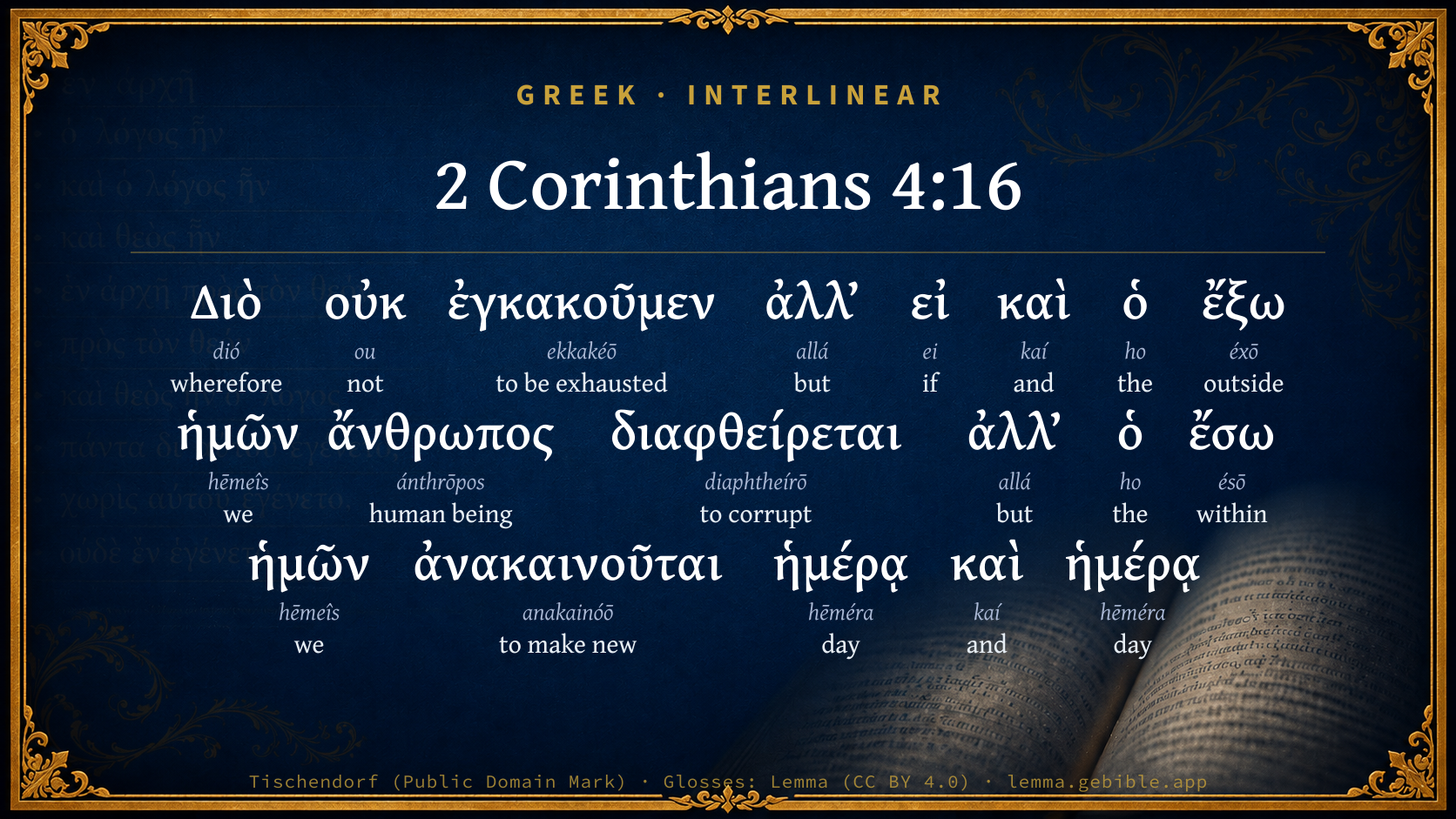
Therefore we don't faint, but though our outward man is decaying, yet our inward man is renewed day by day.
Download a study sheet
One document with this verse’s original text, its word-by-word gloss line, the meaning frame, cross-references with their text, attributed commentary, and full source and license credits — printable, and it pastes into notes with its structure intact.
This verse Autodidact and up
A passage Seminary Student
Up to 50 verses in one chapter. A passage sheet keeps up to 6 commentary sources and 12 cross-references per verse, in the order this page ranks them, and says so on the sheet whenever that leaves anything out. Ask for a single verse and you get the Autodidact verse sheet above.
Everything on this page stays free to read, with no account — the sheet is a download of what is already on screen, not access to it.
Compare translations 3
The same verse in 3 English versions, stacked beneath the original-language interlinear above. Click any original word for its lexicon entry.
Each is an independent rendering of the whole verse — the interlinear is not word-aligned to these translations.
Highlighted words mark where these versions differ — a whole-verse word diff, not a word-by-word alignment.
-
World English Bible Public Domain
Therefore we don't faint, but though our outward man is decaying, yet our inward man is renewed day by day.
-
King James Version Public Domain
For which cause we faint not; but though our outward man perish, yet the inward man is renewed day by day.
-
unfoldingWord Literal Text CC BY-SA 4.0
So we do not become discouraged. Rather, even if our outer man is decaying, yet our inner is being renewed day day.
unfoldingWord Literal Text — © unfoldingWord, licensed CC BY-SA 4.0. Word-aligned USFM3 via Door43 (git.door43.org/unfoldingWord/en_ult).
Show all 19 translations
Every available English version of this verse, each an independent rendering of the whole verse.
-
World English Bible Public Domain
Therefore we don't faint, but though our outward man is decaying, yet our inward man is renewed day by day.
-
Berean Standard Bible Public Domain
Therefore we do not lose heart. Though our outer self is wasting away, yet our inner self is being renewed day by day.
-
Majority Standard Bible Public Domain
Therefore we do not lose heart. Though our outer self is wasting away, yet the inner self is being renewed day by day.
-
King James Version Public Domain
For which cause we faint not; but though our outward man perish, yet the inward man is renewed day by day.
-
American Standard Version (1901) Public Domain
Wherefore we faint not; but though our outward man is decaying, yet our inward man is renewed day by day.
-
Revised Version (1885) Public Domain
Wherefore we faint not; but though our outward man is decaying, yet our inward man is renewed day by day.
-
Geneva Bible (1599) Public Domain
Therefore we faint not, but though our outward man perish, yet the inward man is renewed daily.
-
Douay-Rheims (1899) Public Domain
For which cause we faint not; but though our outward man is corrupted, yet the inward man is renewed day by day.
-
Young's Literal Translation Public Domain
wherefore, we faint not, but if also our outward man doth decay, yet the inward is renewed day by day;
-
Literal Standard Version CC BY-SA 4.0
for this reason, we do not faint, but if our outward man also decays, yet the inward is renewed day by day;
-
Unlocked Literal Bible CC BY-SA 4.0
So we do not become discouraged. Even though outwardly we are wasting away, inwardly we are being renewed day by day.
-
unfoldingWord Literal Text CC BY-SA 4.0
So we do not become discouraged. Rather, even if our outer man is decaying, yet our inner is being renewed day day.
-
Darby Bible Public Domain
Wherefore we faint not; but if indeed our outward man is consumed, yet the inward is renewed day by day.
-
World Messianic Bible Public Domain
Therefore we don’t faint, but though our outward person is decaying, yet our inward person is renewed day by day.
-
Webster's Bible Public Domain
For which cause we faint not; but though our outward man is wasted, yet the inward man is renewed day by day.
-
Free Bible Version CC BY-SA 4.0
So we don't give up. Even though our physical bodies are falling apart, our inner selves are being renewed daily.
-
Bible in Basic English Public Domain
For which cause we do not give way to weariness; but though our outer man is getting feebler, our inner man is made new day by day.
-
Text-Critical English NT CC BY 4.0
Therefore we do not lose heart. Even though on the outside we are wasting away, on the inside we are being renewed day by day.
-
Tyndale New Testament (1534) Public Domain
Wherfore we are not weried but though oure vttward man perisshe yet the inwarde man is renewed daye by daye.
Literal Standard Version (2020), Covenant Press — licensed CC BY-SA 4.0. Text via the HelloAO Bible API (eBible.org). Unlocked Literal Bible (unfoldingWord) — licensed CC BY-SA 4.0. Text via the HelloAO Bible API (eBible.org). unfoldingWord Literal Text — © unfoldingWord, licensed CC BY-SA 4.0. Word-aligned USFM3 via Door43 (git.door43.org/unfoldingWord/en_ult). Free Bible Version, Dr. Jonathan Gallagher — licensed CC BY-SA 4.0. Text via the HelloAO Bible API (eBible.org).
Word by word
More ways to search: Search by grammar → Find every occurrence → Compare this word →
Practice this passage: Drill this verse → Learn its vocabulary →
- Appears 2× in the Greek New Testament
- First appears here
- Part of Speech
- Verb
- Tense
- Present
- Voice
- Passive
- Mood
- Indicative
- Person
- 3rd person
- Number
- Singular
Full Thayer's Definition
- Διὸ dió G1352 “wherefore” Conjunction
- οὐκ ou G3756 “not” Particle, Negative
- ἐγκακοῦμεν ekkakéō G1573 “to be exhausted” Verb, Present, Active, Indicative, 1st person, Plural
- ἀλλ’ allá G235 “but” Conjunction
- εἰ ei G1487 “if” Conditional
- καὶ kaí G2532 “and” Conjunction
- ὁ ho G3588 “the” Article, Nominative, Singular, Masculine
- ἔξω éxō G1854 “outside” Adverb
- ἡμῶν hēmeîs G2249 “we” Personal pronoun, 1st person, Genitive, Plural
- ἄνθρωπος ánthrōpos G444 “human being” Noun, Nominative, Singular, Masculine
- διαφθείρεται diaphtheírō G1311 “to corrupt” Verb, Present, Passive, Indicative, 3rd person, Singular
- ἀλλ’ allá G235 “but” Conjunction
- ὁ ho G3588 “the” Article, Nominative, Singular, Masculine
- ἔσω ésō G2080 “within” Adverb
- ἡμῶν hēmeîs G2249 “we” Personal pronoun, 1st person, Genitive, Plural
- ἀνακαινοῦται anakainóō G341 “to make new” Verb, Present, Passive, Indicative, 3rd person, Singular
- ἡμέρᾳ hēméra G2250 “day” Noun, Dative, Singular, Feminine
- καὶ kaí G2532 “and” Conjunction
- ἡμέρᾳ hēméra G2250 “day” Noun, Dative, Singular, Feminine
About this verse
These counts appear in no published source. They are computed here, from the morphology-tagged text and Lemma’s own curated glosses. What Lemma adds →
- 19
- words
- 14
- distinct lemmas
- Pauline Epistles
- section
Notable vocabulary
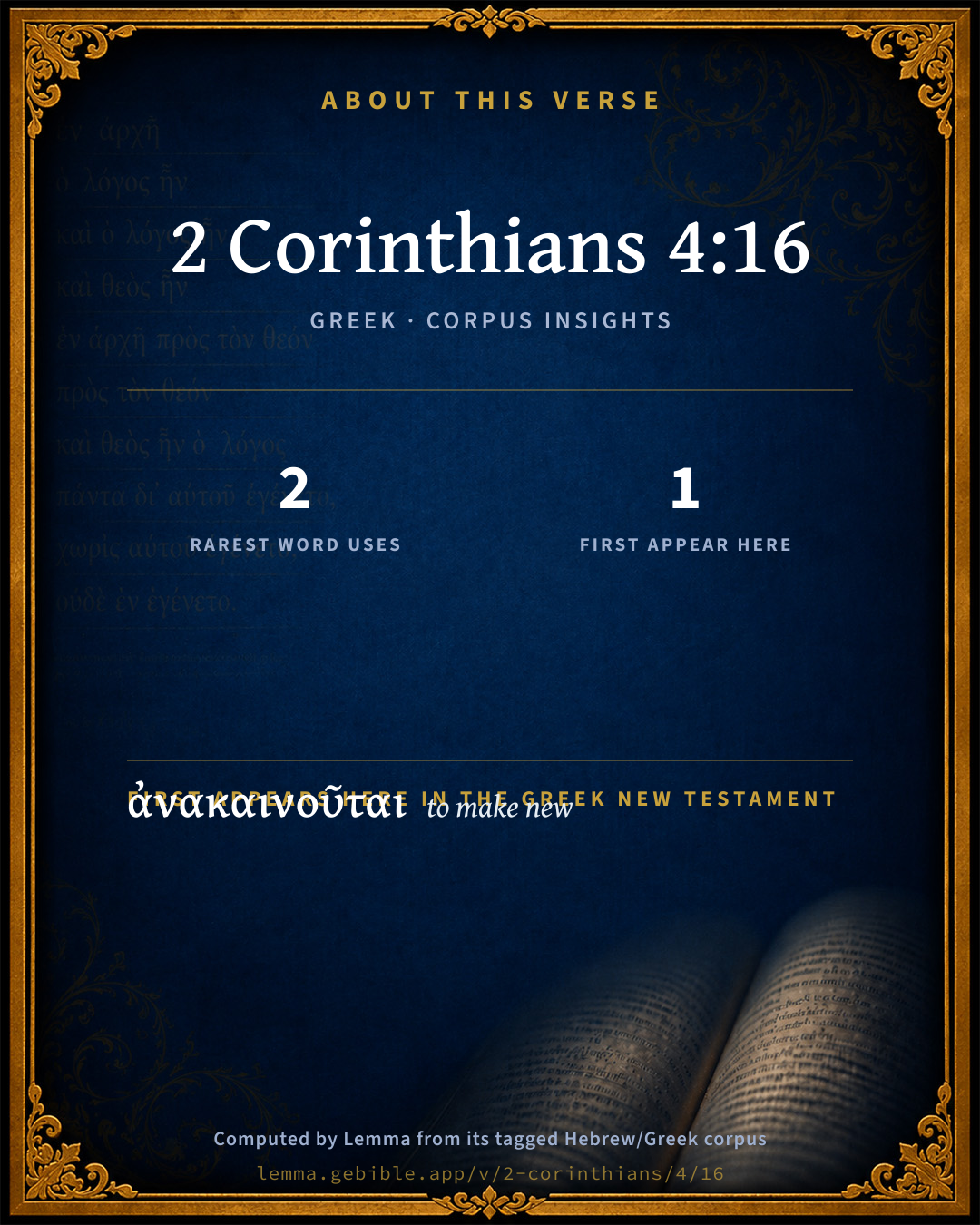
The rarest word here is ἀνακαινοῦται to make new G341 — appearing just 2 times in the whole Greek New Testament.
First appearance in Scripture
This word makes its first canonical appearance in the Greek New Testament here:
- ἀνακαινοῦται to make new G341
Shared distinctive vocabulary
ἀνακαινοῦται to make new G341 occurs in 2 verses of the Greek New Testament. Also found in:
Cross-references
20Topical passages linked to 2 Corinthians 4:16 in the Treasury of Scripture Knowledge — connected by theme and wording, ordered by reader-vote popularity; previews shown in the World English Bible.
- Isaiah 40:31 but those who wait for Yahweh shall renew their strength; they shall mount up with wings as eagles; they shall run, and not be weary; they shall walk, and not faint.
- Colossians 3:10 and have put on the new man, that is being renewed in knowledge after the image of his Creator,
- Isaiah 40:29 He gives power to the faint; and to him who has no might he increases strength.
- Romans 12:2 Don't be conformed to this world, but be transformed by the renewing of your mind, so that you may prove what is the good, well-pleasing, and perfect will of God.
- Psalms 73:26 My flesh and my heart fails, But God is the strength of my heart and my portion forever.
- 2 Corinthians 4:1 Therefore seeing we have this ministry, even as we obtained mercy, we don't faint.
- Ephesians 3:16 that he would grant you, according to the riches of his glory, that you may be strengthened with power through his Spirit in the inward man;
- Romans 7:22 For I delight in God's law after the inward man,
- Titus 3:5 not by works of righteousness, which we did ourselves, but according to his mercy, he saved us, through the washing of regeneration and renewing by the Holy Spirit,
- Psalms 27:13 I am still confident of this: I will see the goodness of Yahweh in the land of the living.
- Psalms 51:10 Create in me a clean heart, O God. Renew a right spirit within me.
- 1 Corinthians 15:58 Therefore, my beloved brothers, be steadfast, immovable, always abounding in the Lord's work, because you know that your labor is not in vain in the Lord.
- Ephesians 4:23 and that you be renewed in the spirit of your mind,
- 1 Peter 3:4 but in the hidden person of the heart, in the incorruptible adornment of a gentle and quiet spirit, which is in the sight of God very precious.
- Job 19:26–27 After my skin is destroyed, Then in my flesh shall I see God,
- Isaiah 57:1–2 The righteous perishes, and no man lays it to heart; and merciful men are taken away, none considering that the righteous is taken away from the evil [to come].
- Luke 11:3 Give us day by day our daily bread.
- Psalms 119:81 My soul faints for your salvation. I hope in your word.
- 2 Corinthians 12:15 I will most gladly spend and be spent for your souls. If I love you more abundantly, am I loved the less?
- Matthew 5:29–30 If your right eye causes you to stumble, pluck it out and throw it away from you. For it is more profitable for you that one of your members should perish, than for your whole body to be cast into Gehenna.
Cross-references courtesy of OpenBible.info (CC BY 4.0).
Lesson kit
Teaching starters — assembled from the data on this page, not authored interpretation. Every prompt links to the verse data it draws on. Edit before teaching.
2 Corinthians, in the Pauline Epistles, opens this verse with 19 words (14 distinct Greek lemmas). Its most distinctive word is anakainóō (“to make new”). A historical commentator’s framing appears above. Read the whole chapter for the surrounding context.
Discussion questions
- How does “to make new” (anakainóō) shape what this verse is saying?
- This is the first place “to make new” appears in Scripture (first appears here). What does its debut here establish?
- How does Colossians 3:10, which shares the word «to make new», read alongside this verse?
- What does the repetition of “day” (2× in this one verse) do in this verse?
- These translations render this verse differently; the difference is in the English rendering, not the original. What questions does that raise?
- Compare how The Cambridge Bible for Schools and Colleges and The Biblical Illustrator read this verse. Where do they agree or differ?
Things to notice
- 1 word makes its first canonical appearance in Scripture here.
- These translations choose different wording for 18 words in this verse.
- “day” occurs 2× in this single verse.
- 14 distinct Greek lemmas span 19 words in this verse.
Commentary
Notes on 2 Corinthians 4:16 from classic Christian and Jewish commentators (each source and its license shown beneath its notes). The classic Christian expositions comment on the surrounding passage and are grouped to its opening verse, so a note may address several verses; the Jewish commentaries on the Tanakh (Rashi and others) are per-verse, so they appear only where the commentator wrote on this verse.
Lemma curates 59 commentaries, every one of them public domain or Creative Commons licensed, each selected and text-cleaned for this edition rather than reprinted as found. About our sources →
The Cambridge Bible for Schools and Colleges
gen. ed. J. J. S. Perowne
The Cambridge Bible for Schools and Colleges (gen. ed. J. J. S. Perowne; Cambridge University Press, 1878–1918) — public domain. Text from a community e-Sword module.
The Biblical Illustrator
Joseph S. Exell
The Biblical Illustrator, edited by Joseph S. Exell (c. 1880s–1900s) — public domain. Text from a community e-Sword module.
Joseph Benson's Commentary
Joseph Benson's Commentary on the Old and New Testaments (1811–1818) — public domain. Text from a community e-Sword module.
Tyndale Open Study Notes
Tyndale Open Resources
Tyndale Open Study Notes — © Tyndale Open Resources, licensed CC BY-SA 4.0. Text via the HelloAO Bible API.
Bengel's Gnomon
Johann Albrecht Bengel
Bengel's Gnomon of the New Testament — English translation (T&T Clark, Edinburgh, 1860) — public domain. Text from a community e-Sword module.
Meyer's Critical & Exegetical Commentary
Heinrich August Wilhelm Meyer
Meyer — Critical and Exegetical Commentary on the New Testament — English translation by Peter Christie, edited by Frederick Crombie (T&T Clark, 1880) — public domain. Text from a community e-Sword module.
Expositor's Greek Testament
ed. W. Robertson Nicoll
The Expositor's Greek Testament, edited by W. Robertson Nicoll (1897–1910) — public domain. Text from a community e-Sword module.
Geneva Bible (1599)
Geneva Bible translators
Geneva Bible (1599) marginal notes — public domain. Text via Bolls.life.
Jamieson, Fausset & Brown
Robert Jamieson, A. R. Fausset & David Brown
Jamieson, Fausset & Brown — Commentary Critical and Explanatory on the Whole Bible (1871) — public domain (CC PDM 1.0). Text via the HelloAO Bible API.
Adam Clarke's Commentary
Adam Clarke's Commentary on the Bible (1810–1826) — public domain. Text from a community e-Sword/MySword module.
John Calvin's Commentaries
John Calvin's Commentaries (1540-1563) — public domain. Text from the Calvin Translation Society English edition (1840s-50s) via the Christian Classics Ethereal Library (ccel.org). Calvin's coverage is partial (roughly two-thirds of the Bible); uncommented books and verses are honest gaps, never fabricated. The 19th-century editor's footnotes and remarks are omitted so the notes are faithfully Calvin's own voice.
Ellicott's Commentary for English Readers
A Bible Commentary for English Readers, edited by Charles John Ellicott (1878–1897) — public domain. Text from a community e-Sword module.
John Gill's Exposition
John Gill's Exposition of the Whole Bible (1746–1763) — public domain (CC PDM 1.0). Text via the HelloAO Bible API.
Trapp's Complete Commentary
John Trapp
John Trapp, A Commentary or Exposition upon All the Books of the Old and New Testament (1647–1656) — public domain. Text from a community e-Sword module.
Albert Barnes' Notes on the Bible
Albert Barnes' Notes on the Bible (1834–1885) — public domain. Text from a community e-Sword/MySword module.
Matthew Poole's English Annotations
Matthew Poole's English Annotations on the Holy Bible (1683–1685) — public domain. Text from a community e-Sword/MySword module.
Whedon's Commentary on the Bible
Daniel D. Whedon
Daniel D. Whedon (gen. ed.), Commentary on the Old and New Testaments (1874–1909) — public domain. Text from a community e-Sword module.
The Pulpit Commentary
The Pulpit Commentary (1880–1919), ed. H.D.M. Spence-Jones & Joseph S. Exell — public domain. Text from a community e-Sword module.
John Wesley's Explanatory Notes
John Wesley, Explanatory Notes Upon the Whole Bible (1754–1765) — public domain. Text via the GEBible commentary corpus.
Burkitt's Expository Notes on the New Testament
William Burkitt
William Burkitt's Expository Notes on the New Testament (1700–1703) — public domain. Text from a community e-Sword module.
McGarvey & Pendleton's Commentaries
J. W. McGarvey
J. W. McGarvey (with Philip Y. Pendleton), Commentaries on the New Testament (The Fourfold Gospel, 1914; Acts; and the epistles) — public domain. Text from a community e-Sword/MySword module.
The People's New Testament
B. W. Johnson
B. W. Johnson's The People's New Testament with Notes (1889–1891) — public domain. Electronic text from the Christian Classics Ethereal Library (CCEL) ThML edition.
unfoldingWord translationNotes
Door43 World Missions Community
unfoldingWord translationNotes — © Distant Shores Media and the Door43 World Missions Community, licensed CC BY-SA 4.0. Source: git.door43.org/Door43/en_tn.
Cambridge Greek Testament for Schools and Colleges
Cambridge Greek Testament for Schools and Colleges (Cambridge University Press, 1896; 21 vols, various authors incl. Carr, Maclear, Plummer, Farrar, Lumby, Moule, M. R. James, Simcox) — public domain. Text from a community e-Sword module.
Alford’s Greek Testament
Henry Alford
Henry Alford, The Greek Testament (1849–1861) — public domain. Text from a community e-Sword module.
International Critical Commentary
International Critical Commentary — older volumes (1896–1929), various authors — public domain. Text from a community e-Sword module.
Vincent's Word Studies in the New Testament
Marvin R. Vincent
Marvin R. Vincent, Word Studies in the New Testament (1887–1900) — public domain. Text from a community e-Sword/MySword module.