

2 Corinthians 4:8
Greek (Tischendorf 8th ed.) 2 Corinthians 4:8 appears in the Greek New Testament. The text above is from the Tischendorf 8th edition. Each word links to its Strong’s number and a concise gloss. Click any word for its full Thayer’s Greek Lexicon entry.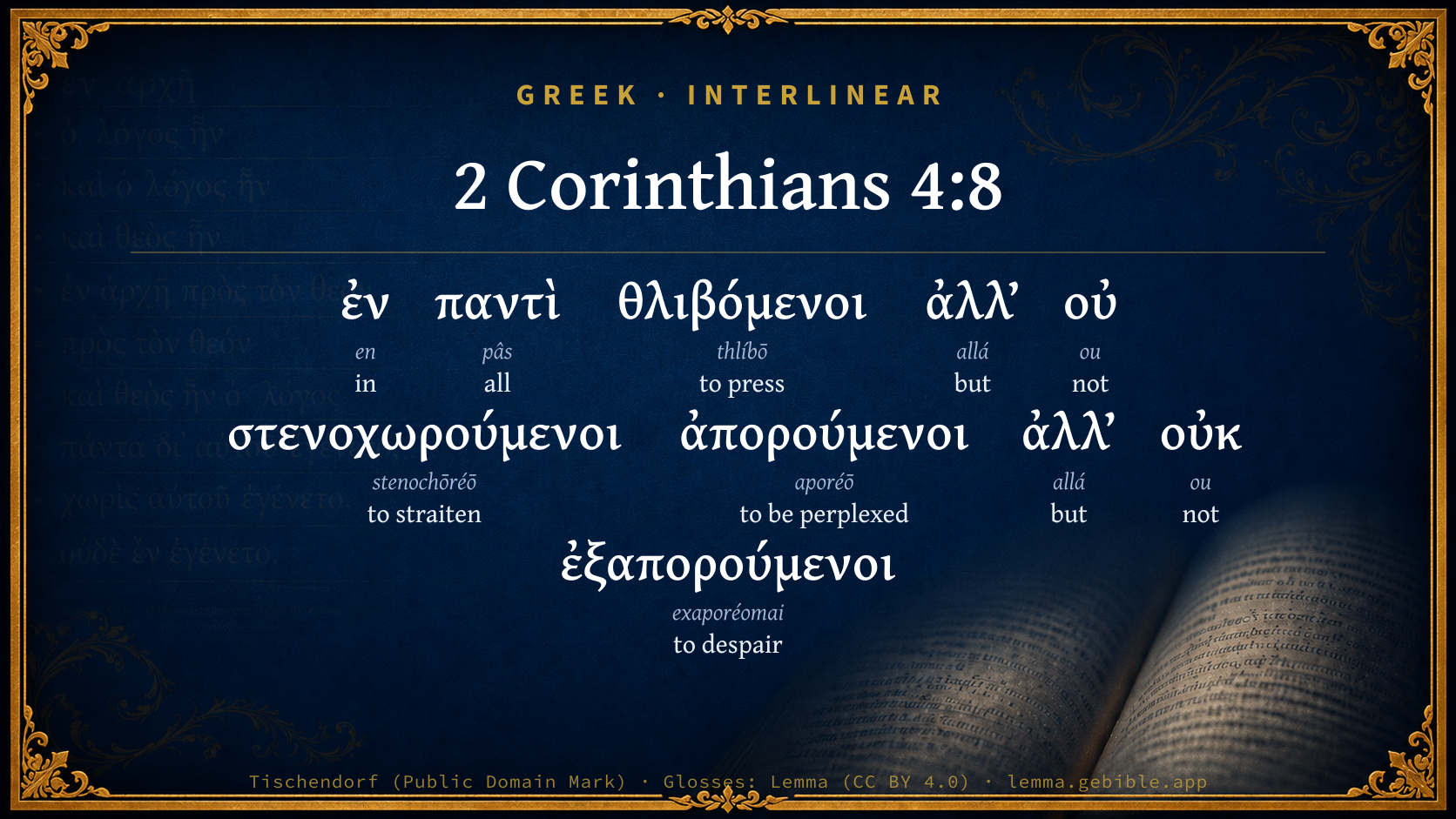
We are pressed on every side, yet not crushed; perplexed, yet not to despair;
Download a study sheet
One document with this verse’s original text, its word-by-word gloss line, the meaning frame, cross-references with their text, attributed commentary, and full source and license credits — printable, and it pastes into notes with its structure intact.
This verse Autodidact and up
A passage Seminary Student
Up to 50 verses in one chapter. A passage sheet keeps up to 6 commentary sources and 12 cross-references per verse, in the order this page ranks them, and says so on the sheet whenever that leaves anything out. Ask for a single verse and you get the Autodidact verse sheet above.
Everything on this page stays free to read, with no account — the sheet is a download of what is already on screen, not access to it.
Compare translations 3
The same verse in 3 English versions, stacked beneath the original-language interlinear above. Click any original word for its lexicon entry.
Each is an independent rendering of the whole verse — the interlinear is not word-aligned to these translations.
Highlighted words mark where these versions differ — a whole-verse word diff, not a word-by-word alignment.
-
World English Bible Public Domain
We are pressed on every side, yet not crushed; perplexed, yet not to despair;
-
King James Version Public Domain
We are troubled on every side, yet not distressed; we are perplexed, but not in despair;
-
unfoldingWord Literal Text CC BY-SA 4.0
in every being pressed in, but not being crushed; being perplexed, but not despairing;
unfoldingWord Literal Text — © unfoldingWord, licensed CC BY-SA 4.0. Word-aligned USFM3 via Door43 (git.door43.org/unfoldingWord/en_ult).
Show all 19 translations
Every available English version of this verse, each an independent rendering of the whole verse.
-
World English Bible Public Domain
We are pressed on every side, yet not crushed; perplexed, yet not to despair;
-
Berean Standard Bible Public Domain
We are hard pressed on all sides, but not crushed; perplexed, but not in despair;
-
Majority Standard Bible Public Domain
We are hard pressed on all sides, but not crushed; perplexed, but not in despair;
-
King James Version Public Domain
We are troubled on every side, yet not distressed; we are perplexed, but not in despair;
-
American Standard Version (1901) Public Domain
`we are' pressed on every side, yet not straitened; perplexed, yet not unto despair;
-
Revised Version (1885) Public Domain
we are pressed on every side, yet not straitened; perplexed, yet not unto despair;
-
Geneva Bible (1599) Public Domain
Wee are afflicted on euery side, yet are we not in distresse: we are in doubt, but yet wee despaire not.
-
Douay-Rheims (1899) Public Domain
In all things we suffer tribulation, but are not distressed; we are straitened, but are not destitute;
-
Young's Literal Translation Public Domain
on every side being in tribulation, but not straitened; perplexed, but not in despair;
-
Literal Standard Version CC BY-SA 4.0
being in tribulation in every [way], but not crushed; perplexed, but not despairing;
-
Unlocked Literal Bible CC BY-SA 4.0
We are afflicted in every way, but not overwhelmed. We are perplexed but not filled with despair.
-
unfoldingWord Literal Text CC BY-SA 4.0
in every being pressed in, but not being crushed; being perplexed, but not despairing;
-
Darby Bible Public Domain
every way afflicted, but not straitened; seeing no apparent issue, but our way not entirely shut up;
-
World Messianic Bible Public Domain
We are pressed on every side, yet not crushed; perplexed, yet not to despair;
-
Webster's Bible Public Domain
We are troubled on every side, yet not distressed; we are perplexed, but not in despair;
-
Free Bible Version CC BY-SA 4.0
We are attacked from every direction, but we are not crushed. We are at a loss as to what to do, but never in despair.
-
Bible in Basic English Public Domain
Troubles are round us on every side, but we are not shut in; things are hard for us, but we see a way out of them;
-
Text-Critical English NT CC BY 4.0
We are afflicted in every way, but not crushed; perplexed, but not in despair;
-
Tyndale New Testament (1534) Public Domain
We are troubled on every side yet are we not with out shyft. We are in povertie: but not vtterly without somwhat.
Literal Standard Version (2020), Covenant Press — licensed CC BY-SA 4.0. Text via the HelloAO Bible API (eBible.org). Unlocked Literal Bible (unfoldingWord) — licensed CC BY-SA 4.0. Text via the HelloAO Bible API (eBible.org). unfoldingWord Literal Text — © unfoldingWord, licensed CC BY-SA 4.0. Word-aligned USFM3 via Door43 (git.door43.org/unfoldingWord/en_ult). Free Bible Version, Dr. Jonathan Gallagher — licensed CC BY-SA 4.0. Text via the HelloAO Bible API (eBible.org).
Word by word
More ways to search: Search by grammar → Find every occurrence → Compare this word →
Practice this passage: Drill this verse → Learn its vocabulary →
- Appears 2× in the Greek New Testament
- First appears at 2 Corinthians 1:8
- Part of Speech
- Verb
- Tense
- Present
- Voice
- Middle or Passive deponent
- Mood
- Participle
- Case
- Nominative
- Number
- Plural
- Gender
- Masculine
Full Thayer's Definition
- ἐν en G1722 “in” Preposition
- παντὶ pâs G3956 “all” Adjective, Dative, Singular, Masculine
- θλιβόμενοι thlíbō G2346 “to press” Verb, Present, Passive, Participle, Nominative, Plural, Masculine
- ἀλλ’ allá G235 “but” Conjunction
- οὐ ou G3756 “not” Particle, Negative
- στενοχωρούμενοι stenochōréō G4729 “to straiten” Verb, Present, Passive, Participle, Nominative, Plural, Masculine
- ἀπορούμενοι aporéō G639 “to be perplexed” Verb, Present, Middle, Participle, Nominative, Plural, Masculine
- ἀλλ’ allá G235 “but” Conjunction
- οὐκ ou G3756 “not” Particle, Negative
- ἐξαπορούμενοι exaporéomai G1820 “to despair” Verb, Present, Middle or Passive deponent, Participle, Nominative, Plural, Masculine
About this verse
These counts appear in no published source. They are computed here, from the morphology-tagged text and Lemma’s own curated glosses. What Lemma adds →
- 10
- words
- 8
- distinct lemmas
- Pauline Epistles
- section
Notable vocabulary
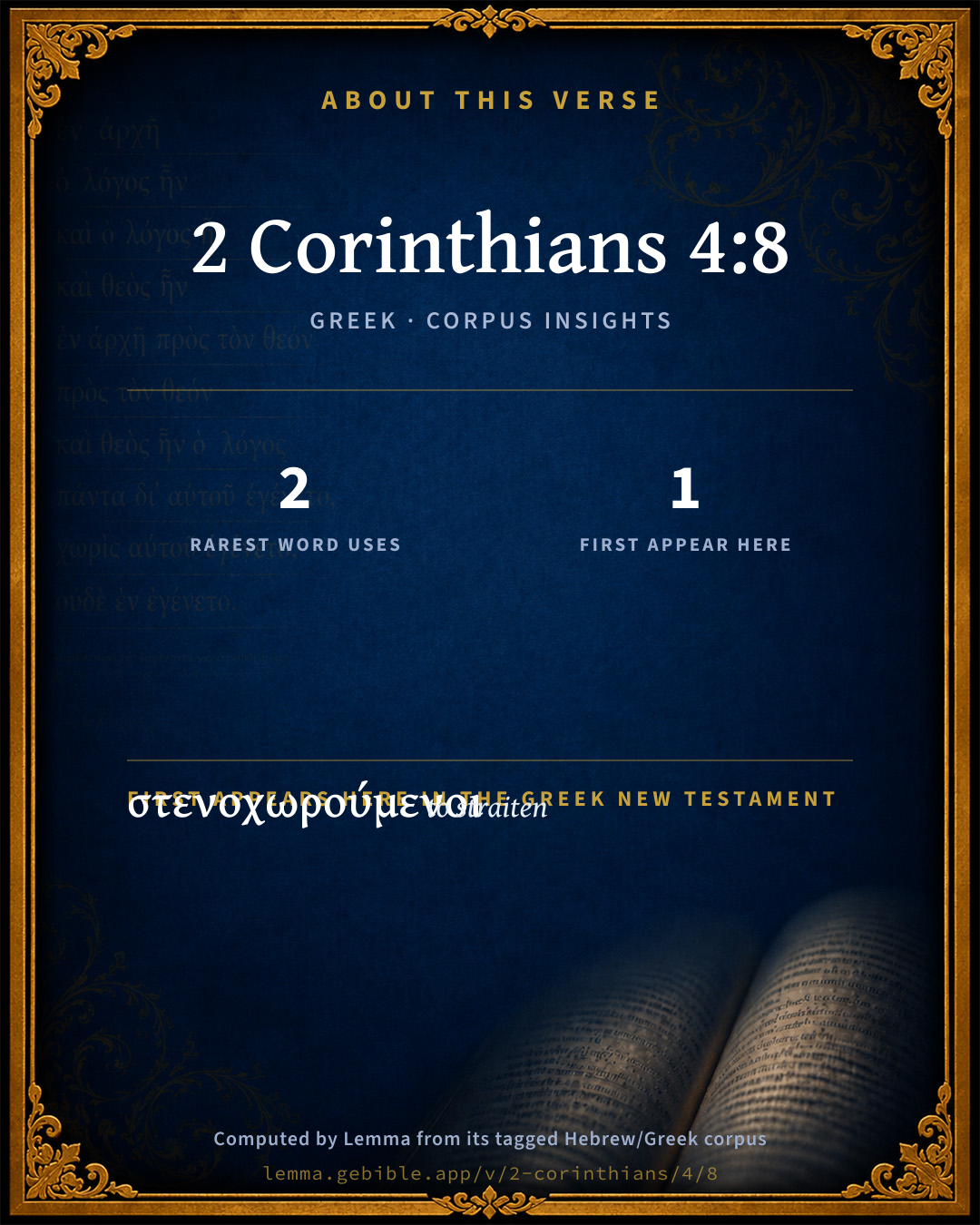
The rarest word here is ἐξαπορούμενοι to despair G1820 — appearing just 2 times in the whole Greek New Testament.
First appearance in Scripture
This word makes its first canonical appearance in the Greek New Testament here:
- στενοχωρούμενοι to straiten G4729
Shared distinctive vocabulary
ἐξαπορούμενοι to despair G1820 occurs in 2 verses of the Greek New Testament. Also found in:
Cross-references
20Topical passages linked to 2 Corinthians 4:8 in the Treasury of Scripture Knowledge — connected by theme and wording, ordered by reader-vote popularity; previews shown in the World English Bible.
- James 1:2–4 Count it all joy, my brothers, when you fall into various temptations,
- Romans 8:35–37 Who shall separate us from the love of Christ? Could oppression, or anguish, or persecution, or famine, or nakedness, or peril, or sword?
- 1 Peter 4:12–14 Beloved, don't be astonished at the fiery trial which has come upon you, to test you, as though a strange thing happened to you.
- 2 Corinthians 12:10 Therefore I take pleasure in weaknesses, in injuries, in necessities, in persecutions, in distresses, for Christ's sake. For when I am weak, then am I strong.
- Psalms 56:2–3 My enemies want to swallow me up all day long, For they are many who fight proudly against me.
- 2 Corinthians 7:5 For even when we had come into Macedonia, our flesh had no relief, but we were afflicted on every side. Fightings were outside. Fear was inside.
- Romans 5:3–5 Not only this, but we also rejoice in our sufferings, knowing that suffering works perseverance;
- 1 Peter 1:6–7 Wherein you greatly rejoice, though now for a little while, if need be, you have been put to grief in various trials,
- Job 2:9–10 Then his wife said to him, "Do you still maintain your integrity? Renounce God, and die."
- Psalms 37:33 Yahweh will not leave him in his hand, Nor condemn him when he is judged.
- 2 Corinthians 1:8–10 For we don't desire to have you uninformed, brothers, concerning our affliction which happened to us in Asia, that we were weighed down exceedingly, beyond our power, so much that we despaired even of life.
- John 14:18 I will not leave you orphans. I will come to you.
- 1 Corinthians 10:13 No temptation has taken you except what is common to man. God is faithful, who will not allow you to be tempted above what you are able, but will with the temptation also make the way of escape, that you may be able to endure it.
- 2 Corinthians 4:16–17 Therefore we don't faint, but though our outward man is decaying, yet our inward man is renewed day by day.
- 1 Samuel 28:15 Samuel said to Saul, Why have you disquieted me, to bring me up? Saul answered, I am sore distressed; for the Philistines make war against me, and God is departed from me, and answers me no more, neither by prophets, nor by dreams: therefore I have called you, that you may make known to me what I shall do.
- 1 Samuel 30:6 David was greatly distressed; for the people spoke of stoning him, because the soul of all the people was grieved, every man for his sons and for his daughters: but David strengthened himself in Yahweh his God.
- 2 Corinthians 6:4 but in everything commending ourselves, as servants of God, in great endurance, in afflictions, in hardships, in distresses,
- 2 Corinthians 11:23–30 Are they servants of Christ? (I speak as one beside himself) I am more so; in labors more abundantly, in prisons more abundantly, in stripes above measure, in deaths often.
- Proverbs 14:26 In the fear of Yahweh is a secure fortress, And he will be a refuge for his children.
- Proverbs 18:10 The name of Yahweh is a strong tower: The righteous run to him, and are safe.
Cross-references courtesy of OpenBible.info (CC BY 4.0).
Lesson kit
Teaching starters — assembled from the data on this page, not authored interpretation. Every prompt links to the verse data it draws on. Edit before teaching.
2 Corinthians, in the Pauline Epistles, opens this verse with 10 words (8 distinct Greek lemmas). Its most distinctive word is exaporéomai (“to despair”). A historical commentator’s framing appears above. Read the whole chapter for the surrounding context.
Discussion questions
- What does “to despair” (exaporéomai) contribute to the verse as a whole?
- The word “to straiten” first appears here in Scripture. What is being introduced at this debut?
- 2 Corinthians 1:8 shares the word «to despair» with this verse. How do the two illuminate each other?
- “but” occurs 2× in this one verse. What is the effect of the repetition?
- These translations render this verse differently; the difference is in the English rendering, not the original. What questions does that raise?
- Reading how Matthew Henry's Commentary and The Biblical Illustrator read this verse, where do the two commentators agree and where do they part?
Things to notice
- 1 word makes its first canonical appearance in Scripture here.
- These translations choose different wording for 9 words in this verse.
- “but” occurs 2× in this single verse.
- 8 distinct Greek lemmas span 10 words in this verse.
Commentary
Notes on 2 Corinthians 4:8 from classic Christian and Jewish commentators (each source and its license shown beneath its notes). The classic Christian expositions comment on the surrounding passage and are grouped to its opening verse, so a note may address several verses; the Jewish commentaries on the Tanakh (Rashi and others) are per-verse, so they appear only where the commentator wrote on this verse.
Lemma curates 59 commentaries, every one of them public domain or Creative Commons licensed, each selected and text-cleaned for this edition rather than reprinted as found. About our sources →
Matthew Henry's Commentary
Matthew Henry's Commentary on the Whole Bible (1708–1710) — public domain (CC PDM 1.0). Text via the HelloAO Bible API.
The Biblical Illustrator
Joseph S. Exell
The Biblical Illustrator, edited by Joseph S. Exell (c. 1880s–1900s) — public domain. Text from a community e-Sword module.
Joseph Benson's Commentary
Joseph Benson's Commentary on the Old and New Testaments (1811–1818) — public domain. Text from a community e-Sword module.
Bengel's Gnomon
Johann Albrecht Bengel
Bengel's Gnomon of the New Testament — English translation (T&T Clark, Edinburgh, 1860) — public domain. Text from a community e-Sword module.
Meyer's Critical & Exegetical Commentary
Heinrich August Wilhelm Meyer
Meyer — Critical and Exegetical Commentary on the New Testament — English translation by Peter Christie, edited by Frederick Crombie (T&T Clark, 1880) — public domain. Text from a community e-Sword module.
Expositor's Greek Testament
ed. W. Robertson Nicoll
The Expositor's Greek Testament, edited by W. Robertson Nicoll (1897–1910) — public domain. Text from a community e-Sword module.
Jamieson, Fausset & Brown
Robert Jamieson, A. R. Fausset & David Brown
Jamieson, Fausset & Brown — Commentary Critical and Explanatory on the Whole Bible (1871) — public domain (CC PDM 1.0). Text via the HelloAO Bible API.
Adam Clarke's Commentary
Adam Clarke's Commentary on the Bible (1810–1826) — public domain. Text from a community e-Sword/MySword module.
John Calvin's Commentaries
John Calvin's Commentaries (1540-1563) — public domain. Text from the Calvin Translation Society English edition (1840s-50s) via the Christian Classics Ethereal Library (ccel.org). Calvin's coverage is partial (roughly two-thirds of the Bible); uncommented books and verses are honest gaps, never fabricated. The 19th-century editor's footnotes and remarks are omitted so the notes are faithfully Calvin's own voice.
Ellicott's Commentary for English Readers
A Bible Commentary for English Readers, edited by Charles John Ellicott (1878–1897) — public domain. Text from a community e-Sword module.
The Cambridge Bible for Schools and Colleges
gen. ed. J. J. S. Perowne
The Cambridge Bible for Schools and Colleges (gen. ed. J. J. S. Perowne; Cambridge University Press, 1878–1918) — public domain. Text from a community e-Sword module.
John Gill's Exposition
John Gill's Exposition of the Whole Bible (1746–1763) — public domain (CC PDM 1.0). Text via the HelloAO Bible API.
Trapp's Complete Commentary
John Trapp
John Trapp, A Commentary or Exposition upon All the Books of the Old and New Testament (1647–1656) — public domain. Text from a community e-Sword module.
Albert Barnes' Notes on the Bible
Albert Barnes' Notes on the Bible (1834–1885) — public domain. Text from a community e-Sword/MySword module.
Haydock's Catholic Bible Commentary
George Leo Haydock (1774–1849), Haydock's Catholic Family Bible and Commentary, 1859 edition — public domain. Excludes Psalms (Douay-Rheims chapter numbering differs from Protestant) and Deuterocanonical books (Catholic canon only).
Matthew Poole's English Annotations
Matthew Poole's English Annotations on the Holy Bible (1683–1685) — public domain. Text from a community e-Sword/MySword module.
Whedon's Commentary on the Bible
Daniel D. Whedon
Daniel D. Whedon (gen. ed.), Commentary on the Old and New Testaments (1874–1909) — public domain. Text from a community e-Sword module.
The Pulpit Commentary
The Pulpit Commentary (1880–1919), ed. H.D.M. Spence-Jones & Joseph S. Exell — public domain. Text from a community e-Sword module.
John Wesley's Explanatory Notes
John Wesley, Explanatory Notes Upon the Whole Bible (1754–1765) — public domain. Text via the GEBible commentary corpus.
Burkitt's Expository Notes on the New Testament
William Burkitt
William Burkitt's Expository Notes on the New Testament (1700–1703) — public domain. Text from a community e-Sword module.
McGarvey & Pendleton's Commentaries
J. W. McGarvey
J. W. McGarvey (with Philip Y. Pendleton), Commentaries on the New Testament (The Fourfold Gospel, 1914; Acts; and the epistles) — public domain. Text from a community e-Sword/MySword module.
The People's New Testament
B. W. Johnson
B. W. Johnson's The People's New Testament with Notes (1889–1891) — public domain. Electronic text from the Christian Classics Ethereal Library (CCEL) ThML edition.
Cambridge Greek Testament for Schools and Colleges
Cambridge Greek Testament for Schools and Colleges (Cambridge University Press, 1896; 21 vols, various authors incl. Carr, Maclear, Plummer, Farrar, Lumby, Moule, M. R. James, Simcox) — public domain. Text from a community e-Sword module.
Alford’s Greek Testament
Henry Alford
Henry Alford, The Greek Testament (1849–1861) — public domain. Text from a community e-Sword module.
International Critical Commentary
International Critical Commentary — older volumes (1896–1929), various authors — public domain. Text from a community e-Sword module.
Vincent's Word Studies in the New Testament
Marvin R. Vincent
Marvin R. Vincent, Word Studies in the New Testament (1887–1900) — public domain. Text from a community e-Sword/MySword module.