
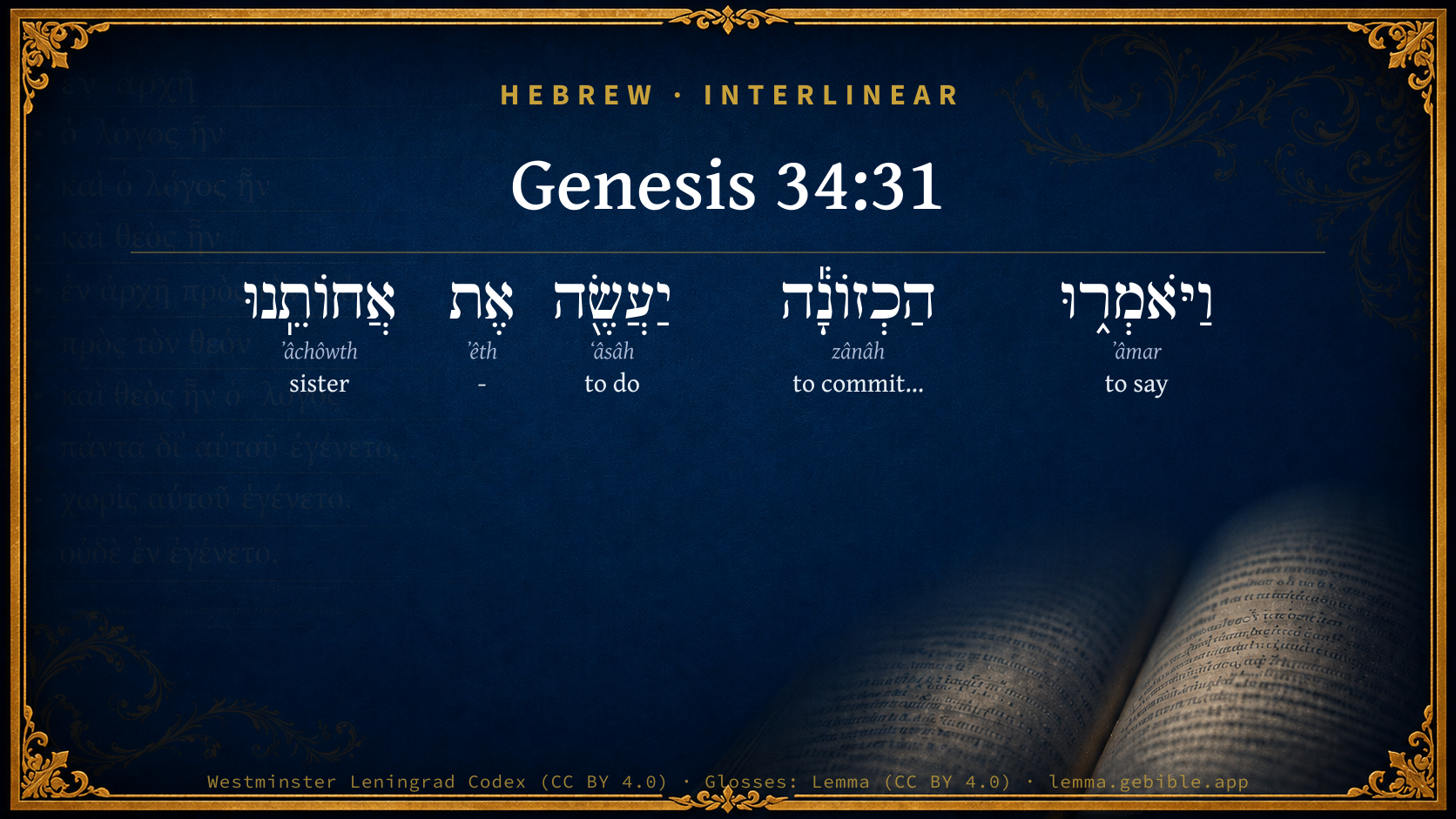
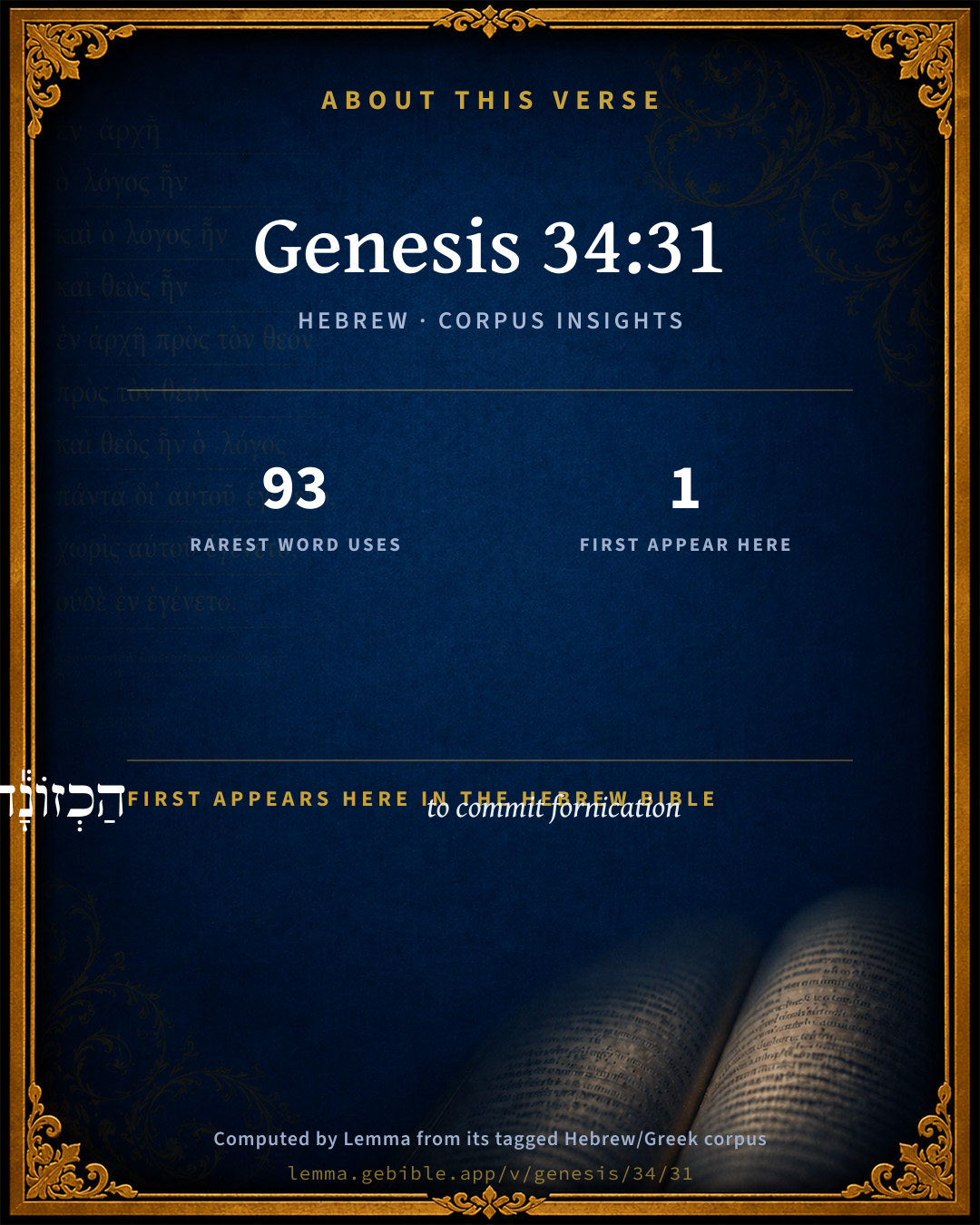
Genesis 34:31

Hebrew (Westminster Leningrad Codex) Genesis 34:31 appears in the Hebrew Old Testament. The text above is from the Westminster Leningrad Codex. Each word links to its Strong’s number, a concise gloss, and parsing drawn from the Open Scriptures Hebrew Bible morphology. Click any word for its full Brown-Driver-Briggs (BDB) entry.
Download image
Cite this verse

Genesis 34:31 (World English Bible). Public Domain. Lemma interlinear Bible study tool, https://lemma.gebible.app/v/genesis/34/31.

Show BibTeX & RIS
BibTeX
RIS
English Translation
They said, "Should he deal with our sister as with a prostitute?"
World English Bible · Public Domain
Highlights
  • 1 first appearance in the Hebrew Bible
Full analysis ↓
Download a study sheet

One document with this verse’s original text, its word-by-word gloss line, the meaning frame, cross-references with their text, attributed commentary, and full source and license credits — printable, and it pastes into notes with its structure intact.

This verse Autodidact and up

Study sheet (.html) Plain text (.txt)

A passage Seminary Student

Up to 50 verses in one chapter. A passage sheet keeps up to 6 commentary sources and 12 cross-references per verse, in the order this page ranks them, and says so on the sheet whenever that leaves anything out. Ask for a single verse and you get the Autodidact verse sheet above.

Everything on this page stays free to read, with no account — the sheet is a download of what is already on screen, not access to it.

Want to remove ads? Support Godless Engineer
Compare translations 3

The same verse in 3 English versions, stacked beneath the original-language interlinear above. Click any original word for its lexicon entry.

Each is an independent rendering of the whole verse — the interlinear is not word-aligned to these translations.

Highlighted words mark where these versions differ — a whole-verse word diff, not a word-by-word alignment.

  • World English Bible Public Domain
    They said, "Should he deal with our sister as with a prostitute?"
  • King James Version Public Domain
    And they said, Should he deal with our sister as with an harlot?
  • unfoldingWord Literal Text CC BY-SA 4.0
    But they said, “Should he have treated our sister like a prostitute?”

unfoldingWord Literal Text — © unfoldingWord, licensed CC BY-SA 4.0. Word-aligned USFM3 via Door43 (git.door43.org/unfoldingWord/en_ult).

Versions to compare (up to 4)

3 of 4 selected

Show all 18 translations

Every available English version of this verse, each an independent rendering of the whole verse.

  • World English Bible Public Domain
    They said, "Should he deal with our sister as with a prostitute?"
  • Berean Standard Bible Public Domain
    But they replied, “Should he have treated our sister like a prostitute?”
  • Majority Standard Bible Public Domain
    But they replied, “Should he have treated our sister like a prostitute?”
  • King James Version Public Domain
    And they said, Should he deal with our sister as with an harlot?
  • American Standard Version (1901) Public Domain
    And they said, Should he deal with our sister as with a harlot?
  • Revised Version (1885) Public Domain
    And they said, Should he deal with our sister as with an harlot?
  • Geneva Bible (1599) Public Domain
    And they answered, Shoulde hee abuse our sister as a whore?
  • Douay-Rheims (1899) Public Domain
    They answered: Should they abuse our sister as a strumpet?
  • Young's Literal Translation Public Domain
    And they say, `As a harlot doth he make our sister?'
  • Literal Standard Version CC BY-SA 4.0
    And they say, “Does he make our sister as a harlot?”
  • Unlocked Literal Bible CC BY-SA 4.0
    But Simeon and Levi said, “Should Shechem have dealt with our sister as with a prostitute?”
  • unfoldingWord Literal Text CC BY-SA 4.0
    But they said, “Should he have treated our sister like a prostitute?”
  • Darby Bible Public Domain
    And they said, Should people deal with our sister as with a harlot?
  • World Messianic Bible Public Domain
    They said, “Should he deal with our sister as with a prostitute?”
  • Webster's Bible Public Domain
    And they said, Should he deal with our sister, as with a harlot?
  • Free Bible Version CC BY-SA 4.0
    But they replied, “Should we have let him treat our sister like a prostitute?”
  • Bible in Basic English Public Domain
    But they said, Were we to let him make use of our sister as a loose woman?
  • JPS Tanakh (1917) Public Domain
    And they said: 'Should one deal with our sister as with a harlot?'

Literal Standard Version (2020), Covenant Press — licensed CC BY-SA 4.0. Text via the HelloAO Bible API (eBible.org). Unlocked Literal Bible (unfoldingWord) — licensed CC BY-SA 4.0. Text via the HelloAO Bible API (eBible.org). unfoldingWord Literal Text — © unfoldingWord, licensed CC BY-SA 4.0. Word-aligned USFM3 via Door43 (git.door43.org/unfoldingWord/en_ult). Free Bible Version, Dr. Jonathan Gallagher — licensed CC BY-SA 4.0. Text via the HelloAO Bible API (eBible.org).

Word by word

More ways to search: Search by grammar → Find every occurrence → Compare this word →

Practice this passage: Drill this verse → Learn its vocabulary →

הַכְזוֹנָ֕ה
zânâh
H2181
“like/as · committing fornication”
Particle, Interrogative + Preposition + Verb, Qal, Participle Active, Feminine, Singular, Absolute
Part of Speech
Particle + Preposition + Verb
Stem
Qal
Form
Participle Active
Gender
Feminine
Number
Singular
State
Absolute
Full BDB Definition

Origin: a primitive root [highly-fed and therefore wanton]

TWOT: 563

to commit fornication, be a harlot, play the harlot - (Qal) - to be a harlot, act as a harlot, commit fornication - to commit adultery - to be a cult prostitute - to be unfaithful (to God) (figuratively) - (Pual) to play the harlot - (Hiphil) - to cause to commit adultery - to force into prostitution - to commit fornication
  1. וַיֹּאמְר֑וּ ʼâmar H559 “and · to say” Conjunction + Verb, Qal, Sequential Imperfect, 3rd Person, Masculine, Plural
  2. יַעֲשֶׂ֖ה ʻâsâh H6213 “to do” Verb, Qal, Imperfect, 3rd Person, Masculine, Singular
  3. אֶת ʼêth H853 “-” Particle, Direct Object
  4. אֲחוֹתֵֽנוּ ʼâchôwth H269 “sister · our” Noun, Common, Feminine, Singular, Construct + Suffix, Personal, 1st Person, Common, Plural

About this verse

These counts appear in no published source. They are computed here, from the morphology-tagged text and Lemma’s own curated glosses. What Lemma adds →

5
words
5
distinct lemmas
Pentateuch
section

First appearance in Scripture

This word makes its first canonical appearance in the Hebrew Bible here:

  • הַכְזוֹנָ֕ה to commit fornication H2181

Grammatical profile

  • 3 verbs
  • 1 noun
  • 1 particle

Verb forms

  • וַיֹּאמְר֑וּ Qal · Sequential Imperfect
  • הַכְזוֹנָ֕ה Qal · Participle Active
  • יַעֲשֶׂ֖ה Qal · Imperfect

Hebrew & Septuagint length

In English translation the verse runs 12 words from the Hebrew and 13 from the Septuagint (LXX English) — closely comparable.

A rough comparison of the two English renderings, which tokenize alike — not a word-level alignment.

Word counts can differ between the Hebrew and the Greek without any difference in meaning — e.g. the Hebrew direct-object marker אֵת has no separate Greek word, and Greek often adds the article ὁ.

Cross-references

3

Topical passages linked to Genesis 34:31 in the Treasury of Scripture Knowledge — connected by theme and wording, ordered by reader-vote popularity; previews shown in the World English Bible.

  • Proverbs 6:34 For jealousy arouses the fury of the husband. He won't spare in the day of vengeance.
  • Genesis 34:13 The sons of Jacob answered Shechem and Hamor his father with deceit, and spoke, because he had defiled Dinah their sister,
  • Genesis 49:7 Cursed be their anger, for it was fierce; And their wrath, for it was cruel. I will divide them in Jacob, Scatter them in Israel.

Cross-references courtesy of OpenBible.info (CC BY 4.0).

Hebrew and Greek witnesses Masoretic Hebrew ↔ Greek Septuagint

The same verse in the two great witnesses to the Old Testament, shown verse-for-verse.

These are two independent witnesses, not word-aligned to each other, and the Septuagint is shown in lemma (dictionary) form.

Hebrew Genesis 34:31 Masoretic · Westminster Leningrad Codex

וַיֹּאמְר֑וּ הַכְזוֹנָ֕ה יַעֲשֶׂ֖ה אֶת אֲחוֹתֵֽנוּ

They said, "Should he deal with our sister as with a prostitute?"

World English Bible · Public Domain

Greek LXX Genesis 34:31 Septuagint · lemma form

ὁ δέ εἶπον ἀλλά ὡσεί πόρνη χράω ὁ ἀδελφή ἐγώ

And they said, Nay, but shall they treat our sister as an harlot?

LXX2012 (modern English Septuagint) · Public Domain

Hebrew: Westminster Leningrad Codex (CC BY 4.0). Greek: Septuagint (public domain); English from LXX2012 (modern English Septuagint) (Public Domain). How the Septuagint differs from the Hebrew →

Targum (Aramaic paraphrase)

2

The Targum is the ancient Jewish Aramaic paraphrase of the Hebrew Scriptures — an interpretive translation, not the Hebrew text itself. Onkelos (literal) and Pseudo-Jonathan (expansive) render the Torah, and Jonathan the Prophets. Coverage is partial: where no permissively-licensed English translation exists for a verse, only the Aramaic is shown. This is verse-level text, not a word-by-word alignment to the Hebrew.

  1. Targum Onkelos Torah (Genesis–Deuteronomy)
    וַאֲמָרוּ הַכְנָפְקַת בָּרָא יִתְעֲבֵד (נ''א יַעְבֵּד יָת אַחָתָנָא) לַאֲחָתָנָא

    (no public-domain English translation for this verse)

    Targum Onkelos — Aramaic: “Onkelos Genesis” (public domain); “Onkelos Exodus” (public domain); “Onkelos Leviticus” (public domain); “Onkelos Numbers” (public domain); “Onkelos Deuteronomy” (public domain). English: “Sefaria Community Translation” (CC0 1.0 (public-domain dedication)); “J.W. Etheridge. The Targums of Onkelos and Jonathan Ben Uzziel on the Pentateuch. London: Longmans, Green, 1862” (public domain). Text via Sefaria.

  2. Targum Pseudo-Jonathan Torah (Genesis–Deuteronomy)
    עַנְיָן שִׁמְעוֹן וְלֵוִי לָא יָאִי לְמֶהֱוֵי מִתְאַמַר בִּכְנִישְׁתֵּהוֹן דְיִשְרָאֵל עַרְלָאִין סְאִיבוּ לִבְתוּלְתָּא וּפַלְחֵי צַלְמִין טָנִיפוּ לִבְרַתֵּיהּ דְיַעֲקב אֱלָהֵין כְּדֵין יָאֵי לְמֶהֱוֵי מִתְאַמַר עַרְלָאִין אִתְקְטִילוּ בְּגִין בְּתוּלְתָּא וּפַלְחֵי צַלְמִין בְּגִין בְּרַתֵּיהּ דְיַעֲקב וְלָא יֶהֱוֵי שְׁכֶם בַּר חֲמוֹר מְלַגְלֵג בְּמִילֵיהּ עֲלָנָא וּכְאִיתָא מְטַעֲיָיא נַפְקַת בְּרָה דְלֵית לָהּ תְּבוֹעַ יַעֲבֵיד יַת אַחֲתַן אִין לָא עֲבַדְנָא יַת פִּתְגָמָא הָדֵין

    And Shimeon and Levi answered, It would not have been fit to be said in the congregations of Israel that the uncircumcised polluted the virgin, and the worshippers of idols debased the daughter of Jakob: but it is fit that it should be said, The uncircumcised were slain on account of the virgin, and the worshippers of idols on account of the daughter of Jakob. Shekem bar Hamor will not (now) deride us with his words; for as a whorish woman and an outcast who hath no avenger would he have made our sister, if we had not done this thing.

    Targum Pseudo-Jonathan — Aramaic: “Targum Jonathan on Genesis” (public domain); “Targum Jonathan on Exodus” (public domain); “Targum Jonathan on Leviticus” (public domain); “Targum Jonathan on Numbers” (public domain); “Targum Jonathan on Deuteronomy” (public domain). English: “The Targum of Jonathan ben Uzziel, trans. J. W. Etheridge, London, 1862” (public domain). Text via Sefaria.

Commentary

Notes on Genesis 34:31 from classic Christian and Jewish commentators (each source and its license shown beneath its notes). The classic Christian expositions comment on the surrounding passage and are grouped to its opening verse, so a note may address several verses; the Jewish commentaries on the Tanakh (Rashi and others) are per-verse, so they appear only where the commentator wrote on this verse.

Lemma curates 59 commentaries, every one of them public domain or Creative Commons licensed, each selected and text-cleaned for this edition rather than reprinted as found. About our sources →

Trapp's Complete Commentary

John Trapp

Gen 34:31 And they said, Should he deal with our sister as with an harlot?

Ver. 31. Should he deal with our sister as with an harlot?] Why, no: but should you therefore speak so boldly to your father, and deal so cruelly with your confederates; whom you first cheated into a covenant, and then basely butchered, when not able to help themselves? But anger is outrageous, and forethinks not what will follow hereafter, or becomes a man for present. Bridle it therefore. The word harlot is written with a great letter in the original æ, to show with what a courage they spake it. {Hebrew Text Note}

John Trapp, A Commentary or Exposition upon All the Books of the Old and New Testament (1647–1656) — public domain. Text from a community e-Sword module.

Joseph Benson's Commentary

Gen 34:31. Should he deal with our sister as with a harlot? — No, he should not; but, if he do, must they be their own avengers? and nothing less than so many lives, and the ruin of a whole city, serve to atone for the abuse?

Joseph Benson's Commentary on the Old and New Testaments (1811–1818) — public domain. Text from a community e-Sword module.

Adam Clarke's Commentary

Verse 31. Should he deal with our sister as with a harlot?] On this outrage alone they vindicated their flagitious conduct. The word harlot first occurs here: the original is not פילגש pilegesh, which we render concubine, (see its explanation Ge 22:24), but זונה zonah, which ordinarily signifies one who prostitutes herself to any person for hire. Our word harlot is said to have been derived from a very odd circumstance: Robert, duke of Normandy, seeing a fine - looking country girl dancing with her companions on the green, took her to his bed. She was the daughter of a skinner, and her name was Arlotta; and of her William, surnamed The Conqueror, was born. Hence it is said all such women were from her called harlots, as William himself was usually termed the Bastard. But horelet, the diminutive of whore, is not a less likely derivation.

SOLOMON has very properly said, My son, enter not into the path of the wicked, and go not in the way of evil men; avoid it, pass not by it, turn from it, and pass away, Pr 4:14-15. Had not Dinah gone out to see the daughters of the land, and very possibly at one of their idolatrous festivals, she had not suffered the foul disgrace mentioned in this chapter. Not only prudence dictates that young women should keep at home, but God expressly commands it, Tit 2:5. Dinah got among idolaters, and thus partook of their iniquities; and this led to the most base and cruel transaction upon record. How true is the saying, Those who wander out of the way of understanding shall abide in the congregation of the dead! In the case before us blame seems to attach to all parties.

1. It was wrong in Jacob to suffer his daughter, alone and unprotected, to visit the daughters of the land.

2. It was excessively wicked in Shechem to take this advantage of the daughter of a respectable stranger, who had sought his friendship, and came to sojourn among his people, and whose righteous dealing they must have witnessed for at least seven years past. In his behalf we may say, and it would be unjust not to say it, that having done the mischief, and sinned deeply against the laws of hospitality, he wished to make all the reparation in his power; and therefore in the most frank and liberal manner he not only offered, but most pressingly entreated, permission to take Dinah to wife. This was the utmost he could do in such a case. And in this he is a saint of the first order when compared with the noble and ignoble profligates who, while blaspheming the Christian name by continuing to assume it, commit all kinds of breaches on the virtue of simple females, and the peace of respectable families, and not only make no reparation, but glory in their shame.

3. It was diabolical in Jacob's sons to slay a whole tribe for the offence of one man, and especially as that one had offered to make all the restitution in his power. They required that Hamor, Shechem, and all their subjects should be circumcised before they could conscientiously consent to give their sister to Shechem in marriage. This required conformity was made the cloak of the most base and infamous designs. The simple unsuspecting Shechemites agreed to the proposal; and when rendered by this religious rite incapable of defending themselves, they were basely murdered by Simeon and Levi, and their city destroyed. Jacob, to his great honour, remonstrated against this barbarous and bloody act, committed apparently under the sanction of religion; and God showed his abhorrence of it by directing the patriarch, in his dying moments, to proscribe them from the blessings of the covenant, so that they barely retained a name among the tribes of Israel, being in general small, and ever disreputable, except merely in the service of the sanctuary, in which Levi was employed. How often since, notwithstanding this solemn warning, has the pure and benevolent religion of God been made, by wicked and designing men, a political stalking-horse to serve the basest purposes, and a covert to the worst of crimes! But shall we find fault with the holy religion of the blessed God because wicked men have abused it? God forbid! Were it not so good as it really is, it would be incapable of such abuse. An evil cannot be abused, a good may; and the greater and the more acknowledged the good, the more liable to abuse. As every good is so capable of being abused, does he act wisely who argues against the use of the thing on this account? Shall we say that various kinds of grain, fruits, and aliments are a curse, because wicked men abuse them to the purposes of drunkenness and gluttony? This would argue an utter perversion of all reason: and is it not on such a pretext as this that many persons have ventured to call in question even the truths of Christianity?

Whatever such men may be determined to think on the subject of this chapter, with the unprejudiced reader the ample and detailed relation which we have here of this barbarous transaction will appear an additional proof of the veracity and impartiality of the sacred historian.

Adam Clarke's Commentary on the Bible (1810–1826) — public domain. Text from a community e-Sword/MySword module.

The Cambridge Bible for Schools and Colleges

gen. ed. J. J. S. Perowne

31. Should he deal] Simeon and Levi regard the incident as one in which the honour of the clan was involved, and as if they had only one course of action to follow with regard to Shechem and Hamor.

The Cambridge Bible for Schools and Colleges (gen. ed. J. J. S. Perowne; Cambridge University Press, 1878–1918) — public domain. Text from a community e-Sword module.

Haydock's Catholic Bible Commentary

Should they, &c. This answer, full of insolence, to a father who was as much hurt by the indignity offered to Dina as they could be, heightens their crime. Sichem was the only one among the citizens really guilty, unless perhaps some of his servants might have given him assistance; and Hemor, the king, might contract some stain by not causing a better police to be observed, and by not punishing his son with greater severity, and not sending Dina home, &c. But why are the harmless citizens to be involved in ruin? unless Quicquid delirant Reges, plectuntur Achivi. (Haydock)

Procopius says Hemor also abused Dina; but the plural is here used for the singular, and this author builds upon a false supposition. Calmet)

George Leo Haydock (1774–1849), Haydock's Catholic Family Bible and Commentary, 1859 edition — public domain. Excludes Psalms (Douay-Rheims chapter numbering differs from Protestant) and Deuterocanonical books (Catholic canon only).

Matthew Poole's English Annotations

Shall we express no more resentment of this abominable abuse of our sister, than if she had been some common harlot, whose abuse no man either regardeth or revengeth? Thus they excuse one fault by committing another, and defend themselves by accusing their father of stupidity, and insensibleness of so great an indignity and injury.

Matthew Poole's English Annotations on the Holy Bible (1683–1685) — public domain. Text from a community e-Sword/MySword module.

The Pulpit Commentary

And they said, Should he deal with our sister as with an harlot? But Shechem offered Dinah honorable marriage.

The Pulpit Commentary (1880–1919), ed. H.D.M. Spence-Jones & Joseph S. Exell — public domain. Text from a community e-Sword module.

John Wesley's Explanatory Notes

Should he deal with our sister as with an harlot? - No, he should not; but, if he do, Must they be their own avengers? And nothing less than so many lives, and the ruin of a whole city, serve to atone for the abuse.

John Wesley, Explanatory Notes Upon the Whole Bible (1754–1765) — public domain. Text via the GEBible commentary corpus.

Rashi

Rabbi Shlomo Yitzchaki (Rashi)

הכזונה implies as one unprotected.

אחותנו The Targum renders it as an accusative — ית אחתנא “our sister”,) so that the meaning is: Should one (be permitted to) make our sister become as a woman who has no-one to protect her (Genesis Rabbah 80:12).

Rashi on the Tanakh — English translations: “The Judaica Press complete Tanach with Rashi, translated by A. J. Rosenberg” (CC BY 4.0); “Pentateuch with Rashi's commentary by M. Rosenbaum and A.M. Silbermann, 1929-1934” (public domain); “The Metsudah Tanach series, Lakewood, N.J” (CC BY 4.0); and “The Book of Joshua, Metsudah Publications, 1997” (CC BY 4.0). Text via Sefaria.

Radak

Rabbi David Kimhi (Radak)

?ויאמרו הכזונה, is Shechem to be allowed to treat our sister as if she were a harlot, and we should not avenge the shame she was subjected to?

Radak on the Tanakh — English translations: “Sefaria Community Translation” (CC0 1.0 (public-domain dedication)); “Eliyahu Munk, HaChut Hameshulash” (CC BY 4.0); “Rabbi Mike Feuer, Jerusalem Anthology” (CC BY 4.0); and “R. David Kimhi on the first book of Psalms, Translated by R.G. Finch, London, 1919” (public domain). Text via Sefaria.

Lesson kit

Teaching starters — assembled from the data on this page, not authored interpretation. Every prompt links to the verse data it draws on. Edit before teaching.

Genesis, in the Pentateuch, opens this verse with 5 words (5 distinct Hebrew lemmas). Its most distinctive word is zânâh (“to commit fornication”). A historical commentator’s framing appears above. Read the whole chapter for the surrounding context.

Discussion questions

  1. The word zânâh carries the sense “to commit fornication.” How does it shape the verse?
  2. This is the first place “to commit fornication” appears in Scripture (first appears here). What does its debut here establish?
  3. How does Proverbs 6:34, which shares this passage’s theme, read alongside this verse?
  4. These translations render this verse differently; the difference is in the English rendering, not the original. What questions does that raise?
  5. «וַיֹּאמְר֑וּ» is a Qal Sequential Imperfect verb. How does that grammatical form shape the action described?
  6. Compare how Trapp's Complete Commentary and Joseph Benson's Commentary read this verse. Where do they agree or differ?

Things to notice

  • 1 word makes its first canonical appearance in Scripture here.
  • These translations choose different wording for 6 words in this verse.
  • 5 distinct Hebrew lemmas span 5 words in this verse.

Reading settings

Reading text

Shown beneath each verse's original-language words.

Old Testament
Old Testament edition

Read the OT as the Masoretic Hebrew (MT) or the Greek Septuagint (LXX).

English shown for the Greek Septuagint (in the Hebrew ↔ Greek comparison).

Comparing translations? Open the Compare panel on any verse page to stack up to four side by side.