

2 Corinthians 10:4
Greek (Tischendorf 8th ed.) 2 Corinthians 10:4 appears in the Greek New Testament. The text above is from the Tischendorf 8th edition. Each word links to its Strong’s number and a concise gloss. Click any word for its full Thayer’s Greek Lexicon entry.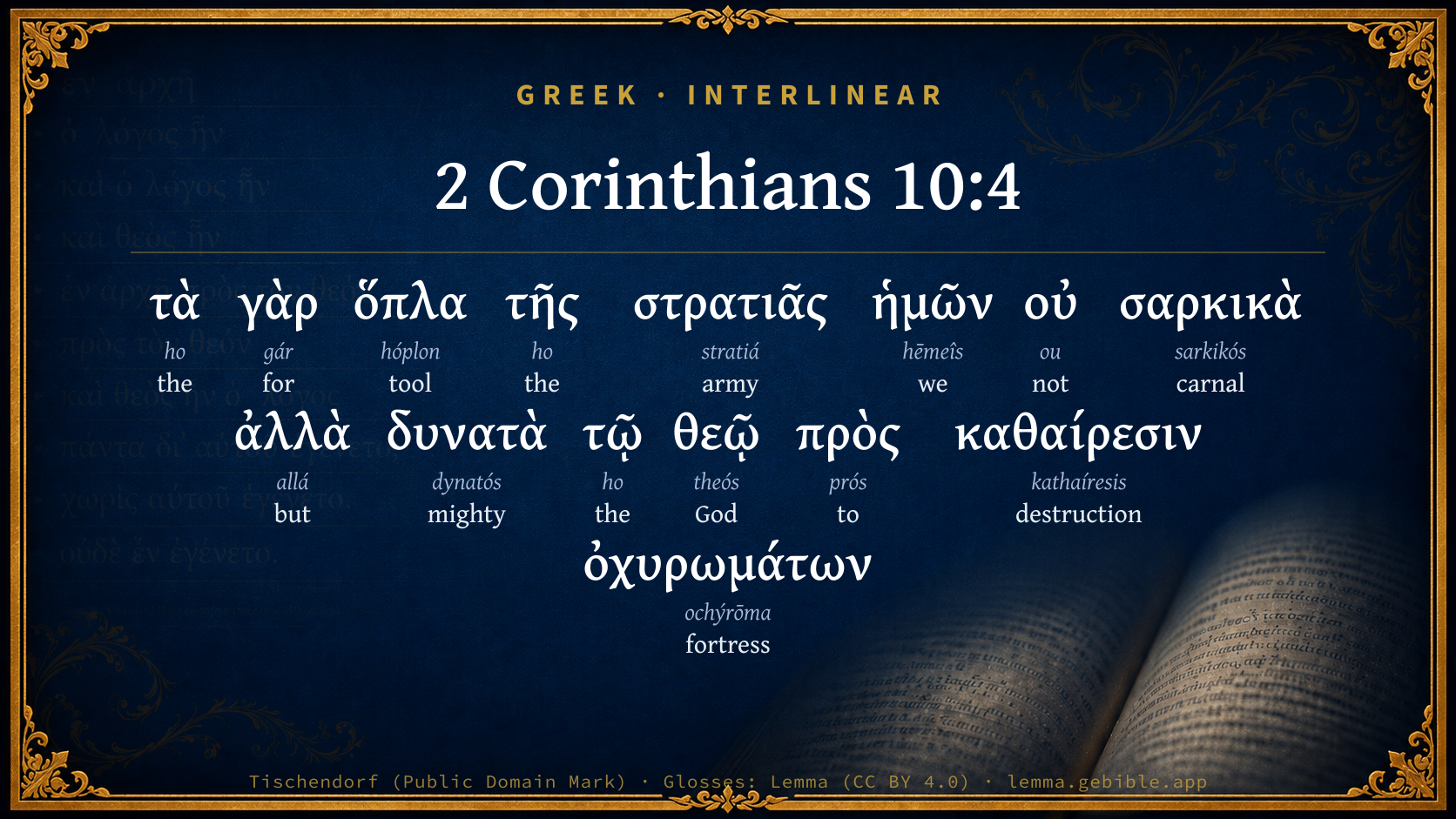
for the weapons of our warfare are not of the flesh, but mighty before God to the throwing down of strongholds,
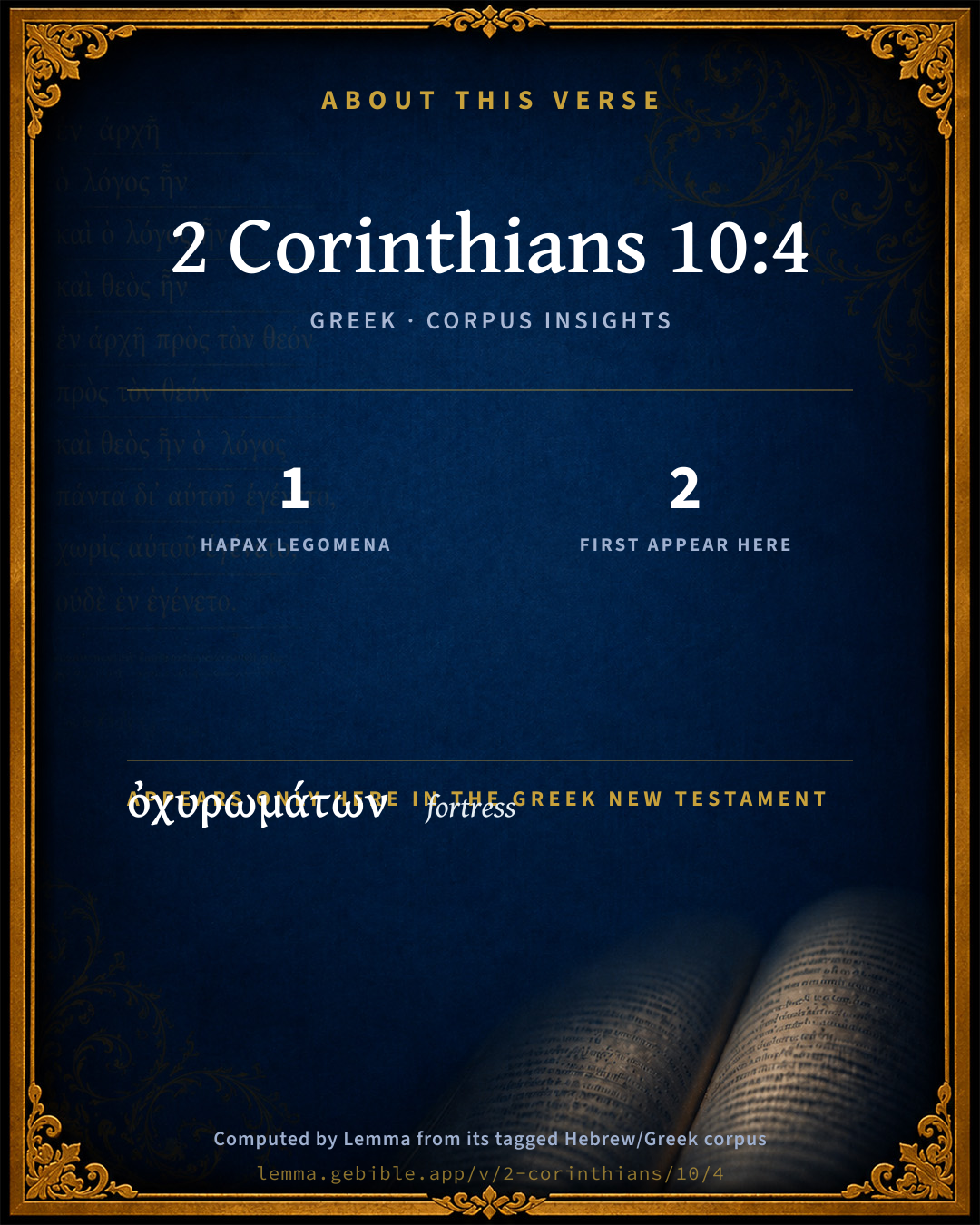
- 1 hapax legomenon — only here in the Greek New Testament
- 2 first appearances in the Greek New Testament
Download a study sheet
One document with this verse’s original text, its word-by-word gloss line, the meaning frame, cross-references with their text, attributed commentary, and full source and license credits — printable, and it pastes into notes with its structure intact.
This verse Autodidact and up
A passage Seminary Student
Up to 50 verses in one chapter. A passage sheet keeps up to 6 commentary sources and 12 cross-references per verse, in the order this page ranks them, and says so on the sheet whenever that leaves anything out. Ask for a single verse and you get the Autodidact verse sheet above.
Everything on this page stays free to read, with no account — the sheet is a download of what is already on screen, not access to it.
Compare translations 3
The same verse in 3 English versions, stacked beneath the original-language interlinear above. Click any original word for its lexicon entry.
Each is an independent rendering of the whole verse — the interlinear is not word-aligned to these translations.
Highlighted words mark where these versions differ — a whole-verse word diff, not a word-by-word alignment.
-
World English Bible Public Domain
for the weapons of our warfare are not of the flesh, but mighty before God to the throwing down of strongholds,
-
King James Version Public Domain
(For the weapons of our warfare are not carnal, but mighty through God to the pulling down of strong holds;)
-
unfoldingWord Literal Text CC BY-SA 4.0
For the weapons of our warfare not fleshly, but powerful to God for the tearing down of strongholds, tearing down strategies
unfoldingWord Literal Text — © unfoldingWord, licensed CC BY-SA 4.0. Word-aligned USFM3 via Door43 (git.door43.org/unfoldingWord/en_ult).
Show all 19 translations
Every available English version of this verse, each an independent rendering of the whole verse.
-
World English Bible Public Domain
for the weapons of our warfare are not of the flesh, but mighty before God to the throwing down of strongholds,
-
Berean Standard Bible Public Domain
The weapons of our warfare are not the weapons of the world. Instead, they have divine power to demolish strongholds.
-
Majority Standard Bible Public Domain
The weapons of our warfare are not the weapons of the flesh. Instead, they have divine power to demolish strongholds.
-
King James Version Public Domain
(For the weapons of our warfare are not carnal, but mighty through God to the pulling down of strong holds;)
-
American Standard Version (1901) Public Domain
(for the weapons of our warfare are not of the flesh, but mighty before God to the casting down of strongholds),
-
Revised Version (1885) Public Domain
(for the weapons of our warfare are not of the flesh, but mighty before God to the casting down of strong holds);
-
Geneva Bible (1599) Public Domain
(For the weapons of our warrefare are not carnall, but mightie through God, to cast downe holdes)
-
Douay-Rheims (1899) Public Domain
For the weapons of our warfare are not carnal, but mighty to God unto the pulling down of fortifications, destroying counsels,
-
Young's Literal Translation Public Domain
for the weapons of our warfare `are' not fleshly, but powerful to God for bringing down of strongholds,
-
Literal Standard Version CC BY-SA 4.0
for the weapons of our warfare [are] not fleshly, but powerful to God for bringing down of strongholds,
-
Unlocked Literal Bible CC BY-SA 4.0
For the weapons we fight with are not fleshly. Instead, they have divine power to destroy strongholds. They bring to nothing misleading arguments.
-
unfoldingWord Literal Text CC BY-SA 4.0
For the weapons of our warfare not fleshly, but powerful to God for the tearing down of strongholds, tearing down strategies
-
Darby Bible Public Domain
For the arms of our warfare [are] not fleshly, but powerful according to God to [the] overthrow of strongholds;
-
World Messianic Bible Public Domain
for the weapons of our warfare are not of the flesh, but mighty before God to the throwing down of strongholds,
-
Webster's Bible Public Domain
(For the weapons of our warfare are not carnal, but mighty through God to the pulling down of strong holds;)
-
Free Bible Version CC BY-SA 4.0
Our weapons are not of this world but God's mighty power that destroys fortresses of human thinking, demolishing misleading theories.
-
Bible in Basic English Public Domain
(For the arms with which we are fighting are not those of the flesh, but are strong before God for the destruction of high places);
-
Text-Critical English NT CC BY 4.0
For the weapons of our warfare are not of the flesh, but are powerful in God for tearing down strongholds.
-
Tyndale New Testament (1534) Public Domain
For the weapes of oure warre are not carnall thinges but thynges myghty in god to cast doune stronge holdes
Literal Standard Version (2020), Covenant Press — licensed CC BY-SA 4.0. Text via the HelloAO Bible API (eBible.org). Unlocked Literal Bible (unfoldingWord) — licensed CC BY-SA 4.0. Text via the HelloAO Bible API (eBible.org). unfoldingWord Literal Text — © unfoldingWord, licensed CC BY-SA 4.0. Word-aligned USFM3 via Door43 (git.door43.org/unfoldingWord/en_ult). Free Bible Version, Dr. Jonathan Gallagher — licensed CC BY-SA 4.0. Text via the HelloAO Bible API (eBible.org).
Word by word
More ways to search: Search by grammar → Find every occurrence → Compare this word →
Practice this passage: Drill this verse → Learn its vocabulary →
- Appears 1× in the Greek New Testament
- First appears here
- Part of Speech
- Noun
- Case
- Genitive
- Number
- Plural
- Gender
- Neuter
Full Thayer's Definition
- τὰ ho G3588 “the” Article, Nominative, Plural, Neuter
- γὰρ gár G1063 “for” Conjunction
- ὅπλα hóplon G3696 “tool” Noun, Nominative, Plural, Neuter
- τῆς ho G3588 “the” Article, Genitive, Singular, Feminine
- στρατιᾶς stratiá G4756 “army” Noun, Genitive, Singular, Feminine
- ἡμῶν hēmeîs G2249 “we” Personal pronoun, 1st person, Genitive, Plural
- οὐ ou G3756 “not” Particle, Negative
- σαρκικὰ sarkikós G4559 “carnal” Adjective, Nominative, Plural, Neuter
- ἀλλὰ allá G235 “but” Conjunction
- δυνατὰ dynatós G1415 “mighty” Adjective, Nominative, Plural, Neuter
- τῷ ho G3588 “the” Article, Dative, Singular, Masculine
- θεῷ theós G2316 “God” Noun, Dative, Singular, Masculine
- πρὸς prós G4314 “to” Preposition
- καθαίρεσιν kathaíresis G2506 “destruction” Noun, Accusative, Singular, Feminine
- ὀχυρωμάτων ochýrōma G3794 “fortress” Noun, Genitive, Plural, Neuter
About this verse
These counts appear in no published source. They are computed here, from the morphology-tagged text and Lemma’s own curated glosses. What Lemma adds →
- 15
- words
- 13
- distinct lemmas
- Pauline Epistles
- section
Notable vocabulary
1 hapax legomenon — a word that appears only here in the entire Greek New Testament:
- ὀχυρωμάτων fortress G3794
First appearance in Scripture
These words make their first canonical appearance in the Greek New Testament here:
Shared distinctive vocabulary
στρατιᾶς army G4756 occurs in 3 verses of the Greek New Testament. Also found in:
Repetition
A word recurs within this verse:
- τὰ the G3588 ×3
Cross-references
26Topical passages linked to 2 Corinthians 10:4 in the Treasury of Scripture Knowledge — connected by theme and wording, ordered by reader-vote popularity; previews shown in the World English Bible.
- 2 Corinthians 6:7 in the word of truth, in the power of God; by the armor of righteousness on the right hand and on the left,
- Ephesians 6:13–18 Therefore, put on the whole armor of God, that you may be able to withstand in the evil day, and, having done all, to stand.
- Jeremiah 1:10 behold, I have this day set you over the nations and over the kingdoms, to pluck up and to break down and to destroy and to overthrow, to build and to plant.
- 1 Corinthians 2:5 that your faith wouldn't stand in the wisdom of men, but in the power of God.
- 1 Samuel 17:45–50 Then said David to the Philistine, You come to me with a sword, and with a spear, and with a javelin: but I come to you in the name of Yahweh of hosts, the God of the armies of Israel, whom you have defied.
- 2 Corinthians 13:3–4 seeing that you seek a proof of Christ who speaks in me; who toward you is not weak, but is powerful in you.
- 1 Timothy 1:18 This charge I commit to you, my child Timothy, according to the prophecies which led the way to you, that by them you may wage the good warfare;
- Zechariah 4:6–7 Then he answered and spoke to me, saying, "This is the word of Yahweh to Zerubbabel, saying, 'Not by might, nor by power, but by my Spirit,' says Yahweh of Hosts.
- Romans 13:12 The night is far gone, and the day is near. Let's therefore throw off the works of darkness, and let's put on the armor of light.
- 1 Thessalonians 5:8 But let us, since we belong to the day, be sober, putting on the breastplate of faith and love, and, for a helmet, the hope of salvation.
- 2 Corinthians 4:7 But we have this treasure in clay vessels, that the exceeding greatness of the power may be of God, and not from ourselves.
- Romans 6:13 Neither present your members to sin as instruments of unrighteousness, but present yourselves to God, as alive from the dead, and your members as instruments of righteousness to God.
- Psalms 110:2 Yahweh will send forth the rod of your strength out of Zion. Rule in the midst of your enemies.
- 2 Corinthians 3:5 not that we are sufficient of ourselves, to account anything as from ourselves; but our sufficiency is from God;
- Hebrews 11:30 By faith, the walls of Jericho fell down, after they had been encircled for seven days.
- Isaiah 41:14–16 Don't be afraid, you worm Jacob, and you men of Israel; I will help you, says Yahweh, and your Redeemer is the Holy One of Israel.
- 2 Timothy 2:3 You therefore must endure hardship, as a good soldier of Christ Jesus.
- Joshua 6:20 So the people shouted, and [the priests] blew the trumpets; and it happened, when the people heard the sound of the trumpet, that the people shouted with a great shout, and the wall fell down flat, so that the people went up into the city, every man straight before him, and they took the city.
- Acts 7:22 Moses was instructed in all the wisdom of the Egyptians. He was mighty in his words and works.
- Hebrews 11:32–33 What more shall I say? For the time would fail me if I told of Gideon, Barak, Samson, Jephthah, David, Samuel, and the prophets;
- Judges 15:14–16 When he came to Lehi, the Philistines shouted as they met him: and the Spirit of Yahweh came mightily on him, and the ropes that were on his arms became as flax that was burnt with fire, and his bands dropped from off his hands.
- Isaiah 30:25 There shall be on every lofty mountain, and on every high hill, brooks [and] streams of waters, in the day of the great slaughter, when the towers fall.
- Judges 7:13–23 When Gideon had come, behold, there was a man telling a dream to his fellow; and he said, Behold, I dreamed a dream; and, behold, a cake of barley bread tumbled into the camp of Midian, and came to the tent, and struck it so that it fell, and turned it upside down, so that the tent lay flat.
- 1 Corinthians 1:18–24 For the word of the cross is foolishness to those who are dying, but to us who are saved it is the power of God.
- 2 Corinthians 13:10 For this cause I write these things while absent, that I may not deal sharply when present, according to the authority which the Lord gave me for building up, and not for tearing down.
- 1 Corinthians 9:7 What soldier ever serves at his own expense? Who plants a vineyard, and doesn't eat of its fruit? Or who feeds a flock, and doesn't drink from the flock's milk?
Cross-references courtesy of OpenBible.info (CC BY 4.0).
Lesson kit
Teaching starters — assembled from the data on this page, not authored interpretation. Every prompt links to the verse data it draws on. Edit before teaching.
2 Corinthians, in the Pauline Epistles, opens this verse with 15 words (13 distinct Greek lemmas). Its most distinctive word is ochýrōma (“fortress”). A historical commentator’s framing appears above. Read the whole chapter for the surrounding context.
Discussion questions
- The word ochýrōma carries the sense “fortress.” How does it shape the verse?
- 1 word here appears nowhere else in the Greek New Testament. Why might the author reach for such rare wording?
- 2 words make their first appearance in Scripture here. What does this debut establish?
- How does Luke 2:13, which shares the word «army», read alongside this verse?
- What does the repetition of “the” (3× in this one verse) do in this verse?
- The translations on this page render this verse differently — a whole-verse word diff, not a word-by-word alignment. What might account for the different wordings?
- Compare how The Biblical Illustrator and Joseph Benson's Commentary read this verse. Where do they agree or differ?
Things to notice
- 1 word in this verse appears nowhere else in the Greek New Testament.
- 2 words make their first canonical appearance in Scripture here.
- These translations choose different wording for 14 words in this verse.
- “the” occurs 3× in this single verse.
- 13 distinct Greek lemmas span 15 words in this verse.
Commentary
Notes on 2 Corinthians 10:4 from classic Christian and Jewish commentators (each source and its license shown beneath its notes). The classic Christian expositions comment on the surrounding passage and are grouped to its opening verse, so a note may address several verses; the Jewish commentaries on the Tanakh (Rashi and others) are per-verse, so they appear only where the commentator wrote on this verse.
Lemma curates 59 commentaries, every one of them public domain or Creative Commons licensed, each selected and text-cleaned for this edition rather than reprinted as found. About our sources →
The Biblical Illustrator
Joseph S. Exell
The Biblical Illustrator, edited by Joseph S. Exell (c. 1880s–1900s) — public domain. Text from a community e-Sword module.
Joseph Benson's Commentary
Joseph Benson's Commentary on the Old and New Testaments (1811–1818) — public domain. Text from a community e-Sword module.
Bengel's Gnomon
Johann Albrecht Bengel
Bengel's Gnomon of the New Testament — English translation (T&T Clark, Edinburgh, 1860) — public domain. Text from a community e-Sword module.
Meyer's Critical & Exegetical Commentary
Heinrich August Wilhelm Meyer
Meyer — Critical and Exegetical Commentary on the New Testament — English translation by Peter Christie, edited by Frederick Crombie (T&T Clark, 1880) — public domain. Text from a community e-Sword module.
Expositor's Greek Testament
ed. W. Robertson Nicoll
The Expositor's Greek Testament, edited by W. Robertson Nicoll (1897–1910) — public domain. Text from a community e-Sword module.
Geneva Bible (1599)
Geneva Bible translators
Geneva Bible (1599) marginal notes — public domain. Text via Bolls.life.
Jamieson, Fausset & Brown
Robert Jamieson, A. R. Fausset & David Brown
Jamieson, Fausset & Brown — Commentary Critical and Explanatory on the Whole Bible (1871) — public domain (CC PDM 1.0). Text via the HelloAO Bible API.
Adam Clarke's Commentary
Adam Clarke's Commentary on the Bible (1810–1826) — public domain. Text from a community e-Sword/MySword module.
John Calvin's Commentaries
John Calvin's Commentaries (1540-1563) — public domain. Text from the Calvin Translation Society English edition (1840s-50s) via the Christian Classics Ethereal Library (ccel.org). Calvin's coverage is partial (roughly two-thirds of the Bible); uncommented books and verses are honest gaps, never fabricated. The 19th-century editor's footnotes and remarks are omitted so the notes are faithfully Calvin's own voice.
Ellicott's Commentary for English Readers
A Bible Commentary for English Readers, edited by Charles John Ellicott (1878–1897) — public domain. Text from a community e-Sword module.
The Cambridge Bible for Schools and Colleges
gen. ed. J. J. S. Perowne
The Cambridge Bible for Schools and Colleges (gen. ed. J. J. S. Perowne; Cambridge University Press, 1878–1918) — public domain. Text from a community e-Sword module.
John Gill's Exposition
John Gill's Exposition of the Whole Bible (1746–1763) — public domain (CC PDM 1.0). Text via the HelloAO Bible API.
Trapp's Complete Commentary
John Trapp
John Trapp, A Commentary or Exposition upon All the Books of the Old and New Testament (1647–1656) — public domain. Text from a community e-Sword module.
Albert Barnes' Notes on the Bible
Albert Barnes' Notes on the Bible (1834–1885) — public domain. Text from a community e-Sword/MySword module.
Haydock's Catholic Bible Commentary
George Leo Haydock (1774–1849), Haydock's Catholic Family Bible and Commentary, 1859 edition — public domain. Excludes Psalms (Douay-Rheims chapter numbering differs from Protestant) and Deuterocanonical books (Catholic canon only).
Matthew Poole's English Annotations
Matthew Poole's English Annotations on the Holy Bible (1683–1685) — public domain. Text from a community e-Sword/MySword module.
Whedon's Commentary on the Bible
Daniel D. Whedon
Daniel D. Whedon (gen. ed.), Commentary on the Old and New Testaments (1874–1909) — public domain. Text from a community e-Sword module.
The Pulpit Commentary
The Pulpit Commentary (1880–1919), ed. H.D.M. Spence-Jones & Joseph S. Exell — public domain. Text from a community e-Sword module.
John Wesley's Explanatory Notes
John Wesley, Explanatory Notes Upon the Whole Bible (1754–1765) — public domain. Text via the GEBible commentary corpus.
Burkitt's Expository Notes on the New Testament
William Burkitt
William Burkitt's Expository Notes on the New Testament (1700–1703) — public domain. Text from a community e-Sword module.
McGarvey & Pendleton's Commentaries
J. W. McGarvey
J. W. McGarvey (with Philip Y. Pendleton), Commentaries on the New Testament (The Fourfold Gospel, 1914; Acts; and the epistles) — public domain. Text from a community e-Sword/MySword module.
The People's New Testament
B. W. Johnson
B. W. Johnson's The People's New Testament with Notes (1889–1891) — public domain. Electronic text from the Christian Classics Ethereal Library (CCEL) ThML edition.
Cambridge Greek Testament for Schools and Colleges
Cambridge Greek Testament for Schools and Colleges (Cambridge University Press, 1896; 21 vols, various authors incl. Carr, Maclear, Plummer, Farrar, Lumby, Moule, M. R. James, Simcox) — public domain. Text from a community e-Sword module.
Alford’s Greek Testament
Henry Alford
Henry Alford, The Greek Testament (1849–1861) — public domain. Text from a community e-Sword module.
International Critical Commentary
International Critical Commentary — older volumes (1896–1929), various authors — public domain. Text from a community e-Sword module.
Vincent's Word Studies in the New Testament
Marvin R. Vincent
Marvin R. Vincent, Word Studies in the New Testament (1887–1900) — public domain. Text from a community e-Sword/MySword module.